Article Contents:
- What is a Baluster and Why is it Needed
- Classification of Wooden Balusters
- Turned (Lathe) Balusters — Timeless Classic
- Carved and Milled — Three-Dimensional Decor
- Flat Balusters — Modern Minimalism
- Square and Columnar Balusters
- Materials: Wood Species for Balusters
- Oak: Strength and Aristocracy
- Beech: The Top-Grade Workhorse
- Pine: Affordability and Character
- Larch: The Coniferous Champion
- Birch and Ash
- How to Choose Baluster Size: Parameters You Can't Ignore
- Standard Sizes
- Installation Spacing Calculation
- Proportion to Flight and Handrails
- Wooden Handrails and Balusters — A Unified Ensemble
- What's Included in a Stair Railing Kit
- DIY Baluster Installation: Methods and Techniques
- Fastening methods
- Step-by-step installation instructions
- Common Installation Mistakes
- Balusters and Handrails: Price and What Affects It
- Staircase Design Styles in 2026
- Classic and neoclassic
- Provence
- Baroque and Empire
- Scandinavian Style
- Eco and Biophilia — 2026 Trend
- Loft and Neo-Industrial
- Care for Wooden Balusters
- FAQ: Buying Wooden Balusters — Where, How Much, How Not to Make a Mistake
- About the Company STAVROS
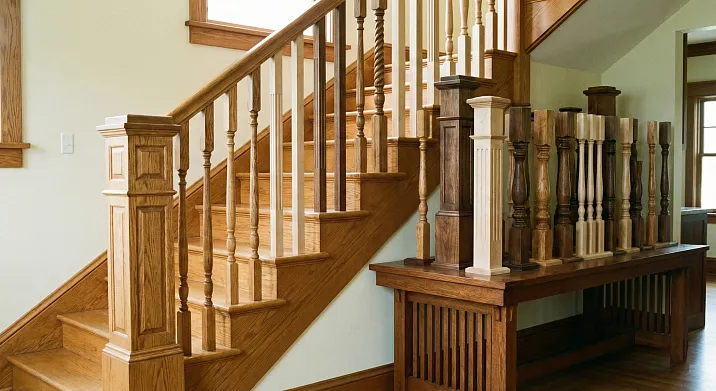
A staircase in a home is not just a connector between floors. It's an architectural manifesto. Here, every detail speaks about the owner: their taste, their attitude toward space, their understanding of beauty. And among all the elements of the staircase structure, a special role is played bybalusters— vertical posts that support the handrail and enclose the flight space. Small, repeating, rhythmic — they create that very image of the staircase that we remember at first glance.
In 2026, interest in wooden balusters is experiencing a true renaissance. After several years of fascination with metal and glass, the design community is increasingly turning toward natural materials. Wood is returning to interiors not as a tribute to nostalgia, but as a conscious choice — eco-friendly, warm, durable. The 2026 trends state clearly: wooden balusters are back in favor, and they're here to stay.




What is a Baluster and Why is it Needed
Before discussing selection, let's understand the nature of the object. A baluster is a vertical load-bearing element of a stair railing. Essentially, it performs three functions simultaneously.
Structural: the baluster bears the load from the handrail, holds it at the required height, and provides rigidity to the entire railing. Without balusters, railings sag, wobble, and lose stability.
Protective: properly installedBalusters for staircase— is a reliable barrier, especially important for families with children and elderly people. The distance between them is regulated by building codes and should not exceed 150 mm.
Decorative: and this is where true art begins. A baluster is rhythm, plasticity, the vertical graphics of space. Thirty identical posts lined up along a flight create a visual effect comparable to the rhythmic colonnade of an ancient temple. Only on a smaller scale—and no less expressive for it.




Classification of Wooden Balusters
The variety of shapes is enormous, but the system is clear. AllWooden balustersare divided into several basic types, each with its own niche in interior design.
Our factory also produces:


Turned (lathe) balusters — timeless classics
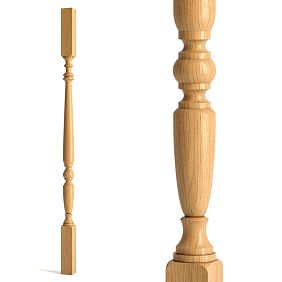
Turned balusters are products created on a lathe by rotating a workpiece. They are the first thing that comes to mind when the word 'baluster' is mentioned: rounded, with smooth curves, alternating expansions and contractions, with characteristic 'belts' and 'vases'.
The shape of a turned baluster is a play of proportions. A well-designed product follows the laws of classical order architecture: a wide base for stability, a narrowing in the central body, an expansion in the decorative element (a ball, ovoid, or vase), and a narrowing again toward the top. This is not arbitrary but the mathematics of beauty.
Lathe-turned balusters are versatile. They are organic in classic, neoclassical, Provence-style, and traditional Russian interiors.Buy wooden balustersChoosing a lathe-turned type means making an infallible aesthetic choice that will not become outdated in ten years.
Get Consultation
Carved and milled — three-dimensional decor
This is a higher level of complexity and expressiveness. Carvedwooden balusters for staircasesare created using 3D milling on CNC machines. The result is complex sculptural surfaces: acanthus leaves, fluting, grapevines, geometric weaves, Baroque shells.
Such balusters are no longer just a structural element but an independent artistic object. They turn the staircase into the main decorative accent of the house, setting the tone for the entire interior. Suitable for classical, Baroque, Renaissance, and luxuriously decorated spaces. The cost is higher, but so is the result: an original staircase with carved balusters becomes an object of admiration and conversation.
Flat balusters — modern minimalism
Flat balusters— are products made from a board by cutting out a silhouette with a jigsaw or on a milling machine. They are not turned on a lathe—they exist in two dimensions, creating a continuous vertical plane.
Flat balusters can be simple rectangular boards with rounded edges (maximum minimalism) or richly ornamented products with openwork plant or geometric patterns (carved flat balusters in Slavic or fusion style). The first option is ideal for Scandinavian, Japanese, and high-tech interiors. The second is for ethnic and authorial concepts.
Visually, flat balusters create a 'screen' effect—a continuous vertical plane, which looks especially expressive in modern interiors with long, clean lines.
Square and columnar balusters
A laconic rectangular or square profile—a minimalist alternative to turned forms. No curves, no turning, just pure geometry. Such balusters work wonderfully in modern, loft, and industrial interiors, where clarity of lines and the rejection of decoration for decoration's sake are important.
Square balusters are often combined with metal parts—this creates a stylish hybrid look: the warmth of wood + the cold precision of metal.
Materials: wood species for balusters
Choosing a wood species is not just about aesthetics. It is practice, physics, and economics all at once. Each wood species has its own character, its own advantages and limitations.
Oak: strength and aristocracy
Oak is the gold standard for stair balusters. High density (about 750 kg/m³), pronounced texture with a characteristic medullary ray pattern, excellent resistance to mechanical loads.Wooden balustermade of oak will last for decades without losing strength or appearance.
Oak is well-suited for turning and milling, although it requires powerful equipment and sharp tools. Under clear varnish, it reveals all the beauty of its natural grain; under stain, it acquires a noble dark tone, associated with classicism and solidity. The only caveats: higher price and significant weight.
Recommended for: classic interiors, grand staircases, country houses in neoclassical style, public spaces with high traffic.
Beech: The workhorse of the highest grade
Beech is a favorite among professional craftsmen and the optimal choice for most projects. Its density is slightly lower than oak (670–720 kg/m³), but it is significantly easier to work with. Its fine-grained, uniform structure allows for the creation of the thinnest decorative details without chipping. It holds finishes excellently — varnish, enamel, and oil lay perfectly smooth.
wooden handrails and balustersProducts made from beech offer a combination of decent quality and reasonable price. This is precisely why beech dominates the catalogs of serious manufacturers: it provides the optimal balance of all parameters.
Recommended for: interior staircases of any style, kitchen and living areas, as the primary material for most residential projects.
Pine: Affordability and character
A soft coniferous species — the most budget-friendly option. Pine is easy to work with, has a pleasant resinous scent, and a characteristic golden hue with a pronounced annual ring pattern. However, its softness is also a drawback: pine balusters are more sensitive to impacts and abrasion.
For a dacha, a country house in a rustic style, or a temporary staircase — it's a perfectly respectable choice. Be sure to use a high-quality protective finish. Resin inclusions require special primer before applying varnish.
Recommended for: country houses, interiors in country, rustic, or rural styles; for projects with a limited budget.
Larch: The coniferous champion
The only coniferous species that can be confidently recommended for serious projects. Larch is denser than pine and naturally resistant to rot and moisture. Its characteristic reddish-pink hue and beautiful grain make it an excellent choice for exterior staircases, verandas, and terraces.
If the staircase is partially outdoors or in conditions of high humidity — larch will be the right compromise between cost and durability.
Recommended for: exterior staircases, terraces, staircases in country houses with open elements.
Birch and Ash
Birch is uniform, dense, and takes stain well. It is popular in regions where other species are less available. Ash is light-colored, with a beautiful striped texture, and is strong. Both options are worthy of attention, although in professional baluster production, they are less in demand than beech and oak.
How to choose baluster size: parameters you cannot ignore
Size is both mathematics and aesthetics. Get the height wrong — the railing doesn't meet safety standards. Get the cross-section wrong — the baluster looks disproportionate. Here's what you need to know.
Standard Sizes
The height of a baluster is directly determined by the height of the handrail above the step. According to building codes, railings on a staircase must be at a height of at least 900 mm from the step surface. On landings — at least 1200 mm. Taking into account the thickness of the handrail and the sub-rail (usually 80–120 mm total), the working height of the baluster is 780–850 mm for flights and 1070–1110 mm for landings.
In the STAVROS catalog, the standard baluster height is 900 mm. This is the optimal value, covering most residential projects. If you have non-standard conditions — the height can be custom-ordered.
The cross-section of a baluster depends on style and wood species. For turned classic balusters, the typical diameter at the widest part is 80–100 mm. The minimum diameter at the 'waist' is 40–60 mm. For square balusters, the cross-section is typically 60×60 or 80×80 mm.
The most important parameter: the ratio of height to minimum diameter. An aesthetically harmonious baluster has a height 8–12 times greater than its minimum diameter. Balusters that are too thin look fragile and unreliable; those that are too thick visually overload the railing.
Installation spacing calculation
The distance between balusters is regulated by standards: for residential buildings — no more than 150 mm clear between units. For facilities with children — 100–120 mm.
In practice, the scheme of '1–2 balusters per step' is most often used. One baluster per step gives a spacing of about 150–200 mm (depending on the tread depth), two — about 75–100 mm. For an elegant classic look, two balusters per step are often chosen: the staircase looks more substantial, and the railing appears more reliable.
Quantity calculation formula: (number of steps × number of balusters per step) + 2 support posts = total quantity. For example, 14 steps × 2 + 2 = 30 units. Add 5–10% extra to this number for unforeseen situations during installation.
Proportion to the flight and handrails
A baluster should be proportional to the width of the flight. A narrow flight (800–900 mm) — balusters should be thin or medium. A wide, grand flight (from 1200 mm) — balusters should be more massive, with pronounced decoration.
The height of the handrail affects the feeling of safety and comfort. A handrail that is too low (below 850 mm) — feels unreliable. One that is too high (above 1000 mm) — is uncomfortable for the hand. The optimum is 900–950 mm.
Wooden handrails and balusters — a unified ensemble
The most common mistake when designing a staircase is choosingHandrails and balusterscomponents separately. It's like pairing a jacket with trousers of a different cut — each item is good on its own, but together they create dissonance.
The handrail and balusters should form a unified system: in wood species, in finish tone, in style and character of forms. If the balusters are classic turned oak, the handrail should have a soft rounded profile, not a sharp geometric edge. If the balusters are minimalist square beech, the handrail should be laconic, without unnecessary details.
Ideally — order allstaircase componentsfrom one manufacturer, from one batch of material. This guarantees matching wood shade, identical texture, and unity of the entire system.
What is included in a stair railing kit
A complete wooden stair railing kit includes:
-
Balusters — main vertical posts
-
Support posts — massive corner and starting posts, cross-section 80×80 or 100×100 mm, significantly more loaded than regular balusters
-
Handrail — horizontal element for the hand, cross-section 50×80 or 50×100 mm
-
Underhandrail batten — intermediate bar connecting the top ends of balusters and serving as a base for the handrail
-
Risers — vertical boards between steps (optional, for closed stairs)
-
Stringers or carriages — load-bearing side elements of the stair flight
Each of these elements must combine into a unified system. STAVROS produces the full range of components, which allows ensuring absolute visual integrity for any project.
Installing balusters yourself: methods and technology
Installationinstalling wooden balusters and railings— is a task a competent DIYer can handle. The main things are methodicalness, the right tools, and understanding the technology.
Mounting methods
Fastening with a wooden dowel — a classic carpentry method. Holes for a 10–12 mm diameter dowel, 35–40 mm deep, are drilled into the end of the baluster and into the step. The dowel is coated with wood glue, driven into the step, and the baluster is placed on top. The joint is neat and invisible. The method requires precise drilling strictly vertically — use a drill press.
Fastening with an M8–M10 metal stud — a more technological and reliable option. A threaded stud is screwed into the lower end of the baluster for 45–50 mm, the remaining part goes into a hole in the step. In the through version, the nut is tightened from below. This connection allows for tightening if necessary — an additional advantage for heavily used stairs.
Special anchor fasteners — third-generation systems with stainless steel inserts. Provides maximum strength, used in public buildings and stairs with increased safety requirements.
Step-by-step installation instructions
A detailed guide onmanufacturing balustersand their installation is available in STAVROS articles. Here are the key stages:
-
Marking. Determine the installation points for each baluster. Stretch a cord between the end posts as a guide. Make a paper or plywood template for repeated marking — this saves time and eliminates errors.
-
Preparing balusters. For an inclined flight, cut the top ends at an angle corresponding to the stair slope (usually 30–40°). This ensures a tight fit for the underhandrail batten.
-
Drilling holes. Holes for the dowel or stud are drilled into the step and into the end of the baluster. Strictly perpendicular to the baluster axis. Depth — 40 mm in each element.
-
Installation. The dowel is coated with glue, inserted into the step. Glue is applied to the end of the baluster. The baluster is placed onto the dowel, aligned with a level in two planes. Fixed with temporary supports until the glue dries (12–24 hours).
-
Mounting the underhandrail batten. The horizontal bar is laid on the top ends of the balusters and fastened with screws from below.
-
Installing the handrail. The handrail is laid on the batten, fastened with glue and screws.
Typical installation mistakes
-
Neglecting the level. One tilted baluster ruins the entire row. Check each one — without exceptions.
-
Saving on glue. Mechanical fasteners without glue create play and squeaks. Glue is a mandatory component.
-
Incorrect end cut angle. If the ends are not cut to the flight angle, the batten will not lie flat — gaps and misalignments will occur.
-
Rushing with the handrail. Install the handrail only after the glue on the balusters has completely dried. Otherwise, the entire structure will shift.
Balusters and railings: price and what affects it
The question of cost always warrants a separate discussion.balusters price— the range is wide: from 1,760 rubles for a simple model to 7,000 rubles and above for complex carved products. What determines the price?
Wood species. Oak is more expensive than beech, beech is more expensive than pine. The difference in raw material cost is directly reflected in the price of the finished product.
Complexity of shape. A simple turned baluster with minimal decor will cost less than a model with a complex profile, fluting, or carved elements. 3D milling means time on expensive equipment.
Sanding category. 'Standard' — machine sanding, ready for coating. 'Prestige' — additional manual processing, perfectly smooth surface requiring no further work. A crucial difference for products under clear varnish.
Size. Taller balusters require more material and machine time.
Presence of coating. A finished painted product costs more than an unpainted one — due to the cost of professional finishing.
In the STAVROS catalog, the price range for balusters is from 1,760 rubles (model L-019) to 7,310 rubles (model L-030) per unit. For a 14-step staircase with two balusters per step (30 units), the budget for balusters will range from 53,000 to 220,000 rubles — depending on the chosen model and wood species.
Staircase design styles in 2026
The question of style is a question of identity. The staircase should continue the story told by the entire house. Let's look at the relevant styles of 2026 and which balusters suit them.
Classicism and neoclassicism
A timeless theme that never goes out of style. HereWooden balusters and railings— are turned forms made of oak, with dark tinting or clear varnish. Massive support posts with carved capitals, handrails with a soft rounded profile. The rhythm of balusters is dense — at least two per step. Together, it creates a sense of solidity, substance, and time.
Provence
French South in the interior. Balusters — white or ivory, with rounded forms, no sharp edges. Light, almost airy. Made of beech or pine with opaque enamel. Handrail — soft beige or cream shade. A feeling of warmth, homeliness, a leisurely southern morning.
Baroque and Empire
For grand mansions and country residences. Carved balusters with acanthus leaves, cartouches, floral garlands. 3D milling allows for creating the most complex reliefs. Must be made of oak or walnut, with a dark, deep coating. Support posts — with molded finials. This is a staircase people say about: 'Now that's architecture.'
Scandinavian style
Purity of lines, light wood, minimal decor. Balusters with a square cross-section of 60×60 mm or simple turned ones with a minimal profile. Beech or ash with clear matte varnish. Handrail smooth, rectangular cross-section. White or light gray walls — contrast and purity.
Eco and biophilia — trend of 2026
One of the strongest interior trends of the current year. Natural materials, natural textures, organic forms.Wooden balusterwithout coating or with natural oil — the perfect image for this direction. Sometimes balusters with intentionally emphasized texture, with brushing (mechanical treatment imitating aging) are used. Living, warm, authentic.
Loft and neo-industrial
Here, balusters are often made contrasting — dark, almost black against a background of light concrete or white metal. Or vice versa — light wooden ones surrounded by dark metal hardware. Straight-line forms, no roundness. Material — oak or larch with dark tinting.
Care for wooden balusters
A wooden baluster is not a finicky element. But it's worth following basic care rules so the product retains its original appearance for decades.
Regular cleaning. A soft, damp cloth is the best tool. No abrasive agents, hard scrubs, or aggressive chemicals. The coating does not like rough treatment.
Monitoring coating condition. Once a year, inspect balusters for chips, peeling, darkening. Damaged areas need timely restoration, otherwise unprotected wood will start absorbing moisture.
Periodic renewal. Every 5–7 years with intensive use, it makes sense to completely renew the coating. It's not difficult: sanding the old layer, applying a new one. The result — balusters are like new again.
Protection from moisture. If the staircase is in a high-humidity area (veranda, attic), the coating must be moisture-resistant — yacht varnish or polyurethane compound.
FAQ: buying wooden balusters — where, how much, how not to make a mistake
Can Ito buy balustersfrom a single piece?
Yes. STAVROS accepts orders from a single unit. This is convenient for designers at the sample selection stage, for private clients who need to replace a damaged baluster, or for small projects.
How to calculate the number of balusters for a staircase?
Formula: number of steps × number of balusters per step + 2 support posts. For families with children, 2 balusters per step are recommended (clear distance — about 100 mm). Add 10% extra.
Which wood species to choose — oak or beech?
For most residential interiors, beech is the optimal choice: durable, beautiful, easy to install, moderately priced. Oak is for grand projects where maximum strength and expressive grain are important.
Are balusters sold with or without a finish?
In the STAVROS catalog — both options. Ready-made colors: black, white, brown, clear finish. Unfinished balusters — for custom finishing in the desired color.
How much does delivery cost?
Delivery is carried out by transport companies throughout Russia and CIS countries. The cost is calculated individually based on volume and region. Showrooms for pickup are located in St. Petersburg and Moscow.
What is the production time if the required model is not in stock?
Average production time — 5–10 business days. For large orders — expedited production can be discussed.
Can I order balusters in non-standard sizes?
Yes. STAVROS accepts custom orders based on your drawings and dimensions, subject to minimum order quantity.
What is the difference between the 'Standard' and 'Prestige' categories?
'Standard' — quality machine sanding, surface is ready for finishing with minor touch-ups. 'Prestige' — additional hand sanding to a perfectly smooth state. For products with clear varnish or oil finish, 'Prestige' is recommended.
How to properly store balusters before installation?
In a dry, enclosed room with normal humidity (50–60%). Do not leave balusters under direct sunlight or in conditions of extreme temperature fluctuations — this will lead to cracking.
Is a design project needed for an order?
For large projects — advisable. STAVROS managers will help select the right models based on description or photos. Drawings of all products are available on the website for precise parameter coordination.
About the company STAVROS
Behind every baluster in the STAVROS catalog lies a story that began in 2002. Two artists — Andrey Ragozin and Evgeny Tsapko — founded a small workshop in St. Petersburg. From the very beginning, the guiding principle was one: no compromises on quality. This stance led them to work on the Konstantinovsky Palace in Strelna, the Hermitage, the Alexander Palace, the Trinity-Izmailovsky Cathedral, the Sheremetev Mansion — projects where mistakes are simply unacceptable.
Today, STAVROS is a full-cycle manufacturer with its own facilities, a modern CNC equipment fleet, a stock program starting from a single piece, and showrooms in the two capitals. Over fifty baluster models in the catalog — from budget to exclusive. Delivery throughout Russia and CIS countries with professional packaging that prevents damage during transportation.
wooden balusters for staircases from STAVROS are products backed by twenty years of continuous work with the country's finest projects. Here, every detail is crafted with the understanding that it must last not just a few years — but a generation. It is this approach that distinguishes true manufacturing from mere trading.
By choosing STAVROS, you are not just choosing a product. You are choosing a partner who understands your project and is ready to help bring it to life at the highest level.