












































































Article Contents:
- Why Choosing Balusters is a Philosophy, Not Just a Purchase
- Typology of Wooden Balusters: From Classic to Avant-Garde
- Turned Balusters: A Classical Symphony of Forms
- Carved Balusters: When Wood Becomes Lace
- Flat Balusters: Minimalism with Character
- Square balusters: geometric strictness
- Wood Species: Choosing a Foundation for Centuries
- Oak: monumentality and prestige
- Beech: The Balance of Quality and Affordability
- Ash: Resilience and Expressiveness
- Larch: Moisture Resistance
- Birch: The Perfect Base for Painting
- Handrails and Balusters: A Symphony of Structural Elements
- Support posts: foundation of railing
- Handrails: Ergonomics in Your Hands
- Subrail: The Hidden Reinforcer of the Structure
- Norms and Distances: Safety as a Priority
- Railing Height
- Distance between balusters
- Structural strength
- Fastening Methods: Reliability in the Details
- Mortise and Tenon Joint: The Classic of Carpentry
- Dowel Fastening: Modern Reliability
- Screw Fastening: Functional Simplicity
- Finishing Options: From Natural Texture to Rich Color
- Clear Varnish Coating: Highlighting Nature
- Oil-Wax Coating: Naturalness in Every Touch
- Painting: Color as Character
- Toning and Patination: Artificial Nobility
- Stylistic Compatibility: Matching Balusters to the Interior
- Classic Interiors
- Baroque and Empire
- Provence and shabby chic
- Scandinavian Style
- Minimalism and High-Tech
- Loft and Industrial Style
- Baluster Installation: Step-by-Step Algorithm for Professional Setup
- Preparation stage
- Installing Support Posts
- Marking the Position of Balusters
- Cutting Ends at an Angle
- Attaching Balusters to Steps
- Handrail Installation
- Finishing
- Caring for Wooden Balusters: Preserving Beauty for Decades
- Regular Cleaning
- Recoating
- Repair of damage
- Checking Mounting
- Combining Balusters: Creating a Unique Rhythm
- Alternation of simple and complex forms
- Contrasting color combinations
- Combination of flat and volumetric elements
- Errors in selection and installation: what to avoid
- Mismatch with interior style
- Saving on material
- Incorrect distance between balusters
- Poor-quality fastening
- Lack of miter cutting
- Ignoring the finishing
- Balusters for different types of stairs
- Straight-run stairs
- Helical staircases
- Stairs with Turns
- Outdoor stairs and terraces
- Calculating the required number of balusters
- Number of steps
- Length of horizontal sections
- Support columns
- Reserve
- Price and value: what to invest in
- What affects the cost
- Investment in quality
- Where to Buy
- FAQ: Answers to Popular Questions
- Conclusion: balusters as the soul of your staircase

Imagine a staircase without a railing — bare steps leading to the second floor, devoid of elegance and safety. Now add to this picture gracefulBalusters for staircasethat transform a functional structure into an architectural work. This is where the conversation begins about how to turn an ordinary ascent to the second floor into a journey through your own home, where every detail is thought out and filled with meaning.



Why choosing balusters is a philosophy, not just a purchase
When it comes to creating a staircase railing, many make the same mistake: they perceive balusters as ordinary vertical posts. However, a wooden baluster is not just a structural element. It is the voice of your home, its character, a reflection of your taste and understanding of space. By choosing wooden balusters, you define the tone of the entire interior for decades to come.
Wood lives. It breathes with the house, changes with the climate, ages nobly, gaining depth and character. When you decidebuy balustersmade from solid natural wood, you are investing not just in components, but in durability, environmental friendliness, and unparalleled aesthetics.




Typology of wooden balusters: from classic to avant-garde
Our factory also produces:


Turned balusters: a classic symphony of forms
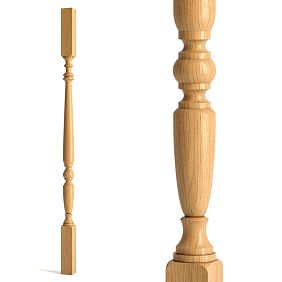
A turned wooden baluster is a classic, tested by centuries. On a lathe, forms are born that delighted aristocrats of the Renaissance and continue to inspire modern architects. Every line matters here: the smooth curve of the baluster's body, the elegant capital at the top, the stable base at the bottom.
Such balusters for stairs fit perfectly into interiors where tradition is valued: English style, Victorian era, Russian manor. Vase-shaped expansions, faceted transitions, fluting — all this creates a play of light and shadow, turning vertical posts into sculptural elements.
Get Consultation
Carved balusters: when wood becomes lace
If turned balusters are elegance, then carved ones are luxury and exclusivity. EachWooden balusterHand-carved balusters bear the mark of the craftsman, their skill in seeing the future ornament within the solid wood. Grapevines, oak leaves, geometric patterns, floral motifs—carving transforms a baluster into a work of art.
Carved balusters for a staircase require a certain context. They are appropriate in large spaces where details can be admired, in interiors with high ceilings where architectural complexity is welcomed. Baroque, Empire, Classicism, Neo-Russian style—these are their natural habitat.
Flat balusters: minimalism with character
Modern architecture gravitates towards conciseness, and here flat balusters take the stage. These are thin vertical panels with a thickness of twenty to forty millimeters, which can be either completely smooth or decorated with openwork patterns. Slavic traditions of wooden architecture have given us balusters with solar symbols, rosettes, and geometric patterns. Modern design offers strict geometry without decoration.
Flat wooden balusters are economical to produce, visually light, and create a sense of airiness. They look organic in Scandinavian interiors, lofts, and minimalist spaces where functionality and purity of lines are important.
Square balusters: Geometric Rigor
Square cross-section—maximum strength with minimal decorativeness. Beams with a cross-section of forty by forty, fifty by fifty, or sixty by sixty millimeters, sanded to perfect smoothness, painted or oiled—this is the portrait of a modern baluster. No curls, no complex profiles—only honest geometry and functionality.
Square balusters are worth buying for interiors in minimalist, Japanese design, constructivist, and industrial aesthetic styles. They create a clear vertical rhythm, do not overload the space with details, and allow focus on the architecture of the staircase itself.
Wood species: choosing a foundation for centuries
Oak: monumentality and prestige
When talking about wooden balusters, it is impossible not to mention oak. This is the king of hardwoods, a material used for building ships and palaces. The wood density reaches seven hundred and fifty kilograms per cubic meter, its hardness is phenomenal, and its resistance to wear is unsurpassed.
Oak balusters withstand colossal loads, do not deform for decades, and retain their original shape even under active use. Oak texture is coarse-pored, with expressive annual rings and medullary rays that create a unique pattern. The color varies from honey-golden to dark brown, depending on the treatment and age of the wood.
If you wantBuy wooden balustersFor centuries, choose oak. Yes, the cost is higher than other species, but it is an investment in the future—an oak railing will serve more than one generation of your family.
Beech: a balance of quality and affordability
Beech is the golden mean for those who value quality but are not ready to overpay for the prestige of oak. Beech density is about six hundred fifty to seven hundred kilograms per cubic meter, with sufficient strength for any staircase structure. Beech is excellent to work with, can be turned, and sanded to a mirror-like smoothness.
Beech texture is calm, uniform, with small specks of medullary rays. The color is pinkish-beige, warm, and cozy. Steamed beech acquires a richer pinkish hue and a more uniform structure. Beech balusters for stairs are universal: they are equally good in classic interiors under varnish, in Provence style under paint, and in Scandinavian style under oil.
Ash: elasticity and expressiveness
Ash is a species for those who appreciate the natural beauty of wood. Contrasting annual rings create an expressive striped pattern; the light tone of the wood, from creamy to light brown with an olive tint, makes ash recognizable. The density is high, about seven hundred kilograms, but ash also possesses elasticity—it cushions and does not crack under dynamic loads.
Wooden ash balusters are ideal for modern eco-friendly interiors where the natural wood texture is important. Under oil, ash reveals its full beauty—the grain becomes deep, the tactile sensations pleasant, and the color noble.
Larch: Resistance to Moisture
Larch is the choice for specific conditions: high humidity, temperature fluctuations, and outdoor use. Its resinousness makes larch practically invulnerable to water and rot. If you need balusters for a terrace staircase, porch, or sauna—larch is indispensable.
Larch color is warm, honey-golden with reddish hues. The texture is expressive, with clear annual rings. The density is high, about six hundred fifty to seven hundred kilograms. Processing is more difficult than beech due to resinousness, but the result is worth it.
Birch: the perfect base for painting
When planning a painted railing—white, gray, pastel—no better material than birch can be found. Birch density is about six hundred kilograms—sufficient for balusters that do not experience extreme loads. The main advantage of birch is its perfect receptiveness to paints and enamels.
Birch texture is inexpressive, which is a plus for painting—there is no pattern that would show through the paint. Birch balusters are worth buying for interiors in Provence, shabby chic, and Scandinavian styles with painted elements. The cost is twenty to forty percent lower than beech, making birch an economical choice.
Railings and balusters: a symphony of structural elements
It is impossible to talk about balusters without mentioningHandrails and balustersas a unified system. A staircase railing works like an orchestra: every instrument is important, but only the harmony of all elements creates the melody.
Support posts: foundation of the railing
staircase componentsbegin with support posts—massive vertical elements that bear the main load. Standard post cross-sections are eighty by eighty, one hundred by one hundred, one hundred twenty by one hundred twenty millimeters. Posts are installed at key points: the start of a flight, the end, turns, and landings.
The post is the visual dominant, an accent that sets the tone for the entire railing. It can be turned with decorative profiles, square with milled details, or carved with three-dimensional ornaments. The post finial—another decorative element: a ball, cone, pyramid, vase, carved finial—crowns the structure, adding verticality and completeness.
Handrails: ergonomics in hand
The handrail is the element a person physically contacts with every ascent and descent. Therefore, its shape must be ergonomic, and its surface perfectly sanded. A round handrail with a diameter of fifty to sixty millimeters is comfortably grasped by the palm. An oval cross-section of fifty by seventy or sixty by eighty millimeters is even more comfortable. A rectangular handrail with rounded edges combines modern graphic quality with ease of use.
The handrail is made from the same wood species as the balusters to create harmony. But contrasting combinations are possible: white painted balusters with a dark oak handrail create a bright visual effect, emphasizing the staircase's architecture.
Subrail: The Hidden Structural Reinforcer
A subrail is an additional rail with a cross-section of thirty by fifty or forty by sixty millimeters, which is attached to the tops of the balusters from below. The handrail is laid on top of the subrail. This component increases the rigidity of the structure, simplifies the installation of the handrail, and provides additional strength to the entire system. A subrail is not mandatory but is recommended for long flights of stairs and heavy handrails.
Norms and Distances: Safety as a Priority
The beauty of a stair railing should not come at the expense of safety. Building codes clearly regulate the parameters, and compliance with them is mandatory.
Railing height
The minimum height of balusters for a staircase, measured from the surface of the tread to the top of the handrail, is ninety centimeters. For children's institutions, this norm increases to one hundred ten to one hundred twenty centimeters. This prevents accidental falls through the railing, which is especially important for families with children.
Distance between balusters
The maximum clear distance between balusters is fifteen centimeters. This is a critical safety parameter: a child should not be able to slip between the posts. In practice, two schemes are used: one baluster per tread (distance between centers about twenty-five to thirty centimeters) or two balusters per tread (distance between centers twelve to fifteen centimeters).
Flat balusters for stairs, due to their lower bending strength, are installed more frequently—every ten to twelve centimeters.
Structural strength
The railing must withstand a horizontal load of one hundred kilograms applied to the handrail. This simulates a situation where an adult leans on the railing with their full weight. Proper fastening of balusters to treads, reliable installation of posts, and quality fixation of the handrail ensure the required strength.
Fastening Methods: Reliability in the Details
Quality installation is half the success. There are several proven methods for fastening balusters to treads.
Tenon Joint: The Classic of Woodworking
A tenon with a diameter of twenty to thirty millimeters and a length of thirty to forty millimeters is turned on the lower end of the baluster. A corresponding mortise is drilled into the tread. The tenon is coated with wood glue, and the baluster is inserted into the mortise. The joint is strong, aesthetic (fasteners are not visible), and durable. Requires precision in manufacturing and care during installation.
Stud Fastening: Modern Reliability
A metal stud—a threaded rod with a diameter of eight to ten millimeters and a length of eighty to one hundred millimeters—is screwed into the lower end of the baluster. Half of the stud remains in the baluster, and half enters the tread through a drilled hole. Glue secures the connection. The baluster is literally screwed onto the stud. The method is reliable and allows for vertical adjustment during installation.
Screw Fastening: Functional Simplicity
Screws are driven through the tread from below at an angle, entering the lower end of the baluster. The method requires access to the underside of the treads but provides maximum strength. An alternative is fastening with screws from above, with masking using wooden plugs matched to the color.
Finishing Options: From Natural Texture to Rich Color
The final finish determines the ultimate appearance of the stair railing, protects the wood from external influences, and affects durability.
Clear Varnish Coating: Emphasizing Nature
Varnish creates a hard, transparent film, preserving the visibility of the wood grain. Polyurethane varnishes are the most wear-resistant, ideal for stairs with high loads. Acrylic water-based varnishes are eco-friendly, odorless, but less resistant to abrasion. Varnish is applied in two to three coats with intermediate sanding using fine abrasive—this removes raised fibers and creates a perfectly smooth surface.
Gloss varnish emphasizes color and texture, creates shine, but scratches are visible on it. Semi-matte varnish gives a silky sheen and is universal. Matte varnish creates a velvety surface and hides minor defects.
Oil-Wax Coating: Naturalness in Every Touch
Oil penetrates the wood, emphasizes the grain, and creates a natural matte appearance. The wood remains pleasant to the touch and retains its ability to breathe. Modern oils contain hard wax, which provides additional protection and a silky sheen.
Oil is applied in a thin layer, and excess is wiped off. After twelve to twenty-four hours, a second coat is applied. After complete drying, the surface is polished with a soft cloth. Advantages of oil: natural appearance, tactile pleasure, ease of local repair. Requires renewal every two to three years.
Painting: Color as Character
Paint completely hides the wood grain, creating a uniform colored surface. Acrylic water-based paints are odorless, fast-drying, eco-friendly, and create a matte or semi-matte surface. The color palette is endless: white for Scandinavian style, gray for modern minimalism, pastel tones for Provence, rich colors for eclecticism.
The painting technology includes sanding, priming to equalize absorbency, paint in two to three coats with intermediate sanding, and a final protective coating of varnish or wax.
Staining and Patination: Artificial Nobility
Stain changes the color of the wood while preserving the visibility of the grain. Light birch turns into walnut, beech into mahogany. After staining, a coating of varnish or oil is mandatory.
Patination creates an antique effect: dark paint is applied to the baluster, then the top layer is partially wiped off, revealing the light base. The effect of wear, vintage, and the nobility of time. Popular in Provence, shabby chic, and vintage styles.
Stylistic Compatibility: Choosing Balusters to Match the Interior
Classic Interiors
For classical style, English interiors, Victorian mansions, choose turned balusters made of oak or beech with expressive profiles. Vase-shaped expansions, fluting, smooth transitions — these are the hallmarks of classicism. A transparent varnish finish highlights the wood grain. Colors range from natural honey to walnut or dark oak stain.
Baroque and Empire
Carved balusters for staircases with three-dimensional ornaments, gilded or silvered patina on a white base — a choice for luxurious interiors. Grapevines, acanthus leaves, rosettes, intricate carving transform the baluster into a sculptural element. Massive carved posts with finials complete the majestic picture.
Provence and Shabby Chic
White or pastel painted balusters made of birch or beech, often with patina and a distressed effect. Turned forms of medium complexity, without excessive opulence. Matte finish, soft tones, a feeling of coziness and slight nonchalance.
Scandinavian style
Natural balusters made of ash or beech with oil finish, preserving the natural grain and light tone of the wood. Painted white with a matte finish is also an option. Forms are laconic: round turned or square with a chamfer. Minimum decoration, maximum naturalness.
Minimalism and High-Tech
Square balusters made of any wood species, painted black, graphite, white, or varnished. Strict geometry, absence of decorative elements, clear vertical rhythm. Contrasting combinations: black balusters with a white handrail or vice versa.
Loft and industrial style
Flat balusters or square ones with a rough texture, finished with oil or stained in dark, cool tones. Combinations of wood with metal are possible. Minimal processing, emphasis on the naturalness of the material, functionality over decorativeness.
Baluster Installation: Step-by-Step Algorithm for Professional Installation
Preparation Stage
Before starting work, check the horizontality of the steps with a level. Permissible deviation is one to two millimeters per meter. Prepare tools: drill with a set of bits, screwdriver, miter saw with angle adjustment capability, bubble and laser levels, tape measure, square, pencil, wood glue, fasteners.
Installation of Support Posts
Start by installing the support posts — they determine the position of the entire system. The starting post is mounted on the first step or on the floor in front of the staircase, the final post — on the top step or landing. Mark the installation locations, drill holes for dowels or prepare mortises for a tenon joint. Install the posts, check verticality with a level, secure with glue and fasteners.
Marking the Position of Balusters
Stretch a string from the top of the lower post to the top of the upper post — it will show the line along which the tops of all balusters should be aligned, taking into account the staircase slope. Mark the baluster installation points on the steps. For a layout with one baluster per step, place it in the center of the tread or at a distance of five to ten centimeters from the front edge. For a layout with two balusters per step, divide the tread into equal parts.
Cutting Ends at an Angle
Since the staircase has an incline, the lower ends of the balusters are cut at an angle for a tight fit against the step. The cutting angle equals the staircase incline angle, usually thirty to forty degrees. The upper ends are also cut at an angle to fit against the handrail. Use a miter saw with adjustable angle. All balusters must be cut identically.
Attaching balusters to steps
Choose a fastening method depending on the staircase construction and available tools. For a tenon joint, drill mortises in the steps with a Forstner bit, apply glue to the tenon, insert the baluster, check verticality. For dowel fastening, screw a dowel into the baluster, drill a hole in the step, apply glue, screw the baluster onto the dowel. For screw fastening, drive screws from under the step at an angle or from above with subsequent concealment.
Allow the glue to dry completely — twelve to twenty-four hours — before installing the handrail.
Handrail installation
If the handrail is installed into a groove, first rout a groove on the underside, fifteen to twenty millimeters deep. Lay the handrail on the balusters, check that all tops fit snugly into the groove. Apply glue, press the handrail. Additionally secure with screws through the handrail into the balusters, concealing with wooden plugs, or through a sub-rail from below.
Final finishing
Conceal fasteners, fill gaps with putty, sand with fine-grit abrasive. Apply a finish coating to all railing elements — balusters, posts, handrail. Use the same coating for color and texture unity.
Care for Wooden Balusters: Preserving Beauty for Decades
Regular cleaning
Wipe balusters and handrail with a damp, soft cloth weekly. Remove dust, dirt, hand marks. Avoid aggressive detergents, abrasives, solvents — they damage the protective coating. For stubborn stains, use a weak soap solution. After wet cleaning, wipe dry.
Recoating
Renew varnish coating every three to five years. Lightly sand the surface with fine-grit abrasive, clean from dust, apply a fresh coat of varnish. Renew oil finish every two to three years: clean the surface, apply a thin coat of oil, wipe off excess, polish. Touch up painted balusters when chips and wear appear.
Repair of damage
Lightly sand scratches on varnish with fine-grit abrasive, apply varnish locally, polish. Dents can be restored with steam: moisten with water, cover with a damp cloth, iron with a hot iron. The fibers will swell, the dent will level out. Sand, apply finish. Fill cracks with wood putty to match the tone, sand, coat. Replace a broken baluster with a new one of the same profile and finish.
Checking fasteners
Check the railing strength every six months. Shake the handrail — it should not have play. Check balusters — they should stand vertically, not wobble. If loosening is detected, tighten screws, add glue, reinforce fastenings.
Combining Balusters: Creating a Unique Rhythm
Monotony is the enemy of an interesting interior. Combine different types of balusters to create a unique rhythm and visual dynamics.
Alternating Simple and Complex Forms
Install two balusters on each step: one simple turned cylindrical and one with a more complex vase-shaped profile. Or alternate round and square balusters. This creates rhythm, breaks monotony, adds visual interest.
Contrasting Color Combinations
White balusters with a dark handrail — a classic combination. Black balusters with a light ash handrail — modern drama. Natural wooden balusters with a handrail painted to match the wall color — harmony with the interior.
Combining Flat and Volumetric Elements
Flat balusters with cut-out ornaments can be alternated with simple square posts. Or use flat balusters on straight sections, and turned balusters on turns and near posts. This creates visual variety while maintaining stylistic unity.
Mistakes in selection and installation: what to avoid
Mismatch with interior style
Carved Baroque-style balusters in a minimalist interior create stylistic dissonance. Square, laconic balusters in a classic mansion lack decorative appeal. Choose balusters that match the overall style of the house.
Saving on material
Balusters made from softwood (pine) for a heavily used staircase will wear out quickly, become deformed, and lose their shape. Invest in quality hardwoods—it will pay off in durability.
Incorrect spacing between balusters
A clear distance of more than fifteen centimeters violates safety standards. Too frequent installation leads to material waste and visual clutter. Follow recommended standards.
Poor-quality fastening
Balusters secured only with glue without additional fasteners can become loose. Fastening with only screws without glue is also insufficiently reliable. Use combined fastening: glue plus dowels or screws.
Lack of angle trimming
Balusters with straight ends on an inclined staircase do not fit tightly to the steps and handrail. Gaps form, and the structure looks sloppy. Always trim the ends at an angle corresponding to the staircase's incline.
Ignoring finishing
Unprotected wood quickly absorbs moisture, gets dirty, darkens, and deforms. Always apply a protective coating—varnish, oil, paint—immediately after installation.
Balusters for different types of staircases
Straight-flight staircases
Straight-flight staircases are the most common type. Here, balusters are installed according to the classic scheme: one or two per step. The handrail is straight, and installation is maximally simple. Any types of balusters are suitable: turned, carved, flat, square.
Helical staircases
Spiral staircases require a special approach. Balusters are installed along the radius, and the handrail curves in a spiral. Here, small-diameter round turned balusters are preferable—they are visually lighter and fit better into the curvilinear geometry. Massive carved balusters on a spiral staircase look bulky.
Staircases with turns
Staircases with landing turns or winder steps combine straight and curved sections. On straight sections, use any balusters; on turns, use simpler shapes for easier installation. Support posts must be installed at turning points.
Outdoor staircases and terraces
For outdoor use, choose larch—its moisture resistance is unparalleled. Treatment with antiseptics and protective coatings for exterior work is mandatory. Simple baluster shapes are preferable—turned or square, without intricate carvings where moisture can accumulate.
Calculating the required number of balusters
To correctly calculate how many balusters to buy, consider the following parameters.
Number of steps
Count the number of steps in the flight. With a scheme of one baluster per step, the number of balusters equals the number of steps. With a scheme of two balusters per step, double this number.
Length of horizontal sections
If there are horizontal sections (landings), measure their length. Divide the length by the distance between balusters (usually twenty-five to thirty centimeters)—this gives the number of balusters for the landing.
Supporting posts
Add two to four support posts depending on the staircase configuration: starting, ending, turning.
Reserve
Always order five to ten percent more balusters than the calculated amount. This is a reserve for possible defects, installation errors, and future repairs.
Price and value: what to invest in
When it comes toBuy wooden balusters, price should not be the only criterion.
What affects the cost
Wood species: oak is more expensive than beech, beech is more expensive than birch. Processing complexity: carved balusters are five to ten times more expensive than simple turned ones. Size: tall and thick balusters are more expensive than standard ones. Finish: patination, complex multi-layer painting increase the cost.
Investment in quality
Cheap balusters made from softwood species or with poor processing will require replacement after a few years. High-quality balusters made from hardwood with professional finishing will last for decades without losing their appearance. Saving now results in costs later. Invest in quality — it pays off with durability and aesthetics.
Where to buy
Buy balusters from manufacturers with their own production, quality control, and guarantees. Read reviews, study samples, request certificates. Avoid anonymous suppliers with suspiciously low prices — the quality of such products often leaves much to be desired.
FAQ: Answers to popular questions
How many balusters are needed for a staircase with fifteen steps?
With one baluster per step scheme — fifteen pieces. With two balusters per step scheme — thirty pieces. Plus two to four support posts. Plus a reserve of five to ten percent.
Which wood species is best for balusters?
Oak — the most durable and long-lasting, but expensive. Beech — optimal price-to-quality ratio. Ash — beautiful grain, high elasticity. Birch — for painted balusters. Larch — for humid conditions.
Can balusters be installed by oneself?
Yes, if you have basic carpentry skills, necessary tools, and patience. Critical aspects are marking accuracy, proper angle cutting, and checking verticality. Without experience, it's better to entrust the work to professionals.
How often should baluster finishes be renewed?
Varnish coating — every three to five years. Oil coating — every two to three years. Painted balusters — as damage appears.
Can different baluster shapes be combined?
Yes, combining creates visual interest and uniqueness. You can alternate simple and complex shapes, round and square, painted and natural. The main thing is to maintain unity of material and overall style.
What to do if the baluster is cracked?
Fill small cracks with wood putty matching the tone, sand, and apply a finishing coat. For serious damage, replace the baluster with a new one of the same profile and finish.
Are baluster supports needed?
Sub-rails are not mandatory but are recommended for long flights and heavy handrails. They increase structural rigidity, simplify handrail installation, and provide additional strength.
How to choose the color of balusters?
Focus on the overall color scheme of the interior. Natural wood tones are universal, suitable for most styles. White balusters brighten the space, suitable for Scandinavian and Provence styles. Dark tinted balusters add solidity, suitable for classic interiors. Contrasting combinations create visual drama.
What distance should be between balusters?
Maximum clear distance (between inner surfaces) — fifteen centimeters. This is a safety standard preventing a child from slipping through. In practice, when installing one baluster per step, the clear distance is fifteen to twenty centimeters.
How to care for painted balusters?
Wipe with a damp soft cloth without aggressive detergents. If chips and abrasions appear, sand the damaged area, prime, and touch up to match the tone. To refresh the entire surface, lightly sand and repaint in two coats.
Conclusion: balusters as the soul of your staircase
A staircase is not just a path from the first floor to the second. It is a daily route you ascend and descend hundreds of times a year. It is the first thing guests see when entering your home. It is an architectural element that sets the tone for the entire interior. And staircase balusters are what turn a functional structure into a work of art.
ChoosingBuy wooden balusters, you are investing in family safety, space aesthetics, and structural durability. The right choice of material — hardwood species, quality processing, professional finishing — ensures decades of impeccable service.
Harmonious combination of balusters, posts, and handrails creates a unified system where each element complements the other. Adherence to safety standards, proper installation, regular maintenance — these are the keys to ensuring your staircase railing will serve more than one generation of your family.
STAVROS company has specialized in the production ofstaircase components made from natural wood for over twenty years. Own production, modern CNC equipment, multi-stage quality control, chamber drying of wood to eight to twelve percent moisture content — all this guarantees the highest product quality.
The STAVROS catalog features over fifty models of solid wood balusters made from oak, beech, ash, larch, birch — from classic turned to modern flat, from carved with three-dimensional ornaments to minimalist square. Each product is manufactured with an accuracy of up to half a millimeter, ensuring perfect fit during installation.
STAVROS offers a complete set of staircase railing elements made from a single wood species with uniform coating: balusters, support posts of various sections with carved finials, handrails of different profiles, sub-rails, decorative overlays. All finishing options are available: natural oil with hard wax, polyurethane varnish of various gloss levels, tinting with stains, painting in any color from the catalog, patination with an antique effect.
Individual approach to each project: manufacturing balusters according to your sketches and dimensions, 3D visualization of the staircase with selected elements, calculation of the required number of components, professional recommendations for installation and finishing. Professional consultations from specialists with years of experience in woodworking and staircase craftsmanship will help you choose optimal solutions, avoid mistakes, and create a staircase that will last for centuries.
STAVROS works with private clients, construction companies, and interior designers across Russia. Own production, established logistics, flexible discount system for wholesale buyers, delivery to any city. Visit STAVROS showrooms in Moscow and St. Petersburg to see the full variety of shapes, textures, shades, touch the perfectly sanded surface, and evaluate the quality of processing.
STAVROS — it's the traditions of carpentry craftsmanship, modern production technologies, strict multi-stage quality control at all stages, care for your family's safety. Create staircases that last forever, delight every day with their beauty and functionality, and are passed down to future generations as a model of quality and reliability.
Choosebalusters for staircases from STAVROS — choose quality tested by time, the beauty of natural wood, and safety for the whole family.


