












































































Article Contents:
- Why Classic Style Works in the Restaurant Business
- Psychology of Perceiving Classic Style
- Classic Style and Target Audience
- Stair Balusters: Architectural Prologue of a Restaurant
- The Role of Balusters in Staircase Perception
- Choosing Wood Species for Balusters
- Baluster Profile: From Simplicity to Ornamentation
- Support Columns: Structural Accents
- Handrails: Completing the Staircase Composition
- Handrail Profile
- Toning and Finishing
- Classic Restaurant Furniture: Creating Intimacy in a Large Space
- Tables: Center of the Dining Ritual
- Chairs and Armchairs: Comfort with Character
- Sofas and Banquettes: Zoning the Hall
- Furniture Decor: Details That Create Style
- Carved decoration
- Hardware and Overlays
- Color Palette of a Classic Restaurant
- Main colors
- Color schemes
- Lighting: theater of light and shadow
- Central Lighting: Chandeliers
- Accent Lighting
- Color Temperature
- Textiles: softness and luxury
- Curtains
- Tablecloths and Napkins
- Upholstery Fabrics
- Frequently Asked Questions
- How Much Does It Cost to Design a Restaurant in Classic Style?
- Can Classic Style Be Combined with Modern Elements?
- How to Care for Wooden Balusters and Furniture in a Restaurant?
- What Certificates Are Needed for Restaurant Furniture?
- How Long Does Solid Wood Classic Furniture Last?
- Where to Order Balusters and Classic Furniture for a Restaurant?
- Conclusion: Investing in Atmosphere

A restaurant is a theater of gastronomy, where food is the performance and the interior is the scenery that sets the mood for the guest-spectator. Classic style in restaurant design is not a tribute to fashion, but a choice of atmosphere that conveys respectability, confidence, and timelessness. When a guest ascends a staircase withcarved oak balusterswhen sitting down at the tableclassical furniture with patina and gilding, they enter not just a food service establishment, but a space with history, status, and the aesthetics of palaces and mansions.Balusters for staircasebecome an architectural accent in the entrance area,handrails and balusters made of solid woodframe the guest's path to the table,the restaurant's classical furniturecreates a sense of privacy, of the moment's significance. Let's examine how to use these elements to create a restaurant where every guest feels like an attendee at a ball in the Winter Palace.



Why classic style works in the restaurant business
Fashionable styles replace each other every 5-7 years. Loft was at its peak in 2015-2020, Scandinavian in 2018-2023, now the era of biophilia and ethnic styles is arriving. Classic style is independent of trends. It has existed for centuries, perceived as eternal, reliable, expensive.




Psychology of perceiving classic style
A classic interior activates archetypes of a palace, an aristocratic estate, a place where important people gather. Even if a guest has never been in a real palace, the cultural code works — cinema, literature, and art have shaped the image. A person sitting in a chair with carved decor at a table on curved legs subconsciously feels an elevation of their status. This is not a rational thought, but an emotional reaction.
This is critical for a restaurant. A guest comes not just to eat (it's cheaper at home). They are buying an experience, an emotion, status. A classic interior sells these emotions more effectively than minimalism or loft. Minimalism is cold, impersonal. Loft is democratic, close to street culture. Classic style is the warmth of aristocracy without pretension to familiarity.
Our factory also produces:


Classic style and target audience
A classic restaurant attracts a specific audience:
Age group 40+ — people with established tastes, financial means, who value tradition, quality, stability.
Business meetings — partners, negotiations, presentations. A classic interior creates an atmosphere of seriousness, solidity, trust. Signing a contract in a loft with brick walls is not solid. In a hall with stucco and crystal chandeliers — it's respectable.
Family celebrations — anniversaries, weddings, christenings. An event requires an appropriate frame. A classic restaurant gives a sense of the moment's importance, of a worthy setting.
Romantic dinners — classic style is associated with 19th-century romance, balls, gallantry. For a couple wanting to create a special atmosphere, a classic restaurant is preferable to a democratic bistro.
The average check in a classic restaurant is 30-50% higher than in an establishment with a contemporary style. The guest is willing to pay for the atmosphere, understanding that the expensive interior is part of the product.
Get Consultation
Balusters for the staircase: the restaurant's architectural prologue
A staircase in a restaurant is not only a functional element (access to the second floor) but also a scenographic one. It creates a moment of transition: the guest enters from the street (the mundane world), ascends the stairs (a transitional ritual), enters the hall (the restaurant's sacred space).
The role of balusters in perceiving the staircase
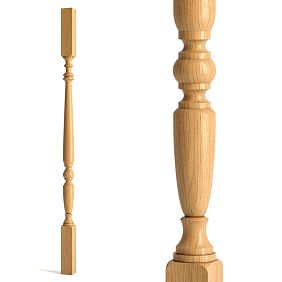
balusters— vertical posts of the railing, supporting the handrail. Their function is safety (preventing falls) and aesthetics (creating rhythm, ornamentation, and status for the staircase).
In the classical styleWooden balustersare turned on a lathe, forming a complex profile of alternating thickenings and waists. Each baluster is a sculpture in miniature, repeating the classical proportions of columns (base, shaft, capital). A row of balusters creates a vertical rhythm, associated with a colonnade — a symbol of monumental architecture.
. Tactile contact with warm, smooth wood, the feeling of the structure's massiveness, the visual complexity of the profile — all this forms the impression: 'Everything here is genuine, expensive, reliable.'wooden balustersChoosing the wood species for balusters
The wood species determines color, texture, durability, and cost.
Oak — a classic choice for restaurants. Hardness of 3.7 on the Brinell scale ensures resistance to mechanical damage (impacts, abrasion — critical in a restaurant with high traffic). Expressive texture with large annual rings is visible even under tinting. Color range: from light golden (young oak) to dark brown (bog oak, aged in water for decades). Oak is associated with monumentality, age-old traditions, solidity.
Oak is a classic choice for restaurants. A hardness of 3.7 on the Brinell scale ensures resistance to mechanical damage (impacts, abrasion—critical in a high-traffic restaurant). Its expressive texture with large annual rings remains visible even under tinting. Color range: from light golden (young oak) to dark brown (bog oak, aged in water for decades). Oak is associated with monumentality, centuries-old traditions, and solidity.
Beech is lighter than oak, with a pinkish tint and a more uniform texture. Hardness 3.8 — even higher than oak. But beech is more hygroscopic and reacts more strongly to humidity. For a restaurant (where humidity is stable due to climate control) this is not a problem. Beech balusters are optimal for light classic interiors (French provincial, Scandinavian classic).
Ash — contrasting texture (dark lines on a light background), maximum hardness among European species (4.0). Ash balusters are effective after brushing (removing soft fibers with a brush) — the texture becomes relief-rich and tactilely rich. Suitable for restaurants where classic style is combined with modern elements.
Exotic woods (mahogany, teak, wenge) — for premium positioning. Red-brown mahogany, almost black wenge, golden teak — species with unique colors that do not require tinting. Expensive (3-5 times more expensive than oak), but create a sense of exclusivity.
Baluster profile: from simplicity to ornamentation
The complexity of the baluster profile determines the decorative quality of the staircase.
Simple classic profile: cylindrical body with one thickening in the middle, simple base and capital. Laconic, not overloaded, suitable for restrained classic style.
Medium profile: two or three thickenings of different diameters, alternating with constrictions. Creates a more pronounced vertical rhythm. Standard for most classic restaurants.
Complex Baroque profile: multiple thickenings, carved ornaments (flutes, spirals, plant motifs), carved capital. Maximum decorative quality, suitable for luxurious restaurants in Baroque or Empire style.
Square balusters with carving: not turned, but milled from square-section timber with three-dimensional carving on the faces. Less traditional, but creates individuality.
Support posts: structural accents
Support posts (baluster posts of increased cross-section)are installed at the beginning and end of a flight of stairs, at turns, every 5-7 ordinary balusters. They are thicker (100×100 mm, 120×120 mm vs. 50×50 mm for ordinary balusters), taller (often 10-15 cm taller than the handrail), and bear structural load (take the main stress from the handrail).
The decor of support posts is more complex: carved capitals (with acanthus leaves, volutes), finials (balls, vases, shaped elements), inlay. They serve as compositional accents that organize the rhythm of the staircase.
In restaurants with high ceilings (4-5 meters), support posts can be very massive (150×150 mm, up to 2.5 meters tall), turning into columns. This creates theatricality, monumentality, and impresses guests.
Handrails: completing the staircase composition
handrails— a horizontal element on which the hand rests when ascending. They complete the staircase structure, linking the balusters into a single system.
Handrail profile
Solid wood handrails are milled into a complex profile, comfortable to grip and aesthetically coordinated with the balusters.
Rounded profile: the top part is rounded (radius 25-40 mm), the side edges are slightly beveled. A universal option, comfortable for the hand, does not snag clothing.
Rounded-flat: the top is flat (width 60-80 mm) with rounded edges. More massive, solid, suitable for wide staircases.
Figurative classic: a complex profile with hollows (concave grooves), beads (convex roundings), chamfers (angled bevels). Maximally decorative, coordinates with carved balusters.
Tinting and finishing
The natural color of wood is beautiful, but often the tone needs to be changed to coordinate with the restaurant's overall color scheme.
Stain tinting: changing the color of the wood while preserving the visible grain. Oak can be tinted to walnut (dark brown), wenge (black-brown), gray (fashionable Scandinavian shade). Stain penetrates the wood, does not create a surface film.
Patination: a two-color technique where a base color (usually light) is overlaid with patina (dark paint), which remains in the recesses of the carving. Creates an antique effect, emphasizes relief.
Gilding or silvering: for Baroque luxurious restaurants. Applied to carved elements (baluster capitals, handrail ornaments), creating accents. Uses imitation gold leaf (imitation of gold leaf) or gold paint.
Final coating — varnish or oil. Varnish creates a durable glossy or matte film, protects against abrasion, moisture. Oil penetrates the wood, preserves tactility, requires periodic renewal (every 2-3 years). For a restaurant, varnish is preferable — higher wear resistance, easier maintenance.
Classic restaurant furniture: creating intimacy in a large space
The restaurant hall is a public space, but every guest wants to feel privacy.Classic Furnituresolves this task through form, scale, decor.
Tables: the center of the dining ritual
A table in a classic restaurant is not just a surface for plates, but a symbol of the hearth, a place for family gatherings.
Shape:
Round tables (diameter 110-140 cm) — for groups of 4-6 people. They create a sense of equality (no head of the table), intimacy (everyone can see each other). Suitable for romantic dinners, friendly gatherings.
Oval tables (140×90 cm, 180×100 cm) — for groups of 6-8 people. They combine the advantages of round (no corners) and rectangular (compactness) tables. Elegant, traditional.
Rectangular tables (120×80 cm, 140×90 cm) — versatile, easy to arrange in the hall, can be joined for banquets. For classic style, those with rounded corners are preferable (less formal).
Construction:
Central pedestal (one massive turned leg in the center of the tabletop, splaying into three or four feet at the bottom). Traditional for round and oval tables, creates a sense of lightness (despite its massiveness), does not obstruct guests' legs.
Four legs (at the corners of the tabletop). Classic turned legs with thickenings, carved elements. More stable than a central pedestal, suitable for rectangular tables.
Tabletop:
Solid wood (oak, ash, walnut) — a premium option. Warm, pleasant to the touch, with visible grain. Requires protection with a durable varnish (the tabletop comes into contact with liquids, hot plates).
Veneered (base — MDF or plywood, top — veneer of valuable wood species). Cheaper than solid wood, lighter, does not warp from humidity. Visually indistinguishable from solid wood (the grain is real). The standard for most restaurants.
Marble or granite — for premium classic restaurants. Cold, monumental, eternal. Suitable for Italian and French concepts.
Chairs and armchairs: comfort with character
A guest spends 1.5-3 hours in a restaurant armchair. Ergonomics are critical, but in classic style, they must be concealed behind decorativeness.
Frame materials:
Solid oak, beech — a traditional choice. Durable, long-lasting (a chair lasts 15-20 years under restaurant load), amenable to carving and turning.
Combination of solid wood (legs, back frame) and plywood (seat and back base). Cheaper, lighter, sufficiently strong.
Construction:
Four legs (front legs straight or turned, rear legs often slightly splayed backward for stability). Legs are connected by aprons (horizontal rails) and stretchers (lower crossbars between legs — add rigidity).
Backrest: high (up to shoulder blades or higher — for armchairs), medium (up to the middle of the back — for chairs). Shape: straight vertical, slightly reclined backward (more ergonomic), curved (follows the anatomy of the back). Backrest decor: carved vertical slats, solid carved panel, fabric-upholstered soft insert.
Upholstery:
Fabric: velour, velvet, jacquard — luxurious materials with deep color, soft texture. Colors: burgundy, emerald, dark blue, golden — rich, noble shades associated with palace interiors.
Leather: genuine leather (expensive but durable and prestigious) or faux leather (cheaper but less wear-resistant). Colors: brown, burgundy, black. Leather is easier to clean (important for a restaurant), does not absorb odors.
Upholstery decor: capitonné (button tufting creating a diamond pattern — an icon of classic decor), piping (edging the upholstery with contrasting trim), fringe (for Baroque).
Sofas and banquettes: zoning the hall
Sofas create intimate zones in a large hall, separating tables from each other. Banquettes (short sofas or backless armchairs) are placed along walls.
Sofa construction:
Straight (length 140-180 cm, for 2-3 people). Placed with their back to the wall or used as dividers between tables (the back faces the hall — must be decorative).
Corner (L-shaped, U-shaped). Create isolated zones (lounge zones for groups, smoking areas, waiting areas).
Upholstery and decor as with chairs, but the scale of elements is larger (carving on armrests is more massive, capitals of legs are more expressive).
Furniture decor: details that create style
Classic furniture is recognized by its details — carving, hardware, ornaments.
Carved decor
Wood carving is the hallmark of classic style. Types of carving:
Relief (ornament protrudes above the background): acanthus leaves, grapevines, roses, cartouches (ornamental shields).
Contour (ornament carved with lines recessed into the surface): geometric patterns, interlacing.
Pierced (through-cut, background removed): openwork chair backs, table sides.
Carving is applied to:
Chair backs (top rail, central panel)
Table and chair legs (capitals, bases)
Armchair armrests
Cabinet and dresser fronts (if present in the restaurant — for storing dishes, textiles)
Hardware and overlays
Handles, keyholes, decorative overlays — details that create the impression.
Materials:
Brass (gold-like, bronze-like). Warm metallic sheen, develops patina over time (antique effect).
Bronze (heavier, more noble than brass, more expensive).
Blackened steel (for strict classic style, closer to Gothic or English style).
Hardware styles:
Baroque: lavish scrolls, mascaron faces, abundant decoration.
Empire: strict symmetrical forms, military symbolism (laurel wreaths, swords, eagles).
Classicism: restrained geometric forms, antique motifs (columns, capitals).
Color palette of a classic restaurant
Color in classic style is not accidental. It follows traditions, psychology of perception, and symbolism.
Main colors
Beige, cream, ivory — basic background colors for walls, ceilings. Warm, neutral, create a sense of light, air, tranquility.
Brown (all shades from light walnut to dark wenge) — the color of wood. Dominates in furniture, staircases, panels. Grounds, creates stability, coziness.
Bordeaux, wine — rich red-brown. Associated with wine, luxury, passion. Used in upholstery, curtains, accent walls.
Emerald, malachite — deep green. Symbol of wealth, nobility. In upholstery, draperies.
Gold, bronze — accent colors for hardware, picture frames, moldings. They do not dominate but emphasize.
Color Schemes
Dark classic: dark brown walls (oak panels), black-brown furniture, burgundy upholstery, gold accents. Intimate, mysterious, chamber-like. Suitable for evening restaurants, private clubs.
Light classic: beige walls, light brown or bleached furniture, pastel upholstery (soft blue, peach, mint), silver accents. Airy, aristocratic, refined. Suitable for daytime cafes, French bistros.
Contrast: white or light gray walls, dark furniture, bright saturated upholstery. Modern interpretation of classic, more graphic, less traditional.
Lighting: theater of light and shadow
Lighting in a classic restaurant is multi-layered, creating drama.
Central lighting: chandeliers
Crystal chandeliers are an icon of classic interior design. They are hung in the center of the hall (if the ceiling is high—from 3.5 meters) or above each table/zone (if the ceiling is lower). They create a play of light through crystal pendants, festivity, and solemnity.
An alternative for more restrained classic style: wrought iron chandeliers (black or bronze metal, imitation candles), wooden chandeliers (massive beams with lamps—for hunting or rustic classic restaurants).
Accent lighting
Wall sconces (on walls between tables, along the staircase)—create local light spots, coziness, intimacy. Style is coordinated with the chandeliers.
Table lamps (on bar counters, consoles)—rare in classic restaurants, but possible for lounge areas.
Decorative lighting: directional spotlights on paintings, sculptures, carved panels. Create visual accents, reveal textures.
Color temperature
Warm light (2700-3000 K)—essential for classic style. Creates coziness, makes food look more appetizing (red and brown tones are enhanced), guests' skin—healthier. Cold light (4000+ K) kills classic style, makes the interior look like an office.
Dimming (brightness adjustment)—critical for a restaurant. During the day—brighter (80-100% brightness), in the evening—subdued (40-60%), creating an intimate atmosphere.
Textile: softness and luxury
In classic style, textiles are not only functional (curtains for sun protection, tablecloths for stain prevention) but also decorative.
Curtains
Heavy curtains made of velvet, velour, jacquard. Colors are saturated (burgundy, emerald, golden). Draping is abundant (folds, tiebacks with tassels, lambrequins—decorative horizontal elements above the curtains).
Lining is mandatory (curtains are two-layered: an outer decorative layer and an inner functional layer—blocks light, adds volume).
Tablecloths and napkins
White or cream linen tablecloths—the standard for a classic restaurant. Linen is noble, associated with palace receptions, and pleasant to the touch.
Fabric napkins (not paper)—made of the same material as the tablecloths. Folded into decorative shapes (fan, crown, swan).
Runners (narrow strips of fabric along the center of the table)—contrasting or with embroidery. Add decorative appeal.
Upholstery fabrics
Already mentioned, but let's repeat: velour, velvet, jacquard, leather. Abrasion resistance (critical for a restaurant)—minimum 50,000 cycles according to the Martindale test (international standard). Treatment with anti-static (attracts less dust) and dirt-repellent impregnation (easier to clean).
Frequently asked questions
How much does it cost to decorate a restaurant in classic style?
Depends on scale, materials, region. Approximately: furniture (tables, chairs) for a hall with 50 seats—1.5-3 million rubles (depends on whether it's solid wood or veneer, machine or hand carving). Staircase with balusters (one flight, 12-15 steps)—300-600 thousand rubles. Textiles (curtains, tablecloths)—150-300 thousand. Lighting (chandeliers, sconces)—200-400 thousand. Total: from 2.5 to 5 million for finishing and furnishing, excluding construction work.
Can classic style be combined with modern elements?
Yes, this is called neoclassical or contemporary classic. Classic forms (balusters, carving, symmetry) are preserved but simplified, made more laconic. The color palette expands (gray, black, even blue are allowed). Materials are combined (wood + metal, marble + glass). The result is classic style without museum-like stiffness, relevant and vibrant.
How to care for wooden balusters and furniture in a restaurant?
Daily: dry cleaning (wiping with microfiber to remove dust). Weekly: wet cleaning (slightly damp cloth with a mild wood cleaner). Annually: renewal of protective coating (if varnished—check integrity, if necessary—polishing or local re-varnishing; if oiled—apply a new layer). Avoid: aggressive chemicals, abrasive sponges, excess water.
What certificates are needed for restaurant furniture?
For commercial use, furniture must comply with: fire safety (wood is treated with fire-retardant impregnations, fabrics are fire-resistant), sanitary and hygienic standards (materials, varnishes, adhesives used should not emit toxic substances—confirmed by a certificate), strength requirements (furniture is tested for cyclic loads—a chair must withstand 50,000 sit-stand cycles). The supplier is required to provide certificates of conformity.
How long does classic solid wood furniture last?
With proper care—20-30 years of active use in a restaurant (for comparison: furniture made of chipboard lasts 5-7 years). Solid wood can be restored: it can be sanded, re-varnished, upholstery replaced. After restoration, furniture serves another 10-15 years. Essentially—a lifelong investment, paying off through image, guest loyalty, and reduced replacement costs.
Where to order balusters and classic furniture for a restaurant?
Look for manufacturers specializing in commercial projects, with experience working with restaurants, hotels, public spaces. Important: having their own production (not resellers), a portfolio of completed projects, the ability to customize for a specific project.
Conclusion: Investment in atmosphere
A restaurant doesn't sell food. It sells an experience, an emotion, status, a moment of escape from the ordinary.Balusters for a staircase made of solid wood, carved railings, classical furniture with patina and gilding— it's not just finishing and furnishing. It's creating a space where the guest feels valued, where every detail speaks of quality, tradition, and respect for them.
The classical style is not subject to fashion. A restaurant designed in the classical style today will look relevant in ten years, while a trendy loft or Scandinavian style will become outdated. This is a long-term investment that pays off through the loyalty of guests who return not only for the food but also for the atmosphere.
STAVROS Company has been working with commercial projects for over twenty years — restaurants, hotels, country clubs, public spaces. The company's specialization isClassic Furnitureandwooden architectural elementsfor premium-level interiors.
Balusters and Posts for Staircasesare produced on CNC lathes from solid oak, beech, and ash. Programmable control guarantees the identical profile of all balusters in a batch (critical for restaurants where the staircase is long and there are many balusters). Final hand sanding (grit up to P240) ensures smoothness, absence of splinters, and tactile comfort.
Handrails are milled on CNC machines, connected to balusters with dowels (wooden pins) or metal studs. The structure is designed for a load exceeding building standards by 1.5-2 times (for commercial facilities with high traffic).
STAVROS classical furniture is produced according to individual projects. The restaurant designer provides sketches or selects models from the catalog, then adapts them to the establishment's concept: changes dimensions (backrest height, tabletop width), selects wood species, tinting, carved decor, upholstery fabric. The production manufactures samples (1-2 units of each furniture type), coordinates with the customer, and then launches serial production.
All wooden elements undergo treatment with fire-retardant compounds (flammability group II — compliance with requirements for public buildings), coated with wear-resistant varnishes (polyurethane or acrylic-urethane — withstand intensive use, easy to clean).
The company works on a turnkey basis: design project (in collaboration with the customer's architect or its own designers), production, logistics, on-site installation by its own team, after-sales service (warranty, repair, restoration).
For large projects (restaurants from 150 m², hotels), payment deferrals, phased payments, and discounts are provided. Production time: from 4 weeks (for standard furniture from the catalog) to 12 weeks (for fully customized projects with individual carving and complex structures).
Create restaurants where every element —from the staircase balusterstoto the last chair— tells a story of quality, tradition, and respect for the guest. Classicism is not archaic, but a timeless value that works for centuries.


