Article Contents:
- Aesthetics of balusters: architectural language of verticals
- Safety: when regulations are written in blood
- Child safety: double attention to details
- Installation norms: technology of correct mounting
- Checking quality of installation
- Operation and maintenance
- Common Installation Mistakes
- Conclusion

A staircase without a railing is not just an architectural oversight. It is a direct threat to the life and health of anyone ascending or descending the steps. Balusters transform an open span into a protected space, where every step is safe, where a hand instinctively finds support, where even losing balance does not result in a fall. But the role of balusters does not end there — they form the visual image of the staircase, create the rhythm of vertical lines, define the style of the entire interior. Classical turned posts speak of traditional values, modern minimalist profiles speak of a concise mindset, carved elements demonstrate commitment to luxury and detail.
Balusters for staircaseThis is an element where aesthetics are inseparably linked with engineering calculations, where beauty must combine with strength, where designer vision is limited by strict safety regulations. Building codes and regulations are not bureaucratic obstacles, but concentrated experience from thousands of projects, analysis of hundreds of trauma cases, results of human biomechanics research. Every figure in the regulation has justification: the baluster spacing of 120 millimeters is calculated so that a child’s head cannot pass through the gap; the railing height of 900 millimeters is defined by the ergonomics of average human height; the load of 30 kilograms per meter accounts for body weight during loss of balance.




Aesthetics of balusters: architectural language of verticals
A staircase with balusters is a visual composition where vertical posts create rhythm, guide the gaze, and define the character of the space. The aesthetic perception of the staircase railing is formed by multiple factors: proportions of individual balusters, their quantity and spacing frequency, relationship with other staircase elements, material and finish, color and texture.
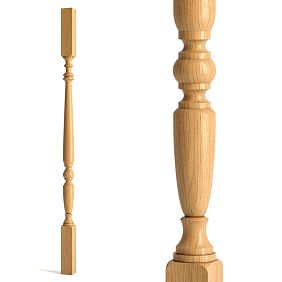
Proportions of a baluster determine its visual weight. A massive baluster with a wide base and thick central element creates an impression of solidity, reliability, and tradition. Suchwooden balusters for staircasesare characteristic of classical interiors, where monumentality and respectability are valued. An elegant baluster with a slender neck and graceful transitions creates the opposite impression — lightness, airiness, refinement. It suits modern spaces where minimalism and functionality dominate.
The spacing rhythm of balusters affects the visual density of the railing. Frequent placement with a 100-120 millimeter step creates an impression of a dense barrier, almost a continuous surface, interrupted only by narrow gaps. This enhances the feeling of protection and safety, but visually weighs down the structure. More sparse placement (which is permissible only when complying with regulations, for example, when using additional horizontal elements) creates an impression of openness, transparency, lightness.
The profile of a baluster is an artistic expression in material. Polished forms with smooth transitions, spheres, barrels, and cones — the language of classical architecture, tested over centuries. Each element of a polished profile has its own name and meaning: the base ensures stability, the central body creates volume, the neck adds elegance, the finial completes the composition.Wooden balustersBalusters with a classical polished profile never go out of style — they are universal, harmonious, suitable for interiors of different styles.
Carving turns a baluster into a sculpture. Botanical ornaments — grapevines, oak leaves, roses — create a romantic, natural atmosphere. Geometric patterns — meanders, braids, diamonds — add strictness and rhythm. Figurative carving — lion heads, bird wings, human figures — turns the staircase into an artistic object. Carved balusters require the highest level of craftsmanship and appropriate surroundings — in a minimalist interior, they will appear out of place.
Material determines not only physical characteristics but also aesthetic impression. Oak balusters with pronounced texture, dark tone, and sense of massiveness create an atmosphere of solidity and prestige. Pine balusters of light tone with soft texture and natural resin inclusions suit interiors in country, Provence, and Scandinavian styles. Painted balusters in white, black, or any other color allow integrating the staircase into the interior color scheme, creating contrasts or harmony.
Combination with other staircase elements is critical for overall aesthetics. Balusters must harmonize with support posts in style, material, and color. The handrail must correspond to balusters in scale and finish character. Steps and risers must support the overall stylistic unity.staircase componentsare selected as a unified system, where each element complements the other.




Safety: when regulations are written in blood
Behind every figure in building codes stand real stories of injuries, analyses of accident causes, studies of human behavior on stairs. Safety of the staircase railing is not an abstract concept, but specific parameters, each of which is justified and critical.
Railing height is determined by human anthropometry and biomechanics of falling. The minimum height of 900 millimeters from the step surface to the top of the handrail is established for residential and public buildings. This figure corresponds to approximately the level of the thigh of an average-height adult. When losing balance, a person instinctively lowers their center of gravity and leans on the railing. A height of 900 millimeters allows effectively grasping the handrail and preventing a fall. For childcare facilities, the regulation increases to 1200 millimeters — children are more mobile, less stable, and more often lean on the railing with their entire body.
In private homes, a height of 1000-1100 millimeters is often used — this provides additional safety margin and is more comfortable for tall people.wooden balustersare manufactured taking into account the required railing height — usually 850-900 millimeters for the posts themselves plus 40-50 millimeters of handrail thickness.
The baluster spacing — the distance between adjacent posts — is critical for preventing falls. Regulations establish a maximum distance of 120 millimeters for residential buildings. This distance is calculated so that a spherical object with a diameter of 107 millimeters — approximately the size of a baby’s head — cannot pass through the gap. For childcare facilities, the regulation is stricter at 100 millimeters, which prevents even the smallest child from getting stuck.
These regulations are not recommendations, but mandatory requirements. Violating baluster spacing creates a real risk of injury, especially for children. A child may attempt to crawl between balusters, get stuck, suffer an injury, or in the worst case, fall through completely and fall from height. Domestic animals may also fall through too wide gaps.
The calculation of the number of balusters is based on baluster spacing and the width of the posts themselves. If the baluster width is 50 millimeters and the required gap is 100 millimeters, the installation step (distance from the center of one baluster to the center of the next) will be 150 millimeters. On a straight run 3 meters long, approximately 20 balusters plus two support posts at the ends of the run will be required.
The strength of the railing is determined by its ability to withstand horizontal load. Regulations require the railing to withstand a minimum of 30 kilograms per linear meter, applied horizontally at the handrail level. This simulates a situation where a person leans on the railing after running or a crowd presses against the railing. Each individual baluster must withstand a minimum of 100 kilograms of horizontal load without damaging the fastening.
are ensured by several factors: quality of wood (hardwoods are stronger than softwoods), baluster cross-section (thicker posts are stronger than thinner ones), method of fastening (deep connections with dowels or bolts are stronger than surface connections with screws), frequency of installation (the more frequently balusters are installed, the better they support each other).Oak balustersensure maximum strength due to the hardness and density of the wood.
Child safety: double attention to details
Our factory also produces:


Children use stairs differently than adults. They run across steps, jump over them, slide down railings, and poke their heads between balusters out of curiosity. Child safety requires a special approach to staircase railing design and installation.
Reduced baluster spacing — the first and most important requirement. In homes where children under 7 years old live, balusters should be installed with a spacing of no more than 100 millimeters between posts. This prevents children’s heads from getting stuck and their bodies from falling through. Even if residential building norms allow 120 millimeters, it is wiser to be cautious and reduce the distance.
Additional handrails at child height — the second important requirement. A standard handrail at 900 millimeters is too high for a child who is 100–120 centimeters tall. The child cannot grasp it or get support while climbing. An additional child handrail is installed at 500–600 millimeters from the steps. It is attached to the same balusters as the main handrail, creating a two-level support system.
Absence of sharp elements is critical for child safety. Children often grip balusters, slide down them with their hands, or may hit them during a fall. All baluster elements must be carefully sanded, sharp edges rounded, protruding parts removed or protected. Carved elements must be treated especially carefully — no splinters, chips, or sharp edges.
Additional protective elements are sometimes necessary. If the staircase design makes it impossible to reduce baluster spacing to a safe level (for example, on spiral staircases with turning steps), additional measures are used: transparent panels made of tempered glass or polycarbonate between balusters, strong mesh, or horizontal boards creating an additional barrier.
Protective caps on handrails prevent injuries during sliding. Children love sliding down railings — this is a fact that must be accepted and secured. A smooth varnished handrail is slippery and may lead to a fall. The handrail should have a matte or semi-matte surface with good friction coefficient. The handrail shape should be comfortable for a child’s hand — an 80–100 millimeter grip is optimal.
Visual safety is also important. The staircase should be well-lit — children often don’t notice steps in dim light. Contrasting coloring of balusters and steps helps visually distinguish structural elements. Some use illuminated elements or lighting for additional safety during nighttime.
Installation norms: technology of correct installation
Get Consultation
Baluster installation — a process where measurement accuracy and connection quality determine safety for decades to come. Norms establish not only parameters of the finished structure but also requirements for installation technology.
Marking — the first and critically important stage. Points for baluster installation are marked on steps or the handrail support. All points must lie on a straight line parallel to the step edge, at a distance of 30–50 millimeters from it. The offset from the edge is necessary to ensure strong connection — too close to the edge may cause the step to crack. Marking is done using a taut string, laser level, or guide board.
Distance between points corresponds to the calculated installation spacing. It is critically important that all distances are equal with precision to 2–3 millimeters. Uneven spacing is immediately noticeable, creates an impression of poor workmanship, and most importantly — may lead to exceeding the allowable gap in certain areas.
Baluster preparation includes cutting ends at the required angle. If balusters are installed on a sloped staircase, the lower end is cut at an angle equal to the staircase’s slope. The upper end is also cut for tight fitting against the sloped handrail. Cutting is done with a miter saw with precise angle adjustment. An error of even 1–2 degrees will result in gaps in the connection.
Methods of attaching balusters to the base vary in complexity and reliability. Baluster attachment using dowels — a traditional method providing strong, invisible connections. A hole 40–50 millimeters deep is drilled into the step, and the same depth into the baluster. A wooden dowel 8–10 millimeters in diameter is coated with glue and driven in, connecting the baluster to the step. This method requires high drilling precision — the holes must be perfectly aligned.
Baluster attachment using screws — a simpler and faster method. A hole is pre-drilled into the step and a plastic anchor is installed. A hole is drilled into the baluster for the screw. The baluster is placed in position, aligned vertically with a level, and screwed from below. The screw head is pressed into the wood and covered with a decorative cap or filled with putty. This method allows adjusting the baluster position until final tightening.
Baluster attachment using metal brackets — a modern solution for precise and adjustable installation. A metal bracket with a threaded pin is screwed into the step. A thread is cut into the baluster or a threaded bushing is installed. The baluster is screwed onto the pin, allowing height adjustment to the millimeter. This method ensures maximum strength and allows disassembly without damaging components.
Verticality of each baluster must be checked. Even a slight tilt of several balusters will create a visual impression of curvature in the entire railing. Each baluster is checked with a construction level in two planes — along the staircase and across. Deviation exceeding 1–2 millimeters at a height of 900 millimeters is unacceptable.
Installation of support posts precedes installation of intermediate balusters. Support posts (newels) are installed at the beginning and end of each flight, at turns, and on landings. They have a larger cross-section (usually 80×80 or 100×100 millimeters) and bear the main load. Support posts are secured especially securely — with bolts through the step or using metal anchor plates. The accuracy of support post installation determines the geometry of the entire railing.
Handrail installation completes the railing assembly. The handrail must lie tightly on the upper ends of all balusters. If balusters are installed correctly — strictly vertically and at the same height — the handrail will lie perfectly. The handrail is attached to balusters from below with screws or from above with subsequent filling of connection points with putty. At joints, the handrail is connected at a 45-degree angle or using special connecting elements.
Final finishing includes filling all connection points with putty, sanding, and applying protective-decorative coatings. If elements were not coated before installation, the entire baluster and handrail system is treated after installation. High-wear-resistant varnishes, oil-wax for natural finish, or paints for color change are used. Special attention is paid to end cuts and connection points — they must be sealed to prevent moisture penetration.
After completion of installation, a thorough check of all safety and quality parameters is required. Visual inspection reveals obvious defects: uneven baluster spacing, deviations from verticality, gaps in connections, coating defects. Each baluster is inspected individually, special attention is paid to connection points and joints with the handrail.
Installation Quality Check
Strength check is performed physically. Each baluster is checked by pressing and rocking — it must not wobble, squeak, or have play. The handrail is checked by pressing down and sideways — it must not bend or detach from balusters. The entire railing is checked by simulating real load — strong pressure at handrail level. If any unstable baluster is found — immediate reinforcement is required.
Measurement of baluster gaps is done with a tape measure or template. Each gap must be within normative 120 millimeters (or 100 millimeters for child facilities). Exceeding even by a few millimeters is unacceptable — additional balusters must be added or the installation spacing corrected.
Height check of the railing is performed at several points along the flight length. Height is measured from the step surface to the top of the handrail and must be at least 900 millimeters. Due to possible step unevenness, height may vary slightly, but it must not be below the norm at any point.
Functional check includes actual use of the staircase. One must climb up and down several times, holding the handrail, assessing grip comfort, absence of sharp elements, and movement comfort. The handrail must feel pleasant to the touch, smooth, without splinters or roughness. The railing must convey a sense of safety and reliability.
Staircase railing requires regular maintenance and periodic condition checks. Daily cleaning includes wiping the handrail and balusters with a slightly damp cloth to remove dust. The handrail — being a surface constantly touched by hands — requires cleanliness not only for aesthetic but also for hygiene reasons.
Operation and Maintenance
Weekly cleaning is more thorough — using special wood cleaning agents that not only clean but also nourish the wood and preserve the finish. Special attention is paid to recessed areas of carved or profiled sections — dust accumulates there and must be removed with a soft brush or vacuum cleaner.
Monthly strength check — mandatory safety procedure. Each baluster must be checked for absence of play, and listened for squeaks under pressure. Any signs of weakened connection require immediate intervention — tightening fasteners, adding glue, replacing damaged elements.
Annual preventive maintenance includes inspection of all railing elements for cracks, chips, and coating wear. The handrail in areas of frequent contact may wear — the finish dulls, roughness appears. Such areas require coating renewal — sanding and reapplying varnish or oil.
Annual preventive maintenance includes inspection of all railing elements for cracks, chips, and coating wear. The handrail in areas of frequent contact may wear — the finish dulls, roughness appears. Such areas require coating renewal — sanding and reapplying varnish or oil.
The coating is updated as needed, typically every 5-10 years depending on usage intensity and coating type. Lacquered coating requires complete removal of old lacquer, sanding, and application of new coating. Oil-based coating is easier to refresh — the surface is lightly sanded and re-oiled.
Damage repair must be done immediately. A cracked baluster is a safety hazard, as it cannot withstand calculated load. Small cracks that do not compromise cross-section integrity may be glued. Deep cracks, chips, and splits require replacement of the baluster.buy balusters for the staircaseReplacement must be with the exact same profile, size, and wood species; otherwise, the replacement will be noticeable.
Typical installation mistakes
Insufficient number of balusters is the most dangerous error. Attempting to save money or believing that sparse balusters look more elegant, some install them with excessive spacing. Result — violation of safety norms, risk of injury, and issues during building inspection.
Uneven baluster spacing creates visual chaos and may lead to local exceedance of allowable spacing. Usually caused by careless marking or attempting to 'fit' the number of balusters to existing steps without precise calculation.
Deviation from vertical even by a few degrees is immediately noticeable. Slanted balusters create an impression of curvature and unprofessionalism, triggering subconscious feelings of unreliability. Cause — failure to check level during installation or installation on uneven steps without compensation.
Weak fastening — a hidden threat. Visually everything appears normal, but during inspection, play or wobbling balusters are detected. Causes: insufficient fastening depth, use of weak fasteners, absence of glue in mortise joints, fastening too close to step edge.
Non-compliance with guardrail height regulations — a gross violation. Sometimes short balusters are used or installed with offset from step edge, reducing final guardrail height. Result — guardrails below 900 millimeters do not provide required safety.
Sharp elements and poor finishing — sources of injury. Un-sanded balusters with splinters, sharp edges, or chips pose danger, especially for children. Finishing quality must be perfect — surface silky smooth, all edges rounded, no defects.
Conclusion
Balusters for staircaseBalusters are elements where aesthetics and safety exist in inseparable unity. Beautiful balusters installed in violation of regulations are dangerous. Strong balusters that do not match interior style spoil visual impression. Only combination of proper design, quality materials, and professional installation creates stair railings that serve for decades, ensuring safety and pleasing the eye.
Installation norms — not bureaucratic formalities, but concentration of experience and knowledge. 120 mm baluster spacing, 900 mm guardrail height, 30 kg/m strength — each figure is justified and critical. Compliance is mandatory not only formally, but morally — it is responsibility for people’s safety, especially children’s.
Child safety requires special attention. Reduced baluster spacing, additional child handrails, absence of sharp elements, additional protective measures — all this transforms stairs into a safe space for the most vulnerable family members.
Quality installation — guarantee of longevity and safety. Precise marking, correct end trimming, secure fastening, verticality check, finishing — each stage requires attention and professionalism. Cutting corners on installation quality leads to problems during operation.
STAVROS produces a full range ofbalusters for wooden staircases— from simple turned to complex carved, in various wood species, sizes, and styles. All items meet safety requirements, made from dry wood (moisture 8-10%), and undergo multi-stage quality control.
In addition to balusters, at STAVROS you will find allcomponents for wooden staircases: support posts, handrails, baluster supports, steps, landings — everything for turnkey staircase construction. Consultants will help calculate the number of elements, select the style, and organize delivery.
Choosing STAVROS means choosing safety confirmed by compliance with all regulations. Choosing quality verified by multi-stage control. Choosing beauty crafted by experienced masters. Because a staircase is not just a path between floors. It is a home element that must be flawless in everything — from aesthetics to safety.