












































































Article Contents:
- What Makes Up a Stair Railing: The Role of Balusters and Posts
- Railing Anatomy: Five Elements
- Loads and Responsibility of Elements
- Types of Wooden Balusters: From Lathe to Chisel
- Turned Balusters: Classic Production Quality
- Carved Balusters: Artistic Expression
- Square (Rectilinear) Balusters: Modern Minimalism
- Flat Balusters (Milled Overlays): A Special Genre
- Combined Balusters: Metal + Wood
- How to Calculate the Quantity and Installation Spacing of Balusters: A Foolproof Method
- Method 1: "One Baluster per Step"
- Method 2: "Two Balusters per Step"
- Method 3: "By Fixed Spacing"
- Reserve
- Gap Standards for Safety
- Support Post Calculation
- Baluster Price: What Determines the Cost
- Factor 1: Wood Species
- Factor 2: Profile Complexity
- Factor 3: Processing Category — "Standard" or "Prestige"
- Real Prices for STAVROS Balusters
- Typical Budget for Balusters for a Two-Flight Staircase
- Compatibility of Posts and Handrails: How to Assemble a Complete Set
- Rule of Uniform Wood Species
- Rule of Uniform Style
- Support Posts: Matching the Balusters
- Dimensional Compatibility
- Balustrade as an Architectural Ensemble
- Balusters for Terraces and Outdoor Stairs: A Separate Topic
- Wood Species for Outdoors: Oak is a Priority
- Protective coating for outdoor balusters
- Baluster mounting on a terrace
- How to choose balusters correctly: a practical guide
- FAQ: answers to the most frequently asked questions
- STAVROS: wooden balusters for stairs — over 50 models

A staircase doesn't begin with a step. It begins with the first glance at the railing. You look up — and see either an expressive row of wooden posts leading the eye upward, or metal rods sticking out of the handrail like a forgotten palisade. The difference isn't in price. The difference is in understanding what exactly you are building.
balusters and postsWooden balusters are not just 'safety elements,' as they are sometimes called in construction estimates. They are the rhythm of the staircase. They are its character, its signature. And if you are currently at the selection stage — this article will give you a complete frame of reference: types of balusters, calculation of quantity and spacing, pricing, compatibility with handrails and posts, real prices from the catalog.


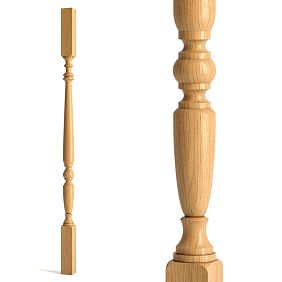
What a stair railing consists of: the role of balusters and posts
A stair railing is a system. Each part in it has its own task, and replacing one element with another without understanding this task inevitably leads to problems: structural or aesthetic.




Anatomy of a railing: five elements
1. Support posts (newel posts) — load-bearing vertical elements that take the horizontal load from the entire railing structure. They are installed at the beginning and end of each flight, at turns, and on landings. The cross-section of a support post is 100×100 mm or more. Mounting — exclusively via a metal anchor or threaded rod into the step or floor slab. The support post holds the entire system — it is the anchor.
2. Balusters (intermediate posts) — vertical decorative elements of the railing between support posts. They carry limited load — they work in bending under lateral impact, but are not load-bearing for the handrail to the same extent as a post. This is important to understand: if there are children in the house who occasionally 'hang' on the handrails, the load is primarily taken by the posts.
3. Handrail (railing) — a horizontal or inclined profiled element that the hand holds onto when ascending and descending. It connects the system at the top, resting on support posts and balusters.
4. Baluster shoe (bottom rail) — a lower horizontal strip that receives the lower ends of the balusters. Used when mounting on a horizontal step surface — simplifies alignment and hides the fasteners.
5. Turning elements — 'gooseneck,' 'handrail volute,' 'turn' — elements that provide the transition of the handrail from an inclined flight to a horizontal landing and back.
Our factory also produces:


Loads and responsibility of elements
A common installation mistake: all loads are distributed evenly among the balusters, while the posts are mounted 'as it comes.' In practice, it's the opposite: a support post takes on average 70–80% of the horizontal load from the handrail; balusters take the remaining 20–30% as impact load.
If a support post is poorly secured — the railing 'wobbles' even with perfectly installed balusters. If the balusters are installed incorrectly — the railing is unsafe for children, even with a rigid post. The system only works as a whole.
Get Consultation
Types of wooden balusters: from lathe to chisel
The market for wooden stair balusters offers several fundamentally different structural and artistic types. Understanding their differences is the key to making the right choice.
Turned balusters: the classic of production quality
A turned baluster is the result of processing a blank on a CNC lathe. This is the most common type: standardized, affordable, universal.
The shape of a turned baluster is a variable profile along its height: base (a square or rectangular block for mounting), transition cone, 'body' with a sequence of geometric elements (balls, cylinders, barrels, spools, necks), upper transition cone, upper base.
It is precisely the combination of geometric shapes in the body of the baluster that determines its artistic character:
-
Simple 'barrel' — laconic, universal, classic
-
Complex profile with several barrels and balls — rich, for classic interiors
-
'Elongated' baluster with vertical accents — dynamic, for high-ceilinged rooms
Standard sizes of turned balusters from the STAVROS catalog: height — 900, 970, 1000 mm; lower base — 45×45, 50×50, 60×60, 80×80 mm. All products are supplied with white acrylic primer.
Carved balusters: an artistic statement
A carved baluster is created by 3D milling (processing on a multi-axis CNC milling machine) or by hand carving — in author's and one-off pieces. This is a fundamentally different level of detail: an acanthus leaf in the body of the baluster, flutes (vertical grooves along the entire height), Baroque scrolls, laurel leaves, ornamental bands.
A carved baluster creates a sense of handcraftedness. Even if made on a milling machine, the lively relief that creates a play of shadows is perceived as handwork. Carved balusters are used in country mansions with classic interiors, in houses in Provencal or Renaissance style, and in historical buildings.
Carvedwooden handrails and balustersSTAVROS encompasses styles: Baroque, Empire, Classicism, Neo-Renaissance, Art Nouveau. Each style has its own system of forms and its own sense of space.
Square (rectilinear) balusters: modern minimalism
A square baluster has a rectangular or square cross-section along its entire height. No variable profile, no rounded elements. Sometimes with chamfers on the corners to soften the geometry.
This is the choice for minimalist, Scandinavian, 'industrial' interiors, where the smooth forms of a classic baluster would stand out from the overall system.
Square balusters pair well with metal staircase components: metal stringers, steps with visible metal bases. Cross-section: 40×40, 45×45, 50×50 mm.
Flat balusters (milled overlays): a special genre
A flat baluster is not a turned product, but a milled flat component. Used in staircases with a stringer (closed side), where the railing is mounted into grooves in the stringer. The profile of a flat baluster is only visible from the front side—unlike turned ones, which are visible from all sides.
Flat balusters allow for creating patterned 'lattice' railings—as in the Classicism era, when stair stringers were decorated with alternating flat carved posts.
Combined balusters: metal + wood
A separate category—balusters with a metal core and a wooden decorative casing. The metal provides structural strength, the wood provides aesthetics. Used in non-standard constructions where strength requirements are higher than usual.
How to calculate the quantity and installation spacing of balusters: an error-free methodology
Calculation is what any real purchase starts with. An error in calculation means either downtime during installation while waiting for delivery of missing balusters, or excess leftovers in stock.
Method 1: 'one baluster per step'
The simplest and applicable in most projects. One baluster per step, centered or closer to the front edge. Spacing between balusters along the axis ≈ tread width ÷ 1 = 250–290 mm.
Clear gap between balusters with a 45 mm cross-section and 270 mm spacing: 270 − 45 = 225 mm. This is large—does not meet safety standards for homes with children.
Method 2: 'two balusters per step'
Two balusters per step, symmetrically across the width. Spacing between balusters along the axis ≈ tread ÷ 2 = 125–145 mm. Gap with a 45 mm cross-section: 130 − 45 = 85 mm—safe for children.
This is the standard for family homes.
Method 3: 'by fixed spacing'
A fixed spacing for baluster placement along the axis is set—120, 140, or 160 mm. Number of balusters:
K = (L − d_post × 2) ÷ t
where L is the horizontal length of the flight, d_post is the width of the support post, t is the spacing along the axis.
Example: L = 3200 mm, d_post = 100 mm, t = 140 mm.
K = (3200 − 100 × 2) ÷ 140 = 3000 ÷ 140 ≈ 21 balusters + rounding up.
Reserve
Add 10% to the calculated quantity. This accounts for trimming (balusters near turning posts sometimes require shortening), possible installation defects, and replacement reserve.
Gap standards for safety
-
Maximum clear gap between balusters: 120 mm—general standard
-
For premises with children under 3 years: 80 mm
-
Industrial and public facilities: 100 mm
Calculation of support posts
Number of support posts = (N flights × 2) + N turns + N intermediate. For a two-flight staircase with one landing: 2 × 2 + 1 = 5 posts minimum.
Baluster price: what determines the cost
The price range for wooden stair balusters in the STAVROS catalog is from 1,760 rubles to 7,310 rubles per piece. This is a significant spread, and understanding it helps form the correct budget.
Factor 1: wood species
This is the main pricing factor. A baluster made of pine and a baluster made of oak with the same profile can differ in price by 1.5–2 times.
-
Pine is the most affordable species. Density 380–550 kg/m³, soft, easy to work with. A good option for dachas, temporary housing, interiors with subsequent painting using 'opaque' paints.
-
Beech – density 630–720 kg/m³, uniform structure, ideal for turning and milling. Takes stains and varnish of any color well. Optimal price/quality ratio.
-
Oak – density 650–750 kg/m³, Brinell hardness 3.7–4.0 HB. The benchmark for strength. Expressive texture with characteristic medullary rays. The most expensive species. For grand and representative staircases.
-
Ash – characteristics similar to oak, slightly lighter, with pronounced grain. Aesthetically closer to modern interiors.
Factor 2: profile complexity
A turned baluster with a simple profile and one 'barrel' – faster to produce, cheaper. A complex profile with several heterogeneous elements – more machine time, more expensive.
A carved baluster with flutes or an acanthus leaf – even more expensive, as it requires multi-axis milling or manual labor.
Factor 3: processing category – 'Standard' or 'Prestige'
STAVROS offers two levels of finish processing:
-
'Standard' – quality sanding, white acrylic primer, ready for final painting or varnishing
-
'Prestige' – additional fine sanding, improved surface cleanliness, more thorough detailing of the relief
Real prices for STAVROS balusters
| Article | Price from | Characteristic |
|---|---|---|
| L-019 | 1 760 р. | Entry-level position, simple profile |
| L-020 | 2 220 р. | Classic entry-level profile |
| L-056 | 2 860 р. | Turned, medium detail |
| L-021 | 2 880 р. | Turned, symmetrical profile |
| L-097 | 3 000 р. | Turned with reinforced base |
| L-117 | 3 340 р. | Turned, expanded profile |
| L-118 | 3 390 р. | Round baluster |
| L-099.1 | 3 980 р. | Mid-price segment |
| L-054 | 3 980 р. | Turned with volumetric body |
| L-052 | 4 520 р. | Complex profile |
| L-049 | 4 790 р. | Classic mid-range profile |
| L-045 | 4 860 р. | Volumetric body with details |
| L-038 | 4 900 р. | Carving elements |
| L-050 | 4 910 р. | Turned complex profile |
| L-026 | 5 170 р. | High detail |
| L-047 | 5 280 р. | Carved series |
| L-032 | 5 280 р. | Ornamental baluster |
| L-048 | 5 300 р. | Complex carved profile |
| L-095 | 5 300 р. | Representative series |
| L-037 | 5 310 р. | Milled ornament |
| L-024 | 5 310 р. | High-end classic |
| L-111 | 5 850 р. | Carved with accents |
| L-014 | 5 850 р. | Detailed profile |
| L-027 | 6 100 р. | "Prestige" series |
| L-002 | 6 100 р. | Representative series |
| L-041 | 6 230 р. | Figural baluster |
| L-025 | 6 370 р. | Parade series |
| L-046 | 6 380 р. | Carved, high detail |
| L-028 | 6 490 р. | Historical style |
| L-030 | 7 310 р. | Maximum detail |
Typical baluster budget for a two-flight staircase
Two-flight staircase with landing. Parameters: 12 steps per flight, 2 balusters per step = 48 balusters + 10% reserve = 53 balusters.
-
Budget option (L-019, 1,760 rub.): 53 × 1,760 = 93,280 rub.
-
Mid-range (L-049, 4,790 rub.): 53 × 4,790 = 253,870 rub.
-
High-end (L-030, 7,310 rub.): 53 × 7,310 = 387,430 rub.
This is only for balusters. Support posts, handrails, and accessories are calculated separately.
Post and railing compatibility: how to assemble a complete set
Wooden balusters and railingsshould be perceived as a unified system, not as a set of randomly selected parts. This requirement is both aesthetic (style unity) and structural (size compatibility).
Rule of uniform wood species
All wooden railing elements—balusters, posts, handrails—must be made from the same wood species. Oak and beech have different textures and colors: even with identical staining, the differences are noticeable.
If the balusters are oak, the handrail must also be oak. Exception—painting with 'opaque' paints (enamel, acrylic): then the wood species is hidden and mixing is acceptable.
Rule of uniform style
A classic turned baluster with a pronounced Baroque profile—and a geometric rectangular handrail: dissonance. The handrail shape must match the character of the baluster. Turned balusters—oval or D-shaped handrail. Square balusters—rectangular or square handrail. Carved balusters with ornament—handrail with a figured profile.
Support posts: compatibility with balusters
A support post should visually 'set the tone' for the entire railing: it is larger than the balusters, taller (with a finial), and catches the eye first. Mismatch in size and style between the post and balusters is the most common aesthetic mistake.
STAVROSbalusters and postsSelected from unified style series — this eliminates incompatibility when purchasing within the same series.
Dimensional compatibility
The handrail attaches to the top ends of the balusters. The width of the handrail must be no less than the width of the baluster's top base. If the baluster base is 45×45 mm — a 40 mm wide handrail will not provide proper support contact.
Standard handrail for balusters with a 45 mm base — width 55–70 mm. For balusters with a 60 mm base — handrail 70–80 mm.
Balustrade as an architectural ensemble
The term 'balustrade' refers precisely to the complete ensemble: support posts + balusters + handrail.Buy a balustradeas a single kit — the optimal solution: all elements from the same batch, same wood species, same tone.
STAVROS offers turnkey balustrade configuration: support posts, balusters, handrail, sub-baluster rail, turning elements — everything is calculated and ordered as one kit with the help of a manager.
Balusters for terraces and outdoor stairs: a separate topic
An outdoor staircase involves fundamentally different operating conditions. Moisture, frost, direct sunlight, temperature fluctuations. Not all wooden balusters are suitable for outdoor use — wood species and protective coating must be considered.
Wood species for outdoors: oak is the priority
Oak contains natural tannins that inhibit the development of rot fungi. This makes oak the most durable species for outdoor use among all domestically available options. Beech — less resistant to moisture, not recommended for uncovered terraces. Pine — applicable when treated with special preservative impregnations, but requires regular maintenance every 2–3 years.
Protective coating for outdoor balusters
Wood outdoors requires a coating that protects against UV radiation and moisture. Exterior oil (teak, linseed with added natural resins) — a traditional choice. Exterior acrylic varnish with UV filter — a modern option. Alkyd stain with varnish — good protection when applied correctly.
Coating renewal frequency: oil — every 2–3 years; varnish — every 5–7 years (provided the film integrity is maintained).
Attaching balusters on a terrace
On a terrace, balusters are attached not to a wooden step, but to the horizontal joists of the decking. Dowel or bolt connection — must be made of stainless steel: galvanized fasteners rust outdoors and stain the wood.
How to choose balusters correctly: a practical guide
Six questions to answer before purchasing:
1. Interior style? Classic — turned with a voluminous profile or carved. Modern classic — turned with a concise profile. Minimalism — square or round with a simple profile.
2. Wood species? Oak — for grand staircases and outdoors. Beech — for interiors with subsequent tinting. Pine — for budget projects and country houses.
3. Finish coating — open grain or painting? If the wood will be visible — the color and grain of the specific species are important. If the balusters will be painted with enamel — the species is less important aesthetically.
4. Quantity? Calculate using the method above. Add a 10% reserve.
5. Size? Standard height 900–970 mm. Lower base — according to your attachment method (dowel — for 22–24 mm; dowel pin — for a metal sleeve).
6. Processing category? 'Standard' for self-finishing. 'Prestige' for professional painting or varnishing.
FAQ: answers to the most frequently asked questions
Can turned and carved balusters be mixed on one staircase?
Technically — yes. Aesthetically — caution is needed. One technique: support posts — carved, balusters — simple turned. This contrast works if the difference in profile complexity is not too great.
How to calculate baluster height considering the flight slope?
A standard baluster 900–970 mm is designed for an inclined flight. The top end of the baluster is cut at the angle of the flight's incline, the bottom end is perpendicular to the tread. The cut angle = the flight's incline angle (typically 30–45°).
How to fasten a wooden baluster to a wooden tread?
Three main methods: dowel (wooden cylindrical rod Ø18–22 mm, PVA glue); M8 threaded rod with threads on both ends (one end into the tread, the other into the baluster); mounting bracket from below (concealed fastener).
Is it necessary to treat balusters with antiseptic?
In heated residential premises with normal humidity — varnish or oil is sufficient. For terraces, verandas, open stairs — antiseptic-preservative is mandatory before the final coating.
How long do wooden balusters last indoors?
Oak and beech balusters under normal operating conditions last 50 years or more. Pine — 20–30 years with periodic coating renewal.
Is it possible to order balusters of non-standard height?
STAVROS offers custom orders for non-standard sizes with a minimum quantity of 20–30 pieces. The standard height of series-produced balusters is 900–970 mm.
What is the difference between wooden railings and balusters?
In common usage, 'railings' refers to the entire ensemble of the guard (balusters + posts + handrail). In technical terminology, 'railings' = handrail. 'Balusters' are the intermediate vertical posts. Clear distinction is important when ordering specific components.
What do wooden balusters look like in photos before purchase?
STAVROS provides on its website over 60 visualizations and photos of finished stairs with balusters from different series — to evaluate the result in the context of a real interior solution.
STAVROS: wooden balusters for stairs — over 50 models
When a staircase is built once and for all — the cost of an error in choosing components is too high. An ugly baluster in the wrong place — is visible every day. A flimsy guard — is frightening when children are nearby.
STAVROS has been operating since 2002. In the catalog ofwooden balusters for stairs— over 50 models in the range from 1,760 to 7,310 rubles per piece. Material — solid oak, beech, pine from our own production. Tolerances during turning — ±0.2 mm. Two levels of finishing: 'Standard' and 'Prestige'. White acrylic primer — on every product.
For a comprehensive project:wooden handrails and balustersthey are supplementeda full set of stair components— treads, risers, handrails, turning elements — all from one production line, all from one material, all in one tone.
Delivery across Russia and CIS. Individual calculation of a kit based on your staircase parameters. Packaging with corrugated cardboard, bubble wrap, and stretch film — for complete safety during transportation over any distance.
A staircase with the right balusters — is not 'just another element of renovation'. It's something you look at every day with pleasure. STAVROS helps you get that pleasure.


