












































































Article Contents:
- Wood species: when the name determines half the cost
- Profile complexity: when shape costs more than material
- Size matters: how dimensions affect cost
- Order volume: when quantity lowers the unit price
- Finish treatment: when coating costs more than wood
- Logistics: when delivery costs more than the product
- Seasonality: when the season affects your wallet
- Brand and reputation: overpayment or quality guarantee
- Frequently Asked Questions
- Conclusion

Price. This word comes first when talking about buying balusters. How much does it cost? Why is it so expensive? Can it be cheaper? These are understandable, logical, important questions. But incomplete. Because the question isn't how much a baluster costs — the question is what you're paying for and what you're getting in return.
which vary from 250 rubles for the simplest pine to 15,000 rubles for an exclusive carved oak — these are not just elements of stair railings. They are embodied time, craftsmanship, technology, and wood quality. An inexpensive baluster may be made from inadequately dried pine with large knots, roughly processed on an old lathe, and coated with a single layer of cheap varnish. In half a year, it will crack, warp, and the varnish will flake off. An expensive baluster is made from properly dried, high-grade oak, precisely machined on a CNC lathe, polished to a silk-smooth finish, and coated with a quality multi-layer compound. It will last a century, retaining its original appearance.
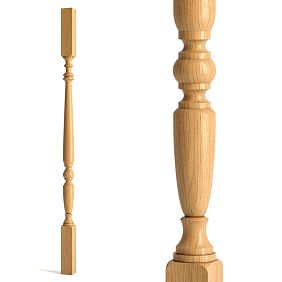
Wooden balusters pricePrices range from 250 rubles for the simplest pine baluster to 15,000 rubles for an exclusive carved oak piece — these are not just elements of stair railings. These are embodied time, craftsmanship, technology, and wood quality. An inexpensive baluster may be made from inadequately dried pine with large knots, roughly machined on an old-fashioned lathe, and coated with a single layer of cheap varnish. After half a year, it will crack, warp, and the varnish will flake off. An expensive baluster is crafted from properly dried, high-grade oak, precisely machined on a CNC lathe, polished to a silk-smooth finish, and coated with a high-quality multi-layer finish. It will last a century, retaining its original appearance.
But expensive does not always mean good, and cheap does not always mean bad. There are overpayments for brand, prestige of species, for complex decoration that no one will appreciate. There is sensible savings — choosing species based on functionality rather than fashion, simplifying the profile without losing aesthetics, doing your own finish, buying in bulk. And there is foolish savings — buying inadequately dried wood, defective items, handmade products without warranties.
This article is a detailed breakdown of what makes up the price of wooden balusters and how you can save without sacrificing quality or appearance. Understanding pricing mechanisms gives you control over your budget: you stop being a hostage to other people's decisions and start making conscious, optimal choices for your project.




Wood species: when the name determines half the cost
The first and most significant factor forming the price of a baluster is the wood species from which it is made. The price range between species is enormous: from 1:2 to 1:10 depending on specific types. A standard-sized pine baluster (50×50×900 mm) costs 280-400 rubles. An oak baluster of the same size — 1000-1500 rubles. From exotic wenge or teak — 3000-5000 rubles.
Why such a difference? It's not due to collusion among manufacturers or market caprice. It's due to objective wood characteristics that determine its cost at every stage — from logging to the finished product.
Growth rate of the tree. Pine grows quickly — a tree reaches commercial maturity in 40-60 years, suitable for logging. Oak grows slowly — full commercial timber takes 80-120 years. This means oak forests require twice as much time to regenerate, and the land beneath them is "frozen" for decades longer. This is factored into the raw material cost.
Availability of raw material. Pine grows widely in the middle belt and northern regions of Russia, its reserves are enormous, logging is well-established, logistics are optimized. Oak grows in limited regions, its reserves are smaller, many oak groves are protected as natural monuments. Exotic species like teak or merbau grow only in tropical regions, requiring imports with corresponding customs duties and logistics costs.
Density and hardness. Pine is soft, density 450-500 kg/m³, easily cut with standard tools, processing is fast, energy consumption is low. Oak is dense, 700-800 kg/m³, hard (3.7-4.1 on Brinell), requires powerful equipment, hard metal tools, slow feed rate. Cutting tools wear out much faster when working with oak, energy consumption is higher, processing time is longer. All of this is factored into the cost.
Drying. Pine dries relatively quickly and easily — kiln drying to 8-10% moisture takes 7-14 days. Oak dries slowly and capriciously — requires 3-4 weeks under strict regime control, otherwise the wood will crack. Longer drying means higher energy consumption, longer capital tied up in raw material, larger drying capacity needed. This is also included in the price.
Yield of good material. From a pine log, the yield of suitable wood for balusters is 60-70% — knots are relatively few, the wood is uniform. From an oak log, the yield is lower — 50-60%, since defective areas, large knots, internal cracks must be removed. Lower yield means the cost of raw material is distributed over a smaller volume of finished product.
Specific prices by species (for a 50×50×900 mm baluster, grade A, simple turned profile):
-
Pine: 280-400 rubles. Budget option, accessible, sufficiently strong for residential spaces, pleasant texture.
-
Spruce: 250-350 rubles. Slightly cheaper than pine, but softer, more knots, used less frequently.
-
Larch: 500-750 rubles. Coniferous species with the density of hardwoods, moisture-resistant, beautiful texture, optimal choice for demanding conditions.
-
Birch: 400-600 rubles. Light-colored, medium hardness, uniform structure, good for painting.
-
Beech: 700-900 rubles. Hard, dense, fine-grained, ideal for complex profiles, light rose color.
-
Ash: 900-1200 rubles. Hard, sticky, beautifully textured, light color, modern look.
-
Oak: 1000-1500 rubles. The strongest and most durable domestic wood, pronounced texture, classic look, an investment for centuries.
Exotic species (wenge, teak, merbau, iroko) cost 3000-7000 rubles per baluster — this is a narrow niche for exclusive projects where budget is not limited.
How to save on wood without losing quality:
Choose the wood type based on usage conditions, not prestige. For a regular staircase in a heated house, pine lasts 20-30 years — that’s sufficient. Paying extra for oak is justified if the staircase is in a mansion intended for generations, or if the interior specifically requires oak texture.
For humid areas or unheated cottages, choose larch — it’s 60-80% more expensive than pine but 40-50% cheaper than oak, and it outperforms both in moisture resistance. This is a sensible investment.
If you plan to paint with opaque paint that hides the texture, there’s no point paying extra for the beautiful oak or ash texture. Birch or pine painted will look identical to oak, saving you 50-70%.
Consider combining wood types: oak for load-bearing posts (few in number, moderate cost), balusters from more affordable beech or ash. When color is properly matched, the combination looks harmonious, saving 30-40% compared to a fully oak staircase.




Profile complexity: when shape costs more than material
The second major price component — baluster profile complexity. The variation in this parameter is no less impressive than in wood types: from 1:3 to 1:10. A simple square-section baluster with minimal processing costs 250-300 rubles (pine). A complex turned profile with multiple elements — 600-900 rubles from the same pine. An exclusive hand-carved baluster — 3000-8000 rubles.
Why such a difference? Due to time, craftsmanship, equipment complexity, tool costs, and scrap rates.
Simple profiles — square or rectangular balusters with minimal processing: rounded corners, chamfers, simple straight lines. Made on a four-sided planer in one pass, processing takes 3-5 minutes, sanding is simple, scrap is minimal. Such balusters cost the least — the processing fee added to the raw material cost is 50-100 rubles.
Standard turned profiles — balusters with classic elements: one or two spheres, cylinders, cones, simple ovals. Made on a CNC lathe according to the programmed design, processing takes 10-15 minutes, sanding requires processing all profile elements. Processing fee — 150-250 rubles added to the raw material cost.
Complex turned profiles — balusters with multiple elements: several spheres of different diameters, complex transitions, small details, asymmetric elements. Require precise machine setup, special programs, multi-stage processing. Production time 20-30 minutes, sanding labor-intensive (each oval, each transition is processed separately), higher scrap rate (risk of chipping when turning small elements). Processing fee — 300-500 rubles.
Milled profiles — balusters with elements created by milling: longitudinal grooves, fillets, geometric patterns, relief surfaces. Made on CNC milling machines, require precise positioning, special cutters, multi-pass processing. Production time depends on complexity — from 15 to 40 minutes. Processing fee — 250-600 rubles.
Carved balusters — items with hand or machine-carved elements: floral ornaments, geometric patterns, figurative elements. Hand carving is done by a master carver, takes several hours to several days depending on complexity. Machine carving on 5-axis CNC centers is faster but requires expensive equipment and complex programming. Carved baluster cost — from 2000 to 15000 rubles depending on complexity and craftsmanship.
Profile impact on sanding labor intensity is often underestimated. A simple cylindrical baluster takes 5-7 minutes to sand on a sander. A baluster with a complex profile requires 15-25 minutes of manual sanding for each oval, transition, or protrusion. Small elements are sanded with abrasive pads or even manually with sandpaper. This is pure skilled labor time, paid and included in cost.
Scrap rate increases with profile complexity. For simple balusters, scrap is 2-3% (chips on ends, minor wood defects revealed during processing). For complex turned balusters, scrap may reach 5-7% (chips on thin elements, cracks from internal stresses, defects revealed after processing). For hand carving, scrap may be 10-15% (carver errors, splitting from improper chisel movement, hidden wood defects). Scrap cost is included in the price of good product.
How to save on profile without losing aesthetics:
Assess how necessary a complex profile really is for your interior. In minimalist modern interiors, simple square-section balusters with chamfers look natural and stylish, saving 50-60% compared to complex turned profiles.
In classic interiors, choose standard turned profiles from the manufacturer’s catalog, not custom carving on order. Standard profiles are made using a proven program, quickly, with minimal scrap. Custom profiles require program creation (additional cost), test runs, and machine setup. Savings on standard profiles — 30-40%.
If you want decoration but your budget is limited, consider accent elements: a few carved balusters at key points (start of staircase, turn, upper landing), the rest — simple turned. Visually, it creates the impression of a decorated staircase, saving 60-70% compared to fully carved.
Combine technologies: main baluster body turned (fast and cheap production), decorative inserts carved (small elements that can be made faster and cheaper than carving the entire baluster). Savings compared to fully carved balusters — 40-50%, visually comparable result.
Our factory also produces:


Size matters: how dimensions affect cost
Baluster size — the third significant pricing factor. Seems simple: larger baluster — more material — higher price. But the relationship is not directly proportional; there are nuances that affect cost more than raw wood consumption.
Standard sizes — balusters with cross-sections of 40×40, 45×45, 50×50, 60×60 mm and height 900 mm. These are standard items produced in bulk. Technologies are refined, equipment is set up, supply of blanks of required cross-sections is established. These balusters have optimal price-to-quality ratio. 50×50×900 mm pine baluster — 300-400 rubles, 60×60×900 mm — 400-500 rubles.
Non-standard cross-sections — balusters 35×35, 70×70, 80×80 mm or rectangular sections like 40×60, 50×70. These sizes are produced less frequently, often require individual blank cutting, machine reconfiguration. Additional cost for non-standard — 15-30% of the price of a standard baluster of similar volume.
Increased height — balusters 1000, 1100, 1200 mm and above. Long balusters require long blanks, which are more expensive (less yield from logs, more difficult drying, higher risk of warping). Long balusters are harder to machine (vibrations, need for additional supports), higher risk of scrap. Additional cost for every 100 mm above standard 900 — approximately 10-15% of base price.
Material consumption increases with cross-section area not linearly, but quadratically. A 60×60 mm baluster has a cross-section area of 3600 mm², a 50×50 mm baluster — 2500 mm². Thus, increasing cross-section by 20% (from 50 to 60 mm) increases material consumption by 44%. But price increases slower — not by 44%, but by 25-35%, since other costs (processing, sanding, packaging) increase less significantly.
Technological limitations. Too thin balusters (less than 35 mm in diameter for turned) are brittle, high risk of breakage during processing and use. Too thick (more than 80 mm) require powerful equipment, difficult to achieve uniform drying (inside may remain moist while surface is dry). Optimum — 45-60 mm, exactly in this range production is most efficient and price is optimal.
A set of different-sized balusters is more expensive than a set of identical balusters. If the staircase requires balusters of three different heights (for different incline angles of the tread), the manufacturer will need to set up the equipment three times, produce three batches, and package in three types. Overhead costs are higher than for producing one batch. Surcharge for a mixed-size set — 10-20%.
How to save on sizes:
Use standard sizes, even if you need to trim balusters on-site. Trimming ends on-site is cheaper than ordering non-standard-height balusters. Savings — 15-25%.
Optimize the cross-section according to actual loads. For residential staircases with baluster spacing of 120-150 millimeters, a cross-section of 45×45 or 50×50 millimeters is sufficient for strength. Switching to 60×60 increases cost by 30-40% without functional necessity. Heaviness looks good in spacious interiors, while elegant balusters look better in compact spaces.
Standardize sizes across the entire staircase. If geometry allows using balusters of one height on all landings, do so. If not, try to reduce the number of sizes to a maximum of two. The fewer size variants, the lower the production costs.
Get Consultation
Order volume: when quantity reduces the price per unit
Order volume — a factor that can change the price of a baluster by 30-50% under otherwise equal conditions. Mass production is more efficient than single-unit production for many reasons: optimized equipment setup, bulk material procurement, economies of scale in logistics.
Single order (1-10 balusters) — the most expensive format. The manufacturer must set up the machine for a specific profile (takes 30-60 minutes of a skilled technician), produce a small batch (inefficient equipment loading), package (fixed packaging material costs for small quantities), and ship (logistics for small batches are expensive relative to product value). The price of a single baluster may be 40-60% higher than the same baluster in a batch of 100 units.
Small batch (10-50 balusters) — typical volume for private homes with single- or double-landing staircases. Production is already more efficient: machine setup amortizes over more units, material procurement is slightly more optimal, logistics are more reasonable. But full economies of scale are not achieved. Price is 20-30% higher than for large batches.
Medium batch (50-200 balusters) — optimal volume for most projects (country houses with several staircases, small commercial projects). Production is efficient: machine setup amortizes over the entire batch, bulk material procurement gives supplier discounts, logistics for consolidated cargo are cheaper per unit. Price approaches optimal.
Large batch (200+ balusters) — volume for commercial projects, multi-apartment buildings, construction companies. Maximum efficiency: mass production using a refined technology, maximum material discounts, minimal logistics costs per unit. Price is minimal, may be 40-50% lower than for single orders.
Mechanism of volume discount formation:
Equipment setup — fixed time costs (30-60 minutes for a technician), distributed across the number of items in the batch. For a batch of 10 items, this is 3-6 minutes per item; for a batch of 100 items — 0.3-0.6 minutes per item. The difference is tenfold.
Material procurement: the manufacturer buys timber in batches. Small batch (0.5-1 cubic meter) is purchased at retail price. Medium batch (2-5 cubic meters) — with 10-15% discount. Large batch (10+ cubic meters) — with 20-30% discount. This discount is partially passed on to the customer.
Logistics: delivery of one box with 10 balusters versus a truckload of 200 balusters differs in cost by orders of magnitude, but not by 20 times. Conditional delivery of 10 balusters — 1000 rubles (100 rubles per unit); 200 balusters — 3000 rubles (15 rubles per unit).
Overhead costs: order processing, invoice issuance, document handling, packaging, storage — all are fixed or weakly dependent on volume costs, which are more efficiently amortized over larger batches.
Typical discount system for manufacturers (baluster 50×50×900, pine, simple profile):
-
1-9 units: 400 rubles/unit (base price)
-
10-49 units: 360 rubles/unit (10% discount)
-
50-99 units: 330 rubles/unit (17.5% discount)
-
100-199 units: 300 rubles/unit (25% discount)
-
200+ units: 270 rubles/unit (32.5% discount)
How to save on volume:
If you are building a house with several staircases, order balusters for all staircases simultaneously. A consolidated order falls into a more favorable price category. Savings of 15-25% compared to separate orders.
Cooperation with neighbors or acquaintances building simultaneously. If several people need balusters of similar profile and species, a consolidated order is beneficial for everyone. Organizational complexities are offset by savings of 20-30%.
Order a reserve. If you need 85 balusters, order 100. Transitioning to a more favorable price category offsets the cost of the additional 15 balusters, plus you will have a reserve for damage or future repairs.
Consider standard profiles from continuous production, not custom design. The manufacturer produces standard profiles in large batches on the warehouse, with minimal cost, and can offer a better price. Custom profiles — always small batches to order with corresponding pricing.
Finish processing: when coating is more expensive than wood
Finish processing — coating balusters with protective and decorative compounds — can add 20% to 200% to the cost depending on the type of coating and number of layers. Baluster without coating (only sanding) — base price. Baluster with transparent lacquer in three layers — plus 25-40%. Baluster stained with patina and multi-layer lacquer — plus 80-150%. Baluster with artistic painting — plus 200-500%.
Types of finish processing and their impact on price:
Unfinished (only sanded) — the baluster is sanded and ready for the buyer to apply their own finish. Lowest price. Suitable for those willing to perform the final finishing themselves, saving 25-50% on finish costs.
Primer — application of one layer of primer that fills pores, creates a base for subsequent coating, and improves adhesion. Additional cost: 30-50 rubles per baluster. Primed balusters are ready for lacquer or paint application with minimal preparation.
Transparent lacquer (2-3 layers) — standard protective coating that preserves the natural wood color and texture. Additional cost: 100-150 rubles per baluster. Includes application of the first layer, intermediate sanding after nap removal, and application of the second and third layers.
Staining + lacquer — changing the wood color using stain or colored oil while preserving texture visibility, followed by protective transparent lacquer. Additional cost: 150-250 rubles. Additional expenses for the staining agent and its even application.
Patina + lacquer — artificial aging to create a noble worn effect, followed by lacquering. Labor-intensive process requiring experience: application of base tone, patina application, partial removal, and final lacquering. Additional cost: 250-400 rubles.
Opaque paint coating — covering the baluster with paint that hides the wood texture. Requires careful preparation (filling knots and defects, sanding), priming, and applying paint in 2-3 layers with intermediate sanding. Additional cost: 200-300 rubles.
Oil finish — application of oil or oil-based wax that penetrates wood and creates a natural matte appearance. Requires 2-3 layers with intermediate drying. Additional cost: 120-200 rubles.
Complex decorative techniques — painting, gilding, multi-color patina, crackle finish, and other artistic methods. Performed manually by a decorator, may take several hours per baluster. Additional cost: 500 to 5000 rubles depending on complexity.
Why final finishing is expensive:
Time: application of each layer takes 3-5 minutes, drying takes 4-24 hours depending on the composition. Three-layer lacquering means three application-drying cycles, spread over several days. All this time the item occupies space in production, requires monitoring, and ties up resources.
Material consumption: quality lacquers, oils, and paints cost 500-1500 rubles per liter. Consumption per baluster: 50-100 milliliters depending on size and wood porosity. Thus, the pure material cost is 25-150 rubles per baluster.
Intermediate sanding: after the first lacquer layer, the nap (microscopic fibers that absorbed lacquer and hardened) rises and must be removed with fine abrasive. This is an additional operation, 3-5 minutes of skilled labor.
Defects during application: streaks, uneven coverage, bubbles, orange peel, stuck dust — all these defects occur during manual application. Defects require resanding and reapplying or scrapping. Defect rate during final finishing is 3-5%, and its cost is included in the price of good products.
How to save on finishing without losing appearance:
Buy balusters without finish and perform final finishing yourself. This is realistic for a home handyman with minimal experience. Lacquer or oil is applied with a brush or cloth, dries, and is reapplied 2-3 times. Savings — 100-300 rubles per baluster, for a batch of 50 pieces — 5000-15000 rubles. Spend time (a couple of weekends), but save significantly.
If you need staining, use stain or colored oil yourself. This is slightly more complex than simple lacquering (even application is important), but entirely feasible. Instructions are on product packaging, and video tutorials are available online. Savings — additional 50-100 rubles per baluster.
Patina and complex decorative techniques are better entrusted to a professional. Saving on self-execution here may result in ruined balusters. However, you can save by ordering patina from a local decorator rather than the baluster manufacturer. Often, private decorators charge 20-30% less than large manufacturers.
If you plan to paint with opaque paint, there’s no point buying premium-grade balusters. Paint hides texture and minor defects, so grade B or even C can be used. Savings on grade — 30-40%, on self-painting — another 200-300 rubles per baluster.
Logistics: when delivery is more expensive than the product
Logistics — often underestimated component of the final baluster cost. For small batches and long distances, delivery cost may be 20-40% of the product price. Balusters are long, requiring special packaging and transport, making logistics more expensive than for compact goods.
Factors affecting delivery cost:
Distance — obvious factor. Delivery within Moscow — 1000-2000 rubles. Delivery to Moscow Oblast — 2000-4000 rubles depending on remoteness. Delivery to regions via transport companies — 30-60 rubles per kilogram. A batch of 100 kg of balusters to Kazan will cost 3000-6000 rubles for delivery.
Cargo volume and weight — transport companies calculate by volume or weight, choosing the higher. Balusters are long, packed in long boxes, with large volume relative to weight. Often, calculation is by volume (1 cubic meter equals 250 kg), making delivery more expensive than by actual weight.
Delivery method — supplier’s transport is more expensive (driver + vehicle for a full day), but more convenient (delivery to door, assistance with unloading). Transport company delivery is cheaper (cargo goes on a shared route with other goods), but requires pickup from terminal or additional payment for delivery from terminal to address. Express delivery (1-2 days) is 2-3 times more expensive than standard (5-10 days).
Packaging — balusters require protection from damage: individual wrapping of each baluster, placement in rigid boxes with padding, stretch wrap. Cost of packaging materials and labor — 10-30 rubles per baluster depending on complexity and size.
Delivery to floor — if the object is on an upper floor without a freight elevator, manual lifting of long cargo up stairs is required. This is either your labor and time or hiring laborers. Lifting 100 balusters to the 5th floor — 2-4 hours of two laborers, costing 3000-5000 rubles.
Urgency — standard delivery to regions — 5-10 days, cost 30-50 rubles/kg. Express delivery 1-3 days — 80-150 rubles/kg. Urgency surcharge is 2-3 times higher.
Geographic specifics: large cities with developed logistics infrastructure (Moscow, St. Petersburg, Kazan, Yekaterinburg, Novosibirsk) have competitive rates and fast delivery. Small cities and remote regions — more expensive and slower. Delivery to Crimea or the Far East may cost 80-120 rubles/kg due to remoteness and limited logistics.
Example of delivery cost calculation:
Batch of 50 balusters 50×50×900 mm, weight around 60 kg, package volume around 0.3 cubic meters. Delivery from Moscow:
-
In the Moscow region (50 km): by supplier's transport 2500 rubles, by freight company to the terminal in the nearest city 1500 rubles + self-pickup.
-
In Saint Petersburg: 75 cubic meters × 250 kg/m³ × 40 rubles/kg = 3000 rubles, delivery time 3-5 days.
-
To Kazan: 75 cubic meters × 250 kg/m³ × 45 rubles/kg = 3375 rubles (or by weight 60 kg × 50 rubles/kg = 3000 rubles), delivery time 5-7 days.
-
To Novosibirsk: 75 cubic meters × 250 kg/m³ × 60 rubles/kg = 4500 rubles, delivery time 7-10 days.
How to save on logistics:
Self-pickup — if possible, collect the goods from the manufacturer's warehouse yourself. You need a vehicle capable of transporting long items (minimum: a GAZEL with a long body, preferably 4-meter). Savings: full delivery cost — 1500–5000 rubles depending on the region. But consider fuel, time, and possible rental costs.
Consolidation of shipments — if you are ordering not only balusters but also other staircase components (handrails, steps, nosings), order everything from one supplier in a single shipment. Consolidated shipment is more cost-effective per unit.
Terminal delivery — if your city has a freight company terminal, agree to delivery to the terminal with self-pickup. This is 30–50% cheaper than delivery to your address. Spend a couple of hours traveling to the terminal, but save 1000–2000 rubles.
Choosing the optimal freight company — tariffs of different companies vary by 20–40% for the same route. Ask the manufacturer to calculate delivery through 2–3 different companies, and choose the most optimal one. Savings: 500–2000 rubles.
Combining orders — if you are building a house with a neighbor or acquaintance in the same village, combine delivery. One vehicle will bring goods for both, each pays half the cost. Savings: 50% on logistics.
Planning without rush — order in advance, choose standard delivery, not express. The price difference is 2–3 times, while the delivery time difference of 3–5 days is rarely critical when building a house.
Seasonality: when the season affects your wallet
Seasonality — a factor that few consider when planning a purchase, but which can change the price by 15–25%. The market for wooden products has pronounced seasonality, linked to construction and renovation cycles.
High season (April–September) — time of active construction and renovation. Weather allows work, people want to complete projects before winter, demand for construction materials is at its peak. Manufacturers are overloaded with orders, production lead times are extended (instead of usual 5–10 days — 15–25 days), prices rise by 15–25% compared to base rates. Some manufacturers introduce surcharges for urgency — if you need faster delivery, pay an additional 10–20%.
Low season (October–March) — time of lull. Construction slows down (cold weather, short days, difficulties with work), demand drops. Manufacturers are underutilized, ready to lower prices to support sales volumes and equipment utilization. Discounts reach 20–30% compared to summer prices. Production lead times are minimal — 3–7 days. Additional bonuses may be available — free delivery, discounts on related products.
Transition periods (March–April, September–October) — demand increases or decreases, prices rise or fall accordingly. In early spring, prices begin to rise but have not yet reached their peak. In early autumn, prices begin to fall. These periods are good times to buy: discounts are still available, but delivery times are not critical.
Why seasonality affects price:
Demand and supply — basic economic law. High demand with limited production capacity leads to price increases. Low demand with excess capacity leads to price decreases. The manufacturer balances between maximizing profit in the high season and maintaining turnover in the low season.
Storage and capital freezing costs: if the manufacturer produces goods in the warehouse during the low season, it incurs storage space costs and ties up capital in inventory. Therefore, it is willing to sell at a lower price so that the goods are sold immediately rather than sitting for months.
Maintaining staff: during the low season, the manufacturer has a choice — to reduce staff (but then it’s difficult to hire qualified workers for the high season) or to maintain the team by lowering prices to support utilization. Many choose the second option, which leads to seasonal discounts.
How to save on seasonality:
Plan your purchase for the low season — autumn-winter. If your house construction is spread over a year and a half, order balusters in winter when prices are minimal. Store until installation (balusters store well if conditions are met — dry space, horizontal position). Savings: 20–30% compared to summer purchase.
Track promotions and sales: manufacturers often hold clearance sales, "winter discounts" promotions, and special offers for orders placed during the low season. Subscribe to the manufacturer’s newsletter and monitor their website. You may catch discounts of up to 40% on certain models.
Pre-order for the next season: some manufacturers accept pre-orders for future shipments at fixed prices. In winter, you order with a 30–50% advance payment, lock in a low price, and receive it in spring at that price, when market prices have already risen. Savings: 15–20%.
If you urgently need items during the high season, look for manufacturers with ready stock on hand. They may have standard-profile balusters in stock that they will sell quickly without an urgency surcharge.
Brand and reputation: overpayment or quality guarantee
Manufacturer's brand — an intangible factor that can add 20–50% to the price of balusters. Well-known manufacturers with long histories, recognizable brands, and quality certifications set prices higher than regional workshops. But behind the brand is not just marketing — behind it are guarantees, responsibility, and proven quality.
Large manufacturers (factories with modern equipment, decades on the market, well-known brand) offer:
-
Stable quality: proven technologies, control at every stage, minimal parameter variation within a batch.
-
Warranties: official warranty against manufacturing defects, readiness to replace defective items.
-
Documents: certificates of conformity, test protocols, confirmation of wood moisture.
-
Service: consultations on selection, assistance in calculating quantity, organized logistics.
-
Reputation: value their name, do not risk quality for immediate profit.
Prices from large manufacturers are 20-40% higher than from small workshops. But this premium is justified by reduced risks: probability of defects, non-compliance with stated characteristics, warranty issues is minimal.
Medium manufacturers (regional companies operating 5-15 years, own production, local reputation) offer a balance of price and quality:
-
Acceptable quality: equipment is not the newest, but sufficient, technologies are well-tested.
-
Limited warranties: usually ready to replace obvious defects, but warranty-related complications may occur.
-
Basic documents: not always have a complete set of certificates, but the main ones will be confirmed.
-
Average service: will help with selection, but consultations are less in-depth.
Prices are 10-20% lower than from large manufacturers. A reasonable choice for mid-budget projects.
Small workshops (private masters, family businesses, small-scale production) offer low prices, but with risks:
-
Unstable quality: depends on the experience of a specific master, mood, workload.
-
No warranties: no one to claim against, the workshop may close tomorrow.
-
Documents are absent: operate unofficially or semi-officially.
-
Minimal service: do what was ordered, consultations are minimal.
Prices are 30-50% lower than large manufacturers. Suitable for low-demand projects or if willing to risk for savings.
Premium for brand or quality guarantee?
If the project is serious (your own home, where you will live for decades), if budget allows, if you value peace — choose a large manufacturer. The 20-40% premium is justified by reliability, warranties, and absence of problems.
If the project is budget-oriented (temporary housing, investment property for sale, dacha), if willing to personally control quality — consider medium manufacturers or even workshops. Savings of 30-50%, but must carefully inspect each baluster upon delivery.
How to avoid paying extra for brand:
Look for second-tier manufacturers — companies that work with quality, have modern equipment, but do not spend on large-scale advertising or premium branding. Their prices are 15-25% lower than established brands with comparable quality.
Buy directly from the manufacturer, bypassing intermediaries. Retail networks, dealers, stores add 20-40% to the manufacturer’s price. Find the manufacturer online, contact directly, order with factory delivery. Save the entire dealer markup.
Do not chase imports. European balusters (Italy, Germany) cost 2-3 times more than Russian ones with comparable quality. The premium for European origin is not always justified — Russian manufacturers with modern equipment produce no worse.
Frequently Asked Questions
How much does one wooden baluster cost on average?
Average price depends on species and profile complexity. A simple pine baluster of standard size — 300-450 rubles. Standard oak — 1000-1500 rubles. A medium-complexity baluster from beech or ash — 700-1000 rubles. To calculate staircase budget, multiply the average baluster price by quantity (typically 40-80 pieces for a standard staircase) to get baluster cost — usually 20000-80000 rubles depending on choice.
Can you save money by buying balusters without finish?
Yes, significant savings — 100-300 rubles per baluster. For a batch of 50 pieces, this is 5000-15000 rubles. You can perform final finishing (varnish or oil) yourself over weekends. You will need varnish or oil (2-3 liters, cost 2000-4000 rubles), brush, time. Total savings 3000-11000 rubles if willing to spend time.
Which wood species offers the best price-to-quality ratio?
For residential spaces — larch. Price is 60-80% higher than pine, but 30-40% lower than oak. Strength, moisture resistance, and longevity are significantly higher than pine, close to oak. Service life 40-60 years. For budget projects — pine, lasts 20-30 years, which is sufficient for most tasks.
Is it worth ordering balusters with complex profiles?
Depends on the interior style. In a classical interior with moldings, carved furniture, and parquet, a complex baluster profile is harmonious and justified. In a modern minimalist interior, simple square-section balusters look stylish, and paying extra for a complex profile is meaningless. Assess the overall style — if decoration is appropriate, a complex profile adds expressiveness. If the style is minimalist, simplicity is preferable.
How to check the quality of balusters upon receipt?
Inspect before signing acceptance documents. Visually examine each baluster: check for cracks, large knots, unevenness. Run your hand over the surface: it should be smooth, without splinters or roughness. Measure the length of several balusters: variation should not exceed 1-2 mm. Check the perpendicularity of ends: place them on a flat surface and use a square. Compare profiles of several balusters: they should match. If you have a moisture meter, measure the moisture: it should be 8-10%. If defects are found — prepare an act and do not sign acceptance.
Does the size of a baluster affect its service life?
Yes, but not directly. Thicker balusters (60×60 mm vs. 45×45 mm) are stronger, have a higher safety margin, and greater resistance to loads. However, for residential staircases with normal loads and 45×45 mm balusters, they are sufficient — they last for decades. More important are the quality of the wood (moisture, species, absence of defects) and protective coating than size. Paying extra for thicker balusters is justified in commercial spaces with high foot traffic or for creating a massive look in spacious interiors.
When is it better to buy wooden balusters?
The optimal time is autumn-winter (October to March). The construction season is over, demand is low, manufacturers offer discounts of 15-30% to maintain production load. Manufacturing lead times are minimal. If staircase installation is planned for spring-summer, order balusters in winter and store them until installation (dry room, horizontally). Savings compared to purchasing during peak season — 20-30%.
How much does delivery of balusters to regions cost?
Depends on distance, volume, and delivery method. Within Moscow and its region — 1000-4000 rubles. To nearby regions (Saint Petersburg, Tula, Kaluga) — 2000-4000 rubles. To distant regions via transport companies — 30-60 rubles per kilogram. A batch of 100 kg balusters to Yekaterinburg — around 4000-5000 rubles, to Novosibirsk — 5000-6000 rubles. Express delivery is 2-3 times more expensive. Self-pickup saves the full delivery cost, but requires transport for long items.
Why do prices for balusters vary so much among different sellers?
Differences are due to many factors: actual wood quality (grade, moisture), profile complexity, manufacturer equipment (modern CNC or outdated manual), final finish (number of layers, quality of coatings), brand and reputation, intermediary markup. Suspiciously low prices often hide under-dried wood, low grade, rough processing. Overpriced items may be due to brand premiums or dealer markups. The optimum is the mid-price range from second-tier manufacturers with good reputation.
Can balusters of different species be combined on one staircase?
Yes, if done correctly. Use expensive species (oak) for support posts, and more affordable species (beech, ash) for balusters. Visually, with proper color matching, the combination appears harmonious. Saves 30-40% compared to a fully oak staircase. Important: species should be similar in color or tinted to a unified tone. Combining light and dark wood requires design skill; otherwise, it looks random. Do not combine species with vastly different characteristics (pine + oak) — differences in wear resistance will become noticeable over time.
Conclusion
Wooden balusters priceThis is an investment in safety, longevity, and staircase aesthetics. Understanding pricing factors turns purchasing from a lottery into a conscious process, where every decision is based on knowledge, not guesswork.
Wood species determine strength, durability, and visual qualities. Choosing species based on functionality and usage conditions, not prestige, saves 30-50% without compromising quality. Pine for normal conditions, larch for humid areas, oak for eternity — each task has its own solution.
Profile complexity reflects manufacturing effort. Simplifying decoration to match interior style reduces costs by 40-60%. Minimalism does not require carving, classic style harmonizes with standard precision profiles, exclusive carving is justified in luxurious interiors. Combining simple and decorative balusters creates accents at moderate cost.
Order volume determines production efficiency. Large batches are 30-40% cheaper than individual orders due to economies of scale. Consolidating orders, cooperating with other builders, ordering with buffer stock to fall into a favorable price category — paths to optimization.
Final finish adds 20-150% to cost depending on coating complexity. DIY varnishing or oiling saves 100-300 rubles per baluster if you’re willing to spend weekends. Buying for painting allows using lower-grade wood, hiding defects with paint.
Logistics adds 10-40% to product cost for long distances and small batches. Self-pickup, terminal delivery, cargo consolidation, choosing optimal transport company, planning without rush — each measure reduces logistics costs.
Seasonality causes price fluctuations of 20-30%. Buying during low season (autumn-winter), when manufacturers are underutilized and lower prices to maintain volume, significantly saves budget when storing balusters until installation.
Reasonable savings do not mean sacrificing quality. Saving on species prestige while maintaining functionality, on decorative complexity without losing aesthetics, on intermediary markups through direct purchases from manufacturers, on seasonal fluctuations through planned purchases — all these are ways to reduce costs without compromising results.
Unwise savings — buying under-dried wood, defective items, questionable products without warranties — will result in multiple costs for rework, replacements, and repairs. A cheap baluster that cracks and warps after half a year is not savings, but wasted money and ruined nerves.
The optimal strategy for purchasing balusters includes several principles:
Appropriateness to the task. Do not overpay for oak if pine suffices for the task. Do not order carving if the interior requires minimalism. Do not take 60×60 mm section if 45×45 mm is sufficient. Each parameter must match real needs, not perceptions of "correctness" or prestige.
Balance between cost and longevity. A staircase in your own home, where you’ll live for decades, deserves investment in quality materials — oak or beech will last generations. A staircase in temporary housing, a dacha, or investment property can be made of pine or birch — 20-30 years of service is sufficient, paying extra for century-long durability is not cost-effective.
Direct contact with the manufacturer. Bypassing intermediaries (retail networks, dealers, stores), you save 20-40% of their markup. Find manufacturers through the internet, communicate directly, receive consultations from those who make, not resell. This is not only cheaper, but also more reliable — the manufacturer is responsible for product quality.
Planning and patience. Buying during low season saves 20-30%. Choosing standard delivery over express saves another 50-70% on logistics. DIY final finish saves 100-300 rubles per baluster. Patience and willingness to invest your time pays off in thousands of rubles saved.
Quality control. A cheap baluster from an unverified manufacturer is a lottery. Demand documented proof of wood moisture, clear specification of grade, opportunity to inspect the goods upon receipt, warranty. Saving 15-20% on questionable goods may result in 100% loss if you have to replace everything.
STAVROS offers a comprehensive pricing approach where every ruble is justified and transparent. Production on modern European equipment ensures optimal cost — no overpayment for manual labor where a CNC machine does it faster and more accurately. Direct sales without dealer markups make prices competitive. Flexible volume-based discount system allows every customer to get optimal conditions.
wooden balustersSTAVROS pricing is transparent — you understand exactly what you pay for. Wide selection of species (from affordable pine to elite oak) allows finding optimal price-quality ratio for any budget. Variety of profiles (from simple square to complex carved) allows choosing aesthetics matching the interior and financial possibilities.
STAVROS consultants will help optimize your project budget: select the species optimal for your usage conditions (not the most expensive, but the most suitable), recommend a profile matching interior style (not the most complex, but the most harmonious), calculate optimal quantity with reasonable buffer (not excessive, but sufficient), suggest cost-saving options for final finish without compromising appearance.
STAVROS provides full price transparency: commercial offers detail the price of balusters, cost of finishing (if ordered), packaging cost, and delivery cost. No hidden markups, additional fees, or unexpected charges upon receipt. The price quoted at order placement is fixed in the contract and will not change.
Documentary support for each batch includes: conformity certificates, moisture content measurement protocols (each batch is checked with a moisture meter, data recorded), warranty tags (12-month warranty against manufacturing defects), installation and care instructions. This is not mere formality — it is proof of quality and manufacturer responsibility.
Logistics are organized as economically as possible for the client: calculation of the optimal transport company from several options, cargo consolidation (if ordering balusters and other components), insurance for valuable batches, delivery time control, and updates at all stages. For Moscow and its region, delivery is possible via own transport with unloading assistance.
STAVROS works with both private customers (homeowners, dacha owners, apartment owners with staircases) and professional builders, designers, and architects. For professionals, corporate discounts, payment deferrals for regular partners, priority manufacturing timelines, and technical support during the design phase are provided.
STAVROS — honest pricing without middleman markups, no payment for defects (defects are rejected at the factory and do not reach the client), no hidden charges. This is an investment in quality, reliability, and longevity. It is assurance that every ruble spent is wisely used, each baluster meets stated specifications, and any issue (if it arises) will be resolved promptly.
Priceof wooden balusters for the staircaseBuying balusters is not an expense category where you should save at any cost. But it is also not a category where you should blindly overpay for prestige or fashion. This is a category where a rational approach, understanding of pricing mechanisms, and conscious selection of parameters based on real needs allow you to achieve an optimal result — a staircase that is safe, beautiful, durable, and fits your budget.
Knowing the factors that form the price transforms the purchase from a lottery into a controlled process. You no longer depend on what the seller offers. You yourself formulate the order, optimizing every parameter: choose the wood species based on functionality and usage conditions, determine the profile complexity based on interior style, plan the purchase for a favorable season, decide which works to perform yourself to save money, and find the balance between cost and longevity.
This is not about finding the cheapest option. It is about finding the optimal balance of price, quality, durability, and aesthetics for specific conditions and budget. It is understanding that cheap often ends up costing more, while expensive is not always justified. It is the ability to find the middle ground, where every ruble contributes to the result.
Correct selectionwooden balustersA staircase with properly selected balusters will serve for decades, delighting the eye, ensuring safety, and creating a home atmosphere. And every time you ascend it or simply admire its elegance, you will thank yourself for the rational approach to selection — not the cheapest, not the most expensive, but the most suitable for you.
Wooden balusters: what makes up the price and how to save without losing aesthetics | STAVROS Company


