












































































Article Contents:
- Woodturning Technology: From Blank to Finished Product
- Elements of a Turned Profile: A Dictionary of Forms
- Stair Balusters: The Vertical Element of Architecture
- Installing Balusters: Strength and Precision
- Furniture Legs: The Vertical Element of Function
- Attaching Legs to Furniture: Construction and Reliability
- Visual Connection Through Repetition of Form
- Color and Texture: Material Unity
- Solid Wood Products by STAVROS: Technology and Range
- Catalog of Balusters and Legs: Hundreds of Options
- Classic STAVROS Furniture: Ready-Made Solutions
- Conclusion: The Vertical as a Leitmotif

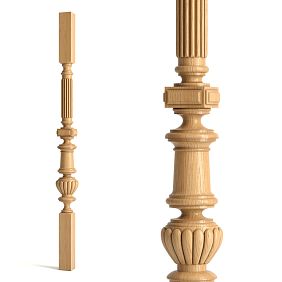
An interior is perceived as a cohesive whole when elements of different scales, functions, and locations are connected by a common formal language — the repetition of forms, rhythms, proportions, and materials, creating visual rhymes between architecture and furniture, vertical and horizontal, static and dynamic.wooden balustersfor stairs andfurniture legsfor tables, chairs, armchairs, executed in a unified style of woodturning, become such connecting elements — vertical supports of different purposes but related form, unifying the space of a home through the repeating motif of turned wood. A staircase with turnedwooden balustersand a dining table on turned legs of identical profile create a visual dialogue — the eye, having registered the form of a baluster, recognizes it in the table leg, subconsciously registers the connection, perceives the interior as a thoughtful whole, not a random collection of objects. This works not through literal copying — a baluster 900 millimeters high with a diameter of 60-80 cannot be identical to a table leg 720 millimeters high with a diameter of 40-60 — but through the repetition of key profile elements: the alternation of cylinders and spheres, the proportions of waists, the character of fillets, the overall rhythm of convexities and concavities.
Woodturning — the ancient technology of transforming a cylindrical blank into a rotating body shaped by cutting tools that form the profile — unites balusters and furniture legs not only visually but also technologically. Both products are created on a lathe, undergoing identical stages: selecting the blank, centering, rough turning, finish turning using a template, sanding, final finishing. A craftsman turning balusters can easily turn table legs — the tools, techniques, and skills are the same. Ordering balusters and legs from a single manufacturer guarantees unity of style, execution precision, wood quality, and finishing — the elements will be perceived as parts of a single ensemble, which is critical for classic interiors where the harmony of details creates a sense of completeness, thoughtful
ness, and cultural continuity.



Woodturning Technology: From Blank to Finished Product
The blank for a turned product is a square or near-square cross-section block of solid wood, dried to a moisture content of 8-10 percent, free of knots, cracks, or rot along the working length. For a baluster 900 millimeters high with an 80 mm diameter, a blank of 90x90x950 millimeters provides allowance for processing and trimming. For a furniture leg 720 mm high with a 60 mm diameter — a blank of 70x70x750 mm. The wood species is chosen based on hardness, texture, and cost. Beech — a light pinkish-cream wood of medium hardness (3.5 on the Brinell scale), turns, sands, and stains excellently, costs 350-500 rubles per linear meter of blank. Oak — light brown, very hard (3.7), with pronounced grain, durable, 600-900 rubles. Ash — grayish-beige, hard (4.0), elastic, with beautiful striped grain, 500-800 rubles.
Centering — marking the centers on the blank ends, drilling center holes, securing it in the lathe chuck between the headstock with the drive rotation and the tailstock for support — ensures coaxial rotation and eliminates runout. The lathe is started at 800-1200 RPM for roughing. Rough turning with a semicircular gouge removes the corners of the square blank, turning it into a cylinder 2-3 millimeters larger than the final diameter. Shavings come off in large ribbons, the blank quickly acquires a round shape. Uneven wood density, cross-grain, and swirl are revealed at this stage — problematic blanks are rejected.
Finish turning using a template — the key stage forming the profile of the baluster or leg. The template — a flat board with the profile contour cut out full-size — is applied to the rotating blank; the craftsman uses tools — skew chisel, gouge, parting tool — to remove wood, forming convexities, concavities, cylinders, spheres, cones, and fillets according to the template. Accuracy of ±0.5 millimeters is achieved through experience, feel for the tool, and constant control with calipers. Modern CNC lathes automate the process — tools are controlled by a program, the profile is reproduced with ±0.1 mm accuracy, a series of balusters or legs is identical. But final finishing remains manual — the craftsman sands, removes the smallest imperfections, smooths transitions.




Elements of a Turned Profile: A Dictionary of Forms
Cylinder — a section of constant diameter, creating visual stability, verticality, serving as the base element from which complexities unfold. The diameter of cylinders in a profile varies — a thin waist of 20-30 millimeters creates elegance, a thick one of 60-80 — massiveness. Alternating thick and thin cylinders creates rhythm and dynamism. Sphere, ball — a section of convex profile where the diameter smoothly increases from the edges to the center, reaches a maximum, and symmetrically decreases. Spheres add volume, plasticity, soften the rigidity of cylinders. Hemisphere, part of a sphere, elongated or compressed, creates variations.
Cone — a section where the diameter smoothly increases or decreases along the length, creating dynamic upward or downward movement. Upward cone — widening towards the top — is characteristic of the upper parts of balusters, creating visual stability. Downward cone — narrowing towards the bottom — for table legs, lightens the base, visually lifts the tabletop. Fillet — a concave section of the profile where the diameter is minimal, forming a waist that emphasizes element boundaries, adding graphic quality. A deep fillet creates drama, a shallow one — a light accent. Alternating fillets and spheres creates the classic rhythm characteristic of traditional turned products.
Bead, torus — a convex ring element of small diameter, protruding from the main profile, creating detailing, decorativeness. Several beads in a row form a decorative band, characteristic of Baroque and Renaissance styles. Flutes — vertical grooves cut into the surface of a cylinder, characteristic of classical order columns, rare in balusters but found in exclusive products, creating play of light and shadow, enhancing verticality. A smooth cylinder without decoration — characteristic of minimalist, modern interpretations of turned forms.
Our factory also produces:


Stair Balusters: The Vertical Element of Architecture
wooden balustersfor stairs — vertical elements of the railing between steps and handrail, performing the structural function of supporting the handrail, ensuring safety, preventing falls, and the decorative function of styling the staircase, creating visual rhythm, and stylistic connection to the interior. Standard baluster height is 900 millimeters for a staircase with a railing height of 900-950 millimeters from step to top of handrail, meeting safety requirements. Maximum diameter of 60-80 millimeters in the central part ensures visual proportionality, minimum of 25-35 in waists — elegance without fragility. The number of balusters per flight is determined by spacing — one baluster per step creates a sparse rhythm, suitable for wide flights, substantial balusters. Two per step — a dense rhythm, visually richer, characteristic of grand staircases, narrow flights.
The profile of a baluster consists of several functional parts. The lower support part is a cylinder or square base 80-120 millimeters high, attached to the tread with a dowel, screw, or by fitting into a groove. The base provides stability and structural rigidity. The central decorative part is a section 500-600 millimeters high, where the main profile elements are concentrated: spheres, fillets, beads, cylinders, creating the baluster's visual identity and style recognizability. The upper support part is a cylinder or cone 100-150 millimeters high, attached to the handrail or sub-rail strip. The top can be a smooth cylinder for fitting into a handrail groove or have a tenon for mounting the handrail.
The stylistic profile of balusters is determined by the era and interior style. Classical balusters feature a symmetrical profile with alternating spheres, fillets, and cylinders, proportional, balanced, without excessive detailing. Characteristic of Neoclassicism, English classicism, and American Colonial style. Baroque balusters have a complex profile with many small elements, beads, and transitions, creating visual richness, decorativeness, and luxury. Characteristic of palatial, representative interiors. Minimalist balusters have a simplified profile of 2-3 large elements without fine detailing, laconic, modern, compatible with contemporary furniture and minimalist interiors.
Get Consultation
Baluster Installation: Strength and Precision
Attaching balusters to treads and handrails is critical for the railing's strength, safety, and durability. Dowel mounting uses wooden pins 8-12 millimeters in diameter, glued into the baluster ends and corresponding holes in the tread and sub-rail strip—a traditional method ensuring strength and concealed fastening. Holes 40-50 millimeters deep are drilled into the lower and upper ends of the baluster, and dowels with a 25-30 mm protrusion are glued in. Corresponding holes are drilled in the tread and strip, glue is applied, the baluster is fitted and pressed until fully seated. The glue cures for 24 hours, after which the joint is strong and non-disassemblable.
Screw fastening from below uses 5x70 mm self-tapping screws, screwed from under the tread at an angle into the baluster end—providing quick installation and disassembly but requiring precision in drilling pilot holes. The screw enters the baluster end by 40-50 millimeters, ensuring strength. The top of the baluster is attached to the sub-rail strip similarly or with dowels. This method is applicable for straight flights where access from under the tread is possible. For winder or spiral stairs where treads are triangular, narrow, and under-access is limited, top dowel mounting is used.
Aligning balusters vertically and in height is critical for the staircase's visual quality. Balusters must stand strictly vertical, not leaning along or across the flight—checked with a level during installation. The upper ends of the balusters must lie in a single plane, sloped at the flight's angle, ensuring even contact with the sub-rail strip. Height marking is done with a laser level, stretched string, or template. Balusters with height deviations of ±2 millimeters are trimmed with a miter saw and leveled. Assembly precision determines whether the staircase will look amateurish or professional.
Furniture Legs: The Vertical of Function
furniture legsTurned from solid wood, furniture legs are supports for tables, chairs, armchairs, sofas, beds, and dressers. They perform the structural function of supporting weight and transferring load to the floor, and the decorative function of defining furniture style, creating visual lightness or massiveness, and connecting with the rest of the interior. Standard table leg height is 710-730 mm for dining tables, 720-750 mm for work tables, ensuring comfortable seating. Maximum diameter of 50-70 mm in the upper support part transfers load from the tabletop; minimum diameter of 30-40 mm in the center creates elegance, visual lightness, and reduces leg mass. Four legs at the tabletop corners is the classic configuration, ensuring stability. A central pedestal with four radiating legs is for round tables where peripheral legs would hinder chair placement.
Chair legs are 430-450 mm high for rear legs, 400-420 mm for front legs, providing a seat height of 450 mm—the comfort standard. Diameter of 30-45 mm ensures strength with reasonable mass. Four legs, connected by aprons—horizontal bars forming a frame supporting the seat—create a rigid structure. Rear legs often transition into back posts, forming a single piece from floor to top of back—this is structurally more rational, stronger, and visually more cohesive than separate leg and back post.
The profile of furniture legs stylistically aligns with the baluster profile but is adapted to the smaller height and different proportions. If a baluster has a central part with alternating two spheres and three fillets over 500 mm height, a table leg 720 mm high can have a similar alternation but with fewer elements or smaller element height—one sphere, two fillets—preserving proportions and shape recognizability but adapted to scale. This creates a visual rhyme—the eye, seeing the baluster on the staircase and the table leg, recognizes the kinship of forms, registers the connection, subconsciously assessing the interior as thoughtful and cohesive.
Furniture Leg Attachment: Construction and Reliability
Attaching a leg to a tabletop is done via an apron frame—a frame of four aprons joined at corners with mortise and tenon joints, to which the legs are attached. Aprons are bars with a cross-section of 40x60 or 50x80 mm, length 100-150 mm shorter than the tabletop sides, forming a frame set back from the tabletop edge by 50-75 mm. Legs are attached to the frame corners from the outside or inside. Outside attachment: the leg is placed against the outer corner of the frame, joined with tenons, glued, and additionally secured with screws from inside the aprons. Inside attachment: the leg is inserted into the frame corner, joined with a complex corner tenon, forming a rigid node.
The tabletop is attached to the apron frame via Z-shaped metal fasteners or wooden buttons, allowing the wood to expand and contract with humidity changes without cracking. Rigidly attaching the tabletop with screws directly to the aprons is unacceptable—wood expands across the grain by 3-5 mm per meter of width with seasonal humidity fluctuations; rigid attachment prevents this, causing the tabletop to crack or pull out the fasteners. Z-fasteners and buttons allow the tabletop to slide relative to the aprons, preserving integrity.
Attaching chair legs to seat aprons uses a mortise and tenon joint, where a tenon is formed on the leg's upper end, and a mortise or socket in the apron; the leg is inserted and glued. Strength is increased by installing stretchers—horizontal connections between legs 150-250 mm from the floor, forming an additional frame that rigidly links the legs. Stretchers can be turned, repeating leg motifs, or simple rectangular bars—depending on style and budget.Classic FurnitureSTAVROS uses turned stretchers, coordinated with the legs, creating visual cohesion.
Visual Connection Through Form Repetition
An interior with staircase balusters and furniture legs of identical or related profile is perceived as designed, not random. A staircase in the hall with balusters of a classic profile—sphere, fillet, cylinder, fillet, sphere—and a dining table in the dining room with legs of a sphere, fillet, cone profile create an echo of forms. A guest ascending the staircase notices the baluster profile, then sees the table in the dining room, recognizes the leg form, subconsciously registers the connection. This doesn't require conscious analysis—the brain's visual system automatically detects repeating patterns, assessing them as a sign of order, coherence, and quality.
Repetition works not only between staircase and table but also among various furniture pieces. A dining table, its chairs, a console table in the hallway, a coffee table in the living room, bedside tables in the bedroom—all on legs of related profile—create a visual network of connections permeating the entire house. Each furniture piece becomes a node in this network, the leg form the connecting thread. Adding a staircase with balusters of the same profile makes the network three-dimensional, incorporating vertical architecture and horizontal furniture.
Variation within unity prevents monotony. Staircase balusters 900 mm high have an expanded profile with five elements. Dining table legs 720 mm high have a simplified version with three elements preserving key forms. Coffee table legs 450 mm high have a minimal version with two elements. All are recognizably related but not identical—this creates visual interest, avoids literal repetition, preserving unity through principle, not copying.
Color and Texture: Material Unity
Unity of profile is enhanced by unity of material, wood species, and finish tone. Balusters of solid oak in a natural tone, treated with oil, and furniture of solid oak treated with the same oil create material kinship beyond formal. Oak texture—pronounced annual rings, large pores, characteristic grain pattern—is recognizable and identical on balusters and legs. Color—light brown with a golden undertone—is identical. Touching a baluster and a table leg evokes the same tactile sensation—the smoothness of oiled wood, slight roughness of pores, warmth of wood.
An alternative is contrast of tones with unity of species. Balusters of oak, stained dark with walnut or wenge oil, almost black, and furniture of oak in a natural light tone create a contrast of light and dark while sharing texture and form. Dark balusters on the staircase visually ground the vertical, creating graphic quality. Light furniture lightens the space, adding airiness. Contrast works with balance—30% dark (staircase, accent furniture), 70% light (main furniture, walls, floor) creates dynamism without gloom.
Combining species is acceptable while preserving tone. Balusters of beech, bleached almost white, and furniture of ash, also bleached, create tonal unity despite texture difference—beech is fine-pored, ash is large-pored with stripes. Texture difference is noticeable up close, adding detail, but from a distance, unity of light wood linking elements is perceived. Critical—avoid combining warm and cool tones: warm golden oak and cool gray ash conflict, disrupting harmony.
STAVROS Solid Wood Products: Technology and Assortment
Solid Wood ItemsSTAVROS—balusters, furniture legs, millwork, furniture—are produced at our own facilities in St. Petersburg using European equipment, kiln drying, CNC lathes, and manual finishing. Wood—oak, ash, beech, pine—is sourced from verified suppliers with FSC certification, guaranteeing legal, sustainable origin. Kiln drying reduces moisture to 8-10%—optimal for furniture products used in heated spaces with 40-60% humidity. Wood after drying is stable, does not warp or crack, dimensions are preserved for years.
Turning on CNC lathes ensures profile accuracy of ±0.1 mm, identity of items in a series—critical for balusters where dozens of elements must be indistinguishable. The machine program contains profiles of hundreds of baluster and leg models from the STAVROS catalog, allowing manufacture of any model to order. Manual finishing by a craftsman removes minute tool marks, smoothes transitions, brings the product to perfect condition. Sanding with P180-P220 grit creates smoothness ready for finishing.
Finishing—oil, wax, varnish—is performed in the workshop; products are supplied ready for installation. Natural oil—linseed, Danish—soaks into the wood, emphasizes texture, creates a matte surface, tactilely warm and pleasant. Colored oil stains the wood—walnut, rosewood, wenge, bleached—changing tone while preserving texture. Water-based varnish creates a transparent matte or semi-matte coating, protecting from moisture, scratches, and dirt. Opaque enamel in white, black, gray conceals texture, creating a monochrome surface for contemporary interiors.
Baluster and Leg Catalog: Hundreds of Options
The STAVROS catalog contains over 100 modelswooden balustersand 80 modelstable legsSystematized by styles—classic, baroque, minimalism, Provence, loft. For each style, profiles are selected that correspond to the era, aesthetics, and proportions. Classic—balusters with symmetrical profiles of spheres, cylinders, and fillets, proportional, restrained, elegant. Table and chair legs with identical profile elements, adapted to height and function. Ordering balusters and legs from the same collection ensures visual consistency.
Baroque—balusters and legs with complex profiles, numerous small elements, beads, and transitions, creating decorativeness and luxury. Suitable for representative interiors, country residences, where demonstrating status, taste, and cultural continuity is important. Minimalism—balusters and legs with simplified profiles of 2-3 large elements without detailing, laconic, modern. Often combined with square, rectangular elements, creating geometricity and graphic quality. Provence—balusters and legs with medium detailing, often with whitewashed or patinated finishes, creating an antique effect, cozy rustic elegance.
Custom orders allow creating a unique baluster or leg profile based on a client's sketch, drawing, or photograph. The STAVROS designer develops the profile, adapts it to the technological capabilities of lathe processing, and creates a template. The master turns a sample, coordinates with the client, and after approval, a series is manufactured. The cost of a custom order is 30-50 percent higher than standard due to development, template production, and equipment setup, but the result is a unique product with no analogues, perfectly matching the interior concept.
STAVROS classic furniture: ready-made solutions
Classic FurnitureSTAVROS—dining tables, chairs, armchairs, chests of drawers, consoles, display cabinets made of solid oak, ash, beech—are designed using turned legs, balusters, columns, pilasters, creating stylistic unity with architectural elements. The 'Classic' dining table on four turned legs with a profile coordinated with the balusters of the 'Classic' collection creates a direct visual connection with the staircase decorated with these balusters. Chairs for the table with rear leg-back posts and front legs of identical profile enhance the unity.
A console table on turned legs in the hallway by the staircase creates an immediate visual connection—the staircase balusters are nearby, the console legs repeat the profile, the connection is instantly perceived. A display cabinet in the living room with turned corner columns repeating baluster motifs integrates the furniture into the architectural context. A chest of drawers with turned legs in the bedroom continues the theme of vertical turned elements permeating the entire house.
The advantage of ready-made STAVROS furniture—all elements are designed in a unified style, proportions, material, and finish. Purchasing a table, chairs, and console from the same collection guarantees ensemble harmony. Complementing furniture with balusters, legs, and millwork from the STAVROS catalog of the same collection creates a cohesive interior where each element is in its place, connected to the others, and works for the overall concept. This eliminates the agonizing search, combination of disparate elements from different sources, inevitable compromises, and disappointments.
Conclusion: verticality as a leitmotif
Turned products—wooden balustersfor staircases,furniture legsfor tables and chairs—unite the interior through repetition of form, rhythm, proportions, and material, turning disparate elements into a connected whole. The verticality of turned wood becomes a leitmotif, permeating the house from staircase architecture to room furniture, creating a visual rhyme, subconsciously recognizable, appreciated as a sign of thoughtfulness, quality, and culture. This is not accidental but the result of conscious choice, design, and coordination of elements—work that STAVROS performs for clients, offeringSolid Wood Itemsin coordinated collections, ready-madeclassic furniture, custom design.
Create interiors where the form of a baluster echoes the form of a table leg, where the staircase and furniture speak the same language of turned wood, where verticals—architectural and furniture—are connected by visible threads of kinship, creating harmony, integrity, beauty born from repetition with variation, unity in diversity, order without monotony. This is the highest form of interior art, where details are not accidental but coordinated, where each element enhances the others, where the whole is greater than the sum of its parts.


