Article Contents:
- Standards and regulations: when beauty meets safety
- Installation step: the mathematics of safety
- Styles and forms: from classic to avant-garde
- Manufacturing materials: from wood to composites
- Installation technology: from marking to final finishing
- Safety: when it comes to life
- Features for different types of staircases
- Posts and support elements
- Combined railings
- Maintenance and care
- Restoration and replacement
- Cost and manufacturer selection
- DIY construction
- Frequently Asked Questions
- Conclusion

Imagine a staircase without a railing—an open flight that's frightening to climb. No hand support, no protection from falling, no sense of security. Now imagine the same staircase with elegant, turned posts supporting a smooth handrail. A completely different feeling, right? These posts are balusters, architectural elements that transform a staircase from a simple functional object into a work of art, while simultaneously providing the main thing—safety of movement.
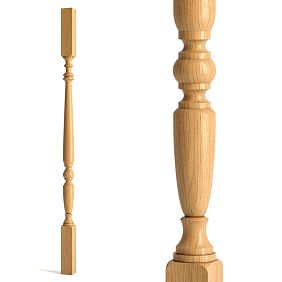
BalusterA baluster is a vertical post installed between staircase steps and railings, forming a railing. But this definition does not convey the full essence. A baluster is an element in which functionality is inseparably linked with aesthetics. It must withstand significant loads, ensure safety, comply with construction standards, and at the same time be beautiful, harmonize with interior style, and accentuate the staircase’s architecture. The history of balusters spans millennia — from ancient stone columns to modern design solutions, but the essence remains unchanged: protection and beauty in one element.



Standards and regulations: when beauty meets safety
Installation of balusters is not creative whimsy, but a strictly regulated process. In Russia, SP 118.13330.2012 (the updated version of SNiP 31-02-2001) defines requirements forstaircase railingsand handrails. These norms are not written for formality — each requirement is dictated by analysis of thousands of trauma cases, biomechanical studies of the human body, and structural strength calculations.
The distance between balusters — the first and critically important parameter. According to regulations, the gap between adjacentstair balustersshall not exceed 120 millimeters for residential and public buildings. Where does this number come from? It is based on the principle of non-passage: a spherical object with a diameter of 107 millimeters should not pass through the space between balusters. This is an approximate size of a baby’s head. For childcare facilities, the regulation is even stricter — no more than 100 millimeters, which prevents a child from getting stuck between posts.
The height of the railing together withhandrailsmust be at least 900 millimeters from the surface of the step to the top of the handrail. This is the optimal height for an average-height person, allowing comfortable support on the handrail when ascending. In private homes, this parameter is often increased to 1000–1100 millimeters, especially if there are tall people in the family. For childcare facilities, requirements are even stricter — height may reach 1200 millimeters, plus additional handrails must be installed at 500–600 millimeters for toddlers.
Structural strength — a parameter checked by calculations and tests. EachWooden balustermust withstand a horizontal load of at least 100 kilograms applied at the handrail level. This simulates the situation when a person leans on the railing after running. A system of several balusters connected by a handrail must withstand even more — up to 300 kilograms per linear meter. Insufficient strength is a direct path to injuries.
The placement relative to the edge of the step is also regulated. Balusters are not installed flush against the edge of the step — this reduces the strength of the fastening and creates a risk of wood splintering. The optimal offset from the edge is 20–40 millimeters. This ensures secure fastening and visual harmony.Wooden balustersBalusters are mounted either directly to the step, or to the stringer or stringer of the staircase.
Manufacturing materials are also subject to regulation. Wood must be dry (moisture 8–12%), free of cracks, rot, and large knots. Metal balusters must have anti-corrosion coating. Stone and concrete balusters must have sufficient strength grade. All finishes (varnish, paint) must be non-slip and safe for health.




Installation step: the mathematics of safety
Calculating the baluster spacing is not simply dividing the length of the staircase run by the number of posts. It is an exact calculation, taking into account numerous factors: the width of the balusters themselves, safety requirements, aesthetic proportions, and the structural characteristics of the staircase.
The basic formula looks like this: if the baluster width is 50 millimeters and the required distance between them is 100 millimeters (for children's facilities), then the installation step (distance from the center of one baluster to the center of the next) will be 150 millimeters. Sounds simple, but in practice, dozens of nuances must be considered.
First nuance — the start and end of the stair run.Wooden balusters pricewhich vary depending on the species and processing complexity, are not installed from the very edge of the step. The first baluster is mounted with an offset from the start of the stair run, usually on the first step. The last one — on the top landing or the last step. The remaining balusters are distributed between them with equal spacing.
Second nuance — support posts. On every stair run, initial and final support posts (newels) must be installed. They are stronger than regular balusters, with a cross-section of 80×80 or 100×100 millimeters versus 40×40 or 50×50 for balusters. Intermediate balusters are distributed between the support posts. The support posts bear the main load, transferring it to the stair structure.
Third nuance — number of balusters per step. There are two approaches: one baluster per step, or two. The choice depends on the step depth and required railing frequency. If the step is deep (more than 300 millimeters), one baluster may be insufficient — the distance between posts on adjacent steps will be too large. In this case, two balusters are installed per step, distributed evenly.
Fourth nuance — accounting for the stair incline angle. Balusters are installed strictly vertically, but handrails follow the incline, mirroring the stair slope. This means the distance between balusters measured along the handrail will be greater than the horizontal measurement. Correction formula: horizontal distance multiplied by the cosine of the stair incline angle.
Practical example of calculation for a straight stair run: stair run length 3000 millimeters, number of steps 10, baluster width 50 millimeters, required clearance between balusters 100 millimeters. Installing one baluster per step. Installation step will be 300 millimeters (stair run length divided by number of steps). Check: with a baluster width of 50 mm, the distance between adjacent balusters on one step will be 250 mm, which exceeds the allowable 120 mm. Therefore, two balusters must be installed per step or the number must be increased.
Recalculating: to ensure the clearance does not exceed 120 mm with a baluster width of 50 mm, the installation step must be at most 170 mm. Dividing the stair run length of 3000 mm by 170 mm gives approximately 18 balusters. Rounding to 20 for symmetry. Final step: 3000 / 20 = 150 mm. Check: distance between balusters 150 - 50 = 100 mm. Meets the standard for children's facilities.
Our factory also produces:


Styles and forms: from classic to avant-garde
Baluster— this is not just a functional post. It is a decorative element that defines the style of the staircase and the entire interior. Over centuries of evolution, dozens of baluster styles and forms have emerged, each carrying its own aesthetic and cultural weight.
Turned forms — the genre's classic. A baluster is turned on a lathe from a solid wooden block, creating a rotational shape — symmetric about its axis. Elements of a turned baluster have specific names: base, central body, neck, finial. A classic turned baluster may include spherical elements (spheres), cylindrical sections (shafts), conical transitions, concave profiles (ovolos). Each element serves not only aesthetics but also strength — proper mass distribution along the height ensures stability under load.
Carved elements elevate balusters to the level of art. If a turned baluster is created by rotation, a carved one requires the manual work of a master carver. Vegetal ornaments (leaves, flowers, vines), geometric patterns, zoomorphic motifs (animal heads, bird wings), anthropomorphic elements (human figures, faces) — all of this transforms the baluster into a sculptural composition.Flat balusters— especially often decorated with through carving — when the ornament is cut through, creating an openwork effect.
Classic baluster styles evolved over centuries under the influence of architectural eras:
Ancient style — balusters in the shape of amphorae, with smooth curves characteristic of ancient Greek and Roman architecture. Wide base, narrow neck, expanded body, again narrowing toward the top. Such balusters were often adorned with fluting (vertical grooves) and classical ornaments.
Baroque — ornate, decorative balusters with complex curves and numerous decorative elements. Carving, gilding, patination. Balusters in the Baroque style — a demonstration of wealth and luxury.Buy Baroque furniture— and balusters in the same style — a classic combination for a luxurious interior.
Renaissance — more restrained compared to Baroque, but still decorative balusters. Correct geometric proportions, symmetry, elements of ancient architecture. Columns, capitals, bases — all reinterpreted at the scale of balusters.
Neoclassicism — strict, proportionally balanced balusters with minimal decoration. Clean lines, correct forms, no excesses. Beauty through perfect proportions, not through excessive ornamentation.
Modern — smooth, organic forms imitating natural objects. Curved lines, vegetal motifs, asymmetry. Balusters in the modern style often lack a clear axis of symmetry; they are fluid and dynamic.
Modern styles offer new interpretations:
Minimalism — balusters of simple geometric forms. Square or rectangular cross-section, no decoration, maximum functionality. Beauty in the purity of lines and material quality.chair legs— in a minimalist style, and balusters must harmonize in form and material.
High-tech — often uses metal, glass, composite materials. Metal balusters from stainless steel, aluminum, with chrome finish. Glass panels instead of individual posts. This is futuristic, modern, but requires a professional approach to installation.
Loft — deliberately rough, industrial balusters. Metal pipes, unprocessed wooden beams, visible fasteners. Aesthetic of incompleteness, industrial romance.
Get Consultation
Materials for manufacturing: from wood to composites
Material selection for balusters is determined not only by aesthetic preferences but also by operational requirements, budget, and installation conditions.
Wood — traditional and the most popular material.Balusters from wood for sale in SPB— can be made from various species, each with its own characteristics.
Pine — affordable, lightweight, easy to process. Suitable for turning and simple carving. Minus: the softness of the wood makes it vulnerable to mechanical damage; resin requires removal before painting. Pine balusters — budget-friendly choice for country house staircases and auxiliary rooms.
Oak — premium wood with outstanding characteristics. Hardness, density, durability, beautiful texture. Oak balusters last for decades, practically wear out. Color ranges from light gold to dark brown. Minus — high price and difficulty of processing.
Ash — hardness comparable to oak, but lighter and with more pronounced texture. Easily bends, allowing for curved elements. Ash balusters — choice for modern interiors where natural wood beauty is appreciated.
Beech — warm, dense wood with fine-grained texture. Easily stains and takes patina.Beech balustersSuitable for classic interiors.
Larch — coniferous species with unique properties. Not afraid of moisture, becomes harder over time. Can be used even on open staircases and terraces. Color ranges from golden-yellow to reddish-brown.
Metal — second most popular material. Metal balusters have high strength at lower thickness, allowing for more elegant structures.
Stainless steel — modern classic. Does not rust, does not require painting, easy to clean. Polished stainless steel creates a futuristic look, matte finish — more restrained. Suitable for any conditions, including outdoors and humid interiors.
Cast iron — traditional material for cast balusters. Allows creating complex decorative shapes through casting. Heavy, strong, durable. Requires corrosion protection — painting or patination.CarvedCast iron elements — classic for outdoor staircases, balconies, terraces.
Wrought metal — balusters made by artistic forging. Each one is unique, handmade. Floral ornaments, scrolls, geometric patterns. Expensive, exclusive, striking.
Stone — material for monumental staircases. Marble, granite, travertine. Stone balusters are incredibly strong and durable, but require professional installation due to their weight. Used mainly in public buildings, mansions, palaces.
Concrete — modern alternative to stone. Balusters are cast in molds and can imitate any material — from wood to marble. Strong, durable, relatively inexpensive. Require reinforcement to increase strength.
Composite materials — new direction. Polymer concrete, fiber concrete, wood-polymer composites. Combine advantages of different materials: lightness, strength, resistance to moisture and temperature fluctuations, variety of forms and textures.
Installation technology: from marking to final finishing
Baluster installation — a process requiring precision, care, and understanding of staircase construction. Errors at this stage may lead not only to aesthetic defects but also to safety hazards.
Preparation begins with marking. Points for baluster installation are marked on the lower beam (stringer) or directly on the treads. Measuring tape, square, level are used. All points must lie on a single line parallel to the tread edge, 20–40 mm from it. Distance between points corresponds to the calculated installation step.
For straight staircases, marking is simple — ruler and pencil. For spiral or turning staircases, more complex calculations are required, taking into account the curvature of the path and changes in tread width.Railings and balusters for wooden staircasesMust be installed so that the handrail line is smooth, without breaks or steps.
Baluster preparation includes end processing. If balusters are mounted directly to treads, the bottom end must be cut at an angle matching the staircase’s incline. The top end is also beveled for tight fit against the handrail. Cuts are made with a miter saw to within 0.5 degrees precision.
If balusters are longer than required railing height (common with standard products), they are cut to size. Measure distance from tread surface to bottom of handrail, subtract fastener thickness, to get required baluster length. Cutting accounts for incline angles.
Baluster mounting can be done in several ways:
Mounting with screws (self-tapping screws) — most common method. Pre-drill holes in treads or stringer for anchors. Drill hole in bottom of baluster for screw. Place baluster in position, check vertical alignment with level, and tighten screw. Screw head is pressed into baluster body and covered with decorative cap or filled with putty.
Mounting with dowels (wooden pins) — more traditional and aesthetic method. Drill aligned holes in tread and baluster end for dowel. Apply glue to dowel and drive into one hole. Then slide baluster over protruding dowel. This method ensures strong connection without visible fasteners, but requires high drilling precision.
Mounting on stringer — option where balusters are mounted not to treads but to a special wooden beam (stringer) running along the staircase. Stringer is mounted to stringer or tread ends. This method is convenient because it simplifies marking and ensures a single mounting line for all balusters.
Mounting with metal brackets — modern method used for wooden and metal balusters. Screw metal bracket with threaded pin into tread. Drill threaded hole in bottom of baluster. Screw baluster onto pin. This ensures strong connection with height adjustment capability and tightening if loosened.
Installation begins with mounting support posts. First post is installed on first tread or floor before staircase. Final post — on last tread or top landing. Support posts must be perfectly vertical — checked with level in two planes. Accuracy of support post installation determines entire railing geometry.
After support posts, intermediate balusters are installed. Each baluster is checked for verticality with a level. This is critical — even slight tilt of several balusters creates visual impression of curvature in entire railing. If tread is uneven (common), baluster must be installed vertically, and difference compensated during handrail mounting.
Handrail mounting — final stage of railing assembly. Handrail must fit tightly against top ends of all balusters. If balusters are installed correctly, handrail will lie perfectly. If any deviations exist, they must be corrected before handrail mounting. Handrail is mounted with screws from below (through balusters into handrail) or from above (through handrail into balusters with subsequent hole filling).Handrails and balustersMust form a single, rigid structure.
Final finishing includes filling mounting points, sanding, priming, and applying protective-decorative coating. If balusters and handrail are made of natural wood, use varnish or oil-wax. If painting is required, use special wood paint. All elements must be treated before installation, and after installation, only final finishing and coating of connection points are performed.
Safety: When it comes to life
Balusters are not decoration. They are safety elements whose proper installation directly affects human lives. Improperly installed, low-quality, or non-compliant balusters become sources of injuries.
Connection strength — the first safety parameter. A baluster must be secured to withstand a horizontal load of at least 100 kilograms. This is physically tested — after installation, each baluster should be pulled forcefully. It must not wobble, creak, or deflect. Any movement indicates insufficient connection strength.
Distance between balusters — the second critical parameter. Through gaps betweenbalusters photowhich are often used to demonstrate the beauty of products, a 10-centimeter diameter ball must not pass through. This is a standard safety test. A larger gap creates a risk of a child getting stuck or being squeezed through and falling.
Railing height — the third parameter. If the railing is less than 90 centimeters, an adult may fall over it upon losing balance. This is especially dangerous on upper floors, where falling off the staircase means falling from several meters high.
Absence of sharp elements — a requirement often ignored. Balusters must not have sharp angles or protruding elements that could cause injury. All edges must be rounded, and all decorative elements must be smoothly sanded. This is especially important for staircases used by children.
Slip resistance — applies to the handrail, not the balusters. The handrail must be easy to grip and non-slip. A smooth varnished handrail may be slippery, especially if moisture is present. A matte or semi-matte surface is preferred.
Regular condition checks — mandatory safety condition. Over time, connections may loosen, wood may dry out, and fasteners may weaken. At least once a year, check the strength of all balusters, tighten fasteners, and inspect the handrail integrity. If a loose baluster is detected — immediately reinforce it.buy balustersTo replace damaged ones, use pieces of the same size and style.
Special requirements for staircases in children's facilities. Here, standards are even stricter: distance between balusters not exceeding 10 centimeters, railing height up to 120 centimeters, mandatory additional handrails at 50–60 centimeters for toddlers, rounded corners and edges, use of only eco-friendly materials without toxic coatings.
Load tests are conducted before commissioning. The railing system is tested by applying calculated loads at the most vulnerable points — middle of the flight, element joints, areas with maximum spacing between fasteners. If the structure fails the test — it is not allowed for use.
Features for different types of staircases
Each type of staircase imposes its own requirements on balusters and their installation.
Straight single-flight staircase — the simplest case. Balusters are installed in a straight line from bottom to top. Step spacing is constant, and angles of inclination are identical for all balusters. The only complexity — ensuring strict verticality of each baluster and a uniform line of top edges.
Two-flight staircase with a landing complicates the task. Each flight has its own balusters, and the landing has a separate railing. The key point — support posts on the landing. They must be installed to ensure a smooth transition from the lower flight to the landing and from the landing to the upper flight.Balusters and Posts for StaircasesOn the landing, posts are often made more massive, emphasizing structural nodes.
P-shaped or G-shaped staircase with turning steps requires a special approach. On turning (tread) steps, width along the inner edge is less than along the outer edge. Balusters on such steps should be placed closer to the outer edge, where more space is available. At the same time, it is important to maintain the required distance between balusters, measured along the shortest trajectory.
Helical staircase — the highest level of skill. Here, all steps are turning, and the movement trajectory is a spiral. Balusters are installed along the outer edge of the steps, forming a helical surface. Each baluster has its own angle of inclination relative to the vertical (radial inclination) plus the overall angle of inclination in the plane of movement. The handrail on a helical staircase is a complex three-dimensional curve that cannot be made from a straight board. It requires either bending wood, or gluing short sections, or using flexible materials.
Staircase with a herringbone (sawtooth, mill) pattern has steps with variable width — wide on one side, narrow on the other. Balusters on such a staircase are installed asymmetrically, which complicates calculation and marking. It is important to ensure safety on both sides, despite the asymmetry of the steps.
Attic folding staircase usually does not require balusters due to its temporary nature. However, if the attic is used regularly, installing at least minimal railing around the hatch opening increases safety.
Posts and support elements
In addition to balusters, the railing system includes support elements that bear the main load.
Support posts (newels, tumbrels) — these are reinforced balusters with larger cross-sections, installed at the beginning and end of each flight. Their cross-section is usually 80×80 or 100×100 millimeters, compared to 40×40 or 50×50 for standard balusters. Height may be greater, especially if the post serves a decorative function. Support posts are secured especially securely — bolts through the tread or landing, with additional fastening to the wall or staircase structure.
Turning posts are installed at staircase turns — at the start of turning steps, on landings, and at points of direction change. They serve as support for the handrail at trajectory change points and must withstand increased load, as people lean more heavily on railings at turns.
Finishing posts (finishing caps) are installed at the end of the staircase flight on the upper landing. Often, they are taller than standard support posts and are decorated with ornamental caps — spheres, vases, figures. This is an architectural accent that completes the staircase composition.
Tumbrels (bases) — these are especially massive support elements installed at the very beginning of the staircase, on the first floor’s floor. Their cross-section can reach 150×150 millimeters or even more. A tumbrel is not only a functional element but also a powerful decorative accent that sets the tone of the entire staircase.Furniture supportBoth stair railings and stair supports share similar construction principles — solidity, secure fastening, and decorative function.
Intermediate reinforced balusters are sometimes installed on long stair runs for additional rigidity. Their cross-section is larger than standard balusters but smaller than support posts. They are evenly distributed along the length of the run, for example, every fifth or seventh baluster is reinforced.
Combined railings
Stair railings do not always consist solely of balusters. There are combined solutions where balusters are combined with other elements.
Balusters plus glass panels — a modern solution where glass panels are installed between sparsely spaced balusters (or support posts). The glass must be tempered or triple-glazed, at least 8-10 millimeters thick. This creates an effect of lightness, transparency, and does not clutter the space. At the same time, safety is ensured — you cannot squeeze through the glass panel.
Balusters plus metal rods — a classic combination for outdoor staircases. Wooden support posts and handrail, between them — vertical metal rods with a diameter of 10-16 millimeters and a spacing of 100-120 millimeters. Durable, long-lasting, relatively inexpensive.
Balusters plus wooden panels — a traditional solution for enclosed staircases. The lower part of the railing (usually up to half the height) is covered with wooden panels or boards, the upper part — balusters and handrail. This creates a sense of protection, plus additional sound insulation.
Balusters plus forged elements — a decorative solution. Between wooden balusters, forged decorative inserts — scrolls, flowers, geometric patterns — are inserted. The forging can be painted in a contrasting color or patinated.Moldings decorationAnd forged elements are often used in the same interior to create a unified style.
Balusters plus ropes or cables — a nautical style. Between wooden support posts, ropes or metal cables are tensioned in several rows. This evokes an association with ships, suitable for staircases in coastal homes, terraces, yachts.
Care and Maintenance
Balusters require regular maintenance to preserve their appearance and ensure safety.
Regular cleaning — at least once a week. Wooden balusters are wiped with a slightly damp cloth or cleaned with a soft brush. Do not use excessive water — it may seep into joints, causing wood swelling. For cleaning, use specialized wood cleaning agents that do not contain aggressive solvents.
Strength check — every 3-6 months. Each baluster is checked by light pressing and shaking. If a loose baluster is detected, it must be immediately secured. Loose connections are tightened, and if necessary, adhesive is added or fasteners are replaced.
Coating renewal — the frequency depends on the type of coating and usage intensity. Lacquered balusters require renewal every 5-7 years. Oil-based coating — every 2-3 years. Painted — every 4-5 years. Signs of needing renewal: surface dullness, scratches, wear spots, roughness.
Repair of damage — as needed. Minor scratches on wooden balusters are removed by sanding and local application of coating. Chips are filled with special wood putty, sanded, toned, and lacquered. Deep damage or cracks may require replacing the baluster.
Protection from moisture is critical for wooden balusters. If the staircase is located in a room with high humidity (bathroom, pool, basement), the wood must be especially carefully protected with moisture-resistant lacquer or oil. Periodically check for darkened or swollen areas — these are signs of moisture penetration.
Protection from mechanical damage — when moving furniture or transporting large items up the stairs, be careful not to hit the balusters. Even strong oak balusters can crack from a strong impact.Buy chair legsAnd balusters require careful handling.
Restoration and Replacement
Over time, even high-quality balusters may require restoration or replacement.
Restoration of old balusters — an art requiring skill. If you have a historic staircase with unique balusters, it is worth restoring them rather than replacing them. The process includes: removal of old coating (by stripping or sanding), repair of damage (gluing cracks, restoring chipped fragments), sanding, toning (if needed to even out color), application of new protective coating. Sometimes restoration of carved elements is required — this is work for a wood carver.
Replacing individual balusters is simpler, but requires finding exact matches. If your balusters are standard, this is not a problem. If they are unique or old — you will need to order a custom-made replica. To do this, one baluster (preferably the least damaged) is removed, a drawing or 3D scan is made, and then a replica is manufactured on a lathe or CNC milling machine.
Complete replacement of all balusters is required if most of them are damaged or if you have decided to change the staircase style. The process: dismantling old balusters and handrail, cleaning mounting sites, marking for new balusters (may differ from the old), installing new balusters, mounting new handrail, finishing touches.buy wooden balusters for the staircaseIt's necessary in advance so they can acclimate to the indoor environment before installation.
Structural reinforcement may be necessary if old balusters do not provide the required strength. Reinforcement options: adding intermediate balusters (reducing spacing), installing reinforced support posts, adding a handrail support (if not present), strengthening fasteners (replacing screws with bolts, adding adhesive).
Cost and manufacturer selection
The price of balusters varies widely depending on the material, complexity of processing, wood species, and manufacturer.
Price categories for wooden balusters:
Economy segment: 50-150 rubles per piece. Pine, simple turned shapes, minimal processing, grade V. Suitable for budget projects, garden staircases.
Mid-range segment: 200-500 rubles per piece. Premium-grade pine or birch, more complex turned shapes, quality sanding, possible toning. Optimal choice for most projects.
Premium segment: 600-1500 rubles per piece. Oak, beech, ash, complex turned or carved shapes, flawless processing, possible patina or gold leafing. For luxury interiors.
Exclusive: from 2000 rubles per piece. Valuable species (walnut, mahogany), hand-carved, unique shapes, custom manufacturing. Custom work.
The choice of manufacturer affects quality. Large manufacturers with modern equipment ensure consistent quality, precise geometry, and proper wood drying. Small, artisanal workshops can produce unique items, but quality is inconsistent. When choosing, pay attention to: presence of quality certificates, opportunity to inspect samples, customer reviews, and the manufacturer's experience in the market.
Do-it-yourself
If you have a lathe and experience working with wood, you can make balusters yourself.
Process of making a turned baluster:
Selecting the blank — a square-sectioned block of dry wood (moisture content 8-12%). The cross-section should be 5-10 mm larger than the maximum future baluster diameter. Length with allowance 50-100 mm.
Preparation — the blank is marked, centers of the ends are located, and recesses for the lathe centers are made.
Turning — the blank is mounted on the lathe, turned into a cylinder, then shaped according to the drawing to form the baluster profile. Various cutters are used: a roughing cutter for rough turning, a finishing cutter for fine turning, and a concave cutter for concave profiles.
Sanding — directly on the lathe, while the blank is rotating, using progressively finer sandpaper (from 80 to 240 grit).
Final finishing — the baluster is removed from the lathe, the ends are trimmed to the required angle, and a protective coating is applied.
Difficulty — turning balusters requires skill. The first samples may be far from ideal. A steady hand, understanding of tool operation, and sense of form are needed. But with experience, mastery comes.wooden planks on the walland balusters — similar items in terms of processing.
Carved balusters require even greater skill and special tools — a set of wood chisels, possibly a milling machine with a set of cutters. Carving is an art requiring years of practice.
Frequently asked questions
What is the optimal distance between balusters for a private home?
For a private home without small children, a distance of 100-120 mm between balusters can be used. If there are children under 7 years old — no more than 100 mm. This ensures safety, preventing children from getting stuck or falling. Remember that the normative distance of 120 mm is the maximum; less is possible and even better for safety.
Can balusters be installed every other step?
No, if this violates the requirement for distance between balusters. Installing balusters every other step may result in distances between balusters on adjacent steps exceeding 200-300 mm, which is dangerously unsafe. Balusters must be installed so that the gap between any two adjacent ones does not exceed 120 mm.
What height is optimal for balusters on a home staircase?
The height of the balusters depends on the staircase construction. The total height of the railing (from step to top of handrail) should be 900-1100 mm for adults. Subtract the thickness of the handrail (usually 40-50 mm) — this gives the required baluster height. Typically, this is 850-1050 mm.
Can different balusters be used on one staircase?
Yes, if it is a deliberate design solution. For example, alternating two types of balusters creates rhythm. Or using special balusters at turns, at the start and end of the run. But chaotic mixing of different balusters looks untidy.
Are balusters required on the landing between runs?
Yes, definitely, if the landing does not abut a wall on both sides. The landing is just as dangerous as the run itself. It must have a railing with balusters or handrails to ensure safety.
Which wood is better for balusters — oak or pine?
Oak is significantly stronger, more durable, and more resistant to wear and mechanical damage. But it is 3-4 times more expensive. Pine is a budget option, quite acceptable for indoor staircases provided it is properly processed and coated. For outdoor staircases, oak or larch is better.
How long does it take to install balusters on a staircase?
For an experienced craftsman, installing balusters on a single-run staircase with 10-15 steps will take 1-2 working days, including marking, preparation, mounting balusters and handrail, and final finishing. For a beginner, it will take 2-3 times longer. Staircases with turns require more time.
Can already installed balusters be painted?
Yes, but it is more difficult than before installation. It is hard to paint all areas, especially joints. It is better to paint before installation, and after installation, only touch up the joints and fasteners. If you still paint after installation — use painter’s tape to protect the handrail and steps.
After how long can the staircase be fully used after installation?
If adhesive was used — wait for it to fully dry (24-48 hours). If only mechanical fastening — you can use it immediately, but carefully. If a paint coating was applied — wait for it to fully dry (as indicated on the package, usually 24-72 hours).
What to do if the baluster is cracked?
A small crack can be glued with carpentry glue, clamped until dry, then sanded and painted. A deep crack or split that compromises strength — only replacement of the baluster. Do not risk safety; a cracked baluster does not provide the required strength.
Conclusion
BalusterThis is an element where function and form merge into one. It is not just a decorative post, but a critically important part of the staircase's safety system. Properly selected and installed according to all standards and regulations, balusters provide fall protection while simultaneously giving the staircase a finished, aesthetically perfect look.
Standards exist not for formality — they are written from the experience of thousands of cases, trauma analysis, strength calculations. The distance between balusters should not exceed 120 millimeters, the height of the railing at least 900 millimeters, the strength of each baluster at least 100 kilograms — this is not the whim of officials, but minimum safety requirements. Their compliance is mandatory.
Baluster styles and forms are so diverse that they allow implementing any design concept — from a classic carved baluster in the baroque style to a minimalist metal post in the high-tech style. Precision shapes, carved elements, combined solutions — the choice depends on interior style, budget, personal preferences. But in all cases, requirements for strength, safety, and manufacturing quality remain unchanged.
The installation step of balusters is calculated individually for each staircase, taking into account its construction, baluster dimensions, and safety requirements. This is not simply dividing the length of the flight by the number of posts — it is an exact calculation, where an error may lead to violation of safety norms or visual disharmony.
Safety is the top priority when selecting and installing balusters. Beautiful but weak balusters installed in violation of norms — this is a direct threat to life and health. This is especially critical if the staircase is used by children or elderly people, or if the staircase leads to upper floors, where a fall means falling from a great height.
STAVROS produces a full range of balusters for staircases of any complexity and style.Balusters for staircaseMade from solid wood — pine, oak, ash, beech — from simple turned forms to complex carved compositions. All items are produced on modern equipment with adherence to technology and quality control at every stage.
Wood undergoes a full cycle of kiln drying to a moisture content of 8-10%, ensuring geometric stability and absence of deformation after installation. Turning is performed on CNC lathes, ensuring perfect identity of all balusters in a batch. Carving is done by experienced masters manually or on CNC milling machines — depending on complexity and production volume. Sanding is a three-stage process, with a final abrasive of 220 grit, creating a silky surface.
With pierced carving for ethnic and country styles.Flat balustersIn addition to standard models, STAVROS offers custom baluster manufacturing. If you have an idea, drawing, or simply an image in your head — STAVROS masters will bring it to life in wood. Modern equipment allows creating balusters of any complexity, from simple geometric forms to complex sculptural compositions.
In addition to standard models, STAVROS offers custom baluster fabrication. If you have an idea, drawing, or simply an image in mind — STAVROS masters will bring it to life in wood. Modern equipment allows creating balusters of any complexity, from simple geometric forms to intricate sculptural compositions.
Support posts, handrails, baluster supports, treads, landings,components for wooden staircasesa complete set for constructing a staircase of any configuration. All made from quality wood, all complying with safety standards, all with manufacturer’s warranty.
STAVROS consultants will help calculate the number of balusters, select the optimal installation step, choose a style and form matching your interior. They will provide detailed installation instructions or recommend trusted installers. Because STAVROS is not just production and sales — it is a comprehensive approach to creating safe and beautiful staircases.
Baluster: Standards, Styles, Installation Step, Safety | STAVROS Company