Article Contents:
- Problems with traditional materials: why concrete and plaster are becoming obsolete?
- Concrete: heaviness, literally and figuratively
- Plaster: beauty that requires sacrifice
- Natural stone: luxury with a price tag
- Polyurethane: the 21st century material for facade decor
- Physical and mechanical properties: impressive numbers
- Production technology: precision in every detail
- Ecological Safety
- Range of facade decor: from cornices to pilasters
- Cornices: finishing the facade
- Trims: framing windows and doors
- Pilasters and Half-columns: Vertical Accents
- Corner elements: rustication and quoins
- Pediments and sandriks: crowning elements
- Balustrades: Railings with Character
- Corbels and brackets: support with elegance
- Installation of facade decor: reliability technology
- Preparing the base: the foundation of success
- Marking: accuracy saves time
- Adhesive compounds: the chemistry of fastening
- Mechanical fastening: insurance against detachment
- Joint sealing: protection against moisture
- Painting: protection and aesthetics
- Economics of choice: why is polyurethane more profitable?
- Concrete decor: high initial costs
- Plaster decor: beauty requires sacrifice
- Polyurethane decor: optimal ratio
- Conclusion: the savings are obvious
- Design possibilities: styles and directions
- Classicism: symmetry and proportion
- Baroque: opulence and drama
- Color Solutions and Final Finishing
- Art Deco: Geometric Luxury
- Modern architecture: minimalism of forms
- Russian style: traditions of wooden architecture
- Frequently asked questions about polyurethane facade decor
- How long does polyurethane facade decor last?
- Can decor be installed in winter?
- Is It Necessary to Paint Polyurethane Decor?
- How to care for facade decoration?
- Can the decor withstand wind loads?
- Is polyurethane flammable?
- Can facade molding be purchased in non-standard sizes?
- Does polyurethane look different from plaster or concrete?
- STAVROS Company: your reliable partner in creating architectural masterpieces
- World-Class Production
- Extensive Assortment
- Professional design
- Quality installation
- Long-term Support

A building facade is not just an enclosing structure protecting from bad weather. It is the face of the house, its business card, the first and often defining impression formed by everyone who sees the building. Architectural facade decor transforms a faceless box into an architectural work, endowing the building with character, style, and individuality. For centuries, architects used stone, concrete, and plaster to create columns, cornices, balustrades, pediments — elements that made buildings beautiful. But these traditional materials have significant drawbacks: enormous weight, installation complexity, susceptibility to destruction from moisture and frost, and astronomical cost. The revolution came with the advent of polyurethane — a material that reproduces the aesthetics of classic materials but is lightweight, durable, affordable, and incredibly long-lasting.
Facade molding made of polyurethane is a technological breakthrough that has democratized architectural beauty. What was once available only to owners of palaces and mansions can now adorn any country house, cottage, even an urban high-rise building. Polyurethane elements convey the finest nuances of relief, imitate stone texture, retain their shape for decades, while being installed in days, not months, and cost several times less than traditional counterparts. This article is a detailed exploration of why polyurethane has become the material of choice for modern facade decor, how it works, and why it surpasses concrete and plaster in almost all parameters.

Problems of traditional materials: why are concrete and plaster becoming a thing of the past?
To understand the revolutionary nature of polyurethane, it is necessary to clearly realize the shortcomings of traditional materials that have been used for centuries to create facade decor.




Concrete: heaviness, literally and figuratively
Concrete architectural elements — cornices, balusters, consoles, capitals — are produced by pouring concrete mixture into molds. After hardening, strong products are obtained, which, it would seem, should last forever. However, reality turns out to be less rosy.
Weight is the main problem of concrete. The density of ordinary concrete is 2200-2400 kg/m³. A facade cornice 2 meters long and 30 cm wide weighs 60-80 kilograms. For comparison: a similar element made of polyurethane weighs 6-8 kilograms — ten times less. Heavy concrete decor creates enormous loads on walls, requires reinforced fastening, and increases the risk of collapse if installation is faulty.
Brittleness is a paradoxical property of concrete. Despite its hardness, concrete performs poorly under bending and tension. Thin decorative elements — scrolls, leaves, rosettes — easily chip upon impact or mechanical loads. Reinforcement partially solves the problem but increases weight and cost.
Water absorption — concrete is a porous material that absorbs water. Freezing in the pores, water expands, creating internal stresses that destroy the structure. After dozens of freeze-thaw cycles, concrete elements become covered with a network of cracks, begin to crumble, and lose their decorative appearance. Modern water repellents reduce water absorption but do not eliminate it completely.
Installation complexity — installing heavy concrete elements requires special equipment (lifts, scaffolding), professional installers, and precise load calculations. Mistakes are fraught with decor collapse, which creates a threat to people's lives. Installation stretches over weeks and requires halting other work.
Cost — producing concrete decor is labor-intensive and energy-consuming. Heavy molds, long hardening time (28 days to achieve full strength), transportation of massive products — all this increases the price. Architectural facade decor made of concrete costs 2-4 times more than polyurethane.
Our factory also produces:


Plaster: beauty requiring sacrifices
Plaster molding is a tradition rooted in antiquity. Plaster allows creating the finest details, conveying the most complex reliefs. But for facade application, it is categorically unsuitable.
Hygroscopicity — plaster actively absorbs moisture from the air. At relative humidity above 60% (which is the norm for most regions of Russia), plaster elements soften, lose strength, and deform. Rain falling on unprotected plaster molding leads to its partial dissolution — literally being washed away by rain.
Low frost resistance — wet plaster, when frozen, deteriorates even faster than concrete. After just 5-10 freeze-thaw cycles, cracking and crumbling begin. Protective coatings help but require regular renewal.
Brittleness — plaster is even more brittle than concrete. Thin elements break from the slightest impacts. Transporting plaster decor is a complex task requiring careful packaging. The percentage of defects during delivery reaches 10-15%.
Need for protection — for use on facades, plaster requires multi-layer protective coating: primer, water repellent, several layers of paint, finishing varnish. This increases cost and labor intensity, but even with ideal protection, the service life of plaster on a facade rarely exceeds 10-15 years.
Get Consultation
Natural stone: luxury with a price tag
Stone — limestone, sandstone, marble, granite — is an eternal material, unafraid of either water or frost. But its application is limited not by technical but by economic factors.
Price — natural stone is expensive in itself, and carved decorative elements require the manual labor of stonecutters — highly skilled craftsmen whose work is paid very highly. The cost of stone decor is 10-20 times higher than polyurethane.
Weight — stone density is 2500-2800 kg/m³, comparable to concrete. All problems with installation, transportation, and loads on structures remain.
Limitation of forms — not all forms are technically feasible in stone. Thin, lacy, complex reliefs are either impossible or require months of work and cost fabulous money.
Polyurethane: The 21st Century Material for Facade Decoration
Polyurethane is a synthetic polymer obtained through the reaction of polyols and isocyanates. Depending on the ratio of components and additives, materials with radically different properties can be produced: from soft elastic foams to hard plastics.For facade decoration, high-density rigid polyurethane is used — durable, stable, and resistant to external influences.
Physico-Mechanical Properties: Impressive Numbers
Facade molding made from high-quality polyurethane has a density of 350-500 kg/m³ — 5-7 times less than concrete. This radically reduces the load on load-bearing structures and simplifies transportation and installation.
Compressive strength — 40-60 MPa, comparable to M400 grade concrete. Polyurethane elements withstand significant mechanical loads without deformation.
Flexural strength — 20-30 MPa. This is 3-4 times higher than concrete. Thin polyurethane elements do not break but bend, maintaining integrity.
Impact strength — polyurethane possesses elasticity. Upon impact, the material cushions, absorbing energy, and then returns to its original shape. This protects the decor from accidental damage.
Water absorption — less than 1% by mass. Polyurethane practically does not absorb water, which is critically important for facade application. The decor does not swell, deform, or lose strength in a humid environment.
Frost resistance — more than 300 freeze-thaw cycles without property changes. Architectural facade decor made of polyurethane lasts for decades in any climatic conditions — from humid subtropics to the harsh Arctic.
Temperature stability — polyurethane retains its properties in the range from -60°C to +80°C. Neither winter frosts nor summer heat affect the geometry and strength of the elements.
UV stability — modern facade polyurethanes contain UV stabilizers that protect the material from the destructive effects of solar radiation. The decor does not fade, yellow, or become brittle from the sun.
Production Technology: Precision in Every Detail
Polyurethane decor is produced by casting in molds. The process begins with creating a master model — the original element, executed with maximum detail. The master model can be hand-carved by a sculptor, milled on a CNC machine from a 3D model, or cast from a historical sample.
A silicone or polyurethane mold is taken from the master model, reproducing the finest details of the original — down to the texture of wood fibers or the graininess of stone. The quality of the mold determines the quality of all subsequent castings.
The polyurethane mixture — two components (polyol and isocyanate) with additives — is mixed in precise proportions. Modern equipment ensures dosing accuracy up to 0.1%, which is critical for the reproducibility of material properties. The mixture is poured into the mold, where the chemical polymerization reaction occurs — molecules connect, forming a three-dimensional polymer network.
The polymerization process takes from several minutes to an hour, depending on the size of the product and temperature. Unlike concrete (28 days) or plaster (several days), polyurethane gains working strength almost instantly. This radically accelerates the production cycle.
After extraction from the mold, the product undergoes quality control: geometry, absence of defects, and surface quality are checked. Defective elements are sent for recycling — polyurethane can be crushed and used as filler in the production of other products.
Oak skirting boards are an indispensable element of classic interior styles. In the English style, oak skirting boards with rich carving emphasize the aristocracy and solidity of the space. Dark wood tones harmonize beautifully with traditional materials — natural stone, leather, bronze.
Fully cured polyurethane is chemically inert. It does not emit volatile substances, does not cause allergies, and poses no health hazard. All modern facade polyurethanes have sanitary-epidemiological certificates confirming their safety.
Polyurethane does not support combustion (flammability class G1-G2 depending on composition). When exposed to fire, it chars, forming a protective layer that prevents further flame spread. The toxicity of combustion products is no higher than that of natural wood.
The biological resistance of polyurethane is absolute. The material is not a nutrient medium for microorganisms, fungi, or insects. Facade molding made of polyurethane does not mold, rot, or get damaged by wood-boring beetles.
Assortment of Facade Decor: From Cornices to Pilasters
Modern manufacturers offer thousands of items of polyurethane elements for facades. Let's consider the main categories.
Cornices: Finishing the Facade
Facade cornices are horizontal elements that separate the roof from the wall or divide the facade into tiers. They serve two functions: decorative (creating a visual finish, emphasizing horizontals) and practical (protecting the wall from water running off the roof).
Cornices can be simple — with a smooth or slightly profiled cross-section — and complex, with rich relief: modillions (consoles), dentils (teeth), meanders, and plant ornaments. The choice of profile is determined by the architectural style of the building.
The width of facade cornices varies from modest 15-20 cm for small buildings to monumental 50-80 cm for multi-story buildings. The standard element length is 2 meters, which simplifies transportation and installation. Longer cornices are custom-made.
Cornice installationis performed using a combined method: polyurethane adhesive ensures continuous contact with the substrate, while additional mechanical fasteners (anchor bolts) provide protection against detachment under wind loads or snow weight. After installation, joints are sealed, and the top surface is coated with a hydrophobic compound to prevent water from seeping under the element.
Architraves: framing windows and doors
Windows and doors are accent elements of the facade that draw the eye. Framing them with architraves transforms functional openings into decorative compositions. Polyurethane architraves replicate traditional forms—from simple frames to complex compositions with pediments, keystones, and side pilasters.
Architraves are assembled from individual components: vertical side pieces, horizontal lintels, corner elements, and a finishing pediment or cornice. The modular system allows standard elements to be adapted to openings of various sizes.
The decorative richness of architraves depends on the facade style. Classical architraves are adorned with floral ornaments, volutes, and rosettes. Modern minimalist ones are strict and laconic, relying on clean lines and proportions.Russian carved window casingsmade of polyurethane replicate the intricate patterns of traditional house carving.
Pilasters and half-columns: vertical accents
Pilasters are vertical elements that imitate flat columns embedded into the wall. They vertically divide the facade, create rhythm, and emphasize the building's height. A pilaster consists of three parts: the base (the lower expanded part), the shaft (the main body), and the capital (the upper decorative finish).
Half-columns are similar elements but with a semicircular shaft cross-section, more expressive and voluminous. They protrude from the wall plane by half their diameter, creating a powerful play of light and shadow.
Architectural facade decor in the form of pilasters and columns follows classical order systems—Doric, Ionic, Corinthian, Composite, and Tuscan. Each order has characteristic proportions and decorative elements. Doric is strict, powerful, with a simple capital. Corinthian is elegant, adorned with acanthus leaves and volutes.
The height of pilasters can reach 3-4 meters, requiring a composite structure: the shaft is made of several sections joined vertically. Joints are concealed with ornamental bands. The base and capital are solid elements installed separately.
Corner elements: rustication and quoins
Building corners are a focal point requiring architectural emphasis.Rusticated corners—imitation of stone masonry—give the facade monumentality and classical respectability.
Rustication is a rectangular block protruding from the wall plane by 20-50 mm, creating a play of light and shadow. Rustications are arranged vertically with a specific rhythm: uniform in height (regular rustication) or alternating (large-small-large).
Rustication texture can be smooth—imitating polished stone—or textured: bumpy (rustic stone), faceted (diamond rustication), with beveled edges. The choice of texture determines the building's character: smooth rustication for neoclassical styles, textured for castle-like, medieval styles.
Quoins—cornerstones of European architecture—are a similar technique but with more expressive, often contrasting design. Quoins can stand out by color (e.g., white on a red brick facade) or texture.
Pediments and cornices: crowning elements
A pediment is a triangular or semicircular finish above a window, door, or portal. It creates architectural hierarchy, highlights main openings, and lends solemnity to the facade. The classical triangular pediment is associated with ancient temples. The semicircular (segmental) pediment with Baroque and Renaissance. The broken pediment (with a gap at the apex) with Classicism.
The tympanum—the field inside the pediment—can be smooth or decorated with relief: a coat of arms, ornament, or inscription. Facade decor in the tympanum creates a visual center of the composition.
A cornice is a simplified version of a pediment, a small protruding element above a window, serving as a decorative canopy. Cornices are characteristic of urban architecture from the 19th-20th centuries.
Balustrades: railings with character
Balustrade—a railing for a balcony, terrace, or roof, consisting of shaped posts (balusters) connected by handrails. Polyurethane balusters replicate classical turned forms or sculptural compositions.
The height of a balustrade is regulated by building codes (at least 900 mm for railings with a height difference). Balusters are installed with a spacing of 120-150 mm, ensuring safety and creating a rhythmic structure.
Despite its decorative function, a balustrade must withstand regulatory loads (100 kg of horizontal force). Therefore, polyurethane balusters are often installed on a metal frame that bears the mechanical loads, while the decorative elements serve an aesthetic role.
Corbels and brackets: support with elegance
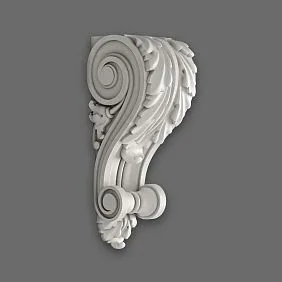
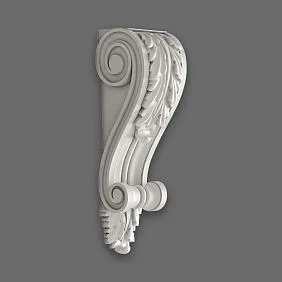
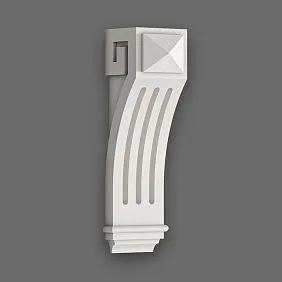
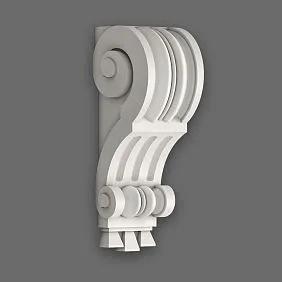
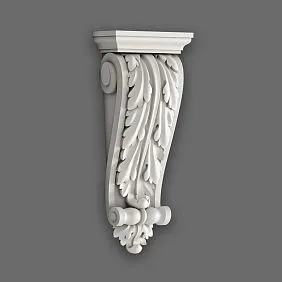
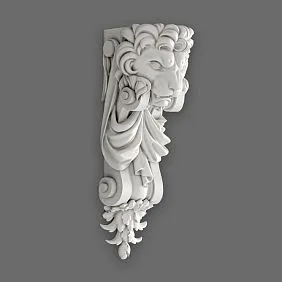
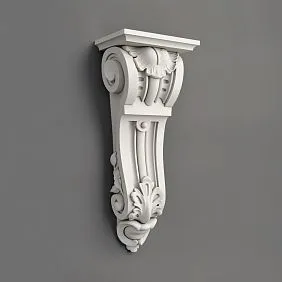
Corbels are protruding elements that visually support cornices, balconies, and bay windows. Historically, corbels were structural elements that actually bore loads. Modern polyurethane corbels are decorative but create the illusion of structural logic.
The shape of corbels varies from simple brackets to complex sculptural compositions: volutes, scrolls, lion heads, floral motifs. The size of corbels is proportional to the building's scale: from compact 200×300 mm for residential houses to monumental 600×800 mm for public buildings.
Facade decor installation: reliability technology
Installation quality is critical for the longevity of facade decor. Improper installation leads to detachment of elements, moisture penetration, and degradation of the decor.
Base Preparation: The Foundation of Success
Facade decor is mounted on a prepared surface. The base must be strong, dry, and clean. Crumbling plaster, peeling paint, dust, and dirt all reduce the adhesive's bond strength.
Preparation includes:
-
Cleaning the surface of contaminants (mechanical cleaning, high-pressure washing)
-
Removal of unstable layers of old finish
-
Repair of cracks and potholes (filling with repair compounds)
-
Leveling of coarse irregularities (local plastering)
-
Priming the base (improves adhesion, strengthens the base)
Primer is applied 24 hours before installation and must be completely dry. Deep-penetration primers are used, which strengthen the surface layer of plaster or concrete.
Marking: accuracy saves time
Before installation, detailed marking of the position of all elements is performed. For horizontal elements (cornices), a laser level or water level is used, ensuring perfect horizontality around the entire perimeter of the building.
Vertical elements (pilasters, architraves) are marked using a plumb line or laser level in vertical mode. Not only the verticality of an individual element is important, but also the symmetry of the composition: distances from corners, windows, and other reference points must be strictly identical.
Marking is applied with durable marks (chalk line, marker) and checked twice before starting installation. An error in marking is only discovered after the elements are installed, when correction requires dismantling and repeating the work.
Adhesive compounds: the chemistry of fastening
Specialized adhesive compounds resistant to atmospheric influences are used for mounting polyurethane facade decor.
Polyurethane adhesives are one-component compounds that cure under the action of air moisture. They provide excellent adhesion to most substrates (concrete, brick, plaster), are elastic after curing (compensate for thermal expansion), and are water-resistant. Setting time is 20-30 minutes, full polymerization is 24 hours.
Polymer-cement adhesives are two-component compounds based on cement with polymer additives. Cheaper than polyurethane, but less elastic. Suitable for simple-shaped elements without fine details. Setting time is 30-60 minutes.
Acrylic adhesives are water-based dispersions, environmentally friendly, odorless. Used for lightweight, small-sized elements. Not suitable for loaded nodes (cornices, large consoles).
Adhesive is applied to the back of the element in a continuous layer or in a zigzag pattern with a frequent pitch (50-80 mm). The element is pressed against the base, its position is adjusted according to the markings, ensuring tight contact over the entire area.
Mechanical fastening: insurance against detachment
Large and heavy elements (cornices wider than 30 cm, pilasters taller than 2 m) are additionally secured with mechanical fasteners. Anchor bolts or dowels are used, passing through the decor into the wall.
Fastening points are located in inconspicuous places: in recesses of the relief, under protruding elements. After installing the fasteners, the heads are concealed: filled with repair compound, sanded, and painted to match the color of the decor.
Mechanical fastening is mandatory for elements subject to wind loads (cornices, consoles, protruding pediments). Wind creates lifting forces that the adhesive may not withstand. A combination of adhesive (distributes load, seals the joint) and mechanical fasteners (local fixation) ensures maximum reliability.
Joint sealing: protection against moisture
After installation, all joints between elements and between the decor and the wall are sealed. Acrylic or polyurethane sealants for exterior use are employed, resistant to UV radiation, temperature fluctuations, and atmospheric moisture.
Sealant is applied with a caulking gun, forming a neat seam; excess is removed with a damp sponge. After the sealant polymerizes, the seams are painted along with the decor, becoming practically invisible.
Special attention is paid to sealing the top horizontal planes (tops of cornices, window canopies). Water accumulation is possible here, which can seep under the decor, causing delamination. Sealing prevents moisture penetration, ensuring the longevity of the installation.
Painting: protection and aesthetics
Polyurethane facade decor can be used without painting—the material is resistant to atmospheric influences. However, painting is recommended for two reasons: additional protection from UV radiation and the ability to create the desired color scheme.
Paints for facade decor:
-
Acrylic facade paints are water-based dispersions, vapor-permeable, elastic, and resistant to washing. Service life is 7-10 years.
-
Silicone paints have high vapor permeability, water-repellent properties, and self-cleaning (dirt washes off with rain). Service life is 10-15 years.
-
Siloxane paints combine the advantages of acrylic and silicone, offering the optimal price/quality ratio. Service life is 10-12 years.
Painting is done in 2-3 layers. The first layer is a primer, equalizing absorbency. The second and third are finishing layers, creating a uniform colored coating. Paint is applied with a brush (for complex reliefs) or by spraying (for smooth surfaces).
Color solutions are diverse. The classic approach is painting the decor in a color contrasting with the main facade: white decor on colored walls, dark on light. A monochrome solution is decor and facade of the same color, with relief perceived through light and shadow. An impressive solution is material imitation: decor is painted to resemble stone, bronze, or patinated copper.
Economics of choice: why is polyurethane more advantageous?
Let's compare the cost of ownership of facade decor made from different materials using the example of decorating a house with a facade area of 200 m².
Concrete decor: high initial costs
Set of concrete elements (cornices, trims, pilasters) — 400,000 - 600,000 rubles (material).
Installation (including rental of special equipment, work of professional installers) — 200,000 - 300,000 rubles.
Total costs: 600,000 - 900,000 rubles.
Service life: 15-25 years (with regular maintenance).
Operational expenses: periodic painting (every 5-7 years), crack repair — 30,000 - 50,000 rubles every 5 years.
Gypsum decor: beauty requires sacrifice
Set of gypsum elements — 300,000 - 500,000 rubles.
Protective treatment (multi-layer coating) — 80,000 - 120,000 rubles.
Installation — 150,000 - 200,000 rubles.
Total costs: 530,000 - 820,000 rubles.
Service life: 10-15 years (under favorable conditions).
Operational expenses: mandatory renewal of protective coating every 3-5 years — 60,000 - 80,000 rubles.
Polyurethane decor: optimal balance
Set of polyurethane elements — 120,000 - 200,000 rubles.
Installation (without special equipment, by 2-3 installers) — 60,000 - 100,000 rubles.
Painting — 40,000 - 60,000 rubles.
Total costs: 220,000 - 360,000 rubles.
Service life: 30-50 years (without loss of decorative appearance).
Operational expenses: repainting every 10-15 years — 40,000 - 60,000 rubles.
Conclusion: the savings are obvious
Polyurethane facade decor costs 2-3 times less than concrete and gypsum in initial expenses. Operational expenses are minimal. Considering the service life, the cost of ownership of polyurethane decor is 3-5 times lower than alternatives.
Design possibilities: styles and directions
Architectural facade decor made of polyurethane is stylistically universal. It reproduces any historical and modern styles.
Classicism: symmetry and proportion
Strict pilasters with fluting, cornices with modillions and dentils, pediments above windows, balustrades with turned balusters. Colors — white, cream, ivory. The decor is precisely proportional, symmetrical, creating a sense of harmony and order.
Baroque: Opulence and Drama
Richly decorated elements: cartouches, volutes, garlands, putti. Consoles in the form of atlantes or caryatids. Complex architraves with broken pediments. Colors — gilding, patina, multicolored schemes. The facade turns into a theatrical decoration.
Modern: natural forms
Asymmetric compositions, plant motifs (irises, lilies, winding stems), female faces with flowing hair. Smooth, flowing lines, rejection of right angles. Colors — muted natural (green, brown, lilac) with patina effects.
Art Deco: geometric luxury
Stepped forms, zigzags, sun rays, geometric plants. Contrasting color combinations (black with gold, white with bronze). Facade stucco creates a dynamic, contemporary image.
Modern architecture: minimalism of forms
Concise elements without ornament: simple cornices, smooth architraves, minimalist consoles. Work through proportions, not decoration. Color is monochrome, often matching the facade. Decor structures planes without visual overload.
Russian style: traditions of wooden architecture
Carved Mouldingswith plant and geometric patterns, pricheliny, towels, shutters with openwork cutouts. Polyurethane accurately reproduces fine wood carving, but surpasses wood in durability and weather resistance.
Frequently asked questions about polyurethane facade decor
How long does polyurethane facade decor last?
With proper installation and periodic maintenance (repainting every 10-15 years) — 30-50 years without loss of functional and decorative properties. The material does not rot, rust, or deteriorate from frost and moisture.
Can decor be installed in winter?
Yes, but with limitations. Most adhesive compounds work at temperatures not lower than +5°C. For winter installation, special frost-resistant adhesives are used, maintaining properties down to -10°C. At lower temperatures, installation is not recommended — the adhesive does not achieve the required strength.
Is it necessary to paint polyurethane decor?
Not mandatory, but desirable. Painting provides additional UV protection (although modern polyurethanes already contain UV stabilizers) and allows creating the desired color solution. Unpainted decor may slightly yellow from the sun over time (within 5-10 years).
How to care for facade decoration?
Minimal care: periodic washing with water under pressure (removes dust and dirt). For mechanical damage (chips, scratches) — local restoration: sanding, priming, touch-up painting. Every 10-15 years — complete repainting to renew the protective coating.
Does the decor withstand wind loads?
Yes, with proper installation. Adhesive fastening combined with mechanical (for large elements) ensures reliable fixation. Design wind load — up to 120 kg/m², corresponding to hurricane winds. Cases of decor detachment are isolated and related to gross violations of installation technology.
Does polyurethane burn?
Facade polyurethane has a flammability class of G1-G2 (low-flammable, difficult to ignite). When exposed to fire, it chars, forming a protective layer, does not support combustion. Smoke toxicity during combustion does not exceed that of wood. For objects with increased fire safety requirements, polyurethanes with special flame retardants are used.
Can custom-sized facade stucco be purchased?
Yes, many manufacturers offer custom-sized element production. This is more expensive than standard products (requires mold creation) but allows implementing unique architectural solutions. Production time for custom elements — 2-4 weeks.
Does polyurethane differ visually from plaster or concrete?
With quality execution — no. Polyurethane accurately reproduces the texture of any material. Painted and installed decor is visually indistinguishable from plaster, concrete, or stone. It can only be distinguished upon close inspection (light weight when attempting to move an element, characteristic sound when tapped).
Company STAVROS: your reliable partner in creating architectural masterpieces
Choosing quality facade decor is only half the success. The other half — professional installation, competent design, technical support at all stages. Company STAVROS combines production, design, and installation, offering comprehensive solutions for creating perfect facades.
World-class production
STAVROS producesarchitectural facade decorof the highest quality polyurethane. European raw materials, precision molds, automated casting lines, multi-stage quality control — each production stage guarantees product perfection.
Material density of 400-500 kg/m³ ensures optimal combination of strength and weight. UV stabilizers protect against solar radiation. Modifying additives increase frost resistance to 400 cycles. Geometric accuracy — deviations no more than 0.5 mm per meter of length.
Extensive assortment
In the STAVROS catalog — thousands of items: cornices of various widths and profiles, architraves for any openings, pilasters and half-columns of all orders, rustication, consoles, balustrades, pediments, keystones, decorative panels. Elements for all architectural styles are presented — from ancient classics to ultra-modern minimalism.
Standardized elements are always in stock, shipping within 1-3 days. Custom products are manufactured to order in 2-4 weeks.
Professional design
STAVROS designers and architects will develop a facade design concept considering the building's architectural style, surrounding development, and client wishes. 3D visualization allows seeing the result before work begins, making adjustments, choosing the optimal solution.
Calculation of required materials, selection of components, development of installation diagrams — all of this is handled by the company's specialists. The customer receives a turnkey solution.
Quality installation
STAVROS installation teams are professionals with years of experience in installing facade decor. Adherence to technology, attention to detail, responsibility for results. Installation is performed with a guarantee — if problems arise (peeling, cracks, deformations), the company will fix them at its own expense.
Installation includes a full range of work: base preparation, marking, element installation, joint sealing, and painting if necessary. The customer receives a finished facade without delving into technical details.
Long-term Support
Cooperation with STAVROS does not end after installation. The company provides a warranty on materials (5 years) and on installation (3 years). Consultations on decor care, maintenance recommendations, assistance with restoration if needed.
If after a few years additional elements are needed (for example, for decorating an extension), STAVROS will provide exactly the same products from the same collection, ensuring stylistic unity.
Choosing STAVROS means choosing quality, reliability, professionalism. This is a company that turns architectural dreams into reality, creating facades that inspire, delight, and last for decades. Architectural polyurethane facade decor from STAVROS is an investment in beauty that pays off with durability, aesthetic perfection, and pride in your home.