Article Contents:
- Why Modern Interiors Have Such Poor Sound
- How Acoustic Slat Panels Work: Physics Without Formulas
- Diffusion (Scattering)
- Absorption
- Construction of Acoustic Slat Panels: What They're Made Of
- Wood Species for Acoustic Slat Panels
- Oak
- Ash
- Pine and Larch
- MDF
- Where Acoustic Wooden Slat Panels Are Used
- Home theater and media room
- Living room with open floor plan
- Meeting rooms and offices
- Study and home office
- Bedroom
- Children's room
- Restaurant and cafe
- Library, conference hall, study space
- Technical parameters of acoustic slat panels: what's important to know
- Absorption coefficient (α): what it is
- Aesthetics of acoustic slat panels: beauty that works
- Backing color as a design element
- Stylistic solutions for acoustic slat panels
- Modern Interior
- Scandinavian interior
- Neoclassical Study
- Home Theater
- Acoustic Slat Panel Finishing System: Cornices, Skirting Boards, Moldings
- Installation of Acoustic Slat Panels: What Is Crucial
- Frame Mounting — for Maximum Acoustic Performance
- Direct Mounting — for Decorative-Acoustic Performance
- Acclimatization of Wooden Slat Panels
- Importance of Uniform Slat Spacing
- Calculation of Required Acoustic Panel Area
- Wooden Slat Panels and Other Natural Interior Elements: A System, Not a Set of Materials
- Acoustic Slat Panel Care
- Daily care
- Restoring oil coating
- Replacing Damaged Slats
- Common Mistakes When Choosing Acoustic Slat Panels
- Frequently Asked Questions
- How Does an Acoustic Slat Panel Differ from a Regular Decorative One?
- Are Acoustic Slats Needed in a Regular Apartment?
- Can an Acoustic Slat Panel Be Combined with Built-in Lighting?
- Which Material Is Better for Acoustic Slat Panels — Oak or MDF?
- How Often Do Acoustic Slat Panels Need Maintenance?
- Will Acoustic Slat Panels Reduce Noise from Neighbors?
- Can Acoustic Slats Be Placed on the Ceiling?
- Conclusion
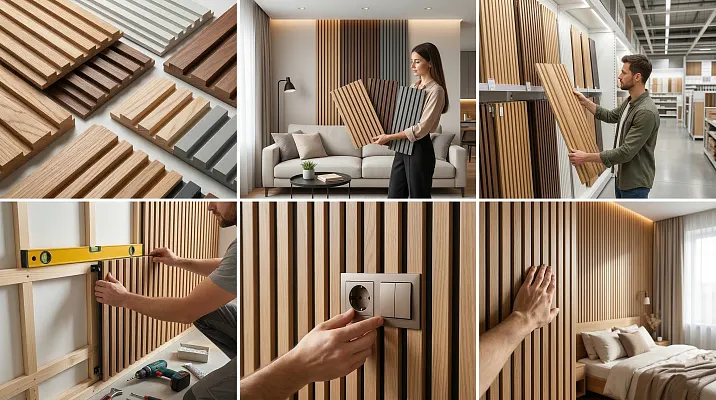
There's a problem that's not usually spoken about openly when discussing renovations. People spend hours choosing wall colors, weeks comparing parquet and tiles, arguing about furniture—and almost never think about sound. Until the renovation is complete and they find themselves in a new space where every sound reflects off bare walls, multiplies, gets confused, and turns into acoustic chaos. Conversation at the table becomes an echo. Music becomes a hum. A work call becomes discomfort.
Acoustic slat wall panels solve exactly this problem. And they do it in such a way that acoustic comfort becomes inseparable from visual appeal: the panels simultaneously manage the room's acoustics and create one of the most expressive interior looks in modern design. Two results. One solution. That's why interest in acoustic slat panels grows every year—both in residential interiors and commercial spaces.


Why sound is so poor in modern interiors
Before talking about the solution, it's worth understanding the cause of the problem. Why are modern apartments and offices acoustically uncomfortable?
The answer lies in the finishing materials. Drywall, ceramic tiles, glass, polished concrete, laminate with rigid underlay—all these surfaces are acoustically 'hard.' They don't absorb sound; they reflect it. A sound wave emitted by a source—voice, music, television—hits a hard surface, reflects, and hits another surface again. Reverberation occurs—a prolonged, booming echo that 'muddies' the soundscape.
Reverberation time (RT60)—the time it takes for the sound level to drop by 60 dB after the source stops—in a modern untreated room with hard surfaces can be 0.8–1.5 seconds or more. A comfortable value for a living space is 0.3–0.5 seconds. For a meeting room—0.2–0.4 seconds. The difference lies in the perceived clarity of sound, speech intelligibility, and physical comfort during prolonged stays.
Acoustic slat wall panels—are an elegant way to reduce reverberation time without turning the room into a recording studio lined with foam.




How acoustic slat panels work: physics without formulas
The working principle of an acoustic slat panel is based on two mechanisms: sound diffusion and absorption.
Our factory also produces:






Scattering (diffusion)
The textured surface of a slat panel is a set of parallel protrusions (slats) and recesses (gaps). When a sound wave hits such a surface, it scatters in different directions—unlike a smooth wall, which reflects it specularly. The scattered wave loses energy with each additional reflection and decays faster.
The effectiveness of scattering depends on the geometry of the surface: the width of the slats, the depth of the gaps, and their ratio. The optimal gap depth for scattering sound in the 500 Hz–2 kHz range (the human voice range) is from 20 to 40 mm. It is in this range that slat panels are most acoustically effective.
Get Consultation
Absorption
The second mechanism is the absorption of sound by the material behind the slats and by the slats themselves. Wooden slats made of porous wood partially absorb sound energy on their own. But the main absorber is the material placed behind the slats in the gap between the panel and the wall.
Acoustic felt, mineral wool, acoustic foam—these materials, installed behind the slat panel, absorb sound energy that penetrates into the gaps. The denser and thicker the absorber, the more effectively it absorbs lower frequencies. It is the combination of 'slats + absorber' that turns a decorative wooden panel into a full-fledged acoustic element.
Construction of acoustic slat panels: what they consist of
An acoustic slat panel for a wall is not just a set of slats. It is a system in which each element performs its own function.
Slats— the front part of the panel. Material: solid wood (oak, ash, pine, larch) or MDF. Shape: rectangular, beveled, or rounded profile. Width: 20–80 mm. Pitch (distance between slats): 15–50 mm.
Substrate— the base to which the slats are attached. Traditionally, it is a felt panel or MDF board. Felt substrate itself is an acoustic absorber: dense technical felt with a surface density of 500–1000 g/m² effectively absorbs mid and high frequencies.
Acoustic filler— an additional layer behind the substrate when mounted on a frame. Mineral wool 50–100 mm thick significantly expands the absorption range — down to low frequencies (125–250 Hz).
Air gapbetween the substrate and the wall during frame mounting — is also an acoustically active element: the air layer resonates at certain frequencies and, in combination with an absorber, increases the overall efficiency of the panel.
Wood species for acoustic slatted panels
Oak
Oak Slat Panels— the optimal choice for acoustic applications. A density of 700–750 kg/m³ provides sufficient rigidity of the slat, while the open porous structure of oak partially absorbs high-frequency sound. Oak accepts any tinting while preserving the natural grain pattern. Durability and resistance to mechanical impact are important parameters for public and commercial spaces.
Ash
Ash — a light, elastic species with a well-defined grain pattern. Density 650–700 kg/m³. Acoustically behaves similarly to oak. Optimal for Scandinavian and modern interiors where a light neutral tone is required.
Pine and larch
Pine is soft, porous, with a characteristic resinous smell. Higher sound absorption coefficient compared to oak due to lower density (500–550 kg/m³). Suitable for country houses, saunas, eco-friendly interiors. Larch is denser than pine, significantly more moisture-resistant, recommended for rooms with variable humidity.
MDF
MDF slats with felt backing — the most common and affordable option for acoustic slat panels. Homogeneous surface for painting, precise geometry, stable dimensions. Acoustically, MDF works primarily due to the backing and filler — the slats themselves made of dense MDF are acoustically neutral.
Where are acoustic wooden slat panels used
Home theater and media room
This is a classic application of acoustic slat panels. In a home theater, acoustic comfort is critically important: high reverberation time blurs dialogue, makes low-frequency bass 'boomy' and indistinct, and robs the soundstage of clarity. Wooden acoustic slats on the side walls and rear wall of a home theater, combined with soft furniture and carpeting, are a standard solution for achieving a comfortable RT60 of 0.3–0.4 seconds.
Visually: dark-toned oak slats on the side walls, soft armchairs in the center, a screen in focus — this is an image that works for both acoustics and atmosphere. The movie begins even before pressing the play button.
Living room with an open floor plan
Open floor plans in modern apartments and private houses are an acoustic problem. A large volume of air, hard surfaces, lack of absorbing elements — the RT60 in such a room easily reaches 1 second.Acoustic slat wall panelson one or two accent planes reduce reverberation time by 30–50% — the difference is felt immediately: the space 'calms down', voices become clearer, music — cleaner.
Meeting rooms and offices
In meeting rooms, speech intelligibility is a production issue that directly affects communication efficiency. Wooden acoustic slats with felt backing and mineral wool behind the panels are a professional solution for meeting rooms. Walls with slatted panels create both a business-like appearance and acoustic comfort. Video conferences, presentations, negotiations—everything becomes cleaner and clearer.
Office and home office
In a home office, a work call with echoing reverberation is not only personally uncomfortable but also unpleasant for the interlocutor and unprofessional. A slatted acoustic panel on the wall behind the desk is a dual solution: an aesthetically expressive background for video calls and acoustic comfort for the workspace.
Bedroom
Bedroom acoustics directly affect sleep quality. In a city apartment with external noise sources—sound leaks through walls and windows—the internal acoustics of the room also matter. Wooden acoustic slats on the wall behind the bed with felt backing reduce reflected sound, creating a 'quieter' sensation. A soft space is a physiologically favorable environment for rest.
Children's room
Children make noise. That's a fact. But noise in a room with hard surfaces is one thing, while noise in a room with sound-absorbing elements is quite another. Wooden acoustic slats made of light ash or birch with felt backing in a child's room reduce peak sound levels by 3–6 dB (subjectively perceived as a noticeable reduction in volume) and create a more comfortable environment for play, study, and sleep.
Restaurant and cafe
Anyone who has ever been in a restaurant where it's impossible to hear the interlocutor due to the multi-voiced hum understands what this is about. Poor restaurant acoustics are not just guest discomfort. It means shorter stays, lower average checks, and negative reviews. Wooden acoustic slatted panels in a restaurant are an investment in atmosphere and business. Slats made of stained oak on the side walls of a restaurant create both a warm, cozy visual image and acoustic 'calming' of the space.
Library, meeting hall, study space
Wherever speech intelligibility and concentration are important, acoustic slatted panels are an architectural standard. That is why they can be seen in the best libraries, auditoriums, conference halls—where architects understand acoustics and take it seriously.
Technical parameters of acoustic slatted panels: what's important to know
| Parameter | Value | Impact on acoustics |
|---|---|---|
| Slat width | 20–80 mm | The narrower — the higher the proportion of open substrate, the better the absorption |
| Slat spacing (gap) | 15–50 mm | Wider gap — better sound access to the absorber |
| Gap depth | 20–40 mm | Determines the scattering range |
| Underlay | Felt 500–1000 g/m² | Main absorber of mid and high frequencies |
| Filler | Mineral wool 50–100 mm | Extends absorption to low frequencies |
| Air gap | 30–80 mm | Affects low-frequency absorption |
| Slat covering | Oil / varnish (open pores) | Preserves the natural porosity of wood |
Absorption coefficient (α): what it is
The sound absorption coefficient (α) is the proportion of sound energy absorbed by a surface, ranging from 0 to 1. A perfectly reflective surface has α = 0 (smooth concrete wall ≈ 0.02–0.05). A perfect absorber has α = 1. Wooden acoustic slats with felt backing in the 500–2000 Hz range have α = 0.4–0.7. Across a broad range, it depends on the panel design and the presence of filler.
This means: an acoustic slat panel absorbs 40 to 70% of sound energy in the human speech range. For comparison: a standard drywall wall — α ≈ 0.05. The difference is an order of magnitude.
The aesthetics of acoustic slat panels: beauty that works
This raises a question that concerns most people: what does it look like? Is it true that acoustic panels don't necessarily look like foam cones in a recording studio?
Absolutely true.Wooden acoustic slat panelslook like one of the most expressive interior solutions in modern design. Even parallel slats of natural oak or tinted ash, the natural grain pattern, the play of light and shadow in the gaps — this is a wall you want to look at. Where you want to work. Next to which you want to sit.
The felt backing that performs the acoustic work is practically invisible behind the slats. With narrow slat spacing (15–20 mm), the backing is not visible at all. With wide spacing (35–50 mm) — it's visible as a dark background that visually 'deepens' the surface, making it more textured and expressive.
Backing color as a design element
The felt backing of an acoustic slat panel can be different colors: traditional black or dark gray creates a deep dark background behind the slats. This is the most popular combination: light or warm slats on a dark background — maximum contrast and a sense of depth.
Natural gray-beige felt — a neutral, delicate background.
White felt — for white and light slats in light interiors.
Colored felt — for accent design solutions (sage, mustard, terracotta behind the slats).
Stylistic solutions for acoustic slat panels
Modern interior
In a modern interior, acoustic slats are architectural geometry. Dark oak slats with 'graphite' or 'anthracite' tinting on a black felt backing — a wall that is simultaneously an acoustic and visual statement. Zero ornament, zero decorative excess — only the rhythm of lines, material, and shadow.
Scandinavian interior
Light ash slats with bleached oil coating on a light gray felt backing — a classic of Scandinavian acoustic design. Nordic purity, natural delicacy, functional honesty of the material. Combined with white walls and minimal furniture — a space where one can think and rest equally well.
Study in neoclassical style
Warm oak slats with 'walnut' or 'tobacco' tinting on a dark backing, framed bypolyurethane moldings— a slat acoustic panel in an architectural frame of a neoclassical study. Next to it —Classic Furniturewith carved details. This is the image of a study where people think, make decisions, and have serious conversations.
Home theater
Dark slats on a black felt backing on the side walls. Screen at the end. Directional lighting from built-in spotlights. Nothing extra. This is an image where cinema is the main focus, and the space 'dissolves' around the screen.
Acoustic slat panel finishing system: cornices, baseboards, moldings.
Professional acoustic slat finishing is not just the slats themselves. It is a complete architectural system that includes finishing elements.
Upper cornice.The slat field must be finished at the top.a polyurethane cornice— the ability to choose any profile: from a minimalist one for a modern style to a rich classical one for neoclassicism.
Lower baseboard.The transition from the slat field to the floor is a fundamental detail.solid wood baseboardmatching the slats — a unified natural system from wall to floor. OrSkirting board made of MDFpaintable for monochrome solutions.
Important: the baseboard in an interior with wooden acoustic slats must be coordinated in tone and material with the slats. This is not a decorative trifle—it's a detail that either completes the system or destroys it. By choosingwith a classic profile creates a sense of solidity, reliability.to match the tone of the slat panels, you create a unified natural context where the walls and floor 'speak' the same material language.
Demarcation moldingsfor two-zone wall solutions. Slat acoustic panel on the lower part of the wall, neutral plaster on the upper part—a horizontal molding at the boundary of the zones.Wooden moldings and cornicesorpolyurethane alternatives—depends on style and budget.
Installation of acoustic slat panels: what is fundamentally important
Frame installation—for maximum acoustic result
Frame installation with an air gap and acoustic filler is the standard for professional acoustic application. A 60×27 mm metal profile at a distance of 40–80 mm from the wall creates an air space. Mineral wool or acoustic foam is placed in this space. A felt underlay with slats is attached to the profile.
Such a construction provides:
-
Sound absorption by felt underlay
-
Resonant absorption by air gap
-
Additional absorption by mineral wool
-
Total absorption coefficient α = 0.5–0.8 in the range of 250–4000 Hz
Direct mounting — for decorative-acoustic result
Direct mounting of acoustic slat panel with adhesive and nails to the wall — a simpler option with limited acoustic effect. Felt underlay works as an absorber, but without an air gap and filler — only in the mid and high frequency range (500 Hz and above). Sufficient for residential spaces with moderate acoustic requirements.
Acclimatization of wooden slat panels
Wooden slats before mounting — mandatory acclimatization for 48–72 hours in the room. Under residential conditions (18–22°C, humidity 45–65%), the wood adopts the environmental parameters and stabilizes. Slats mounted without acclimatization may deform — this negates both the acoustic and visual result.
Importance of uniform slat spacing
The acoustic effect of a slat panel directly depends on the uniformity of the spacing. Uneven spacing is not only visually poor — it reduces acoustic efficiency due to uneven distribution of the absorber's open area. During installation — precise marking of spacing and vertical alignment control for each slat.
Calculation of required acoustic panel area
How much area of slatted acoustic panels is needed to achieve a comfortable RT60? Approximate calculation:
For a living room of 25 sq. m with a ceiling height of 2.7 m (volume ~67 cubic m):
-
Target RT60: 0.4 seconds
-
Required surface area with α ≈ 0.6: ~12–15 sq. m of acoustic panels
-
This is one large accent wall (4×3 m = 12 sq. m) or two walls partially
For a meeting room of 15 sq. m with a ceiling height of 2.5 m (volume ~37 cubic m):
-
Target RT60: 0.3 seconds
-
Area of acoustic panels α ≈ 0.6: ~8–10 sq. m
-
This is a wall 3×2.5 m + part of a second wall
The figures provided are approximate. An accurate acoustic calculation is performed taking into account all surfaces of the room (floor, ceiling, furniture, textiles) and their acoustic characteristics.
Wooden slat panels and other natural interior elements: a system, not a set of materials.
Acoustic wooden slats work most harmoniously when they are part of a well-thought-out material system of the interior.
Slats + wooden floor. with a classic profile creates a sense of solidity, reliability.In the tone of the slat panels, it connects the wall and floor into a single natural context.the wooden floor baseboardMade of solid oak or ash — this is the final touch, without which the system remains incomplete.
Slats + wooden slats on other elements. Wooden planksAs a furniture element — shelves, consoles, cabinet fronts in the tone of the acoustic wall panels — create a unified natural system.
Slats + staircase.In private homes with an open staircase, wooden acoustic panels on the wall of the staircase landing are both aesthetically expressive and functionally important.balusters for staircasesfrom the array to match the slats — a unified natural language for the entire interior.
Slats + furniture handles.A detail rarely discussed when choosing finishes — yet it can either 'complete' the look or disrupt it.wooden furniture handlesto match the slatted panels — this is the unity of natural material from walls to furniture.
Care for acoustic slatted panels
Daily Care
A soft damp cloth or slightly damp microfiber is enough to remove dust. The felt backing between the slats can accumulate dust — every few weeks, a light cleaning with a narrow vacuum attachment on minimum power.
Restoring oil coating
Wooden slats with oil finish: every 1–3 years — oil renewal. Light sanding with fine-grit sandpaper (240–320), dust removal, applying oil along the grain, removing excess. The surface restores protective properties and natural shine.
Replacing damaged slats
One of the advantages of slatted construction is repairability. A damaged slat can be replaced without dismantling the entire panel. This is important for commercial spaces with intensive use.
Typical mistakes when choosing acoustic slatted panels
Too dense slat spacing without considering acoustics.Narrow spacing (5–10 mm) with wide slats is visually appealing but acoustically inefficient: the open area of the absorber is too small. For an acoustically effective panel, the proportion of open gap area should be at least 30–40% of the total area.
Dense varnish coating on the slats.Slats coated with film-forming glossy varnish lose the acoustic properties of the wood material. For maximum absorption—matte oil on open pores. For medium values—matte varnish.
Installation without an air gap when low-frequency requirements exist.Direct mounting on the wall is effective only for mid and high frequencies. For low-frequency absorption (important in home theaters and music rooms)—an air gap with filler is mandatory.
Incorrect area calculation.One small slat panel in a large room is a decorative solution without noticeable acoustic effect. For measurable RT60 reduction—the area of acoustic panels should be at least 25–35% of the total surface area of the room.
Frequently asked questions
How does an acoustic slat panel differ from a regular decorative one?
Structurally—by the presence of a felt backing instead of a solid MDF board, optionally—an air gap and acoustic filler behind the panel. A decorative slat panel on a rigid backing practically does not absorb sound. An acoustic one absorbs from 40 to 80% of sound energy depending on the design.
Are acoustic slats needed in a regular apartment?
Yes, if you want to reduce uncomfortable echo, improve speech intelligibility, and make the space subjectively 'quieter'. The effect is especially noticeable in open-plan layouts, rooms with high ceilings, and spaces with minimal furniture and soft textiles.
Can an acoustic slat panel be combined with built-in lighting?
Yes. An LED strip behind the top cornice, directed at the slat wall, is a classic combination. The light emphasizes the relief of the slats and the shadows in the gaps. A built-in LED strip directly behind the slats (between the slats and the backing) creates the effect of 'floating' slats in front of a glowing plane.
Which material is better for acoustic slat panels — oak or MDF?
It depends on the task. For maximum natural look and tactile richness — solid oak. For monochrome and modern solutions for painting — MDF. Acoustically, both options are comparable — the main work is done by the backing and filler.
How often do acoustic slat panels need maintenance?
Dust — regularly, light vacuuming every few weeks. Renewing the oil finish — every 1–3 years. Replacing damaged slats — as needed, without dismantling the entire panel.
Will acoustic slat panels reduce noise from neighbors?
No. Acoustic slat panels work with reflected sound inside the room — with reverberation. They are not a soundproofing barrier against impact or airborne noise penetrating from adjacent rooms. For soundproofing — specialized structures are needed.
Can acoustic slats be installed on the ceiling?
Yes, and this is one of the most effective options, since the ceiling is the largest homogeneous surface in a room. Ceiling slat panels with felt backing are acoustically more effective than wall panels of equal area.
Conclusion
Acoustic slat panels for walls are that rare case where function and aesthetics do not conflict but enhance each other. The felt backing absorbs sound. The wooden slats create a natural architectural image. Together, they transform a wall from a passive reflective plane into an active interior element—both acoustically functional and visually expressive.
Properly selected in design, material, slat width, and spacingacoustic slat panelscombined with finishing elements—wooden skirting board, cornices and moldings—create a complete architectural system that operates on two levels of perception: auditory and visual. This is a space where you want to be—because it is equally good, quiet, and beautiful.
Full rangesolid oak slatted panels, wooden skirting boards and MDF floor skirting boards, wooden strips, polyurethane cornices and moldings— in the STAVROS company catalog.
STAVROS — production of decorative and functional interior solutions with European quality standards. Slatted wall panels, perimeter finishing systems, decorative elements for residential and commercial interiors. For those who build a space you want to live in — with all your senses.