












































































Article Contents:
- The physics of volume: why a 3D slat panel looks the way it does
- 3D slat panel construction: what it consists of
- Load-bearing base
- Slats with variable height
- Gap between slats
- Materials for 3D slat panels: what matters
- High-density MDF
- Solid oak and ash
- MDF with natural wood veneer
- 3D slat panel finishes: from matte enamel to veneer
- Matte enamel
- Two-tone finish
- Natural veneer
- 3D slat panel in interior: space and image
- Accent wall in living room: the main statement
- Bed headboard in bedroom: a sculpture for rest
- Study and home office: concentration and status
- Hallway and corridor: the first impression that lasts
- Restaurant, cafe, lobby: high-end commercial environment
- 3D Panel Technical Parameters: Design Table
- How Light Interacts with 3D Slat Panels: A Practical Guide
- Directional Side Lighting
- Built-in Lighting in Gaps
- Diffused Top Lighting
- 3D Slat Panel Installation: Subtleties That Determine the Outcome
- Foundation Preparation
- Acclimatization
- Hidden fastening
- Painting After Installation
- Compensatory gaps
- Maintaining Level When Installing the First Panel
- 3D Slat Panels and the Comprehensive Interior Ensemble
- 3D Slat Panel Care: What You Need to Know
- Trends in 3D Slatted Panels 2025–2026: What the Market Chooses
- FAQ: Everything You Need to Know About 3D Slatted Panels
- About the Company STAVROS

There are solutions that cannot be described in words—they need to be seen. The 3D slatted panel is exactly from this category. When you first see a wall clad with multi-level slats of varying projection depths, under side lighting—a feeling arises that defies rational explanation. The surface lives. It breathes with shadow and light. It changes depending on the viewing angle, time of day, lighting intensity. This is not just a finish—it is architectural sculpture on the wall of your home.
Over the past five years, three-dimensional slatted panels have evolved from an exotic item in architects' portfolios to an accessible product with a wide range and clear installation technology. Today, 3D slats are installed in living rooms and bedrooms, meeting rooms and restaurants, hotel lobbies and private offices. And each time the result is a space with character that cannot be achieved by any other means within a comparable budget.
What lies behind this effect? How does a three-dimensional slatted panel work from the perspective of light physics? How to choose parameters, material, and finish? And where does the difference lie between a panel that will last twenty years and one that will disappoint in a year and a half? Let's break it all down step by step.





The Physics of Volume: Why a 3D Slatted Panel Looks the Way It Does
Before discussing selection and installation, one must understand the nature of the three-dimensional effect—otherwise, any recommendations will be just a collection of words.
A flat surface reflects light uniformly. Every point on a flat wall is at the same distance from the light source—and is perceived by the eye as a single, faceless field. This is why a smoothly plastered and painted wall, despite the quality of work, remains visually neutral: it exists, but says nothing.
A 3D slatted panel fundamentally disrupts this uniformity. The slats protrude to different heights from the supporting base: some by 14 mm, others by 22 mm, others by 30 mm—all in one plane, in one pattern. Each slat is at its own distance from the light source. A slat protruding higher intercepts more light—and casts a deeper shadow onto the adjacent, lower slat. A continuous play of light and shadow with real depth arises—from 14 to 30 mm, and with special constructions—up to 50 mm or more.
This is not a visual trick or an imitation of volume. This is real physical relief, perceived by the eye exactly as any sculpture is perceived: as a three-dimensional object with its own lighting character. And this character changes with every change in the angle or intensity of light.
In the morning side lighting from the window, shadows on the 3D rails are long and soft—the surface looks plastic and deep. At noon under high diffuse light, the relief becomes less pronounced, the surface more neutral. In the evening, under directed artificial lighting, shadows are sharp and deep, volume is maximized. The same wall throughout the day is three different visual states.




3D rail panel construction: what it consists of
Let's break down the anatomy of a three-dimensional panel—this is important for understanding exactly what you are buying.
Our factory also produces:





Load-bearing base
An MDF board 9 or 12 mm thick is the foundation to which the rails are attached. The quality of the base determines the rigidity of the entire structure, its ability to hold fasteners, and geometric stability under humidity changes. For 3D panels with high rails (22 mm and above)—only a 12 mm base. A thinner one will bend under the weight of protruding elements in real installation conditions.
MDF density for the load-bearing base—not lower than 780 kg/m³. It is the density that determines whether the rails will maintain their shape under seasonal humidity fluctuations from 40% to 75%.
Get Consultation
Rails with variable height
This is the key element creating the three-dimensional effect. One panel can contain rails of two, three, or four height levels—from 12 to 40 mm. The distribution of heights sets the rhythm and depth of the relief. The most common combinations:
-
Two levels: 14 mm and 22 mm—soft, delicate volume, suitable for bedrooms and living rooms
-
Three levels: 14 mm, 22 mm, and 30 mm—pronounced relief with real depth
-
Four levels: 12 mm, 18 mm, 26 mm, and 36 mm — sculptural bas-relief of maximum expressiveness
The width of an individual slat in a 3D panel ranges from 25 to 80 mm. Narrow slats with variable height create a complex, almost jewel-like pattern; wide ones impart a monumental, architectural character.
Gap between slats
The gap in a 3D panel serves a function absent in flat construction: it exposes the load-bearing base, creating a background plane from which the slats 'detach.' With properly chosen contrast between the base tone and the slat tone, this gap significantly enhances the three-dimensional effect.
The most effective technique: a dark (graphite, black, dark gray) load-bearing base with light slats. Or, conversely, a light base with dark slats. The contrast creates a visual depth unattainable with monochromatic painting of the entire structure.
Materials for 3D slatted panels: what matters
3D slatted panelis produced from several materials, and the choice is not a matter of taste, but of compliance with operating conditions and long-term expectations.
High-density MDF
The most common material for three-dimensional slatted panels in residential interiors. The advantages of MDF are well-known to experienced builders and designers: absolute geometric precision, clean edges without chips, predictable reaction to paint coatings, minimal movement with humidity changes in enclosed spaces.
For 3D panels, the geometric precision of the slat is especially important. If in a flat panel a tolerance of ±0.3 mm in slat height is practically unnoticeable, in a three-dimensional structure such tolerance causes uneven shadows and disrupts the rhythm of the relief. Manufacturers of high-quality 3D MDF panels maintain a tolerance of ±0.1 mm — and this requires precise CNC milling equipment.
Formaldehyde emission class: E1 — minimally acceptable. E0 — for children's rooms and bedrooms.
Solid oak and ash
Wooden planksMade from solid oak in a three-dimensional construction — this is a completely different level of material authenticity. Each plank carries a unique grain pattern; the side edges of the protruding battens reveal the texture of the wood's cross-section. Under side lighting, the volume is perceived tactilely — you want to touch it. Under transparent oil, the oak grain takes on a bronze, almost honey tone.
Limitation: solid wood reacts to humidity changes more significantly than MDF. For 3D constructions with battens of varying heights, this requires stricter adherence to acclimatization and operating condition requirements (humidity 40–65%, no direct moisture exposure).
MDF with natural wood veneer
A compromise, but very successful option: the precise geometry of the MDF base and MDF battens combines with the visual and tactile authenticity of natural veneer (oak, ash, walnut). The result is a 3D panel with a surface identical to solid wood, while maintaining the stability of an engineered material. This is the option most commonly found in high-class projects.
3D batten panel finishes: from matte enamel to veneer
Matte enamel
A matte surface is the perfect partner for three-dimensional relief. Gloss reflects light sources, creating highlights that compete with the relief and blur shadows. A matte surface absorbs light softly and evenly, allowing shadows to be maximally sharp and expressive. For 3D panels — matte enamel is preferable to glossy in most cases.
Painting 3D panels after installation: the joints between modules are concealed under a single layer of paint. This is particularly important for three-dimensional constructions — any seam between panels disrupts the continuity of the relief pattern.
Two-tone finish
The load-bearing base and slats are painted in different tones — this enhances the three-dimensional effect manifold. The most expressive combinations:
-
Anthracite base + white slats
-
Black base + golden slats (with oak-like tint)
-
Gray-blue base + light gray slats
-
Dark green base + cream slats
Two-tone painting of 3D panels is, on one hand, technically straightforward, and on the other, requires precise color matching. It is recommended to order exact RAL codes for both tones from the manufacturer in advance.
Natural veneer
Oak, walnut, or ash veneer on slats of varying heights — under side lighting, reveals the texture of each slat individually. A slat 30 mm high is illuminated differently than its neighbor at 14 mm: each has its own lighting situation, its own tone of natural fiber. The effect is organic, alive, incomparable to any artificial material.
Veneered 3D panels are coated with clear oil or matte varnish: oil emphasizes tactility and warm tone; varnish creates a more protected, formal surface.
3D slatted panel in interior: space and image
Let's examine specific interior situations — with real parameters and visual tasks.
Accent wall in the living room: the main statement
An accent wall behind the sofa is the main canvas of the living room. It is here that3D slatted panelit fully unfolds. The relief creates a focal point, a visual anchor that draws the eye. When integrating LED strips behind the slats of the lower tier or in the gaps between levels — the surface acquires a completely new dimension in the evening: light seeps through the gaps, illuminating the dark base from below, and the slats literally 'float' above the background.
Recommended parameters for the living room: slat width 40–60 mm, three height levels (14–22–30 mm), gap 10–18 mm, dark supporting base + light slats. Painting after installation with matte enamel.
Bed headboard in the bedroom: a sculpture for rest
In the bedroom, the task of the 3D panel is different than in the living room: not to impress, but to create coziness and a sense of security. Soft, delicate relief — two levels (14 and 22 mm), narrow slats 30–40 mm, gap 8–12 mm. Tones are neutral: soft white, warm cream, powdery gray-beige. With 2700 K lighting, the slats create the perfect backdrop for evening reading: diffused warm light without a glaring source.
The three-dimensional panel in the headboard also serves a functional purpose: it visually 'frames' the bed, creating a feeling that the sleeping area is a separate, protected space within the room.
Study and home office: concentration and status
The wall behind the desk is the background for video calls and a place that shapes the work mood. A 3D panel in dark, saturated tones (anthracite, dark blue, deep forest green) creates a sense of concentration and significance. Wide slats (60–80 mm) with deep three-level relief — an architectural, monumental image.
At the same time, the three-dimensional slatted surface improves the acoustics of the room: the textured surface scatters sound waves, reducing echo and reverberation. This is not a claim—it's physics.
Entrance hall and corridor: the first impression that lasts
In a narrow corridor, a three-dimensional slatted panel creates a stunning space-expanding effect. Vertical slats with variable height on a long wall create a rhythm that guides the eye along the corridor and makes it appear visually longer. In combination withwooden skirting boardfloor-level lighting and narrow wall sconces, the entrance hall becomes an interior space, not just a transit zone.
Restaurant, cafe, lobby: a high-end commercial environment
In public spaces, 3D panels solve two tasks simultaneously: they create a prestigious image and improve acoustic comfort. A restaurant with three-dimensional slatted walls is a place where conversation isn't lost in the noise, and the space is perceived as thoughtful and high-quality. A hotel lobby with textured slatted panels in neutral warm tones is the establishment's business card, which is understood at first glance.
Technical parameters of 3D panels: design table
| Parameter | Range | Impact on Result |
|---|---|---|
| Slat height (levels) | 12–40 mm | Relief depth and shadow intensity |
| Slat width | 25–80 mm | Drawing scale, matching room size |
| Gap between slats | 5–30 mm | Visibility of background base, "air" in the drawing |
| Thickness of load-bearing base | 9–12 mm | Structural rigidity, installation reliability |
| MDF density | 720–850 kg/m³ | Durability, geometric accuracy |
| Panel length | 2400–3000 mm | Room height compatibility |
| Panel width (module) | 400–1200 mm | Ease of installation and joint visibility |
How light interacts with 3D slat panels: a practical guide
A three-dimensional slat panel is primarily a tool for working with light. Understanding this principle allows achieving the desired visual result, rather than relying on chance.
Directional side lighting
The best thing you can do with a 3D panel is to arrange directional side lighting: wall sconces, spotlights positioned to the side of the wall. With a light incidence angle of 30–60° to the wall plane, shadows from slats at different levels have varying lengths and depths—the surface gains maximum volume. This is the most cinematic and expressive lighting mode for a three-dimensional slat wall.
Built-in lighting in gaps
LED strip in the gaps between slats, directed at the load-bearing base, is an integrated light source that creates a glow-from-within effect. The slats appear to float above the luminous surface. A dark load-bearing base with warm lighting (2700–3000 K) creates a sense of depth and warmth unattainable with any other lighting method.
Technical detail: LED strip profile with or without diffuser — depending on the desired effect. Without diffuser — dotted light strips; with diffuser — uniform soft glow.
Diffused overhead light
With diffused overhead lighting (ceiling lights, chandelier), the three-dimensional effect is less pronounced — shadows are short and soft. This lighting mode is appropriate when a neutral, non-aggressive surface is needed: for example, in work areas or in rooms with high daytime load.
The conclusion from this analysis is one: when designing an interior with a 3D panel, lighting must be designed simultaneously with the selection of the panel — they are inseparable. Buying a three-dimensional panel without thinking about lighting means paying for a complex product and getting a flat result.
Installation of 3D slatted panels: nuances that determine the outcome
Installation of three-dimensional slatted panels is generally similar to the installation of flat panels — with several fundamental differences.
Foundation Preparation
Requirements for base flatness for 3D panels are stricter than for flat ones. If a flat panel visually corrects the surface with a slight wall deviation, a three-dimensional one exposes any unevenness because the relief greatly amplifies the perception of planar deviations. Base level difference — no more than 2 mm per linear meter.
Acclimatization
48 hours in the installation room — mandatory. For massive panels — 72 hours. Neglecting acclimatization with three-dimensional structures is especially dangerous: slats of different heights with uneven MDF movement will cause visible deformations on the relief surface.
Hidden fasteners
For 3D panels — only hidden fasteners. A visible screw on the front surface of the slat immediately and irrevocably destroys the integrity of the relief pattern. Clips inserted into the groove of the supporting base are the professional standard.
Painting after installation
For 3D panels intended for painting — final painting exclusively after installation. Goal: complete masking of joints between modules under a single layer of matte enamel. A visible joint line on a three-dimensional surface with relief painted in two tones is an unforgivable mistake that cannot be corrected without dismantling.
Painting technology: primer in two coats (acrylic, fine-dispersion), then final matte enamel in two coats. Each coat — with intermediate sanding after drying. For two-tone panels: first, prime and paint the supporting base, then — after drying — paint the slats while protecting the base with painter's tape.
Expansion gaps
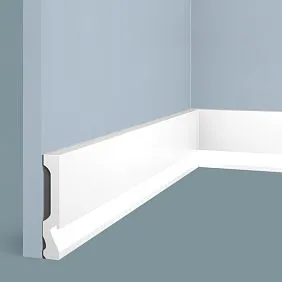
At the floor, ceiling, and end walls — a 4–6 mm gap. Concealed byfloor skirting boardat the floor and cornice molding at the top.buy MDF skirting boardin the same tone as the panel — means creating a finished construction without visible junctions.
Maintaining level during installation of the first panel
This is especially critical for 3D constructions: the slightest misalignment of the first panel during installation will cause slats at different levels to run non-parallel to the floor — and the relief will lose its rhythm. A laser level is mandatory at every stage.
3D slatted panels and a comprehensive interior ensemble
A three-dimensional slatted panel is a strong visual element that requires proper surroundings. It cannot be placed in an arbitrary interior and expected to create harmony — logic is needed.
Rafter panelson the accent wall of the living room work in ensemble with wooden details throughout the space:with a classic profile creates a sense of solidity, reliability.in the same tone,Furniture Handlesof natural wood on furniture fronts,Wooden planksin the framing of mirrors and niches—this is a continuous material thread that ties the space into a unified whole.
If there is a staircase in the house,balusters for staircasesfrom the same wood species as the veneered slats of the 3D panel—this is an architectural gesture that creates a vertical connection from the floor to the second floor.Classic Furniturewith profile details combined with 3D relief on the wall—this is modern classic without pretentiousness and without banality.
As for adjacent walls and ceiling: a three-dimensional accent wall requires neutral, calm neighbors. A white or light gray ceiling, neutral adjacent walls without pattern—this is a rule not worth breaking. Three accent walls in one room is no longer design, but chaos.
Care for 3D slatted panels: what you need to know
A three-dimensional slatted structure in the interior requires slightly more attentive care compared to a flat one—primarily because dust accumulates in the gaps and at the base of the slats.
Regular cleaning: a soft brush with long bristles or a vacuum with a brush attachment on minimum power. Move along the slats, not across. Frequency—once every 1–2 weeks depending on the dustiness of the room.
Wet cleaning: use a slightly damp soft cloth to remove stains. For matte surfaces, use a neutral cleaning agent without abrasives. Abrasives are not allowed: matte coating scratches even with gentle mechanical action.
Coating restoration: local scratches are sanded with fine sandpaper (grit 320–400), primed, and repainted with an exact color match. With the correctly selected RAL code, the result is practically invisible.
Moisture: the ends of 3D panels at the baseboard and ceiling molding must be securely covered with decorative elements. An unprotected MDF end swells and deforms when exposed to moisture. This is especially relevant for entryways due to snow water from shoes.
Trends in 3D slatted panels 2025–2026: what the market is choosing
Asymmetric relief. A shift from strictly uniform alternation of levels to an asymmetric rhythm: three slats of one height, then one tall one, again three medium ones. Asymmetry creates a lively, non-mechanical character of the surface.
Colored MDF base with white slats. Dark green, dark blue, terracotta background with white or cream slats — this is not just a play of contrast. It is a new design language where color becomes an architectural material.
Acoustic 3D panels. An acoustic filler — melamine foam or mineral wool — is integrated into the load-bearing base. Perforation of the base under the slats ensures sound absorption. Decorative and functional results in one product.
Large scale. Slats 80–120 mm wide with three-level relief up to 50 mm high — a monumental three-dimensional surface that turns a wall into an architectural object. Especially effective in high spaces from 3 m.
Minimal gap between slats with maximum relief. Slats are placed close together, almost without a gap — but with sharply differing heights. The surface is closed but volumetric: pure geometry without background, only relief.
FAQ: everything you need to know about 3D slatted panels
What is a 3D slat panel — how does it differ from a regular one?
A 3D slat panel is a structure where slats protrude from the supporting base at different heights, creating a real three-dimensional relief. A regular slat panel is flat: all slats are at the same height. A 3D panel provides play of light and shadow, sculptural volume, and a lively visual character unattainable with a flat construction.
Can a 3D slat panel be installed independently?
Yes, with basic construction skills and an accurate laser level. Key requirements: an absolutely level base (deviation no more than 2 mm per linear meter), strict horizontality when installing the first panel, hidden fasteners. Final painting is mandatory after installation, not before.
What slat sizes are best to choose for a 3D panel?
For residential areas up to 20 m², a slat width of 30–50 mm with three height levels of 14–22–30 mm is optimal. For large living rooms and commercial spaces — slats 50–80 mm with levels up to 40 mm.
Is special lighting needed for a 3D slat panel?
Special — no, but thoughtful — absolutely. Side directional light maximally reveals the three-dimensional effect. Top diffused light flattens the relief. Built-in LED strip in the gaps is an additional level of expressiveness. Plan lighting simultaneously with choosing the panel.
Can 3D panels be used in a bathroom?
Only when using moisture-resistant MDF (HMR class) and special moisture-resistant enamel or lamination. The panel ends must be sealed. Direct contact with water is excluded. If these conditions are met — possible for the sink area; above the bathtub or in the shower — not recommended.
How to choose a color for a two-tone 3D panel?
Contrast is the key rule. The greater the difference in tone between the base and the slats, the more expressive the three-dimensional effect. Classic pairs: white + anthracite, cream + dark brown, light gray + black. A monochrome panel (both elements of the same tone) is a delicate, restrained option for rooms where texture is needed without a bright accent.
What is the cost of 3D slatted panels?
Depending on the material (MDF/solid wood), finish (paint-ready/veneer), manufacturer, and region: paint-ready MDF — from 1800 rub/m², factory-painted — from 2500 rub/m², oak veneer — from 4000 rub/m². Installation — from 600 to 1500 rub/m² additionally.
How long do 3D slatted panels last?
With correctly chosen MDF (density 780–850 kg/m³), high-quality finish, and normal operating conditions — 15–25 years. If necessary — repainting without dismantling.
How do 3D slatted panels affect acoustics?
The textured surface scatters sound waves, reducing reverberation. The effect is moderate compared to specialized acoustic panels, but noticeable — especially in rooms with hard surfaces (glass, concrete, laminate).
Can 3D slatted panels be combined with ordinary flat slats?
Not only can you — it's one of the most interesting design techniques. Flat panels on adjacent walls and 3D relief on an accent wall — create a contrast in which each element enhances the expressiveness of the other.
About the company STAVROS
STAVROS is a Russian manufacturer of architectural wooden interior elements with a full production cycle. Here, we produce3D slatted panels and slatted panelsmade of MDF and solid oak with precise geometry and a rich selection of finishes,Wooden planks for decorative and structural tasks,wooden baseboardmade of solid wood and MDF for completing slatted structures,wooden skirting board purchasemade of solid oak and ash in a wide range of stains,Furniture Handlesmade of natural wood to create a material ensemble,balusters for staircaseshandcrafted, as well asClassic Furniturefor those who value meticulous craftsmanship. STAVROS works with private clients, designers, and architects across Russia, providing finish samples, professional consultation, and full support from parameter selection to final installation. If you want your 3D slatted panel to become a true interior decoration for decades—start with the right manufacturer. STAVROS is the choice for those who care about results.


