Article Contents:
- Modern design: geometry as foundation
- Modular furniture: constructor for adults
- Clear geometry: right angles and clean lines
- Materials: combination of wood, metal, glass
- Wall slats: rhythm as structuring tool
- Vertical Planks: Visual Ceiling Lift
- Horizontal slats: visual expansion of space
- Diagonal and herringbone patterns: complex geometry
- Molding as accent: framing slat blocks
- Moldings around slat panel
- Moldings between slat panels
- Ceiling rosette above slatted wall
- Combining slats with modern furniture
- Sofa against slatted wall background
- Shelving unit by slatted wall
- Console table in front of slatted wall
- Ceiling rosette: centering the composition
- Geometric rosette for modern interior
- Rosette as connection between wall and ceiling
- Alternative: without rosette, emphasis on minimalism
- Baseboard: foundation of multi-layered composition
- Wooden baseboard as continuation of slats
- Contrast baseboard: graphic boundary
- Baseboard as connection between floor and furniture
- Frequently Asked Questions
- Conclusion: multi-layered approach as new norm

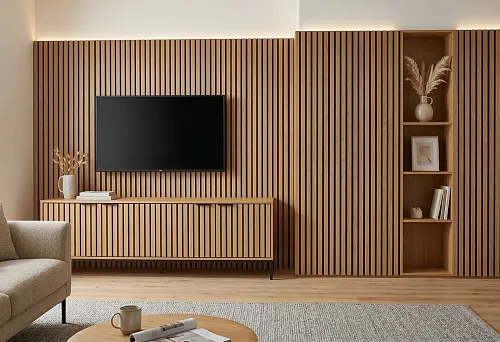
Flatness is the enemy of modern interior. Smooth painted walls without relief, texture, or depth create a box-like feeling, a soulless space.modern furniture designwith clear geometry, minimalist forms, modular structure requires architectural context — walls that are not just background, but active participants in the composition.Buy wooden skirting boardand installing on accent wall creates vertical or horizontal rhythms that structure space, create play of light and shadow, add depth.Moldings made of polyurethanebetween slat blocks or around them create frames, accents, connect wooden texture with architectural molding.3D wall finishingA combination (battens + moldings + baseboard) transforms a flat surface into a layered composition with visual depth, tactile expressiveness, and architectural complexity. In this article, we explore the mechanics of creating a three-dimensional interior: how wooden battens create rhythm, how molding creates accents, how modern modular furniture works against textured walls, how a polyurethane ceiling rosette centers the composition, and how a wooden baseboard ties everything together from below. Prepare for a journey into the third dimension of interior design.


Modern design: geometry as the foundation




Modular furniture: a construction set for adults
Modern furniture rejects monolithic forms. A sofa is not a single-piece construction but a set of sections: straight modules 80-100 cm wide, corner modules, ottomans, poufs. Sections are connected with metal brackets; the configuration can be changed in 15-20 minutes. Today, it's an L-shaped corner sofa for watching TV; tomorrow, two straight sofas facing each other for conversation; the day after, four separate armchair modules around a coffee table for a party.
A shelving unit made of separate cubes 40×40×40 cm or 50×50×50 cm, which can be stacked or placed side-by-side in any combination. Want a low horizontal shelving unit 2.5×0.5 meters? Place five cubes in a row. Want a vertical tower 0.5×2.0 meters? Stack four cubes. Want an asymmetrical composition (three cubes at the bottom, two in the middle, one on top, forming a stepped shape)? Realize it in five minutes.
Modularity provides freedom: furniture adapts to changing needs (moving to another apartment, changes in family composition, new hobbies requiring different item placement). Modularity provides savings: you buy a basic set (three sofa sections), add two more sections a year later—expanding without needing to buy a new sofa.
Our factory also produces:




Clear geometry: right angles and clean lines
Modern furniture avoids ornaments, carvings, and complex profiles. Form is reduced to geometric primitives: rectangle (dresser body, tabletop), cube (shelving module, pouf), cylinder (table leg, armchair armrest). Lines are straight or with a minimal rounding radius (3-5 mm radius on corners for safety, not decoration).
A dresser 120 cm wide, 80 cm high, 45 cm deep—a perfect parallelepiped, without protruding cornices, carved overlays, or complex profiles. Drawer fronts are flat, smooth, without handles (push-to-open system: press the front—the drawer slides out). Color is monochrome (white, gray, black) or natural oiled wood (oak, walnut, ash), but without patina, gilding, or painting.
Coffee table: rectangular or round tabletop 20-30 mm thick (thin, visually light), four thin metal legs 15-20 mm in diameter (create a floating effect—the tabletop hangs in the air, barely touching the floor). No carved cabriole legs, no friezes under the tabletop, no decorative aprons between legs—only geometry.
Get Consultation
Materials: combination of wood, metal, glass
Modern furniture combines materials: metal frame (steel with black or white powder coating, polished stainless steel, matte brass), wood shelves and tabletops (solid wood or veneer of oak, walnut, ash), glass inserts (tempered, 8-10 mm thick, clear or tinted). The combination creates a contrast of textures: the cold smoothness of metal versus the warm roughness of wood, the transparency of glass versus the opacity of wood.
A shelving unit 2.2 meters high, 1.8 meters wide: frame of black steel (vertical posts 30×30 mm cross-section, horizontal rails 20×20 mm cross-section), shelves of solid oak 25 mm thick (natural oiled color). Contrast: black frame lines are graphic, drawing a geometric grid; light wooden shelves create filling and softness. The shelving unit is visually light (frame thin, shelves not massive) but structurally strong (steel withstands heavy loads with a small cross-section).
TV stand 180 cm long, 40 cm high, 35 cm deep: MDF body painted white, doors with fronts of tinted gray glass (contents visible but not brightly, creates mystery), legs of matte brass metal 10 cm high (lift the stand off the floor, create airiness). Materials: white (neutral background) + gray glass (graphics) + golden brass (warm accent). Three materials, three textures, harmony through contrast.
Battens on walls: rhythm as a structuring tool
Vertical planks: visual ceiling lift
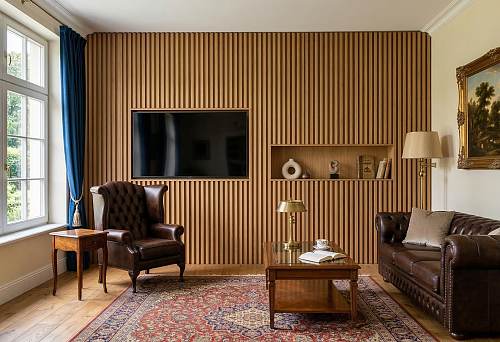
Vertical wooden battens 20×40 mm or 30×50 mm cross-section made of solid oak, installed on an accent wall with a spacing of 80-120 mm (batten width + gap width between battens), create a vertical rhythm that visually raises the ceiling, making the room appear taller.
An accent wall behind a sofa in a living room 2.7 meters high, 4.2 meters wide is completely covered with vertical battens 30×50 mm with 100 mm spacing (batten 30 mm, gap 70 mm, next batten 30 mm). Number of battens: 4200/(30+70)=42 battens. Battens are attached to a frame (horizontal 40×40 mm battens screwed to the wall at three levels: bottom at 50 cm from the floor, middle at 135 cm, top at 220 cm). Battens are screwed to the frame from the front (screws countersunk, holes filled with wooden plugs, sanded—become invisible) or with hidden fasteners (clips, metal brackets that hold the batten from the back, not visible from the front).
Effect: the wall ceases to be a flat surface, becoming textured (texture depth equals batten thickness 30-50 mm). Light falling on the wall from the side (from a window, floor lamp) creates shadows in the gaps between battens, enhancing volume. In the evening, when wall lighting is turned on (LED strip in gaps between battens or spotlights directed at the wall from above), the texture is dramatized, the wall glows in stripes.
Batton color: natural oiled oak (warm beige-brown, emphasizes wood grain), tinted oak (dark brown, wenge, gray—changes hue while preserving grain), painted (white, black, any RAL color—hides grain, emphasizes geometry). For modern interiors, tinted gray battens (cool hue, rhymes with metal furniture elements) or painted white (create black-and-white graphics if the wall behind is dark) are popular.
Horizontal battens: visual expansion of space
Horizontal battens create the opposite effect: they don't raise the ceiling but visually widen the space (the eye slides along horizontal lines, the room appears wider). Horizontal battens are more complex to install: the frame is vertical (vertical studs to which horizontal battens are attached), requiring more attachment points (each 4.2-meter-long batten rests on 5-7 studs to prevent sagging).
An accent wall in a bedroom behind a bed headboard 2.7 meters high, 3.5 meters wide is covered with horizontal battens 20×40 mm with 80 mm spacing (batten 20 mm, gap 60 mm). Number of batten rows: 2700/(20+60)=33.75, rounded to 34 rows. Battens 3.5 meters long (solid, without joints—line integrity is critical for visual effect). Vertical frame of 40×40 mm battens with 60 cm spacing (6 vertical studs for a 3.5-meter wall). Battens are attached to studs with headless nails (pneumatic gun drives in a nail that is almost invisible) or hidden fasteners.
Effect: the bed headboard against a horizontally battened wall looks monumental; the wall becomes an active element (not just a background, but architecture). Horizontal lines are calming (horizontal lines are associated with rest, earth, stability—suitable for a bedroom). Bottom lighting (LED strip at floor level, directed upward at the wall) creates an effect where battens float, hanging in the air without support.
Diagonal and herringbone patterns: complex geometry
Battens can be installed not only vertically or horizontally but also diagonally (at a 45° angle to the floor), creating dynamism. Diagonal battens require a complex frame (frame perpendicular to battens, meaning also diagonal), precise angle cuts (each batten is cut at 45° at the ends to neatly join the floor, ceiling, and wall corners).
An accent wall in a study 2.7 meters high, 3.0 meters wide is covered with battens 30×40 mm, arranged diagonally at a 45° angle with 120 mm spacing. Battens run from the bottom left corner of the wall to the top right, creating an upward movement (associated with growth, development, progress—suitable for a study). Effect: the wall is dynamic, energetic; diagonals create visual tension (in a good sense), stimulating activity.
Herringbone pattern: battens are installed at angles, forming a zigzag (one batten at +45°, next at -45°, alternating). Complex installation (each batten cut on both sides at different angles, joints must be tight), impressive visual (herringbone—a classic parquet pattern transferred to a wall, creates rhythm, richness, complexity).
Molding as an accent: framing batten panels
Moldings around a batten panel
A batten panel on an accent wall (a 3.0×2.2 meter rectangle of vertical battens) is framed with polyurethane moldings 60-80 mm wide, creating a frame. The molding creates a border, a transition from the textured batten surface to the smooth painted wall around it, accentuating the panel (like a picture frame).
The molding is installed around the perimeter of the slat panel (top, bottom, left, right), joined at the corners at a 45° angle (using a miter box or miter saw for a precise cut). The molding is glued to the wall with liquid nails (not to the slats, but to the wall between the slats and the outer edge of the molding—where the wall is smooth). The molding is painted white (classic, contrasts with dark oak slats) or to match the wall color (creates relief without color contrast, more restrained).
Effect: the slat panel is perceived as a painting, an art object, an installation on the wall (not just a finish, but a composition). The molding adds a classic touch to a modern interior, creating eclecticism (a combination of modern slats and classic molding).
Moldings between slat panels
If an accent wall is divided into several slat panels (two panels measuring 1.4×2.2 meters are positioned symmetrically, with a smooth 60 cm wide strip of wall between them), moldings are installed between the panels, creating separators.
A vertical molding 100 mm wide is installed along the central vertical axis of the wall, separating the left slat panel from the right. The molding is contrasting: if the slats are dark oak and the wall is light gray, the molding is white—creating a bright vertical line that structures the composition. Two slat panels + a central molding form a symmetrical composition where the molding is the axis of symmetry.
A horizontal molding between two tiers of slat panels (lower panel 1.2 meters high, horizontal molding at a height of 1.2 meters, upper panel 1.0 meters high) creates tiering, rhythm. The molding can be not just flat but with a profile (cavetto, torus), adding architectural depth.
Ceiling rosette above a slat wall
If the slat accent wall is in an area where a chandelier hangs above (e.g., a slat wall behind a dining table, chandelier above the table), a polyurethane ceiling rosette 80-100 cm in diameter is installed on the ceiling, centered relative to the slat wall. The rosette creates a connection between the textured wall and the ceiling, forming a vertical axis (center of the slat panel on the wall—center of the rosette on the ceiling—chandelier).
A rosette with a simple geometric pattern (concentric circles, radial rays without abundant decoration) suits a modern interior better than a Baroque rosette with cherubs. The rosette is painted white (contrasting with a colored ceiling or walls) or to match the ceiling color (relief without color contrast). The rosette adds classic formality to a modern interior with slats, creating eclecticism.
Combining slats with modern furniture
Sofa against a slat wall
A modular sofa 3.0 meters long (three 100 cm sections), upholstered in gray fabric, with black metal legs, stands against a wall with vertical wooden slats (slats are gray-tinted oak, spacing 100 mm). Color scheme: gray sofa + gray slats + white wall behind the slats (gaps between slats are white) = monochrome palette, calm, modern.
The sofa is not centered relative to the slat panel (the slat panel is 4.0 meters wide, the 3.0-meter-long sofa is not centered but shifted left or right), creating asymmetry. Asymmetry is dynamic, avoiding the static nature of a symmetrical composition. On the wall above the sofa in the area not covered by slats (left or right of the slat panel), a large art object (painting, poster in a frame measuring 100×140 cm) is hung, balancing the composition.
Contrasting pillows on the sofa (if the sofa is gray, pillows in mustard, terracotta, emerald) add a color accent, enlivening the monochrome palette of the gray sofa and gray slats.
Shelving unit against a slat wall
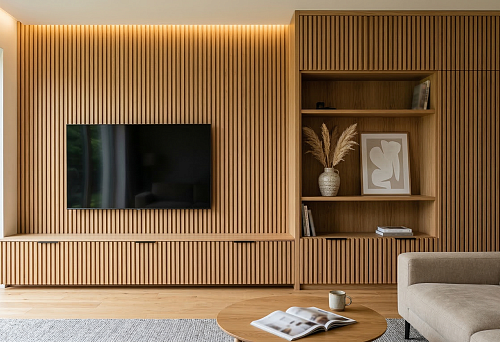
An open shelving unit 2.0 meters high, 1.2 meters wide, made of a black metal frame and natural oak shelves, stands against a wall with horizontal wooden slats (slats are natural oak, spacing 80 mm). Interaction: the horizontal lines of the slats and the horizontal shelves of the unit rhyme, creating parallels. The slats behind the unit are visible between the shelves (the unit is open, shelves do not fully cover the wall), enhancing the relief of the composition.
The shelving unit is filled with books (colorful spines create color spots), decorative objects (vases, small sculptures, potted plants). The filling creates a contrast with the graphic quality of the slats: the slats are ordered, rhythmic; the shelving unit is chaotic, lively, human.
Console table in front of a slat wall
A console table (narrow table) 120 cm wide, 35 cm deep, 80 cm high, with a white marble top and brass legs, stands in front of a wall with vertical slats (slats are black-tinted oak, spacing 100 mm). A composition is arranged on the console: a central mirror in an 80 cm diameter frame (round, brass frame, rhymes with the console legs), two symmetrical 40 cm high vases on the sides (white ceramic, rhymes with the marble top).
The mirror reflects the opposite wall, visually doubling the space. Brass elements (console legs, mirror frame) add a warm golden accent, softening the cool palette of black slats and white marble.
Ceiling rosette: centering the composition
Geometric rosette for a modern interior
For a modern interior with minimalist furniture and slat walls, a Baroque rosette with acanthus leaves and cherubs is inappropriate—a stylistic conflict. A rosette with a geometric pattern is needed: concentric circles (three or four circles of different diameters, nested within each other), radial rays (12-16 straight or slightly curved rays radiating from the center to the edge), squares or hexagons (geometric shapes inscribed in a circle).
A 90 cm diameter rosette with a concentric circles pattern: outer circle 90 cm in diameter (width 80 mm, relief 10 mm), middle circle 60 cm in diameter (width 60 mm, relief 8 mm), inner circle 30 cm in diameter (width 40 mm, relief 6 mm), central hole 10 cm in diameter for chandelier mounting. The pattern is restrained, graphic, not overloaded with details—suitable for a modern interior.
The rosette is painted white (if the ceiling is white, the rosette is white, perceived only by its relief) or in a color contrasting with the ceiling (ceiling light gray, rosette white—creates a distinct circle on the ceiling). The rosette is mounted with ceiling adhesive, the joint between the rosette and ceiling is filled, sanded, painted—the rosette looks like part of the ceiling architecture, not an applied element.
Rosette as a connection between wall and ceiling
The rosette on the ceiling is centered relative to the slat accent wall below, creating a vertical axis. If the slat wall is 4.0 meters wide, a 90 cm diameter rosette is placed on the ceiling directly above the center of the slat wall (2.0 meters from the left edge and 2.0 meters from the right edge). The chandelier hanging in the center of the rosette completes the vertical axis (center of slat wall—center of rosette—center of chandelier).
This axis structures the space, creates order, a focal point. The eye, gliding along the vertical or horizontal slats on the wall, rises to the ceiling, catches the rosette, then the chandelier—the visual path is planned, guided by architecture.
Alternative: without a rosette, emphasis on minimalism
A rosette is a classic element that adds traditionalism. If the interior is strictly minimalist (no references to classicism, only modernity), the rosette can be omitted. The chandelier is attached to the ceiling without a rosette (hidden mounting, only a thin round disc 10-15 cm in diameter on the ceiling, from which the chandelier's suspension descends).
The ceiling remains clean, smooth, and without decoration. This is a more radical minimalism, suitable for loft, high-tech, and Scandinavian minimalist interiors. But if you want to add a touch of formality, tradition, or a connection to classicism, a ceiling medallion with a geometric pattern is a compromise between classic and contemporary.
Baseboard: the foundation of a multi-layered composition
Wooden baseboard as an extension of the slats
If the accent wall is covered with wooden slats (natural oak), a natural oak wooden baseboard with a height of 100-120 mm creates a connection through the material. The baseboard is perceived as an extension of the slat cladding that has descended to floor level. The baseboard and slats are finished the same way (both natural oak with oil or both tinted gray), strengthening the connection.
The height of the baseboard should be proportional to the width of the slats. If the slats have a cross-section of 30×50 mm (face width 30 mm), a baseboard height of 100-120 mm (approximately 3.5-4 times wider than the slat) creates a harmonious proportion. If the baseboard is too narrow (60-80 mm), it gets lost against the slats and doesn't create a sufficient foundation. If the baseboard is too tall (140-180 mm), it dominates and draws attention away from the slats.
Contrasting baseboard: graphic boundary
Alternative scheme: dark slats (oak tinted wenge, almost black), the wall behind the slats is white, the baseboard is painted white. The baseboard creates a clear horizontal boundary between the floor (dark oak parquet) and the wall (white with dark slats). Contrast: dark floor — white baseboard — white wall with dark slats = graphic, black-and-white scheme, modern, strict.
The white baseboard is painted with acrylic enamel (smooth matte or semi-matte surface), the baseboard profile is simple (rectangular cross-section with a 45° bevel on the top edge or a simple ogee). Complex profiles with grooves, beads are not suitable for a minimalist interior — the simpler the profile, the more contemporary.
Baseboard as a connection between floor and furniture
If the floor is natural oak parquet, a natural oak baseboard creates the impression that the floor smoothly rises up the wall. If the furniture (shelving unit, console) is made of natural oak, a natural oak baseboard creates a family of wooden elements (floor + baseboard + furniture), contrasted against painted walls and metal elements.
Color unity is critical: if the floor is light oak (natural without tinting), the baseboard should also be light oak. If the floor is medium oak (tinted brown), the baseboard should also be medium oak. A mismatch in shades (light floor, dark baseboard) destroys the impression of unity and creates visual dissonance.
Frequently asked questions
How much does slat cladding for an accent wall sized 4.0×2.7 meters cost?
Solid oak slats with a cross-section of 30×50 mm, length 2.7 meters cost 850-1400 rubles/piece (depending on wood quality, presence of tinting). For a 4.0-meter wall with a 100 mm spacing (slat 30 mm, gap 70 mm) you need 40 slats, total 40×1100 (average price) = 44,000 rubles. Battens (40×40 mm timber, 30 meters) = 30×180 = 5,400 rubles. Fasteners (screws, clips) = 2,500 rubles. Finishing (oil or tint + oil, if you do it yourself) = 3,500 rubles. Total materials 55,400 rubles. Installation (if hiring a professional) = 12,000-22,000 rubles for a wall of this size. Total turnkey 67,400-77,400 rubles.
Can wooden slats be combined with wallpaper or only with painted walls?
A slat panel looks good against a background of smooth painted walls (the contrast between the relief panel and the flat wall is enhanced). Wallpaper with a pattern (floral, geometric) competes with the slats for attention, overloading the wall. Plain textured wallpaper (imitation fabric, textured plaster) is acceptable but creates complexity (two textures — slats + wallpaper — requires caution). Optimal: the wall behind the slat panel is painted with smooth paint (one texture — slats, one background — paint).
How to care for wooden slats on a wall?
Slats finished with oil or wax: wipe dust with a dry cloth or soft-bristled brush once a week (dust settles in the gaps between slats, it needs to be swept out). Reapply oil once a year (a thin layer of oil is applied with a sponge or cloth, rubbed in, absorbed, renews the wood protection, refreshes the color). Painted slats (paint, enamel): wipe with a damp cloth once a week, repainting possible every 5-7 years (if the paint has faded, scratched). Slats practically require no complex care, are durable (last 20-40 years without replacement).
Is slat cladding suitable for small spaces or does it visually reduce the space?
Vertical slats visually raise the ceiling, making a small space taller, which compensates for limited area (a room can be small but tall — a more comfortable feeling than small and low). Horizontal slats widen the wall, making a narrow space broader. The relief of the slats creates depth but doesn't steal area (slats add 30-50 mm depth to the wall — insignificant for area, but substantial for visuals). For small spaces, it is recommended to use slat cladding on one accent wall (not all walls), light-colored slats (white, light gray, natural oak without tinting), wide spacing (gap between slats wider than the slat — creates lightness, airiness).
Is it necessary to duplicate the color of the slats in the furniture or can contrasting colors be used?
Duplication (slats natural oak, furniture natural oak) creates unity, calmness, monochromaticity. Contrast (slats black oak, furniture white or furniture brass + white marble) creates dynamism, graphics, visual tension. Both approaches work; the choice depends on the desired atmosphere: calm harmonious (duplication) or energetic contrasting (contrast). Important: contrast must be deliberate, not random. If slats are black, furniture is white, the baseboard is also white — contrast black (slats) vs white (furniture, baseboard, possibly part of the walls) = the scheme works.
Can slats be installed independently or is it mandatory to hire a professional?
Installing slats requires precision (battens must be set strictly level and in plane, slats must be vertical or horizontal without deviations), tools (laser or bubble level 180-200 cm long, screwdriver, miter saw or miter box for cutting corners, tape measure, pencil), time (installing a 4.0×2.7 meter wall takes 8-12 hours for an experienced professional, 15-20 hours for a beginner). If you have experience with installation work, tools, and time — you can do it yourself (saving 12,000-22,000 rubles on labor). If you have no experience — it's better to hire a professional (poor-quality installation with crooked slats will ruin the entire visual, redoing it is more expensive than hiring a professional from the start).
Conclusion: Layering as the new norm
The modern interior is no longer flat. Smooth painted walls without relief, without texture, without architectural elements are a thing of the past. Layering is the new norm: walls with wooden slats creating vertical or horizontal rhythms, polyurethane moldings framing slat panels or dividing them, a ceiling medallion centering the composition from above, a wooden baseboard connecting the walls to the floor from below.
This layering creates depth: the wall ceases to be a background, becomes architecture, an object of contemplation. Layering creates tactility: slats protrude 30-50 mm from the wall, creating relief that is perceived not only by the eyes but also by the hands (running a hand over the slats, you feel the rhythm, the texture of the wood, the gaps). Layering creates a play of light and shadow: light falling on the slat wall from the side creates shadows in the gaps, lighting from below or above dramatizes the relief, changes the perception of the wall from morning to evening.
Modern furniture with clear geometry, modular structure, combination of materials (wood + metal + glass) against a background of relief walls with slats and moldings creates balance: the furniture is minimalist (clean lines, absence of patterns), the walls are architectural (relief, rhythm, structure). Balance is critical: if the furniture is complex (abundant carving, many details) and the walls are complex (slats + moldings + medallions + pilasters), the interior is overloaded. If the furniture is minimalist and the walls are minimalist (smooth painted), the interior is boring. Optimum: furniture is minimalist, walls are architecturally complex (slats + moldings).
The company STAVROS has been producing wooden slats for interior cladding and polyurethane moldings for creating multi-layered compositions for over twenty-three years. Wooden slats made from solid oak, ash, beech, larch — cross-sections from 10×20 mm (delicate, for airy compositions) to 40×60 mm (monumental, for dramatic walls), lengths from 1.0 to 3.0 meters (standard 2.4-2.7 meters for ceiling heights), finish natural with oil (emphasizes the texture of growth rings, color natural beige-brown), tinted (gray, brown, wenge, black — changes the shade, preserves the texture), painted (white, black, any RAL color — hides the texture, emphasis on geometry). Cost 420-1600 rubles/m depending on cross-section, species, finish.
Polyurethane moldings — width from 40 to 150 mm, profiles from simple geometric (rectangular cross-section, one bevel, ogee) to classic with patterns (dentils, beads, egg-and-dart, simplified acanthus leaves). Moldings are mounted with polyurethane adhesive, joints are filled and sanded, the entire molding is painted (white, patinated, wall color). Cost 380-1100 rubles/m depending on width, profile complexity.
Polyurethane ceiling medallions — diameter from 40 to 150 cm, patterns from geometric (concentric circles, radial rays, squares, hexagons — suitable for modern interiors) to classic (acanthus leaves, rosettes, garlands — suitable for eclectic interiors where modernity is mixed with classicism). Medallions are mounted with ceiling adhesive, the joint is filled and painted. Cost 2200-42000 rubles depending on diameter, pattern complexity.
Solid oak wooden skirting boards — height from 60 to 180 mm, profiles ranging from simple (rectangular cross-section with chamfer, torus) to classic (torus + ovolo + grooves). The skirting board is planed, sanded, moisture content 8-10%, ready for installation and finishing. Finishes include natural oiled, tinted, painted to match wall color, or contrasting. Price 950-2400 rub/m depending on height, profile complexity, and wood species.
Slat composition design service: STAVROS designers develop a wall slat finishing scheme (vertical, horizontal, diagonal, herringbone patterns), select slat cross-section, spacing, wood species, finish, calculate material quantity, create 3D visualization (you see how the wall will look before installation), select moldings for framing slat panels, ceiling rosettes, and skirting boards. Design cost for one wall is 8500-18000 rub; when ordering materials worth 45000 rub or more, the design cost is deducted from the order total.
Choosing STAVROS means gaining a partner in creating multi-layered interiors with 3D effects. Create walls that are not just background, but architecture. Combine wood and molding, modernity and classic, minimalist furniture and complex architecture. Live in spaces where every wall is a composition, where depth, relief, and texture create atmosphere. With STAVROS, the third dimension of interior design is achievable.