Article Contents:
- Wooden carved panels in Moscow: who they are suitable for and for what tasks
- For walls in living rooms, bedrooms, studies, hallways
- For furniture, facades, doors, niches, and decorative inserts
- For classic, neoclassical, and modern interiors with an accent
- What are wooden carved panels and how do they differ from ordinary decorative panels
- Relief, ornament, depth of pattern
- Difference from smooth wall panels
- Difference from slatted panels and applied decor
- When is it better to choose a carved panel rather than moldings or separate overlays
- What materials are used for carved panels
- Solid oak
- Solid beech
- When are paintable panels and combined solutions appropriate
- What to consider regarding wood stability, texture, and appearance
- Where carved panels are used in interior design
- Accent Wall
- Bed headboard
- Panels for study and library
- Furniture and door decoration
- Niches, portals, columns, decorative inserts
- How to choose wooden carved panels for your interior
- By style: classic, neoclassical, art deco, modern eclecticism
- By pattern: large, medium, small ornament
- By room size
- By lighting and relief depth
- By wood shade and coating type
- What determines the price of carved wood panels in Moscow
- Wood species
- Panel dimensions
- Pattern complexity and carving depth
- Processing, sanding, coating
- Custom manufacturing, delivery, installation
- Custom carved panels in Moscow: how the work is done
- Measurement and task discussion
- Selection of pattern, format, and material
- Approval of dimensions and construction
- Production
- Delivery in Moscow and Moscow region
- Installation and usage recommendations
- How to avoid mistakes when ordering carved wooden panels
- Size error
- Incorrect pattern choice for a small room
- Ignoring humidity and operating conditions
- Poorly planned joint with furniture, moldings, doors
- Selection by photo only, without considering scale
- Delivery and ordering of carved panels in Moscow and the Moscow region
- Why accurate dimensions are important before manufacturing
- What to consider during lifting and transportation
- When is it better to order together with accompanying decor
- Answers to frequently asked questions
- Can panels be ordered in custom sizes?
- Which wood species are best for interior?
- Are carved panels suitable for apartments?
- Can they be used for furniture?
- How to care for wooden panels?
- Conclusion: How to Choose and Where to Order Carved Wood Panels in Moscow
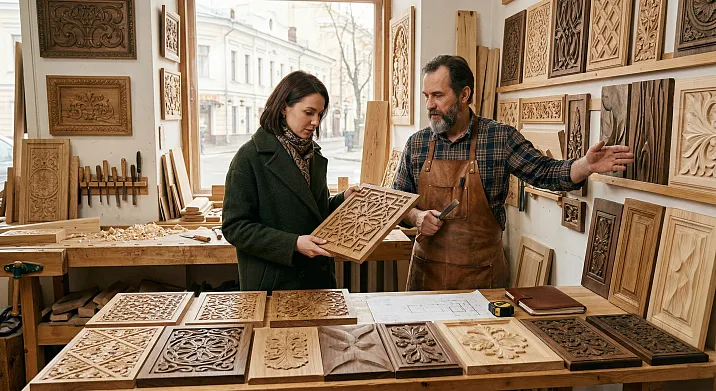
Looking for where to ordercarved wood panels in Moscowfrom the manufacturer? Below is a detailed practical guide: which panels are suitable for walls, furniture, and decorative inserts; how to choose the right material; what determines the price; what to consider before ordering; and how to organize delivery in Moscow and the Moscow region. No fluff — only specifics that will help you make the right decision the first time.

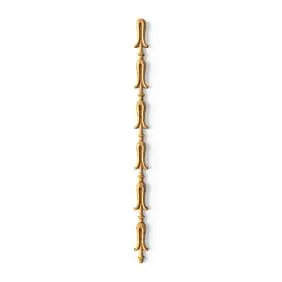
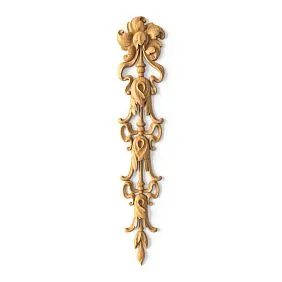

Carved Wood Panels in Moscow: Who They Are For and What Tasks They Suit
First and foremost — an honest answer to the question 'do I even need this?' Carved wood panels are not a universal solution for everyone. They are the choice of those who want to create an interior with character, substance, and long-term aesthetics. Not 'beautiful today,' but 'will bring joy in twenty years.'




For walls in the living room, bedroom, study, hallway
The living room is the most popular space for carved wall panels. It is here that an accent wall with wooden relief works most effectively: it sets the tone for the entire interior, creates a visual center, and unites furniture and finishes into a single composition. A carved panel behind the sofa or behind a fireplace portal is a solution that makes the living room unforgettable.
In the bedroom, carved wood panels are most often installed at the head of the bed. This is a powerful technique: the panel replaces the headboard, creates an architectural accent, and immediately elevates the status of the entire room. It is important to choose the right scale of the pattern — for the bedroom, a calmer, softer ornament without aggressive plasticity works better.
Study and library — a classic environment forwooden carved panels for interiorDense wood, deep relief, dark tinting or natural oak — all of this creates an atmosphere of a serious, thoughtful space. Not an official's office, but the office of a person with a position.
The hallway is a zone where a carved panel works as a first impression. There is one rule: do not overload. One accent panel or half-panels with molding framing — and the hallway acquires the look of a well-thought-out interior, not a transit corridor.
Our factory also produces:


For furniture, facades, doors, niches and decorative inserts
The scope of application of carved wooden panels is significantly wider than just walls. It is precisely panel inserts — in doors, furniture facades, niches and portals — that provide that very handmade effect for which people pay extra.
Decorative wooden insertsin furniture facades turn a serial cabinet into a product with the feel of piece production. The panel is inserted into the facade frame, painted in a common color — and visually this is perceived as complex milling with relief, although technically the solution is much simpler and more affordable.
A door leaf with carved inserts is a separate story. Here the panel works not as a 'surface' decor, but as a built-in structural element that sets the style of the entire door. For classical and neoclassical interiors, this is one of the key techniques.
Niches, portals, decorative columns — spaces where a carved wooden panel performs an architectural function. It structures the volume, creates depth, sets the scale.
Get Consultation
For classical, neoclassical and modern interiors with an accent
Carved wooden panels in Moscow are most often ordered in two styles: classic and neoclassical. And this is logical — precisely these styles involve decorative detailing of walls and furniture, working with ornament and relief.
But carved panels are increasingly entering modern interiors as well — as a single, deliberately contrasting accent. A minimalist interior with one carved panel made of solid oak is not a contradiction, but a play on contrast that speaks of high taste and self-confidence.
What are carved wooden panels and how do they differ from ordinary decorative panels
Confusion in terminology is one of the most common problems when searching and choosing. Wall panels, slat panels, overlay appliqués, carved inserts — these are all different things with different purposes and different visual natures.
Relief, ornament, depth of pattern
A carved panel is a plane made of solid wood or sheet material, on the surface of which a three-dimensional pattern is formed. The pattern is created by milling or hand carving: the tool removes layers of wood, forming a relief with a given depth and detail.
Carving depth is a fundamental parameter. Shallow relief (2–5 mm) provides fine, almost jewelry-like detailing. Medium relief (5–15 mm) creates an expressive play of light and shadow. Deep relief (from 15 mm) is already sculpturality, visible from a distance and effective even with side lighting.
The ornament on a carved panel can be floral (leaves, flowers, branches), geometric (meander, braid, rhombuses), mixed, or unique — developed specifically for the project. It is the ornament that determines the panel's belonging to a style.
Difference from smooth wall panels
A smooth wall panel is primarily about material and texture: wood grain, a uniform surface, possibly a minimal bevel along the edge. Its task is to show the beauty of the wood as such.
A carved panel adds another layer to the texture — ornament and volume. This is no longer just 'wood on the wall,' but a decorative statement: form, rhythm, pattern. It's a fundamentally different level of visual richness.
Difference from slatted panels and applied decor
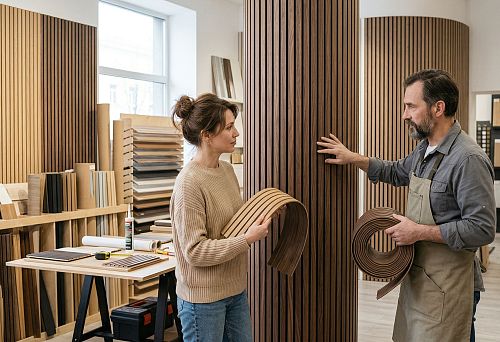
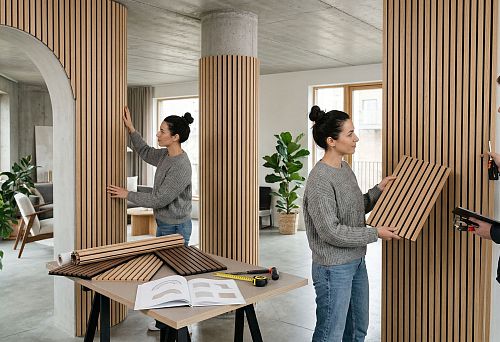
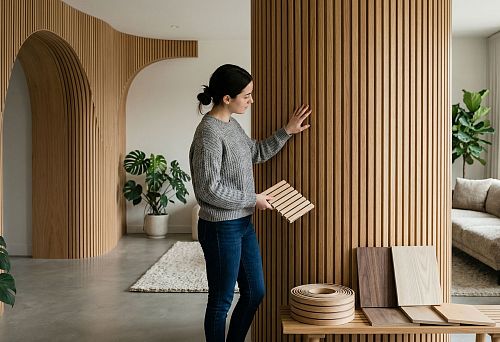
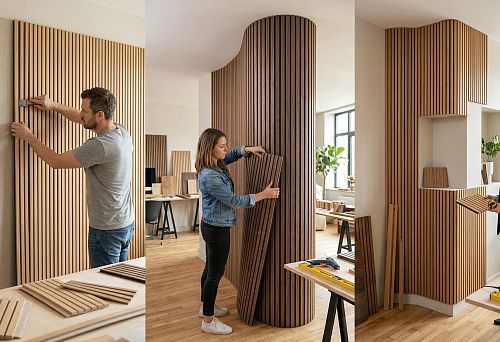
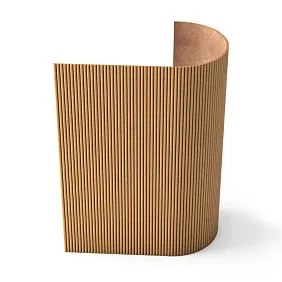
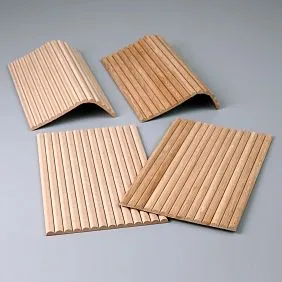
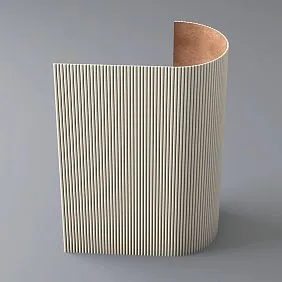
Solid oak slat panels— is a linear decor that works through the rhythm of verticals or horizontals. They create structure, but not ornament. Slats are geometry and rhythm; a carved panel is a story and an image.
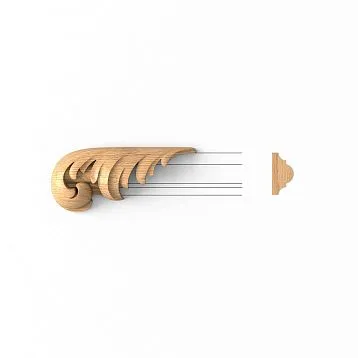
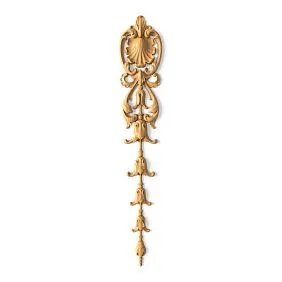
Applied decor (appliqués, rosettes, moldings) are separate elements installed on top of a finished surface. A carved panel is a single-piece product with an integrated pattern. They can be combined: a panel as the base + moldings as framing — this is a classic technique for creating a full-fledged wall composition.
When it's better to choose a carved panel rather than moldings or separate appliqués
A carved panel is the right choice when you need a unified, solid decorative object: without seams, without assembly from fragments, with a complete ornament in one piece. Appliqués and moldings offer more flexibility in composing a layout but require a design approach and precise fitting.
If the task is to create an accent surface with a strong image, and you have exact dimensions — order a carved panel. If the task is to decorate walls, doors, and furniture within a unified system — combine appliqués, moldings, and inserts from a common catalogSTAVROS wooden products online store.
What materials are used for carved panels
Material is not just 'what it's made of.' It's the character of the product, its durability, appearance, finishing possibilities, and behavior in use. Let's break it down without unnecessary words.
Solid oak
Oak is the first choice for premium carved panels. A dense, heavy, exceptionally durable wood with a pronounced grain texture. Carving on oak results in clean lines, smooth edges, and good detail. Oak is resistant to mechanical stress and reacts minimally to temperature fluctuations under normal interior use.
Under a transparent finish—oil or varnish—oak reveals its texture: large grain, natural sheen, and lively color variation. This is something impossible to imitate in any other material. Panelsmade from solid oak for interiors—are the choice of those who want a natural material with character.
The price of oak panels is above the market average. But it's a long-term investment: a properly treated and installed oak panel will look dignified even after twenty years.
Solid beech
Beech is a softer and more uniform wood. Its grain is less pronounced, and its surface is smoother. This is precisely why carving on beech achieves exceptional detail: small ornamental elements, subtle transitions, clean lines—all of these are better accomplished in beech than in oak.
Beech carved panels take enamel paint excellently: the smooth surface provides an even coat without the texture 'showing through.' This makes beech ideal for classic and neoclassical projects where panels are painted white, cream, gray, or beige and should resemble stucco.
In price, beech is somewhat more affordable than oak. In quality and durability—it is comparable with proper treatment.
When are painted panels and combined solutions appropriate
Not every carved panel needs to showcase the wood's texture. Sometimes the goal is to achieve a sculptural, relief object of a specific color that fits the interior's color scheme. In this case, the material's suitability for painting becomes a priority over its natural texture.
For large orders with non-standard sizes, combined solutions are also used: a base made of slab material with solid wood framing, or a carved insert made of oak or beech, integrated into an MDF frame structure. This allows for the creation of large formats at a reasonable cost without compromising the decorative effect.
What to consider regarding wood stability, texture, and appearance
Wood is a living material. It reacts to humidity and temperature: it expands when moistened and contracts when dried. For interior panels, this means one practical rule: installation must account for possible deformations, and the humidity in the room should be stable (optimally 45–60%).
Glued laminated solid wood behaves more stably than a solid board: lamellas selected with consideration for the grain direction compensate for internal stresses. For large-format panels, this is important—a solid board of large size is much more prone to warping.
The open texture of oak with pronounced grain creates a deep, 'living' perception of the surface. Uniform beech with the same relief looks more 'architectural' and strict. Choose based on the image you need.
Where carved panels are used in interiors
Let's go through specific zones—with examples, logic, and recommendations on scale.
Accent Wall
The most in-demand scenario. One wall in a room receives a wooden carved panel—and the entire space is reorganized around it. An accent wall made of natural wood with a pattern is not just decor; it's an architectural element that shapes the character of the room.
For the living room, the accent wall is most often located behind the sofa or behind the fireplace. For the bedroom—at the headboard. For the study—behind the desk. Important: the accent panel should be the only dominant decorative element on its plane—it should not compete with wallpaper, paintings, and other active surfaces.
Bed headboard
A carved wooden panel headboard is a solution that simultaneously serves three purposes: decorative (creates an image), functional (protects the wall), and architectural (provides a vertical accent in the bedroom). The size of the headboard panel is selected based on the width of the bed: usually +300–500 mm on each side of the mattress.
The depth of relief for a headboard is a matter of personal taste and lighting. With night spot lighting, shallow relief creates a delicate play of shadows. Deep carving with side lighting gives an almost sculptural effect. Both options are good—but you need to feel them on samples before ordering.
Panels for study and library
A study is a space that must work to convey authority. Wooden panels with carving along the perimeter of the walls, under the window, behind the desk—this is a classic of the genre. Oak stained to resemble dark walnut, deep relief, a strict pattern—this is exactly what the study of a person who makes serious decisions looks like.
A library allows for a softer palette: light beech under wax or natural oil, a calm floral pattern, open shelving framed by moldings and cornices. Carved wooden panels here create a cozy, intellectual atmosphere.
Furniture and door decor
This has already been mentioned, but let's add specifics. A carved insert in a furniture facade—standard formats: from 150×200 mm for small cabinets to 400×600 mm for wardrobes and dressers. The inserts are attached to the facade frame and painted together with it.
For doors, the three most common zones for installing carved inserts are: the upper rectangular field (transom), the central field, and the lower insert. The dimensions are selected strictly according to the door's construction. This is why precise measurements—down to the millimeter—are needed when ordering carved panels for doors.
Niches, portals, columns, decorative inserts
A niche with a carved wooden panel inside is one of the most effective architectural techniques. The niche itself creates depth, and the carved panel on its back wall turns it into a small stage. Lighting enhances the effect.
Portals and decorative columns made of solid wood with carving are already at the level of large spaces: halls, formal living rooms, reception areas. Here, scale is everything: the element must match the ceiling height and the width of the space, otherwise it will get lost or, conversely, overwhelm the interior.Wall decor made of solid wood panels— learn more about possible solutions in the corresponding section of the website.
How to choose carved wood panels for your interior
Choosing a carved wood panel is not a matter of 'like/dislike'. It is a professional decision that needs to be made based on several criteria simultaneously. Let's break down each one.
By style: classic, neoclassical, art deco, modern eclecticism
Interior style is the first and main filter. It determines the type of ornament, the shape of the panel, the depth of the relief, and the type of finish.
Classic and Baroque: lush floral ornaments, acanthus leaves, garlands, asymmetrical scrolls. Relief — medium and deep. Finish — golden oil, warm varnish, patination.
Neoclassical: symmetrical ornaments, Greek meander, simplified acanthus leaves, strict geometric frames. Relief — medium. Finish — white or cream enamel, light toning.
Art Deco: geometric ornaments, clear lines, symmetry, minimal florals. Relief — moderate. Finish — contrasting, often dark wood or lacquered black.
Modern eclecticism: there are no rules here. The carved panel serves as a deliberate contrast — the sole decorative accent in a minimalist setting. It works if the panel is strong enough to 'hold' the space on its own.
By pattern: large, medium, small ornament
Large ornament with high relief — for large rooms and high ceilings. It is legible from a distance of 3–5 meters, creating a strong first impression.
Medium ornament — universal. Works in both spacious living rooms and standard residential spaces. Pairs well with moldings and framing.
Small relief — for close viewing: headboard, furniture inlays, desk decor. Its detailing is revealed only upon close contact and with proper lighting.
By room size
Small room (up to 15–18 sq.m.) — avoid large relief and aggressive patterns. They visually shrink the space. It's better to choose one small accent panel with a soft, medium ornament.
Standard living room (18–30 sq.m.) — medium format works well: a panel 80–120 cm high on one wall, medium-scale ornament.
Large room (from 30 sq.m., ceiling height from 3 m) — here you can and should work with large formats. Full wall paneling, deep relief, large-scale ornaments.
On lighting and relief depth
This is rarely considered when ordering — and in vain. Deep relief is only revealed with side or directional lighting. Under diffuse or uniform light, it 'flattens' and loses its expressiveness.
If your space only has overhead diffused lighting — choose a relief depth of at least 10 mm so that shadows are still present. If you have the option to install side or accent lighting near the panel — you can work with any carving depth, even the finest.
By wood shade and finish type
Natural oak with oil finish — warm golden-brown shade, lively texture, light matting. This is a choice for interiors in warm tones — ochre, terracotta, dark green.
Tinted beech with enamel finish — white, gray, cream, powder. This is a choice for light classical and neoclassical interiors.
Dark tint (stain under wenge or dark walnut) — for studies, libraries, masculine spaces. Serious, substantial, without unnecessary words.
Lacquer finish with gloss — for Art Deco and formal interiors. Emphasizes relief, adds 'expensive' shine.
What determines the price of carved wood panels in Moscow
The price question is one of the first every client asks. Let's break it down honestly and systematically.
Tree species
Oak is more expensive than beech. Oak of rare cuts (tangential, radial) — is even more expensive. If the budget is limited, and the panels are planned to be fully painted — beech can be considered without loss in the final result.
Panel dimensions
The price directly depends on the area: the larger the panel, the more material, machine and manual time required. However, the square meter of a large panel often turns out cheaper than a set of small inserts with a similar total area, due to savings on edge processing and mounting elements.
Complexity of the ornament and depth of carving
A simple geometric ornament, applied by a milling machine in one pass, requires minimal labor. A complex multi-level floral ornament with manual finishing is significantly higher. Deep carving (from 15 mm) requires multi-pass processing and increases material consumption.
Processing, sanding, coating
An unpainted panel after sanding is the base cost. Oil coating with multi-layer application is an additional charge. Enamel painting with putty and priming is even higher. Patination, tinting with manual blending is premium processing. Clarify what is included in the price and what will require additional payment.
Custom manufacturing, delivery, installation
Serial products from the catalog cost less than those made to individual order. Developing a unique pattern, selecting the format, a trial sample — all this increases the cost, but also guarantees a unique result.
Delivery within Moscow and the Moscow region is calculated separately — depending on dimensions, weight, and address. Installation can be done by the contractor or the client — depending on the agreement.
Custom carved panels in Moscow: how the work is done
Many customers fear the complexity of the process — and in vain. When working with a professional manufacturer, everything is arranged logically and transparently.
Measurement and task discussion
Everything starts with precise measurements. Width, height, depth of the niche (if the panel is to be recessed), location of sockets, protrusions, adjacencies to furniture — all of this needs to be recorded before discussing the pattern and material. That is whyorder carved wooden panelsit is more correct after the measurement, not before it.
At the task discussion stage, it is important to honestly answer several questions: what is the function of the panel (accent, background, furniture insert), what is the interior style, are there adjacent decorative elements (moldings, cornices, doors), what is the lighting in the room.
Selection of pattern, format, and material
After clarifying the task, the manufacturer offers pattern options from the catalog or discusses the development of a custom pattern. At this stage, it is useful to look not only at the 2D image but also at photos of finished products in interiors and at samples in hand — to understand the real scale and depth of the relief.
The material is selected in parallel: oak or beech, solid wood or glued panel, type of finish. If the panel is ordered unfinished — it is discussed what finish the customer plans to apply themselves.
Approval of dimensions and construction
For non-standard tasks, the manufacturer creates a working drawing: exact dimensions, pattern diagram with reference to the panel edges, location and method of fastening. This stage cannot be skipped, especially if the panel is to be integrated into an existing structure.
Production
Serial products are usually in stock or produced quickly. Custom orders take from 2–3 to 4–6 weeks depending on complexity. Confirm lead times before making a prepayment.
Delivery within Moscow and Moscow Region
Large-format wooden panels require careful transportation. A good manufacturer packs each item individually — so that relief corners and edges aren't damaged during shipping. Clarify floor access conditions if you live in an apartment: some formats require professional movers.
Installation and maintenance recommendations
Wooden carved panels are mounted with adhesive (liquid nails, woodworking PVA) with additional fixation using hidden pins or screws for heavy items. After installation, seams are filled, and the surface is touched up if needed.
Care recommendations are simple: stable indoor humidity, avoiding direct contact with water, regular dry or slightly damp cleaning. Varnish or oil coating is periodically refreshed — every few years with active use.
How to avoid mistakes when ordering carved wooden panels
This section is for those who want to get everything right the first time. Reread it before clicking the order button.
Size error
The most common and most costly. Ordered a panel using rounded measurements — received an item that 'almost fits'. With wooden panels there's no 'almost': either exact, or it will need redoing. Measure twice, provide dimensions in millimeters, confirm in writing.
Wrong choice of pattern for a small room
A large ornament with deep relief in a small room is aggression, not decor. A room of 14–16 sq.m. with high ceilings of 2.7 m will not 'handle' a panel with a 30 cm high ornament. The scale of the pattern must match the scale of the space.
Ignoring humidity and operating conditions
Bathroom, kitchen with active steam, unheated cottage — not the best places for carved panels made of solid wood without special treatment. Check with the manufacturer what coating will protect the wood in specific conditions.
Poorly thought-out joint with furniture, moldings, doors
A carved panel does not exist in a vacuum. It coexists with furniture, cornices, door trims, baseboards. If their styles conflict — even the most beautiful panel will look alien. Design the area as a whole, not a separate element.
Choosing only by photo without considering scale
The photo in the catalog is taken in a studio under ideal lighting and from a certain angle. The actual product may be perceived completely differently in your interior. Request photos in real conditions, view samples in person, ask for the scale to be indicated.
Delivery and ordering of carved panels in Moscow and Moscow region
Logistics is not the most romantic topic, but very important for large products made of natural wood.
Why accurate dimensions are important before manufacturing
After production starts, changing the size is no longer possible without significant costs. Therefore — once again — measurements before ordering. Not "approximately," not "standard wall," but specific numbers taking into account outlets, openings, corners, and adjacencies.
What to consider during lifting and transportation
Carved wooden panels are fragile items during transportation: sharp relief elements are vulnerable to impacts. Packaging must be rigid. When picking up yourself, ensure you have an assistant and the right tools for unpacking without risking damage to the relief.
When ordering with delivery to an apartment, consider the dimensions: a large panel (e.g., 180×80 cm) may not fit in the elevator and will require carrying up the stairs. Notify about this in advance so the manufacturer can plan the necessary logistics.
When is it better to order together with matching decor
If you are decorating a wall with a panel, moldings, and cornices — order everything at once. This guarantees style unity, precise profile fitting, and savings on delivery. The manufacturerof wooden decorative products STAVROSoffers a full range: carved panels, moldings, cornices, overlays, trim — all from a single catalog with coordinated styles and profiles.
Answers to frequently asked questions
Can panels be ordered in custom sizes?
Yes. Manufacturing custom-sized carved wooden panels is standard practice for production companies. STAVROS accepts orders for non-standard formats based on drawings or samples. This requires precise measurements and a discussion of the design with a manager.
What types of wood are best for interiors?
Oak and beech are best suited for carved panels. Oak is for natural texture and durability. Beech is for smooth surfaces for painting and detailed ornamentation. Both materials are solid wood, not veneer, not imitation.
Are carved panels suitable for an apartment?
Yes, absolutely. Carved wooden panels are actively used in city apartments. It's important to choose the right scale (not to overload a small space) and ensure a stable microclimate. For a typical apartment, panel inserts in headboards, accent wall panels in the living room, and decorative inserts in furniture work excellently.
Can they be used for furniture?
Yes, this is one of the most popular applications. Carved inserts made of oak or beech are installed into the frames of furniture fronts — cabinets, dressers, kitchen units. Sizes are selected strictly according to the front. After installation, the panel is painted together with the front in a common color.
How to care for wooden panels?
Care is simple: dry or slightly damp cleaning, no direct contact with water, stable humidity in the room (45–60%). The varnish coating is renewed as needed. The oil coating — every 2–5 years depending on the intensity of use.
Conclusion: how to choose and where to order carved wooden panels in Moscow
Carved wooden panels are a product where no detail is insignificant. Material, ornament, size, finish, lighting, installation — each of these parameters affects the final result. But this is precisely what makes them so valuable: a consciously chosen and correctly installed product works for years and decades.
The algorithm is simple: first decide on the zone and function of the panel, then on the style and material, then on the dimensions and pattern. Only after that — place the order. Not the other way around.
Looking forcustom carved wooden panelsin Moscow? Want to selectcarved wooden wall panelsfor your project, get a consultation on material and dimensions? Go tothe STAVROS catalog— over 4000 models of solid oak and beech products for interiors, furniture, doors, and decorative inserts.
STAVROS is a Russian manufacturer with 24 years of experience in creating wooden decor for interiors. Own production, solid oak and beech, custom sizing, delivery from a single piece across Moscow and all of Russia. Quality that endures.Go to homepageand leave a request — the first step to an interior you won't regret.