Article Contents:
- Meaning and Philosophy of Carved Elements in Architecture
- Functional Beauty
- Perception Psychology
- Cultural Identity
- Appliqués and Ornamentation as Accent Details
- Types and Variety of Appliqués
- Application of Appliqués in Furniture
- Ornamental Motifs
- Folk Carving as a Source of Modern Design
- Reinterpreting Tradition
- From Facade to Interior
- Regional Characteristics as a Stylistic Choice
- Application of Carving in Interior: Practical Solutions
- Living Spaces
- Functional Zones
- Commercial interiors
- Color and Texture: Role of Finishing
- Natural Wood
- Staining and painting
- Contrast of Materials and Textures
- Effect of Combination with Smooth Surfaces
- Principle of Contrast
- Play of Light and Shadow
- Color Relationships
- Expressiveness of Form and Light: Philosophical Conclusion
- Carving as Materialized Time
- Light as Creator of Form
- Eternal Relevance of the Handmade
- Questions and Answers
- Can carved elements be used in a modern minimalist interior?
- How to care for carved wooden elements in interior design?
- Which types of wood are best suited for interior carved elements?
- How much does it cost to order carved elements for interior design?
- How to combine carved elements of different styles?
- Where is the best place to place carved elements in interior design?
- Can carved wooden elements be painted?
- Is special care required for carved elements in the kitchen?
- How to choose the scale of carved elements to match the room size?
- Do carved elements match modern appliances and furniture?
- Conclusion: expressiveness as a result of craftsmanship

The space where a person lives has always been more than just shelter from bad weather. A home is a reflection of the soul, an expression of taste, a manifestation of ideas about beauty and harmony. For centuries, people have sought to decorate their homes, transforming them from functional structures into works of art. Carved elements — appliqués, ornaments, details of domestic carving — represent one of the oldest and most expressive ways to decorate space. They can transform the simplest interior, fill it with depth, create a play of light and shadow, and add the warmth of natural material.carved wooden inlaysandwooden ornamentToday, they are experiencing a new rebirth — modern designers discover the expressive potential of this traditional decoration, adapting it to current aesthetic demands. How can we use carved elements so that they become an organic part of the interior, rather than a museum exhibit? We will explore this question in detail.


Meaning and philosophy of carved elements in architecture




Functional beauty
Carved elements have never been mere decoration — each detail carried a specific function, even if today this function is not always obvious. Architectural decoration arose from constructive necessity and gradually evolved into an independent artistic phenomenon. Understanding this connection between form and function helps to properly use carved elements in modern interiors.
Cornices and moldings adorned with carving originally served to protect joints between planes from moisture and dust penetration. Carved decoration made these functional elements also beautiful, turning necessity into virtue. Today, when airtightness is ensured by modern materials, carved cornices retain their visual function — they structure space, create transitions between planes, and establish rhythm in the interior.
Appliqués on furniture facades originally protected connection points, strengthened the structure, and concealed technical gaps.carved wooden inlaysThey transformed these utilitarian details into decorative accents. Modern furniture can technically do without appliqués, but their use adds status, individuality, and artistic value to the piece.
Carved window and door casings performed several functions. They sealed the gap between the wall and the window or door frame, protecting against drafts. Their relief surface directed rainwater away from the opening. But the main function was symbolic — casings served as protective charms, guarding against evil forces. Windows and doors were perceived as vulnerable points through which danger could enter the house, so they were framed with protective symbols and signs.
Columns and pilasters with carved capitals were originally load-bearing elements supporting floor beams. Carved decoration of the capital visually eased the transition from the vertical column shaft to the horizontal beam, making this joint more elegant. In modern interiors, columns are often decorative rather than load-bearing, but the principle remains the same — a vertical element ends in a carved capital, creating a complete composition.
Our factory also produces:


Psychology of Perception
Why do carved elements have such a strong impact on the perception of space? Here, deep psychological mechanisms are at work, related to the characteristics of human vision and emotional associations.
Relief surfaces create a play of light and shadow, which changes throughout the day depending on lighting. A smooth wall is static — it always looks the same. Carved decoration lives with changing light — in the morning, when the sun shines at a sharp angle, shadows in the recesses of the carving are deep and contrasting. At noon, under diffused light, the relief is softer, and details become more distinct. In the evening, under artificial lighting, directional lighting can create dramatic effects. This variability makes the interior dynamic and alive.
The tactile quality of carved elements is also important. Even if we do not touch them constantly, the mere knowledge that the surface is textured creates special sensations. Natural wood, with its warmth, natural roughness, and living texture, evokes a subconscious desire to touch and feel the material. This creates an emotional connection with the space, making it more homelike and cozy.
The rhythm of repeating elements acts almost hypnotically. A row of identical carved modular units on a cornice, a sequence of rosettes on a frieze, a repeating ornament on a casing creates a visual melody. The human brain seeks and finds patterns and rhythms, which evokes satisfaction, a sense of order and harmony. At the same time, small variations within the overall rhythm — individual characteristics of each carved element in handcrafted work — prevent the impression from becoming monotonous.
The symbolic meaning of ornaments works on a subconscious level. Even if a modern person does not know the exact meaning of solar signs or plant motifs, archetypal images of the sun, tree of life, flower are intuitively understood. They carry positive energy, are associated with life, growth, light, and protection. A space decorated with such symbols is perceived as safe, favorable, and meaningful.
Get Consultation
Cultural identity
In the era of globalization, when interiors around the world become similar to each other, carved elements represent a way to preserve and express cultural identity.House CarvingThey are the calling card of Russian culture, as recognizable as Matryoshka dolls or Khokhloma painting.
Using traditional ornaments in interior design is not nostalgia for the past, but a conscious choice in favor of roots, traditions, and cultural continuity. In a home decorated with carved elements featuring national motifs, a person feels a connection to the history of their people, to generations of ancestors who created and perfected these forms. This provides a sense of rootedness, belonging to something greater than one’s own life.
Traditional elements do not necessarily mean archaism. A modern interpretation of folk motifs can be quite relevant, fresh, and in tune with the spirit of the times. Stylized floral ornament, simplified geometric patterns, a new reading of classical forms — all this allows combining respect for tradition with contemporary aesthetics.
Carved elements also serve as markers of the owner's status and education. The choice of a particular ornament, the thoughtful placement of decoration, and the quality of execution speak to taste, knowledge, and financial means. Hand-carved woodwork has always been expensive, requiring the work of a skilled craftsman, so a richly decorated house demonstrated the family's wealth. Today, with more accessible ways of decorating, choosing natural carved wood becomes an even more significant statement.
Inlays and ornaments as accent details
Types and variety of inlays
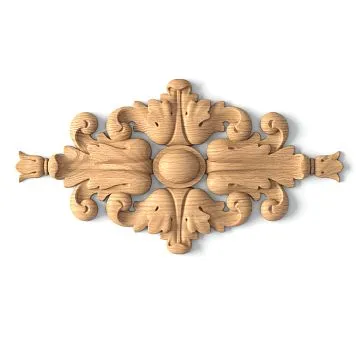
carved wooden inlaysare a universal decorating tool, allowing to transform almost any interior or furniture element. The variety of forms, sizes, and styles of inlays is breathtaking.
Corner inlays are used to decorate the junctions of two planes at a right angle. They can be small — 5–10 cm on each side — for decorating boxes, frames, small furniture. Large corner inlays, 20–40 cm in size, are used on large items — cabinets, chests, door panels. The ornament of a corner inlay is usually symmetrical relative to the angle bisector, creating a harmonious filling of space.
Central inlays are placed in the center of a surface as a compositional focus. Circular, oval, square, rectangular — the shape is chosen depending on the proportions of the decorated surface. A central inlay on a door panel, on a cabinet facade, on a bed backrest attracts attention and becomes the item’s distinctive feature. Size can vary from several centimeters to half a meter and more for large-scale items.
Horizontal frieze inlays create linear compositions. They can be narrow — 3–5 cm high — for delicate decoration or wide — up to 15–20 cm — for creating expressive ornamental bands. Friezes are used on furniture to divide planes, on walls as decorative bands, on cornices to enrich the profile. The ornament can be continuous along the entire length or modular, composed of repeating elements.
Vertical inlays are used to create pilasters, columns, vertical divisions. They can have the same width throughout their height or widen toward the bottom, imitating the perspective shortening of a column. Vertical inlays with plant ornament rising from bottom to top visually increase the height of a room or piece of furniture.
Figurative inlays have complex contours corresponding to the depicted motif. These can be flowers, leaves, fruits, birds, mascarons (decorative masks), cartouches (decorative shields). Such inlays are used as independent decorative elements, placed at key compositional points, creating accents.
Modulons — small consoles supporting cornices, shelves, balconies. They can be simple, in the form of volutes (scrolls), or complex, with plant decoration, mascarons. A row of modulons creates a rhythmic structure, decorating the transition from vertical planes to horizontal projections.
Rosettes — circular or polygonal inlays with centrally symmetrical ornament. The classic motif — a flower with petals radiating from the center. Rosettes are used as central elements on surfaces, at moldings intersections, on ceilings around chandeliers. Size ranges from several centimeters to a meter in diameter for large interiors.
Application of inlays in furniture
Furniture — a fertile field for applying carved inlays. They can turn a simple functional item into a work of art, filling it with individuality and style.
Cabinet and chest facades — the main decorative surface of solid furniture. Central inlays on doors create focal points. Corner inlays frame panels. Horizontal friezes divide tiers, creating divisions. On a large wardrobe, one can create an entire decorative system of inlays of different types, turning a utilitarian item into a work of furniture art.
Bed headboards are traditionally richly decorated with carving. A central inlay with plant ornament or geometric pattern becomes the compositional center. Side parts may be decorated with vertical elements. The top edge of the headboard is often finished with a frieze with repeating ornament. Carved headboards transform a bed from a place for sleeping into the main piece of the bedroom.
Tables receive decoration on the apron — the stretcher connecting legs. A horizontal frieze around the table perimeter creates a decorative band. Corner inlays at the junctions of the stretcher and legs enhance the visual connection of elements. The tabletop can also be decorated — a carved border along the edge, a central inlay, or a rosette. Dining and coffee tables with rich carved decoration are especially effective.
Chairs and armchairs are decorated on backs, armrests, stretchers. A carved chair back — a classic element of traditional furniture. The ornament can be openwork, creating a lacy structure, or relief, with deep carving. Armrests of chairs are finished with carved inlays, often in the form of animal heads, volutes, plant motifs. Chair legs can be decorated with vertical inlays or be turned with carved details.
Buffets and vitrines — items intended for display, especially require decorative treatment. Carved inlays on facades, cornices, bases turn a buffet into a true centerpiece of the dining room. Glass doors are framed by carved casings. The upper cornice is decorated with modulons, friezes, rosettes. Such a buffet becomes an architectural element of the interior.
Mirrors in carved frames — a separate category of decorative objects. The frame can be simple, with shallow relief, or incredibly rich, with multi-layered carving, gilding, inlay. A mirror in a carved frame is not just a utilitarian item, but a decorative panel that decorates the interior on its own. Placed opposite a window or chandelier, it multiplies light and space, adding an element of luxury.
Ornamental motifs
The choice of ornament for inlays determines the style of the item and the mood it creates. There are several main types of ornaments, each with its own symbolic system and associations.
Plant ornaments — the most common and diverse. Leaves of acanthus, oak, grapevine, pomegranate fruits, roses, lilies, palmettes — the arsenal of plant motifs is vast. Plant ornament is associated with nature, growth, fertility, life force. It can be naturalistic, with carefully detailed botanical elements, or stylized, simplified to a decorative formula. Plant inlays work well in any interiors — from classical to modern.
Geometric ornaments are based on lines, circles, polygons, their combinations. Meanders, braids, rhombuses, stars, rosettes with geometric structure create clear, rhythmic compositions. Geometric ornament is more strict, cold, rational compared to plant ornament. It suits modern interiors where clarity of lines and minimalism of forms are valued. At the same time, geometric ornament can be very ancient, archaic, dating back to pagan symbols.
Zoomorphic ornaments include images of animals, birds, fantastical creatures. Lions, griffins, dragons are often used as supporting elements — legs of furniture in the form of lion paws, armrests of chairs with eagle heads. Birds — doves, owls, peacocks — symbolize various qualities and create a certain mood. Zoomorphic motifs add dynamism, drama, and can be playful or menacing depending on interpretation.
Anthropomorphic elements — mascarons (decorative masks), caryatids and atlantes (female and male figures supporting architectural elements), cherubs. A human face or figure in ornament creates a special, almost mystical feeling. Mascarons can be serious, cheerful, grotesque — their expression sets the tone of the composition. Using anthropomorphic elements requires delicacy — in excess, they can create a tense, uncomfortable feeling.
Mixed ornaments combine different types of motifs in a single composition. For example, plant scrolls from which birds or masks emerge, a geometric frame filled with plant ornament. Such complex compositions are characteristic of rich, multi-layered styles — Baroque, Rococo. They require skill in creation and a sense of proportion in application.
Abstract ornaments do not depict specific objects, but create free compositions from lines, spots, volumes. This is the most modern type of ornament, allowing to move away from traditional motifs and create something unique. Abstract carving can be organic, resembling natural forms, or strictly geometric, based on mathematical constructions.
Carved folk art as a source of modern design
Reinterpreting tradition
House CarvingA rich source of inspiration for modern designers. Centuries-perfected forms, time-tested proportions, deep symbolism provide material for endless interpretations and adaptations.
Direct citation of traditional forms is the most obvious way to use the heritage of house carving. Modern homes are adorned with casings reproducing historical samples of a specific region and period. This creates an effect of authenticity, but requires a serious approach. Direct citation works when the entire concept of the building or interior is based on historical stylization. A single 19th-century carved casing on the facade of a modern house with panoramic windows will look out of place.
Stylization allows preserving the spirit of traditional carving by simplifying or modifying forms. For example, a complex floral ornament of a casing is reduced to several main elements, contours become more graphic, detailing is reduced. Such stylization can organically fit into a modern interior, introducing a note of tradition without excessive ornamentation. Stylized elements of house carving are used as accents, not as total decoration.
Abstraction goes even further — the principle of ornament organization, its rhythmic structure is taken, but specific motifs are replaced with abstract forms. For example, the traditional three-part structure of a casing (upper lintel, side sills, window sill) is preserved, but instead of carved floral motifs, simple geometric forms, play of planes, contrast of materials are used. This allows preserving traditional logic while adopting a modern aesthetic.
Inversion changes the relationship between figure and background. In traditional carving, the ornament projects over the background or is cut through. A modern interpretation may make the ornament recessed, execute it in contrasting material, create a negative image. Such inversion preserves the recognizability of the motif but gives it freshness and unexpectedness.
Scaling radically changes the perception of a traditional element. A small ornament of a casing, enlarged dozens of times and applied as decoration of an entire wall, becomes a powerful graphic accent. Or conversely — a large facade carving element, reduced and used as furniture applique, acquires intimacy and intimacy. Playing with scales — an effective technique of modern design.
From Facade to Interior
Traditionally, house carving decorated the exterior walls of buildings — facades, porches, window casings. Modern practice transfers these elements inside, creating interesting interior solutions.
Carved panels on walls — direct transfer of facade decoration into interior. A panel reproducing a fragment of house carving — casing, transom, frieze — becomes a standalone decorative object. It can occupy the entire wall, creating a large-scale accent, or be a small accent, a jewel of the interior. A carved panel is especially effective with backlighting, which reveals the relief and creates dramatic shadows.
Wooden partitions with carving perform the function of space zoning while maintaining visual connection between zones. Pierced carving, traditionally used in transoms, becomes material for delicate partitions. Light passes through the pattern, creating a play of light and shadow in the interior. Such a partition is both a functional element and a work of art.
Ceilings with carved decoration — a bold and effective solution. Carved beams, coffered ceilings with ornament, central rosette around a chandelier transform the ceiling from a neutral plane into the main decorative element of the interior. Motifs of house carving — solar symbols, floral ornaments — naturally look on the ceiling, associated with the sky, the upper world.
Doors with carved decoration become portals, grand entrances between rooms. Traditional door casing with lintel, sills, and window sill is transferred to interior doors. The door panel itself may be adorned with appliques, carved panels with ornament. A grand entrance door, richly decorated with carving, sets the tone for the entire interior.
Fireplaces with carved portals — the focal point in the living room. A fireplace portal, adorned with carving in the traditions of house carving, creates an atmosphere of coziness and solidity. Columns or pilasters beside the firebox, carved frieze, central applique above the firebox — all these are elements borrowed from facade decoration and adapted for the fireplace.
Furniture in the style of house carving unifies the interior into a single ensemble. A cabinet adorned with carving in the same motifs as wall panels or door casings becomes part of the overall decorative program. This approach creates stylistic unity, transforming a set of items into a thoughtfully composed ensemble.
Regional characteristics as a stylistic choice
House CarvingDifferent regions of Russia had their own distinctive features. Today, these regional characteristics can become the basis for a stylistic choice, allowing to create an interior with a specific character.
Northern carving, with its strict geometry, archaic solar symbols, flat interpretation, suits minimalist, restrained interiors. Clear lines, rhythmic repetition of simple forms, absence of excessive ornamentation resonate with modern aesthetics. Northern carving in interiors creates a sense of solidity, connection with antiquity, masculinity.
Volga carving, with its baroque opulence, deep relief, abundance of floral motifs, suits rich, representative interiors. Grape clusters, palmettes, roses, intertwined in complex compositions, create an atmosphere of abundance and luxury. Volga carving requires space and high ceilings — in a small room, it may overwhelm.
Ural carving, combining northern strictness with Volga ornamentation, allows for compromise solutions. Geometric base is enriched with floral details, creating a balance between minimalism and luxury. Ural carving is universal, suitable for most interiors.
Siberian carving with Eastern influences — a choice for those seeking exoticism and uniqueness. Dragons, lotuses, complex interweavings of lines add mystery to the interior, creating a sense of travel to another culture. Siberian carving harmonizes well with Eastern interior elements — Chinese furniture, Japanese accents.
Choosing a regional style is not only an aesthetic decision but also a way to emphasize a connection with a specific place, region, cultural tradition. If a house is built in a certain area, it is logical to use motifs of local house carving, creating an organic connection with the surroundings.
Application of carving in interior: practical solutions
Residential spaces
Each room in a house has its own function and atmosphere, which determines the character and volume of carved decoration.
Living room — a formal space where the most elaborate decoration is appropriate. Carved panels on the main wall create a focal point. A fireplace portal with carved framing becomes a compositional center. A ceiling rosette around a chandelier adds grandeur. Door casings with rich lintels emphasize the importance of entering the room.carved wooden inlaysCarved elements on furniture facades unify the interior into a stylistic whole. But it is important not to overload the space — better a few expressive elements than total coverage of all surfaces with decoration.
Dining room also belongs to formal spaces. Here, the center of composition becomes a buffet or display case with carved decoration. A dining table with carved apron and legs supports the theme. Wall panels in the lower third of walls create a respectable background. Ceiling cornice with modular elements completes the composition. Carving in the dining room should be sufficiently restrained to not distract from food and conversation, yet create a sense of festivity.
Bedroom — an intimate space requiring a more delicate approach. Carved headboard — the main decorative element. It can be tall, almost to the ceiling, creating a canopy effect, or more modest, to the height of pillows. Carved frame of a mirror on a dressing table, door casings of cabinets — additional accents. Ceiling decoration in the bedroom should be soft, non-aggressive — deep shadows and dramatic reliefs are inappropriate here.
Office — a place of work and concentration. Carving here should be serious, solid. Bookshelves with carved cornices and bases, a work desk with decorated legs, wall panels of wood with carved inserts create an atmosphere of solidity. Ornaments are preferably geometric or floral, but restrained. Color palette is dark — natural wood with lacquer finish or dark stain.
Children's room requires a special approach. Carving here can be more playful, including zoomorphic motifs — birds, animals, mythical creatures. But sharp angles, deep recesses must be excluded for safety reasons. Carved appliques on furniture must be securely fastened. Colors can be bright, cheerful. As the child grows, the decoration can be changed, adapted to age.
Functional zones
Utility rooms can also be decorated with carved elements, but taking into account their specific characteristics.
Foyer - the first space seen by those entering the house. Here, it is important to make an impression, but the space is usually small. A carved door portal, a decorative coat rack, or a key console, a mirror in a carved frame - this is enough to create the desired atmosphere. Carving in the foyer should be sufficiently large and readable - fine details in a narrow space are not perceived.
Staircase - a standalone decorative object. Carved balusters, decorative newel posts with carved capitals, carved handrails create a grand character for the staircase. The railing can be with pierced carving, creating an openwork structure. Under the staircase, a carved panel or console can be placed. A staircase with rich carved decoration becomes an ornament of the hall, attracting attention.
Kitchen - a space with high humidity, temperature fluctuations, and contamination. The use of carved decoration here is limited. However, carved appliqués on furniture facades (provided with good protective treatment), carved clock frames, decorative shelves are possible. It is important to choose locations away from the stove and sink, where the impact of aggressive factors is minimal. Carving in the kitchen should be of simple form, without deep recesses where dirt could accumulate.
Bathroom - the most challenging place for applying carved wood. Constant humidity and direct contact with water make natural wood a problematic material. If very much desired, carved decoration in the bathroom should use the most moisture-resistant species (teak, larch), ensure ideal protective treatment, and place elements away from direct water contact. Alternative - polyurethane imitations of carving, resistant to moisture.
Balcony or terrace - a transitional zone between interior and exterior. Carved balcony railing in the style of domestic carving connects the facade and interior. Carved brackets supporting the awning, decorative posts, frieze under the railings create a complete composition. Wood for the balcony must be treated with facade compositions resistant to ultraviolet and precipitation.
Commercial interiors
Carved decoration effectively works not only in residential, but also in public spaces.
Restaurants with national cuisine or concept use carved decoration to create an authentic atmosphere. A Russian restaurant with carved panels imitating domestic carving, carved chair backs, buffets in folk furniture traditions immerses visitors in the appropriate atmosphere. Carving here becomes part of a theatrical space, enhancing the impression of the kitchen.
Boutique hotels use carved decoration to create a unique identity. A hall with carved panels, a staircase with carved balusters, rooms with carved headboards and mirrors in carved frames create a memorable image, distinguishing the hotel from chain hotels with standard decor. Carving adds a sense of handcrafted work, individual approach, attention to detail.
Representative-class offices may use carved decoration to create a solid, prestigious impression. A negotiation room with a carved table and carved panels on the walls, a manager's office with carved furniture demonstrate the company's success, its connection to traditions, solidity. However, it is important not to overdo it - too rich decoration may appear pretentious, outdated.
Museums and cultural centers naturally use carved decoration as part of the exhibition or interior design. A museum of wooden architecture, a center for folk crafts logically should be designed using authentic domestic carving or its modern interpretations. This creates immersion in the theme, enhancing the educational effect.
Color and texture: role of finishing
Natural wood
Preserving the natural color of wood is the simplest and often most effective way to finish carved elements. Natural wood carries warmth, liveliness, and a connection to nature.
Transparent varnish protects wood without hiding its texture. Wood texture - annual rings, grain direction, natural color variations - is itself a decorative element. Carving reveals this texture, making it even more expressive. Varnish can be matte, creating a soft, velvety feel, satin, giving a slight gloss, or glossy, creating a mirror surface. Matte and satin varnishes are preferable for interior carving - they do not create glare, and wood texture reads naturally.
Oil finish penetrates deeper into the wood structure than varnish, emphasizing texture and making color more saturated. Oil does not form a film on the surface, leaving wood tactilely pleasant and warm. The drawback is less protection compared to varnish, requiring periodic renewal. Oil finish is ideal for furniture, carved panels in interior, where there are no extreme conditions.
Wax finish provides a soft silk-like gloss, emphasizes texture, and creates tactile pleasure. Wax is rubbed into the surface, fills pores, and creates a protective layer. This is the most traditional way of finishing wood, used for centuries. Wax requires regular renewal, but the care process itself is pleasant - polishing with wax is meditative, creating a special connection with the object.
Combined finish uses different methods on one item. For example, carved relief is coated with wax, while the background is varnished. This creates a contrast of textures - matte carving on a glossy background or vice versa. Playing with different finishes adds depth, emphasizing relief.
Staining and painting
Changing the color of wood expands decorative possibilities, allowing carved elements to be adapted to the color scheme of the interior.
Stains and toning agents change the color of wood while preserving visible texture. Wood can be lightened to almost white, or the tone can be intensified to create the effect of valuable species. Dark stains - walnut, padauk, wenge - give carving a solid, noble appearance. Light tones create lightness and airiness. Colored stains - blue, green, red - provide unexpected effects, allowing carving to fit into a modern interior.
Covering paints completely hide wood texture, creating a uniform colored surface. For carving, this may be justified when color is important rather than material texture. White color - a classic choice for carved decoration in light interiors. White carving on white or light walls stands out only through relief, play of light and shadow. This creates an elegant, aristocratic atmosphere. Colored paints - pastel or saturated - allow carving to become an accent, drawing attention to it.
Patina creates an effect of aging, noble wear. A contrasting second layer is applied over a base coat of paint, partially worn away, revealing the lower color on raised parts of the relief. Dark color remains in recesses, light color on raised parts. This emphasizes relief, creates depth, gives a sense of the object's history. Patina can be gold, silver, or colored - depending on the desired effect.
Gilding - the most luxurious finish. Electroplated gold, gold leaf, or gold paints transform carving into a precious object. Gilding can be full or selective - only on raised parts of the relief. Gold carving creates an atmosphere of luxury, solemnity, evoking traditions of imperial palaces and boyar estates.
Contrast of materials and textures
Combining carved wood with other materials creates interesting visual and tactile effects.
Wood and metal - a classic combination. Bronze or brass inlays on carved furniture, metallic inlays in wooden carving, combination of carved wooden and wrought metal elements in one composition create a contrast of warm and cold, soft and hard. Metal emphasizes the organic nature of wood, while wood softens the coldness of metal.
Wood and stone also work well together. Carved wooden framing around a stone fireplace, carved wooden elements on a stone wall, stone countertop on a carved wooden base - these combinations create a sense of solidity, connection with natural elements. Both materials are natural, but different in character - stone is cold, static, eternal, wood is warm, alive, changeable.
Wood and glass create a contrast between massiveness and lightness, opacity and transparency. A display case with a carved wooden frame and glass doors, carved mirror frame, glass door with a carved wooden frame - glass does not compete with carving, but reveals its beauty through contrast.
Wood and textile - a traditional combination in furniture. A carved wooden chair upholstered in velvet, brocade, or leather creates comfort and luxury. The softness of fabric contrasts with the hardness of wood, creating tactile variety. Color and texture of textile can complement or contrast with wood, creating different effects.
Wood and smooth modern surfaces - plastic, laminate, painted panels - create a contrast between tradition and modernity. This contrast can be the basis for an interesting eclectic interior, where a carved element becomes a highlight in a minimalist space.
Effect of combining with smooth surfaces
Principle of contrast
Carved elements are most expressive against smooth surfaces. The contrast between relief and flat, complex and simple, detailed and monochromatic creates visual tension, making the interior dynamic and interesting.
A single accent in a minimalist space is a powerful design technique. Imagine a white room with simple forms, minimal furniture, smooth walls. In this space, a single carved panel, richly ornamentedwith wooden ornamentbecomes the absolute focal point. It does not compete with other elements, does not get lost in detail. The gaze inevitably draws attention to it, lingers, examines the details. Such an approach requires boldness — leaving most of the space empty, concentrating all decorative energy at one point.
Rhythmic repetitions create structure. Several identical carved elements placed at regular intervals on a smooth wall create rhythm, organize space. This can be a row of carved rosettes, a sequence of vertical appliqués, a group of carved frames. The empty space between elements gives the eye a rest, emphasizing the rhythmic structure.
Carved decoration framing a flat surface creates a frame that focuses attention on the enclosed space. A smooth wall framed by carved molding is perceived as a painting or panel. Within the frame, an artwork, mirror, or simply a surface of another color or texture can be placed. The carved frame transforms an ordinary interior element into a significant object.
Game of Light and Shadow
The relief of carving creates a play of light and shadow, especially expressive against smooth surfaces.
Natural lighting changes throughout the day, and carved elements live in harmony with these changes. Morning sunlight, shining at a sharp angle, creates long dramatic shadows in the recesses of the carving, making the relief appear especially deep. Midday diffused light more gently reveals details, nuances of form become discernible. Evening lighting, on the other hand, creates a new play of shadows, revealing the carving from an unexpected side. When placing carved elements, one must consider where light falls at different times of day.
Artificial lighting allows complete control over the lighting character. Directed light from a spotlight, striking along the surface of the carving, creates the most dramatic effect — deep black shadows, brightly lit protrusions, contrasting play. Diffused light from general sources more gently outlines forms, creating a calm, comfortable perception. Underlighting creates an unusual, slightly mystical effect — shadows directed upward, which is unfamiliar to the eye.
Sliding light is especially good for revealing relief. The light source is positioned so that rays slide along the carved surface at a very sharp angle. Under such lighting, even a small relief casts a noticeable shadow, making the carving appear deeper, details revealed to maximum extent. This is a classic museum technique that can be used to highlight especially valuable carved elements.
Backlighting (backlit) works effectively with pierced carving. Light passes through the openings, creating a silhouette image of the ornament. Such backlighting turns a carved partition or panel into a glowing object, creating soft diffused lighting in the room, emphasizing the delicacy of the carving.
Color relationships
The color of the carved element relative to the background determines the character of its perception.
Contrasting combinations — dark carving on a light background or light on dark — create maximum readability, clear graphics. Natural dark wood on a white wall looks expressive, noble. White carving on dark gray or black backgrounds creates an elegant, aristocratic impression. Contrast makes carving the dominant element, immediately drawing attention.
Subtle combinations — similar shades, slight tonal differences — create a more delicate effect. Light wood on a cream wall, tinted wood on a wall of similar tone stands out primarily due to relief, not color. Such an approach creates an elegant, unobtrusive atmosphere, where carving is present but does not shout.
Monochromatic solution — carving and background of the same color — creates a bas-relief effect, where only plasticity, only light and shadow work. White carving on a white wall, wood stained to match the wall color stands out exclusively by relief. This is the most refined, aristocratic variant, requiring high-quality execution — any imperfections will be noticeable.
Accent color solution uses carving as a color accent in a neutral interior. A brightly colored carved panel — red, blue, green — against white or gray walls becomes a color spot, attracting attention. This approach is characteristic of modern eclectic interiors.
Expressiveness of form and light: philosophical conclusion
Carving as materialized time
Each carved element carries time — the time spent creating it, the cultural tradition it embodies, the time during which it will serve. In an era of mass production and disposable items, carving represents the opposite pole — slow, thoughtful creation, designed for a long life.
Hand carving is dozens or hundreds of hours of master’s work. Each tool cut, each ornament swirl is created with deliberate effort, requiring concentration, skill, and sensitivity to the material. In the finished product, this time is present invisibly but perceptibly. An object into which much time and effort has been invested possesses a special aura; it is valuable not only aesthetically but also ethically — as evidence of human labor and craftsmanship.
Cultural time — centuries and millennia during which ornamental systems were formed, techniques refined, knowledge passed from master to apprentice. Contemporary carving stands on the shoulders of this tradition, even if it reinterprets it. Using traditional motifs, we connect to this long cultural process, becoming part of it.
Future time — longevity of carved elements. Quality carving survives generations, is passed down as heritage, becomes a family relic. Unlike stamped decor, which becomes outdated morally within a few years, carved wood becomes more valuable over time — patina adds nobility, the object’s history enriches. A carved chest that is a hundred years old is more valuable than a new one not only materially but emotionally — it preserves memories of the past, connects generations.
Light as the creator of form
Carving exists only with light. Without light, relief is invisible, ornament unreadable, all complexity of form remains hidden. Light recreates carving anew at every moment, revealing some details and hiding others, changing depth of shadows, direction of lines, overall impression.
Natural light, changing throughout the day and year, makes the carved element a living, constantly renewing object. The same carved casing looks different on a clear summer noon and on a cloudy autumn day, under morning sun and evening twilight. This variability prevents perception from stagnating, each time offering a new reading of a familiar form.
Artificial lighting allows us to direct the perception of carving. Properly placed light can turn a modest carved element into a dramatic compositional center or, conversely, delicately reveal its beauty without demanding attention. Playing with lighting — the most important tool for designers working with carved decoration.
Shadow is as important as light. It is shadow that creates volume, reveals depth, shows the plasticity of form. Carving without shadow is a flat image. Deep black shadow in the recesses of the ornament, soft half-shadow on rounded forms, absence of shadow on brightly lit protrusions — this gradation creates three-dimensionality, transforming a flat board into a volumetric composition.
Eternal relevance of the handmade
In the era of digital technology, when any form can be modeled on a computer and reproduced on a CNC machine, hand carving retains special value. It carries something that cannot be programmed — the living touch of the craftsman, his sense of material, barely perceptible deviations from perfect symmetry, which make the form alive.
Each hand-carved element is unique. Even if the craftsman creates a series of identical appliqués, there will be minor differences between them — a slightly deeper cut here, a softer transition there. These micro-variations are not consciously perceived but are subconsciously felt, creating a sense of individuality and handmade craftsmanship.
Machine carving is perfectly precise, all elements are absolutely identical. This has its advantages — predictability, low cost, fast production. But in this perfection lies coldness, lack of soul. A space filled exclusively with machine-made decor may be technically flawless but emotionally empty.
Combining hand-carved and machine-made elements is a sensible compromise for modern interiors. The bulk of decor — standard moldings, cornices, simple appliqués — can be machine-produced. Key elements — central carved panels, unique headboards, fireplace surrounds — are handcrafted, becoming true works of art and the interior’s signature features.
Questions and answers
Can carved elements be used in a modern minimalist interior?
Yes, and it can be very effective. The principle is one or two expressive carved accents in a minimalist space. For example, a single carved panel on a white wall or a carved headboard in a Spartan bedroom. The contrast between the complexity of carving and the simplicity of the surroundings creates a powerful visual effect. Choose elements with clear graphic carving, avoid excessive ornamentation.
How to care for carved wooden elements in the interior?
Regularly remove dust with a soft brush or a specialized dust broom — dust accumulates faster in the recesses of carving. Wipe once a month with slightly damp cloth, then dry. Do not use aggressive cleaning agents. Once a year, renew the protective coating — wax or oil. Avoid direct sunlight, which can fade the wood and dry it out.
Which wood species are best suited for interior carved elements?
Linden — ideal for delicate openwork carving, soft and pliable. Oak — for furniture and elements requiring strength, provides clear deep carving. Beech — good for furniture appliqués, strong and beautiful. Birch — affordable, has a beautiful texture. Walnut — noble color, durability, but expensive. Ash — expressive texture, well-suited for large elements. The choice depends on the element’s purpose and budget.
How much does it cost to order carved elements for the interior?
Costs vary significantly. A simple machine-carved appliqué — from 500 to 3000 rubles. A hand-carved appliqué of medium complexity — from 5000 to 20000 rubles. A complex hand-carved panel — from 50000 to 300000 rubles depending on size and detail. A carved headboard — from 30000 to 200000 rubles. A full set of carved decor for a room — from 100000 to one million rubles. Prices are approximate and depend on region and craftsman.
How to combine carved elements of different styles?
It’s better to stick to one stylistic direction within a single room. If using floral ornaments, let all elements feature floral motifs. If geometric — accordingly. You can vary complexity — richer decoration on main elements, simpler on secondary ones. Mixing styles (e.g., baroque and modern) requires a professional approach; otherwise, it results in chaos.
Where are carved elements best placed in the interior?
Focal points — areas where the gaze naturally falls upon entering a room. Main wall in the living room, headboard, fireplace surround, entrance door. At eye level and slightly above — here decor is most carefully examined. In well-lit areas where light and shadow play will highlight the relief. Avoid placing in corners, behind furniture, or in dark areas — there the beauty of carving will be lost.
Can wooden carved elements be painted?
Yes, painting expands decorative possibilities. Covering paints completely hide the wood texture, creating a smooth colored surface. White is classic for carved decor. Colored paints allow integrating carving into the interior’s color scheme. Patination creates an antique effect. Gilding adds luxury. Use quality paints and properly prepare the surface — prime and sand.
Do carved elements on the kitchen require special care?
Yes, the kitchen is a challenging environment due to humidity, grease, and temperature fluctuations. Carved elements must be coated with a protective finish resistant to these factors — polyurethane varnish or special kitchen paint. Place carving away from the stove and sink. Regularly clean grease residues with specialized wood cleaners. Avoid complex deep carving, where cleaning is difficult — prefer simple forms.
How to choose the scale of carved elements to match room size?
For small rooms (up to 20 m²) choose small elements, delicate carving, avoid over-decorating. For medium rooms (20–40 m²) standard-sized elements are suitable, you can create several decorative accents. For large rooms (over 40 m²) large elements are needed, otherwise they will be lost — tall headboards, large panels, elaborate surrounds. Ceiling height also matters — the higher the ceiling, the larger the elements can be.
Do carved elements combine with modern appliances and furniture?
Yes, with the right approach, it creates an interesting eclectic style. The contrast between traditional carving and modern forms adds dynamism to the interior. It’s important to maintain balance — if furniture is ultra-modern and minimalist, carved decor should be restrained and accentual. If the interior’s base is classical with carved decor, modern appliances should be integrated delicately, possibly built into carved furniture. Color harmony helps unify disparate elements.
Conclusion: expressiveness as a result of craftsmanship
carved wooden inlays, wooden ornamentand elementshouse carvingrepresent a powerful tool for creating expressive, deep, emotionally rich interiors. In an era of mass production and standardization, carved decor returns individuality to space, connects it to the traditions of craftsmanship, evokes a sense of handmade care and attention to detail.
Expressiveness of carved elements is determined by many factors. Quality of execution — primary: clear relief, detailed work, harmonious proportions distinguish a master’s work from a craft project. Proper placement — carving should be placed where its beauty will be appreciated, where light will reveal the relief, where it will become an organic part of the composition. Thoughtful color solution — natural wood, toning, painting, patination must match the overall interior concept.
Play of light and shadow — the soul of carved decor. Without proper lighting, even the most virtuosic carving remains unnoticed. Thoughtful backlighting, use of natural light, understanding how relief perception changes depending on light direction and quality — all this transforms decoration into the art of light direction.
Contrast with smooth surfaces enhances carving expressiveness. Complex is perceived more sharply against simple, detailed against monochrome, relief against flat. Modern approach to using carved decor — not total ornamentation of all surfaces, but targeted application, creating accents and focal points that organize space and guide perception.
Connection with cultural heritage adds additional depth to carved elements. Using traditional motifs of domestic carving — this is not imitation of antiquity, but conscious engagement with roots, dialogue with tradition. Each ornament carries meanings accumulated over generations. Solar symbols, floral compositions, geometric patterns — these are not just beautiful pictures, but a language through which our ancestors spoke about the most important things: connection with nature, cyclicity of life, protection and well-being.
Modern interpretation of traditional forms allows avoiding museum-like aesthetics while preserving the spirit of heritage. Stylization, simplification, abstraction, and scale alteration — all these techniques enable the use of traditional ornamentation's richness in a contemporary context. A carved element can be both a quotation from the past and a bold modern statement on the theme of tradition.
The durability of carved wooden decoration is its important advantage. Unlike trendy decorative techniques that become outdated within a few years, quality carving transcends time. It will remain relevant for ten, twenty, or even fifty years. Moreover, over time, carved wood becomes even more beautiful, acquiring a noble patina of age and filling the home and family with history.
Investing in carved decoration is an investment in long-term quality of life. A space adorned with carving creates a unique atmosphere — of coziness, solidity, connection to traditions, and respect for craftsmanship. Such a space is pleasant to inhabit, never tiresome, and reveals new details every day. Carved decoration turns a home into more than just a place of residence — it becomes a true home, a space filled with meaning, beauty, and soul.
STAVROS offers a wide selection of carved elements for interiors — from simple inserts to complex compositions, from traditional folk carving motifs to modern interpretations. The assortment includes items made from various types of wood, differing levels of complexity and cost. Professional consultants will help select elements that harmoniously fit a specific interior, taking into account the style, scale of the space, and project budget. STAVROS works with ready-made items as well as accepts custom orders — creating unique carved elements based on the client’s or designer’s sketches. Quality materials, craftsmanship, attention to detail, and professional approach at every stage — from consultation to installation — ensure that carved decoration becomes a genuine interior accent, its distinctive feature, and a source of pride for owners for many years.