Article Contents:
- Magic of transformation: how carved details change space
- Psychology of relief surfaces' impact
- Emotional climate of the home
- Architecture of details: classification of carved elements
- Applied ornaments: point accents of big style
- Three-dimensional architectural details
- Staircase elements: vertical symphony
- Material Science: The Soul of Wood in the Master’s Hands
- Luxury species for elite decoration
- Technological species for mass production
- Exotic Species: Luxury in Details
- Stylistic Navigation: From Classic to Avant-Garde
- Historical line of styles
- Modern Interpretations
- 21st century technologies serving traditional craftsmanship
- Digital design
- High-Precision Equipment
- Innovative Finishes
- Practical selection: professional secrets
- Defining Functional Requirements
- Stylistic Compatibility
- Budget planning
- Installation and Integration: The Art of Proper Mounting
- Preparatory work
- Joining technologies
- Final finishing
- Operation and Maintenance: Preserving Beauty for Decades
- Regular Maintenance
- Preventive measures
- Restoration and repair
- Economic efficiency: investments in beauty and status
- Impact on property value
- Long-term perspective
- Social status
- Regional specifics: market features and offerings
- Moscow market: concentration of craftsmanship
- Saint Petersburg: traditions and innovations
- Regional centers: accessibility and quality
- Trends and prospects: where the industry is heading
- Ecological requirements
- Personalization and customization
- Integration with smart technologies
- Buying psychology: how to make the right decision
- Defining priorities
- Working with consultants
- Making a decision
- Conclusion: the art of proper selection

Want to turn an ordinary home into a work of art? Dream of a home where every detail exudes nobility and elegance? Then it's time to buy carved decorative elements and immerse yourself in the world of true beauty, created by the hands of true masters.
In today's world of standard apartments and generic solutions, carved decoration becomes that magical key that opens the door to the kingdom of individuality. This is not just decoration — it is a philosophy of life, where beauty matters and quality is paramount.


Magic of transformation: how carved details change space




Psychology of relief surfaces' impact
When a sunbeam glides over the surface of a carved applique, creating a play of light and shadow, true magic occurs. The human brain instinctively responds to complex textures and ornamentation, perceiving them as signs of quality and status. This is an evolutionary program ingrained in us over millennia of civilization's development.
Wooden carved appliques activate brain areas responsible for aesthetic perception and emotional response. Scientific studies show: people living in environments with quality decor experience less stress, sleep better, and feel more confident.
Our factory also produces:


Emotional climate of the home
Each ornament carries a specific energy. Plant motifs create a sense of connection with nature, geometric patterns stimulate logical thinking, and classical baroque scrolls immerse one in an atmosphere of luxury and grandeur. Carved wooden panels become not just decoration, but a tool for creating the desired mood in the home.
Get Consultation
Architecture of Details: Classification of Carved Elements
Applied Decorations: Point Accents of Grand Style
The world of wooden decorative appliqués impresses with its diversity. From miniature rosettes with a diameter of 30 mm to large-scale compositions of 600×400 mm — each size solves its own artistic tasks.
Round rosettes with a diameter of 80–150 mm are ideally suited for centering compositions on furniture facades. They create focal points that attract attention and organize perception of the entire object.
Corner elements measuring 100×100 mm mask joints and transitions while simultaneously adding elegance. Corner appliqués with asymmetrical plant motifs in the modern style are especially effective.
Long friezes 80–120 mm wide create horizontal decorative bands, visually expanding space and adding rhythmic composition.
Three-dimensional Architectural Details
Carved capitals transform ordinary columns into architectural masterpieces. The Doric order, with its strict geometry, emphasizes the masculinity of the interior; the Ionic order, with its elegant volutes, adds femininity; and the Corinthian order, with its lush acanthus leaves, creates an atmosphere of imperial grandeur.
Carved brackets serve a dual function: they support shelves, cornices, balconies, and simultaneously decorate them. Sizes vary from compact 150×200 mm to monumental 400×600 mm, capable of bearing significant loads.
Staircase Elements: Vertical Symphony
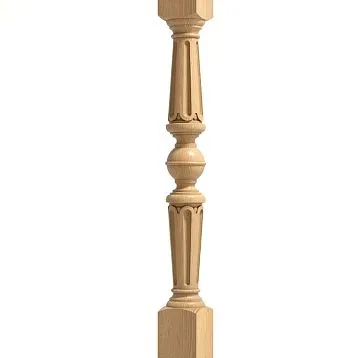
Standard height of carved wooden balusters is 900 mm, but individual sizes from 600 to 1200 mm are also possible. Each baluster is a miniature sculpture, but together they create a rhythmic composition, transforming the staircase into a work of art.
Carved posts with cross-sections of 150×150 mm or 200×200 mm serve as supporting elements of staircase structures. Their capitals can repeat column capitals’ motifs, creating stylistic unity throughout the house.
Material science: the soul of wood in the master's hands
Luxury Woods for Elite Decoration
European oak with density of 670–720 kg/m³ is considered the standard for creating carved decoration. Its fine-grained structure allows carving of the finest details, which will retain clarity for decades. Tannins contained in oak wood provide natural protection against pests and fungi.
Manchurian ash with contrasting texture creates an effect of natural inlay. Light and dark bands of annual rings form a picturesque pattern, especially beautiful in large architectural elements.
American walnut is valued for its noble chocolate tone and excellent working qualities. Its wood is easy to process, holds fine details well, and creates the feeling of expensive antique furniture.
Technological Woods for Mass Production
European beech, with its uniform structure, is ideal for items of complex geometry. The absence of a pronounced texture makes it an ideal canvas for toning to any valuable species.
Heartwood linden is chosen for delicate work. Its softness allows creating lace-like compositions, but requires special skills and care during processing.
Exotic Woods: Luxury in Detail
Burmese teak, with its natural oiliness, does not require additional protection from moisture. Teak items can be used in bathrooms and on open terraces.
Gondwanan mahogany is synonymous with luxury in the world of wood. Its reddish tone and silky texture create a sense of preciousness for each element.
Stylistic navigation: from classicism to avant-garde
Historical Line of Styles
Gothic style brought upward striving and mathematical precision of ornamentation. Gothic rosettes impress with the complexity of geometric constructions, where each line is subordinate to a single logic of vertical movement.
Renaissance motifs revived ancient traditions, enriching them with Christian symbolism. Palmettes, acanthus, putti, cartouches create a sense of scholarly refinement and cultural continuity.
Baroque theatricality transforms each element into a scene of dramatic action. Asymmetric compositions, complex perspectives, emotional expression — all aimed at creating maximum impact.
Rococo took decoration to jewel-like refinement. Small details, pastel palette, gilding, asymmetrical shells create an atmosphere of the age of gallantry.
Modern Interpretations
Modern brought the cult of nature and rejection of straight lines. Stylized plants, insects, sea waves create a sense of organic ornament growth.
Art Deco combined luxury with industrial aesthetics. Sun rays, zigzags, stylized flowers reflect the spirit of the era of technical progress and jazz music.
Minimalism has proven that beauty can be concise. Simple geometric forms, flawless surface treatment, ideal proportions create a sense of perfection.
21st-century technologies at the service of traditional craftsmanship
Digital Design
The modern process of creating carved decoration begins in virtual space. 3D modeling allows creating complex compositions, calculating material behavior, and optimizing technological processes.
Parametric design allows quickly adapting base models to any dimensions and proportions. Changing one parameter automatically recalculates the entire product geometry.
High-precision equipment
5th-generation CNC machines can process details of complexity unattainable by manual methods. Positioning accuracy ±0.02 mm ensures ideal repeatability of elements in mass production.
Laser cutting with a 0.1 mm beam allows creating delicate jewelry-like elements. Absence of mechanical contact eliminates chips and deformation of thin parts.
Innovative finishes
Nanostructured lacquers create coatings several microns thick but with unique properties: self-cleaning, antibacterial, increased wear resistance.
UV-curable compositions polymerize in seconds, creating coatings of exceptional hardness and chemical resistance.
Practical selection: professional secrets
Defining Functional Requirements
Before to buy carved decorative elementsIt is important to clearly define their purpose. Furniture appliqués operate under gentle conditions and can be made from softwoods. Carved moldings are exposed to humidity fluctuations and require durable materials.
Staircase elements experience mechanical loads and must be made only from hardwoods with appropriate fastening systems.
Stylistic compatibility
Carved decoration must harmonize with the architectural style of the building and the overall interior concept. Classical orders are suitable for houses with corresponding architecture, modernist forms require a contemporary context.
Scaling is a critically important aspect. Large elements in small rooms create a sense of confinement, while small details in large spaces become lost.
Budget Planning
The cost of carved decoration varies widely. Linden appliqués with simple ornamentation cost from 300 rubles per piece. Hand-carved oak capitals may reach 50,000 rubles.
When planning your budget, consider not only the cost of the items but also installation, finishing, and delivery expenses. A comprehensive approach will help avoid unpleasant surprises.
Installation and integration: the art of proper installation
Preparation Work
The quality of installation determines 70% of the final result. Surfaces must be perfectly prepared: old coatings removed, cleaned, dried to a moisture level not exceeding 12%.
Marking is done using laser levels and templates. Even minor deviations in symmetrical compositions will be noticeable and spoil the overall impression.
Mounting technologies
Adhesive bonding is the primary method for applied elements. Modern polyurethane adhesives provide strength up to 12 MPa, exceeding the strength of the wood itself.
Mechanical fastening is used for heavily loaded elements. Hidden self-tapping screws, dowels, and bolted connections ensure reliability while preserving aesthetics.
Combined fastening combines adhesive and mechanical fastening, ensuring maximum reliability for critical connections.
Final finishing
After installation, all joints must be perfectly fitted and finished. Wood putty fills micro-gaps, local touch-up removes scratches and installation damage.
Finish coating is applied after full installation of all elements. This ensures uniform color and texture across the entire composition.
Operation and maintenance: preserving beauty for decades
Regular Maintenance
Weekly cleaning with a soft brush or vacuum cleaner with brush attachment prevents dust accumulation in ornament recesses. Use only dry methods — wet cleaning may damage the coating.
Seasonal inspections help identify problems early. Pay attention to the appearance of cracks, color changes, and loosening of fasteners.
Preventive measures
Microclimate control is key to the longevity of wooden elements. Maintain air humidity at 45–55%, avoid sharp temperature fluctuations.
Protection from direct sunlight prevents fading and drying of wood. Use curtains, blinds, or protective films on windows.
Minor damage to oak balusters can be repaired yourself using special wax pencils or wood putty. It is important to select the material to match the wood tone precisely for an undetectable repair.
Local repair of minor damage can be done independently. Special wax pencils, wood putty, and touch-up markers will help remove scratches and chips.
Professional restoration is required for serious damage. An experienced craftsman can restore even completely lost ornament fragments.
Economic efficiency: investments in beauty and status
Impact on property value
Quality carved decoration can increase property value by 15-25%. This is especially relevant for the luxury segment, where buyers are willing to pay extra for uniqueness and exclusivity.
Unique interiors always attract more attention from potential buyers, sell faster, and at higher prices.
Long-term perspective
The antique value of quality carving increases over time. Works by renowned masters become collectible items, and their value may increase several-fold.
Repairability of wooden elements allows maintaining them in perfect condition for decades, unlike plastic analogs.
Social status
The presence of quality carved decoration is always perceived as a sign of wealth and good taste. This is especially important for reception areas — offices, meeting rooms, lobbies.
Regional specifics: market features and offerings
Moscow market: concentration of craftsmanship
The capital region offers the widest selection of carved decorative elements. Here, both large production centers and exclusive artisan workshops operate.
The pricing policy of Moscow manufacturers varies widely: from budget mass-produced items to exclusive artist-made works costing hundreds of thousands of rubles.
Saint Petersburg: traditions and innovations
The northern capital is renowned for its woodworking traditions. Here, leading educational institutions train specialists in carving and restoration.
The St. Petersburg school is distinguished by technical perfection and attention to historical traditions.
Regional centers: accessibility and quality
Major regional centers offer the optimal price-to-quality ratio. Here, workshops specializing in specific product types operate.
Logistical advantages of regional manufacturers — proximity to consumers, which reduces transportation costs.
Trends and prospects: where the industry is heading
Ecological Requirements
FSC certification is becoming a mandatory requirement for wood suppliers. Consumers are increasingly paying attention to the origin of materials.
Safe coatings free of formaldehyde and volatile organic compounds — a trend that will only grow stronger.
Personalization and Customization
Individual projects are becoming increasingly accessible thanks to digital technologies. Each client can receive unique elements created specifically for their interior.
Interactive capabilities — a new direction. Carved decoration may include hidden mechanisms, lighting effects, even elements of augmented reality.
Integration with smart technologies
IoT sensors embedded in wooden elements can monitor their condition, signal the need for maintenance, even regulate the room’s microclimate.
Psychology of Buying: How to Make the Right Decision
Priority definition
Before to buy carved decorative elementsDefine your true needs. Is this an aesthetic improvement to the interior? An investment in status? Preserving family traditions?
Honest self-analysis will help avoid impulsive purchases and select truly necessary elements.
Working with consultants
Professional consultants will help select optimal solutions, take into account the specifics of your interior, and propose alternative options.
Portfolio of works — the best way to assess the quality of execution. Request to see real projects, talk to previous clients.
Making a decision
Do not rush with your final choice. Quality decoration is an investment for decades — mistakes will cost dearly.
Get several proposals from different manufacturers. Compare not only prices, but also quality, timelines, and warranties.
Conclusion: the art of making the right choice
Solution to buy carved decorative elements This is a step toward the world of true beauty and quality. In the era of mass production and standardization, carved decoration remains an island of individuality, where every detail is created with love and craftsmanship.
The right choice of carved elements will turn your home into a work of art, create a unique atmosphere, and enhance the quality of life. This is an investment not only in beauty, but also in the emotional well-being of your entire family.
Modern technologies make high-quality carved decoration accessible to a wide range of consumers. At the same time, the essence — the soul of craftsmanship, the individuality of each item, and the connection to centuries-old traditions — is preserved.
Quality materials, professional execution, and proper installation — these three pillars support a successful project. Do not compromise on these components, and the result will exceed all expectations.
Carved furniture appliqués, solid wood decorative panels, carved wooden balusters, carved capitals — each element has its place in the overall symphony of interior design. The key is to understand the role of each piece in this orchestra of beauty.
For many years, STAVROS has remained a benchmark of quality in the world of carved decoration. By combining traditional craftsmanship with innovative technologies, the team of professionals creates items that become family heirlooms. Choosing STAVROS means choosing not just decoration — you are choosing a partner in creating your dream home, where every detail speaks of your impeccable taste and understanding of true values.