Article Contents:
- What wooden carved decor is most often searched for in Moscow
- Overlays and decorative elements for furniture
- Carved panels, cornices, and moldings
- Capitals, pilasters, and accent interior decor
- Facade decor and entrance groups
- How to choose wooden carved decor for a specific task
- For Apartments
- For private house
- For furniture and cabinet fronts
- For doors, portals, and wall accents
- What is better to buy ready-made, and what is wiser to order
- When standard decorative elements are suitable
- When custom sizing is needed
- When the project requires a unique pattern
- How not to overpay for custom work unnecessarily
- When instead of ready-made decor, custom carved platbands are needed in the Moscow region
- For a wooden house
- For a cottage and country house
- For a non-standard window opening
- For a facade in Russian or classical style
- How to order carved window trims in the Moscow region without mistakes
- Prepare dimensions
- Understand the pattern type and house style
- Determine the material and finish
- Submit a photo, template, or example
- Agree on the set and additional elements
- Which materials and decorative formats are most often chosen
- Oak and beech for interior solutions
- Pine and facade window trims
- Solid wood for accent decor
- What to consider regarding installation and operation
- What to combine carved decor and trims with
- Moldings and Panels
- Coffers and Panels
- Connecting elements
- Complete facade decor set
- Common mistakes when choosing carved decor and trims
- Mixed interior and facade decor
- Chose trims without considering the opening
- Evaluated only by photo, without dimensions
- Chose too complex an ornament
- Did not distinguish between ready-made purchase and custom project
- Table: ready-made decor vs custom order
- Step-by-step checklist: from selection to installation
- FAQ: Answers to Popular Questions
- Where to buy carved wood decor in Moscow?
- Which elements are most often chosen for interiors?
- When is a ready-made decorative element sufficient?
- Can I order carved window trims in the Moscow region?
- Are trims made to size and patterns?
- What to choose for a wooden house?
- Which materials are suitable for facades?
- What needs to be sent for calculation?
- Can a set be assembled for the facade?
- How to combine trims with other decor?
- About the Company STAVROS
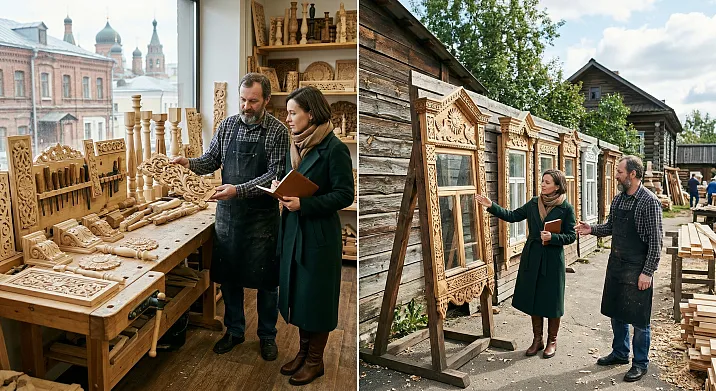
There are questions that the internet answers loudly but misses the mark. You type 'carved wood decor Moscow' — and you land in a sea of catalogs where everything is at once: furniture overlays, facade brackets, carved iconostases, and a hallway coat rack. You type 'custom carved window trims Moscow region' — and you find yourself alone with several pages that promise to make 'everything to your dimensions' but don't explain where to start.
This article is written for those who have already decided — they need carved wood decor. Ready-made or custom, for interior or exterior, for a Moscow apartment or a country cottage in the Moscow region. There will be no history of wood carving and no stories about folk crafts. Only practice: how to choose, what to order, what to buy ready-made, and when a project specifically requires window trims to individual dimensions.


What carved wood decor is most often searched for in Moscow
Moscow is a huge market. Here, lofts are being built and mansions are being restored simultaneously, Scandinavian apartments are being made and classic Moscow region estates are being erected. Interest incarved wood decoramong Moscow buyers is not homogeneous — it breaks down into several completely different scenarios, and confusing them when choosing is not allowed.




Overlays and decorative elements for furniture
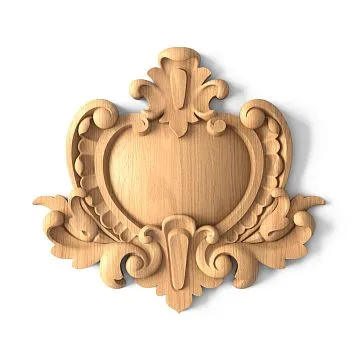
The first and most common request is decorative overlays for furniture. Wooden carved overlays are installed on the fronts of cabinets and dressers, on kitchen unit doors, on cabinets and consoles. These are small elements — carved rosettes, corner overlays, openwork inserts, central panels, overlay handles. Their task is to add character to furniture, to turn an ordinary IKEA carcass into an item with history.
CarvedDecorative Insertsmade of oak or beech — this is no longer a souvenir shop. This is a professional tool for designers and restorers. Element width — from 20 to 100 mm, relief depth — from 5 to 30 mm. Mounting on glue or screws. Material — oak, beech, pine, high-density MDF. The choice depends on what will be nearby and under what finishing coating.
Our factory also produces:


Carved panels, cornices, and moldings
The second major segment is linear decor. This includeswooden cornices and moldings, wooden baseboards, and profile strips. They are used to create classic boiserie (wooden wall panels), decorate ceiling cornices, and frame door and window openings in interiors.
Oak and beech cornices are a completely different story compared to their plaster counterparts. Wood lives, breathes, and ages beautifully—developing a patina, not cracks. The height of ceiling cornices in the standard line ranges from 45 mm (for compact spaces) to 200 mm (for prestigious interiors with ceilings from 3.6 m). Moldings for panel systems range from 40 to 80 mm. Beech profiles can be bent: after steaming at 100–110°C, they take on curved shapes with a minimal bending radius, which is indispensable for decorating bay windows and arches.
Get Consultation
Capitals, pilasters, and accent interior decor
Capitals and pilasters belong to the architectural class. A wooden capital on a column, a pilaster along a wall, a fireplace portal with carved details—such elements create the atmosphere of a palace interior or a rich classic living room. The catalogof wood and MDF products features both standard and custom solutions.
A pilaster is not just decor. It is the vertical rhythm of a wall, an architectural support, a visual framework for the interior. Height ranges from 1200 to 2700 mm. Width ranges from 80 to 200 mm. Material is oak or high-density MDF for painting. Installation is with adhesive and dowels; when properly installed, they bear loads without deformation for decades.
Facade decor and entrance groups
Finally—facade carved wood decor. This is a separate category where interior logic no longer applies: the material must be weather-resistant, the coating must protect against UV and moisture, and installation must account for the seasonal expansion of wood.
House CarvingFor facades — window trims, brackets, balusters, gable boards — this is a separate world. Especially in the Moscow region, where every second buyer is building or finishing a country house. We'll talk about this segment separately and in detail.
How to choose carved wooden decor for a specific task
One of the most frequent questions asked in search is: 'Which carved wooden decor should I choose?' The correct answer always begins with a clarifying question: what exactly is it for?
For apartments
In an apartment, carved wooden decor works as an accent. There's no need to cover all walls with wood — it's enough to correctly place focal points. Wooden molding around a doorway. A carved rosette for a chandelier. Overlay decorative panels in the living room at the level of the wall frieze. A capital on a decorative column by the fireplace.
Choosing material for an apartment — in favor of oak or beech. These species are stable in standard apartment climate: temperature 20–24°C, humidity 45–65%. Sharp humidity fluctuations of more than ±15% can cause deformations in any solid wood, so a stable microclimate is important.
For a private house
A private house consists of two different spaces: interior and facade. For the interior, the logic is the same as for an apartment. For the facade — completely different requirements. Here you needcarved decor from solid woodwith high-quality weather-resistant treatment: antiseptic impregnation, primer, a finishing coat with UV protection.
For a wooden house, carved decor on the facade is a natural unity. Wood on wood looks organic, without being forced. White carved window trims on a dark log house, light brackets under the cornice, lacy balusters on the porch — the classic image of a Russian country house.
For furniture and cabinet fronts
Carved overlays for furniture require precise style matching. For a kitchen in Provence style — floral motifs, smooth shapes, milky-white paint. For a classic living room — geometric profiles, gilding, patina. For a modern interior — laconic straight overlays without excessive ornamentation.
By material: oak and beech hold their shape, do not deform, and accept any coating well. High-density MDF is ideal for painting, absolutely stable in geometry, and does not crack. For furniture that does not come into contact with moisture, MDF is a reasonable choice with excellent results.
For doors, portals, and wall accents
A door portal with carved framing is one of the most expressive techniques in a classic interior. A pair of pilasters with capitals, a profile cornice above the door, a carved central overlay above the arch—and an ordinary doorway becomes an architectural statement.
Oak and beech molding products—is precisely the material that makes it possible to create such solutions. Profiles from 50 to 200 mm wide, blank lengths of 2–4 meters, surface finish class—final sanding to Ra 1.6 µm. This is a level that is visible and felt by hand.
What is better to buy ready-made, and what is wiser to order
This question is key. And the correct answer depends not on the budget, but on the task.
When standard decorative elements are suitable
Standard, ready-to-ship decorative elements are suitable in most cases. If your openings are standard, furniture is serial, ceiling height is typical (2.7–3.0 m), style is classic or neoclassical, then everything you need can be found in the catalog. Fast, predictable, at a fair price.
Ready-madeCarved Decor—is over 4000 models and 20,000 modifications in 39 product groups. You need to spend time here: look, compare, request samples. But the result will be achievable without a long wait.
When custom sizing is needed
A custom order is justified for non-standard openings (arches, trapezoids, non-standard height), when precise matching of profiles with existing interior elements is necessary, and when working with rooms with high ceilings (from 3.5 m), where a standard profile would look disproportionate.
For facade trims, a custom order is required for windows of non-standard sizes or when wanting to create a unique ensemble where all elements repeat a single pattern. This is especially relevant when building a new house according to an individual project.
When the project requires a unique pattern
If you are creating an interior or facade with an authorial concept — custom carving for the project becomes a necessity. The designer develops the pattern, coordinates it with the manufacturer, receives a sample, approves it, and launches it into production. This is more complex and expensive, but the result is one of a kind.
How not to overpay for custom work unnecessarily
The most costly mistake is ordering a custom project where a standard catalog item would suffice. Before writing 'order by sketch' — browse the entire assortment. In a large catalog, you very often find exactly what seems 'unique'. Or you find a base that can be refined with minimal intervention.
When instead of ready-made decor you need custom carved trims in the Moscow region
And here a different conversation begins. A country house, Moscow region, facade, windows — and the question is no longer 'which decor to choose for a shelf', but 'how to design the exterior of the house so that it looks complete and lasts for 30 years'.
The Moscow region market consists of thousands of cottage settlements, garden partnerships, dachas, country houses of various classes. And most of them have bare windows. Either with a white PVC slope. Or without any framing at all. This is not beautiful, and the owners feel it. Therefore, the query 'custom carved trims Moscow region' is one of the most active in this topic.
For a wooden house
A wooden house with carved window trims is not a stylization, not an 'antique look,' not an attempt to make the house resemble a picture from the internet. It is an organic continuation of the material itself. Wood on wood. When the trim, bracket, and cornice are made from the same solid wood as the walls, the house looks cohesive.
Carved window trims made from solid pine— a basic and correct choice for a wooden country house. Glued laminated furniture board without knots and resin pockets, hand sanding, length 2000 mm, thickness 18 mm. Can be cut to any size. White or light color against the dark wood of the log house — a classic, flawless combination.
For cottages and dachas
A cottage is most often made of brick, aerated concrete, or mixed structures. A wooden trim on such a facade is not 'naturalness' as a principle, but style as a solution. It creates a warm contrast with cold stone or plaster, adding scale and detail.
For dachas, the flat trims of the NL series are optimal: NL-5 (2,550 rub.), NL-1 (3,130 rub.), NL-14 (3,350 rub.) — laconic models that look good on small buildings and are easy to install yourself. If you want more elegance — NL-7 (4,550 rub.) or NL-8 (7,310 rub.) will provide visual weight and presence.
For a non-standard window opening
Windows of non-standard sizes, arched openings, trapezoidal windows — all this makes buying a ready-made trim impossible. Here, you specifically need custom ordering of carved trims to individual sizes and templates. The manufacturer receives measurements or a template, agrees on the ornament, and manufactures for the specific project.
It takes a bit longer than shipping from stock, but the casing will fit perfectly, without gaps or on-site adjustments. For an expensive facade with non-standard architecture — it's the only correct approach.
For a facade in Russian or classical style
If the house is built in the concept of a 'Russian estate,' 'terem,' or 'classical wooden house' — casings become not an optional decoration, but a mandatory element. A full set is needed here: side pieces, a kokoshnik with a central overlay, corner rosettes, brackets under the cornice, balusters on the veranda. All in a unified pattern, from the same wood species, under the same finish.
It's more cost-effective to order such a set from one manufacturer. STAVROS offers exactly this:House Carvingas a system — casings, SNL connecting elements, KR series brackets, BNL balusters — in a single catalog, with the ability to assemble a complete facade ensemble.
How to order carved casings in the Moscow region without mistakes
The order of actions is important. If the sequence is broken — at best, you'll get unsuitable casings. At worst — money is spent, installation is impossible, and you have to start over.
Prepare the dimensions
The first step is precise measurements. Not 'about 1 meter 20,' but exactly, with a tape measure: opening height, opening width, wall width (needed to understand the kokoshnik projection). For each window — separately, because in old houses, 'identical' windows often differ by 2–5 cm.
Understand the pattern type and house style
Before choosing an ornament — look at the house from the street. What is its scale? How many floors? How 'heavy' or 'light' does it look visually? A small house with a large, lush ornament is a bad story. A large house with a thin, laconic casing is lost expressiveness.
If the house already has decorative elements - gates, porch, fence - focus on their ornamentation. Unity of style is more important than the 'beauty' of an individual element.
Determine material and finish
For exterior use - only solid wood. Pine (glued panel), larch, oak. MDF for facade - no, absolutely not. Next - choose the finish. White weather-resistant paint, glaze (semi-transparent tint), impregnation with UV filter. All STAVROS trims are supplied 'in white' - without finish, allowing the buyer to choose the color and type of finish themselves.
Provide photo, template, or example
If a custom order is needed - photo of the house (preferably from several angles), photo of existing windows, template or drawing of a non-standard opening, examples of liked styles. The more information - the more accurate the result. STAVROS manager will help select the ornament and calculate the kit completeness.
Agree on the kit and additional elements
Trim without connecting elements is an unfinished job. Always order the full kit: side planks + top kokoshnik + corner connecting elements (SNL series). Optionally - central overlay on the kokoshnik, apron (bottom plank), additional rosettes.
Which materials and decorative formats are most often chosen
The question 'what is better?' is one of the most popular. The answer depends on the task, but the general logic is as follows.
Oak and beech for interior solutions
For interior carved decor, oak and beech are unrivaled. Oak provides an expressive texture with annual rings, characteristic depth of pattern, density of 650–750 kg/m³, and a service life of 70–100 years with proper care. Natural tannin content protects against rot and insects.
Beech has a homogeneous structure and a neutral pinkish tone, ideal for tinting. Thanks to steaming technology, beech moldings can be bent into radial shapes, which is indispensable when working with arches and bay windows. Both materials undergo special drying to 8–12% moisture at the STAVROS production facility, eliminating deformation after installation.
Pine and facade trims
For facade applications, pine (glued furniture board) remains the optimal balance of price and quality. The main difference between 'facade' pine and regular pine is the removal of knots and resin pockets, which cause regular pine boards to 'weep' resin in the sun. This problem does not exist in the board: the surface accepts the coating evenly, without stains.
Solid wood for accent decor
When wooden decor is an accent element in a rich interior, solid oak or walnut creates an incomparable effect. No MDF can provide the same play of texture under side lighting, the same feeling of weight and nobility under the hand.
What to consider regarding installation and operation
Wooden carved decor requires proper fastening. For walls: dowels with a diameter of 6–8 mm spaced 400–500 mm apart. For heavy cornices: anchor bolts spaced 600 mm apart. Corner joints: cutting at 45° with an accuracy of ±0.1°, gluing with polyurethane adhesive, fixing until cured.
Compensation gaps during installation: 2–3 mm for every 3 m of length for solid wood. This is important—without a gap, the wood will press on the joints and deform the elements during seasonal expansion.
What to combine carved decor and trims with
Carved wooden decor never works alone. A single door overlay is an 'attached part'. A decor system is something different.
Overlays and panels
Decorativeplanks from solid woodcombine into panel systems. Horizontal moldings divide the wall into zones: lower panel zone (up to 900 mm from the floor), middle frieze, upper cornice zone. Vertical pilasters create rhythm. Corner elements tie everything together.
Cornices and moldings
cornices and moldingsare the skeleton of the decor. They are the first to set the horizontal lines, scale, and proportions. A ceiling cornice 120–150 mm high in a room with a 3.2 m ceiling is the correct proportion (about 1/10 of the room height). A cornice that is too thin gets lost with high ceilings; one that is too massive feels oppressive with low ceilings.
Connecting elements
For facade casings — SNL series corner rosettes. From compact SNL-19 (380 rub.) to large SNL-15 (1,350 rub.). They cover the joints of the side parts with the kokoshnik, give the corners a neat appearance, and add an ornamental accent precisely where the planks meet.
Complete facade decor set
Full facade ensemble: NL-series casings + SNL connecting elements + KR brackets (from 2,990 to 4,780 rub.) + BNL balusters (from 1,590 rub.) — this is not just a set of parts. It is a system that transforms a faceless facade into a distinctive, recognizable image.
Common mistakes when choosing carved decor and casings
Mistakes in this area are costly — not only financially, but also aesthetically. Redoing a facade or re-gluing moldings in an already finished interior is a below-average pleasure.
Mixed interior and facade decor
The most common mistake is to buy an interior casing or overlay and install it outdoors. MDF, plywood, thin pine without proper treatment—none of these will survive the first season on the facade. Moisture, frost, and direct sunlight will quickly take their toll. Interior decor is for interiors. Facade decor must be solid wood and properly treated.
Chose casings without considering the opening
Choosing a casing 'by eye,' without measurements, is a gamble. One that's too narrow doesn't visually 'hold' the opening. One that's too wide covers part of the wall and makes the window look heavy. The casing width should be 10–15% of the opening width. For a 900 mm opening, the optimal width is 90–135 mm.
Evaluated only by photo, without dimensions
Photos in the catalog are taken with studio lighting, a neutral background, and a professional camera. On your house, it will look different. Order samples, hold them against the wall, and view them in real lighting.
Chose an overly complex ornament
An intricate kokoshnik with deep carving on a small country house creates a visual conflict. Massive decor requires proportionate architecture. For a small house, it's better to use a simple flat casing plus a neat corner rosette.
Didn't distinguish between ready-made purchase and custom project
Some customers go straight for 'custom order' without exploring the catalog of ready-made solutions. This increases wait time and cost. First, carefully review the standard range. Custom order only when the catalog truly lacks the needed solution.
Table: ready-made decor vs custom order
| Criterion | Ready-made catalog | Custom order |
|---|---|---|
| Delivery time | 3–5 business days | 10–21 business days |
| Price | Below | 20–50% higher |
| Precision fit to the opening | Suitable for standard | Exact fit for any size |
| Pattern selection | Over 40 models | Any according to sketch |
| Suitable for | Typical houses, dachas | Non-standard objects, custom projects |
| Risks | Minimal | Depend on measurement accuracy |
Step-by-step checklist: from selection to installation
This list will save you time and money.
-
Define the task: interior or exterior, ready-made or custom
-
Take precise measurements — each opening separately
-
Choose a style — based on architecture and existing elements
-
Determine the material — oak/beech for interior, pine/larch for exterior
-
Browse the catalog of ready-made products — before initiating a custom order
-
Order samples — attach them to the wall in natural light
-
Calculate the kit — overlays or trims + connecting elements + extensions
-
Clarify installation conditions — fasteners, adhesive, gaps
-
Prepare the surface for installation — leveling, priming
-
Apply the finish coating after installation — on the exterior especially carefully: edges and joints
FAQ: Answers to popular questions
Where to buy carved wood decor in Moscow?
In the STAVROS catalog on stavros.ru — over 4000 models made of oak, beech, pine, and MDF, 20,000 modifications across 39 product groups. Shipping from stock from 1 piece.
Which elements are most often chosen for interiors?
Moldings and cornices for wall panels, overlays for furniture fronts, capitals and pilasters for portals, corner and ceiling profiles. For classic — oak. For modern — paintable MDF.
When is a ready-made decorative element sufficient?
When dimensions are standard, style is common, and the task is typical. This covers most residential interiors and country houses.
Can carved window trims be ordered in the Moscow region?
Yes. STAVROS manufacturescarved window trims to orderaccording to custom sizes and templates. Delivery across Moscow and the Moscow region.
Are architraves made to size and templates?
Yes. For non-standard window openings, arched forms, any deviations from standard sizes — custom manufacturing. Precise measurements or a template are needed.
What to choose for a wooden house?
Flat or overlay architraves made of pine (glued panel) from the NL series. White or light color against dark wood. Plus corner rosettes SNL and brackets KR — to complete the ensemble.
Which materials are suitable for the facade?
Only solid wood: pine (glued panel), larch, oak. MDF, plywood, PVC — are not suitable for outdoor use.
What needs to be sent for a quote?
Photos of the facade and windows, precise dimensions of each opening, style and ornament preferences, if necessary — a template of a non-standard opening.
Can a kit be assembled for the facade?
Yes. Architraves from the NL series + connecting elements SNL + brackets KR + balusters BNL — all in a single catalog, unified style.
How to combine window trims with other decor?
A unified pattern and wood species is the main rule. If window trims have a floral pattern, cornices and brackets should also feature floral motifs. Mixing styles and ornamentation is only possible with a clear design concept.
About the company STAVROS
When it comes to choosing between a beautiful picture and genuine quality, the choice becomes obvious once you see the product in person.
STAVROS is a Russian manufacturer of carved products from solid wood and MDF with a production base using high-precision European-class CNC machines. Controlled microclimate in production (temperature 20–24°C, humidity at least 40%), multi-stage wood drying to 8–12%, manual fine-sanding of each product — these are not marketing words but the technological foundation that ensures product stability and durability.
The STAVROS catalog features over 4,000 models, 20,000 modifications, 39 product groups: from carvedwindow trims for facadestomolding and cornicesfor classic interiors, from decorative overlays for furniture to brackets and balusters for country homes. Two quality levels — Standard and Prestige — allow choosing a solution for any budget without compromising aesthetics.
STAVROS works with both private customers and professional teams: designers, architects, construction contractors. Custom orders by size and sketches are possible, with delivery across Moscow, Moscow Region, and all of Russia. Stock program — shipping from one piece, without long waits.
Carved wood decor is not a luxury or retro. It's the choice of people who understand: a house is built once, and it must be done with care.