Article Contents:
- Production technology: from raw material to perfection
- Raw material selection - the foundation of quality
- Kiln drying - guarantee of stability
- Sanding - the art of creating an ideal surface
- Classification and quality standards
- Grading of sanded boards
- Geometric Parameter Control
- Dimensional series and technical characteristics
- Standard sizes for various applications
- Calculation of strength characteristics
- Wood Species and Their Characteristics
- Coniferous species - tradition and reliability
- Broadleaf species - elegance and prestige
- Applications of sanded boards
- Construction structures
- Finishing works
- Furniture manufacturing
- Decorative applications
- Interior design
- Architectural Details
- Advantages of sanded boards over alternatives
- Comparison with plain-edged boards
- Comparison with artificial materials
- Protection and preservation technologies
- Antiseptic Treatment
- Fire Protection Treatment
- Installation and fastening of sanded boards
- Preparatory work
- Mounting methods
- Features of installation under various conditions
- Final processing and finishing
- Surface Preparation
- Types of finish coatings
- Maintenance and operation
- Usage Rules
- Technical Maintenance
- Restoration and repair
- Ecological Aspects
- Sustainable forestry
- Recycling and disposal
- Economic Aspects
- Material cost
- Comparative economic efficiency
- FAQ - Frequently Asked Questions
- What are the main advantages of sanded boards over plain-edged boards?
- What moisture content should a quality sanded board have?
- Which wood species are best suited for sanded boards?
- Is additional treatment required for sanded boards before use?
- How should sanded boards be stored?
- What type of fasteners are best for sanded boards?
- How to determine the grade of a sanded board?
- Can sanded boards be used in high-humidity conditions?
- What is the lifespan of sanded boards?
- How to calculate the required quantity of sanded boards for a project?
- Conclusion

In modern construction and interior design, materials combining the traditional advantages of natural wood with innovative processing technologies occupy a special place.Planed wooden stripis exactly such a material - a universal solution for numerous tasks in construction, renovation, and decorative finishing of spaces. Thistrim materialdistinguishes itself by exceptional processing quality, precise geometric parameters, and readiness for use without additional preparation.
What makes planed trim so attractive to professional builders, designers, and DIY enthusiasts? The answer lies in the unique combination of technical characteristics and aesthetic qualities achieved through special surface processing technology. Unlike ordinary sawn trim, planed material undergoes additional mechanical processing, resulting in perfectly smooth edges and extremely precise dimensions.


Production Technology: From Rough Cut to Perfection




Raw Material Selection - The Foundation of Quality
The production of high-quality planed trim begins long before the wood reaches processing machines. Raw material selection is an art requiring deep knowledge of the properties of various wood species and understanding of how the material will behave during complex multi-stage processing.
For productionplaned trim productsOnly high-quality wood, harvested at the optimal time of year, is used. Winter harvesting ensures minimal moisture content in tree trunks, which is critically important for subsequent processing stages. Each log undergoes careful visual and instrumental inspection for the absence of developmental defects, signs of decay, insect damage, and other flaws.
Special attention is paid to the direction of wood grain. For producing quality trim, radial or semi-radial sawing is predominantly used, where the cutting plane passes through the tree's core or near it. This approach ensures maximum dimensional stability of the finished product, minimal deformation with humidity changes, and an expressive surface texture.
Our factory also produces:



Kiln Drying - Guarantee of Stability
The next critically important stage - kiln drying of wood to an optimal moisture level.Planed wooden stripHigh-quality wood should have a moisture content of no more than 8-12%, achieved through controlled drying in special kilns.
Kiln drying is a complex technological operation requiring precise adherence to temperature and air humidity regimes. Too rapid drying may cause cracking and deformation of blanks, while too slow drying may lead to fungal infestation and loss of wood quality.
Modern drying kilns are equipped with automatic control systems that allow maintaining optimal parameters at each stage of the process. Drying duration depends on wood species, blank thickness, and initial moisture content, but typically ranges from several days to several weeks.
Get Consultation
Planing - The Art of Creating an Ideal Surface
Planing is the final and most critical stage of production, determining the quality of the finished product. At this stage, blanks are processed on specialized four-sided planers, which simultaneously process all sides of the trim, ensuring ideal geometry and perfectly smooth surfaces.
Planing quality depends on multiple factors: sharpness and correct adjustment of blades, feed rate of blanks, wood moisture content, and grain direction. Professional planers allow achieving surface roughness less than 40 microns, meeting the highest quality standards.
The peculiarity of planing is that this process not only creates a smooth surface but also 'reveals' the wood's texture, making it more expressive and attractive. Properly processed planed trim has a characteristic silky sheen and pleasant tactile surface.
Classification and Quality Standards
Grade of Planed Trim
The quality of finished products is determined not only by production technology but also by the grade of the raw material used.Planed wooden stripis classified by grades depending on the presence of natural wood defects and surface processing quality.
Highest Grade (Extra) - This material is practically free of visible defects. Only minimal healthy light knots up to 10 mm in diameter, barely noticeable resin pockets in coniferous species, and minor color deviations are permitted. Such trim is intended for the most demanding tasks where appearance is of primary importance.
First Grade - May contain healthy knots up to 25 mm in diameter, small resin pockets, areas with slight waviness of fibers, minor mechanical damage that does not affect strength. First-grade trim is suitable for most construction and finishing tasks.
Second Grade - Allows larger knots (up to 40 mm in diameter), small non-penetrating cracks, knot stains, localized planing defects. Such products are used in structures where aesthetic requirements are not high, but strength and functionality are crucial.
Geometric parameter control
One of the main advantages of planed trim is the precision of geometric dimensions. Tolerances for thickness and width should not exceed ±1 mm, ensuring perfect element alignment during installation and creating a flat, attractive surface.
Geometric control is performed at every stage of production. After planing, each trim is checked with measuring tools, and selectively with high-precision equipment. Special attention is paid to straightness of the product - deviation from straightness should not exceed 2 mm per meter of length.
Size range and technical specifications
Standard Sizes for Various Applications
The modern market offers a wide variety of planed boards in different sizes, allowing to select the optimal solution for any task. The most popular sizes are:
Thin boards (10-20 mm thick):
-
10×20 mm - for light decorative structures, battens
-
15×25 mm - universal size for finishing work
-
10×30 mm - for creating elegant lattices and partitions
-
20×20 mm - square cross-section for special applications
Medium planks (20-40 mm):
-
20×40 mm - the most popular size, the "golden standard" of construction
-
25×50 mm - for structures with increased loads
-
30×40 mm - optimal for medium-complexity frame work
-
20×60 mm - for creating wide decorative elements
Large boards (40+ mm):
-
40×60 mm - for serious structural applications
-
50×80 mm - similar in characteristics to beams
-
40×100 mm - for special architectural solutions
Strength characteristics calculation
Strength characteristics of planed boards depend not only on the wood species but also on geometric parameters of the cross-section. To choose the correct size, it is necessary to understand the basic parameters:
The moment of resistance determines the ability of a beam to resist bending loads. For a rectangular cross-section, it is calculated by the formula W = b×h²/6, where b is the width, h is the height of the cross-section.
The moment of inertia characterizes resistance to deformation under bending and is calculated as I = b×h³/12. This parameter is critically important when calculating deflections of structures.
It is important to understand that doubling the height of the cross-section increases the moment of resistance by 4 times and the moment of inertia by 8 times. That is why, for the same cross-sectional area, it is preferable to use boards with greater height.
Wood species and their characteristics
Coniferous species - tradition and reliability
Coniferous wood species are traditionally the main raw material for producing planed boards. Their popularity is due to availability, good technical characteristics, and specific properties useful in many applications.
Spruce - the most common species for producing planed boards. Spruce wood is characterized by straight grain, uniform density (about 500 kg/m³), pleasant light-yellow color with distinct annual rings. The resin content in spruce wood provides natural protection against moisture and biological damage.
Spruce boards are easy to process, hold fasteners well, and practically do not crack during drying. Resin content can be an advantage (natural preservation) or a disadvantage (difficult painting), depending on the application area.
Pine has a more uniform structure compared to spruce, less resin, and a light, almost white color. Pine wood is characterized by good workability and dimensional stability. Pine density is slightly lower than spruce (450-500 kg/m³), making the products lighter.
Larch deserves special attention due to its exceptional resistance to moisture and biological damage. Larch density is 650-700 kg/m³, which brings it close to hardwoods in strength. The wood has a beautiful reddish-brown hue and distinct texture.
Hardwood species - elegance and prestige
For producing elitemolding productshardwood species are used, which have higher aesthetic and operational characteristics.
Oak is the king among wood species, the standard of strength and durability. The density of oak is 700-750 kg/m³, hardness by Brinell is 3.7-4.0 units. Oak planks feature a distinctive texture with clearly visible annual rings and medullary rays.
Tannins present in oak wood provide natural protection against moisture, insects, and fungal damage. The color palette of oak ranges from light golden to dark brown tones, allowing selection of material to suit any design solution.
Beech is an excellent alternative to oak at a more affordable cost. Beech density is 680-720 kg/m³, hardness is 3.8-4.2 units. Beech wood has a uniform fine-pored structure and a pleasant light tone with a barely noticeable pinkish hue.
Beech takes dyeing and painting exceptionally well, opening up wide possibilities for design experiments. High density ensures excellent workability and ability to hold fine details.
Ash is distinguished by high strength and elasticity, surpassing oak. Ash density is 650-700 kg/m³. The wood has a light color with a distinctive wavy texture, creating beautiful patterns on sanded surfaces.
Applications of sanded boards
Structural constructions
Planed wooden stripfinds the widest application in modern construction due to its technical characteristics and readiness for use without additional processing.
Frame construction is one of the main areas of application for sanded boards. They are used to create load-bearing wall, partition, and roofing systems. The precise geometry of sanded products ensures perfect element alignment, which is critically important for the strength and airtightness of structures.
Sheathing for various coverings - a traditional area of use for boards. Underwooden planks, block house, imitation of beams requires high-quality sheathing that ensures a smooth surface and necessary ventilation. Sanded boards are ideal for these purposes.
Roofing systems in low-rise construction often use boards with increased cross-section as auxiliary elements - counter sheathing, braces, ties. High-quality processing ensures precise fitting of parts and reliable connections.
Flooring and floors - another important area of application. Boards are used both for creating subflooring and as joists for finish coverings. Sanded surface improves adhesion with adhesives and mastics, enhancing the quality and durability of the structure.
Finishing works
In interior finishing, sanded boards play an important role, ensuring high-quality finish coverings and creating a basis for various decorative solutions.
Internal wall finishing involves using boards to create gypsum board frames, surface leveling, and mounting decorative panels. The perfectly flat surface of sanded boards provides a quality base for any finishing materials.
Ceiling structures are often created using board frames. Multi-level ceilings, niches, cornices - all these elements require precise dimensions and high-quality material processing. Sanded boards allow creating structures with minimal gaps and perfectly flat surfaces.
Window and door casings are traditionally finished with wooden boards of the appropriate profile. Sanded surface does not require additional preparation for painting or varnishing, significantly simplifying and speeding up the work.
Furniture manufacturing
The furniture industry is one of the largest consumers of high-quality sanded boards. Special requirements for appearance and dimensional accuracy make sanded material indispensable in many technological processes.
Frames of soft furniture are primarily made from sanded boards of hardwood species. High strength, dimensional accuracy, and surface quality ensure durability and reliability of structures capable of withstanding significant loads.
Furniture facades are often created using board structures. Modern design values the natural beauty of wood, and the sanded surface highlights the texture and color of the wood, creating elegant and stylish solutions.
Internal furniture elements - shelves, partitions, guides - require material with precise dimensions and smooth surface. Sanded boards are ideal for these purposes, ensuring quality fitting of parts and pleasant tactile sensations.
Decorative applications
Interior design
Modern interior design increasingly turns to natural materials, and sanded boards occupy a special place in this trend. Their versatility and aesthetic qualities open up limitless possibilities for creative self-expression.
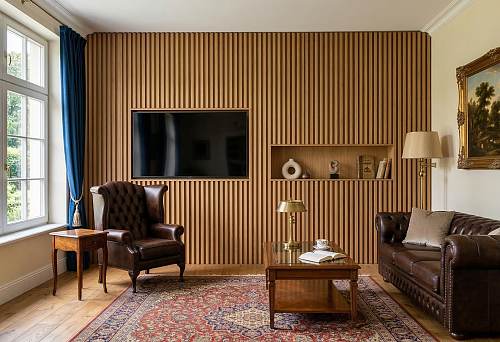
Accent walls made of sanded boards have become one of the most popular design solutions in recent years. Vertical placement of boards visually increases room height, horizontal placement expands space. Various coloring and staining options allow creating unique color solutions.
Ceiling decorative structures using boards add volume and expressiveness to the interior. Board ceilings are especially popular in modern styles - loft, Scandinavian, eco-style. Integration of lighting systems into board structures creates additional decorative effects.
Space zoning - another important function of decorative board structures. Semi-transparent partitions do not block natural light but create visual separation of functional zones. This is especially relevant for modern open floor plans.
Furniture and decorative elements made of sanded boards allow creating a harmonious interior in a unified style. Shelves, racks, decorative panels, made from the same material, unify space and create a sense of design cohesion.
Architectural Details
Sanded boards are used in creating various architectural details that highlight the style of the building and create its unique character.
Outdoor decorative elements require special wood species resistant to atmospheric effects. Larch and oak, treated with special protective compounds, can serve for decades while retaining their original appearance.
Railings and balustrades made of sanded boards combine functionality and aesthetic appeal. Smooth surface is pleasant to touch, and various arrangement options allow creating unique design solutions.
Pergolas and small architectural forms are traditionally made using sanded boards. High-quality surface processing not only improves appearance but also simplifies maintenance of structures, extending their service life.
Advantages of planed boards over alternatives
Comparison with sawn boards
The main difference between planed and sawn boards lies in surface finish quality and geometric dimension accuracy. If a sawn board is simply a sawn blank from all sides, a planed board undergoes additional mechanical processing.
The surface quality of planed boards is incomparably higher. The roughness of a planed surface is less than 40 microns, whereas for sawn surfaces this value can reach 200-300 microns. This is critically important for applications where the material remains exposed or requires high-quality finishing.
Dimensional accuracy is another important advantage. Planed boards have tolerances of ±1 mm in cross-section, whereas sawn boards may have tolerances of ±3-5 mm. Dimensional accuracy ensures perfect element alignment and eliminates the need for additional fitting.
Ready for use — an important advantage in modern construction, where time is money. Planed boards require no additional processing and can be immediately used for finishing work or under transparent coatings.
Comparison with artificial materials
In the era of composite materials, it is important to understand the advantages of natural wood over artificial analogs.
Ecological safety — the main advantage of natural wood. Planed boards do not contain formaldehyde, phenol, or other harmful substances that may be present in composite materials. Wood "breathes," regulating indoor air humidity.
Workability of natural wood significantly surpasses composites. Boards can be easily sawn, drilled, planed, and sanded with standard tools. Artificial materials often require special tools and produce harmful dust during processing.
Repairability — an important advantage in the long term. A damaged wooden board can be repaired, sanded, or have its finish replaced. Composite materials can only be replaced in case of serious damage.
Aesthetic qualities of natural wood cannot be fully replicated artificially. Natural texture, color, and tactile sensations create a unique atmosphere of warmth and coziness that even the most perfect imitations cannot convey.
Protection and conservation technologies
Antiseptic treatment
Despite the natural resistance of many wood species to biological damage, additional protective treatment may be required under certain operating conditions. Modern antiseptics provide reliable protection of wood against fungi, mold, and insect pests.
Water-soluble antiseptics are used for interior applications and do not alter the wood's color. They penetrate deeply into the material structure, providing long-term protection. These compositions are environmentally safe and do not hinder subsequent staining or varnishing.
Organosoluble antiseptics provide deeper penetration into wood and better protection under high humidity conditions. They are often used for exterior applications and in rooms with extreme operating conditions.
Combined compositions combine antiseptic and decorative functions. They simultaneously protect wood and impart the desired shade, simplifying the finishing process.
Fire Protection
In certain operating conditions, increased fire resistance of wooden structures may be required. Modern fire-retardant compositions can significantly reduce wood flammability and slow flame spread.
Surface treatment with fire retardants creates a protective layer on the wood surface that releases non-flammable gases upon heating and forms a carbonaceous layer that prevents oxygen access to the material.
Deep impregnation provides more reliable protection, as fire-retardant substances are distributed throughout the material volume. Such treatment is especially important for critical structures.
Comprehensive protection combines antiseptic and fire-retardant properties, allowing one composition to solve multiple wood protection tasks.
Installation and fastening of planed boards
Preparation Work
Quality installation of planed boards begins with careful preparation. The material must undergo acclimatization — exposure to future operating conditions for 2-3 days. This allows the wood to reach equilibrium moisture content and minimize subsequent deformations.
Quality inspection includes visual examination of each board for compliance with grade, absence of mechanical damage, and correct geometry. Defective items should be rejected or used in less critical areas.
Marking — a critically important stage determining the quality of the entire structure. Laser levels, tape measures, and squares are used to ensure dimensional accuracy and correct geometry.
Tool preparation includes checking saw blade sharpness, correct drill settings, and availability of all necessary fasteners. Quality tools are essential for precise work.
Methods of mounting
The choice of fastening method depends on the structure's purpose, loads, operating conditions, and aesthetic requirements.
Mechanical fastening with self-tapping screws — the most common and reliable method. To prevent wood cracking, it is recommended to pre-drill holes with a diameter of 0.8–0.9 times the screw diameter. Screw heads can be countersunk and masked with wooden plugs or putty.
Nailing is used for less critical structures. Finishing nails with small heads can be countersunk with a nail set and masked. It is important to correctly select nail length — it should be 2.5–3 times the thickness of the nailed element.
Adhesive joints are used in furniture manufacturing and for creating decorative elements. Modern woodworking adhesives provide joint strength exceeding the strength of the wood itself. It is important to ensure even adhesive application and sufficient pressing time.
Special fastening systems are used to create disassemblable structures or when it is important to ensure concealed fastening. There are various types of concealed fastening, allowing to create a perfectly flat surface without visible fastening elements.
Features of installation under various conditions
Internal works usually do not require special protective measures, but it is important to control air humidity and temperature. Sudden changes in microclimate may lead to deformation of fixed battens.
External works require the use of stainless or galvanized fasteners, and preliminary protective treatment of wood. It is important to ensure ventilation of structures and protection from direct moisture exposure.
Wet rooms (bathrooms, saunas) require a special approach. It is recommended to use moisture-resistant wood species, special protective treatment, and ensure good ventilation.
Final finishing and decoration
Surface preparation
Despite the high quality of the planed surface, additional preparation is often required before applying finishing coatings.
Sanding with fine-grit sandpaper (grit 150-220) removes minor defects and creates a perfectly smooth surface. Sanding should be performed in the direction of the wood grain.
Dust removal is an important preparation step. A vacuum cleaner with a soft brush is used, then the surface is wiped with a sticky cloth to remove fine particles.
Priming is necessary when using certain types of coatings. Primer improves adhesion, reduces the consumption of finishing material, and ensures even coating.
Types of Finish Coatings
The choice of finishing coating depends on the conditions of use, aesthetic preferences, and functional requirements.
Lacquers provide a durable protective film and highlight the natural beauty of wood. Polyurethane lacquers have high wear and chemical resistance. Nitrocellulose lacquers dry quickly and are easy to repair. Acrylic lacquers are eco-friendly and suitable for residential spaces.
Oils penetrate into the wood structure, highlight the texture, and preserve the natural tactile qualities of the material. Oil-based coatings are easy to renew but require more frequent maintenance.
Waxes create a soft, silky surface that is pleasant to the touch. Wax coatings highlight the natural beauty of wood but are less resistant to mechanical impacts.
Stains and dyes change the color of wood while preserving the visibility of the texture. Modern formulations allow achieving a wide range of shades—from traditional wood tones to bright colors.
Paints completely cover the wood texture but allow achieving any color and creating a smooth, uniform surface. Acrylic paints are eco-friendly and dry quickly, while alkyd paints are more durable and long-lasting.
Care and Maintenance
Rules of Operation
Proper use of planed battens ensures their longevity and maintains their attractive appearance for many years.
Microclimate control is the foundation of the longevity of wooden structures. Optimal air humidity is 40-60%, temperature is 18-22°C. Sudden changes in these parameters may lead to deformation and cracking.
Protection from direct sunlight is necessary to preserve the original color of wood. Ultraviolet radiation causes photochemical reactions leading to color change and lignin degradation.
Prevention of mechanical damage includes protection against impacts, scratches, and abrasion. In areas of heavy traffic, protective pads or harder wood species are recommended.
Humidity control is especially important for external structures. It is necessary to ensure water drainage, ventilation of structures, and timely renewal of protective coatings.
Technical Maintenance
Regular technical maintenance extends the service life of wooden structures and maintains their attractive appearance.
Visual inspection should be conducted at least twice a year—spring and autumn. The condition of protective coatings, absence of cracks, deformations, and signs of biological damage are checked.
Surface cleaning is performed as needed. A soft brush or vacuum cleaner is used to remove dust. Stronger stains are removed with a damp cloth and mild cleaning agents.
Coating renewal is necessary when signs of wear on protective layers appear. Oil-based coatings are renewed annually, lacquer-based coatings every 3-5 years depending on usage conditions.
Minor repairs include filling small cracks, scratches, and chips. Wood putty, wax pencils, and matching color repair kits are used.
Restoration and Rehabilitation
In case of serious damage or significant wear of wooden structures, restoration may be possible.
Sanding allows removing damaged wood layers and old coatings. The depth of sanding is determined by the nature of damage, but should not exceed 2-3 mm.
Geometric restoration may be required in case of element deformation. Various methods are used—humidification, steaming, mechanical leveling.
Replacement of damaged sections is performed in case of localized severe damage. Damaged sections are cut out and replaced with new elements made of similar wood.
Complete coating restoration includes removal of old coating, surface preparation, and application of new protective and decorative layers.
Ecological aspects
Sustainable Forestry
Modern production of planed battens increasingly focuses on principles of sustainable development and responsible forestry.
FSC certification (Forest Stewardship Council) guarantees that the wood originates from forests managed according to ecological, social, and economic standards. Certified products are marked with a special logo.
PEFC certification (Programme for the Endorsement of Forest Certification) is another international system for certifying sustainable forestry, recognized in more than 40 countries worldwide.
Local production reduces the product's carbon footprint by minimizing transportation costs and supports the local economy. Using local timber species also helps preserve traditional craftsmanship.
Recycling and disposal
At the end of their service life, wooden structures can be recycled or disposed of in an environmentally safe manner.
Reusing entire components is possible with careful dismantling of structures. High-quality planed boards can be used in new constructions after minimal processing.
Shredding allows the use of retired timber for producing wood panels, fuel briquettes, and garden mulch.
Burning wood is a carbon-neutral process, as the amount of CO2 released during combustion equals the amount absorbed by the tree during growth.
Composting untreated wood creates valuable organic fertilizer for agriculture and gardening.
Economic Aspects
Material cost
The price of planed boards depends on many factors and can vary significantly depending on specific conditions.
The wood species is the main pricing factor. Coniferous species (pine, spruce) are the most cost-effective, while hardwoods (oak, beech) are significantly more expensive.
Dimensions and cross-section also affect the cost. Non-standard sizes are usually more expensive than standard ones due to lower production volumes and the need for equipment retooling.
The quality of processing and grade significantly determine the price. First-grade boards with perfect geometry and surface finish cost 2-3 times more than third-grade boards.
The volume of delivery affects the unit cost. Large orders are usually supplied with significant discounts, while small retail purchases are charged at the maximum price.
Seasonal demand can cause price fluctuations. Peak demand occurs during the spring-summer period, which may lead to price increases.
Comparative economic efficiency
When selecting material, it is important to consider not only the initial cost but also the total lifecycle cost.
The durability of high-quality planed boards significantly exceeds the service life of cheaper alternatives. With proper maintenance, oak boards can last 50-80 years, while pine boards 25-40 years.
Maintenance costs for natural wood are usually lower than for composite materials. Wooden structures can be easily repaired and restored, whereas damaged composites typically require complete replacement.
Wooden structures are more energy-efficient due to the material's low thermal conductivity. This can lead to savings on heating and air conditioning.
The residual value of high-quality wooden products remains high even after long-term use. Antique wooden structures are often valued higher than new ones.
FAQ - Frequently Asked Questions
What are the main advantages of planed boards over sawn boards?
Main advantagesoak planed plankslie in surface quality and dimensional accuracy. A planed surface has roughness less than 40 microns compared to 200-300 microns for sawn boards, providing better appearance and coating adhesion. Dimensional tolerances are ±1 mm compared to ±3-5 mm for sawn boards, ensuring perfect element alignment.
What moisture content should a quality planed board have?
A quality planed board should have a moisture content of no more than 8-12%. This moisture level is achieved through kiln drying and ensures dimensional stability during use. Higher moisture content may lead to warping, cracking, and dimensional changes after installation.
Which wood species are best suited for planed boards?
The choice of species depends on usage conditions and budget. For interior work, pine (cost-effective, good properties), beech (strength, beauty), and oak (maximum durability and prestige) are optimal. For humid environments, larch is best due to its natural moisture resistance.
Is additional treatment required for planed boards before use?
High-quality planed boards are ready for use without additional treatment. However, depending on usage conditions, additional treatments such as antiseptic treatment (for humid environments), fire-retardant impregnation (for special fire safety requirements), or decorative finishing may be required.
How should planed boards be stored properly?
Rai should be stored in a dry, well-ventilated space, protected from direct sunlight and atmospheric precipitation. Material is laid on spacers with air gaps between rows. Air humidity should be 50-60%, temperature - 15-25°C. For long-term storage, end protection against cracking is recommended.
What type of fastener is best for planed boards?
The choice of fasteners depends on the purpose of the structure. For critical joints, stainless steel or corrosion-resistant coated screws are recommended. Length should exceed the board thickness by 2.5-3 times. To prevent cracking, pre-drilling holes is necessary.
How to determine the grade of planed boards?
Grade is determined by the presence of wood defects and surface quality. The highest grade allows minimal healthy knots up to 10 mm, first grade - knots up to 25 mm, second grade - up to 40 mm. Also considered are cracks, stains, and planing defects. Quality boards should have a smooth surface, precise dimensions, and no major defects.
Can planed boards be used in high-humidity conditions?
Yes, but under certain conditions. It is necessary to choose moisture-resistant species (larch, oak), provide protective treatment with special compounds, ensure good ventilation of structures. It is important to use stainless fasteners and regularly inspect protective coatings.
What is the lifespan of planed boards?
Lifespan depends on wood species and usage conditions. Under normal conditions, pine boards last 25-40 years, oak boards - 50-80 years or more. With proper care and timely renewal of protective coatings, service life can be extended several times. Regular inspection and timely maintenance are important.
How to calculate the required amount of planed boards for a project?
Calculation depends on the type of structure and installation method. For lathing, quantity is determined by the formula: surface area / installation spacing. Add 10-15% for waste and possible defects. For complex structures, it is recommended to create a detailed drawing with all dimensions specified and calculate each element separately.
Conclusion
Planed wooden stripPlaned boards are a universal high-quality material used in various areas of modern construction, renovation, and design. The unique combination of technical properties, aesthetic qualities, and ecological safety makes this material indispensable for creating durable and beautiful structures.
The production technology of planed boards, including careful selection of raw material, controlled drying, and high-precision mechanical processing, ensures exceptional quality of the finished product. Perfectly smooth surface, precise geometric dimensions, and stable characteristics — all of this makes planed boards ready for use without additional preparation.
A wide range of wood species — from economical conifers to premium hardwoods — allows selecting the optimal solution for any project and budget. Each species has unique properties that can be effectively utilized depending on usage conditions and aesthetic requirements.
The variety of sizes and cross-sections of planed boards opens up limitless possibilities for architects, designers, and builders. From delicate decorative elements to robust load-bearing structures — planed boards can solve the most diverse technical and artistic challenges.
Proper use and maintenance ensure the longevity of wooden structures for many decades. Natural wood not only retains its functional qualities but also becomes even more beautiful over time, acquiring a noble patina of age.
The ecological advantages of planed boards make them an ideal choice for modern conscious consumption. Use of renewable natural material, recyclability, and carbon neutrality — all of this meets modern requirements for sustainable development.
Company STAVROS, with extensive experience in producing high-qualitywooden trim productsCompany STAVROS offers a full range of planed boards in various sizes and wood species. Modern equipment, strict quality control at all production stages, and deep knowledge of properties of different wood species enable STAVROS to supply products fully meeting the highest quality standards. Choosing STAVROS planed boards means investing in reliability, beauty, and longevity of your projects.