Article Contents:
- What is a slatted wall panel: construction, logic, principle
- Materials: MDF or oak — not a question of quality, but a question of purpose
- MDF: color as the main tool
- Solid oak: nature that cannot be imitated
- Slat profile: why the cross-sectional shape is more important than it seems
- Dimensions and parameters: what you need to know before ordering
- Slat orientation: horizontal versus vertical
- Acoustics: an invisible function with a tangible result
- Application in interiors: from bedrooms to five-star hotel lobbies
- Residential spaces
- Furniture fronts: slats in the third dimension
- Commercial spaces: a first impression that works
- Installation of slatted wall panels: step-by-step and without unnecessary words
- Surface Preparation
- Adhesive installation on a flat substrate
- Installation on a frame
- Module joining
- Finishing elements
- Slatted panels in various interior styles
- Scandinavian style and Japandi
- Loft and Industrial Style
- Modern classic and neoclassic
- Organic design
- Restaurant and hotel concepts
- Care: how to preserve beauty for years
- Frequently asked questions and precise answers (FAQ)
- STAVROS: slatted wall panels from the manufacturer
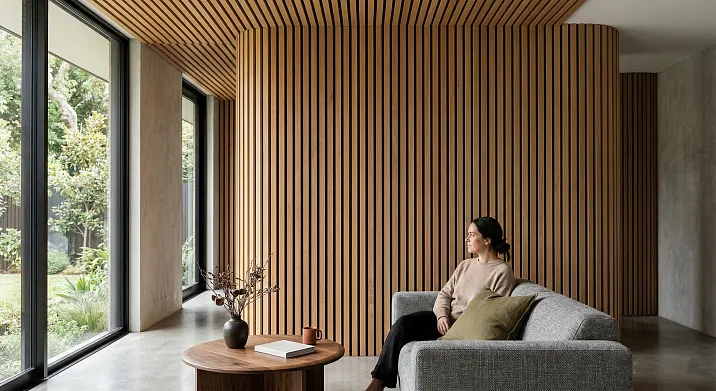
Imagine: morning light glides across a wall, and instead of bland plaster, you see a living, textured rhythm — warm stripes of wood alternating with thin shadow gaps. Each slat is a separate line, and together they form a surface that breathes, changes, reacts to light. This is not an illusion or a designer's trick. This isSlatted wall panels— a material that has redefined the very concept of 'wall finishing' in just a few years.
Slatted wall panels have rapidly become one of the most popular decorative solutions for interiors of any class. But behind this success lies not fashion — but impeccable functional logic. A wall clad with slats is simultaneously more beautiful, 'warmer,' acoustically more comfortable, and visually richer than any painted or wallpapered surface. It invites you to come closer, run your hand over it, stay. And this is precisely the main criterion of a good interior.


What is a slatted wall panel: construction, logic, principle
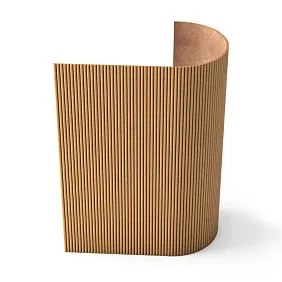
To choose consciously, you first need to understand exactly what you are working with.Slatted wall panel— is a structure made of parallel slats (battens or strips) of identical cross-section, fixed at equal intervals onto a substrate — a rigid MDF board or an elastic fabric base. The uniform rhythm of the slats creates a linear graphic pattern, which interacts with light fundamentally differently than any flat surface.
The secret lies in physics. A flat wall reflects light uniformly and predictably — the result is monotonous and visually 'flat'. A slatted surface breaks up the light flow: each slat reflects it in its own way, the gaps recede into shadow, and rounded or beveled edges create a gradient from light to dark across the width of each batten. With directed lighting — spotlights, sconces, floor lamps — the wall literally 'comes to life': a clear, constantly changing play of light and shadow appears as the observer moves. This is not a photo effect. This is the real, daily aesthetic of the material.
Structurally, the panels are divided into two fundamentally different types. The first — rigid slatted panels on an MDF board: battens are glued to the board, forming a monolithic module with fixed geometry. The second — flexible panels on a fabric base: slats are fixed onto an elastic polyester or fiberglass mesh, which allows the panel to be bent to any curvature. Each type solves its own class of tasks, and understanding this difference is the first step to making the right choice.




Materials: MDF or oak — not a question of quality, but a question of purpose
When it's time to choosedecorative slatted wall panels, the first question is the material of the battens. And there is no universal answer here: there are two fundamentally different tools for different design goals.
Our factory also produces:
MDF: color as the main tool
MDF battens with a density of 750–850 kg/m³ are the choice for those who work with color. The homogeneous, defect-free structure of MDF provides a perfectly smooth surface for applying any paint coating. Matte, satin, semi-gloss enamel — any finish applies evenly, without stains or streaks. The main advantage is precise color matching to the desired RAL or NCS shade. A monochrome white hall with white slats, barely discernible against a white wall — purity close to architectural minimalism. Or, conversely, deep anthracite — an anchor accent surface around which the entire interior is built.
MDF slatted panels for painting solve another important task: they allow for precise color coordination of the slatted surface with other elements of the space — doors, trims, furniture,moldings. In monochrome concepts, this is critically important: the slightest tonal discrepancy destroys the integrity of the image. MDF for painting is a tool of precision.
An important nuance: in rooms with high humidity (bathroom, kitchen area with steam loads), moisture-resistant MDF of the HMR grade should be used. Standard MDF swells and loses its shape under systematic steam exposure. Moisture-resistant MDF maintains its geometry.
Get Consultation
Solid oak: nature that cannot be imitated
Solid oak is a material for a different conversation. Density 700–750 kg/m³, high mechanical strength, a unique natural grain pattern in each slat. Oak wall slats are not a texture applied by a printer. It is a living surface: warm, tactile, with the unique chromatic character of each plank.
Under transparent oils, oak reveals its natural golden tone; tinting oils allow for achieving a Scandinavian cool gray, deep wenge, honey cognac, or pronounced graphite. Stain before varnish is an even more precise tool for working with color while preserving the natural texture. It is precisely this variability on an unchanging natural base that makes oakSlatted wall panels universal for any design concept — from warm Scandinavian to strict neoclassical.
Oak is durable. With proper coating, a slatted wall made of solid wood lasts 15–25 years without loss of appearance. Oil coating can be restored locally — without dismantling, simply by polishing and applying a new layer. This is fundamentally important for commercial facilities with high mechanical load.
Slat profile: why the cross-sectional shape is more important than it seems
A conversation about slatted panels is impossible without discussing the batten profile. The shape of its cross-section determines not only the appearance but also the acoustic properties, light play, and tactile sensations of the surface.
Semi-circular profile — the most popular and most functional. The rounded cross-section works like a lens: it reflects light unevenly, creating a smooth gradient from a light center to dark edges on each batten. Multiplied across the entire slatted surface, this effect turns the wall into a living, changing light sculpture as one moves. Furthermore, semi-circular slats scatter sound waves more effectively than rectangular ones — they lack a flat face parallel to the sound that could create directional reflection.
Rectangular profile — graphically strict, architecturally precise. Provides a more rigid, 'disciplined' pattern. Ideal for interiors requiring clear geometry: modern minimalism, high-tech, strict loft. Flat faces under side lighting create pronounced shadows with sharp edges — not a soft gradient, but contrasting stripes.
Trapezoidal profile — a compromise: a wide base ensures secure fixation to the substrate, a narrowed front face creates a moderately pronounced relief. Works well where expressive volume is needed without the excessive softness of a semi-circle.
Dimensions and parameters: what you need to know before ordering
Professional work with slatted wall panels begins with understanding the parameters. A vague 'I want slats on the wall' is a source of errors and rework. A clear technical specification with parameters is a guarantee of results.
Batten width: 20, 25, 30, 40 mm. Narrow slats (20–25 mm) create a dense, finely rhythmic pattern — suitable for small walls and rooms where subtle, delicate decor is needed. Wide slats (30–40 mm) provide a more monumental, 'weighty' pattern — appropriate for large halls, lobbies, restaurants.
Gap between battens: 5, 8, 10 mm. A narrow gap (5 mm) creates a dense, closed surface — wood dominates visually. A wide gap (10 mm) makes the pattern 'airy', open — the wall background is visible through it, becoming part of the visual concept.
Standard module dimensions: width — 300 or 600 mm; length — 1200, 2400 or 2700 mm. For non-standard projects, manufacturers produce modules to specific room dimensions — minimizing joints and offcuts.
Batten thickness: 14–22 mm for MDF; 12–18 mm for solid wood. Total construction thickness with substrate: 20–30 mm — for rigid panels on an MDF board.
To calculate the required amount of material, measure the surface area (height × width), then increase the result by 10–12% for waste on end cuts and non-standard elements. If there are niches, door and window openings — subtract their area from the total.
Slat orientation: horizontal vs vertical
This is one of the key design choices when working with slatted wall panels—and yet one of the most underrated.
Vertical slats are a classic and the undisputed leader in popularity. Vertical lines are one of the most powerful visual tools for increasing the perceived height of a space. In a standard apartment with 2.7 m ceilings, a vertical slatted wall creates a feeling of 3.2–3.5 m. This is not an optical illusion—it's the physiology of vision. The eye follows the lines upward and registers the ceiling as being farther away than it actually is. For bedrooms, living rooms, and children's rooms with low ceilings, this is a strategically sound choice.
Horizontal slats are a rarer but no less effective technique. They expand the space horizontally: long parallel lines guide the eye along the wall and make the room appear visually wider. A narrow corridor 90–100 cm wide with horizontal oak slats is perceived as a full-fledged gallery space. Horizontal orientation is the choice for elongated rooms and for accent walls where an unexpected, non-trivial design gesture is needed.
Diagonal and mixed solutions are an author's technique for exclusive interiors. Diagonal slats create dynamism and directionality; a V-shaped 'herringbone' pattern (chevron) is an expressive pattern for large accent surfaces in restaurants, hotels, and conceptual living spaces. Implementation requires precise calculation and experience, but the result is an unmistakable author's signature in the interior.
Acoustics: an invisible function with a tangible result
This is rarely discussed—and completely in vain.Slatted wall panelspossess a documented acoustic effect that fundamentally changes the quality of the sound environment in a room.
A flat, smooth wall is an ideal acoustic reflector. Sound waves, hitting it, reflect at a precise angle and create reverberation—that very 'echo' that makes large rooms noisy, tiring, and uncomfortable for conversation. In a restaurant hall with high ceilings and flat walls at full capacity, the noise level can reach 80–85 dB—this is physiologically uncomfortable.
A slatted surface breaks up sound waves: the slats, the gaps between them, and their profile create a diffuse scatterer—a surface that reflects sound chaotically in different directions. The intensity of direct reflection decreases; reverberation is reduced; the space becomes quieter and more comfortable for speech and music.
The effect is greatly enhanced if sound-absorbing material—acoustic foam or mineral wool—is laid behind the slatted panels during frame installation. The slats scatter the sound, the absorber behind them absorbs the scattered waves—the combined effect can reduce the reverberation time in a room by 30–50%. This is why meeting rooms, home theaters, recording studios, and restaurant halls with high guest traffic are increasingly using slatted walls as a standard for acoustic comfort.
Application in interiors: from the bedroom to a five-star lobby
Residential Spaces
In residential interiors, slatted wall panels are used primarily as a tool for creating accents—areas that concentrate visual attention and set the tone for the entire room.
An accent wall in the living room is the most common scenario. A slatted surface behind the sofa or in the TV area creates an 'architectural background' that makes the furniture arrangement look complete and thoughtful even in a minimalist space. White MDF slats blend into the interior, emphasizing volume; dark oak becomes a dominant feature—heavy, noble, 'grounding'. Scandinavian gray is a universal compromise that works with any color scheme.
The headboard zone in the bedroom is the second most popular scenario. A slatted wall behind the bed replaces a headboard, creating an intimate, cozy 'architectural cocoon' for sleep. Vertical slats of natural oak in a warm honey tone behind a double bed—an image that has become a symbol of the modern 'warm minimalist' aesthetic. To this, %sWooden Skirting Boardsin the same tone are organically added—a unified lower trim of the slatted surface, giving completeness to the entire wall.
Children's room—a space where slatted panels are especially appropriate. Natural materials in a child's room are a fundamental choice: wood does not emit formaldehyde, does not accumulate static electricity, and does not cause allergies with a properly applied oil finish. Light oak slats with clear oil create a neutral, calm background that does not compete with colorful toys and textiles but makes the space visually rich.
Furniture fronts: slats in the third dimension
Slatted wall panels have long moved beyond walls. The furniture industry actively uses slatted decor for the fronts of cabinets, dressers, kitchen sets, and islands. Vertical slats on sliding wardrobe fronts visually lighten the massive structure, turning it from a 'wall unit' into an architectural element. A kitchen island with slatted fronts in dark oak is an object around which the entire kitchen concept is built.
Slatted fronts in furniture are produced according to the same principles as wall panels and are often ordered as part of a unified concept—the same material, the same tint tone, the same profile as on the slatted accent wall. A unified material language throughout the interior is a sign of mature, well-thought-out design. To such a solution, it's worth adding %swooden furniture handlesfrom the same manufacturer—details that complete the look.
Commercial spaces: the first impression that works
In commercial spaces, slatted wall panels perform a function that is hard to overestimate: they shape the first impression. And the first impression, as we know, is formed in 7 seconds—and is practically impossible to change afterward.
Restaurant and bar. A slatted wall in a restaurant hall is not just decor. It is a tool for atmosphere creation. Warm oak slats create intimacy; dark tinting creates an elegant, 'adult' image for an evening establishment. With properly designed lighting, the slatted surface completely changes the accents in the hall: during the day—light, business-like; in the evening, with warm directional lighting—dark, cozy, intimate.
Hotel lobby and reception. A guest decides on the hotel's level within the first minutes of being in the lobby. Slatted walls behind the reception desk, slatted columns in the waiting area, slatted ceilings in elevator lobbies—all this creates a visual narrative of 'nature, quality, care'. Wood in a hotel lobby is synonymous with hospitality and coziness. This is why world-class boutique hotels have long used slatted wooden surfaces as a basic architectural language.
Office. A slatted meeting room is a standard of modern corporate design. A business meeting in a room with slatted walls is perceived differently than in a conference room with painted walls: wood 'lowers the temperature' of negotiations, creates an atmosphere of equal partnership, not pressure. Plus acoustics—with slatted walls and an absorber, the meeting room becomes a comfortable zone for lengthy meetings.
Installation of slatted wall panels: step by step and without unnecessary words
Surface preparation
This is the foundation on which everything depends. The wall must be: dry (moisture content no higher than 4%, checked with a moisture meter), clean (without oil stains, old adhesive residues, crumbling plaster), level (permissible deviations up to 3 mm over 2 m for adhesive installation; for frame installation—levelness is not critical). Drywall, concrete, and plaster are primed with a universal acrylic primer before applying adhesive.
Adhesive installation on a level base
Neoprene-based contact adhesive is applied with a notched trowel (2–3 mm notch) to both surfaces — the panel and the wall. Allow 5–10 minutes for the adhesive to become tacky. The panel is applied to the wall in one motion — contact adhesive does not allow repositioning. Roll with a rubber roller from the center to the edges. Joints between modules are controlled by matching the batten spacing. For polyurethane adhesive: applied to only one surface, open time 15–20 minutes, allows for precise panel positioning. Preferred for installation on uneven or complex substrates.
Installation on a Frame
Horizontal guides made of 60×27 mm metal profile are attached to the wall with a spacing of 400–600 mm. The frame allows for leveling the plane regardless of the wall condition. Sound-absorbing material is placed in the space between the frame and the wall. Panels are attached to the profile with headless finishing nails or hidden clips through the fabric backing (for flexible panels) — the fasteners go into the gap between the battens and remain invisible.
Module Joining
Modules are joined so that the end battens of adjacent modules form a full gap equal to the panel's standard gap. This ensures a visually continuous, 'endless' batten surface without visible seams. A technical adhesive tape is applied to the joint on the inside before pressing — to fix the precise gap.
Finishing Elements
The top edge of the batten wall is finished withwith wooden cornicesor a ceiling molding matching the battens. The bottom edge —wooden skirting boardor a floor molding. Side edges at doorways are finished with corner profiles orsolid wood casings. These details are not optional. Without them, a batten wall looks unfinished, like a picture without a frame.
Batten Panels in Various Interior Styles
Scandinavian Style and Japandi
Light oak, clear oil, 8 mm gap, batten width 20–25 mm — this combination has become the signature of Scandinavian minimalism and its Japanese variant, Japandi. Simplicity of form, natural materials, rejection of excess. Here, the batten wall is not an accent, but part of a unified, neutral natural background that calms and creates a sense of security.
Loft and industrial style
Anthracite or graphite on MDF, wide 10 mm gap, batten width 30–40 mm. Batten wall panels combined with exposed utilities, concrete floors, and metal lighting fixtures create an urban, 'adult' look. The contrast of dark battens with brickwork or gray concrete is a visual language that is clear and convincing.
Modern Classicism and Neoclassicism
White MDF battens with a semi-circular profile combined withornate moldings, pilastersandcornices— a dialogue between classical architecture and a modern rhythm. Here, the batten surface replaces historical fabric wall upholstery, preserving its 'warmth' and visual richness, but adding contemporary lightness.
Organic Design
Natural oak or warm ochre tones of MDF, live surface curves (flexible panels), minimal symmetry — batten panels in organic design work as a natural metaphor: tree branches, coastal reeds, waves. This style is one of the fastest-growing in commercial interior design in recent years.
Restaurant and Hotel Concept
Dark stained oak, semi-circular profile, directed spot lighting — a formula that works in 90% of restaurant projects. Add batten partitions between tables, a batten bar counter, and a batten ceiling over the bar area — and the space gains the necessary depth, layering, and 'seriousness' that a guest reads as a sign of the establishment's quality.
Care: How to Preserve Beauty for Years
Batten wall panels do not require complex care — but they do require regular care. The difference between 'complex' and 'regular' is fundamental.
For paintable MDF panels, routine care involves wiping along the battens with a dry or slightly damp soft cloth. Stains are removed with a neutral soap solution. Heavy stains, scratches, and chips are addressed with local touch-up painting without disassembly — matte finishes are restored almost imperceptibly.
For solid oak panels with oil finish: refresh the oil layer annually or every two years. Oil is applied along the grain, rubbed into the gaps between battens, and excess is removed after 15–20 minutes. This is 2–3 hours of work per year that keeps the surface 'like new' for decades. Lacquered panels require less frequent maintenance — every 3–5 years — but if the lacquer layer is damaged, they require more skilled repair.
Prohibited: abrasive cleaners, stiff brushes, aggressive household chemicals, direct exposure to high humidity.
Frequently Asked Questions and Precise Answers (FAQ)
How do batten wall panels differ from regular ones?
Regular wall panels are monolithic slabs without relief. Batten panels create a three-dimensional linear pattern of parallel battens with gaps — this is a fundamentally different aesthetic, light play, and acoustic behavior.
What is better — MDF or solid oak?
For precise color work and monochrome concepts — MDF for painting. For natural aesthetics, high loads, and long-term use — solid oak. This is not a question of 'better or worse,' it's a question of purpose.
How to install — with adhesive or on a frame?
On a flat, well-prepared wall — adhesive (faster and easier). On uneven walls or when acoustic insulation is needed — a frame with an absorber. The frame also allows hiding utilities.
Can it be installed in a bathroom?
Only moisture-resistant MDF (HMR). For areas without direct water or steam exposure. Oak in the bathroom — only with an oil-wax hydrophobic coating. Direct contact with water is unacceptable for both materials.
Is acclimatization needed?
For solid oak — mandatory, at least 48 hours in the room. For MDF — recommended 24 hours.
What gap to choose?
5 mm — tight, closed pattern, wood dominates. 8 mm — universal balance. 10 mm — airy, light pattern, the wall background color becomes part of the decor.
How much do slatted wall panels cost?
The price starts from 7,850 rubles per module for standard items. The final price depends on the material, module size, profile, and order volume.
Can I order a custom size?
Yes. Custom lengths, widths, and slat profiles are manufactured according to specific technical requirements.
How to join panels without a visible seam?
The end slats of adjacent modules are installed with a half-gap from each module — at the joint, a full standard gap is formed, indistinguishable from the internal ones.
How much do slatted panels reduce noise?
A slatted surface without an absorber provides a moderate acoustic effect (sound scattering). With an absorber behind the frame — reduction of reverberation by 30–50% depending on the room.
STAVROS: slatted wall panels from the manufacturer
The logical conclusion of any professional discussion about slatted wall panels is the question: where to get material that can be trusted.
STAVROS is a Russian manufacturer of wooden products and interior decor with 24 years of experience. Not a trading intermediary, not an aggregator: own production, own control at every stage — from raw material selection to final packaging.Slatted wall panels made of MDF and solid oakin the STAVROS catalog — these are rigid modules on an MDF base and flexible ones on a fabric base, profile semi-circular and rectangular, slat width from 20 to 40 mm, gap to choose, oak tinting and MDF painting in the desired RAL or NCS.
inStavros catalognext to the slatted panels — the full range of wooden products for creating a cohesive interior:Baseboards, Crown Molding, Moldings, Casings, pilasters and columns, Furniture Handles. One material, one tone, one manufacturer — this is exactly what ensures that visual integrity which is impossible to achieve by buying everything from different places.
STAVROS consults, calculates, manufactures according to custom technical requirements, delivers throughout Russia. Non-standard module size, special slat profile, rare oak tint tone — not a problem, but a work task. Because 24 years of experience is not a marketing line. It's thousands of completed projects and zero percent of quality complaints.