Article Contents:
- What the eye sees: the visual anatomy of a slatted wall panel
- Photos of slatted wall panels in the living room: five looks
- Look one: dark oak on a light background, vertical
- Look two: natural oak with built-in lighting, night shot
- Look three: white slats, Scandinavian living room
- Look four: horizontal slats in a loft living room
- Look five: slatted partition between the living room and kitchen
- Photos of slatted wall panels in the bedroom: visual scenarios
- Wall behind the bed: warm oak and hidden lighting
- Biophilic bedroom: pine and live plants
- Photo of slatted wall panels in the hallway and corridor
- Long slatted wall in the corridor
- Slatted panel behind the mirror in the hallway
- Slatted wall panels in the office: photos of workspaces
- Slatted wall behind the monitor: background for video calls
- Library with slatted panels between shelves
- Slatted wall panels in the bathroom: an unexpected but convincing look
- SPA-style bathroom with wooden slats
- Slatted wall panels in commercial interiors: photos of professional projects
- Restaurant with warm oak slats
- Office with slatted panels in the meeting room
- Hotel lobby with slatted accent walls
- Slatted wall panel parameters in tables: quick reference guide
- Choosing slat width by room type
- Slat/gap ratio and visual effect
- Finishing a slatted system: what it looks like in photos
- How to properly photograph slatted wall panels
- Frequently Asked Questions
- Why do slatted wall panels look better in photos than in real life?
- How to determine the width of a slat from a photo?
- Is it possible to identify the wood species from a photo?
- What is the most popular tone of slatted panels in photos?
- Is lighting needed for a beautiful photo of a slatted wall?
- How often are oil-coated slatted wall panels updated?
- Conclusion

When someone types 'slatted wall panels photo' into a search engine, they're not looking for an abstract description. They're looking for an image. They want to see what it looks like in a real apartment, a living restaurant, an actual office—not in a perfectly staged render from a design bureau. They want to understand: will this suit me? Will my space accept this?
That's precisely why this article is structured differently than most materials on the topic. Here, you'll find specific visual scenarios, detailed descriptions of exactly how slatted wall panels look in different contexts, with different parameters, materials, and lighting. Reading these descriptions, you'll see the picture—vivid, accurate, real.
Five minutes of reading this article will replace an hour of scrolling through Pinterest with unsuitable foreign interiors. Here—only what is truly applicable, truly beautiful, and truly works.
What the eye sees: the visual anatomy of a slatted wall panel
Before looking at photos of finished interiors, you need to learn how to 'read' a slatted surface. Understand what visual components it consists of. Then any photo stops being just a pretty picture and becomes an instruction.
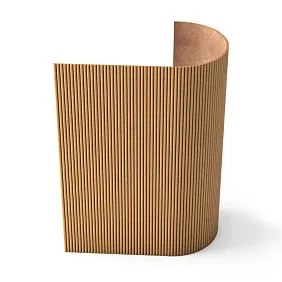
A slatted wall panel consists of three visual elements that the eye sees:
Slat — a wooden plank. What protrudes forward. It features the natural grain pattern, tinting, and a highlight on the front face from lighting. This is the 'positive' of the slatted surface.
Gap — the space between slats. Shadow, depth, air. With integrated lighting — a glowing line. With directed external lighting — a dark accent emphasizing the relief. This is the 'negative' — the void that makes the slat visible.
Backing — the surface behind the slats. With integrated lighting — a colored glow background. Without lighting — a dark, deep background that enhances the three-dimensionality of the slatted field. Most often — dark felt or MDF.
It is precisely the ratio of these three elements — slat width, gap width, backing color — that creates a particular visual image. Understanding this, you can 'read' any photo of slatted wall panels and reproduce the desired effect.
Solid oak slatted wall panels— a living surface that changes its appearance depending on the lighting angle, time of day, and color of surrounding surfaces. No render fully conveys this. That's why photos of real interiors are the best source for understanding.




Photos of slatted wall panels in the living room: five looks
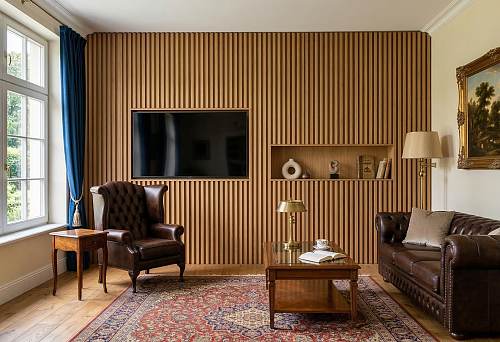
The living room is the most common place for slatted wall panels. Here they work most expressively — as an accent wall, a zoning element, a carrier of lighting. Let's examine five specific visual scenarios — with a detailed description of what the eye actually sees.
Our factory also produces:
First look: dark oak on a light background, vertical
Imagine a living room of 26 sq. m. Walls are a warm light gray tone. Ceiling is white. Floor is natural-colored oak parquet. On the end wall behind the sofa, there are vertical slatted wall panels made of solid oak, 40 mm wide, with a 20 mm gap, finished in 'anthracite' stain. Height is from floor to ceiling (2.75 m).
What does the eye see? Dark vertical stripes against the room's light background. Each slat is a graphic dark line. The gaps are thin light slivers through which the dark felt backing is visible. Above the slatted field is a hidden cornice from which warm light (2700 K) 'flows' down in the evening.
In daylight, it's an architectural, strict look. Dark slats on a light wall are like a musical staff: a rhythm that organizes the space. In evening lighting, a transformation occurs. The slats 'come alive': each has a lit edge on top and a shadow below. The surface becomes a three-dimensional sculpture.
In photos, this look is recognized by a characteristic feature: a strict dark slatted wall + a sofa in a light or neutral tone + warm cornice lighting. One of the most sought-after looks for modern Russian living rooms.
Get Consultation
Second look: natural oak with integrated lighting, night shot
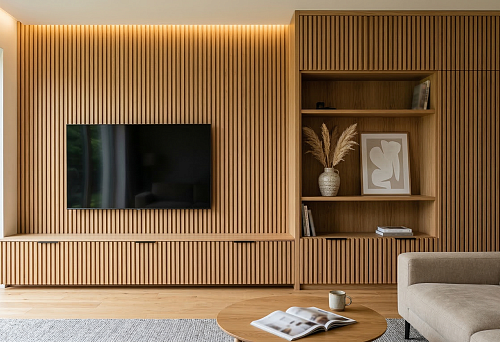
Those searching for 'slatted wall panels photo night interior' are looking for exactly this look. Vertical oak slats 30 mm wide, 20 mm gap, finished in 'natural oak' stain. Behind the slats is a warm white (2700 K) LED strip in horizontal grooves of the dark felt backing.
The main light is off. Only the integrated lighting behind the slats is on. What does the eye see?
Dark slats are silhouettes against a warm glowing background. The gaps are glowing strips of warm golden color. The natural grain of the oak on the slats is barely visible in the shadow but present as texture. The floor in front of the slatted wall reflects the diffused light from the gaps, creating a soft glow at the base.
In the photo, it's a 'light installation made of wood.' Warm glowing strips in a dark interior. This photo most often 'goes viral' in interior blog compilations because it's beautiful regardless of style and taste. Beautiful on a physical level, at the level of the nervous system's reaction to warm light in the dark.
Third look: white slats, Scandinavian living room
MDF battens 25 mm wide, painted with matte white enamel, 15 mm gap, backing - light gray felt. The height of the batten field is only the upper third of the wall (from 1.8 m to the ceiling). Below the batten field - a white painted wall.
What does the eye see? A delicate white rhythm on the upper part of the wall. A soft division of the upper zone. Gaps are thin gray stripes (the color of the felt backing). Daylight from the window 'glides' over the white battens, creating soft shadows in the gaps - the surface looks voluminous despite the white color.
This image works especially well in small Scandinavian and Nordic interiors, where the battens should not 'overwhelm' the space. The delicate white rhythm is present, organizes, but does not dominate.
Image four: horizontal battens in a loft living room
Living room with exposed brickwork, concrete ceiling, metal pipes for open wiring. One wall - horizontal oak battens 60 mm wide, 25 mm gap, 'cognac' tint. Battens from floor to ceiling, horizontally - like wooden layers.
What does the eye see? Contrast of warm amber wood and cold gray concrete and brick. Horizontal wooden layers against the background of vertical brickwork - dynamics built on the contrast of orientation. Wide battens with the large natural grain of oak - each batten like an independent wooden 'layer'.
In photos, loft living rooms with horizontal oak battens are one of the most 'powerful' images. The contrast of materials (concrete, brick, wood, metal) creates a rich, masculine, architectural atmosphere.
Image five: batten partition between living room and kitchen
Not a wall, but a partition - a freestanding batten structure dividing the open space into zones. Vertical battens 35 mm wide, 35 mm gap (equal rhythm of batten and gap), 'natural oak' tint. Height - from floor to ceiling.
What does the eye see? An openwork wooden lattice - open, 'breathing'. From the kitchen, the living room is visible through the gaps - but not directly, but through the 'filter' of the wooden rhythm. Light passes through the partition - kitchen light is 'strained' through the wooden verticals, creating a striped pattern on the living room floor.
Slatted wall panelsIn the form of a partition — one of the most effective tools for zoning open layouts without losing the sense of space.
Photos of slatted wall panels in the bedroom: visual scenarios
The bedroom requires a special visual 'language'. Here, tranquility is needed, not dynamism. Warmth, not severity. Naturalness, not technologicality. That is why photos of slatted wall panels in the bedroom are a special category of images.
Wall behind the bed: warm oak and hidden lighting
Wall behind the bed headboard — vertical oak slats 35 mm wide, 18 mm gap, 'cognac' tint, height from floor to ceiling (2.8 m). Hidden cornice lighting above the slatted field with 2700 K LED strip.
Bed with a linen headboard in natural linen color. Bedding — warm white. Bedside tables made of solid light oak withwooden furniture handlesmatching the slats.
What does the eye see in the evening? Warm light from the cornice flows from top to bottom along the amber slats. Each slat — an illuminated front edge and a shadow in the gap. The bed under the slatted wall — in soft, diffused, warm light. Image: coziness, security, naturalness. It is precisely such a photo that makes one say 'I want a bedroom like that'.
Biophilic bedroom: pine and living plants
Bedroom with two slatted walls — behind the bed and a side wall. Pine slats in a natural tone (clear oil), width 30 mm, gap 20 mm. On the side slatted wall — wooden consoles with hanging ceramic pots with living plants.
What does the eye see? A natural 'cocoon': wood on two sides, greenery of plants on the slatted wall, natural stone on the floor. Pine slats with natural knots — not a 'perfect' material, but a living one, with character. In daylight — a soft natural image. In the evening under warm light — a meditative natural refuge.
Photo of slatted wall panels in the hallway and corridor
The hallway is the first impression of a home. And at the same time — the most challenging space to finish: narrow, often windowless, with many functional elements (coat racks, shelves, mirrors).
Slatted wooden wall panelsin the hallway work on several levels simultaneously.
Long slatted wall in the corridor
Long corridor 1.2 × 6 m. One long wall is fully clad with vertical slats — 'anthracite' oak, width 40 mm, gap 15 mm. Floor uplighting from bottom to top: aluminum profile with a slit at the base of the wall, LED strip 2700 K.
What does the eye see? A long row of dark vertical slats, illuminated from below with warm golden light. Shadows from the slats go upward — inverted chiaroscuro, which is perceived as unconventional, almost surreal. The corridor walls visually 'part' thanks to the vertical rhythm.
In photos, such a corridor is one of the most frequently 'saved' images in interior collections. This is the power of a simple solution executed with precision.
Slatted panel behind a mirror in the hallway
Small hallway 3 sq. m. One wall — vertical birch slats, white oil finish, width 25 mm, gap 15 mm. On the slatted wall — a round mirror in a wooden frame, clothing hooks from a wooden rail matching the slats.
What does the eye see? A delicate light rhythm of birch slats — a background for functional elements. A round mirror on a slatted wall — a play of circles and straight lines.Wooden furniture handlesand hooks matching the slats — a unified natural system.
This is the image of a 'Scandinavian hallway' at its best: functional, natural, without excess.
Slatted wall panels in the office: photos of workspaces
The home office is experiencing a renaissance. After the mass transition to remote work — the 'home workroom' has transformed from an optional bonus into a functional necessity. And the question of the office's image is no longer a designer's whim, but a practical task: the workspace must create a mood of work and professionalism.
Реечная стена за монитором: фон для видеозвонков
Desk against the wall. Behind the monitor — vertical oak slats 45 mm wide, 20 mm gap, 'walnut' tint. The height of the slatted field — only the wall behind the desk (1.5 m × 1.8 m), not the entire wall.
Hidden cornice above the slatted field with 3000K LED strip — neutral warm white, which creates good lighting for video calls without shadows on the face.
What does the eye see on the interlocutor's screen? A professional background: warm wooden slats, even light. An image of competence, taste, quality of space. This is not a neutral white background — it's a working 'professional portrait' of its owner.
At the same time,wooden slatted wall in the officeIt doesn't just serve as a background for calls—it acoustically 'softens' the space, reducing reverberation. In an office without soft furniture, this is practically important for sound quality during recording and calls.
Library with slatted panels between shelves
Study-library. Solid wood bookshelves on three walls. The fourth wall—vertical slats of dark oak (wenge finish), width 50 mm, gap 25 mm, from floor to ceiling (3.0 m). In front of the slatted wall—a leather armchair and a floor lamp with a brass stem.
What does the eye see? Dark slats—a 'curtain' behind the reading chair. The floor lamp with warm light creates a 'spot' of soft lighting by the chair. Dark slats behind the back—a feeling of shelter, a 'niche' within the large library space. Vibe: club-like, masculine, intellectual.
In combination withwith solid wood floor skirtingmatching the slats andwith a classic polyurethane corniceacross the ceiling—the image is complete, architecturally cohesive.
Slatted wall panels in the bathroom: an unexpected but convincing look
Wood in the bathroom? Many doubt it—and in vain, if we're talking about properly selected and properly treated materials.Slatted wall panelsmade of thermally modified wood or larch with a moisture-resistant varnish finish—a functional and beautiful solution for bathrooms.
SPA-style bathroom with wooden slats
8 sq. m bathroom. The wall behind the bathtub features vertical larch slats, 30 mm wide, with a 20 mm gap, finished with waterproof matte varnish. Walls and floor are covered with large-format porcelain stoneware in 'gray concrete' color. The freestanding bathtub rests on wooden legs.
What does the eye see? The contrast of cold gray stone and warm wooden slats — a classic SPA look. The slats on the wall behind the bathtub serve as a natural 'screen' in front of which the bath is taken. Warm lighting (2700 K) above the slatted wall casts a golden light on the wooden slats.
This photo works as an advertisement for a luxury-class sanatorium — regardless of the bathroom's actual budget. The right material + the right lighting + surface contrast = an image that is worth much more than its cost.
Slatted wall panels in commercial interiors: photos of professional projects
Commercial interiors are a separate universe for the application of slatted wall panels. Here, wood functions as a tool for shaping the brand's image.
Restaurant with warm oak slats
Restaurant with 60 seats. Three walls feature vertical oak slats, 40 mm wide, with a 20 mm gap, stained in 'tobacco' tone. The fourth wall is exposed brickwork. The ceiling is black, with track spotlights directed at the slatted walls at a 40° angle.
What does the eye see? Warm amber slats under directed light — each slat 'glows' on its illuminated edge, casting a thin shadow into the gap. The space is visually 'warmed up' to a state of maximum gastronomic coziness. The contrasting brickwork adds 'history'.
In the photo, this image is the archetype of a St. Petersburg-Moscow restaurant interior. Warm wood + brick + black ceiling + track lighting. It works because it has always worked.
Office with slatted panels in the meeting room
Meeting room 25 sq. m in a business center. End wall — horizontal oak slats 60 mm wide, 25 mm gap, 'walnut' tint. Height — from floor to ceiling (2.7 m). Behind the slatted wall — LED backlight (3000 K) in horizontal grooves.
What does the eye see at a business meeting? A monumental horizontal slatted wall behind the screen — a professional, serious background. With the built-in lighting on — warm glowing strips through the gaps. In work mode, the lighting is reduced to 30% — an atmospheric work background. During an important presentation — full brightness.
wooden wall panelsin the meeting room — is an investment in the corporate image that pays off with every business visit from partners and clients.
Hotel lobby with slatted accent walls
City hotel lobby 80 sq. m. Main wall behind the reception — vertical solid ash slats, width 30 mm, gap 20 mm, 'natural ash' tint (light, natural). Height — 4.5 m (double-height space). Built-in LED backlight behind the slats.
What does the guest see upon entry? A glowing natural wall 4.5 meters high. Warm light through the ash slats — soft, diffused, natural glow. The reception desk against this wall — professional, natural, memorable.
In photos, such a lobby is the first image of the hotel in the guest's mind. And this image is about warmth, naturalness, quality.
Parameters of slatted wall panels in tables: quick reference
Choosing slat width by room type
| Room | Recommended width | Orientation | Tinting |
|---|---|---|---|
| Small bedroom up to 16 sq. m | 20–30 mm | Vertical | Light |
| Living room 20–30 sq. m | 35–50 mm | Vertical/horizontal | Any |
| Restaurant, cafe | 40–60 mm | Vertical | Warm tones |
| Office, meeting room | 50–70 mm | Horizontal | Dark, neutral |
| Hallway | 25–40 mm | Vertical | Warm or white |
| Staircase, hallway | 35–55 mm | Vertical | To match the staircase wood tone |
| SPA, bathroom | 25–40 mm | Vertical | Natural, without tinting |
Slat/gap ratio and visual effect
| Ratio | Visual image | For which interiors |
|---|---|---|
| Slat twice as wide as gap (40/20) | Dense, restrained | Classic, neoclassic |
| Slat equals gap (30/30) | Openwork, 'breathing' | Partitions, zoning |
| Slat narrower than gap (25/35) | Light, graphic | Minimalism |
| Wide slat with narrow gap (60/15) | Monumental, large-scale | Lobbies, large halls |
Finishing the slat system: what it looks like in photos
When you look at a photo of a finished interior with slat wall panels and think 'this was done professionally' — it's almost always about the finishing system. It's in the details that aren't noticeable at first glance, but without which the image 'falls apart.'
Cornice along the top edge.a polyurethane corniceIn the tone of the slats or the color of the ceiling — the transition between the slat field and the ceiling. In the photo: a neat horizontal strip that 'closes' the top end of the slats and creates a smooth transition.
Floor skirting board.solid wood baseboardIn the tone of the slat panels. In the photo: the lower edge of the slat field 'sits' on the baseboard without a gap. The transition from wall to floor is clean, professional.
Molding.Moldings made of polyurethaneIn a two-zone solution — a horizontal 'frame' at the border of the slat field and the upper part of the wall. In the photo: a clear horizontal line that makes the transition architectural, not accidental.
Furniture handles.Wooden furniture handlesOn built-in cabinets and nightstands in the tone of the slat panels. In the photo: a thin detail that, upon closer inspection, reads as part of a unified natural system.
How to properly photograph slat wall panels
A small practical section — for those who have completed a renovation with slat panels and want to get beautiful photos for a portfolio or publication.
Lighting. Shoot in warm evening lighting — when the cornice or built-in lighting is on. Daytime 'work' light removes the beauty of shadows and relief. Evening directional light — creates that three-dimensionality for which it was all started.
Shooting angle. The best angle for a slatted wall is slightly from the side, at a 20–30° angle to the surface. Straight frontal shooting 'flattens' the slats—the relief disappears. A side angle makes each slat visible in volume, with an illuminated edge and shadow.
Framing. Include the finishing system in the frame: cornice at the top, baseboard at the bottom. A cropped slatted wall without finishing looks incomplete in a photo, even if everything is covered by furniture in reality.
Detail shot. In addition to the general shot—capture a detail: a close-up of a slat with the natural grain of oak, a gap with shadow, the joint between a slat and the cornice. Detailed photos of slatted wall panels are what make viewers think 'I want the same'.
Frequently asked questions
Why do slatted wall panels look better in photos than in real life?
If the photo is professional—it's about the lighting. A professional photographer sets up the light to maximally emphasize the relief of the slats. In real life, you need to design the lighting correctly—then the slatted wall will look just as good as in a professional photo.
How to determine the width of a slat from a photo?
Look at the ratio of the slat width to the gap. If the slat is about twice as wide as the gap—that's the standard balanced rhythm (e.g., 40/20 mm). If the slat and gap are equal—that's an 'equal' rhythm. Count the number of slats per meter and divide 1000 mm by the sum of the slat and gap.
Can you determine the wood species from a photo?
Oak: warm golden-brown tone, pronounced large grain pattern, characteristic medullary rays. Ash: lighter than oak, contrasting fine pattern. Birch: uniform, neutral, without a pronounced pattern. Pine: knots are visible, softer light tone.
What tone of slatted panels is the most popular in photos?
Based on search demand and photo popularity in interior blogs: natural oak and anthracite share first place, cognac is third. Bleached ash is a top choice for Scandinavian style.
Is lighting necessary for a beautiful photo of a slatted wall?
Not mandatory, but desirable. Without built-in lighting — for a beautiful photo you need directional external light (a spotlight at a 35–45° angle). Built-in lighting behind the slats creates an effect that cannot be reproduced with external lighting.
How often should slatted wall panels with oil finish be refreshed?
Every 2–3 years for residential spaces. For commercial premises with high traffic — every 1–2 years. Refreshing means applying a thin coat of oil in the same tint. Takes a few hours. The slats look like new after oil refresh — the natural tone is renewed, minor scratches disappear.
Conclusion
Slatted wall panels in photos are inspiring images. But the main value of these images isn't just to admire and close the tab. The main value is to see your own space through this image. Imagine your living room with dark slats behind the sofa. Your bedroom with amber oak under the warm light of a cornice. Your restaurant with wooden slats that 'warm up' the atmosphere to the right temperature.
Slatted wooden wall panels— is not 'decor'. It's an architectural solution that changes the character of a space. With correctly matchedcornicesandpolyurethane moldings, withwith solid wood floor skirting, withfurniture handles in matching tone— is a system that creates an interior looking exactly like in the best photos: professional, natural, beautiful.
The full catalog of slatted panels, perimeter finishing systems, and decorative elements made from solid wood — available in the STAVROS company's assortment.
STAVROS — production of decorative interior solutions of European quality level. Slatted panels made of solid oak, ash, birch, and pine with professional tinting. Cornices, moldings, baseboards, decorative elements for stairs and furniture — everything that turns a beautiful photo of a slatted interior into your reality.