Article Contents:
- Why the living room can support a complex decorative composition
- Scale and viewing distance
- Usage scenarios as an architectural program
- Where to place slatted panels in the living room: the logic of choosing a plane
- The wall behind the sofa: the main scenario
- TV wall: a natural background for the screen
- Lower slatted belt: modern wainscoting
- Stucco decor in the living room interior: what is appropriate and why
- Ceiling cornice: an essential element of completeness
- Ceiling rosette: the point from which coordinates diverge
- Moldings: dividers and organizers
- Pilasters: an order system without pomp
- How to unite the TV zone, sofa group, and ceiling into a single system
- Horizontal axis as a unifying principle
- Ceiling as the fifth wall: a system of completion
- Slats and decor: different zones, unified style
- Light, textiles, color, and relief: how four layers work together
- Lighting: the director of relief
- Textile: a buffer between architecture and people
- Color: the tone that sets the type of conversation
- Relief as the fourth layer: a dialogue of textures
- Living room styles where the combination of slats and molding works flawlessly
- Neoclassicism and Modern Classicism
- Organic modernism and biophilic style
- Eclecticism: a dialogue of eras
- Mistakes of an oversaturated living room: what not to do
- First mistake: slats and molding on the same plane
- Second mistake: different styles of battens and moldings
- Third mistake: too many accent walls
- Fourth mistake: furniture competing with architecture
- Mistake five: uneven lighting of textured surfaces
- Practical cases: three living rooms — three characters
- Case one: 28 m² city apartment, neoclassicism
- Case two: 45 m² country house, organic modernism
- Case three: 22 m² apartment, bold eclecticism
- Frequently Asked Questions (FAQ)
- STAVROS: when the living room becomes architecture

The living room is the most candid spatial self-portrait. It is here that the homeowner speaks about themselves without words: through the choice of materials, through the rhythm of surfaces, through how light interacts with form. And it is here that design mistakes are most often made — not from a lack of funds, but from a lack of concept. A good renovation without an idea is just an expensive renovation.
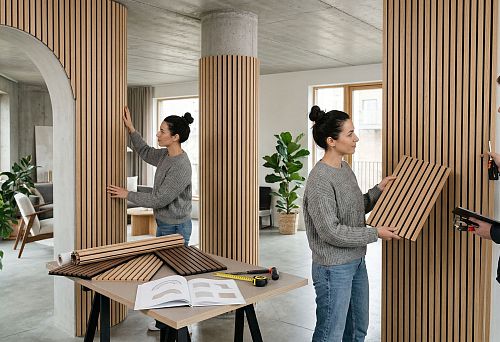
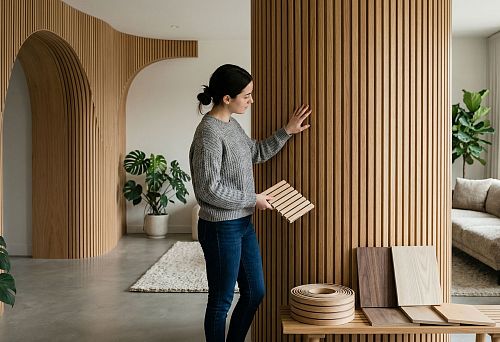
Slatted panels in the living room interiorandRelief Decor in Interior— these are two different architectural languages. The first speaks with nature and rhythm — line, wood, repetition. The second — with tradition and ornament, with moldings as a cultural code conveying a connection with time. A living room where both languages sound not simultaneously or discordantly, but in a structured dialogue, becomes a space with its own voice. Not resembling a catalog, not quoting others' solutions — its own.
This is what we will discuss: how to build this dialogue.


Why the living room can support a complex decorative composition
The bedroom does not forgive overload—it demands peace. The kitchen dictates function—aesthetics are secondary here. The hallway is too small for elaborate statements. The living room is the only space that has the scale, viewing distance, and semantic capacity for a complex design solution.




Scale and viewing distance
An adult in the living room is positioned 3–5 meters from the main wall. This is a fundamentally different perception distance than in the bedroom or hallway. From five meters, the details of an ornament, the relief of slats, the shadow from molding—all of this is perceived simultaneously as a single picture. It is precisely this distance that allows the architectural composition of the wall to be 'read' in its entirety.
Small details are not lost: from five meters away from the wall, a person sees the overall image and simultaneously distinguishes details—the depth of the groove between the slats, the profile of the cornice, the relief of the rosette. This is a unique property of the living room as a space, which no other room in the apartment possesses.
Our factory also produces:


Usage scenarios as an architectural program
The living room serves several behavioral scenarios: morning coffee in silence, a workday with video calls, an evening movie, meeting with guests, a festive dinner. Each of these scenarios presents different requirements for the atmosphere. The architectural complexity of the wall—slats and stucco decoration in the right combination—creates a space that changes along with the light and mood: strict in the morning under bright light, solemn in the evening by candlelight, cozy under subdued side lighting.
This is a quality that neither wallpaper nor a painted wall provides. Only relief in dialogue with light.
Get Consultation
Where to place slatted panels in the living room: the logic of choosing a plane
Slatted panels in living room interior photos—a query for which thousands of people search for inspiration. And most find the same answer: an accent wall. But not just any wall—the one that works in a specific space with a specific furniture arrangement.
The wall behind the sofa: the main scenario
The wall behind the sofa is the living room's 'stage.' It's the first thing everyone sees upon entering the room and the focal point for guests seated opposite. The slatted panels on this wall create a natural architectural backdrop, transforming the sofa from a mere piece of furniture into an integral part of a composed scene.
Vertical slats behind the sofa function as a 'colonnade'—a powerful, solemn image. Horizontal slats behind a horizontally elongated sofa create a unified sense of horizontal motion, merging the furniture group and the wall into a single architectural object.
TV wall: a natural backdrop for the screen
A television on a bare white wall creates a jarring contrast between the black rectangle of the screen and the empty surface.Slatted wall panels in interior designsolve this problem organically: dark slats behind a dark screen create a unified dark plane from which the screen doesn't stand out but logically emerges. Light slats behind a dark screen create an expressive contrast, but without aggression.
A crucial detail for a TV wall with slats: wires and the mounting bracket must be concealed. A slatted wall with visible wires is a ruined concept.
Lower slatted paneling: modern wainscoting
Slats on the lower part of the wall, 90–120 cm high, are not a half-measure but a deliberate architectural technique. This is a modern interpretation of the classic tradition of wooden wall paneling, known in European architecture. A lower slatted panel combined with a horizontal molding along the dividing line and a decorative cornice near the ceiling forms a complete neoclassical system, realized with contemporary materials.
For a living room with high ceilings and classic furniture, this is the optimal solution: wood 'grounds' the space, giving it weight and coziness; the molding organizes the transition, and the cornice completes the system.
Plaster decor in the living room interior: what is appropriate and why
interior moldingsIn a modern living room, it is not a museum or a palace enfilade. It is an architectural tool that requires an understanding of the function of each element. What exactly does plaster decor bring to the living room — and where is the line between appropriate and excessive?
Ceiling cornice: an essential element of completeness
A cornice at the junction of the wall and ceiling is a horizontal line that organizes the entire living room space. Without a cornice, the ceiling 'detaches' from the walls: the transition between them is technical and rough. A polyurethane cornice with a classic profile creates an architectural horizon, above which is the ceiling, below is the architectural wall.
For a living room with a ceiling height of 2.7–3.0 m, the optimal cornice height is 70–100 mm. For a height of 3.0–3.5 m — 100–150 mm. The rule of proportion: the cornice should be proportionate to the height of the room — neither overwhelming nor lost.
Ceiling rosette: the point from which coordinates diverge
A rosette around the chandelier is an element that fixes the center of the ceiling. Where there is a rosette, the space gains a geometric center. This is more important than it seems: a living room without a center is a space where the gaze wanders. A living room with a plaster rosette is a space with a reference point.
For living rooms in modern neoclassicism — a rosette with a diameter of 40–70 cm with a moderate ornament. For living rooms with high ceilings (3.0 m and above) and classic furniture — a large rosette with a diameter of 80–120 cm with rich relief.
Moldings: dividers and organizers
Horizontal moldings on living room walls do what no other element can: they divide the vertical wall into proportional zones. The lower third of the wall is the field of gravity, the support. The middle third is the field of life, the 'eye' of the room. The upper third is lightness, air.
A molding installed at a height of 90–110 cm creates the room's 'horizon line' — the boundary between the lower, heavier, and upper, lighter layers of the wall. Combined with a slatted lower band, this solution looks complete and architecturally sound.
Pilasters: an order system without pomposity
Vertical polyurethane pilasters on living room walls are one of the most underrated tools of classical decor. They divide the large wall plane into equal vertical fields, create an architectural rhythm that complements the horizontal rhythm of the slats. Pilasters in the living room are not columns: they are flat, delicate, integrated into the wall surface, not protruding from it. But they carry the same meaning: order, proportion, respect for architectural tradition.
For a living room with slatted panels in the lower part: pilasters are placed above the slatted band, on the smooth part of the wall. Pilaster width is 80–120 mm, depending on the room height.
How to unify the TV zone, sofa group, and ceiling into a single system
This is the main design question for a large living room. Three zones with different functions, different equipment, different requirements — how to make them into one picture?
The horizontal axis as a unifying principle
A horizontal molding line running along all living room walls at the same height is a powerful unifying technique. Molding at a height of 90–100 cm 'girds' the entire space: it runs along the wall behind the sofa, along the TV wall, along the side walls. Below this line — different materials (slats behind the sofa, TV console); above — a unified neutral wall or unified finish. The molding band creates visual continuity that is perceived as architectural unity.
The ceiling as the fifth wall: a system of completion
The ceiling in the living room is the surface most often forgotten. A white ceiling without details is a missed opportunity.Relief DecorationA cornice along the perimeter, a central ceiling rosette, and frame moldings across the ceiling field transform it from a technical plane into an architectural surface.
Ceiling scheme for a living room with slatted panels:
-
Cornice along the ceiling perimeter (the same profile as the divider molding on the walls — unity of the system)
-
Central ceiling rosette (diameter proportionate to the area)
-
Optional: frame moldings creating a coffered effect
Everything in a unified white or cream color, which integrates the ceiling into a single architectural surface.
Slats and decor: different zones, unified style
Crucially important: slatted panels and stucco decor in the living room should not compete on the same plane. Their interaction is based on zoning:
-
Slatted panels — on accent walls (behind the sofa, behind the TV)
-
Stucco decor — on horizontal surfaces (ceiling) and transitional elements (cornices, moldings, baseboard)
-
The side walls feature neutral finishes with minimal decor
This logic creates a hierarchy: slats are the main statement, plaster decor is the architectural framework. They don't compete—they structure each other
Light, textiles, color and texture: how four layers work together
The architectural wall solution is only the living room's first layer. To make it work at full capacity, three more are needed
Lighting: the director of texture
Without proper lighting, plaster decor and slatted panels exist as lifeless planes. Light falling on texture at an acute angle creates shadows—these give volume and depth. Light falling perpendicular to the surface eliminates shadows and makes texture invisible
The ideal lighting system for a living room with slatted panels and plaster decor:
-
Main light—hidden cove lighting directed down the walls (creates even soft glow)
-
Accent light—directed track spotlights on slatted walls (30–45° angle to wall plane)
-
Decorative light—sconces, floor lamps, candles in sofa area (create warm cozy zones)
-
Functional lighting — hidden fixtures in work areas
Color temperature for a living room with wooden slats: 2700–3000 K — warm light that emphasizes the natural character of the wood and the golden relief of the molding.
Textiles: a buffer between architecture and people
Textiles in a living room with slats and molding serve one crucial function: they soften. The architectural rigor of the slats and the classical clarity of the molding cornice are on a scale that requires a tactile counterbalance. Linen, velvet, wool, high-density cotton — these are materials that 'dampen' architectural strictness and make the space human.
Principle for selecting textiles for a living room with wooden slats:
-
Sofa: neutral or natural tone — beige, cream, dark green, dusty blue, terracotta. Does not compete with the slats — creates a background for them
-
Pillows: active color accent — mustard, ochre, coral, burgundy. Add vibrancy without disrupting the overall harmony
-
Rug: neutral or with a delicate geometric pattern. The rug's color echoes the tone of the slats or neutralizes the overall color scheme
Color: the tone that sets the type of conversation
The wall color of the living room determines the emotional register of the entire space. For a living room with slatted panels and molding decor — three most convincing strategies:
White and cream — a classic. White walls, white plaster moldings, wooden slats in a natural tone or with pigment. The space looks clean, architectural, modern. Moldings on a white background are invisible in color but visible in relief.
Warm neutral (cream, wheat, baked milk) — cozy. Slats in a warm oak tone on cream walls with cream plaster moldings. The most organic solution for country houses and apartments in neoclassical style.
Saturated tone (dark green, dark blue, terracotta) — bold. Slats in contrasting white or cream tone, plaster moldings in white. This is a living room with a strong character — not for everyone, but for those who know what they want.
Relief as the fourth layer: a dialogue of textures
Relief in the living room is not just slats and moldings. It's parquet with a live wood grain pattern, a stone windowsill with a matte texture, a velvet sofa with visible pile. Every surface in the living room says something with its texture — and the designer's task is to make this conversation harmonious, not cacophonous.
Rule: there should be no more than two 'speaking' reliefs on one plane in the living room. A slatted wall already carries a complex rhythmic relief — adding a large ornamental molding to the same plane creates visual overload. Moldings find their place on the ceiling and transitional elements — where there is no slatted relief.
Living room styles where the combination of slats and moldings works flawlessly
Not every style equally organically accepts both tools. Let's examine the most convincing contexts.
Neoclassicism and modern classicism
This is the native environment for both solutions. Warm oak slats on the lower part of the wall, horizontal molding, a smooth upper part with pilasters, a ceiling cornice with a classic profile, a plaster rosette — all these are elements of a single order system, implemented in modern materials.
Feature of a neoclassical living room with slats: slats should be wide (50–70 mm), with a small gap (10–15 mm). Narrow slat spacing in neoclassicism is associated with industrial or Scandinavian contexts — this is a stylistic conflict.
Organic Modernism and Biophilic Style
In organic modernism, wooden slats form the foundation of the natural aesthetic. Molded decor is present here in a minimalist form: a thin cornice with a simple profile, no ornaments. Ash or oak slats with an oil finish, live plants, natural stone — and a delicate cornice line that organizes the space without historical references.
Eclecticism: A Dialogue of Eras
An eclectic living room is a place where rules are intentionally and consciously broken. Dark slats combined with an ornate molded cornice, Baroque cushions, and modern furniture — this is a clash that can be very convincing if there is a color or material link between the elements.
The key condition of eclecticism: one material or one color must be repeated in all elements and 'stitch together' the disparate details into a unified whole. Natural oak slats, an oak floor, and the oak legs of a modern sofa — this is enough to unite a Baroque cornice and minimalist furniture.
Mistakes of an Over-saturated Living Room: What Not to Do
A complex living room requires discipline. It is discipline — not the number of elements, but their proper selection — that distinguishes an architecturally sound space from an overloaded one.
Mistake one: slats and molding on the same plane
A slatted surface already carries a rich texture. Adding a large molded medallion or ornamental cartouche directly onto a slatted wall creates a conflict between two active textures. The result: visual noise that tires the eye. Molding on walls with slats should only be in the form of a thin framing molding around the perimeter of the slatted field. Anything more complex should go on the ceiling or a smooth wall.
Mistake two: mismatched styles of battens and moldings
Narrow Scandinavian ash slats with a 10 mm gap and a Baroque cornice with acanthus leaves — this is a clash of two incompatible cultures. Scandinavian material requires Scandinavian decor: a minimalist thin cornice or its complete absence. Baroque ornamentation requires wide slats with classical proportions. Stylistic unity is not a luxury, but a basic requirement.
Mistake three: too many accent walls
One slatted accent wall is a statement. Two is already tension. Three is chaos. In the living room, slatted panels are used on one, maximum two walls (for example, the TV wall and an adjacent partition). Molded decor on the ceiling and transitional elements is a separate level, not competing with slatted accents.
Mistake four: furniture competing with architecture
Colorful furniture in a living room with active slatted walls and molded decor is a disaster. An architecturally rich space requires restrained furniture: neutral tones, clean forms, without patterned upholstery. Furniture is the background, architecture is the main character. When there are two main characters, the performance doesn't work.
Mistake five: uneven lighting of textured surfaces
A slatted wall and a molded ceiling in equally uniform general lighting is missed potential. Texture only comes alive in directional or grazing light. A living room without a well-thought-out multi-layered lighting system (general + accent + decorative) is a space that is seen but not perceived.
Practical cases: three living rooms — three characters
Case one: 28 m² city apartment, neoclassicism
Ceilings 2.8 m. Wall behind the sofa 3.6 m wide. Solution: slatted panels made of oak with a 'light walnut' stain on the lower part of the wall (slat height 100 cm), a horizontal polyurethane molding with a classic profile along the dividing line, a smooth upper part of the wall in a cream color. Ceiling: cornice around the perimeter in white, a molded rosette 50 cm in diameter in the center. Moldings around the perimeter of the ceiling field — a framed coffer. Furniture: sofa in a 'scalded milk' colored fabric, armchairs with wooden ash armrests. Lighting: hidden backlighting behind the upper cornice + directional spotlights on the slatted zone. Result: a living room where neoclassicism sounds modern — without heaviness and pomp.
Case two: 45 m² country house, organic modernism
Ceilings 3.2 m, large windows. Solution: vertical ash slatted panels with white oil finish on the wall behind the sofa (floor to ceiling), a thin polyurethane cornice with a simple profile along the entire ceiling perimeter, a small plaster rosette (40 cm diameter) in the center. No additional ornament: the natural material speaks for itself. Furniture: natural linen sofa, wooden coffee table, rattan armchairs. Live plants in tall pots next to the slatted wall. Result: a living room where nature is organized by architecture — calm, deep, alive.
Case three: 22 m² apartment, bold eclecticism
Ceilings 3 m, living room combined with kitchen. Solution: dark oak slatted panels (ebony stain, 45 mm width) on the wall behind the sofa from floor to ceiling. Ceiling: a rich polyurethane cornice with a classic profile in white, a 70 cm diameter ceiling rosette. Kitchen walls — neutral, white — separate zones without a physical partition. Furniture: dusty rose velvet sofa, brass lighting fixtures, marble coffee table. Result: a living room that speaks several languages at once — wood, classic, modernity — and yet sounds coherent, because the brass of the furniture echoes the warm golden tone of the plaster cornice.
Frequently Asked Questions (FAQ)
Can slatted panels and plasterwork be combined in a small living room (up to 18 m²)?
Yes, if you maintain proportion. Narrow slats (20–25 mm) on one accent wall, a thin cornice without ornament. No pilasters or rosettes — only a cornice organizing the ceiling. A laconic system looks expensive in a small living room; an overloaded one feels oppressive.
What color of plasterwork to choose if the slats are dark?
White plasterwork on dark walls is a classic contrast that works in any style. If you want monochrome — plasterwork of the same tone as the wall (10–15% darker or lighter). Gold patina on plasterwork against a dark background — for eclecticism and art deco.
Is professional installation needed for polyurethane plaster decor?
With basic construction skills, installing cornices and moldings is doable yourself. Complex elements (rosettes, cartouches, corner joints of cornices with coves) require precise 45° cuts — a miter box or miter saw is recommended.
How to choose the scale of a plaster rosette for a living room?
Chandelier canopy diameter = 1/10 of the living room floor area in centimeters. For example, for a 25 m² living room — a canopy about 50 cm in diameter. This is an approximate but practical guideline. It is refined visually: the canopy should not 'fall out' from the chandelier and should not be smaller than the lampshade diameter.
Slatted panels made of MDF or solid wood for the living room?
For the living room — both options are good. Solid wood provides natural texture and tactile richness but is more expensive and requires acclimatization. MDF with veneer is more geometrically stable, cheaper, and takes finishes excellently. The choice depends on budget and the priority between naturalness and stability.
Can slat panels be installed independently?
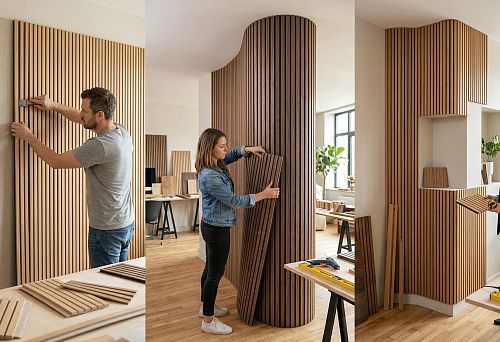
Yes. On a flat wall — MS polymer-based adhesive and finishing nails. Important: marking the axis, 48–72 hours of acclimatization, checking vertical alignment with a level.How to install slatted panels— step-by-step instructions are available in the manufacturer's materials.
STAVROS: when the living room becomes architecture
The main room of the house deserves solutions that do not age. They do not follow seasonal trends, do not require replacement every three years.Wooden slat panelsmade of solid oak and ash with professional finishes.interior moldingsmade of high-quality polyurethane — cornices, moldings, canopies, pilasters — with casting precision sufficient for any classic interior.
STAVROS produces both systems — slatted panels and polyurethane decor — understanding that in the best living room they work together. Naturalness and architecture. Rhythm and ornament. The warmth of wood and the cold precision of a classic profile.
It is this combination that turns the main room of the house into the main room of the house.
STAVROS. Materials that speak architecture.