Article Contents:
- Why a ceiling is not a wall: specifics of applying slatted panels overhead
- Material: oak or MDF for ceiling slatted panels
- Solid oak: natural warmth overhead
- Painting-ready MDF: geometry and color without compromise
- Slat profile on the ceiling: how overhead light works differently
- Rectangular profile on the ceiling
- Semicircular profile on the ceiling
- Trapezoidal profile on the ceiling
- Ceiling slat orientation: three directions, three spatial effects
- Longitudinal orientation (along the long side)
- Transverse orientation (along the short side)
- Diagonal orientation
- Structural types for ceiling mounting
- Rigid panels on MDF backing
- Flexible fabric-based panels for curved ceilings
- Acoustic slatted ceilings with filling
- Spatial effects of slatted ceilings: what exactly changes in a room
- Interior styles and slatted ceilings: seven practical scenarios
- Scandinavian Style
- Japandi
- Minimalism
- Modern classic and neoclassic
- Loft
- Restaurant and cafe
- Office and meeting room
- Where ceiling slat panels are used: specific spaces
- Living Room
- Bedroom
- Kitchen
- Bathroom
- Hallway
- Staircase flight
- Restaurant and commercial spaces
- System: ceiling slat panel in interior ensemble
- Installation of slat panels on ceiling: principles and stages
- Load calculation
- Metal frame
- Attaching Panels to the Frame
- Technical gap
- Lighting
- Finishing elements
- Errors during installation of slat panels on ceiling
- Calculation: how many slat panels are needed for ceiling
- About the Company STAVROS
- FAQ: Answers to Popular Questions

The ceiling is the only surface in a room that a person sees completely. Not partially, not in fragments — entirely, at a single glance. And yet, it is precisely the ceiling that most often receives the most indistinct solution: white paint, stretch film, drywall for painting. There is nothing wrong with these solutions. But they are silent. They do not participate in creating atmosphere — they simply exist.
Slat panels on the ceiling — this is a fundamentally different story. This is a surface that speaks. The rhythmic linear relief overhead creates a visual effect that cannot be achieved in any other way: the space gains scale, depth, architectural character. The ceiling ceases to be a 'lid' and becomes part of the interior concept — a full-fledged architectural element.
This solution has long been used in high-end commercial spaces: restaurants, hotels, showrooms, premium company offices. Today it has become available for residential interiors — and is currently experiencing peak interest in design practice. Why? Because a slatted ceiling simultaneously solves several tasks that previously required different technical solutions: decorative effect, acoustics, concealing utilities, zoning space.
This article is a complete practical guide. Here you will find everything: materials, construction methods, profiles, installation diagrams, spatial effects, style scenarios, technical calculations, and honest warnings about mistakes. Read to the end — the ceiling deserves a conscious choice.

Why the ceiling is not a wall: specifics of applying slatted panels overhead
Let's start with an honest conversation about how installing a slatted panel on the ceiling differs from installing it on a wall. It's not more difficult — but it's different. And you need to understand the difference before starting work.
On a wall, the panel works with a vertical gaze: a person sees it directly in front of them, at different angles, while moving around the room. On the ceiling — the gaze is directed upward. The viewing angle is different. Lighting falls differently. And that's exactly why slatted panels on the ceiling create a different visual effect than the same panels on a wall.
The first difference is gravitational load. A panel on the ceiling does not rest on the floor — it hangs. This means requirements for fasteners and load-bearing structure are stricter. Adhesive installation without mechanical fasteners is unacceptable. Frame installation on metal profiles is mandatory.
The second difference is acoustics. The ceiling is the main reflective surface in a room. It's from the ceiling that sound waves return downward and create reverberation. Slatted relief on the ceiling disperses sound significantly more effectively than a slatted wall. For spaces with acoustic discomfort — restaurants, meeting rooms, open-plan living rooms — this is practically an important effect.
The third difference is concealing utilities. The gap between the slatted ceiling and the slab is space for ventilation ducts, electrical cables, pipes. This allows removing technical utilities from the visible area without drywall boxes.
The fourth difference is light integration. A slatted ceiling is an ideal system for hidden lighting. LED strips in gaps between slats, directional lights between battens — the ceiling becomes a source of architectural light, not just a surface that a lighting fixture looks at.




Material: oak or MDF for ceiling slatted panels
Choice of material forSlatted panels for the ceiling— it's a choice of style and purpose. Two materials, two fundamentally different results.
Our factory also produces:
Solid oak: natural warmth overhead
Oak on the ceiling is an image that's hard to describe in words, but impossible to confuse with anything else. The natural grain pattern, the living tactility of open pores under oil, the warm amber hue under proper lighting — an oak slatted ceiling creates a sense of natural space. A chalet, a Scandinavian villa, an organic modern interior — anywhere where wood is the main material theme.
Oak with a density of 700–750 kg/m³ has sufficient weight — this is taken into account when calculating the load-bearing capacity of the frame for ceiling installation. Oak slats carry natural variability: adjacent battens slightly differ in shade and pattern. This makes the surface alive — and that's precisely why it's chosen.
Get Consultation
MDF for painting: geometry and color without compromise
MDF with a density of 750–850 kg/m³ is homogeneous, stable, with a perfect surface for painting. On the ceiling, this provides two key advantages: precise color (any RAL/NCS) and lighter weight compared to solid wood.
Slatted panels for the ceilingmade of MDF for painting is the right choice for monochrome solutions (ceiling matching the wall color), corporate facilities with brand palettes, minimalist interiors where every color is coordinated down to the millimeter. A white MDF slatted ceiling in a white interior is a monochrome that is only perceived through shadow: this is spatial magic with minimal means.
| Parameter | MDF for painting | Solid oak |
|---|---|---|
| Weight (load on the frame) | Smaller | Larger |
| Color freedom | Any RAL/NCS | Natural tints |
| Natural texture | No | Yes, unique |
| Monochrome to match the ceiling | Ideally | Complex (tinting) |
| Moisture resistance | Standard MDF — no | Higher (natural) |
| Repainting without disassembly | Yes | No (varnish/oil refresh) |
Slat profile on the ceiling: how top lighting works differently
On the wall, side lighting creates a horizontal shadow at the base of each slat. On the ceiling, lighting is typically directed from bottom to top (from fixtures) or horizontally (natural light from windows). This fundamentally changes the nature of light and shadow.
Rectangular profile on the ceiling
With directed light from below — a clear, sharp shadow on the side faces of the slat. The ceiling gains pronounced architectural graphics. With diffused light — a moderate, restrained shadow. A rectangular profile on the ceiling works in minimalism, loft, modern classic, and offices. It is a strict, disciplined surface overhead.
Semicircular profile on the ceiling
Rounded edges diffuse light softly—shadows are smooth, without harsh boundaries. The ceiling appears natural, warm, organic. When integrating LED strips into the gaps between slats—soft diffused glow that creates the feeling of a luminous surface. The semicircular profile on the ceiling is a choice for bedrooms, living rooms, home libraries, any spaces with a cozy atmosphere.
Trapezoidal profile on the ceiling
Extension to the base creates a volumetric, multi-level relief. A ceiling with a trapezoidal profile is rich, dynamic, with pronounced decorative weight. For restaurants, lobbies, representative spaces—where the ceiling needs character.
Slat orientation on the ceiling: three directions, three spatial effects
This decision is made before ordering—and changes the feeling of the room dramatically.
Longitudinal orientation (along the long side)
The gaze follows the slats along the room. The space visually 'stretches' in length. The room appears longer. This technique works in rectangular rooms where length needs to be emphasized—living room, hallway, long restaurant hall.
Transverse orientation (along the short side)
The gaze moves across. The room appears wider. For narrow rooms—kitchens, corridors, narrow living rooms—transverse slat orientation on the ceiling effectively compensates for narrowness.
Diagonal orientation
A rare but powerful solution. Dynamics, kinetics, unconventional perspective. The diagonal slatted ceiling creates a sense of movement—the space 'twists'. Used in commercial spaces with unconventional concepts.
Structural types for ceiling mounting
Rigid panels on MDF backing
Classic—works just as reliably for the ceiling as for the wall. Slats on an MDF backing, rigid module. Mounted on the ceiling exclusively using a frame method: the backing is attached to a metal profile, which in turn is fixed to the ceiling slab.
The rigid panel is ideal for straight rectangular ceilings in standard rooms—apartments, offices, studies, bedrooms, living rooms. The precise geometry of the backing ensures a perfectly flat installed ceiling surface.
Flexible panels on a fabric backing for curved ceilings
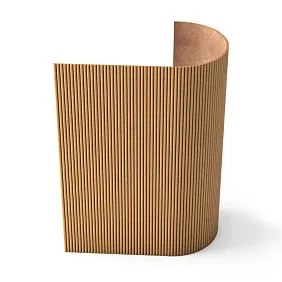
Arched ceilings, curved overhangs, rounded cornice transitions—all of these are solved only with a flexible panel on a fabric backing. Bending radius from 100–150 mm. The slats remain rigid—flexibility is provided by the fabric backing. The pattern continues through the curvature without breaks and without visible seams.
Flexible slatted ceiling panels are especially in demand in commercial spaces with non-standard architecture: restaurant areas with arched vaults, lobbies with curved ceilings, retail spaces with designer ceiling volumes.
Acoustic slatted ceilings with filling
A structure with a space between the slats and the ceiling slab, filled with sound-absorbing material (acoustic foam, mineral wool, acoustic panels). The slats mechanically scatter sound—the texture disrupts the linear reflection of waves. The filling absorbs sound in the technical gap. The combination of the two effects provides significant reduction in reverberation.
This solution is relevant for high-traffic restaurants, meeting rooms, conference halls, home theaters, and recording studios.
Spatial effects of slatted ceilings: what actually changes in a room
The question 'why?' regarding slatted ceilings deserves a detailed answer. Because behind the decorative choice lie specific architectural mechanisms.
The ceiling 'rises'. The slatted rhythm, directed along the short side, leads the eye upward—the ceiling visually recedes. In a room with an actual height of 2.7 m, a slatted ceiling can create a sensation of 3 m or higher. This is not an illusion in the sense of deception—it's optical architecture.
The ceiling 'works' with light. The textured surface interacts with light fundamentally differently than a flat one. Directed spotlights between the slats create sculptural shadows. LEDs in the gaps—diffused shimmer. Diffused daylight from windows—a smooth, lively play. The same slatted ceiling looks different at different times of day—this is a value that neither stretch film nor painted drywall provides.
The ceiling zones the space. In an open-plan living room-kitchen, in a large commercial hall—a slatted ceiling over a specific zone 'marks' it. Without walls, without partitions, without different heights. Only a change in the ceiling material—and the zone gains identity. This is one of the most unobtrusive and architecturally pure ways of zoning.
The ceiling improves acoustics. The textured surface scatters sound waves in different directions—instead of reflecting them straight back down. In rooms with hard floors, walls, and flat ceilings, reverberation can be 1–2 seconds—this is uncomfortable for conversation. A slatted ceiling reduces reverberation to 0.3–0.7 seconds depending on the slat spacing and the presence of acoustic filling. This is a physical, measurable effect.
The ceiling conceals utilities. The gap between the slatted ceiling and the slab—from 80 to 200 mm—accommodates electrical cables, ventilation ducts, pipes, internet and fire alarm cables. All of this disappears from view. No drywall boxes, no surface-mounted cable channels—only a clean slatted surface.
Interior styles and slatted ceilings: seven working scenarios
Scandinavian style
Light oak with oil finish, slat direction—longitudinal, moderate spacing of 30–35 mm. Directed spotlights between the slats. Next towooden moldingaround the perimeter—a natural horizontal 'frame'. The ceiling is warm, natural, homely. No tension.
Japandi
Oak with gray tint. Crosswise orientation of slats. Rare spacing — air between battens. Semicircular profile. The ceiling is meditative, horizontal, natural. Minimum number of fixtures: two-three spotlights, recessed into the gaps. Japanese emptiness — not absence, but deliberate restraint.
Minimalism
MDF for painting in monochrome: ceiling in the same color as the walls. Relief only through shadow. Rectangular profile. White monochrome slatted ceiling in a white interior — it's architectural silence where light lives. Nothing superfluous.
Modern Classicism and Neoclassicism
MDF for painting in a warm neutral tone or oak with 'tobacco' tint. Rectangular profile.Wooden cornice and moldingaround the perimeter of the ceiling creates an architectural 'frame' — slatted field inside, trim along the border. This is a modern version of a coffered ceiling without complex wooden construction.
Loft
Dark oak under matte varnish or MDF in anthracite. Rectangular large profile, wide spacing — the overlap or black backing in the gaps is visible. Metal industrial fixtures. A slatted ceiling in a loft — it's not elegance, it's character. Brutal, self-sufficient.
Restaurant and cafe
Warm oak or MDF in a signature color. Directional spotlights in the gaps. Acoustic filling in the technical gap. A slatted ceiling in a restaurant — it's an atmosphere that the guest doesn't analyze but feels. This is precisely what creates the desire to return.
Office and meeting room
MDF for painting in a neutral corporate tone. Recessed office fixtures in the gaps. Acoustic filling — reducing reverberation in the meeting room. Business, professional image.
Where to use slatted panels on the ceiling: specific spaces
Living Room
Zone above the sofa or above the dining table. A slatted ceiling above the sofa group 'covers' the zone, creating a sense of a separate space within open-plan. Directional spotlights in the gaps. Oak or MDF for painting — depending on the overall concept.
Bedroom
Semi-circular profile, neutral warm tone. LED strip in the gaps provides soft diffused lighting. A slatted ceiling in the bedroom creates intimacy without lowering the actual ceiling: visually, the ceiling rises upward, while physically it is lowered only by the thickness of the structure (80–150 mm).
Kitchen
Slatted ceiling over the work area or over the island. MDF for painting to match the kitchen furniture — vertical coordination. Built-in spotlights over the work surface. The ventilation duct is hidden in the technical gap.
Bathroom
Only moisture-resistant MDF (MDFV) with a special moisture-resistant coating. Forced ventilation in the technical gap. A correctly executed structure with moisture-resistant materials is durable. Mistakes with materials lead to swelling and deformation within a few months.
Corridor
Slatted ceiling in the hallway — one of the best scenarios. Positioning the slats across — the hallway visually expands. Built-in lights replace surface-mounted ones. Utilities are hidden. The result is a concise, architecturally precise hallway without a single superfluous element.
Staircase flight
Slatted ceiling along the staircase flight — a continuous rhythm that accompanies movement from bottom to top. Next tobalusters for staircasessolid oak — a unified wooden architectural theme, vertically connecting the levels.
Restaurant and commercial spaces
The main application scenario for slatted ceilings in commercial architecture. Atmosphere, acoustics, branding through material. Flexible panels for curved ceilings. Acoustic filling. Integrated lighting.
System: ceiling slatted panel in the interior ensemble
Slatted ceiling — part of a system. Its effect is multiplied when it is coordinated with the other elements.
Cornice around the perimeter.Wooden cornice and moldingcreates an architectural 'frame' around the slatted field. In neoclassicism — mandatory. In minimalism — optional, but definitely. A cornice made of the same paintable MDF in the ceiling color — an invisible boundary. A wooden cornice with a natural pattern — an intentional accent.
Wall slatted panels. When a slatted ceiling continues into slatted walls — the space acquires a monolithic, sculptural character. The corner connection between the ceiling and wall via a slat — a continuous rhythm without interruption. This requires precise factory coordination of the spacing — and that is exactly why it is important to buy ceiling and wall panels from the same manufacturer.
Floor skirting board.Wooden baseboardmade from the same solid oak — the lower horizontal boundary, which mirrors the wooden cornice above. The space gains vertical symmetry: wood below, wood above, neutral walls in between. For an MDF system —Baseboard MDFpaintable in a coordinated color.
Furniture.Classic Furniturewith wooden details next to an oak slatted ceiling — this is a dialogue of materials, not competition. A slatted ceiling creates a natural background that enhances the value of the wooden furniture objects beneath it.
Lighting. On the ceiling, lighting is integrated into the structure — this is a unique opportunity not available on the wall. Spotlights in the gaps between slats create directional light without visible fixtures. LED strips in the gaps — diffused, even glow. A combination of the two types — controllable scenario lighting.
Installation of slatted panels on the ceiling: principles and stages
Ceiling mounting is frame mounting. Without exceptions. No 'liquid nails' adhesive without mechanical fasteners.
Load calculation
Before installation — calculate the total weight of the structure. Weight of panels + weight of metal frame + weight of fixtures and cables. Standard load-bearing thread (hanger) supports 15–25 kg. Number of hangers is calculated with a safety factor of at least 2x.
Metal frame
CD-profile 60×27 mm — load-bearing frame beams spaced 400–600 mm across the direction of the slats. Attached to the ceiling via direct or vernier hangers spaced 800–1000 mm. Level controlled by laser — permissible deviation no more than 2 mm per 2 m.
Attaching panels to the frame
Finish nails or screws (3.5×35 mm) through the underlay into the CD-profile — spaced 300–400 mm. At module joints — additional profile to support both ends. Joints — butt-jointed without gaps, slats continue seamlessly across the joint.
Technical gap
Gap between slatted ceiling and ceiling slab — minimum 80 mm (for fixture placement), optimum 120–160 mm (for utilities and acoustic filling). Gap less than 80 mm excludes recessed fixture installation.
Lighting
Recessed spotlights are installed in gaps between slats before final panel fastening or in cut grooves after installation. LED strip is laid along the inner surface of the CD-profile before panel installation.
Finishing Elements
Perimeter cornice conceals panel ends and covers the gap between the slatted field and wall. In minimalism — thin MDF molding matching the ceiling color. In neoclassicism —wooden cornicefrom an array with a pronounced profile.
Mistakes when installing slatted panels on the ceiling
First mistake: adhesive mounting without a frame. Gravity does not forgive. Adhesive weakens over time, especially with temperature fluctuations. A panel may detach entirely. Frame mounting is mandatory.
Second mistake: insufficient gap. A 40–50 mm gap does not allow for recessed lighting fixtures and concealing utilities. Plan for a gap of at least 80–120 mm.
Third mistake: incorrect material in wet areas. Standard MDF in a bathroom guarantees deformation. Only moisture-resistant MDF with a special coating.
Fourth mistake: lighting after installation. LED strips and recessed spotlights must be installed before mounting the panels. After installation, this is either impossible or requires partial dismantling.
Fifth mistake: uncoordinated spacing with wall panels. If the wall will also be slatted, the spacing must match. Otherwise, the pattern 'breaks' at the corner transition. Purchase ceiling and wall panels from the same manufacturer.
Sixth mistake: poor frame leveling. The slightest unevenness in the frame plane creates a wave on the slatted ceiling. A laser level is mandatory. Permissible deviation is 2 mm over 2 m.
Calculation: how many slatted panels are needed for the ceiling
Ceiling area (length × width) minus the area of built-in elements (chandeliers with large bases, ceiling beams, decorative volumes). Divide the area by the area of one module. Round the result up. Add a 10–15% allowance for trimming near walls and built-in elements.
Example: room 5 × 4 m = 20 sq.m. Module 0.6 × 2.4 m = 1.44 sq.m. Required: 20 / 1.44 = 13.9 → 14 modules. With 15% reserve = 17 modules.
About the company STAVROS
A slatted ceiling is a structure that literally works overhead. There is no room for error in step accuracy here: joints on the ceiling are visible under any lighting significantly better than on a wall. There is no room for loose MDF: ceiling fasteners in a loose substrate pose a risk of panel falling. There is no room for unsealed ends: a technical gap with changing humidity swells the ends instantly.
STAVROS is a Russian manufacturer of products made from MDF and solid wood. Slatted panels for walls and ceilings of all types (rigid on MDF substrate, flexible on fabric base, semicircular and rectangular profile), a complete line of coordinated moldings, decorative overlays, elements for stairs, furniture decor and fittings. Over 4000 models, 20,000 modifications, 39 product groups.
MDF from European suppliers with a density of 750–850 kg/m³, climatic wood drying chambers, a two-level quality control system (Standard and Prestige), control of step accuracy in each batch. Shipping from one piece. Delivery across all of Russia. Specialist consultation — before placing an order.
FAQ: Answers to popular questions
Can slatted panels be installed on a ceiling by oneself?
Frame installation requires experience working with metal profiles, a laser level, and correct load calculation. For small rooms with a level ceiling, an experienced craftsman can handle it independently. For large areas and non-standard geometry — a professional crew is recommended.
How much does a slatted ceiling reduce the room height?
The structure occupies from 80 to 160 mm depending on the chosen gap. For rooms with a height of 2.7 m — the recommended minimum gap is 80 mm (resulting height 2.62 m). The visual effect of the rhythm of the slats compensates for and even visually overcomes this reduction.
Is sound insulation needed in the gap of a slatted ceiling?
For residential premises with normal acoustics — not necessary. For meeting rooms, restaurants, cinemas, studios — acoustic filling of the gap (acoustic foam or mineral wool) significantly improves acoustics.
Can a slatted ceiling be installed in a bathroom?
Only with moisture-resistant MDF (MDFW) and moisture-resistant coating. Forced ventilation in the technical gap is mandatory. Standard MDF in the bathroom will deform.
How to integrate lighting into a slatted ceiling?
LED strip is laid along the inner surface of the load-bearing profile before panel installation. Spotlights are mounted in the gaps between slats or in cut grooves. All cable management is hidden in the technical gap.
Which slat profile to choose for a bedroom ceiling?
Semi-circular — for soft, diffused, organic lighting and a cozy atmosphere. MDF for painting in a neutral warm tone or light oiled oak — material depending on the interior concept.
How much does a slatted ceiling cost?
The cost consists of: panel price, metal frame, fasteners, lighting fixtures, perimeter trim, and installation work cost. Specific panel prices are on the STAVROS catalog page. The total project cost is calculated individually.