Article Contents:
- Why slatted partitions and MDF skirting work well in an office
- What a slatted partition provides in an office: zoning, rhythm, light
- Office zoning with a slatted partition
- Vertical rhythm and interior geometry
- Slatted partition and lighting comfort
- Why an office needs MDF skirting: a neat wall base without overload
- What floor MDF skirting conceals and what it gathers
- How to choose MDF skirting height for an office
- MDF Skirting Profile: Smooth or Pronounced?
- How to Combine Slatted Partition and MDF Skirting for a Cohesive Interior Look
- Uniform Wood Tone: Exact Match or Soft Harmony?
- Slat Width and Skirting Height: Proportional Balance
- How to Avoid Clashing with Floor, Doors, and Furniture
- MDF or Wooden Skirting in the Study: What to Choose for Your Interior
- MDF Skirting: Stability and Versatility
- Wooden Skirting: Texture and Naturalness
- Comparison Table: MDF vs. Solid Wood in the Study
- What Mistakes Make a Study Feel Heavy and How to Avoid Them
- Too frequent slats
- Too dark wood on the entire wall
- Too small or too large baseboard
- Texture conflict: floor, door, baseboard, slats
- Attempt to combine 'everything at once'
- Which office is this solution best suited for
- Home office in an apartment
- Office in modern classic style
- Work area in the bedroom
- Small office: slatted partition without losing volume
- How to choose colors: warm wood, calm walls and clean floor outline
- Light oak: airiness and strictness
- Medium walnut: warmth and concentration
- How to coordinate skirting board color with slats and floor
- Practical selection checklist: what to ask before buying
- DIY slatted partition: is it worth doing it yourself
- The bottom line of the office wall: details that change everything
- FAQ: answers to popular questions about slatted partitions and MDF skirting boards in the office
- Conclusion
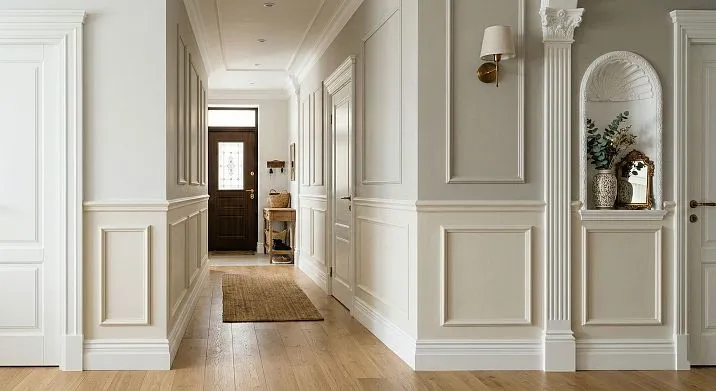
The office is a space where every detail either works for concentration and order, or subtly undermines them. It is here thatSlatted partitionandMDF Skirting Boardbecome not just finishing elements, but architectural tools: the first sets the vertical rhythm and zones the space, the second gathers the bottom line of the wall into a neat, calm outline. Together they create an interior that is strict, geometrically precise, and yet alive — thanks to warm wood that removes any office coldness.


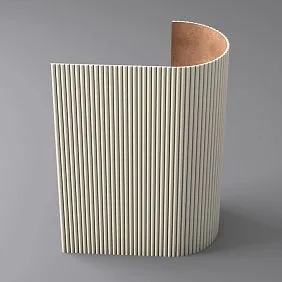
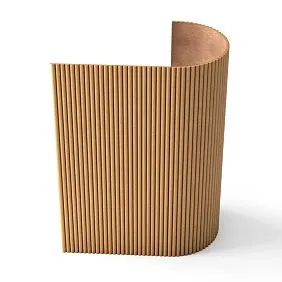
Why slatted partitions and MDF skirting boards work well in a study
A study demands spatial discipline. There is no place for chaotic decor, excess volume, or visual noise here—otherwise thoughts scatter, work stalls, and the interior itself begins to feel oppressive. The two elements discussed here solve this problem systematically and elegantly.
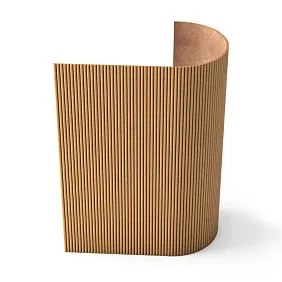
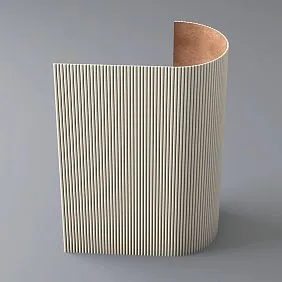
A slatted partition in a study introduces vertical rhythm—one of the strongest visual structures in interior design. Parallel slats running from floor to ceiling organize the gaze, establish order, and simultaneously do not block the space. Unlike a solid wall, a slatted partition preserves a sense of air and light while remaining a clear boundary between zones. For a study, which is often combined with a living room, bedroom, or library, this solution is impeccable.
An MDF skirting board in a study is an element often underestimated. Yet, it is precisely what secures the lower line of the wall: it makes the transition from floor to wall clear, neat, and free of randomness. A well-chosen MDF floor skirting doesn't just conceal the joint—it completes the interior, like a frame completes a painting. Its smooth profile, calm surface, and stable geometry perfectly match the strict character of a workspace.
Wood, in both cases, adds what many modern studies lack—warmth. Not sentimentality, not heaviness, but the living warmth of a natural material, which balances the strictness of geometry and makes the study a place where you want to work for hours.




What a slatted partition provides in a study: zoning, rhythm, light
A home study is one of the most challenging spaces to organize. It needs to be separated enough from the living part of the apartment to avoid distractions from household noise, yet not walled up in a solid box. It is here thatSlatted partitionreveals its main talent.
Our factory also produces:


Zoning a study with a slatted partition
A slatted partition for a study acts as a soft psychological barrier: you physically see the boundary of the work zone, but the space is not fragmented into isolated cells. Light passes through the slats, air circulates, the gaze slides through the gaps—and yet the area 'behind the partition' reads as a distinct space. This is precisely the balance needed in a home study.
Zoning an office with a slatted partition is particularly relevant in several scenarios:
-
Office in the living room — when the desk and sofa area are in the same room
-
Office in the bedroom — when you need to separate the work area from the rest area without cluttering the room
-
Home office in an open-plan layout — when the entire apartment is a studio, and the workspace requires at least visual privacy
Get Consultation
Vertical rhythm and interior geometry
Vertical slats in an office interior with wooden slats work as an architectural accent: they organize the wall plane, create a regular rhythm, and visually raise the ceiling. In an office with low ceilings (2.5–2.7 m), this is an especially valuable quality — a properly chosen slat spacing literally stretches the space upward.
A wooden slatted partition made of oak or beech does not look like a heavy architectural element — it remains a light, airy, almost transparent structure. A slat spacing of 80–100 mm with a slat width of 30–40 mm are optimal parameters for an office: a sufficiently closed boundary, but without the feeling of a wall.
Slatted partition and lighting comfort
One of the key arguments in favor of a slatted solution is the preservation of natural lighting. A slatted partition lets light through in the full sense of the word: daylight from the office windows is not locked behind a solid wall but freely spreads throughout the entire space. In the work area, this directly affects productivity and reduces eye strain — especially when working with documents or at a monitor.
Why an office needs an MDF skirting board: a neat wall bottom without overload
The junction between floor and wall is an area most homeowners notice only when something goes wrong: gaps, unevenness, darkened edges. MDF skirting for a study solves this problem systematically, without drawing unnecessary attention to itself, which is its main function.
What does MDF floor skirting cover and collect?
Any floor covering — parquet, laminate, quartz vinyl — is laid with a technological gap of 8–12 mm from the wall. This gap is necessary to compensate for thermal expansion but looks sloppy. MDF floor skirting completely conceals it, creating a smooth, closed line around the perimeter of the room.
Simultaneously, the skirting protects the lower part of the wall from mechanical damage during cleaning, from accidental impacts by furniture, and from moisture when washing floors. In a study, where heavy wheeled chairs and furniture are often moved actively, this protective layer is not superfluous.
How to choose the height of MDF skirting for a study
Skirting height is one of those parameters where a small error changes the entire perception of space:
-
60 mm — a minimalist option for a study with low ceilings and a laconic interior; the line is present, but the skirting is not accentuated
-
80 mm — a universal height that works equally well in modern and neoclassical studies
-
100–120 mm — high MDF skirting for spaces with ceilings 2.8 m and above; gives weight and significance to the lower wall zone, visually organizes the perimeter
-
from 150 mm — for very high ceilings and interiors with a pronounced architectural character
What height should the baseboard be in a study? A simple rule: the height of the baseboard should not exceed 1/20 of the ceiling height. With 2.7 m ceilings — no higher than 135 mm, with 3 m ceilings — up to 150 mm.
MDF baseboard profile: smooth or pronounced?
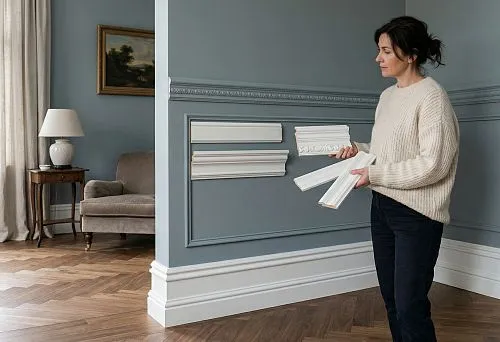
For a strict study, the correct choice is a smooth rectangular or slightly beveled profile. It does not compete with the slats of the partition, does not overload the lower wall zone with decoration, and preserves that very geometric precision that makes a study a study, not a living room. A shaped baseboard with cornice profiles is appropriate in classic interiors, but in a modern study with vertical slats, it hinders rather than helps.
How to combine a slatted partition and an MDF baseboard so that the interior looks cohesive
A slatted partition and an MDF baseboard are two independent elements, and that is precisely what makes their combination require attention. If they 'speak' different languages — in color, texture, scale — the interior falls apart into unrelated details. If they speak in unison — the space reads as a single whole.
A unified wood tone: an exact match or a soft harmony?
The ideal option is not a complete color match between the slats and the baseboard, but their harmony within the same tonal group. For example:
-
Oak slats in a 'natural' shade — MDF baseboard with a wood finish in the color 'light oak' or 'whitish ash'
-
Slats in a dark walnut tone — baseboard in a deep brown with a neutral matte surface
-
Slats in a gray-beige, 'Scandinavian' tone — baseboard in the color 'gray ash' or 'bleached oak'
An exact color match creates a monolithic effect that can look heavy. A slight tonal shift—1–2 shades lighter or darker—enlivens the scheme and adds depth.
Slat width and skirting board height: proportional balance
The width of the slat and the height of the skirting board should be proportional. A rough formula: the wider the slats (40–60 mm), the higher the skirting board can be (80–120 mm). With thin slats (20–30 mm), a massive, tall skirting board will dominate and 'weigh down' the partition structure.
How not to clash with the floor, doors, and furniture
How to combine a slatted partition and a skirting board is not just a question about two elements. The system also includes the floor, doors, and furniture. A simple working rule: an MDF skirting board in the color of the floor creates a sense of a unified wooden horizontal plane. A skirting board in the color of the wall makes the bottom line neutral and visually raises the ceiling. A skirting board in a contrasting color accentuates the perimeter—a bold technique, but appropriate only in a very precisely assembled interior.
MDF or wooden skirting board in a study: what to choose for your interior
This question arises for everyone who seriously approaches the choice of materials. Both options are worthy—but they are different, and the difference is fundamental.
MDF skirting board: stability and versatility
MDF skirting board is made from pressed wood fibers. Its main advantage is perfectly even geometry and absolute uniformity. It does not warp, does not crack due to humidity fluctuations, and has no knots or natural defects. The MDF surface accepts any finish—lamination to look like wood, painting in any RAL color, veneering.
For a study, an MDF skirting board is particularly logical in several cases:
-
Walls and floors with minor irregularities — MDF is easy to process and adjust on-site
-
Interior in a modern or minimalist style — a smooth profile without texture fits in organically
-
Combination with a slatted partition made of painted or laminated slats — homogeneous surfaces rhyme
Wooden skirting board: texture and naturalness
Wooden baseboardMade of solid oak or beech — it's a living texture, a natural grain pattern that cannot be reproduced in MDF.Wooden baseboardWill properly withstand humidity fluctuations, is well-suited for restoration, coating renewal, and repainting. Its service life with proper care is several decades.
wooden baseboardJustified primarily where the slatted partition is made of solid wood — so that both elements are of the same material and speak the same language. In a study with natural oak parquet and a partition of oak slats, a wooden skirting board will complete the look with maximum organicity.
Comparison table: MDF vs. solid wood in a study
| Parameter | MDF skirting board | Wooden skirting board |
|---|---|---|
| Geometry stability | High, does not warp | Depends on drying and conditions |
| Living wood texture | Imitation | Natural |
| Color options | Any, including RAL | Natural shades + coloring |
| Price | Below | Higher |
| Durability | 15–30 years | 30–80+ years |
| Restoration | Limited | Full (sanding, repainting) |
| Compatibility with MDF battens | Ideal | Good |
| Compatibility with solid wood battens | Good | Ideal |
Select and compare options for wall bottom line design in the section moldings, cornices, and baseboardssection of the STAVROS catalog.
What mistakes make an office heavy and how to avoid them
A study with wooden slats and MDF skirting — a solution that, if approached incorrectly, can turn into its opposite: a heavy, cluttered, claustrophobic space. Let's examine typical mistakes and how to avoid them.
Slats placed too close together
A slat spacing of 30–40 mm with a slat width of 30 mm creates an almost solid wooden wall. It blocks light, creates a cage-like feeling, and deprives the partition of its main advantage — airiness. For a study, the optimal gap between slats is at least 50 mm, preferably 60–80 mm. This preserves visual lightness and light permeability.
Too dark wood covering the entire wall
Dark stained oak looks luxurious — on a single element. When it covers an entire wall from floor to ceiling, the dark color begins to absorb light and compress the space. If the slats are dark — the walls should be light. If the walls are dark — the slats should be in a neutral or light tone.
Skirting that is too small or too large
A 40 mm high skirting in a study with 2.8 m ceilings looks accidental — as if it was forgotten. A 200 mm high skirting in a standard apartment with 2.6 m ceilings turns the lower zone of the wall into a visual wall within a wall. Both extremes disrupt proportions and worsen the perception of space.
Texture conflict: floor, door, skirting, slats
When the floor is laminate 'under pine', the doors are MDF 'under wenge', the skirting is plastic 'under oak', and the slats are natural walnut — the interior reads as a collection of unrelated materials. A strict study interior is built on two or three materials in a close tonal range. No more.
Attempting to incorporate 'everything at once'
Slatted partition, accent painted wall, complex multi-level ceiling with beams, decorative fireplace anddecorative elementson all surfaces — this is not richness, it's chaos. Warm wood in a study works precisely when it is the only or main decorative material, and the other surfaces are neutral.
For which type of study is this solution best suited?
Slatted partition for a study and MDF skirting — a universal combination that works well in different workspace formats. But each type of study has its own specifics.
Home study in an apartment
A slatted partition in a home study most often serves a zoning function: it separates the work area from the bedroom, living room, or dining area. Here, maximum light permeability (slat spacing 80–100 mm) and lightness of construction are important. An MDF skirting in the same tone as the slats emphasizes that this zone belongs to a unified material solution.
Study in a modern classic style
A slatted partition in a modern study with classical notes is one of the most refined ways to use this technique. Slats made of natural oak with a more pronounced profile, wooden skirting with a chamfer or a small cornice finish, dark parquet — all this creates an interior where strictness and warmth coexist simultaneously. If desired, the upper perimeter of the wall can be finished withan MDF cornice, which will complete the architectural frame of the study from above.
Work area in the bedroom
A compact work area with a slatted partition for the workspace is a technique that allows you to psychologically 'close' the workstation at the end of the day without even leaving the room. Several slats between the sleeping and working zones create a boundary sufficient for switching modes. In this situation, the height of the skirting board in the work area can match the height of the skirting board around the entire perimeter of the bedroom to maintain spatial unity.
Small office: slatted partition without losing volume
A slatted partition in a small office is not a problem but a solution. Unlike a solid partition or shelving unit, a slatted structure does not take away visual volume: the gaze passes through the slats and perceives the depth of the space. With a high slat spacing (100–120 mm), a small office does not 'shrink'; on the contrary, it gains depth and perspective.
Select a slatted solution for the office and view related Wooden items in the STAVROS catalog.
How to choose colors: warm wood, calm walls, and a clean floor outline
Color is one of the most powerful tools for managing space. In an office with a slatted partition and MDF skirting board, the color system is built around three nodes: floor, slats, skirting board. Walls serve as a neutral background.
Light oak: airiness and strictness
Slats and skirting board in a light oak shade—a natural honey-yellow or slightly bleached tone—create a light, airy office. Perfectly pairs with gray-beige or warm white walls. In this scheme, the floor can be slightly darker than the slats to create a sense of foundation and stability.
Medium walnut: warmth and concentration
Walnut in medium saturation is one of the most 'functional' tones in interior design. Battens in this color create a cozy, focused space. Wood-look MDF skirting in a similar tone completes the lower perimeter without unnecessary accents. Walls are light and neutral: ivory, pastel gray, warm beige.
How to coordinate skirting color with battens and floor
How to choose wood-look skirting color — one of the most practical questions. A working scheme:
-
Skirting in floor color — creates a unified horizontal line, the lower wall zone 'recedes' and doesn't attract attention
-
Skirting in batten color — connects the partition with the wall perimeter, emphasizes material unity
-
Skirting in wall color — skirting becomes neutral, visually increases ceiling height
How to combine battens, floor, and skirting ultimately comes down to priority: if you want to accentuate the partition, the skirting should support it. If the partition is a functional tool rather than an accent, the skirting can remain neutral.
Practical selection checklist: what to ask before purchase
Before buying a batten partition or buying MDF skirting, go through this checklist. It will save time and help avoid mistakes.
Regarding the slatted partition:
-
Where exactly will the partition be placed — between which zones?
-
What slat density is needed — for maximum privacy or for light zoning?
-
Is light passage needed — are there windows on both sides of the partition?
-
What is the room height — this determines the slat length and frame structure
-
What material for the slats — solid oak, beech, or is MDF with coating possible?
-
What shade are the floor and walls — to match the tone of the slats
-
Is partition lighting needed — this is decided before installation
Regarding MDF skirting board:
-
What is the ceiling height — to choose a proportional skirting board height
-
Which profile — smooth rectangular, with a bevel, or with a small cornice finish?
-
Which shade — matching the floor color, matching the slat color, or neutral?
-
Is painting needed — MDF can be easily painted in any RAL color
-
Is ease of installation important — MDF is easier to work with than solid wood
-
Is a cable channel needed — some MDF skirting profiles have a built-in groove for wiring
Compare options and chooseskirting to match the office stylecan be found in the STAVROS catalog — it features the full range of both MDF skirting boards and solid wood products.
DIY slatted partition: is it worth tackling on your own
This question is asked by most people encountering a slatted solution in interior design for the first time. The answer is balanced: it's worth it if you have basic woodworking and tool skills, and if the partition doesn't bear a complex load.
Detailed step-by-step installation instructions, material selection, frame types, and mounting options for slats — all in the article.DIY slatted partitionAll key stages are covered there: from design and calculating the number of slats to finishing and lighting.
The most difficult part of DIY installation is not the installation of the slats themselves, but the proper preparation of the frame. If the guides are installed level and the slat spacing is maintained using a template, the rest is a matter of care and patience. A separate point is treating the slats with oil or varnish before installation: the ends that will be hidden in the frame grooves must also be treated — this will protect against moisture during seasonal changes.
The bottom line of the wall in the study: details that change everything
In interior design, there are areas that are only noticed when they are done poorly. The bottom line of the wall is exactly such an area. A gap between the baseboard and the floor, a crooked corner, a baseboard in a different tone from the rest of the finish — all this creates a sense of incompleteness, even if everything else in the study is impeccable.
How to properly design the bottom of the wall in a study is not just a question of choosing the height or profile. It's a question of how neatly the installation is performed, how accurately the color is matched, how tightly the baseboard fits against the floor and wall. MDF baseboard is more convenient in this regard than solid wood: its even geometry allows for a tight fit even with minor wall irregularities.
When an MDF baseboard in a modern interior is chosen correctly — you notice it exactly at the right moment: when your gaze slides from the floor up the wall and meets a smooth, clean line. After that, the gaze easily rises to the slats of the partition — and the interior reads as a single architectural statement.
FAQ: answers to popular questions about slatted partitions and MDF baseboards in the study
Is a slatted partition suitable for a small study?
Yes, very much so. In a small study, a slatted partition is preferable to a solid wall or a shelving unit precisely because it does not block the space visually. The gaze passes through the gaps between the slats, perceiving depth — and the small study does not 'collapse'. The optimal slat spacing for a small room is 80–100 mm to maintain maximum light permeability.
Which skirting board looks best with wooden slats?
A skirting board works best when it is made of the same material or falls within the same tonal group as the slats. If the slats are made of solid oak, choose a wooden or oak-finished MDF skirting board. If the slats are laminated or painted, opt for an MDF skirting board in a matching or harmonious color. The key is a unified tone, avoiding sharp contrast between the wall's lower line and the vertical slats.
Can MDF skirting be used in a study with a warm wooden floor?
Yes, you can and should. Wood-finished MDF skirting pairs excellently with parquet, engineered wood flooring, or laminate featuring a warm wooden texture. The key is to select a skirting shade that is close to the floor's tone, not contrasting with it. MDF skirting in the floor's color creates a sense of a unified wooden base.
What is better for a study: MDF or wooden skirting?
It depends on the interior. MDF is more stable, cheaper, easier to install, and ideal for a modern, minimalist study. Wooden skirting offers a living texture, naturalness, the possibility of restoration and repainting, and is perfect for a study with a solid wood slatted partition. If the budget allows and the interior is 'wood-centric,' choose solid wood. If practicality and geometric precision are needed, opt for MDF.
What height should I choose for skirting in a study?
Base it on ceiling height: for 2.5–2.7 m ceilings — 60–80 mm, for 2.8–3 m — 80–100 mm, for ceilings above 3 m — 100–150 mm. In a study with a pronounced minimalist character, the skirting can be slightly lower than the norm for greater simplicity.
Should a slatted partition match the skirting board in color?
An exact match is not necessary — it's important that they are in the same tonal group. A slight difference in shade enlivens the scheme and adds depth. A sharp color contrast between the partition and the skirting disrupts the interior's unity.
Can a slatted partition and wall panels be combined in one office?
Yes, provided they do not compete for the same space. A good scheme: decorative wall panels on one wall (the back wall, behind the desk), a slatted partition as the side boundary of the zone. A uniform material and tone maintain integrity.
Is such a solution suitable for an office in a modern classic style?
Yes, and very organically. A slatted partition in a modern classic office is a technique that provides vertical rhythm without heavy architectural forms. Solid oak slats with a chamfer, a skirting board with a small cornice profile, dark parquet — all this makes up an interior where the severity of classicism is softened by the natural warmth of wood.
Conclusion
An office assembled with attention to detail is not a collection of expensive materials or a display of status. It is a space where everything works: every line is in place, every material serves a purpose, every element supports its neighbor.
A slatted partition sets the vertical rhythm and structures the space — not walling it in, but directing it. An MDF skirting board holds the bottom line of the wall, closes the perimeter, and gives the interior a clean base. Wood — in the slats, in the skirting board, in the furniture — removes office coldness and adds that warmth without which an office turns into a place of obligatory work.
It is precisely the combination of the strict geometry of the slats and the neat contour of the skirting board that makes a home office whole, assembled, and yet alive. Not decorated — but arranged.
The company STAVROS manufactures products from solid wood — oak and beech — with full quality control at all stages: from raw material drying to finishing. The catalog includes slats and millwork, solid wood skirting boards, moldings, cornices, andinterior decorationfor creating a unified wooden system in an office, living room, or any other space. Over 4,000 models, shipment from a single item, delivery across Russia. STAVROS — when behind every detail stands a manufacturer who cares about the quality of what will remain in your home for decades.