Article Contents:
- Classic and details: the philosophy of perfection
- Historical roots: when details defined status
- Modern classic: accessibility through technology
- Visual hierarchy: from foundation to crown
- Oak as base: monumentality and prestige
- Physical properties: hardness and stability
- Aesthetics: texture and color
- Profiles: from simple to complex
- Installation: reliability and durability
- Polyurethane as complement: practicality and flexibility
- Moisture resistance: high-risk zones
- Flexibility: curved surfaces
- Complex profiles: decorative richness
- Installation: speed and simplicity
- Combination strategies: two materials in harmony
- Zonal distribution: functional logic
- Profile coordination: visual unity
- Color harmony: tonal coordination
- Material transitions: delicate joints
- Solution examples: from living room to grand hall
- Living room: prestige of natural wood
- Office: monumentality and focus
- Grand hall: palace-scale
- Studio apartment: adapting classic to modernity
- Conclusion: baseboard as the foundation of character

Classic interiorBuilt on details — every element, from a heavy chandelier to a delicate molding, plays its role in creating a harmonious space.Baseboard for classic interiorNot just a technical detail closing the gap between the wall and the floor, but a full architectural element forming the visual base of the room.Oak skirting boardEmbodies monumentality, prestige, and connection to centuries-old craftsmanship traditions.Polyurethane skirting boardEnsures practicality, flexibility of form, and accessibility of complex decoration. The combination of these materials in one project creates an interior where each element occupies its optimal niche — oak where prestige and durability matter, polyurethane where moisture resistance and profile complexity are critical. From basic spatial framing to accent decorative solutions, skirting boards define the character of classic interiors.


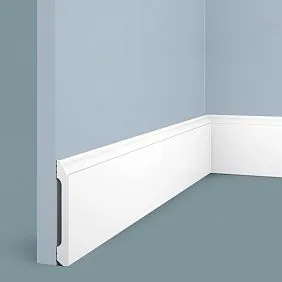
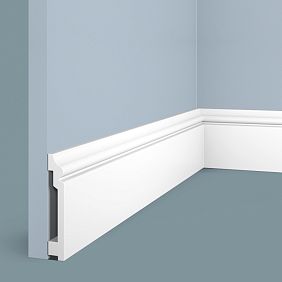
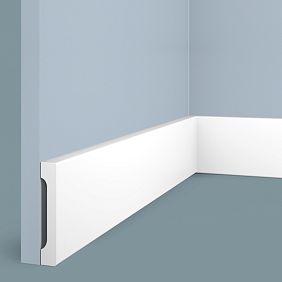
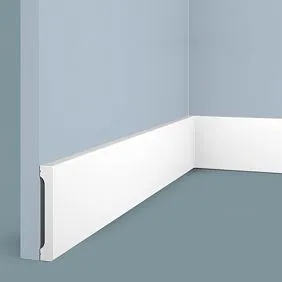
Classic and Details: The Philosophy of Perfection
Classic style does not tolerate carelessness. Every line, every profile, every joint of elements must be precisely aligned to the millimeter. This attention to detail distinguishes authentic classicism from superficial stylization.




Historical Roots: When Details Defined Status
Classical architecture emerged in an era when the quality of details indicated the social status of the owner. Palaces of the aristocracy, mansions of wealthy merchants demonstrated craftsmanship through precise profiles, complex carving, and harmony of all decorative elements. Skirting boards 20-30 centimeters high with multi-step profiles were standard for formal rooms.
Masters worked according to strict canons of classical orders — Doric, Ionic, Corinthian. Each order had specific proportions, profiles, and ornaments. Skirting boards, as part of the order system, followed these rules. The base of a column, wall skirting, ceiling cornice — all were connected by a unified logic of proportions.
Materials were expensive, processing labor-intensive. Oak skirting boards were hand-cut, each meter required hours of skilled carpenter’s work. Gypsum molding was cast on-site, each element unique. This cost made detailed classicism a privilege of the elite, a symbol of wealth and taste.
Our factory also produces:


Modern Classicism: Accessibility Through Technology
The 21st century democratized classical aesthetics. CNC machines cut complex profiles from oak in minutes with micron-level precision. Cast polyurethane perfectly reproduces gypsum molding. What once required weeks of handwork is now produced industrially in hours.
But technological accessibility does not lower requirements for precision — on the contrary, it raises them. Handwork tolerated minor discrepancies, which were perceived as signs of living craftsmanship. Industrial products must be perfectly accurate — any deviation is noticeable, appears as a defect, not as artistic expression.
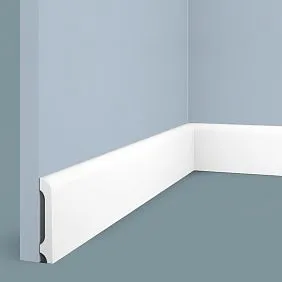
Wood skirting boardModern production skirting boards have geometric tolerances within 0.5 millimeters. The profile is uniform along the entire length, joints align perfectly. Polyurethane elements reproduce details down to 0.1 millimeters thanks to high-precision forms. This industrial precision corresponds to classical ideals of order, symmetry, and harmony.
Get Consultation
Visual Hierarchy: From Foundation to Crown
A classical interior is built on the principle of vertical hierarchy — from a massive foundation to a light crown. Skirting board — the visual foundation, the base upon which the entire wall composition is built. Its height, profile, and color define the character of the entire space.
Low skirting boards 6-8 centimeters dissolve, do not create a foundation. The room appears unstable, lacking support. High skirting boards 15-20 centimeters create a powerful plinth, visually grounding the space, giving a sense of stability. For classical interiors with high ceilings 3-3.5 meters, high skirting boards are necessary — they are proportional to the scale of the room.
The skirting board profile must harmonize with profiles of other elements — door casings, wall moldings, ceiling cornices. All profiles belong to the same stylistic series, with repeating motifs — scrolls, beads, rosettes. Repetition creates rhythm, linking elements into a unified system.
In classical hierarchy, skirting board color is usually darker than walls, lighter than floor. A dark skirting board creates a clear boundary, structuring the vertical. A skirting board matching wall color dissolves, losing its foundational function. A skirting board matching floor color visually extends the floor onto the wall, blurring the boundary. Each solution has meaning, the choice depends on the desired effect.
Oak as Foundation: Monumentality and Prestige
Oak skirting boardPure classicism, a material with centuries of history in prestigious interiors. Oak’s properties make it ideal for creating a durable, respectable foundation for classic spaces.
Physical Properties: Hardness and Stability
Oak wood density 690-750 kg/m³ at standard moisture content of 12% classifies oak as hardwood. Hardness by Brinell 3.7-4.0 units indicates high resistance to mechanical impacts. Oak skirting boards do not dent under furniture impacts, do not wear from constant contact with mops and vacuum cleaners, retain sharp edges and profiles for decades.
For classic interiors where furniture is heavy and frequently moved during rearrangements, skirting board hardness is critical. Softwoods — pine, spruce — quickly develop dents, lose appearance. Oak withstands use, and after 20 years still looks almost new. This is a long-term investment, paying off through quality preservation.
After proper drying, oak’s dimensional stability is relatively high for wood. Tannins, content reaching 6-8%, partially block pores, reducing hygroscopicity. Oak skirting boards swell less with increased humidity and shrink less with decreased humidity compared to other hardwoods.
Oak’s tangential shrinkage is 8-9%, radial 4-5% — significant, but after stabilization at 8-10% moisture content, changes are minimal under household humidity fluctuations of 40-70%. Properly dried oak skirting boards retain geometry, joints remain tight, gaps do not form.
Aesthetics: Texture and Color
Oak’s texture — its hallmark. Early wood’s ring-porous structure with large vessels creates a contrasting pattern — dark stripes on a lighter background. This expressiveness transforms utilitarian skirting boards into decorative elements. Even a simple rectangular oak skirting board profile is visually interesting due to its texture.
Radial oak cutting reveals medullary rays - a characteristic shimmer, especially beautiful under varnish or oil. Tangential cutting shows wavy annual ring patterns - parabolas, ovals, creating a lively composition. Radial oak skirting is valued higher, but tangential also has its own aesthetics.
The color of freshly processed oak is golden-brown, warm and cozy. Over time, oak naturally darkens - after 10-20 years it becomes rich brown with a honey undertone. This noble aging is perceived as an advantage. Oak skirting does not visually become outdated, but rather becomes more refined, acquiring the patina of time.
The ability to stain expands the palette. Stains allow changing the color of oak from light walnut to dark wenge while preserving visible texture. For classic interiors, medium and dark tones are popular - they create solidity and respectability. Light natural oak suits light neo-classical styles.
Profiles: from simple to complex
Oak skirting is produced with various profiles, from minimalist to baroque-complex. A rectangular profile with a slight bevel - modern classic, the simplicity of shape emphasizes the wood texture. Height 10-15 centimeters, thickness 18-22 millimeters - standard sizes for residential interiors.
The 'shoe' profile is a classic choice for traditional interiors. The lower part widens, fitting tightly to the floor even with minor unevenness. The upper part has one or two rounded edges, creating play of light and shadow. Height 12-18 centimeters, upper part 60-70 millimeters. Proportions have been perfected over centuries of use.
Figured multi-level profiles with beads, rosettes, and grooves - a choice for grand classical interiors. Three to four relief levels, each with its own profile, create complex volume play. Height of such skirting is 15-25 centimeters, proportionally matching high palace room ceilings. Cut on CNC machines with micron precision.
Corner elements, internal and external, complete the system. Internal corners join at 45 degrees with perfect profile alignment. External corners are equipped with special corner caps, where the profile smoothly turns 90 degrees. Quality corner elements are a sign of professional approach.
Installation: reliability and longevity
Oak skirting is installed with adhesive, mechanical fasteners, or a combination. Adhesive installation on flat walls provides invisible mounting, but requires perfect flatness. Wood adhesive is applied in a zigzag pattern, skirting is pressed and secured with weights until it sets. Connection strength is high, removal is difficult.
Mechanical fastening with screws through skirting into the wall is more reliable, does not require perfect flatness - screws pull the skirting against the wall. Screws are spaced 40-60 centimeters apart, heads are recessed and covered with wooden plugs or filled with putty. After painting, mounting points are invisible.
Combined mounting - adhesive plus screws - is optimal for heavy, tall skirting. Adhesive ensures tight contact along the entire length, screws provide connection strength and guarantee against peeling. For classic interiors, where skirting serves for decades, reliability is critical.
Oak skirting joints are beveled at 45 degrees for internal corners, at 90 degrees with corner caps for external corners. Precision of beveling is critical - gaps in joints are unacceptable. A dado saw with fence ensures required accuracy. Joints are glued, after drying they are sanded and painted together with skirting.
Polyurethane as an addition: practicality and flexibility
Polyurethane skirting boardIn a classic interior, it performs functions where its properties are optimal. Not competing with oak for the role of prestigious base, polyurethane solves specific tasks inaccessible to natural wood.
Classic interiors include rooms with increased humidity - bathrooms, toilets, entryways with wet cleaning. Oak skirting in such conditions requires especially careful protective treatment, still serving less than in dry rooms. Polyurethane is absolutely non-hygrosopic - water absorption coefficient less than 1 percent.
Polyurethane skirting in bathrooms, where humidity regularly reaches 80-90 percent, does not swell, does not deform, does not develop mold. Direct contact with water during cleaning, splashes from sink and shower do not create problems. Painted surface easily cleaned with any means, retains freshness for decades.
In entryways, where snow, dirt, and salt fall on the floor in winter, skirting constantly contacts moisture. Wood in such conditions darkens and may swell at the bottom. Polyurethane retains appearance, is easy to clean, requires no special care. For classic interiors, where aesthetics matter everywhere, including utility zones, this is critical.
In hallways where snow, dirt, and salt accumulate on the floor in winter, skirting boards constantly come into contact with moisture. Wood in such conditions darkens and may swell at the bottom. Polyurethane maintains its appearance, is easy to clean, and requires no special care. For classic interiors, where aesthetics matter everywhere, including utility zones, this is critical.
Kitchens in classic style also receive polyurethane skirting in areas near sinks, where water spills are possible. Oak is used in dry zones - dining, near pantry. Combination ensures longevity while preserving aesthetics.
Flexibility: curved surfaces
Classic interiors often include architectural elements with complex geometry - bay windows, columns, rounded corners, arched openings. Framing such elements with oak skirting requires complex fitting of many short pieces with precise corner beveling. Result is often unsatisfactory - numerous joints are visible, disrupting line smoothness.
Flexible polyurethane skirting of special formula bends to a 50-centimeter radius without pre-treatment. For smaller radii, skirting is soaked in warm water, bent to a template, and fixed until drying. After curing, it retains the given shape without straightening.
Columns, characteristic of classic halls, are framed with flexible polyurethane skirting without a single joint - smooth line around the entire circumference. Bay windows receive skirting that follows the wall's curve. Rounded corners instead of straight joints have smooth transitions. Visual purity and absence of line breaks are critical for classic aesthetics.
Arched openings are framed with polyurethane elements replicating the arch's curvature. For wood, this requires steaming, bending, and special fixtures - complex, expensive, not always of high quality. Polyurethane is soaked, bent, and glued - simple, affordable, result is ideal.
Complex profiles: decorative richness
Polyurethane is cast into molds, allowing reproduction of any profile complexity. Classic baroque skirting with multi-level relief, plant ornamentation, complex interlacing is available as ready-made items. Detailing down to 0.1 millimeter - every leaf, every swirl, every bead is precisely executed.
Oak skirting of similar complexity requires milling on multi-axis CNC machines - expensive equipment, long processing time, high cost. Or hand carving - even more expensive, slower, accessible to few. Polyurethane democratizes complex decoration, making it accessible to a broad audience.
Height of polyurethane skirting reaches 30 centimeters and more - scales proportional to high ceilings of 3.5-4 meters. Oak skirting of such height weighs 8-12 kilograms per linear meter, requires strong mounting, creates load. Polyurethane weighs 2-4 kilograms, glued with standard mounting adhesive without risk of peeling.
Painting polyurethane skirting opens possibilities inaccessible to wood. Imitation of valuable species - redwood, walnut, padauk - is achieved through multi-layer painting with patina. Gilding, silvering, patina resembling antique bronze - techniques transforming polyurethane into imitation of expensive materials, visually indistinguishable from more than one meter away.
Installation: speed and simplicity
Polyurethane skirting board can be cut with a fine-toothed hacksaw or a sharp knife — no powerful power tools required. Cutting at 45 degrees is done with a simple mitre board. Cutting errors are not critical — the material is inexpensive, and a damaged piece can be replaced with a new one at minimal cost.
Polyurethane adhesive — special polymer-based compounds or liquid nails. Apply in a zigzag or dot pattern to the back of the skirting board, press it against the wall, and secure with painter’s tape until the adhesive sets. After 24 hours, the adhesive reaches full strength, and the painter’s tape is removed. Installing a room can be completed in one day by a single person.
Joint finishing with acrylic putty, sanding, and painting together with the skirting board. A well-finished joint becomes invisible after painting — the skirting board appears as a monolithic unit. For classic interiors, where visual purity is important, meticulous joint finishing is critical.
Combination strategies: two materials in harmony
Successful combination of oak and polyurethane skirting boards in one interior requires a thoughtful strategy — understanding where to use each material, how to harmonize profiles, colors, and scales.
Successfully combining oak and polyurethane skirting boards in one interior requires a well-thought-out strategy — understanding where to use each material, how to coordinate profiles, colors, and scales.
Zonal distribution: functional logic
Grand rooms — living room, dining room, office — receive oak skirting boards. These are spaces where prestige matters, where guests evaluate the quality of finishes, where durability pays off through intensive use. Oak creates a sense of solidity, respectability, and tradition. Height 15–20 cm, complex profile, dark tone — oak skirting boards dominate and define the character.
Private rooms — bedrooms, children’s rooms — may have polyurethane skirting boards if budget is limited. Here, fewer guests, less critical eyes, practicality is more important. Polyurethane skirting boards painted to resemble oak visually resemble natural oak at a lower cost. Height 12–15 cm, medium profile, tone coordinated with oak skirting boards in grand rooms.
Wet areas — bathrooms, toilets, hallways — definitely polyurethane skirting boards. Moisture resistance is critical; oak here is unnecessarily expensive and demanding in maintenance. Polyurethane lasts for decades without problems. Height is coordinated with other rooms, profile simplified — wet zones are not suitable for decorative excess.
Corridors, halls, stair landings — transitional zones where choice depends on budget and concept. If the hall is grand, with high ceilings and marble flooring — oak skirting boards support luxury. If the corridor is utilitarian, narrow, with heavy traffic — polyurethane is more practical.
Profile coordination: visual unity
Oak and polyurethane skirting boards in one interior must have coordinated profiles — not identical, but from the same stylistic series. If the oak skirting board has a classic profile with two rounded edges and a molding, the polyurethane should have a similar profile — two rounded edges, molding, possibly simplified, but recognizably related.
Skirting board heights are coordinated — a difference of no more than 2–3 cm is perceived as variation within the system. Oak 18 cm in the living room, polyurethane 15 cm in the bedroom — coordinated. Oak 20 cm in the hall, polyurethane 10 cm in the bathroom — the gap is too large and perceived as inconsistency.
Skirting board thickness is also important. Oak 20 mm, polyurethane 15 mm — close. Oak 25 mm thick, polyurethane 10 mm thin — contrast is excessive. Visual mass must be comparable when transitioning from room to room.
Profile details are repeated. If the oak skirting board has grooves (vertical channels), the polyurethane also has grooves. If the oak has beads (a row of small hemispheres), the polyurethane also. Repetition of motifs links different materials into a single decorative system.
Color harmony: tonal coordination
Natural oak has a golden-brown color with variations from light to dark depending on treatment. Polyurethane skirting boards are painted to coordinate. If oak skirting boards are in natural tone with oil finish, polyurethane skirting boards are painted with paint mimicking the oak color — golden-brown with light textural finish.
Stained oak — dark brown, wenge, walnut — requires corresponding polyurethane paint. Special wood-imitation paints with patina give convincing results. At a distance over one meter, it is difficult to distinguish between natural oak and well-painted polyurethane skirting boards.
Painted oak — white, gray, pastel tones with visible texture — coordinates with polyurethane painted in the same color. Here, coordination is simpler — both materials are painted, the only difference is the presence/absence of texture. This solution is appropriate for modern classic interiors.
Contrasting solution — dark oak skirting boards, white polyurethane — works if contrast is functionally justified. Dark oak in grand dry rooms, white polyurethane in wet utility areas. Contrast highlights functional differences between zones, making it part of the concept.
Transitions between materials: delicate joints
The joint between oak and polyurethane skirting boards in a door frame should be neat. If profiles are coordinated, the joint is made at a right angle with tight fit. Gaps are unacceptable — even the slightest gap is noticeable, breaking the illusion of unity. Careful fitting is required; if necessary, the joint is filled with putty and touched up.
The door casing can serve as a visual boundary between materials. To the left of the door, oak skirting board from the living room; to the right, polyurethane skirting board from the hallway. A 8–10 cm wide casing separates them, making the transition natural. The eye perceives the casing as a zone boundary, and the difference in skirting board materials does not seem strange.
Examples of solutions: from living room to grand hall
Examples of solutions: from the living room to the entrance hall
Specific scenarios of using oak and polyurethane skirting boards in different types of rooms demonstrate practical application of combination principles.
Living room: prestige of natural wood
Classic living room 25–30 sq. meters with 3-meter ceilings — a grand space requiring maximum quality finish.Oak skirting boardHeight 18 cm with a complex profile - three rounded corners, a molding, beads - around the entire perimeter. Dark brown oak, coated with matte varnish. The profile is cut on a CNC machine with jewel-like precision.
Combined installation - glue plus screws spaced 50 cm apart. Screws are recessed and covered with wooden plugs made of the same oak, sanded flush. After varnishing, mounting points are invisible. Internal corners meet at 45 degrees with perfect profile alignment - work of a professional installer using a panel saw and laser level.
Living room walls are painted in a rich color - burgundy, emerald - or covered with damask-patterned wallpaper. Dark oak baseboard creates a clear contour, framing the space visually grounding it. Parquet oak floor in the same tone as the baseboard or slightly lighter. Ceiling cornice is white polyurethane, 20 cm wide - a classic contrast between dark lower and light upper sections.
Oak door casings 10 cm wide, profile matching the baseboard. Oak paneled doors, possibly with glazing. Classic wooden furniture - sofas with oak frames, solid oak coffee tables, oak bookcases. The living room demonstrates the prestige of natural wood, oak baseboards - the foundation of this concept.
Office: Monumentality and Focus
Classic office 18-20 sq. meters with 2.8 m ceilings - a masculine space requiring a serious, respectable ambiance.Wood skirting boardOak 20 cm high with a very complex profile - four relief levels, grooves, moldings, beads. Dark oak, almost black - stained with wenge, finished with oil and wax.
Office walls clad with 150 cm high oak panels - paneled with relief. Above the panels, the wall is painted dark green or covered with leather wallpaper. The 20 cm high oak baseboard visually continues the panels downward, creating a monolithic wooden base from floor to 170 cm height (20 cm baseboard + 150 cm panels).
Ceiling with oak beams or oak coffered panels. If beams are not possible, ceiling cornice is polyurethane, painted in dark brown oak tone, 18 cm wide. Here, polyurethane imitates wood, providing visual unity with less weight and easier installation at height.
Office furniture - massive oak desk, chair with oak armrests, floor-to-ceiling oak bookcases with glazed doors. Parquet oak floor, possibly with inlays. Warm lighting from a brass-based table lamp, floor lamp, built-in lights in bookcases. The office is maximally wooden, oak baseboards - part of the overall concept.
Grand Hall: Palace-Scale
Grand hall of a country house 60-80 sq. meters with 3.5-4 m ceilings - space for receptions, celebrations, showcasing status. Oak baseboard 25-30 cm high - maximum scale, proportionally to room height. Baroque-complex profile with vegetal ornamentation, scrolls, multi-level relief.
Considering the hall's perimeter of 30-35 meters, the cost of such an oak baseboard is 150-250 thousand rubles just for the material. Professional installation adds another 50-80 thousand. But for a grand hall, this is a justified investment - the baseboard lasts for centuries, passed down to heirs, becoming part of the house's history.
Alternative solution - combination of oak and polyurethane in the baseboard itself. Lower section 15 cm high - simple oak profile, providing mechanical strength in impact-prone zones. Upper section 10-12 cm high - polyurethane with rich ornamentation, glued over the oak base. Saves 40-50 percent while preserving visual effect.
Hall walls divided into three sections - lower tier 120 cm high oak panels, middle tier painted or covered with silk wallpaper, upper frieze tier with 15 cm wide polyurethane frieze. Ceiling with polyurethane coffered panels, 150 cm diameter rose for chandelier, 25 cm wide cornice. Polyurethane ceiling decor painted white with gilding, creating contrast with dark oak lower section.
Floor is marble or artistic parquet with inlays. Doorways 3 meters high with oak double doors, 15 cm wide oak door casings, polyurethane pediments above doors. Floor-to-ceiling windows with oak frames, polyurethane casings on the outside (polyurethane for exterior is moisture-resistant). The hall demonstrates maximum classical luxury, oak baseboards - the foundation of this opulence.
Studio Apartment: Adapting Classicism to Modernity
Modern studio apartment 45-50 sq. meters with 2.7 m ceilings - open space where classic elements adapt to modern layout. Zoning without walls requires visual techniques.Baseboard for classic interiorActs as a unifying element running around the entire perimeter, linking functional zones.
Living room zone - 15 cm high oak baseboard, medium profile, natural tone under oil. Bedroom zone, separated by a shelving unit - continuation of the same oak baseboard, creating visual unity. Kitchen zone - polyurethane baseboard of the same height and similar profile, painted to match oak. Practicality of polyurethane in humid kitchen zones, prestige of oak in living zones.
Entry foyer - polyurethane baseboard, moisture-resistant, easy to clean. Transition to living room oak baseboard near doorway or conceptual zone boundary. Bathroom, separated by a partition - polyurethane baseboard is mandatory. Visually, all baseboards are perceived as a unified system due to consistent height, profile, and color.
Studio ceiling with 12 cm wide polyurethane cornice around perimeter, creating a visual frame for the space. Ceiling zoning by varying heights and suspended elements, but cornice remains unified. Lighting is multi-level - chandelier over dining area, spotlights over kitchen, floor lamps in living room, wall sconces over bed. Classic elements - oak baseboards, polyurethane cornice - fit into modern layout, creating contemporary classicism.
Conclusion: Baseboard as the Foundation of Character
Oak skirting boardandPolyurethane skirting boardInClassic interiorNot interchangeable alternatives, but complementary materials, each with its own role. Oak embodies prestige, longevity, connection to tradition, creating visual and tactile foundation of space. Polyurethane ensures practicality in humid zones, flexibility on curved surfaces, accessibility of complex decoration.
Combining these materials in one project creates an interior where each element is optimal both functionally and aesthetically. Oak baseboards in grand dry rooms, polyurethane in humid utility zones. Consistency in profiles, heights, colors unites different materials into a single system perceived as a whole.
Baseboard for classic interiorDefines the character of space - from massive dark oak 25 cm high in grand hall to elegant 12 cm polyurethane in modern studio. Correct choice of height, profile, material, color is critical. Mistakes are noticeable, expensive to fix, and last for decades.
Investment in qualityWooden baseboardsOak baseboard pays for itself through longevity, maintaining appearance, and potential for restoration. After 20-30 years, oak baseboard looks more noble than new due to patina of time, natural darkening that adds elegance.
The economic efficiency of combining is obvious. Fully oak skirting boards throughout the apartment cost 200-400 thousand rubles depending on the area and profile complexity. A combined solution — oak in formal rooms, polyurethane in wet and utility areas — reduces the cost to 100-200 thousand while maintaining visual quality where it is critical. The 50 percent savings are allocated to other interior elements.
Installing quality skirting boards requires professionalism. Precision of corner trimming, tightness of joints, and secure fastening determine longevity. DIY installation is possible with the right tools and skills, but for classic interiors where flawless execution is essential, it is recommended to hire experienced professionals. The cost of professional installation — 30-50 percent of material cost — is justified by the quality of the result.
Care for oak skirting boards is minimal — wiping with dry or slightly damp cloth, re-oiling every 2-3 years or re-varnishing every 8-10 years. Polyurethane skirting boards are even simpler — cleaning with regular cleaning agents and no special maintenance. For busy people, this care-free operation is significant.
STAVROS offers a full range ofoak skirting boardsof various profiles, heights, and finishes. Professional consultants help select the optimal combination of oak and polyurethane elements for a specific project, calculate quantities, and prepare a budget. Samples in the showroom allow you to see materials in person, evaluate texture, color, and scale.
Create classic interiors where every detail is in its place, and every material is fully expressed. Oak skirting boards as a prestigious foundation for formal spaces, polyurethane as a practical solution for utility zones. Harmony of materials, precision of detailing, and consistency of all elements — the path to authentic classicism that does not become outdated but is enhanced by time. Your home deserves such an approach.