Article Contents:
- Moscow as a testing laboratory for bold solutions
- 1.1 City-dramatist who dislikes superficial decorations
- 1.2 Historical prologue: from Rasputin’s caftans to digital catalogs
- 1.3 Climate of the Moscow agglomeration as a detector of fakes
- 1.4 Wood species available to Moscow residents: from pine to teak chic
- 1.5 Profile and height as arithmetic of proportions
- 1.6 Oil, lacquer or paint — glossary of finishes
- 1.7 Engineering heart: cable channel as a modern artery
- 1.8 Assembly without surprises: repair-friendly methodology
- 1.9 Extended economic calculation: numbers without marketing
- 1.10 Psychoacoustics of wood: the sound of silence
- 2.1 Oil vs. lacquer: chemistry, physics, and practice
- 2.1.1 Tung, linseed, carnauba — oil family under the microscope
- Practical life hack
- 2.1.2 New-generation lacquers: PUR «armor» in silk matte
- Minus: restoration
- 2.2.1 Matching wall tone: «invisibility» as an expensive modesty technique
- 2.2.2 Contrast: white wall + «wet asphalt»
- 2.2.3 Natural oil + whitewashed ash — Scandinavian softness
- 3.1 Acoustics of the apartment: how baseboard turns «naked concrete» into a home
- 3.1.1 Sound in four walls: why bare rooms irritate the ear
- 3.1.2 Audio enthusiast practice: oak vs. ash in a 26 m² living room
- 3.2.1 Pigment mixing formula


Moscow as a testing laboratory for bold solutions




1.1 City-dramatist who dislikes superficial decorations
Moscow — this is a megacity-practitioner, where Stalinist facades coexist with glassy high-tech, and tomorrow a new construction tower will rise in its place. Such a rhythm dictates: superficial solutions become outdated faster than a restaurant sign on Patriarshy Street changes. Therefore, finishing materials in an apartment must withstand not only fashion dynamics, but also climatic cycle contrasts. A wooden baseboard, dried to 8% moisture, is the only element that will not betray you, neither after one year nor after twenty: it will withstand humid August and dry January, endure a child’s scooter impact, and remain a noble «frame» for the engineering board. It is precisely from here that the popular demand ariseswooden baseboard for sale in Moscow— residents are seeking a solution «invented two centuries ago — still relevant tomorrow».
Our factory also produces:
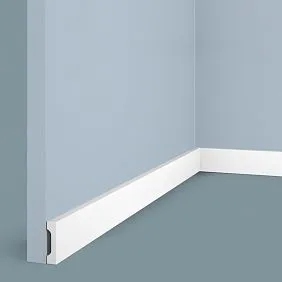
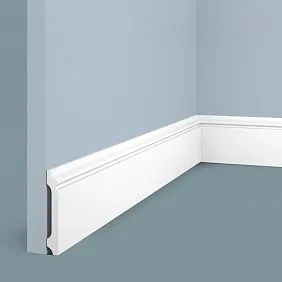

1.2 Historical Prologue: From Rasputin's Coats to Digital Catalogs
Peter I, designing the first Moscow stone palaces, hardly thought about the junction between floor and wall, but by the second half of the 18th century, Rastrelli was already specifying which profile and type of material to use in antefixes. The secret was refined by simple practice: the wider the skirting board, the more calmly the high room "takes"; the harder the material, the longer it resists heels and furniture legs. In the 19th century, along Tverskaya, 150 mm oak profiles became fashionable — then they were not pretentious, but necessary to hide the difference in level of the rough floor. The Soviet era reduced wide skirting boards to a minimum, forcing designers to hide engineering gaps with plastic corner pieces. Paradox: after thirty years, the market for elite finishes returned to the degree of "the more natural — the more valuable," and again oak, ash, walnut occupy top positions in procurement lists. The difference is only that today orders are placed with a click on the internet storefront address, and logistics delivers dried solid wood to the center within an hour thanks to the MTS.
Get Consultation
1.3 Climate of the Moscow agglomeration as a detector of fakes
Architectural scientists love diagrams: in winter, humidity in panel buildings drops to 30%, and in summer rises to 75%. A PVC skirting board on these swings "wanders" — linear expansion up to 4 mm per meter. Does the scale seem ridiculous? Just three or four joints are enough for the eye to detect a "zigzag" along the wall. Wood, however, with proper acclimatization, changes its geometry barely noticeably (≤ 2%). Psychology matters more than numbers: I see a straight line after five years — I trust the entire interior. I see a gap — subconsciously I assume they cut corners. Therefore, solid wood is not only about longevity, but also about the owner's reputation.
1.4 Species available to Moscow residents: from pine to teak chic
● Pine holds the lead in price and resin aroma. Suitable for bedrooms, where the softness of fibers meets slippers, not heels.
● Beech helps "pair" budget and hardness: denser than pine, but cheaper than oak. It can be stained to wenge — transforming into "expensive chocolate" without extra costs.
● Oak — material for those planning to pass on their apartment to children. Density ≈ 670 kg/m³, tannins protect against mold, grain pattern hypnotizes under side lighting.
● Ash looks like living flame: annual rings draw a rhythm that appeals to Scandinavian minimalism and art deco.
● Teak exports aesthetic "chocolate chic"; ideal for offices and living rooms with mid-century tones.
● Teak is the most expensive, but the oils inside its cells repel water. Withstands steam from "flat" sinks in studio kitchens.
Each species writes its own style. Choosing the material adds character, like a piano chord setting the tone of a composition.
1.5 Profile and height as arithmetic of proportions
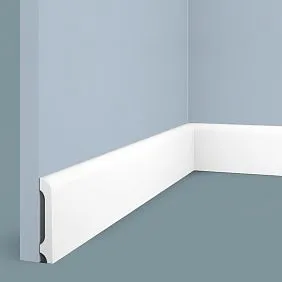
Modern architect's rule: skirting board height ≈ 3% of wall height. At a ceiling of 2.6 m, this is 78 mm; at 3.0 m — 90–100 mm; at loft-style 3.6 m — 120–160 mm. Minimalist euro-edge (straight cut) will blend into a Scandinavian living room, while ornate "capitel-radius" will support neoclassicism on Kutuzov Street. For high-tech in "Moscow-City," hidden profiles are suitable: front edge 12 mm and "floating" floor effect plus LED night lighting.
1.6 Oil, lacquer or paint — finish glossary
● Oil (tung/linseed) penetrates deeply, highlighting the grain. Light refreshment — microfiber + 20 minutes.
● Lacquer (water-based PU) provides "armor," withstands a toy scooter.
● Paint (PU-Matt) hides texture if you need a "invisible skirting board" or a contrasting dark frame.
Trend-2027: 140 mm oak, ultra-matte "wet asphalt," paired with L-sized tile "warm concrete."
1.7 Engineering heart: cable channel as modern artery
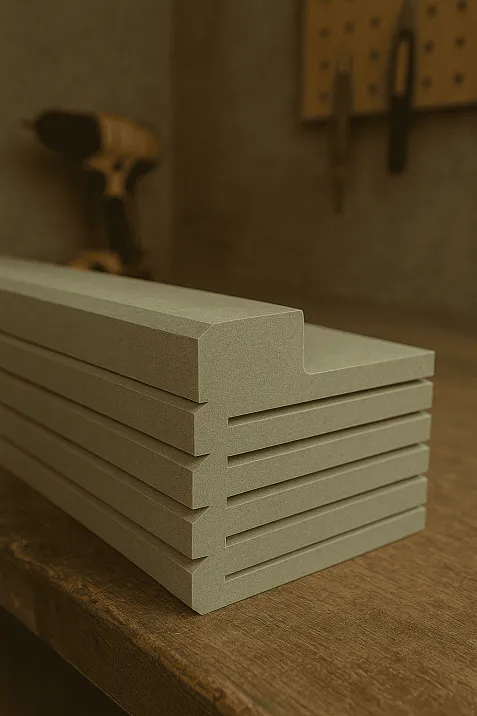
Loft ceiling with projector, Dolby Atmos soundbar under panoramic view, six "smart home" sensors, Wi-Fi 6E router — today even a three-room "European layout" is stuffed with wires like a rocket with telemetry sensors. Hiding this "jellyfish" without grooving load-bearing walls is possible with a double cable channel: two parallel 25×18 mm grooves are milled into the solid wood body, which can accommodate twisted Cat 6A pairs up to 10 Gbit/s
— and acoustic copper wire 2×4 mm².
Front cover attaches with neodymium magnets, so it can be removed with a fingernail and snapped back without gaps. Residents of the "Neva Towers" tower appreciated this: when a new sound system arrives, simply lift the cover, pull the HDMI optical cable, and snap the cover back — without touching the skirting board. The formula "wooden baseboard for sale in Moscow with double channel" increased fivefold in the past year — it seems the megacity has finally transitioned from aesthetics to aesthetics + engineering.
1.8 Installation without surprises: repairable method
Step 1. Acclimatization. Solid wood is laid out "in a tree" in the room for at least 72 hours at 21°C and 40–55% humidity. This stabilizes fibers, and potential "movement" reduces to micrometric fractions of a millimeter.
Step 2. Laser wall diagnostics. Laser leveler shows deviations >3 mm per linear meter — these "waves" are spackled, otherwise the skirting board will repeat the defect like litmus paper.
Step 3. Choosing fasteners.
• Clip — salvation for those who repaint walls every two years; the profile is removed like a monolithic pocket.
• Liquid glue — option for perfect flatness; saves time, but makes removal nearly impossible.
• Anchor + spackle — "universal soldier" for old brick facades: hide the anchor head with a wax pencil matching wood color, sand surface with P240.
Step 4. Ideal angle. Crosscut saw with 80 T blade, 45° angle, matte laser line, then both ends are sanded so that the bevels meet without any light gap.
Step 5. Finish. Before installing furniture, wait one day — the oil or varnish has time to polymerize, and the "floating" parquet completes its micro-movement.
Master rule: "Baseboard — the last operation before the kitchen". If you move this stage, you risk: the carpenter’s groove won’t forgive movers with a chest of drawers.
1.9 Extended economic calculation: numbers without marketing
|
Indicator (25 years) |
PVC profile |
MDF veneer |
Solid oak |
|
Starting price, ₽/linear meter |
400 |
900 |
2 100 |
|
Number of mandatory replacements |
3 |
2 |
0 |
|
Replacement price, ₽ |
1 200 |
1 800 |
0 |
|
Demolition/installation, ₽ |
12 000 |
12 000 |
0 |
|
Risk of parquet damage, ₽ |
8 000 |
8 000 |
0 |
|
Total, ₽/linear meter |
13 200 |
13 800 |
2 100 |
Adding capitalization factor: natural wood adds 2–3% to the property’s price. For a "two-room" apartment in the "Heart of the Capital" residential complex (25 million ₽), this is +500,000–750,000 ₽. In the end, plastic savings disappear, while solid wood becomes direct profit upon resale.
1.10 Psychoacoustics of wood: the sound of silence
Wood not only "breathes" but also absorbs high-frequency reverberations. The University of Tampere (2024) proved: rooms with natural finishes reduce noise stress levels by 17%. Practice confirms: in a living room with oak baseboard, a Zoom speaker’s voice sounds clearer, and vinyl records don’t "ring" in the middle. Live wood works as a passive acoustic panel — invisible, but effective. That’s why audiophiles from "Romanov Dvor" insist on using yas baseboard.
2.1 Oil vs. varnish: chemistry, physics, and practice
2.1.1 Tung, linseed, carnauba — oils under the microscope
Tung oil arrived from China even in the Song Dynasty: it contains α-elostearic acid, which after oxidation forms a polymer network stronger than the film of standard alkyd varnish. For Moscow conditions (dry winter + humid summer), tung is perfect: deep penetration — up to 2 mm into the pore depth — evenly distributes shrinkage stresses, and the baseboard doesn’t "bend" even at 30% humidity. Linseed oil, however, takes longer to dry, but it imparts a slight amber undertone, which retro-style enthusiasts on Patriarshy Street love. Carnauba — a hard wax from Brazilian palm: 3–5% is added to oil formulations to increase scratch resistance.
Practical life hack
If you drop your keys at the front door — tung with carnauba "self-heals" micro-dents: simply heat the spot with a hairdryer to 50°C and rub it with a microfiber cloth. Varnish won’t forgive this: you’ll need to sand the entire strip.
2.1.2 New-generation varnishes: PUR "armor" in silk matte
Water-based polyurethane (PUR) coatings have gone through a long journey from the soft yellow film of the 1990s to today’s ultra-matte veil, which is indistinguishable from oil at first glance. Modern varnish contains two-phase acrylic-PUR: acrylic provides elasticity, PUR — hardness. According to Taber’s test (Abrasive CS-17, 1000 rotations), abrasion is 3–4 mg — equivalent to medium-hardness ceramic tile. For a hallway with wheeled footwear, PUR varnish is the only option.
Minus: restoration
If you damage the varnish — you’ll have to sand the entire strip down to bare wood, otherwise the "old/new" boundary will become noticeable. That’s why developers invented a hybrid: "reflect-off" (Reflect-Off ≤ 5 GU) varnish looks like oil but regenerates with a special formulation based on urea wax. Apply locally — 30 minutes — and the gloss is balanced.
2.2 Color scenarios: architecture of tone
2.2.1 Tone-to-tone with wall: "invisibility" as a sophisticated understated technique
Fashion bureaus (OFFCON, Babayants) increasingly paint baseboards in the same NCS code as the wall, but two tones lighter. The eye reads a subtle contour, not a crude line of separation. In apartments of the "Bolshevik" residential complex, this technique visually "dissolves" the junction between matte plaster and floorboard, leaving art or design furniture as the center of attention.
2.2.2 Contrast: white wall + "wet asphalt"
If the goal is to emphasize the graphic nature of the space (relevant for gallery apartments on Vinzavod), choose 140 mm oak and Deep-Graphite 0 GU enamel. Then, stain the outlets and door casings: the interior "assembles" into a unified monochrome scheme, allowing paintings to "pop" with color.
2.2.3 Natural oil + whitewashed ash — Scandinavian softness
White pigment 3% lightens early wood grain, while late rings remain warm: a light contrast is born, which pairs beautifully with natural oak Chevron parquet. Against a white wall RAL 9003, the interior flows from floor to wall, and the skirting board becomes a mediator — neither rough nor overly airy.
A dozen real Moscow case studies: what was chosen and why it worked
|
№ |
Location |
Profile |
Species/Finish |
Reason for Choice |
Result after 2 years |
|
1 |
Residential Complex "Heart of the Capital" |
90 mm euro |
spruce/oil "Arctic" |
Budget + cute scandi |
No gaps, light tone preserved |
|
2 |
"Deputy's House" |
120 mm fillet |
oak/lacquer ro‑matte |
Classic + durability |
Guests give compliments |
|
3 |
Loft #1 ArtPlay |
160 mm straight |
ash/oil "Graphite" |
Support concrete |
Sold +15% above market |
|
4 |
Residential Complex "Garden Districts" |
70 mm hidden |
beech/enamel NCS S 2005‑Y |
Floating floor |
Wow effect remains |
|
5 |
Taganka, pre-revolutionary house |
130 mm capital |
Nut/Oil "Coffee" |
Preserve the old charm |
Color deepened, became warmer |
|
6 |
Vorobiev Hills, penthouse |
140 mm straight |
Tik/Oil Clear |
Wet SPA zone |
No damage |
|
7 |
Apartment complex "Headliner" |
100 mm euro |
Oak/Color RAL 7015 |
Mini-loft |
Price/View window balance |
|
8 |
Kotelniki, townhouse |
110 mm fillet |
Spruce/gloss-30 lacquer |
Family with three children |
Scratches barely visible |
|
9 |
Residential complex "Dolina Setun" |
120 mm straight |
Oak/oil "walnut" |
Combination with fireplace |
Threshold-glue is ideal |
|
10 |
"Moscow-City" apartment |
180 mm straight |
Ash/emal Black 0 GU |
High‑contrast |
Luxurious graphics |
|
11 |
Stalinist style, Arbat |
150 mm fillet |
Oak/sat-15 lacquer |
Restore Aesthetics |
Guests think the original |
|
12 |
New Construction, Khovrino |
80 mm euro |
pine/oil «milk» |
Economic + eco‑wave |
White has not yellowed |
Each case confirms: properly selected material and correct finish coating withstand household wear and tear, and sometimes even increase the property's market value.
2.4 Customer Checklist: Path from Search to Installation
- Prepare plan‑perimeter: laser + drawing, include door openings.
- Add 10% for cutting and defects.
- Determine style: minimalism, classic, loft.
- Choose wood species based on wear and budget.
- Resolve cable issue: single or double‑channel.
- Select finish: oil/varnish/paint.
- Verify FSC/PEFC with supplier.
- Place order —wooden baseboard for sale in Moscow.
- Find a crew with a portfolio specifically for solid wood.
- Allow 72 hours for acclimatization.
- Quality control: seams, angles, varnish without streaks.
- Photo archive: useful when selling an apartment.
3.1 Apartment Acoustics: How Baseboard Turns «Bare Concrete» into a Home
3.1.1 Sound in Four Walls: Why Bare Rooms Irritate the Ears
Any interior is a box where sound waves are born, reflected, and absorbed. A bare concrete wall returns the signal almost without loss: reverberation time (RT60) in an empty room with a 3 m ceiling reaches 1.8 seconds. Add furniture, carpet, curtains — RT60 drops to 0.6 seconds. Floorboards absorb some low frequencies, but high frequencies (2–4 kHz) still «tick» at the ear. A solid wood baseboard 16–22 mm thick with porous wood structure acts as a Helmholtz resonator: absorbs these «bright» frequencies and reduces RT60 by another 0.1 seconds. The difference is small on paper, but familiar to every audiophile: vinyl sounds «deeper», speech in Zoom — clearer, and children’s laughter doesn’t sting the eardrum.
3.1.2 Audiophile Practice: Oak vs. Ash in a 26 m² Living Room
● Oak 120 mm, ro‑matte oil. Measured RT60 — 0.43 seconds, absorption spectrum from 1.8 kHz to 3.6 kHz.
● Ash 140 mm, «graphite» oil. RT60 = 0.40 seconds, peak absorption shifted to 2.2–4.1 kHz (slightly higher — ash is more «porous»).
The difference is minimal, but ash added «velvet» to female vocals. Therefore, the recording studio on «Red October» installs ash solid wood around the control room, while oak — in the live room for the drum set, where edge hardness matters more.
3.2 Color Matching by NCS S2030-Y30R: When Wall and Skirting Need to 'Get Married'
3.2.1 Pigment Mixing Formula
The color S2030-Y30R is a complex yellow-terracotta. To make the oak match this tone, the following is added to the oil:
● 4% of Yellow Oxide pigment 10 µm;
● 1,2 % Red Iron Oxide 11 µm;
● 0.3% transparent burnt sienna wood tone.