Article Contents:
- Why One Apartment Doesn't Always Need the Same Skirting
- How MDF Skirting Differs from Wooden Skirting: A Substantive Breakdown
- Composition and Material
- Appearance
- Resistance to Room Conditions
- Repairability
- Price and Practicality
- Where to Best Use MDF Skirting: By Rooms and Scenarios
- Bedroom: Cleanliness and Simplicity
- Children's Room: Practicality Above All
- Hallway and Entrance: Load and Wear
- Apartment for Painting and White Interior
- Modern Interior with Geometric Accents
- Where to Best Use Wooden Skirting Boards: Rooms and Styles
- Living Room: Formality and Warmth
- Study: Seriousness and Character
- Bedroom with Natural Materials
- Classical and Neoclassical Interior
- How to Combine MDF Skirting and Wooden Skirting in One Apartment
- By Apartment Zones
- By floor material
- By color: a single tone unites different materials
- By profile: one 'style family'
- By height: unified contour
- At transitions between rooms
- How not to ruin the interior if rooms have different baseboard materials
- When it's better to choose only MDF, and when only solid wood
- Common mistakes when choosing baseboards for an apartment
- Different profiles without logic
- Different baseboard heights in adjacent rooms
- Too cheap MDF next to natural wood
- Solid wood where a more practical material is needed
- Mismatched color with doors and architraves
- What to consider when buying: materials, quality, profile, coating
- What to look at in the catalog to select a solution
- FAQ: answers to popular questions about MDF and solid wood skirting boards
- What is better for an apartment: MDF or wooden skirting board?
- Can MDF and wood be used in the same apartment?
- Where is it better to install a wooden skirting board?
- Where is it better to use an MDF skirting board?
- How to make the interior cohesive when materials are different?
- Should baseboard height be the same in all rooms?
- Is wooden baseboard suitable for a modern apartment?
- How to choose between MDF and solid wood based on budget and appearance?
- About the company
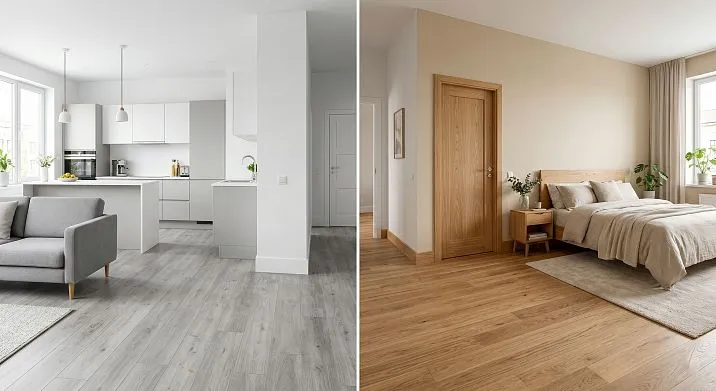
When a person does renovation, they inevitably face the question: should they use the same baseboard throughout the entire apartment or can they combine different materials? Some specialists say "only one material." Others say "the material isn't the main thing, it's the profile and color." Who is right? As usual, both are — depending on the situation.
MDF Skirting BoardandWooden baseboard— these are two fundamentally different solutions with different characteristics, different aesthetics, and different sets of tasks. Using both in one apartment is a completely normal and even smart practice, if you understand the logic: where each works better and how to maintain interior cohesion in the process.
This article is a complete breakdown: how these materials differ, which is preferable in which rooms, how to combine them without losing a unified style, and what mistakes are best avoided. We start with the main thing — the most common misconception.




Why the same baseboard isn't always needed throughout an entire apartment
The stereotype sounds convincing: "all baseboards should be the same." But it's worth thinking — what exactly should be "the same"? Material? Profile? Color? Height?
The truth is that different rooms in an apartment have fundamentally different operating conditions, different tasks, and different aesthetics. A hallway, where people walk daily in outdoor shoes, endures a completely different load than a bedroom. A living room, where one wants to emphasize a formal character and coordinate the skirting board with an expensive wooden floor, presents different requirements than a children's room, where practicality and repairability are needed.
Wooden baseboard— is material warmth, expressive texture, natural character. It is indispensable where you need to emphasize the naturalness of the finish, create a feeling of coziness and solidity. But wood is a living material, and this imposes limitations in rooms with an unstable microclimate.
MDF Skirting Board— is stability, precision geometry, a wide choice of colors and finishes. It holds its shape perfectly under humidity fluctuations, is easy to install, and looks impeccable under paint. In a number of rooms, MDF is not a compromise, but quite simply the best choice.
When you understand that each material has its own role, the question 'MDF or wood?' ceases to be a confrontation and becomes a strategic decision: where which material will bring the maximum result. This is exactly what the entire article is about.




How MDF Skirting Board Differs from Wooden Skirting Board: An Essential Breakdown
To make informed decisions, you need to understand the nature of each material. Not marketing characteristics, but real differences that influence the choice for a specific room.
Our factory also produces:


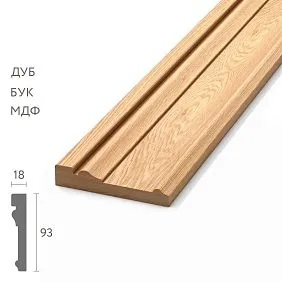


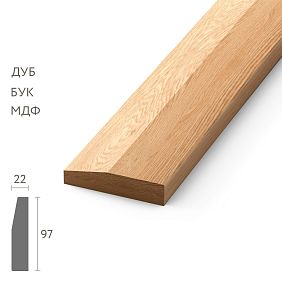
Composition and Material
MDF (Medium Density Fiberboard) is a pressed high-density wood fiberboard. Its basis is fine wood fibers, bonded with resin under pressure and at high temperature. The structure is homogeneous, without knots, voids, or natural defects. This gives a perfectly smooth surface and predictable behavior during processing.
solid wood baseboard— is solid wood, sawn and profiled from solid oak, beech, or another species. Each product is unique: the fiber structure, pattern, tone — all natural, inimitable. This is precisely what makes solid wood alive, warm, and valuable. But this is also the source of nuances during use.
Get Consultation
Appearance
MDF Skirting Board— can have a finish in any color: white, cream, the color of a specific wood species (oak, walnut, cherry), under varnish, under patina. The surface can imitate wood texture or be uniformly matte for painting. Ideal for white interiors, modern classics, minimalist and Scandinavian solutions.
Natural wood skirting board is a living texture that cannot be precisely replicated by any coating. Oak with its large fibers, beech with its fine uniform structure, ash with its delicate pattern — each wood species creates its own surface character. To the touch — warmth; from a distance — liveliness and depth.
Resistance to room conditions
MDF is more stable to short-term humidity fluctuations than solid wood. Properly coated MDF does not swell with minor changes in air humidity. However, with prolonged contact with water — both materials are vulnerable, and neither is used in bathrooms without special protection.
Solid wood skirting board reacts to humidity changes: the wood 'breathes' slightly, expanding when moistened and contracting when the air becomes too dry. For central heating with dry winter air, this must be taken into account — leaving proper gaps during installation.
Repairability
MDF for painting is easy to refresh: sand the damage, touch up the paint — and the surface is like new. MDF with film coating is harder to repair: a scratch on a laminated surface cannot be fixed locally.
Wooden skirting board can be sanded and re-varnished. Small dents, scratches — are sanded and refinished. This is one of its main advantages for long-term use.
Price and practicality
MDF is on average cheaper than solid wood for a comparable profile. This makes it a sensible choice for secondary rooms or large areas where natural material would significantly increase the budget.Wooden trim— is an investment in quality that pays off in rooms where it will be seen and appreciated.
Where MDF skirting board is best used: by rooms and scenarios
The right question is not 'Is MDF worse or better than wood?' but 'In which room does MDF perform optimally?' And there are many such places in an average apartment.
Bedroom: Purity and Simplicity
In the bedroomMDF Skirting BoardIt works excellently in modern and Scandinavian interiors, where walls are white or light, and the decor is built on the 'less is more' principle. A white MDF skirting board with a clean profile creates a neat bottom line of the wall without claiming the role of the main decorative element. In such interiors, the skirting board is part of the background, not an accent.
For a bedroom with a neutral style and laminate or vinyl flooring, MDF skirting is a practical, beautiful, and perfectly sufficient choice. No compromise—it's exactly what you need.
Children's Room: Practicality First
A children's room is a high-traffic area: toys, scooters, balls. Here, you need a skirting board that is easy to refresh. MDF for painting is the ideal choice: it's easy to touch up if damaged, and you can repaint it along with the walls when changing the room's design. It's practical and economical.
Moreover, MDF precisely maintains its profile without defects, which is important when working with small spaces where any sloppiness stands out.
Hallway and Entryway: Load and Wear
The hallway is the most heavily used area in an apartment. Impacts from moving furniture, accidental contact with shoes, high foot traffic.MDF Skirting BoardMDF with a laminated coating handles mechanical stress well. It doesn't dent like softer wood species, and if necessary, it's easy to replace an individual section.
For a hallway with a dark floor — MDF with a dark wood finish or in a neutral dark gray tone creates a calm, stable lower line of the room. For a hallway with a light floor — white MDF skirting makes the space appear wider and brighter visually.
Apartment for painting and white interior
If the entire apartment is decorated in a white palette — white walls, white doors, white ceilings — the only logical choice is MDF skirting for painting. It allows achieving a perfect match of the white shade with other interior elements, including door trims and cornices. No solid wood will provide the same purity of white color: the wood grain always 'shows through' the white paint.
Modern interior with geometric accents
In minimalist interiors with geometric furniture, large-format slabs, or polished surfaces — MDF skirting with a straight-line profile creates the necessary 'strict' lower contour. Here, the natural texture of solid wood would be inappropriate: it adds 'natural warmth' where geometric clarity is needed.
Where to use wooden skirting best: rooms and styles
with a classic profile creates a sense of solidity, reliability.— is not just a finishing element. It is an architectural detail that forms the lower contour of the wall and sets the material character of the entire room. Where wood is appropriate, it works incomparably better than any substitute.
Living room: formality and warmth
The living room is the main space of the apartment. It is where guests are received, and taste and level are demonstrated. That is why the living room is the first place where you should chooseFloor wooden skirtingmade of solid wood.
Wooden skirting for a living room with parquet or engineered wood flooring — this is a logical continuation of the material. Skirting and floor from the same wood species or the same tone create a sense of a unified, cohesive space. At the same time, solid wood skirting with an expressive profile adds architectural weight to the lower wall zone, which thin MDF lacks.
For a living room with ceiling heights from 3 meters — tallwooden baseboardfrom 100–120 mm — this is not just for looks. It's the correct architectural proportion: a tall room requires a tall base.
Study: seriousness and character
A study is a space where the material speaks about the owner. Wood is almost mandatory here: it creates an atmosphere of solidity, focus, and intellectual seriousness.wooden baseboards for floormade of dark oak or walnut — together with wooden bookshelves, a writing desk, and parquet — turn the study into a true place of power.
The geometry of the study is strict: no ornaments or rich decor. Just proper dark wood with a classic profile — that's enough.
Bedroom with natural materials
If the bedroom is decorated using natural materials — linen fabrics, wooden furniture frames, natural shades —with a classic profile creates a sense of solidity, reliability.organically integrates into this system. In such a bedroom, MDF would be an alien element: too 'technological' next to living natural textures.
For a bedroom with wooden floors, a wooden bed, and wooden doors — a solid wood baseboard made from the same species as the floor, or a similar tone — is a logical completion of the idea.
Classic and neoclassical interior
In a classic interior with pilasters, moldings, and stucco—a solid wood baseboard is not just desirable but essential. It forms the 'base' of the architectural wall.Wooden items—pilasters, cornices, and architraves—form a unified system with the baseboard, where wood serves as the consistent material throughout the architectural finish.
MDF in a classic interior with wooden architectural elements always feels like 'the wrong material.' Not because it's bad, but due to a mismatch in nature: living wooden details next to pressed fiberboard.
How to combine MDF baseboard and wooden baseboard in the same apartment
So, you've decided to use both materials—in different rooms, for different purposes. How do you ensure the interior doesn't fall apart into disconnected pieces?
The main principle: a unified style doesn't require identical materials. It requires a unified logic: color, profile, height, and stylistic affiliation.
By apartment zones
The most competent zoning is to separate 'formal' and 'functional' spaces:
-
Public zones (living room, dining room, study, hallway)—Wooden baseboard—solid wood: here it is visible, appreciated, and contributes to the overall impression
-
Private and functional zones (bedroom in neutral style, children's room, hallway) —MDF Skirting Board: practical, beautiful, sufficient
This is a logical allocation of resources: invest solid wood where it contributes to the result, and avoid overpaying where MDF performs fully adequately.
Regarding floor material
The baseboard always correlates with the floor. If the living room has parquet or engineered wood flooring, a wooden baseboard continues this logic. If the hallway has porcelain stoneware or laminate, an MDF baseboard or one with a laminated finish matching the floor covering will be the correct choice.
Ask yourself: 'Which material creates a sense of continuity with the floor?' The answer is almost always obvious.
By color: a unified tone brings different materials together
This is the most effective coordination tool. If the living room has a wooden baseboard in light oak (natural tone), and the hallway has an MDF baseboard with a finish resembling light oak, they will appear coordinated at a glance. Color acts as a visual glue that holds different materials within the same interior field.
Key condition: the tone of the MDF finish must match the tone of the solid wood as precisely as possible. Most manufacturers offer series of MDF baseboards with finishes calibrated to specific wood species. This needs to be checked in natural daylight in the actual room, not from catalog photos.
By profile: one 'style family'
The profile is the character of the skirting board. A classic profile with a bead and a fillet does not combine with a rectangular geometric profile: they are from different 'style families'. If wooden skirting with a classic profile is used in some rooms, MDF skirting in others should use a similar—or at least close—type of profiling.
Rule: one profile for the entire apartment or similar profiles of the same character (both classic or both geometric) is the key to visual integrity when using different materials.
In height: a unified contour
The height of the skirting board in different rooms of the apartment should be the same or differ logically (e.g., higher in a tall hall, slightly lower in a small bedroom). Arbitrary changes in height—say, 120 mm in the living room and 40 mm in the hallway—create a sense of incompleteness. A unified contour in height is one of the most important factors in making the interior 'hold together' as a whole.
At transitions between rooms
The boundary between the living room (with wooden skirting) and the hallway (with MDF) is always an issue. How to make the transition unnoticeable?
The optimal solution is to join the skirting boards in the doorway: each ends at its own side of the door frame. The visible joint is then covered by the architrave or the frame profile. If the joint is still visible—use a special connecting element or make the joint as neat as possible, strictly along the line.
How not to ruin the interior if different skirting materials are used in rooms
There are several practical rules that allow using two different materials in an apartment without creating a sense of chaos.
Rule one: a unified color principle. All skirting boards in the apartment should belong to the same color logic. Either all warm tones (wood, beige MDF, cream) or all cold tones (white, gray). Mixing warm wood in one room and cold gray MDF in another without a transition zone always creates a feeling of fragmentation.
Rule two: unified profile principle. As mentioned above: classic with classic, geometric with geometric. Never—classic next to ultra-minimalist rectangular trim.
Rule three: coordination with doors and casings. Baseboards and door casings are one ensemble. If the doors are white with white casings, the baseboard should follow this: either also white (MDF for painting is ideal), or the tone of the wooden baseboard should harmonize with the tone of the door panels. Mismatching baseboards with doors is one of the most common mistakes.
Rule four: transitions through public areas—only solid wood. If several doors and rooms are visible from the hallway simultaneously, the hallway becomes a 'crossroads' of all materials. This is precisely where it is most important to use solid wood baseboards: they create a confident, warm, unifying outline that visually connects all spaces.
Rule five: joints—always in openings, never—on an open wall. The transition from one material to another should occur where it is naturally concealed by architecture: in a doorway, behind a frame, in a corner. A visible joint of two different baseboards on one continuous wall is a technically crude error.
When is it better to choose only MDF, and when only solid wood
Sometimes a mixed solution is unnecessary—and it is more correct to follow one of two pure scenarios.
Only MDF baseboard—when:
-
An apartment in a white or light monochrome palette, where wood texture would be superfluous
-
A small apartment with low ceilings, where it is necessary to maximally 'lighten' the lower outline
-
Renovation for rental, where practicality and budget are important
-
Modern minimalist interior with ceramic or vinyl flooring
-
Rooms with unstable microclimate (active ventilation, temperature fluctuations)
Only wooden skirting — when:
-
Apartment with natural flooring (parquet, solid wood) throughout the entire perimeter
-
Classical or neoclassical interior with wooden doors, moldings,mouldings
-
High-status interior where material quality is part of the image
-
Long-term housing designed for many years of use
Mixed solution — when an apartment has fundamentally different zones by function, style, or level of 'formality'.
Common mistakes when choosing skirting boards in an apartment
Even when the material is chosen correctly, you can ruin the result with details. Here are the most common mistakes — specific and without unnecessary words.
Different profiles without logic
Buying MDF skirting with a straight profile for some rooms and wooden skirting with a classic ogee profile for others, without any explanation for this choice. This creates the impression that the apartment is 'assembled from leftovers,' rather than designed as a cohesive space.
Different skirting heights in adjacent rooms
A 100 mm high skirting in the living room and 60 mm in the hallway—this is immediately visible when the doors are open. The contrast is neither architecturally justified nor aesthetically considered. A uniform height throughout the apartment (or a deliberate change—higher in formal areas, lower in technical ones) is key to visual order.
Too cheap MDF next to natural wood
This is one of the most painful dissonances: in the living room—an expensive oak skirting with the right profile, and in the hallway—thin MDF with a plastic gloss. In an open perspective, this jars the eye. If you use MDF in 'visible' areas, choose high-quality MDF with a good finish—of an appropriate level.
Solid wood where a more practical material is needed
An expensive oak skirting in a child's room is not a luxury but impractical: it will inevitably suffer from toys and small bicycles, and repairing it is significantly more difficult than touching up MDF. Using solid wood resources where they are not needed is not quality but wastefulness.
Uncoordinated color with doors and architraves
A wooden skirting made of dark walnut and white doors with white architraves—a combination that requires very careful handling. Without a deliberate design decision, such a contrast looks like a mistake, not a technique. Before choosing the material and color of the skirting, look at the doors: they are always nearby, always in the frame.
What to consider when purchasing: materials, quality, profile, coating
Wooden items— this is not the type of product where you should skimp on quality. Especially when it comes to solid wood skirting boards that will last for decades.
Quality of processing. A solid wood skirting board must be properly dried: wood moisture content no more than 8–10%. Over-dried skirting will crack, under-dried — warp. This is not visible at purchase but appears after several months.
Profile. The more precise and cleaner the milled profile, the higher the quality of the product. Blurred edges, unclear transitions, uneven depth — signs of low-quality processing.
Coating.Wooden trim— can be supplied untreated (for self-finishing), primed (for painting or varnishing), or fully finished (varnish, oil, wax coating). Untreated skirting is for those who want to control the finish themselves; ready-made — for quick installation.
Geometry. The skirting board must be straight along its entire length. Any twisting is a defect that cannot be corrected during installation.
For MDF: check the quality of the coating (lamination). It should be even, without bubbles or drips. The film must fit tightly to the profile on all edges — including on profile curves.
What to look for in the catalog to select a solution
For an apartment where a combination of two materials is planned, it is optimal to selectMDF Skirting BoardandSkirting made of solid woodfrom one collection or one manufacturer. This gives the best chance to match profiles and close tones.
For formal rooms — the section of wooden moldings with solid oak and beech skirting boards. For functional and neutral zones — the section of MDF skirting boards with various finishes. The entire assortmentmolding products— moldings, cornices, skirting boards — is presented in a single catalog, which significantly simplifies the search for coordinated solutions.
If a classic interior with wooden pilasters, architraves, and moldings is planned — all these elements are appropriate to choose together as an architectural system. For this, the sectionof materials and products made of woodcontains all the necessary categories.
FAQ: answers to popular questions about MDF and solid wood skirting boards
What is better for an apartment: MDF skirting board or wooden?
Depends on the room and style. In a classic living room with parquet — a solid wood skirting board. In a modern bedroom with white walls and laminate — MDF is quite sufficient and appropriate. There is no universal answer — there is the right choice for a specific task.
Can MDF and wood be used in the same apartment?
Not only is it possible — it's often the optimal solution. The key is to maintain consistency in profile, height, and color logic. With proper coordination, the difference in material between rooms is practically unnoticeable.
Where is it best to install wooden baseboards?
In spaces where natural material creates a sense of warmth and status: living room, study, bedroom with natural floors, hallway. In interiors of classic or neoclassical style — wooden baseboard is architecturally necessary, not just preferable.
Where is it best to use MDF baseboard?
In high-traffic areas (corridor, entryway), children's rooms, modern neutral interiors, white apartments for painting. MDF is the optimal choice where practicality is more important than the tactile feel of natural wood.
How to make the interior cohesive if the materials are different?
Uniform baseboard height, uniform profile (or similar profiles of the same character), uniform color logic. Transitions — only in doorways, hidden behind the frame. Coordination with the color of doors and trims is mandatory.
Is it necessary to have the same baseboard height in all rooms?
Ideally — yes. Or logically justified different heights: larger in tall rooms, more modest in compact ones. Arbitrary changes in height between adjacent rooms disrupt visual cohesion.
Is wooden baseboard suitable for a modern apartment?
Yes, with the right profile selection. A wooden skirting board with a simple, geometrically clean profile—without complex ornamental curves—is organic in a modern interior. A profile with a classic ogee is for classic styles. Rectangular or with a minimalist step—for contemporary style.
How to choose between MDF and solid wood based on budget and appearance?
MDF with a comparable profile will be cheaper. If the budget is limited, the optimal choice is:to buy wooden baseboardfor the living room and study, and useMDF Skirting Boardwith a finish in the same tone for secondary rooms. This is an economically sound solution without compromising the aesthetic result.
About the Company
Choosing between MDF and solid wood is a strategy that requires understanding the material, profiles, and principles of coordination. That is why it is important to work with a manufacturer whose catalog includes both solutions—wood and MDF—with coordinated profiles and well-thought-out collections.
STAVROS—manufacturer of wooden architectural elements and millwork: solid oak and beech skirting boards, MDF skirting boards, moldings, cornices, architraves, pilasters. The entire range is united by a common logic of profiles and stylistic solutions—from strict classic to modern neoclassicism. STAVROS is the choice for those who think of an interior as a system, not a set of random elements. Here you can select a wooden skirting board for a formal living room and a coordinated MDF one for the hallway—and get an apartment where everything holds together.