Article Contents:
- Standard and non-standard baseboard sizes
- Floor baseboards: size range
- Ceiling baseboards (coves, cornices): size grid
- Non-standard sizes: when they are needed
- How to choose the optimal height for a room
- The golden rule of proportions
- Room area matters
- Correcting room proportions with baseboards
- Interior style dictates size
- Practical tips for choosing height
- Impact of shape and profile on interior design
- Simple rectangular profiles
- Profiles with cove (rounded edge)
- Profiles with bevel (angled edge)
- Complex multi-step profiles
- Decorative relief and molding
- Baseboards with cable channel
- Flexible baseboards
- Modern trends: tall and wide baseboards
- Trend 1: Baseboard height of 100+ mm
- Trend 2: Baseboard as a decorative accent
- Trend 3: Wide ceiling cornices with hidden lighting
- Trend 4: Minimalism - no ceiling baseboard
- Trend 5: Baseboards with LED lighting (floor)
- How to select size to match ceilings and walls
- Low ceilings (2.3–2.5 m): selection rules
- Standard ceilings (2.6–2.8 m): universal solutions
- High ceilings (2.9–3.5 m): focus on decoration
- Very high ceilings (3.5+ m): monumental effect
- Uneven walls and ceilings: practical solutions
- Hi Wood and STAVROS recommendations
- Conclusion: size matters
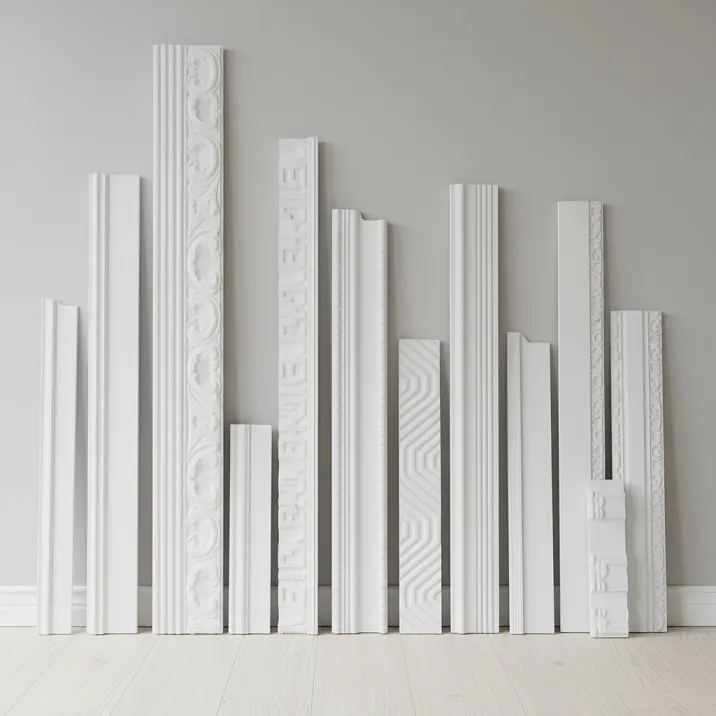
Imagine: repair is almost complete, walls are perfectly even, floor is flawless, furniture is arranged. But something is off. The room looks unfinished, proportions seem wrong, ceiling visually presses down or, conversely, disappears. Often the problem lies in an incorrectly chosen skirting board. A narrow skirting board in a room with a high ceiling disappears, creating a sense of incompleteness. A too wide skirting board in a small room visually 'eats' space.
Choosing the size of the skirting board is not just a technical question of 'buying what's available in the store'. It is a design decision that affects the perception of the entire interior. A correctly chosen skirting board corrects room proportions, highlights architectural features, and creates harmony. An incorrect one destroys even the most expensive design project.
The modern market offers dozens of sizes - from miniatureceiling skirting board polystyrene white 15x15x2000 mmfrom massive skirting board up to 150 mm high. How to choose the right one? What rules exist? What trends are current? Let's examine in detail the sizes, shapes, and design solutions of polystyrene skirting boards.


Standard and non-standard skirting board sizes




Floor skirting boards: size range
The height of the floor skirting board is a key parameter determining visual perception. Manufacturers offer a wide range of sizes.
Low Skirting Boards (40-60 mm):
These are minimalist profiles for small rooms or modern interiors.
Height of 40 mm - the minimum size, rarely encountered. Used in technical rooms or where maximum invisibility of the skirting board is required.
Height of 50 mm - a popular size for Scandinavian style and minimalism. Simple, does not attract attention, visually does not reduce the room.
Height of 60 mm - a universal size for small rooms (up to 12 sq.m) with ceilings 2.5 m. Noticeable enough to serve a decorative function, but does not overload the space.
Application:
-
Studios and small apartments
-
Bathrooms, toilets
-
Corridors less than 1 meter wide
-
Storage rooms, closets
-
Modern minimalist interiors
Medium skirting boards (70-90 mm):
The most popular category, the golden middle for most rooms.
Height of 70 mm - standard for typical apartments. Optimal for rooms 12-20 sq.m with ceilings 2.5-2.7 m. Clearly visible, but does not dominate.
Polystyrene skirting board 80 mm- the most in-demand size on the market. Ideal balance for standard apartments. Suitable for most interior styles.
Height of 90 mm - for rooms from 20 sq.m or ceilings 2.8 m. More noticeable, creates a sense of solidity.
Application:
-
Living rooms, bedrooms of standard size
-
Kitchens
-
Offices
-
Children's rooms
-
Universal choice for standard housing
High Skirting Boards (100-150 mm):
Trend of recent years - high skirting board as a design element.
Height of 100 mm - for spacious rooms (25+ sq.m) or ceilings from 3 meters. Emphasizes the status of the interior.
Height 120 mm - for large living rooms, halls, rooms with ceilings 3.2-3.5 m. Bright decorative element.
Height 150 mm - for rooms with ceilings 3.5+ meters, classical interiors, imitation of palace style. Massive, dominant element.
Application:
-
Spacious living rooms of elite housing
-
Halls and vestibules
-
Rooms with high ceilings
-
Classical interiors (neoclassicism, art deco)
-
Premium-class commercial real estate
Floor skirting board thickness:
Varies from 12 to 22 mm. Thicker skirting board:
-
Stronger
-
Better hides wall imperfections
-
Looks more substantial, solid
-
Creates a more noticeable shadow
Standard thickness 15-18 mm is optimal for most cases.
Plank length:
Standard - 2000 mm (2 meters). This is the optimal length for:
-
Transportation in a passenger car
-
Installation convenience (one person can handle it)
-
Minimizing joints (standard wall 3-4 meters = 2 boards)
Some manufacturers offer boards 2500 mm or 3000 mm. Advantages:
-
Fewer joints on long walls
-
Faster installation
Disadvantages:
-
Harder to transport
-
Heavier to install alone
-
More expensive (10-15% markup for length)
Our factory also produces:


Ceiling skirting (cornices, moldings): size grid
Ceiling skirting is characterized by the width of the adjacent wall and ceiling profiles. Denoted as width×width, e.g., 50×50 mm.
Narrow cornices (15-30 mm):
White polystyrene ceiling skirting 15x15x2000 mm- minimum size. Almost invisible, used for:
-
Minimalist interiors where only technical function is needed (hide wall-ceiling joint)
-
Very small rooms (bathrooms with an area of 2-3 sq.m)
-
Rooms with low ceilings (2.3-2.4 m), where a wide cornice visually lowers the ceiling even further
Sizes: 15×15 mm, 20×20 mm, 30×30 mm
Application:
-
Bathrooms, showers
-
Hallways with low ceilings
-
Storage rooms
-
Technical rooms
Medium cornices (40-70 mm):
The most popular category for living rooms.
Ceiling cornice polystyrene 30x30x2000 mm whiteand sizes 40×40, 50×50 mm - universal options for rooms 12-20 sq.m with ceilings 2.5-2.7 m.
Size 60×60 mm, 70×70 mm - for spacious rooms or ceilings 2.8+ m.
Application:
-
Living rooms, bedrooms, children's rooms
-
Kitchens
-
Standard apartments
-
Most residential interiors
Wide cornices (80-150 mm):
Decorative cornices, often with relief and moldings.
Sizes 80×80 mm, 100×100 mm - for large rooms (30+ sq.m) and ceilings from 3 meters.
Sizes 120×120 mm, 150×150 mm - for halls, rooms with ceilings 3.5+ meters, classic interiors.
Application:
-
Luxury housing
-
Classic and neoclassic interiors
-
Rooms with high ceilings
-
Entrance halls, living rooms
Asymmetric cornices:
Different widths of attachment to walls and ceilings, for example, 50×80 mm, 60×100 mm, 80×120 mm.
Advantages:
-
Visual correction of proportions (narrow part toward ceiling visually raises it)
-
Material savings while maintaining decorativeness
-
More design options
Cornices for hidden lighting:
Special profiles with a groove for LED strips. Installed at a distance of 5-15 cm from the ceiling. Light is directed upward, creating a "floating ceiling" effect.
Sizes: usually 70-120 mm width, groove depth 10-20 mm.
Application:
-
Modern interiors
-
Bedrooms (soft evening lighting)
-
Living rooms (creating atmosphere)
-
Stretch ceilings
Get Consultation
Non-standard sizes: when are they needed
Very high baseboards (over 150 mm):
Rarely encountered, usually custom-made. Used in:
-
Historical interiors (restoration)
-
Rooms with ceilings over 4 meters
-
Palatial styles
-
Commercial spaces (hotel lobbies, museums)
Super-wide cornices (over 200 mm):
Multi-level decorative structures for:
-
Theatrical interiors
-
Manors and estates
-
Rooms with ceilings 5+ meters
Baseboards of non-standard length:
Custom orders allow for 2.5 m, 3 m, even 4 m panels. Recommended for:
-
Large volumes (saving on joints)
-
Long walls (hallways, corridors)
-
Professional installation by a crew
Custom profiles:
Some manufacturers produce baseboards according to custom drawings. This is expensive (minimum order is usually 500 linear meters), but allows for a unique design.
How to choose the optimal height for a room
The golden rule of proportions
There is a classic rule of interior design: the height of the baseboard should be approximately 1/20 - 1/15 of the wall height (from floor to ceiling).
Formula: Baseboard height = Ceiling height / 17 (average between 20 and 15)
Calculation examples:
Ceiling 2.5 m: 2500 mm / 17 = 147 mm... round to 70-80 mm (practical size considering available assortment)
Ceiling 2.7 m: 2700 / 17 = 159 mm... round to 80-90 mm
Ceiling 3.0 m: 3000 / 17 = 176 mm... round to 100 mm
Ceiling 3.5 m: 3500 / 17 = 206 mm... round to 120 mm
Ceiling 4.0 m: 4000 / 17 = 235 mm... round to 150 mm
This is not a strict rule, but a guideline. Deviations of ±20-30% are acceptable depending on interior style and personal preferences.
Room area matters
Not only ceiling height, but room area also affects the choice of skirting board size.
Small rooms (up to 10 sq.m.):
Bathrooms, toilets, storage rooms, small hallways.
Rule: the skirting board should be visually unobtrusive and not 'consume' space.
Recommended height: 50-60 mm, even if the ceiling is 2.7 m (formula gives 80 mm).
Logic: in a small room, a high skirting board visually reduces the already modest space.
Medium rooms (10-20 sq.m.):
Standard bedrooms, kitchens, children's rooms.
Rule: follow the proportion formula, it will give the optimal result.
Recommended height: 70-90 mm for ceilings 2.5-2.8 m.
Large rooms (20-35 sq.m.):
Spacious living rooms, studios, kitchen-living rooms.
Rule: you can increase the skirting board height by 10-20% relative to the formula.
Recommended height: 90-110 mm for ceilings 2.7-3.0 m.
Logic: in a large space, a narrow skirting board disappears and looks disproportionately small.
Very large rooms (over 35 sq.m.):
Halls, grand living rooms, halls.
Rule: the skirting board should be a noticeable decorative element.
Recommended height: 100-150 mm regardless of ceiling height (within reasonable limits).
Skirting board for room proportion correction
Skirting board is a tool for visual correction of room shortcomings.
Low ceiling (2.3-2.4 m):
Problem: ceiling appears to press down, room seems low and cramped.
Solution: narrow skirting board (50-60 mm), painted in wall color. This visually increases wall height and 'lifts' the ceiling.
Do not do: wide dark skirting board will further lower the ceiling.
Very high ceiling (3.5+ m):
Problem: room appears like a well, disproportionately stretched upwards, uncomfortable.
Solution: high skirting board (120-150 mm), possibly contrasting color. This visually 'lowers' the upper wall boundary, making proportions more harmonious.
Narrow long space (corridor):
Problem: tunnel effect, disproportion.
Solution: medium skirting board (70-80 mm) in wall color on long walls, slightly higher (90-100 mm) on end walls. This visually 'brings in' the ends, making the room appear more square.
Disproportionately small height relative to area:
Example: a 30 sq.m room with a 2.5 m ceiling (typical for modern studios).
Problem: feeling of 'confinement' in a spacious room.
Solution: medium skirting board (80-90 mm), no higher. A high skirting board will worsen the feeling of a low ceiling.
Interior style dictates the size
Minimalism, Scandinavian, high-tech:
Philosophy: fewer details, clean lines, unobtrusive functionality.
Choice: narrow skirting board 50-70 mm, simple rectangular profile, in wall color (visually blends in).
Contemporary style, contemporary:
Philosophy: minimalism with accents, geometry, contrasts.
Choice: medium skirting board 70-90 mm, can be contrasting color (white on dark walls, dark on light walls).
Classic, neoclassical:
Philosophy: proportionality, symmetry, decorative elements.
Choice: medium or high skirting board 90-120 mm, with moderate relief, often white.
Baroque, Rococo, Empire:
Philosophy: luxury, abundance of decoration, monumentality.
Choice: high skirting board 120-150 mm, rich relief, possibly gilded or patinated.
Loft:
Philosophy: industrial aesthetics, minimal finishing.
Choice: narrow simple skirting board 50-60 mm or no skirting board at all (characteristic feature of the style). If installed, dark, graphite, matching concrete wall color.
Provence, country:
Philosophy: coziness, rustic romance, natural materials.
Choice: medium skirting board 70-90 mm, painted in pastel tones or mimicking wood (MDF).
Practical tips for choosing height
Tip 1: When in doubt, choose a smaller size
Too narrow a skirting board can be compensated by decor and color. Too wide cannot be fixed — will look disproportionate.
Tip 2: Bring a sample home
Take a piece of skirting board of the desired height (or several options) from the store, and attach it to the wall at home. Assess the proportions on-site, under your lighting, with your furniture. Catalog photos are misleading.
Tip 3: Consider furniture
If there is a lot of furniture along the walls (cabinets, chests), most of the skirting board will be covered. There is no point in paying extra for a high decorative skirting board that no one will see. A medium functional one is sufficient.
Tip 4: Consistency throughout the apartment
It is not necessary to use the same height everywhere. But it is desirable to coordinate:
-
Living rooms (bedrooms, living room) - one size
-
Technical rooms (bathroom, storage) - can be another, narrower one
-
Hallway - can have its own variant
Mismatch (70 mm in one bedroom, 90 in another) looks unprofessional.
Tip 5: Ceiling and floor skirting boards should be proportional
General rule: ceiling cove width = half the height of the floor skirting board.
Examples of harmonious combinations:
-
Floor 70 mm + ceiling 40×40 mm
-
Floor 80 mm + ceiling 50×50 mm
-
Floor 100 mm + ceiling 60×60 mm
-
Floor 120 mm + ceiling 70×70 mm
Disproportion (floor 50 mm + ceiling 100×100 mm) looks ridiculous.
Influence of shape and profile on interior
Simple rectangular profiles
Description:
Skirting board with rectangular cross-section and no decorative elements. Straight edges, clear geometry, minimal details.
Visual effect:
-
Minimalism, strictness
-
Modern
-
Visual lightness (does not overload space)
-
Emphasizes architecture, not decoration
Where to use:
-
Minimalism, high-tech, Scandinavian style
-
Small rooms (visually does not reduce)
-
Office interiors
-
Young people's studio apartments
Advantages:
-
Cheaper (no costs for molding complex relief)
-
Easier to clean (no recesses where dust accumulates)
-
Versatility (fits most interiors)
Profiles with a cove (rounded edge)
Description:
Baseboard with a smooth rounded top. The most common profile type.
Visual effect:
-
Softness, smooth lines
-
Classic Elegance
-
Visually softens the angle between wall and floor
-
Creates a subtle shadow, adding depth
Where to use:
-
Classic and modern interiors
-
Living spaces of any size
-
Universal choice for standard housing
-
Family apartments
Subtypes:
-
Simple cove (single rounded edge)
-
Double cove (two rounded edges of different radii)
-
Stepped cove (rounded edge + straight section)
Profiles with bevel (slanted edge)
Description:
Baseboard with a diagonal top edge cut at 30-45°.
Visual effect:
-
Sharpness, graphic quality
-
Modern elegance
-
Expressive play of light and shadow
-
More dynamic than rectangular
Where to use:
-
Modern interiors (contemporary)
-
Offices, commercial spaces
-
Well-lit spaces (emphasizes the bevel)
-
Male interiors (offices)
Complex multi-step profiles
Description:
Baseboard with multiple protrusions, recesses, steps. Complex relief with alternating straight and rounded sections.
Visual effect:
-
Classic luxury
-
Rich detailing
-
Expressive light and shadow (each step casts a shadow)
-
Visual complexity and decorative appeal
Where to use:
-
Classic interiors (Neoclassicism, Empire)
-
Spacious rooms (in small apartments)
-
Grand reception rooms
-
Rooms with high ceilings
Important: The more complex the profile, the harder it is to clean (dust accumulates in recesses).
Decorative relief and moldings
Description:
Moldings with three-dimensional decoration: plant motifs, geometric patterns, imitation of carving.
Types of decoration:
Plant-based:
-
Laurel branches, oak leaves
-
Vine tendrils
-
Stylized flowers
-
Ancient motifs
Geometric:
-
Meander (Greek ornament)
-
Plaited pattern
-
Dentils (tooth-like elements)
-
Shell pattern
Architectural:
-
Imitation of stone
-
Imitation of plaster cornices
-
Coffers (square recesses)
Visual effect:
-
Luxury, palace-like
-
Historical Styles
-
Emphasis on decorative elements
-
Complex interplay of light and shadow
Where to use:
-
Classic styles (Baroque, Rococo, Empire)
-
Luxury housing
-
Large rooms (from 30 sq.m)
-
High ceilings (from 3 m)
Important: Such decoration looks inappropriate in modern interiors. In small rooms, it is excessive.
Moldings with cable channel
Description:
Molding with an internal cavity for wiring. Features a removable panel for access to cables.
Visual effect:
Looks like a regular baseboard (any profile possible). But thicker than usual (18-25 mm vs. standard 15-18 mm).
Where to use:
-
Offices with many wires (computers, phones)
-
Modern apartments (TV, internet, home theater wires)
-
Rooms where it’s unsightly to run wires openly
-
During renovation without wall grooving
Advantages:
-
Hidden cable routing
-
Easy access for adding/replacing cables
-
Orderly (no dangling wires)
Disadvantages:
-
Thicker and bulkier than usual
-
Limited capacity (only a few cables will fit)
-
Slightly more expensive
Flexible baseboards
Description:
Special high-flexibility baseboards for installation on curved surfaces.
Important: Polystyrene is practically inflexible. Minimum bend radius is about 1 meter. For columns and arches, use polyurethane, not polystyrene.
“Flexible” polystyrene baseboards are usually very thin and narrow profiles (40×2-3 mm), bendable on a 1-1.5 meter radius. But this is not full flexibility.
Modern trends: tall and wide baseboards
Trend 1: Baseboard height of 100+ mm
The essence of the trend:
In modern interior design, there is a trend toward increasing the height of baseboards. If 10 years ago the standard was 50-70 mm, now it’s 80-100 mm, and in the premium segment 120-150 mm.
Reasons for the trend:
Visual solidity:
A tall baseboard creates the impression of a quality, thoughtfully done renovation. It is associated with expensive European interiors.
Proportional correction:
Modern apartments often have large areas (studios 40-60 sq.m) with standard ceiling height of 2.7 m. A tall baseboard balances the proportions.
Influence of classic design:
Return of interest in neoclassicism, where a tall white baseboard is a characteristic feature.
Practicality:
A tall baseboard better protects walls from damage, dirt, and moisture during cleaning.
How to implement the trend:
A tall baseboard is not suitable in all cases. It is appropriate for:
-
Studio apartments with open floor plans
-
Rooms with area of 20 sq.m and above
-
Ceilings from 2.7 m
-
Modern and neoclassical interiors
Not suitable for:
-
Small rooms (visually reduces)
-
Low ceilings 2.3-2.4 m (will lower even more)
-
Minimalist interiors (contradicts philosophy)
Color solution:
White high baseboard - classic trend. Contrasts with dark walls or floor, visually lifts the wall.
Baseboard in wall color - for maximum height increase. Wall visually continues from floor upward.
Dark baseboard - for large light rooms. Creates graphic effect, clear boundary.
Trend 2: Baseboard as decorative accent
The essence of the trend:
Baseboard stops being an unnoticed technical detail and becomes an intentional decorative interior element.
Expressions:
Contrasting color:
Black baseboard on white walls, white on dark gray, graphite on beige. Bright accent, drawing attention.
Metallic:
Baseboards painted with gold, silver, or copper paint. For glamorous interiors (art deco, Hollywood style).
Bright colors:
Blue, emerald, burgundy baseboard as accent in neutral interiors. Bold solution for creative personalities.
Material imitation:
Painted to resemble marble, precious wood, concrete. Creating illusion of expensive materials.
Trend 3: Wide ceiling cornices with hidden lighting
The essence of the trend:
Cornice installed 5-15 cm from ceiling, LED strip placed inside. Light directed upward, creating floating ceiling effect.
Advantages:
Visual effect:
Ceiling appears weightless, visually higher. Soft diffused glow around perimeter creates atmosphere.
Additional lighting:
In the evening, use only backlighting - comfortable level for relaxation.
Zoning:
Different color or intensity of backlighting in different studio zones helps divide space.
Technological advancement:
Modern solution demonstrating knowledge of current trends.
How to implement:
Use special cornices with groove for LED strips. Width usually 70-120 mm. Installed 8-12 cm from ceiling (less - light won't diffuse, more - baseboard may sag).
LED strip: warm white (2700-3000K) for coziness, cool white (5000-6000K) for modern style, RGB for color effects.
Trend 4: Minimalism - abandoning the ceiling skirting
The essence of the trend:
In ultra-modern minimalist interiors, the ceiling skirting is sometimes completely abandoned. The junction between the wall and ceiling remains exposed.
Requirements:
This is possible only with perfectly flat walls and ceiling. Any minor unevenness will be very noticeable. Requires a high level of finishing.
Visual effect:
Maximum line purity, minimalism, "airiness" of the interior. The ceiling appears to be an extension of the wall, boundaries blur.
Where appropriate:
Ultra-modern interiors, minimalism, high-tech. Small rooms with low ceilings (absence of cornice visually increases height).
Trend 5: LED-lit skirting boards (floor-mounted)
The essence of the trend:
Floor-mounted skirting boards with built-in LED lighting, creating a light line along the floor.
Effect:
Soft lighting along the walls, especially effective in the evening and at night. Creates an atmosphere, visually expands the space, serves as a guide in the dark.
Technology:
Skirting with a transparent insert (usually milk-colored polycarbonate), behind which an LED strip is located. Or a skirting with a groove at the bottom, into which the light is directed.
Where to use:
Bedrooms, living rooms, hallways (guides at night). Modern interiors, desire to create a technological space.
Important: Styrofoam skirting boards with lighting are rare. More commonly, these are polyurethane or special aluminum profiles.
How to choose size for ceilings and walls
Low ceilings (2.3-2.5 m): selection rules
Objective: Visually increase the height of the room, create a sense of spaciousness.
Baseboard:
Height: 50-70 mm. No more! A tall skirting visually "cuts off" the lower part of the wall, further lowering the ceiling visually.
Color: matching the walls. A skirting that blends with the wall visually increases the wall height. A contrasting dark skirting creates a horizontal line that visually lowers the ceiling.
Profile: simple, without complex relief. Minimum details that draw attention downward.
Ceiling cornice:
Size: narrow, 30-50 mm. It is possible to completely abandon (with flat walls).
Color: white, matching the ceiling. A wide contrasting cornice visually lowers the ceiling.
Additional techniques:
-
Vertical stripes on walls (wallpaper, paint) elongate the room upward.
-
Skirting, cornice, ceiling of the same color (white) blur boundaries, creating a sense of height.
Standard ceilings (2.6-2.8 m): universal solutions
Universal height: This is the optimal size for typical housing, offering maximum freedom in choosing skirting boards.
Baseboard:
Height: 70-90 mm. Follow the formula (ceiling height / 17) or the room area rule.
For rooms up to 15 sq.m: 70 mm
For rooms 15-25 sq.m: 80 mm
For rooms over 25 sq.m: 90 mm
Ceiling cornice:
Size: 40-70 mm depending on area and style.
Minimalism: 30-40 mm
Universal: 50 mm
Classic: 60-70 mm
Freedom of choice:
At standard height, you can experiment with profiles, colors, and styles. The room has no critical flaws requiring correction with baseboards.
High ceilings (2.9-3.5 m): focus on decorative elements
Options: High ceilings allow using large decorative baseboards without risking visual reduction of space.
Baseboard:
Height: 100-120 mm. Can be larger if the room is very large.
Color: contrasting (white on dark walls, dark on light walls). Emphasizes architecture, creates graphic effect.
Profile: can be complex, multi-level, with relief. High ceilings allow detailed design.
Ceiling cornice:
Size: 70-100 mm and more. Wide cornice harmonizes with high ceilings.
Decor: can include moldings, ornaments, imitation of classical cornices.
Important:
At very high ceilings (3.5+ m), use high baseboards. A narrow 60-70 mm baseboard will look disproportionately small, like a matchstick at the base of a wall.
Very high ceilings (3.5+ m): monumentality
Feature: These are rooms in mansions, pre-revolutionary apartments, lofts in former factories.
Baseboard:
Height: 120-200 mm. The higher the ceiling, the higher the baseboard.
At ceilings 4 m and higher, you can use baseboards 150-200 mm or even composite structures (baseboard + molding).
Ceiling cornice:
Size: 100-150 mm and more. Multi-tiered cornices with complex moldings.
Style:
Such rooms require a classical approach. Rich decorative baseboards, moldings, luxurious details. Minimalism with thin baseboards is inappropriate — it will look unfinished.
Uneven walls and ceilings: practical solutions
Problem: Walls have waves, height variations up to 10-20 mm. Ceiling is uneven. Gaps form when installing baseboards.
Solution for baseboards:
Flexible baseboards: Polystyrene is practically inflexible, but thinner profiles (thickness 12-15 mm) can partially adapt to minor irregularities.
Mounting on spackle: Use acrylic spackle as adhesive. It simultaneously fills irregularities and bonds. Excess forms a smooth transition from baseboard to wall, hiding gaps.
Sealing after installation: Fill gaps between baseboard and wall with acrylic sealant. Smooth with a wet finger to form a seamless transition.
Solution for ceiling cornice:
Wide cornice: The wider the cornice, the better it covers irregularities. A narrow 30×30 mm cornice will repeat all ceiling waves. A wide 70×70 mm cornice 'smooths' them.
Pre-leveling: In critical cases (height differences over 10 mm), it is better to pre-level the ceiling along the perimeter with putty, then install the crown molding.
Asymmetric profile: Use a crown molding with a narrow part toward the ceiling (50 mm) and a wide part toward the wall (80 mm). The narrow part adapts better to uneven surfaces.
Hi Wood and STAVROS Recommendations
STAVROS Company, partner of HiWood (Hi Wood, Hiwood), offers a professional approach to selecting sizes:
For standard apartments (ceiling height 2.6–2.7 m):
-
Baseboard: 80 mm high
-
Ceiling crown molding: 50×50 mm
-
Profile: simple or double molding
-
Optimal balance for 90% of cases
For improved layout apartments (ceiling height 2.8–3.0 m):
-
Baseboard: 90–100 mm
-
Ceiling crown molding: 60×60 or 70×70 mm
-
Profile: multi-step or with moderate decoration
-
Emphasizes the status of the residence
For luxury housing (ceiling height 3.0+ m):
-
Baseboard: 100–120 mm
-
Ceiling crown molding: 80×80 mm and larger, possibly with moldings
-
Individual profile selection based on interior style
Expert advice from STAVROS:
Visit the showroom with photos of your space, ceiling height measurements, and room area. Consultants will show samples of different sizes, help visualize the result, and select the optimal solution considering your budget and interior style.
Conclusion: size matters
Choosing the baseboard size is not a technical question of "what is available in the store" but a conscious design decision. The correctly chosen size corrects room deficiencies, highlights its strengths, and creates harmony of proportions. An incorrect size can ruin even an expensive interior.
Follow proportion rules, but do not be afraid to deviate from them, considering room area, interior style, and personal preferences. A narrow baseboard of 50–60 mm is ideal for minimalism and small rooms. Medium 70–90 mm is universal for most cases. High 100–150 mm is suitable for spacious rooms, high ceilings, and classic interiors.
Do not save on material quality by choosing a smaller size. Hi Wood baseboard with density 32–35 kg/m³ ensures precise profile geometry, pure white color, and durability regardless of selected size. The price difference between 70 mm and 90 mm sizes is insignificant (10–15 rubles/m), but the visual effect may be dramatically different.
If uncertain, consult professionals, bring samples home, and evaluate on-site. STAVROS offers a full range of sizes from minimum 15×15 mm to 150 mm height, with professional assistance in selection. The correctly chosen baseboard will complete your interior, creating the harmony that distinguishes professional design from amateur renovation.