Article Contents:
- What is a Floor Skirting Board and What Role Does It Play in the Interior
- The Technical and Aesthetic Meaning of a Skirting Board
- Why the Right Skirting Board Affects the Perception of the Entire Room
- What Types of Floor Skirting Boards Exist: A Complete Classification
- By material
- By height
- By profile and shape
- Wooden Floor Skirting Board: When to Choose It and Why It's Indispensable
- A Living Texture That Cannot Be Faked
- Combination with Parquet and Engineered Board
- Technical Parameters of a Wooden Skirting Board
- Wooden skirting board coating
- MDF floor skirting board: when it's more convenient and how it differs
- What is MDF in the context of floor skirting
- Advantages of MDF skirting board
- When to choose MDF skirting board
- Limitations of MDF
- Wood or MDF: comparison table
- How to choose skirting board by height, color and profile
- The height question: when bigger is better
- The color question: three strategies
- Smooth or profiled: a question of style
- Which skirting board to choose for a specific floor covering
- Skirting board for laminate
- Skirting board for parquet
- Skirting board for engineered board
- Skirting board for quartz vinyl
- Skirting board for tiles
- Skirting board for floors in different interior styles
- Classic Interior
- Neoclassicism
- Modern interior and minimalism
- Dark floor and contrasting skirting board
- Skirting board for floors in the hallway
- Skirting board for floors in the bedroom
- Skirting board for floors in the living room
- How to Avoid Mistakes When Choosing Floor Skirting: Analysis of Common Errors
- Mistake 1: Skirting Chosen as an Afterthought
- Mistake 2: Skirting Height Mismatched to Room Scale
- Mistake 3: Conflict with Door Casings and Doors
- Mistake 4: Skirting Purchased Unseasoned
- Mistake 5: Incorrect Installation of Corner Joints
- Mistake 6: Failure to Account for Flooring Expansion Gap
- Mistake 7: Mixing Ceiling and Floor Intent
- Where to Buy Floor Skirting: Catalog and Manufacturer Selection
- FAQ: Floor Skirting — Questions and Answers
- STAVROS: full-cycle wooden molding production
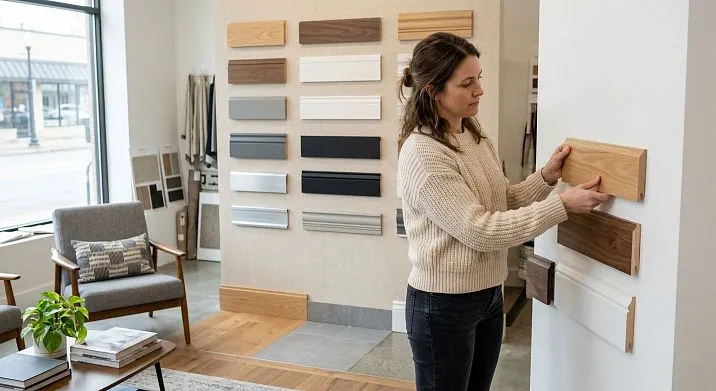
There are details that go unnoticed when they are in place. And they become very noticeable when they are missing or chosen incorrectly. A floor skirting board is exactly such a detail.
The joint between the wall and the floor is a technically vulnerable spot. Two different materials, two different planes, different thermal expansion, different shrinkage. If you leave this joint open, it looks like incompleteness—like a sentence without a period. The skirting board puts that period. It closes the gap, fixes the contour, creates a finished horizontal outline of the entire room.
Butbaseboard for floor— is not just a technical gasket. It is an architectural element that sets the scale of the wall, ties the floor to the wall, and defines the stylistic language of the space. Tall or low, white or matching the parquet, smooth or profiled—each of these decisions changes the feeling of the room.
That is why the choice of of the floor skirting board deserves a separate and careful discussion. Not 'bought whatever was available,' but a conscious decision—regarding material, height, profile, style. This is what we will now examine.




What is a floor skirting board and what role does it play in the interior




The technical and aesthetic meaning of a skirting board
From a technical point of view, skirting board solves several tasks simultaneously:
-
Closes the expansion gap between the floor covering and the wall (especially critical for laminate and engineered wood, which 'breathe' with humidity changes)
-
Secures the bottom edge of wallpaper or plaster, preventing peeling
-
Hides cables and wires if the skirting board has a channel
-
Protects the lower part of the wall from mechanical damage — impacts from furniture, vacuum cleaners, shoes
From an aesthetic perspective, a floor skirting board does exactly what a picture frame does: it creates a clear lower contour for the wall. Without this contour, walls visually 'dissolve' into the floor. With the contour, they achieve completeness.
This is especially important in high-ceilinged rooms. A tall skirting board in a living room with 3 m ceilings is an architectural statement that sets the scale for the entire wall.
Our factory also produces:


Why the right skirting board affects the perception of the entire room
Have you noticed that in cheap finishes, it's often the skirting board that catches the eye? A thin plastic profile on dark parquet, disproportionate to the room's scale, chosen as an afterthought. Meanwhile, saving on a good skirting board is pointless: the linear footage in an average room is 15–25 meters, and the cost difference between a mediocre and a quality solution is a few thousand rubles for an incomparable visual result.
Goodbaseboard for floorshould be perceived as an investment in the integrity of the interior, not as a consumable.
Get Consultation
What types of floor skirting boards exist: a complete classification
By material
This is the first and most important distinction.
Wooden skirting board (solid wood). Made from natural hardwood — oak, beech, ash, pine. Features a lively texture, warm feel, and natural wood grain pattern. Can be coated with varnish — clear, tinted — or painted with enamel.
MDF skirting board. Made from high-density pressed wood fiberboard. Perfectly smooth surface, stable geometry, takes primer and enamel well. Most often supplied primed for painting.
Plastic skirting board. PVC profile, budget segment. Quick installation, lightweight, no need for coating. But also has no relation to natural materials.
Metal skirting board. Aluminum, stainless steel. Used in commercial interiors, modern and industrial styles. Rarely used in residential interiors.
In the context of this article — and in the STAVROS catalog — we are talking about natural materials:wooden baseboard from the array andMDF skirting board.
By height
The height of the floor skirting board is one of the most significant visual parameters.
| Height | Character | Application |
|---|---|---|
| Up to 60 mm | Unobtrusive, minimalist | Modern style, low ceilings |
| 60–80 mm | Standard | Most apartments, neutral option |
| 80–100 mm | Pronounced | Modern classic, ceilings 2.7–2.9 m |
| 100–140 mm | High, accent | Neoclassical, ceilings from 3 m |
| From 140 mm | Architectural | Classic, mansions, custom projects |
General rule: baseboard height should be proportional to wall height. A thin baseboard on a high wall is like a thin frame on a large canvas.
By profile and shape
Smooth rectangular profile — modern style, Scandinavian minimalism. No decorations, just a clean line.
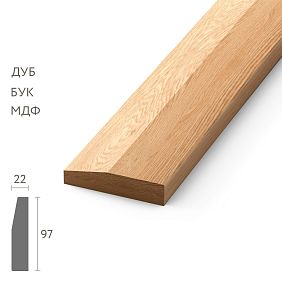
Profile with a heel (S-shaped upper protrusion) — a classic and neoclassical option. Creates a soft shadow near the wall.
A profile with a rounded top edge is a torus. A rounded transition from the skirting board to the wall, soft and neutral.
Composite profile — several elements: lower baseboard plus upper molding. Creates an architectural base for the wall in classic interiors.
Wooden floor baseboard: when to choose it and why it's irreplaceable
Living texture that cannot be faked
Wooden baseboardSolid wood is not just a 'natural material'. It's the specific story of a specific tree: the grain pattern that never repeats, the warmth of the surface to the touch, the living interaction with varnish or oil.
When transparent varnish is applied to an oak baseboard, it doesn't hide the wood — it reveals it. Light and dark veins, the fine pore structure of oak, subtle tonal transitions along the linear meter — this cannot be reproduced by any MDF painting. That's whywith a classic profile creates a sense of solidity, reliability.is chosen where character matters, not just neatness.
Combination with parquet and engineered board
If the flooring is oak parquet, ash engineered board, solid wood board — a wooden baseboard is the only logical choice. It continues the material language of the floor, creating the feeling that the floor and wall are made from one whole.
The wood species is important here. Optimum:wooden baseboardfrom the same species as the flooring. Or from a species similar in color and texture. Oak with oak, ash with ash — or at least light with light, dark with dark.
Staining — not necessarily to match the floor. Contrast also works, but consciously: a light baseboard on a dark floor highlights the horizontal line around the perimeter of the room. A dark one on a light floor grounds and weighs down the bottom. Both solutions are valid if chosen intentionally.
Technical parameters of a wooden baseboard
The quality of a wooden baseboard is determined by several parameters:
-
Species: oak and beech are hardwoods (Brinell hardness 3.7–3.8), durable, resistant to abrasion in the lower zone
-
Moisture content: kiln drying to 8–12% is a mandatory condition for stability. A raw baseboard will warp and pull away from the wall after installation
-
Profile tolerance: ±0.1 mm/m — for precise mitered joints at 45° angles
-
Surface: sanded, ready for coating application
Coating of a wooden baseboard
Clear varnish – preserves the natural color of wood, adds shine and protection. A classic for oak and ash.
Toning varnish or stain – changes the color while preserving the texture. Allows making the skirting board darker or matching the floor tone.
Oil or oil-wax – matte finish, preserves maximum natural appearance. Requires periodic renewal (once every 2–3 years).
Enamel – completely hides the texture, creates a smooth colored surface. Used for white skirting boards in modern interiors. The wood under the enamel loses its visible texture but retains all the technical advantages of solid wood.
MDF floor skirting board: when it is more convenient and how it differs
What is MDF in the context of floor skirting boards
MDF (Medium Density Fiberboard) – a pressed wood fiberboard with high density. The density of skirting board MDF is 720–850 kg/m³. This is almost like oak in weight, but completely without texture: a uniform, fine-pored surface without fibers.
MDF Skirting Board– an excellent choice for interiors where the skirting board is intended to be white or solid-colored. Its surface perfectly accepts primer and enamel, does not require puttying or complex preparation. After applying enamel – an impeccably smooth, even skirting board without the slightest hint of texture.
Advantages of MDF skirting board
Stable geometry. MDF does not have the fibrous structure of solid wood, so it does not warp or crack with changes in humidity the way insufficiently dried solid wood might behave.
Perfect surface for painting. The fine-pored structure of MDF is literally an ideal base for enamel. Two coats of primer and two coats of enamel—and the skirting board looks like a factory-made product without visible defects.
Good profile milling. Complex profiles are milled from MDF with high precision—precisely because the material is homogeneous and lacks unpredictable texture.
Affordable price.Floor MDF skirting boardcosts less than solid wood with a comparable profile.
When to choose MDF skirting board
-
White interiors: white— is a horizontal element that frames the room at the bottom of the walls where the wall meets the floor. Skirting boards perform several functions: they hide the technological gap between the wall and floor covering (necessary for thermal expansion), protect the lower part of the wall from mechanical damage, create visual completion, and may conceal wiring.—a standard solution for Scandinavian, neoclassical, and modern styles
-
High skirting board: for profiles 100+ mm in height, MDF provides a perfectly even plane without waves, which is especially important with a high profile
-
Monochromatic solutions: where the skirting board should literally blend with the wall in color and texture
-
Projects with a tight budget when a large meterage is needed
MDF Limitations
In high humidity areas (bathrooms, toilets), standard MDF is not suitable—it swells upon contact with water. In these zones, moisture-resistant MDF (HDF) or a wooden skirting board made of dense wood with good moisture-protective coating is needed.
If chipped or deeply scratched, MDF is harder to restore than solid wood: wood can be sanded and repainted, while MDF requires filling before repainting.
Wood vs. MDF: Comparison Table
| Parameter | Solid wood | MDF |
|---|---|---|
| Texture | Living, unique | Absent |
| Under clear lacquer | Excellent | No |
| For enamel | Good | Excellent |
| Repairability | High | Medium |
| Moisture resistance | Good (with coating) | Medium (standard) |
| Cost | Higher | Below |
| Stability | High (dry) | Very High |
| Ecological | Natural wood | PF or MF Resins |
How to Choose Skirting Board by Height, Color, and Profile
The Height Question: When More is Better
The height of a floor skirting board is not just millimeters. It's about scale. A tall floor skirting board, when applied correctly, makes walls more monumental and the space more noble.
Practical rule for living spaces:
-
Ceilings up to 2.5 m: baseboard 40–60 mm. Modest, neutral, not overwhelming.
-
Ceilings 2.5–2.7 m: baseboard 60–80 mm. Standard for most apartments.
-
Ceilings 2.7–3 m: baseboard 80–100 mm. Here it's already possible and necessary.
-
Ceilings from 3 m: baseboard 100–140 mm. Wide base of the vertical wall.
Common mistake: installing a standard 60 mm baseboard in a large living room with high ceilings. It looks like a random line. "Wide floor baseboard" is not a whim, it's proper proportion.
Color question: three strategies
Matching the floor covering — baseboard visually "pulls" the floor upward, continuing its color. The wall seems to grow from the floor. Especially good for dark parquet with dark baseboard.
Matching the wall — baseboard dissolves, disappears from view. The wall continues all the way to the floor without horizontal accent. A minimalist and modern solution.
White or neutral on contrast — whitebaseboardon dark floors and any walls. A clear horizontal line around the perimeter. Classic Scandinavian style and neoclassicism.
The fourth option — natural-colored wood — is an accent. Natural wood stands out against any background. Suitable where wood is the central decorative material of the interior.
Smooth or profiled: a question of style
Smooth rectangular profile — this is modernity. No decorations, only geometry.
Profile with a cavetto — this is classic. The S-shaped top creates shadow, adds relief, makes the baseboard 'architectural'.
Profile with a torus — softness. Rounded projection, no sharp lines. Neutral, universal.
Composite baseboard — monumentality. Lower profile plus upper molding. Only for classic styles and with ceilings from 2.9 m.
Which baseboard to choose for a specific floor covering
Baseboard for laminate
Laminate is the most common floor covering in residential spaces. It has a mandatory expansion gap at the wall (8–12 mm) that the baseboard must conceal.
Any floor skirting works under laminate, but the most organic options are:
-
With light laminate — white MDF skirting or light wooden
-
With dark laminate — wooden skirting in matching tone or contrasting white
-
For wood imitation (laminate under oak) —Wooden baseboardreal wood creates a more authentic look
Important: skirting for laminate is attached only to the wall — not to the laminate! Laminate must move freely.
Baseboard for parquet
Parquet — natural flooring. Here, wooden skirting is the only logical choice in terms of material.wooden skirting boardsfrom the same wood species or a similar tone create a system of natural materials around the entire perimeter.
A feature of parquet is greater thermal and moisture expansion compared to laminate. The expansion gap is 10–15 mm. The skirting must reliably cover this gap along its entire height.
Baseboard for engineered wood flooring
Engineered board — next-generation parquet, more stable. The rules are the same as for parquet. Wooden skirting is a priority. With engineered board featuring a characteristic large oak texture, it's advisable to select skirting with the same texture.
Skirting board for quartz vinyl
Quartz vinyl (LVT) is a rigid vinyl tile that imitates wood or stone. Its feature is floating installation with a gap or adhesive installation without a gap.
Both wooden and MDF skirting boards work well with quartz vinyl. If the quartz vinyl imitates light oak, a wooden oak skirting board will look more convincing than a skirting board made of 'quintessential plastic'.
Skirting board for tiles
Tile flooring is often found in the kitchen, bathroom, and hallway. For areas with moisture (bathroom, kitchen), a wooden skirting board made of dense wood with moisture-resistant coating is better — or a separately specified moisture-resistant MDF.
Visually, a white skirting board works well with neutral-colored tiles — it does not compete with the tile pattern and creates a clear outline.
Skirting board for floors in different interior styles
Classic interior
In classic style, the floor skirting board is part of an architectural system along withwith wooden cornicesat the ceiling anddoor casings. All three elements should be made of the same material or the same finish — otherwise the system falls apart.
For a classic interior: a tall wooden baseboard (100–120 mm) with a 'cabochon' profile or a composite profile. Toning — to match the parquet or white enamel. Must coordinate with door trims and cornices.
Neoclassicism
Neoclassicism — restrained classicism. White baseboard, 80–100 mm high, smooth or with one soft projection. MDF under white enamel is absolutely appropriate here — because the white surface is more important than texture.
Wooden baseboard in neoclassicism — provided it's white enamel. Or natural oak, if the furniture is also oak and a system is built between them.
Modern interior and minimalism
Narrow smooth baseboard, 40–60 mm, matching the walls. The goal is to become invisible. Or — a provocation — a tall smooth baseboard, 100 mm, matching the wall, which creates a monumental lower band without any relief.
In Scandinavian style — white baseboard, always. It's part of the visual code of Scandinavian interior: white walls, white baseboard, light floor.
Dark floor and contrasting baseboard
One of the most expressive techniques: dark parquet (wenge, dark oak) and a tall white baseboard. The contrasting horizontal line around the perimeter visually 'highlights' the walls from below. The effect is especially strong with dark walls: the white baseboard acts as a light border between the floor and walls.
Floor baseboard for the hallway
The hallway is the zone of maximum mechanical load. The baseboard here receives the most impacts from shoes, bags, suitcases. The correct choice:Wooden baseboardmade from a hard wood species (oak, beech) with a varnish or oil finish. Height — at least 70 mm: the higher the protective zone, the better.
Floor skirting board for the bedroom
The bedroom does not have high mechanical load, but it does have requirements for coziness and softness. A wooden skirting board with natural tinting or white — both options are good. Medium height (70–90 mm), soft profile, nothing sharp.
Floor skirting board for the living room
The living room is the main room that is seen most often. It is here that the skirting board should work as an architectural element. A high skirting board in the living room with ceilings from 2.7 m is a good investment solution. Wood or MDF under white enamel depending on the style.
How not to make a mistake when choosing a floor skirting board: analysis of typical errors
Error 1: Skirting board chosen as an afterthought
The most common mistake: the finishing is done, the furniture is bought, and only at the end — 'we still need a skirting board'. This is the wrong order. The skirting board should be chosen together with the floor covering, in the same aesthetic solution. The wood species, tint color, profile height — all of this should be agreed upon before the floor installation begins.
Error 2: Mismatch of skirting board height to the scale of the room
A thin 40 mm skirting board in a living room with 3 m ceilings is visual poverty. A wide 120 mm skirting board in a small bedroom with 2.4 m ceilings is oppressive. Proportion is critical. The reference point is always the ceiling height.
Error 3: Conflict with architraves and doors
Wooden baseboards and white MDF architraves are a material conflict. Or baseboards of one tint and architraves of another—this is chaos. All linear products in a space: baseboards, architraves, cornices—must form a system.moldings, cornices, and baseboardsfrom one source, one wood species, one finish—this is what creates interior coherence.
Mistake 4: Baseboard purchased wet
Unprocessed or undried wooden baseboards warp and twist after installation. Gaps at the wall, separated corners, waves along the plane—all are the result of installing wet solid wood. The moisture content of the baseboard before installation should be 8–12%. This is ensured only by kiln drying.
Mistake 5: Incorrect installation of corner joints
A 45° joint in external and internal corners requires precise baseboard geometry and careful cutting. A gap larger than 0.5 mm is visible in side lighting and looks sloppy. A quality wooden baseboard with a tolerance of ±0.1 mm/m allows for a perfect joint; a baseboard with an uneven cross-section does not.
Mistake 6: Not accounting for the expansion gap of the flooring
Laminate and parquet flooring require an expansion gap of 8–15 mm from the wall during installation. This gap must be completely covered by the baseboard—and the baseboard must not press the laminate against the wall. If the baseboard height is 60 mm and the gap is 12 mm—the baseboard must cover the gap along its entire height. If the baseboard is installed too high from the floor—the gap is open at the bottom.
Mistake 7: Mixing ceiling and floor intent
Sometimes in one room, baseboards are installed 'on a leftover principle,' without distinguishing whether it's a floor profile or a ceiling profile. These are different products with different profiles, different adhesion to different surfaces, and different stylistic roles. Do not confuse them.
Where to buy floor skirting: catalog and manufacturer selection
Goodbaseboard for floor— is always a question of the manufacturer, not the store. Retail stores resell; the manufacturer controls everything: from drying the blank to the final sanding.
When choosing a manufacturer of wooden or MDF skirting boards, the key criteria are:
Availability of chamber drying. Ask directly: "What is the moisture content of your skirting board?" An answer of 8–12% is a good sign. "We don't know" is a bad one.
Profile tolerance. A good manufacturer gives a figure of ±0.1 mm/m. It's not rocket science, but it's important for corner joints.
Run length. The standard length of a wooden skirting board is 2.4–3 m. The longer it is, the fewer joints in the room. For rooms 4–5 m long without joints, a run of 4–5 m is needed — check the possibility.
Profile catalog.Floor skirting boards catalogshould contain not one or two options, but a full range of heights and profiles: from narrow modern to wide classic.
Additional elements. Corner caps, connectors, skirting transitions — all of this should be in the same system. Skirting without accessories will force you to look for compatible parts elsewhere.
For a comprehensive order, when you need simultaneouslyWooden baseboard, Casingsfor doors and rail forof slatted panels, — choosing a single manufacturer solves the problem of consistency for the entire wooden molding system.
FAQ: floor skirting board — questions and answers
Which skirting board is best for the floor?
Depends on the task. For parquet and engineered board —solid wood baseboard: natural texture in a system with a wooden floor. For modern white interiors —— is a horizontal element that frames the room at the bottom of the walls where the wall meets the floor. Skirting boards perform several functions: they hide the technological gap between the wall and floor covering (necessary for thermal expansion), protect the lower part of the wall from mechanical damage, create visual completion, and may conceal wiring.: perfect surface for enamel. There is no universal 'best' — there is the right choice for a specific project.
What is better: wooden skirting board or MDF?
Wood — living texture, repairability, appropriateness with natural flooring, possibility of clear varnish. MDF — perfect surface for enamel, stable geometry, lower price. If you want natural texture or clear varnish — only solid wood. If you want a white matte skirting board for painting — MDF is more convenient.
Which baseboard to choose for laminate?
Any — wooden or MDF. The key question: color. For light laminate — white or light wood. For dark — wood to match or white for contrast. Mounting — only to the wall, not to the laminate.
Which skirting board to choose for parquet?
Wooden from the same species or a similar one. Toning — to match or for contrast. Height — proportional to the room height: for rooms from 2.7 m — at least 80 mm.
Where to buy floor skirting board?
inStavros catalog— full rangewooden baseboardsandMDF skirting boardsfor any interior. Own production, chamber drying, precise geometry.
What height should a floor skirting board be?
For ceilings up to 2.5 m — 40–60 mm. For 2.5–2.7 m — 60–80 mm. For 2.7–3 m — 80–100 mm. For ceilings from 3 m — 100–140 mm. Principle: the higher the ceiling, the taller the skirting board.
Is white skirting board suitable for a modern interior?
Yes, it is one of the most common options. Whitebaseboardto match the walls — a neutral and universal choice. White skirting board in contrast with a dark floor — an expressive designer technique.
Is an expansion gap needed under the baseboard?
The baseboard is not attached to the laminate or parquet and does not press them down. It is attached to the wall and merely covers the gap with its body. The gap remains free — the flooring moves.
STAVROS: full-cycle wooden molding production
A proper baseboard is not a single product. It is part of a system: baseboard, casings, cornice, moldings. And this entire system must be manufactured with the same precision, from the same material, in the same finish.
STAVROS is a Russian manufacturer of wooden architectural elements and solid hardwood moldings. Full production cycle: timber harvesting, kiln drying to 8–12% moisture content, profile milling with a tolerance of ±0.1 mm/m, final sanding. Each item leaves the production facility ready for installation and finishing.
In the STAVROS catalog:
-
solid wood baseboard— oak, beech, pine; wide range of profiles
-
Floor MDF skirting board— for painting and enamel
-
Wooden door architraves— in the same system as the baseboard
-
wooden cornice— for a complete architectural room system
-
Wooden plank— for slatted panels and decorative solutions
-
The entire section of moldings, cornices, and baseboards— a complete system of wooden millwork
Baseboard is the last element in finishing and the first one noticed when done incorrectly. Choose consciously.