Article Contents:
- Blank Canvas: Why Pre-Finish is a Gift, Not a Problem
- What is White Box and How It Differs from 'Bare' Concrete
- Freedom of Choice: From Layout to Texture
- Economic Argument
- Illusion of Simplicity
- Relief as an Expressive Tool
- Color as a Complement to Form
- Why Skirting Isn't a Minor Detail
- Advantages of MDF Compared to Other Materials
- Skirting in Wall Color: The 'Invisible' Effect
- Skirting as a Contrast Accent
- Installation: Simplicity and Reliability
- Polyurethane: 21st Century Material for Timeless Ideas
- Why Polyurethane, Not Plaster?
- Zoning Without Walls: How It Works
- Types of Polyurethane Elements for White Box Apartments
- Installation of polyurethane elements
- The Joint Problem: Why It's More Important Than It Seems
- Ready-Made Corner Elements: Beauty Without Adjustment
- Joint Profiles and Transition Strips
- Decorative Rosettes for Hiding Defects
- Comprehensive Wall Decoration Kits
- Why the Ceiling Deserves Attention
- Two-Level Cornice and Hidden Lighting
- Ceiling Rails and Coffers
- Door Casings as a Design Element
- Arches and Portals
- Choosing Flooring in the Context of White Box
- Baseboard and Underfloor Heating
- Minimalism: Fewer Details — More Attention to Each
- Neoclassicism: Nobility Without Pomposity
- Scandi: The Warmth of Wood and Northern Light
- Loft: Industrial Aesthetics on a Domestic Scale
- Step 1: Concept Development
- Step 2: Surface Preparation
- Step 3: Installation of Decorative Elements on Walls and Ceiling
- Step 4: Painting
- Step 5: Laying Flooring
- Step 6: Installing Floor Baseboard
- Mistake 1: Skimping on Preparation
- Mistake 2: White Ceiling — White Walls — White Baseboard
- Mistake 3: Mixing Styles Without a System
- Mistake 4: Neglecting Scale
- Mistake 5: Forgotten Joints
- What Can Be Done for a Reasonable Amount of Money
- For Those Who Want Everything at Once
- Light That Creates Space
- Light and Color: Important Nuances
- When finishing is complete
- Art on a relief wall
- Features of finishing wet rooms
- Decor for the little ones
- The space that welcomes
- Can you paint MDF skirting with regular interior paint?
- How many coats of paint are needed for MDF skirting?
- Do polyurethane elements yellow over time?
- Can you install moldings on already painted walls?
- Which skirting to choose for an apartment with 2.5-meter ceilings?
- How does MDF floor skirting differ from solid wood skirting?
- Can you use polyurethane panels in the kitchen?
- How long does full White Box apartment finishing take?
- Do you need a designer for a White Box apartment?
- Where to buy quality MDF skirting for painting?

When you first step into an apartment in a new building with pre-finish finishing, a strange sight opens before you. Gray walls, leveled for finishing, but devoid of any individuality. A concrete floor with a screed, ready to accept any covering. A ceiling awaiting your decision. Electrical wiring is hidden, pipes are connected, windows are installed—but there is no life here yet. This is the White Box—the 'white box' that the developer hands over to you as a blank canvas. And here's the question: how to turn this standard box into a space where you want to live, breathe, create?
Many owners of such apartments make the same mistake: they perceive pre-finish finishing as a limitation, not an opportunity. They paint the walls white, lay laminate, put furniture from a catalog—and get another faceless apartment that is no different from hundreds of thousands of others. Meanwhile, it is the White Box format that gives a rare chance to create a truly author's interior, where every detail—from wall texture to skirting profile—works for the overall idea.
In this article, we will analyze in detail which decorative solutions allow turning a pre-finish apartment into a cozy and stylish living space. We'll talk about relief walls, the smart choice of floor skirting, polyurethane elements for quick zoning, and ready-made solutions that save time without losing quality. All these are real tools available to everyone who is ready to invest not only money but also thought into their home.


A blank slate: why pre-finish finishing is a gift, not a problem




What is White Box and how it differs from 'bare' concrete
Let's set the record straight right away. White Box is not rough finishing, where you get an apartment with bare blocks, protruding reinforcement, and unfilled chases. This is a pre-finish state: walls are plastered and leveled, floor screed is poured, the ceiling is prepared for finishing, utilities are routed, windows and the entrance door are installed. Essentially, you have a perfectly prepared base, on which only the finishing layer needs to be applied.
And here lies the main advantage. You don't spend money on demolishing what the developer did. You don't need to remove wallpaper you don't like, break tiles in the bathroom that someone else chose, or redo electrical wiring that isn't laid the way you need. Everything starts from scratch—but from a prepared, leveled, ready-to-work scratch.
Our factory also produces:


Freedom of choice: from layout to texture
An apartment with pre-finish finishing is an opportunity to think through every centimeter of space. Want moldings on the walls in a classic style? Go ahead. Prefer minimalist MDF slats? No problem. Dream of decorative plaster with a microcement effect? The walls are ready for it.
Moreover, it is in the White Box format that you can plan space zoning not only with furniture but also with finishing materials. An accent wall in the living room, finished withMDF slats and cornices, will visually separate the relaxation area from the workspace. A ceiling cornice transitioning into a wall molding will create a sense of architectural completeness. Floor skirting, matched to the wall color, will make the transition from floor to wall seamless and elegant.
Get Consultation
The economic argument
There is also a purely financial aspect to the matter. Apartments with pre-finish (white box) condition are generally cheaper than those with full finishing from the developer. At the same time, the cost of final finishing work — painting, laying flooring, installing skirting boards and decorative elements — often turns out to be lower than redoing poor-quality finishing. You pay once and get exactly the result you envisioned. Without compromises, without 'well, it'll do in principle.'
Furthermore, by choosing finishing materials yourself, you control the budget. You can start with basic solutions — painting walls, installing skirting boards — and gradually add decorative elements:wall panels, moldings, battens. Such a phased approach allows you to spread the costs over time without sacrificing quality.
Walls for painting: why 'just painting' is not a solution
The Illusion of Simplicity
It might seem, what could be simpler: take a roller, a bucket of paint — and transform the apartment over a weekend. In theory, it sounds tempting. In practice, monochrome smooth walls look empty, bland and — let's be honest — cheap. Not because the paint is bad. But because a flat surface without relief, without texture, without decorative accents lacks what designers call 'visual depth.'
Look at any interior that evokes admiration. What do you see? The play of light and shadow on a textured surface. The clean lines of moldings creating architectural rhythm. The smooth transition from wall to ceiling via a profiled cornice. A neat floor skirting board that completes the composition. All these are elements that turn a 'painted wall' into a 'designed wall.' And the difference between them is like the difference between sound and music.
Relief as a Tool of Expression
Wall cladding for painting— is not just applying paint to a surface. It's an entire system of solutions that includes preparing the base, creating texture, installing decorative elements, and finally, painting as the finishing stage. Precisely in that sequence: first relief — then color.
What options exist for creating relief?
Decorative plaster. Venetian, Moroccan, concrete-effect plaster, microcement, travertine — there are dozens of options. Each creates a unique surface with its own play of light. The plaster is applied to a prepared wall (and in a White Box apartment, the walls are already prepared) and can be painted any color or left in its natural tone.
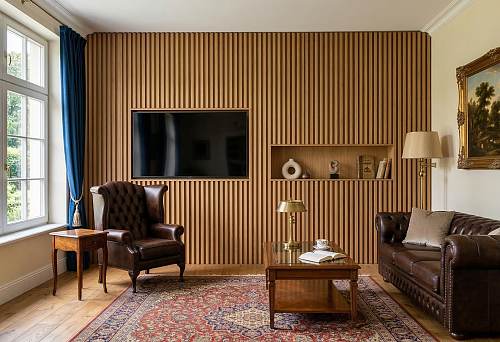
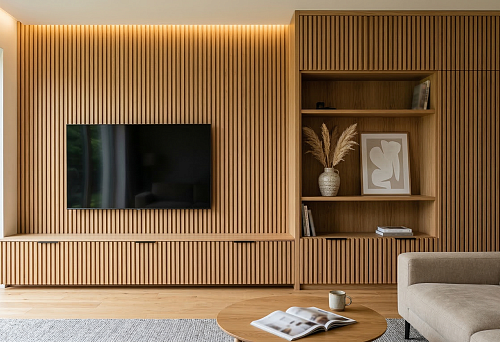
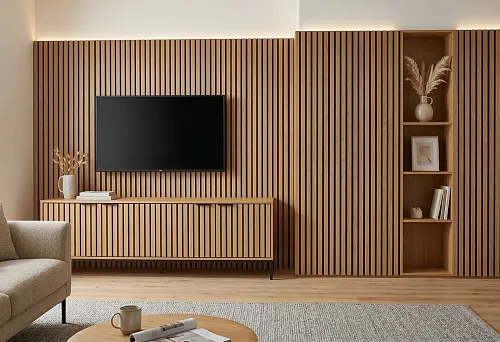
MDF batten panels. Vertical or horizontal battens installed on the wall create a rhythmic pattern and add volume. Such panels are produced for painting, allowing you to perfectly match the interior's color scheme. MDF battens are one of the main trends for 2025 in residential space design.
Moldings and panels. A classic technique that never loses relevance. Rectangular frames made of moldings on the wall create a sense of nobility and completeness. This technique works especially well in combination with matte paint in deep tones — dark blue, emerald, terracotta.
3D wall panels. Geometric patterns, wave patterns, abstract reliefs — panels made of polyurethane or plaster allow you to create an accent wall without complex plastering work.
Color as a Complement to Form
When the relief is created, color becomes its ally. On a textured surface, even neutral shades — warm white, light gray, sandy — begin to play completely differently. Light falls on protruding elements, shadows settle in recesses, and the wall comes to life.
For accent walls, you can use saturated colors. Deep green on a wall with vertical battens. Terracotta on a surface with decorative plaster. Graphite in a niche framed by moldings. Each combination of texture and color creates its own mood and its own story.
It's important to remember: if the walls are painted in a color, all adjacent elements — skirting boards, architraves, cornices — should be either in the same tone or in a deliberate contrast. That's why for colored walls, the ideal solution becomes paintable products, which can be painted the same shade as the walls, creating a cohesive, monolithic surface.
The Perfect Pair: MDF skirting board for painting for colored walls
Why the skirting board is not a minor detail
Do you know what gives away a poorly thought-out interior? The skirting board. No, seriously. You can spend hundreds of thousands on furniture, lighting, and textiles, but if there's a cheap plastic skirting board with a cable channel running around the perimeter of the room — the whole impression is ruined. It's like wearing an expensive suit with rubber flip-flops: each element separately might be fine, but together they create dissonance.
Baseboard MDF— is a fundamentally different level. It is perceived as part of the room's architecture, as an extension of the wall, as a detail that completes the composition. And it's not just about aesthetics: an MDF skirting board for painting solves a whole range of tasks worth discussing in detail.
Advantages of MDF over other materials
Geometric precision. MDF is a medium-density fiberboard produced by dry pressing. It does not deform from temperature fluctuations, does not dry out, and does not swell (under normal humidity levels). This means an MDF skirting board maintains perfect geometry throughout its service life. No gaps between the skirting board and the wall, no peeling, no 'wandering' joints.
Variety of profiles. Unlike plastic skirting boards, which come in a few standard shapes, MDF floor skirting boards are available in dozens of profiles. From minimalist rectangular sections to classic shaped ones with elements of stucco decoration. Height can vary from compact 60 mm to impressive 150 mm and more. The choice of profile depends on the interior style, ceiling height, and overall design concept.
Perfect surface for painting. The surface of an MDF skirting board, primed at the factory, accepts paint evenly, without streaks or runs. One or two coats of quality acrylic or latex paint — and the skirting board acquires exactly the shade you need. Paint adheres to MDF significantly better than to plastic or polyurethane, providing a smooth, even coating.
Eco-friendliness. MDF does not contain phenol-formaldehyde resins (unlike some types of particleboard). The binding agent in the board is lignin — a natural substance released from wood fiber when heated. This makes MDF skirting boards safe for use in living spaces, including children's rooms and bedrooms.
Skirting board in the wall color: the 'invisible' effect
One of the strongest techniques in modern design is painting the skirting board the same color as the wall. When an MDF floor skirting board is coated with the same paint as the wall, it visually 'dissolves,' and the wall appears taller. This technique is especially valuable in apartments with low ceilings (and in most new buildings, the ceiling height is 2.5–2.7 meters).
The effect is enhanced when using a high skirting board — 100 mm and above. Painted the same color as the wall, it creates the illusion that the wall starts directly from the floor, with no visible transition. This gives the room a sense of spaciousness and airiness that cannot be achieved with a standard white skirting board on a colored wall.
Skirting board as a contrasting accent
An alternative approach is to use a skirting board in a contrasting color. White skirting on dark walls. Black — on light walls. Golden — on deep blue. This technique emphasizes the architectural lines of the room and gives the interior a graphic quality.
A contrasting skirting board works especially effectively in combination with contrasting door architraves and ceiling cornices. When all horizontal and vertical lines in a room are highlighted in one color, and the wall planes in another, a clear, precise spatial structure is created. This is the language of classical architecture, adapted for modern apartments.
Installation: Simplicity and Reliability
Installing MDF floor skirting is not a complicated process, but it requires care. The skirting is attached to the wall using special clips, mounting adhesive, or a combined method. Joints between skirting sections are filled and sanded before painting, allowing for a completely seamless line around the entire perimeter of the room.
For finishing internal and external corners, MDF skirting is cut at a 45-degree angle. If you don't have a miter saw — no problem: most companies supplying skirting boards offer a custom cutting service. There are also ready-made corner elements that simplify installation and ensure a perfect fit.
Quick Decor: Polyurethane Elements for Instant Zoning
Polyurethane: The 21st Century Material for Timeless Ideas
If you want to add architectural expressiveness to your interior but are not ready for large-scale plastering or carpentry work, pay attention to decorative polyurethane elements. This material has made a real revolution in the field of interior decor, making solutions accessible that were previously the prerogative of expensive custom projects.
Polyurethane wall claddingThis is an extensive category of products, including moldings, cornices, pilasters, rosettes, panels, architraves, arch elements, and much more. All of them are made from expanded or cast polyurethane — a material that combines lightness with strength, moisture resistance with ease of processing.
Why Polyurethane, Not Plaster?
Traditional plaster stucco is beautiful, but heavy, fragile, and expensive. A plaster cornice weighs several times more than its polyurethane counterpart, requires serious fastening, and chips and crumbles under mechanical impact. A polyurethane cornice, on the contrary, is easily mounted with mounting adhesive, is not afraid of accidental impacts, and does not crack due to house settlement — and for new buildings, where settlement is inevitable, this is a critically important factor.
Moreover, polyurethane does not absorb moisture, allowing it to be used in bathrooms and kitchens. It is not prone to rotting, does not attract insects, and does not emit harmful substances under normal operating conditions. And, importantly, it is significantly cheaper than plaster counterparts with a comparable visual effect.
Zoning Without Walls: How It Works
One of the main tasks in studio apartments and apartments with open floor plans is dividing the space into functional zones. Kitchen, dining area, living room, work corner — all of this must coexist in a single space but be visually demarcated.
Polyurethane elements offer an elegant solution to this task. For example, wall moldings can frame the sofa area, creating a 'frame' that highlights the living room part. Decorative polyurethane pilasters or columns can mark the boundary between the kitchen and dining area. A wide ceiling cornice with lighting can visually separate the sleeping area from the rest of the space.
At the same time, all these elements do not occupy usable floor space (unlike partitions), do not obstruct air and light circulation, and can be easily removed if you decide to change the layout. This is decorative zoning in its pure form — through shape, relief, and color.
Types of Polyurethane Elements for a White Box Apartment
Let's look at specific product types and their applications:
Ceiling cornices. Installed at the junction of the wall and ceiling. They cover the technological gap, hide unevenness, and create a smooth transition. They come in smooth (for modern interiors) and profiled (for classic) styles. Can be used as a hidden channel for LED lighting.
Wall moldings. Thin profile strips that are attached to the wall and form decorative frames, borders, horizontal and vertical lines. Moldings are a universal tool: with them, you can imitate boiserie (wooden panels), create symmetrical compositions, frame mirrors and paintings.
Wall panels. Large-format elements with a relief pattern that are mounted on the wall like tiles. They can cover the entire wall or part of it, creating an accent zone. Available in various designs — from geometric patterns to imitation of carriage-style upholstery.
Rosettes. Round or oval decorative elements traditionally installed on the ceiling around a chandelier. In modern interiors, rosettes are also used on walls — as standalone decorative objects or as framing for wall lights.
Pilasters and half-columns. Vertical elements that imitate architectural columns. Used for framing doorways, fireplace portals, niches. Give the interior monumentality and solemnity.
Architraves. Framings for door and window openings. Polyurethane architraves can be significantly wider and more expressive than standard wooden ones, allowing for an accent on doorways.
Installation of Polyurethane Elements
One of the main advantages of polyurethane products is ease of installation. Lightweight elements are attached with special mounting adhesive for polyurethane. Heavy ones (large panels, columns) are additionally secured with screws, which are then filled. Joints between elements are filled with joint adhesive or acrylic sealant, sanded, and painted.
The entire process — from marking to painting — typically takes one to two days for one room. Compare this to plaster stucco, the installation of which can stretch for a week or more. That is whypolyurethane wall finishingoften referred to as 'quick decor': the result is impressive, while time and effort are minimal.
Time-saving: ready-made solutions for finishing joints and corners
The joint problem: why it's more important than it seems
During apartment finishing, there are stages that take disproportionately more time relative to their scale. One such stage is finishing joints and corners. The joint between wall and ceiling. The joint between wall and floor. Internal and external corners. The junction of door casing with baseboard. The transition from one finishing material to another.
Each of these junctions requires neatness, precision, and often special skills. A sloppy joint can ruin the impression of even the most beautiful interior. A gap between baseboard and floor, a separated cornice corner, an uneven transition from molding to casing—all these are minor details that catch the eye and create a sense of incompleteness.
Ready-made corner elements: beauty without fitting
Modern manufacturers of decorative elements offer ready-made corner blocks that eliminate the need to miter cornices and moldings. A corner element for a ceiling cornice, for example, is a solid piece that perfectly matches the straight profile and creates a flawless corner. You just need to glue the corner block and then join the straight sections of the cornice to it—without a miter saw, without a miter box, without stress.
The same applies to baseboards. Ready-made corner elements forMDF floor baseboardprovide a clean, neat corner without puttying or adjustments. This is especially valuable for those doing finishing themselves: with corner elements, even a person without experience achieves a professional result.
Joining profiles and transition strips
Another category of ready-made solutions is joining profiles. They are used where different finishing materials meet: laminate and tile, parquet and carpet, different floor levels. A joining profile covers the gap between coverings, compensates for height differences, and gives the transition a neat appearance.
For walls, transition strips and connecting elements for moldings perform a similar function. They allow joining moldings of different profiles, finishing the intersection of horizontal and vertical molding, and ending a molding line with a beautiful 'finial.'
Decorative rosettes for hiding defects
Joints and intersections don't always turn out perfect. In such cases, decorative rosettes and overlay elements come to the rescue. A small rosette installed at the intersection of moldings hides the joint while adding a decorative accent. This is a proven technique used in architecture for centuries and still relevant today.
Comprehensive wall finishing kits
Some manufacturers offer ready-made wall finishing kits that include all necessary elements: straight moldings of a specific profile, corner blocks, rosettes, joining elements. Such kits are designed for a specific wall area and eliminate the need to calculate material quantities yourself. You simply specify the wall dimensions, choose a design—and receive a complete set of elements with detailed installation instructions.
This is especially convenient forinterior wall finishing in apartmentswhen several rooms need to be finished in a unified style. Uniformity of details ensures visual integrity of the interior, and ready-made solutions reduce planning and purchasing time.
Ceiling: an undeservedly forgotten canvas
Why the ceiling deserves attention
In most apartments with pre-finishing, the ceiling is a smooth surface prepared for painting. And in most cases, it's simply painted white. This is a safe and neutral solution, but it misses huge potential. The ceiling is the fifth wall of the room, and it can contribute to the overall impression just as well as the other four.
Ceiling cornices are the simplest and most effective way to 'enliven' a ceiling. A wide classic cornice with a profiled section transforms an ordinary concrete plane into an element of architectural space. A minimalist rectangular cornice creates a clear line separating wall from ceiling and gives the room a tidy, finished look.
Two-level cornice and hidden lighting
One of the most impressive techniques is installing a two-level cornice with a niche for LED strip. A wide molding is mounted on the wall, 5–10 centimeters from the ceiling. An LED strip is placed on top of it, with light directed upward toward the ceiling. The light reflects off the white ceiling and creates soft, even perimeter lighting in the room.
This technique visually 'raises' the ceiling, creates a floating sensation, and adds volume to the room. Implementation requires just three elements: a cornice or molding of a specific profile, an LED strip, and a power supply. Installation takes a few hours and doesn't require complex drywall structures.
Ceiling rails and coffers
For those who want to go further, there are ceiling rails and coffered constructions. MDF rails installed parallel on the ceiling create a pronounced rhythm and add individuality to the room. Coffers—decorative cells formed by intersecting beams—give the ceiling volume and a classical tone.
Both solutions can be implemented using paintable MDF products, allowing precise color matching to the overall interior palette. MDF rails and beams are significantly lighter than wooden counterparts, simplifying installation and reducing load on the ceiling structure.
Doors and openings: a frame for space
Door Casings as a Design Element
In White Box apartments, doors are usually absent—the owner installs them. This means you can choose not only the doors but also the casings, which are a crucial decorative element. A casing is not just a strip covering the gap between the door frame and the wall. It is a frame that outlines the opening and influences the perception of the entire room.
Wide, profiled MDF or polyurethane casings create emphasis on doorways and give them a formal appearance. Minimalist hidden casings, on the contrary, make the door as inconspicuous as possible, 'dissolving' it into the wall. The choice depends on the interior style and the role the door plays in the space.
Arches and Portals
If your apartment has open openings (for example, between the kitchen and living room), they can be decorated with decorative portals made of polyurethane or MDF. A portal is a framing of an opening with pilasters and a cornice, which turns an ordinary rectangular hole into an architectural element. Polyurethane arch elements allow you to create a rounded opening even where there was originally a rectangular 'hole' in the wall.
Floor: The Foundation on Which Everything is Built
Choosing Flooring in the Context of White Box
In an apartment with pre-finish finishing, the floor screed is ready for laying the final coating. Laminate, engineered wood, parquet, porcelain stoneware, vinyl tile—the choice is vast. Each material has its own characteristics, but they are all united by one thing: they need a quality baseboard to complete the picture.
MDF floor baseboard stands out favorably from plastic counterparts because it is perceived as a single whole with the wall. Painted in the color of the wall or in a contrasting color, it creates a neat, clean transition from floor to wall. Unlike plastic baseboard, MDF does not have the characteristic shine that reveals the artificiality of the material.
Baseboard and Underfloor Heating
In apartments with pre-finish finishing, an underfloor heating system—hydronic or electric—is often installed. In this case, when choosing a baseboard, it is necessary to consider the thermal expansion of the flooring. MDF baseboard behaves predictably in this sense: it does not deform from moderate heating and does not create stress at the junction with the wall. It is only important to leave a small gap between the baseboard and the coating (1–2 mm), which will be hidden by the baseboard itself.
Style Solutions for White Box Apartments
Minimalism: Fewer Details—More Attention to Each
Minimalism is one of the most popular styles for apartments in new buildings. And it is also one of the most demanding. When there are few details, each of them is under scrutiny. The baseboard must be flawless. The cornice—perfectly even. The joints—invisible.
For a minimalist interior, choose a baseboard with a simple rectangular profile, painted in the color of the wall. Ceiling cornice—narrow, without ornament. Moldings—if used at all—thin and strict. Everything should be subordinated to a single logic: clean lines, calm colors, absence of excess.
Neoclassicism: Nobility Without Pomp
Neoclassicism is classical forms adapted to modern realities. Moldings on walls, profiled cornices, high baseboard with a shaped cross-section—but without gilding, without curls, without excess. Main colors—white, gray, beige, dusty pink. Accents—through texture and relief, not through bright color.
In a neoclassical interior, polyurethane elements reveal their potential to the fullest. Panel frames made of moldings on walls, wide ceiling cornice, rosettes around chandeliers, pilasters on the sides of door openings—all this creates a sense of noble architecture without overloading the space.
Scandi: Warmth of Wood and Northern Light
Scandinavian style involves an abundance of white color, natural materials, and functionality. For a White Box apartment, this is perhaps the most organic choice: white walls are already there, all that remains is to add the texture of wood.
Wooden cladding for interior wall finishing—a classic element of Scandinavian interior. It can cover one accent wall in the living room, the lower part of walls in the hallway, or the entire ceiling in the bedroom. Cladding made of natural wood creates a feeling of warmth and liveliness that cannot be reproduced by any artificial materials.
In combination with wooden cladding, MDF baseboard painted white works excellently. The contrast between the warm tone of wood and the pure white baseboard emphasizes the texture of both materials and creates a characteristic 'Scandinavian' rhythm.
Loft: Industrial Aesthetics on a Domestic Scale
Loft is a style that, it would seem, does not need decorative elements at all. Concrete, brick, metal, exposed utilities—why moldings here? And yet, even in a loft interior, there is a place for thoughtful details.
For example, baseboard. In a loft, it can be made of MDF, painted in a dark color—graphite, anthracite, black. A high baseboard of a dark color against a concrete wall creates a sense of industrial solidity. A ceiling cornice of a simple rectangular profile, painted in the color of the ceiling, gives the room completeness without conflicting with the loft aesthetic.
An accent wall finished with MDF slatted panels and painted in a dark color can become the central element of a loft interior. The slats create a rhythmic relief that echoes the industrial texture of concrete and brick.
Practical Tips: Step-by-Step Plan for Decorating a White Box Apartment
Step 1: Concept Development
Before buying materials, decide on the style, color scheme, and budget. Draw (or order from a designer) a plan of each room indicating finishing materials on walls, floor, and ceiling. Determine where there will be accent walls, where—moldings, where—slats. Think through the color palette: which walls will be painted in neutral tones, which—in saturated ones.
Step 2: Surface Preparation
In a White Box apartment, the walls are already leveled, but they need to be primed before painting. Primer improves paint adhesion, evens out surface absorbency, and prevents stains. Use deep-penetration primer for mineral substrates.
The ceiling is also primed before painting. The floor screed is checked for levelness with a level — variations of more than 2 mm per meter can cause problems when laying laminate or parquet flooring.
Step 3: Installation of Decorative Elements on Walls and Ceiling
Decorative elements — moldings, cornices, panels, battens — are installed before painting. This allows them to be painted together with the wall, creating a unified color surface. Installation sequence:
- Ceiling Cornices
- Wall moldings and panels
- Door frame trims
- Decorative sockets and overlay elements
All joints between elements are filled, sanded, and primed. Only after this is painting performed.
Step 4: Painting
Walls and decorative elements are painted in two to three coats with intermediate drying. For walls, use high-quality interior paint — matte, semi-matte, or 'velvet' (depending on the effect). For decorative elements made of polyurethane and MDF, the same paint as for the walls is recommended — this ensures perfect color matching.
Step 5: Laying Flooring
Flooring is laid after painting the walls and ceiling — to avoid getting paint on the floor. A gap of 8–12 mm is left between the flooring and the wall to compensate for thermal expansion.
Step 6: Installation of Floor Skirting Board
The finishing touch — installation ofMDF floor skirting board. The skirting board is attached to the wall (not the floor!), painted in the chosen color — and the interior gains a finished look. If the skirting board is painted to match the wall color, it's better to paint it after installation to cover screw heads and joints.
Typical Mistakes When Decorating White Box Apartments
Mistake 1: Skimping on Preparation
Walls in a White Box apartment are leveled, but not always perfectly. Minor imperfections, which are not visible on the gray plaster, become obvious after painting — especially with side lighting. Therefore, before painting, it's worth applying a finishing putty to the walls, sanding, and priming.
Mistake 2: White Ceiling — White Walls — White Skirting Board
This is the safest, most boring, and most faceless solution. It turns the apartment into a hospital ward. Add at least one element that breaks the monotony: an accent wall, a colored skirting board, a ceiling cornice with lighting, a batten panel.
Mistake 3: Mixing Styles Without a System
Classical moldings on the wall, minimalist skirting board at the floor, loft-style ceiling light, and Scandinavian textiles on the sofa — if all this is not united by a common idea, the result will be chaotic. Choose one style as the foundation and stick to it in all finishing elements.
Mistake 4: Neglecting Scale
In a room with a 2.5-meter ceiling, a massive 15-centimeter-high cornice will look absurd. Conversely, in a spacious room with a 3-meter ceiling, a thin 5-centimeter-high baseboard will get lost. The scale of decorative elements should match the scale of the room.
Mistake 5: Forgotten Joints
An unadorned wall-ceiling joint, absence of skirting board at the floor, 'bare' door openings — all this creates a sense of incompleteness. Even if your style is minimalism, joints must be finished. With a minimalist cornice, a thin skirting board, a laconic trim — but finished.
Budget Scenario: Maximum Effect with Minimum Costs
What Can Be Done for a Reasonable Amount of Money
Not every White Box apartment owner is ready to invest the cost of another apartment into finishing. And that's normal. The good news is that a stylish interior doesn't necessarily have to be expensive. Here is a budget scenario that delivers an impressive result:
Walls. Painting in two colors: a main neutral tone and one accent color. The accent wall is decorated with simple polyurethane moldings, which are inexpensive but provide a colossal effect. The moldings are painted the same color as the wall.
Ceiling. White matte paint plus a simple-profile ceiling cornice. The cornice is painted white and visually 'raises' the ceiling.
Floor. Mid-price segment laminate plus paintable MDF baseboard. The baseboard is painted the same color as the wall.
Doors. Doors with a hidden frame, painted the same color as the wall. Casing — paintable MDF.
This scenario is significantly cheaper than 'full' finishing with decorative plaster and expensive parquet, but visually looks thoughtful and cohesive. The secret lies in the unity of color and form: when all elements are painted in the same palette, the interior 'comes together' as a unified whole.
Premium scenario: a bespoke interior without limits
For those who want everything at once
If the budget allows, a White Box apartment opens up limitless possibilities for creating a bespoke interior. Here are just a few ideas:
Walls. Decorative plaster with a natural stone effect on the accent wall. The remaining walls — painted with MDF slatted panels. Polyurethane moldings and cornices create a classic layout.
Ceiling. Coffered construction made of MDF beams, painted the same color as the walls or in a contrasting tone. Hidden perimeter lighting and lighting in each coffer.
Floor. Engineered oak plank flooring with an oil finish. Tall MDF baseboard (120–150 mm) with a shaped profile, painted the same color as the walls.
Doors. Paneled MDF doors, painted the same color as the walls. Wide casing with a profiled cross-section. Decorative rosettes at the intersection of the casing and baseboard.
Fireplace. Decorative fireplace portal made of polyurethane with an electric or biofuel insert. The portal is framed by pilasters and a cornice, painted the same color as the wall or in a contrasting tone.
Such an interior is not just a place to live. It is an environment that inspires, calms, and delights every day. And all of this — from a concrete box that the developer handed over to you in a White Box state.
Lighting as a decorative tool
Light that creates space
No decorative element works to its full potential without proper lighting. Moldings, slats, cornices — they all reveal themselves precisely in the play of light and shadow. That is why lighting planning should be part of the overall design concept.
In a White Box apartment, the electrical wiring is installed, and outlets and switches are in place. But lighting points can and should be supplemented. LED strip in the niche of the ceiling cornice. Spotlights directed at the accent wall with slats. Sconces on either side of the decorative fireplace portal. Each of these light sources emphasizes the relief and texture of the finishing materials, making the interior three-dimensional and lively.
Light and color: important nuances
Wall color changes depending on the type of lighting. Warm light (2700–3000 K) makes colors warmer and softer: white becomes creamy, gray becomes beige, green becomes olive. Cool light (4000–5000 K) makes colors cleaner and brighter but can give the interior a 'sterile' look.
Choose the paint color under the lighting that will be in the room. A paint sample that looks perfect in the store under daylight lamps may disappoint you at home under the warm light of a floor lamp. Apply a test patch on the wall and look at it at different times of the day — in the morning under natural light, in the evening under artificial light.
Textiles and accessories: the final touches
When the finishing is complete
After the walls are painted, baseboards installed, moldings and cornices in place — it's time for textiles and accessories. Curtains, pillows, throws, rugs — all of this adds softness and coziness that 'bare' painted walls lack.
Textiles allow you to change the mood of the interior without major renovations. In summer — light linen curtains and cotton pillows in pastel tones. In winter — dense velvet drapes and fluffy throws in deep colors. The decorative wall finish remains unchanged — it creates the 'skeleton' of the interior, which is dressed in textile 'garments' according to the season and mood.
Art on a textured wall
A wall decorated with moldings is an ideal backdrop for paintings and posters. Molding frames become 'boundaries' for placing works of art: one painting in one frame. This organizes the hanging and gives it museum-like elegance.
On a wall with slatted panels, paintings and photographs are better placed without frames — on special rail systems or on shelves installed between the slats. This preserves the rhythm of the slats and adds functionality to the wall.
Wet areas: kitchen and bathroom in the context of White Box
Features of finishing wet rooms
Kitchens and bathrooms have additional requirements for finishing materials: moisture resistance, temperature change resistance, and ease of cleaning. But this doesn't mean decorative elements can't be used in these rooms.
Polyurethane moldings and cornices handle high humidity perfectly. They don't absorb water, swell, or develop mold. Painted with moisture-resistant paint, they last for decades without losing their appearance. This allows you to decorate the bathroom in the same style as the rest of the apartment—with moldings, cornices, and decorative frames.
For the kitchen backsplash and area around the sink, specialized materials are of course needed—ceramic tile, porcelain stoneware, tempered glass. But the other kitchen walls can be decorated the same way as walls in the living room or bedroom: paint, moldings, battens.
As for the baseboard in the bathroom, be more careful with MDF here. Although moisture-resistant varieties of MDF exist, for rooms with direct water contact, it's better to choose a polyurethane or ceramic baseboard. In the kitchen, however, MDF baseboard for painting works excellently—provided it's not in immediate proximity to the sink.
Children's room: safety and fantasy
Decor for the little ones
The children's room in a White Box apartment is a separate story. Here, material safety, coating practicality, and the ability to transform as the child grows are important.
MDF and polyurethane are environmentally safe materials suitable for children's rooms. MDF baseboard has no sharp edges (the profile is usually rounded), doesn't emit harmful substances, and is easy to clean. Polyurethane elements on walls don't chip upon impact and don't form sharp fragments—unlike gypsum stucco.
For a child's room, you can use wall moldings to create 'frames' for drawings or cork boards. MDF battens on one wall can become the basis for hanging shelves and organizers. A ceiling cornice with hidden lighting will create soft night light, calming the child before sleep.
As the child grows, the walls can easily be repainted a different color. The decorative elements remain in place—they just need to be repainted along with the walls. This is much simpler and cheaper than changing wallpaper or panels.
Hallway and corridor: first impression
The space that welcomes
The hallway is the first thing guests see when entering the apartment. And the last thing the owners see when leaving. This space deserves no less attention than the living room or bedroom. Meanwhile, in most apartments, the hallway is decorated as an afterthought: 'well, we'll paint the walls, put in a wardrobe—and that's fine.'
In a White Box apartment, the hallway can be turned into an impressive entry space using a few techniques:
Tall baseboard. An MDF baseboard 100–120 mm high, painted the same color as the wall, visually 'pulls together' the narrow corridor space and gives it architectural completeness.
Moldings on the lower part of the wall. A horizontal molding at a height of 90–100 cm from the floor divides the wall into two zones: lower (which is more prone to dirt) and upper. The lower zone can be painted a darker, more practical color, the upper—a lighter one.
Mirror in a molding frame. A large mirror on the wall, framed by polyurethane moldings, visually expands the space and serves as a functional element in the hallway.
MDF panels. The lower part of the hallway wall can be finished with MDF panels—they are more resistant to mechanical damage than a painted wall, and at the same time look stylish and expensive.
Frequently asked questions
Yes, you can. Any quality acrylic or latex interior paint is suitable for MDF baseboard. Before painting, it's recommended to prime the baseboard surface. If the baseboard is already factory-primed (and most MDF baseboards for painting come that way), re-priming isn't necessary—just lightly sand the surface for better adhesion.
How many coats of paint are needed for MDF baseboard?
Usually two coats are enough. The first coat is applied thinly and evenly; after drying, the second is applied. If the color is saturated (dark blue, black, burgundy), a third coat may be needed for full coverage of the primer.
Do polyurethane elements yellow over time?
Quality polyurethane products, painted with acrylic paint containing a UV filter, do not yellow. If a polyurethane element is left unpainted (in its white factory state), over time it may yellow slightly under UV exposure. Therefore, it's recommended to paint all polyurethane elements—this protects them and extends their service life.
Can moldings be installed on already painted walls?
Yes, but it's less convenient. When installing moldings on a painted wall, you'll need to fill the joints and touch up the paint—and matching the color of the already applied paint can be tricky. The optimal sequence is: first install decorative elements, then paint the entire surface together with the elements.
What baseboard to choose for an apartment with 2.5-meter ceilings?
For low rooms, a baseboard 70–80 mm high is recommended. A baseboard over 100 mm high visually 'eats up' wall height and can create a squat feeling. Exception—if the baseboard is painted the same color as the wall: in this case, it 'blends' with the wall and doesn't affect height perception.
How does MDF floor baseboard differ from solid wood baseboard?
MDF baseboard is cheaper, has more stable geometry, and is better suited for painting (the surface is more uniform). Solid wood baseboard is a natural material with a pronounced texture; it's good for interiors where wood is the main decorative element. For painted interiors, MDF is the optimal choice.
Can polyurethane panels be used in the kitchen?
Yes, polyurethane panels can be used in the kitchen. They are moisture-resistant, easy to clean, and do not absorb odors. However, it is recommended to avoid placing them in direct contact with water or high heat sources, such as immediately next to the sink or stove. For these areas, specialized materials like tile or glass are preferable.
Yes. Polyurethane is resistant to moisture and temperature fluctuations. Polyurethane panels painted with moisture-resistant paint work perfectly in the kitchen — on walls that are not exposed to direct contact with water and grease. For the backsplash area, it's better to use specialized materials.
How long does it take to fully finish a White Box apartment?
It depends on the area, number of rooms, and complexity of the project. A one-room apartment of 35–40 square meters in a basic version (painting, laying laminate flooring, installing baseboards and cornices) is completed in 2–3 weeks. A complex project with decorative plaster, slatted panels, moldings, and a coffered ceiling can take 1.5–2 months.
Is a designer needed for decorating a White Box apartment?
Not necessarily, but advisable. A designer will help develop a cohesive concept, select colors, calculate proportions of decorative elements, and avoid typical mistakes. If the budget doesn't allow hiring a designer, use ready-made visual solutions and follow the principles described in this article.
Where to buy high-quality MDF baseboards for painting?
High-quality MDF baseboards of various profiles and sizes can be found in the catalog of the company STAVROS. They offer products made from solid wood and MDF, including baseboards, moldings, cornices, and other decorative interior elements.
Conclusion: how to turn a standard box into an author's interior
A White Box apartment with pre-finishing is not a limitation but an invitation to creativity. Concrete walls and floor screed are not a gray hopelessness but an ideal base for implementing any design idea. From a minimalist Scandinavian apartment to a luxurious neoclassical residence — everything depends on your choice.
The key to success is a systematic approach. Don't start with buying furniture or choosing curtains. Start with the interior architecture: define the style, plan decorative elements, choose a palette. Ceiling cornices, wall moldings, slatted panels, floor baseboards — these are the elements that create the 'skeleton' of the interior, onto which all other details are then strung.
The company STAVROS (stavros.ru) offers a wide range of decorative elements for creating author's interiors:MDF floor baseboardsof various profiles and sizes, moldings, cornices, slats, panels — all for painting, all made from quality materials. STAVROS is a company that helps turn standard apartments into unique living spaces. Every element presented in the catalog is thought out to the smallest detail: geometric precision of the profile, perfect surface for painting, variety of shapes and sizes. Here you will find solutions for any style — from strict minimalism to luxurious classicism.MDF slatted panels and cornices for paintingfrom STAVROS — this is the 2026 trend that allows creating expressive, memorable interiors with minimal labor costs.
Remember: your apartment is not just a place where you sleep. It's the environment in which your life takes place. And it deserves to be beautiful. Don't be afraid to experiment, don't settle for boring solutions, don't stop at 'good enough.' From concrete to coziness — the path is shorter than it seems. And it begins with the first conscious choice.