Article Contents:
- Principles of Rhythm and Repetition in Ornament
- Rapport as the Foundation of Composition
- Types of Rhythmic Structures
- Symmetry and Asymmetry
- Proportions of Ornamental Elements
- Rails as the Structural Grid of Composition
- Geometric Framework of Space
- Relationship Between Structure and Filling
- Diagonal and Curvilinear Grids
- Transition of Rails into Ornament
- Ornament as Symbol and Aesthetics of Movement
- Symbolism of Vegetal Motifs
- Geometric Symbols
- Direction of Movement in Ornament
- How to Combine Decorativeness and Minimalism
- Principle of Emphasis
- Gradient of Decorativeness
- Contrast Between Ornamented and Smooth Surfaces
- Simplification of Motif
- Interiors STAVROS - Precision of Proportion and Form
- Mathematics of proportions
- Quality of execution
- Finishing and protection
- Installation and mounting
- Conclusion

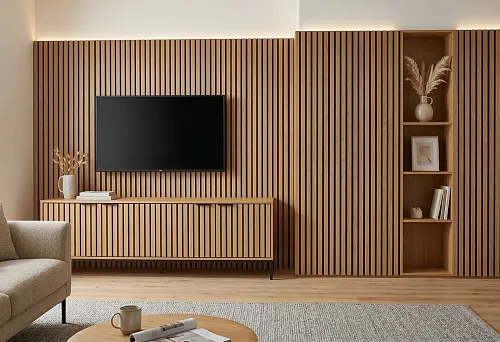
Interior Architecture Speaks in Two Languages - The Language of Lines and the Language of Patterns.Wooden plankForms the Geometric Framework of Space, Creating a Structural Grid from Verticals and Horizontals.wooden ornamentFills This Structure with Meaning, Emotion, and Cultural Memory. The Interaction of These Two Principles - the Minimalist Geometry of Rails and the Complex Plasticity of Ornament - Creates a Visual Dialogue Where Rigor is Balanced by Decorativeness, and the Rhythm of Lines Resonates with the Rhythm of Pattern.


Principles of Rhythm and Repetition in Ornament
Rhythm is the Foundational Principle of Ornamental Composition Organization. As Sounds are Organized in Time in Music, So Elements are Organized in Space in Ornament Through Regular Repetition.decorative wooden ornamentsAre Built Through Alternation of Motifs - Basic Decorative Units That Create Visual Rhythm.




Rapport as the Foundation of Composition
Rapport - The Minimal Repeating Unit of Ornament, Including the Motif and the Distance to the Next Motif.wooden ornamentIs Organized Through Regular Repetition of Rapport Horizontally, Vertically, or in Both Directions. The Size of Rapport Determines the Scale of the Ornament - A Large Rapport Creates Monumentality, a Small One - Detailing and Intimacy.
The ribbon repeat develops in one direction — along the horizontal or vertical axis.carved wooden inlaysWith a ribbon ornament, used for framing doorways, cornices, friezes. The vegetal motif — grapevine, acanthus leaves — repeats along the line, creating a continuous decorative band.
The grid repeat develops along two axes, creating a carpet-like structure. The ornament covers the entire surface of the panel or door with an even grid of repeating elements.House CarvingUses the grid repeat to create rich ornamental compositions on window casings, pediments, and lintels.
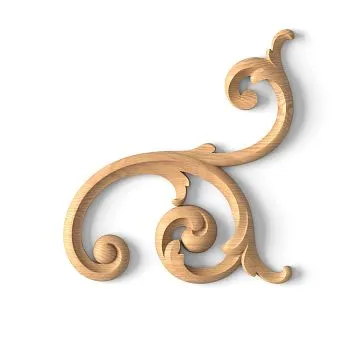
The central repeat is organized around a central point. A rosette — a circular ornament with symmetrically arranged elements around the center — is a classic example.Wooden carved appliquésArranged as rosettes at the center of panels, at the intersection of moldings, and in corners, creating focal points in the composition.
Our factory also produces:




Types of rhythmic structures
The uniform rhythm is based on the repetition of identical elements at equal intervals.Wooden ornamentWith a uniform rhythm, creates a calm, orderly structure. Identical rosettes, placed at equal distances along the frieze, form a predictable, meditative rhythm.
The gradient rhythm is built on the gradual change in the size of elements or the intervals between them. The motif gradually increases from the edges toward the center or decreases from the center to the edges.carved wooden inlaysWith a gradient rhythm, create visual movement, directing the viewer's gaze toward the compositional center.
The contrast rhythm is based on alternating different elements — large and small, simple and complex, dark and light.decorative wooden ornamentsWith a contrast rhythm, compositions are dynamic, creating visual tension and interest. A large rosette alternates with small elements, a complex motif — with a simple geometric one.
The syncopated rhythm disrupts uniformity with unexpected accents. The regular repetition of elements is interrupted by a larger or qualitatively different element, creating a visual pause or accent. This creates complexity and prevents monotony in perception.
Get Consultation
Symmetry and asymmetry
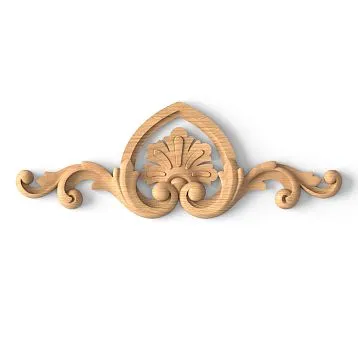
Symmetry is a fundamental principle of classical ornament.wooden ornamentOrganized around a central axis with mirrored repetition of elements on the right and left. This symmetry creates a sense of order, stability, and grandeur. Classical rosettes, palmettes, and cartouches are symmetrical relative to the vertical axis.
Radial symmetry is characteristic of central compositions.carved rosettesHave several axes of symmetry passing through the center. Four, six, eight, or more petals radiate from the center, creating a sense of blooming, unfolding, and radiating energy.
Asymmetry is characteristic of modern and Eastern ornaments. The motif is intentionally shifted from the central axis, creating dynamism and movement.carved wooden inlaysIn the modern style, depict curved vegetal forms leaning in one direction, creating a sense of growth and movement.
Proportions of ornament elements
The ratio of sizes of elements within the ornament determines its harmony. The law of three-componentness requires the presence of at least three different sizes of elements — large, medium, and small.Carved wooden ornamentIncludes a main motif, secondary elements, and filling details, creating a visual hierarchy.
The golden section is applied to the proportions of ornamental elements. The ratio of sizes of the main motif to secondary elements approaches 1:1.618. This creates mathematical harmony, intuitively perceived as beautiful.Wooden carved appliquésClassical proportions possess enduring aesthetic value.
Contrast in sizes enhances expressiveness. A very large central element surrounded by small details creates a dramatic effect. Uniformity in sizes creates calmness.decorative wooden ornamentsDifferent degrees of contrast are used depending on the desired emotional impact.
Ribs as a structural grid of the composition
If ornament is content, then rails are the structure organizing this content in space.Wooden plankIt forms a geometric grid within which ornamental elements are placed. The interaction between the strict geometry of the rails and the organic plasticity of the ornament creates visual tension, enriching the composition.
Geometric framework of space
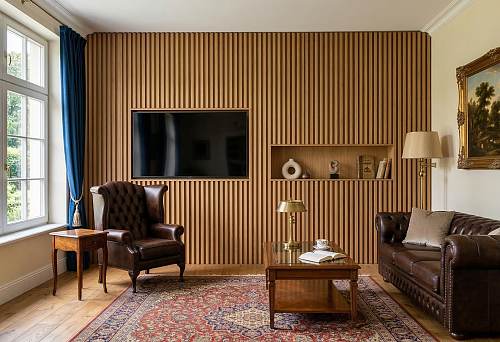
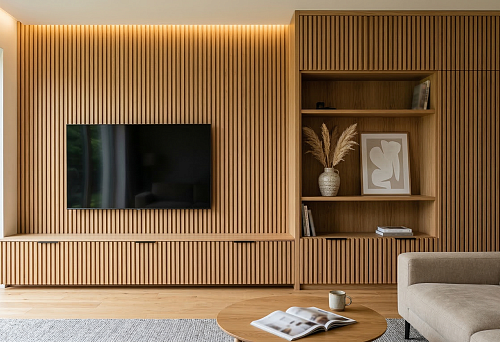
Rails create a coordinate system on the surface of a wall or ceiling. Vertical and horizontal lines intersect at right angles, forming a rectangular grid.Wooden slats on the wallThey divide the plane into modules — rectangular cells, each of which can be filled with ornament or left empty.
The modular grid orders the chaos of ornamental diversity.Wooden rail 20x40It creates cells of a certain size, which are filled with ornamental panels or carved inserts. This modularity allows varying the degree of ornamentation — from minimal to maximal — while preserving structural unity.
The rhythm of the rails creates the basis for the ornament's rhythm. The even repetition of vertical rails every 50-60 centimeters forms the basic rhythm.decorative wooden ornamentsWithin the cells between the rails, this rhythm is repeated or contrapuntally varied, creating a complex polyrhythmic structure.
The thickness of the rails affects the visual mass of the frame. Thin rails of 15-25 millimeters create a delicate grid, almost non-dominant over the ornament.Wooden plankRails of 40-50 millimeters thickness form a powerful frame that subordinates the ornament to its geometry. The balance between frame and filling determines the character of the composition.
Ratio of structure and filling
Dominance of structure is created by massive rails with minimal ornament.Wooden railsThey serve as primary elements, forming expressive geometry.wooden ornamentIt is used sparingly, as accents at key points — at intersections of rails, at corners of cells. This creates a modern interpretation of traditional forms.
Dominance of ornament is achieved by thin rails, serving merely as framing for rich decoration.carved wooden inlaysandornamental panelsThey fill most of the area. Rails merely divide this ornamental surface into readable fragments, preventing visual chaos.
Balance between structure and ornament is created by proportional relationship.Wooden plankRails of medium thickness form a noticeable but non-dominant grid. Ornament fills 50-70 percent of cell area, leaving empty spaces for visual rest. This creates a balanced composition without overload.
Diagonal and curved grids
Diagonal placement of rails creates a dynamic structure.Wooden slats on the wallAt a 45-degree angle, they form rhombic cells. This diagonal quality adds movement, directing the gaze upward.wooden ornamentWithin the rhombuses, the ornament may be oriented either vertically or diagonally, creating different effects.
Curved rails are characteristic of modernism. Curved lines create an organic grid reminiscent of natural structures — leaf veins, cracks in stone.Curved wooden railThey form smooth, irregularly shaped cells.decorative wooden ornamentsThey harmonize perfectly with such a structure in the modern style.
Radial grid is organized around a central point. Rails radiate outward from the center like rays, creating a fan or sunburst structure.carved wooden inlaysThey are arranged as rosettes at the center, while the ornamental filling develops in sectors between the rays.
The transition of rails into ornament
The boundary between structure and ornament may be blurred.Wooden plankWith a profiled section or carved edge, the rail itself becomes an ornamental element. The strict geometric function is retained, but decorative qualities are added. This creates unity between structure and ornament.
The ends of rails may have decorative finishes.carved appliquésIn the form of leaves, scrolls, or geometric shapes, the ends of rails are crowned. A functional structural element is completed with an ornamental accent, creating a natural transition from structure to decoration.
Inlaid ornaments in rails create a perforated structure.Wooden plankWith pierced ornamentation, it simultaneously serves as a structural frame and decorative element. Light passes through the openings, creating a play of light and shadow that enhances the decorative effect.
Ornament as symbol and aesthetics of movement
Ornament is never merely decoration—it always carries meaning, symbolism, cultural memory.wooden ornamentIt speaks a language of symbols understood at the level of cultural subconsciousness. Simultaneously, ornament creates visual movement—static carving comes alive through rhythm, direction of lines, and plasticity of forms.
Symbolism of plant motifs
The acanthus leaf symbolizes vital force and overcoming. This motif originated in antiquity, where the acanthus was considered a sacred plant.carved wooden inlaysUsed in classical interiors, acanthus motifs create a connection to tradition. Curved leaves with sawtooth edges at the tips create a dynamic form full of movement.
The grapevine symbolizes fertility, abundance, and joy of life.Wooden ornamentGrapevines with clusters and leaves are characteristic of classicism and baroque. Twisting stems create smooth lines that guide the viewer along the ornamental band. Clusters serve as accents, points of visual attraction.
The laurel wreath symbolizes victory, glory, and immortality. This motif is characteristic of the Empire style, associated with Napoleonic wars.decorative wooden ornamentsLaurel wreaths create solemnity and monumentality. The circular form of the wreath symbolizes eternity and continuity.
The palmette is a stylized fan-shaped motif tracing back to ancient Egyptian and classical prototypes. Its symmetrical form with elements radiating from the base creates a sense of unfolding, blooming.Wooden carved appliquésUsed as finials for vertical elements or as independent decorative accents in the form of palmettes.
Geometric symbols
The circle symbolizes eternity, perfection, and the sun. The rosette—a circular ornament—is one of the oldest motifs found in all cultures.carved wooden inlaysIn the form of rosettes, they create compositional centers, points of rest in dynamic compositions. Rays radiating from the center create centrifugal movement.
The meander—a continuous broken line—symbolizes eternal flow and the infinity of life. This Greek motif creates strong horizontal movement.wooden ornamentUsed as framing for panels, it creates an active boundary. The rhythm of right angles creates a mechanical yet hypnotic dynamism.
The spiral symbolizes development, growth, movement from the center to the periphery or vice versa.decorative wooden ornamentsWith spiral motifs, they create rotational movement. Volutes—architectural spirals—are characteristic of Ionic capitals and Baroque decoration. The spiral directs the viewer’s gaze along its curve, creating a dynamic trajectory.
Direction of movement in ornament
Vertical movement is created by elements directed upward. Stylized plants with long stems, Gothic spires, and flame tongues direct the gaze upward.wooden ornamentWith vertical orientation, it visually increases height, creating a sense of spiritual uplift and aspiration.
Horizontal movement is formed by extended ribbon-like ornaments. Grapevines, meanders, and bands of geometric elements guide the gaze along a line.carved wooden inlaysUsed with horizontal orientation on friezes and moldings, creating a sense of calm, stability, and spatial continuity.
Circular movement is created by spirals, volutes, and rosettes. The gaze moves in a circle, returning to the starting point. This creates closure, completeness, and self-sufficiency in composition.decorative wooden ornamentsUsed as independent panels, medallions, or central elements with circular movement.
Diagonal movement creates maximum dynamism. Diagonal lines, slanted elements, and S-shaped curves guide the gaze diagonally, creating instability, tension, and speed.Modern ornamentUses diagonal directions to create a sense of growth, impulse, and emotional intensity.
How to combine decorative elements with minimalism
The eternal dilemma of interior design — between the desire to decorate and the necessity to preserve the purity of space.wooden ornamentExcess decoration overloads the interior, turning it into a museum exhibit. Complete absence of ornament creates coldness and impersonality. The balance between decoration and minimalism is an art requiring understanding of compositional principles.
Principle of accentuation
Focusing decoration in key points leaves the rest of the space calm.carved wooden inlaysPlaced only in the corners of panels, at the intersections of moldings, or in the center of the main wall. Other surfaces remain smooth. This creates a visual hierarchy — accents attract attention, while calm zones give the eye a rest.
Concentrating ornament in one area creates a focal point in the interior.decorative wooden ornamentsCover the wall behind the bed, above the fireplace, and around the entrance door. Other walls remain neutral. This creates a dramatic effect — the richness of ornament is perceived more sharply against minimalist surfaces.
Vertical accentuation uses ornament on individual vertical elements.Wooden railsRemain smooth, but some have carved decoration. Alternating smooth and ornamented rails creates rhythm, where decoration is measured.carved wooden inlaysHighlight individual rails to distinguish them from the rest.
Gradient of decoration
Gradual increase in decoration from the periphery to the center creates visual movement. The edges of the wall or panel have minimal ornament — simple geometric frames. As one approaches the center, the ornament becomes more complex, reaching its maximum in the central zone.wooden ornamentWith a gradient of decoration, attention is directed toward the compositional center.
Vertical gradient uses more complex ornament in the upper part of the wall. The lower zone — the plinth — remains minimalist or has simple geometric decoration. The middle section is moderately ornamented. The upper part — frieze and cornice — has rich carved decoration. This creates a sense of lightness and visual uplift.decorative wooden ornamentsConcentrated in the area that attracts the gaze.
Gradient from dense to sparse changes the density of ornament while preserving the motif. In the center of the composition, ornament elements are closely placed, almost merging. Toward the edges, the distance between elements increases, the ornament becomes sparser, and empty spaces appear.carved wooden inlaysLarge and detailed in the center, smaller and simpler toward the edges.
Contrast between ornamented and smooth surfaces
Alternating decorated and neutral zones creates a visual rhythm.Wooden plankForms cells, some of which are filled with ornament, while others remain empty. This checkered order creates dynamism and prevents monotony. The eye rests on smooth areas, perceiving ornament on adjacent areas more sharply.
Surrounding ornament with wide smooth fields enhances its perception.wooden ornamentSurrounded by a wide frame of smooth wood or painted surface. This framing focuses attention on the ornament, creating a visual pause between the decorated central area and the rest of the space.
Inversion — using ornament on part of the surface while keeping the rest of the space active through color or texture.decorative wooden ornamentslight wood on a dark background or vice versa. The ornament occupies a smaller area but contrasts with the background, creating a strong visual impression while minimizing decoration.
Simplification of the motif
Stylizing traditional motifs into symbols preserves recognizability while reducing decorative complexity. A detailed acanthus leaf is simplified into a generalized form with several main curves.carved wooden inlaysIn modern interpretation, they retain the essence of the motif while abandoning fine details.
Geometrization of plant forms transforms organic motifs into geometric ones. A flower becomes a polygon, a leaf a triangle or rhombus, a stem a straight or broken line.wooden ornamentWith geometrization, the ornament retains its decorative quality but acquires strictness, harmonizing with modern aesthetics.
Silhouette solution uses only the outline of the motif without internal detailing.decorative wooden ornamentsThey are cut as silhouettes — dark on a light background or light on a dark one. The absence of internal details creates graphic clarity and conciseness while preserving ornamental expressiveness.
STAVROS Interiors — precision in proportions and forms
Creating a harmonious interior where ornament and structure are in balance requires professional understanding of proportions and precision in execution.Wooden plankmust be perfectly straight,wooden ornament— precisely cut. Even the slightest deviation from geometry or careless carving destroys the impression of the most refined motifs.
Mathematics of proportions
The ratio of the width of the rails to the size of the cells between them determines the character of the composition.Wooden rail 20x40Rails 40 mm wide with gaps of 80–120 mm create a ratio of 1:2 or 1:3. This ensures that the filled area dominates over the frame. More massive rails with narrow gaps invert the ratio, emphasizing the structure.
The size of ornamental elements is proportional to the size of the panel in which they are placed.carved wooden inlaysThey occupy 15–25 percent of the panel’s area — sufficient to create an accent without overloading. Too large an ornament presses on its confining frame; too small an ornament disappears into the space.
The relief thickness of the ornament corresponds to the thickness of structural elements.wooden ornamentWith a relief of 8–12 mm, it harmonizes with rails 15–25 mm thick. A deeper relief creates excessive plasticity; a flat relief lacks expressive power. The balance between relief and flatness is critical for harmony.
Quality of execution
The clarity of carving determines the readability of the ornament.decorative wooden ornamentsThey require precise execution of every line and curve. Blurred contours, unclear transitions between planes, tool marks spoil the impression. Professional carving features sharp edges, smooth transitions, and flawless surface cleanliness.
Geometric precision of the rails is critical for the perception of the composition.Wooden slats on the wallThey must be strictly parallel to each other and strictly perpendicular to intersecting rails. A deviation of even 1–2 mm per meter of length becomes noticeable, creating an impression of carelessness.
The quality of the wood affects durability and expressiveness.wooden ornamentFrom dense species — oak, ash, beech — retains line clarity for decades. Softwoods — linden, aspen — are easier to cut but less durable. The choice of species depends on the intended use and operating conditions.
Finishing and Protection
Proper finishing highlights the material’s and ornament’s merits. Oil finish penetrates the wood, emphasizing texture and preserving tactile quality.carved wooden inlaysWith oil finish, they have a warm matte surface, pleasant to the touch. Oil accumulates in carved recesses, making them darker than raised parts, enhancing relief.
Lacquer finish creates a protective film. Matte lacquer preserves the natural wood appearance while adding protection. Semi-gloss creates a soft sheen, highlighting form. Glossy lacquer produces bright highlights on raised areas, maximizing relief through light play.decorative wooden ornamentsWith lacquer, they are more durable and easier to clean.
Staining changes the wood’s color while preserving or emphasizing texture. Stain penetrates the structure, recesses are colored more intensely. This creates contrast between raised and recessed areas of carving.wooden ornamentWith staining, it has a more expressive relief due to color contrast.
Installation and Mounting
The installation accuracy determines the final impression.Wooden plankMounted using a laser level to ensure perfect verticality and parallelism. Hidden mounting via clamps or mounting strips ensures facade purity without visible fasteners.
carved wooden inlaysMounted with adhesive or hidden dowels. Visible self-tapping screws ruin the aesthetic of the carving. Precise positioning is critical — the central overlay must be exactly centered, corner pieces must be precisely at the corners. Deviation creates imbalance in the entire composition.
Joints of elements require meticulous precision.wooden ornamentElements composed of multiple fragments must join so that decorative lines transition seamlessly from one element to another without breaks. This requires precise marking during manufacturing and careful installation.
Conclusion
The language of ornament and the language of line — two facets of architectural expression that, in harmony, create spaces of true beauty.Wooden plankForms a geometric frame — strict, rational, orderly.wooden ornamentFills this frame with emotion, symbolism, cultural memory.
Rhythm and repetition — the foundation of organization for both ornament and structural grid of rails. The ornament’s repeat aligns with the rail module, creating a polyphony of rhythms. The gradient of decorative intensity, from rich to minimalist, controls attention, creating visual hierarchy.
The symbolism of ornament speaks a language understood by the subconscious. Vegetal motifs carry meanings of fertility, vitality, victory. Geometric symbols embody eternity, perfection, infinity.decorative wooden ornamentsCreate not only visual beauty but also meaningful content for the space.
The balance between ornamentation and minimalism — the art of dosage.carved wooden inlaysCreate accents at key points while preserving calm zones. Simplifying motifs into symbols preserves ornamentality while maintaining modern restraint.
Company STAVROS offers a full range ofwooden planks, wooden ornamentsandcarved wooden inlaysMade from solid oak, ash, beech, and lime. The precision of rail geometry ensures an ideal structure. The clarity of ornamental carving guarantees readability of each element. The variety of motifs — from classical to modern stylizations — allows realization of any concept. High-quality processing and finishing ensure longevity and preservation of the original appearance. Professional consultation with specialists helps find the balance between structure and ornament, between ornamentation and minimalism, creating interiors where every line and every pattern is in its place, forming a harmonious whole.