Article Contents:
- Magic of ancient Russian symbolism in the modern world
- Evolution of styles: from antiquity to our days
- Secrets of craftsmanship: how masterpieces were created
- Material Selection: The Foundation of Durability
- Carving techniques: from simple to complex
- Regional Characteristics: Diversity in Unity
- Northern motifs: the harsh beauty of Arkhangelsk and Vologda
- Central Russia: elegance and harmony
- Volga region: synthesis of cultures
- Modern revival: traditions in the 21st century
- New technologies — old traditions
- Design solutions of the new era
- Practical Aspects: From Selection to Installation
- Style selection: harmony with architecture
- Materials and processing: guarantee of longevity
- Installation: the art of proper mounting
- Regional schools of craftsmanship: heritage we are proud of
- Mезен carving: geometry of the north
- Gorodets tradition: festival of colors
- Abramtsvet workshop: rebirth on a new level
- Symbolism and meaning: reading the stone book of cornices
- Solar symbols: source of life
- Plant motifs: connection with nature
- Zoomorphic images: protection and patronage
- Technology and innovations: the future of traditions
- CNC machines: precision and productivity
- Materials of the new generation
- 3D printing and the future of craftsmanship
- World traditions: Russian cornices in context
- Alpine motifs: function and beauty
- Scandinavian restraint
- Balkan opulence
- Care and Restoration: Preserving Beauty for Centuries
- Regular Inspection and Preventive Maintenance
- Recoating
- Restoration of Historical Elements
- Economic Aspects: Investment in Beauty
- Cost Formation
- Increase in property value
- Tourist Potential
- Psychological Aspects: Impact on People
- Connection with traditions
- Aesthetic Impact
- Sense of Pride and Identity
- Conclusion: Living Traditions in the Modern World
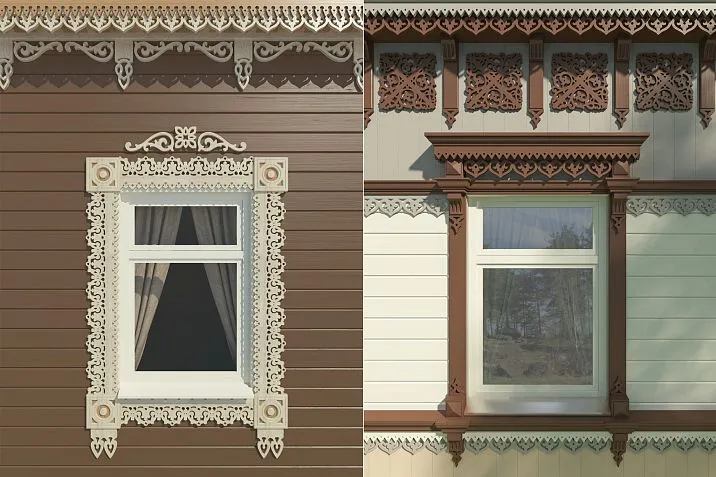
What could be more beautiful than a morning view from the window of an old house, where every detail breathes history? When sunlight dances on carved patterns of the window frames, creating a unique dance of light and shadow, you realize — this is not just an architectural element. It is living memory of the people, frozen wood poetry of our ancestors. Windows with Russian-style frames photo — it is a journey through time, where every swirl of carving tells its own amazing story.
Can one remain indifferent when looking at these lace-like creations of past masters? Each pattern hides deep meaning, each line carries the soul of the creator. Today, when the world strives for uniformity, Russian window frames remind us of the value of individuality and handcrafted beauty.


Magic of Ancient Russian Symbolism in the Modern World
Immersing oneself in the world of traditional Russian architecture, one cannot help but admire the depth of meaning our ancestors infused into every element of home decor. Wooden window frames were not merely decorative — they served as true protective charms, safeguarding the home and its inhabitants from evil forces.
Look at the top of any traditional window frame — there you will surely find an image of the sun, symbolizing life force and divine protection. Side elements were often adorned with plant motifs: grapevine, symbolizing fertility, or birch leaves, symbolizing purity and renewal.
The lower part of the frame traditionally depicted 'earthly firmness' — plowed fields, sown crops, intended to bring wealth and prosperity into the home. Every swirl, every line had its purpose and carried a specific message for future generations.




Evolution of Styles: From Antiquity to Our Days
Amazingly, how Carved Door Casings for Windows they changed over centuries, absorbing influences of various epochs and cultural trends. The 17th century gifted us magnificent examples of 'Russian ornamentation' with characteristic kokoshniks and 'dymniki', while the 18th century introduced elements of Baroque and Classicism.
The 19th century became the golden age of Russian-style window frames — it was precisely then that the canonical forms we today consider truly Russian were formed. Masters of that time achieved incredible perfection in the technique of relief carving, creating true lace-like wonders from wood.
The 20th century brought its own modifications: Constructivism simplified forms, yet did not deprive them of expressiveness. And today we witness a remarkable revival of interest in traditional window frames, which seamlessly integrate into modern architecture, bringing warmth and soulfulness to it.
Our factory also produces:


Secrets of Mastery: How Masterpieces Were Created
Every true woodcarver will tell you: creating a quality window frame is not merely a technical task — it is real art, requiring deep understanding of the material, traditions, and symbolism. Domestic carving has always been a special craft, passed down from generation to generation.
Get Consultation
Material Selection: The Foundation of Durability
For making traditional window frames, coniferous woods — pine, spruce, larch — were predominantly used. These types of wood possess the necessary strength, are easy to work with, and have beautiful grain. Pine was especially prized for its resinous nature, which provided natural protection against moisture and insects.
Less frequently, deciduous woods — linden and aspen — were used. Linden was ideal for delicate lace carving due to its softness and uniform structure. Aspen was valued for its ability not to crack upon drying and to retain its shape for many years.
Master craftsmen of the past knew: properly selected and prepared material — this is already half the success. Wood was harvested at a specific time of year, carefully dried, and only then work began.
Carving Techniques: From Simple to Complex
Three main techniques existed for making carved window frames: simple relief carving, blind (cut-out) and through (relief) carving. Each had its own characteristics and area of application.
Simple carving was used to create basic elements — boards, cornices, simplest decorative details. Blind carving allowed creating three-dimensional images while preserving the background, giving the frame a special expressiveness and solidity.
But true mastery was considered to be through carving, where the background was completely removed, and the pattern resembled lace. It was precisely this technique that allowed creating those airy, almost weightless structures that still astonish us with their beauty and elegance.
Regional Characteristics: Diversity in Unity
Traveling across Russia and studying windows with Russian-style casings in photos, one is amazed by the variety of forms and styles that have developed in different regions of our vast country. Despite shared basic principles, each region developed its own unique features and characteristics.
Northern Motifs: The Rugged Beauty of Arkhangelsk and Vologda
Northern Russia has gifted us particularly expressive examples of wooden architecture. The harsh climate and abundant forest resources left their mark on local traditions. Traditional northern casings were distinguished by their particular monumentality and solidity.
A typical feature of northern casings were massive gables with solar symbols, heavy side posts with plant ornamentation, and mandatory 'earrings' — decorative hangings at the bottom. The color palette tended toward natural wood tones with occasional accents of white and blue paint.
The masters of the Russian North were renowned for their ability to create complex multi-level compositions, where each element complemented the overall picture, creating an impression of solemnity and grandeur.
Central Russia: Elegance and Harmony
The casings of central governorates had a completely different character. Here, a more refined aesthetic prevailed, leaning toward elegance of form and harmony of proportions. Carved Decorative Elements Distinguished by their intricate execution and richness of detail.
Artisans from Vladimir, Yaroslavl, and Kostroma governorates were especially renowned. Their works were distinguished by particular lightness and airiness, complex interweavings of plant motifs, and virtuoso execution of the finest details.
The color scheme here was more varied: in addition to traditional white, green, blue, and red were widely used, creating a festive, cheerful impression.
Volga Region: Synthesis of Cultures
The casings of the Volga region hold a special place in the history of Russian wooden architecture, where Russian traditions seamlessly blended with cultural influences from other peoples. Here, a unique style emerged, combining the strictness of Russian forms with the vividness and ornamentation of Eastern motifs.
A characteristic feature of Volga casings was the widespread use of geometric patterns alongside plant motifs. Often, stylized bird images — symbols of freedom and the soul’s flight — were encountered.
Modern Revival: Traditions in the 21st Century
Who would have thought a few decades ago that in the age of glass and metal, people would once again turn to wooden casings for windows? But this is exactly what is happening today. Modern clients increasingly turn to time-tested solutions, seeking to bring the warmth and coziness of traditional Russian homes into their own dwellings.
New Technologies — Old Traditions
Modern Production carved window casings remarkably combines advanced technologies with centuries-old craftsmanship traditions. High-precision CNC machines allow for the reproduction of the most complex ornaments with mathematical accuracy, but the final finishing touches are still performed by hand by the master.
Modern protective coatings and lacquering materials have significantly extended the service life of wooden structures. Special impregnations protect wood from moisture, ultraviolet radiation, mold, and insects, while preserving its natural beauty and ability to 'breathe'.
Innovative drying and wood treatment methods allow avoiding deformations and cracking, which is especially important for complex carved structures. The use of laminated timber enables creating casings of any size without limitations imposed by natural log dimensions.
Design Solutions of the New Era
Modern architects and designers do not blindly copy past examples, but creatively reinterpret traditional motifs, adapting them to contemporary requirements. Casings in the Russian style are appearing that seamlessly integrate into modern architecture without disrupting its harmony.
Stylized solutions have become especially popular, where traditional motifs are simplified and geometricized, acquiring a modern sound. Such casings look excellent on facades of houses in 'neo-Russian', 'country', or 'eco' styles.
An interesting direction has been the use of contrasting color schemes, where carved elements stand out against the wall due to bright coloring, or, conversely, create an impression of refinement through the play of shades of a single color.
Practical Aspects: From Selection to Installation
Decorating your home with window casings requires a serious approach and consideration of many factors. It is not enough to simply choose a favorite pattern — one must also take into account the climate, the architecture of the house, personal preferences, and the project budget.
Style Selection: Harmony with Architecture
First, attention should be paid to the style of the window casings' correspondence with the overall architecture of the building. Ornately carved casings will look naturally appropriate on a traditional wooden house, but may appear out of place on a strict minimalist facade.
For houses in Russian style, classical solutions with traditional motifs — solar symbols, floral ornaments, geometric patterns — are ideal. Houses in Scandinavian style are better adorned with simple, minimalist casings without excessive ornamentation.
It is important to consider window sizes: large panoramic windows require appropriate framing, while small windows will be lost in heavy decoration.
Materials and finishing: the guarantee of longevity
Material selection is one of the key aspects in manufacturing window casings. Traditional pine remains the optimal choice due to the combination of strength, workability, and affordable price. Larch provides maximum durability but costs more.
Modern protective coatings allow using almost any wood species, but it is important to remember: the quality of treatment directly affects the lifespan of the product. Saving on protective coatings may result in the need to replace the casings entirely within a few years.
Special attention should be paid to the end parts of the details — it is through these that moisture penetrates wood most actively. Quality end treatment with special compounds is a mandatory condition for the longevity of the structure.
Installation: the art of proper mounting
Correct installation is no less important than the quality of the casings themselves. Incorrect installation can negate all the merits of even the most beautiful product and significantly shorten its service life.
Main rule: the casing must be securely attached to load-bearing wall elements, not to the window frame. This ensures structural stability and prevents deformation due to thermal expansion.
Special attention should be paid to waterproofing joints. Properly executed junctions to the wall prevent moisture from entering under the structure and forming areas of decay.
Regional schools of craftsmanship: heritage we are proud of
Studying windows with casings in Russian style photos, one is amazed by the richness of regional traditions, each contributing its unique element to the overall treasure of Russian wooden architecture. These schools of craftsmanship evolved over centuries, absorbing local characteristics of climate, culture, and aesthetic preferences.
Mезенская резьба: геометрия севера
The Mезенская school of carving holds a special place in the history of Russian traditional casings, forming in the basin of the Mезень River. Here, a unique style emerged, based on strict geometric forms and ancient symbols.
Mезенские masters created casings that amazed with their mathematical precision and harmony of proportions. The composition was based on rhombuses, circles, spirals — symbols of the sun, earth, water, and wind. These elements formed complex ornamental systems, where each detail had its place and meaning.
The color scheme of Mезенские casings was particularly restrained: traditionally, only red and black colors were used on a white or natural background. This minimalism created an impression of special solemnity and spiritual depth.
Городецкая традиция: праздник красок
The Gorodets school of carving and painting had a completely different character. Masters from this region created wooden casings for windows that amazed with their liveliness and decorative quality. Here, the principle "the richer, the better" prevailed.
Gorodets casings were decorated not only with carving but also with bright multi-colored painting. Traditional motifs — flowers, birds, riders — were executed in a characteristic manner with obligatory whitewashing, giving the image particular expressiveness.
This tradition had a tremendous influence on the development of decorative arts throughout the Volga region and continues to inspire modern masters to create bright, memorable works.
Абрамцевская мастерская: возрождение на новом уровне
The Abramtsvet Art Workshop played a special role in preserving and developing the traditions of domestic carving, established at the estate of S.I. Mamontov at the end of the 19th century. Here, under the guidance of outstanding artists and architects, folk crafts were revived on a qualitatively new level.
Abramtsvet masters did not copy old samples but creatively reinterpreted traditional motifs, creating works that became classics of "Russian style." It was here that many samples of carved casings were developed, later mass-produced throughout Russia.
The Abramtsvet school introduced elements of professional artistic education into traditional craftsmanship, enabling the quality of products to be raised to a new level and ensuring their compliance with modern aesthetic requirements.
Symbolism and meaning: reading the stone book of casings
Each carved casing is a kind of book written in the language of symbols and images. Our ancestors imbued ornaments with deep meaning, creating not just decorations, but true talismans intended to protect the house and its inhabitants from all misfortunes.
Solar symbols: source of life
Solar symbols occupy a central place in the symbolism of Russian casings — images of the sun in various forms. Circles with rays, rosettes, multi-petaled flowers — all these are different variations of solar symbolism, intended to bring light, warmth, and life energy into the home.
Solar symbols were especially often placed at the top of carved window frames, symbolically indicating the sunrise and the beginning of a new day. The number of rays also had significance: an eight-rayed sun symbolized harmony, a twelve-rayed sun — the completeness of the annual cycle.
Solar symbols were sometimes supplemented with images of birds — messengers of the sun, which intensified the overall semantics of light and goodness.
Plant motifs: connection with nature
Plant ornaments constituted the second most significant group of symbols. Each plant carried its own meaning: the oak symbolized masculine strength and longevity, the birch — feminine essence and purity, the grapevine — fertility and abundance.
Stylized images of the Tree of Life — a central symbol of many mythological systems — were especially popular. This could be a realistic depiction of a tree with branches and leaves, or a highly stylized geometric ornament.
Floral motifs also had their symbolism: roses meant love and beauty, lilies — purity and innocence, poppies — fertility and continuation of the family line.
Zoomorphic images: protection and patronage
Images of animals and birds on Russian-style window casings performed a protective function. Lions and griffins repelled evil spirits, horses symbolized the sun and celestial power, birds served as intermediaries between the earthly and heavenly worlds.
Images of birds — both real (rooster, duck, swan) and fantastical (firebird, paradise bird) — held special significance. The rooster was considered a protector against evil forces, the duck symbolized the water element, and the swan — purity and fidelity.
Snakes and dragons, despite their apparent negativity, also performed a protective function, symbolizing wisdom and guardianship of the home.
Technology and innovations: the future of traditions
Modern production of wooden window casings represents a remarkable synthesis of ancient traditions and the most advanced technologies. Today, masters have at their disposal tools and materials that their predecessors could only dream of.
CNC machines: precision and productivity
The use of CNC machines revolutionized the manufacturing process carved decorative elementsNow, even the most complex ornaments can be reproduced with mathematical precision, which is especially important when manufacturing symmetrical compositions.
Modern CAD/CAM systems allow not only to accurately reproduce historical samples, but also to create new designs, modeling them in three-dimensional space even before the start of manufacturing. This allows the client to see the future product and make necessary adjustments.
Laser cutting has opened new possibilities for creating complex lace-like structures, which would have been practically impossible to achieve using traditional methods. At the same time, surface quality and geometric accuracy are maintained.
Materials of the new generation
Modern chemical industry offers a wide range of protective compositions that significantly extend the service life of wooden structures. New-generation antiseptics not only protect wood from biological damage but also impart additional strength.
The use of modified wood — a technology in which polymer components are introduced into the wood structure — allows creating materials with improved characteristics: increased moisture resistance, dimensional stability, and UV resistance.
New water-based coatings provide reliable protection with minimal impact on the environment. Special formulations allow creating coatings that not only protect but also highlight the natural beauty of wood grain.
3D printing and the future of craftsmanship
The development of 3D printing technologies opens up amazing prospects for manufacturing complex decorative elements. It is already possible to print from wood composites that closely resemble natural wood in their properties.
This technology is especially valuable in restoring historical objects, where it is necessary to precisely reproduce lost elements. Three-dimensional scanning of surviving fragments allows creating an accurate digital model, which can then be reproduced in any quantity.
World traditions: Russian casings in context
When studying windows with casings in the Russian style through photos, it is important to understand that the Russian tradition of window decoration is part of the global cultural heritage. In many countries around the world, unique traditions of window opening decoration have developed.
Alpine motifs: function and beauty
In Alpine countries — Austria, Switzerland, Southern Germany — there is also a rich tradition of decorating wooden houses. However, here the emphasis is less on carved ornamentation and more on functionality and harmony with the surrounding landscape.
Alpine casings are distinguished by strict forms and practical construction. Wide overhangs protect windows from rain and snow, and side elements often serve as supports for flower boxes — an indispensable element of an Alpine house.
Scandinavian restraint
Scandinavian window trim tradition leans toward minimalism and functionality. Here, the focus is not on decorative elements, but on craftsmanship quality and proportion harmony. Scandinavian-style wooden window casings impress with their simplicity and elegance.
The color palette is limited to natural wood tones or classic white and red. If present, ornamentation is characterized by strict geometry and restraint.
Balkan opulence
The tradition of window trim on the Balkans has a completely different character, where a rich decorative style has developed, combining European and Eastern influences. Balkan-style carved window casings impress with their ornamental richness and color variety.
Here, plant and geometric motifs are widely used, often supplemented with images of animals and birds. The color palette includes bright, saturated tones, creating a festive, joyful impression.
Care and restoration: preserving beauty for centuries
Even carved window casings, even if made from the highest quality materials and using modern protective compounds, require regular care and periodic renewal. Proper care is the key to longevity and preserving the original appearance.
Regular inspection and prevention
The foundation of proper care is regular inspection of the structure to identify potential problems at an early stage. Special attention should be paid to the condition of the paint finish, joints, and fasteners.
Cracks in the coating, paint peeling, darkening of wood — all of this signals the need for immediate action. Timely elimination of minor defects prevents the development of serious problems.
Coating renewal
The frequency of renewing protective coating depends on many factors: quality of initial treatment, climatic conditions, orientation of the facade relative to cardinal directions. On average, full renewal is required every 5-7 years.
The renewal process includes removing the old coating, sanding the surface, treating with antiseptic, and applying a new protective-decorative compound. Properly executed work will extend the service life window casings for many years.
Restoration of historical elements
Restoring historical window casings, which have both practical and cultural value, presents particular difficulty. Here, it is important not only to restore functionality, but also to preserve the authenticity of the item.
Restoration should be carried out using traditional materials and technologies. Modern compounds are used only in cases where their application does not compromise historical authenticity and ensures better preservation of the object.
Economic aspects: investment in beauty
Installing quality wooden window casings is not just a money expenditure, but a long-term investment that pays off in several ways. Beautiful, well-made casings significantly enhance the attractiveness of a home and its market value.
Formation of Value
The cost of manufacturing and installing window casings depends on many factors: design complexity, size of the structure, selected material, method of manufacture. Simple casings made by machine cutting will be significantly cheaper than exclusive handcrafted items.
However, saving on material quality and manufacturing may turn out to be a false economy. Cheap casings made from inferior materials will require replacement within a few years, whereas premium items serve for decades.
Increase in property value
A house with beautifully carved window casings always stands out among standard construction, positively affecting its market value. Potential buyers are willing to pay extra for the uniqueness and individuality of the architectural solution.
This is especially relevant for suburban real estate, where buyers are looking not just for a place to live, but for a home with character and soul. Traditional Russian window casings perfectly meet these requirements.
Tourist potential
Houses with traditional Russian-style window casings often become tourist attractions. In the era of growing domestic tourism and interest in national traditions, such real estate can generate additional income through rental or organizing tours.
Psychological aspects: influence on people
The influence of architectural environment on a person's psychological state is a proven scientific fact. Windows with Russian-style casings do not merely please the eye — they exert a deep effect on people's emotional state, creating a sense of coziness, safety, and connection to one's native culture.
Connection with traditions
Traditional architectural forms evoke a sense of stability and intergenerational continuity. Living in a house with traditional casings, a person feels part of a continuous cultural tradition, which is especially important in the era of globalization and homogenization.
This sense of roots, belonging to a specific culture positively affects psychological state, reducing stress and anxiety levels typical of modern urban life.
Aesthetic impact
The beauty of carved window casings has a direct positive effect on a person's mood and well-being. Contemplating harmonious forms and proportions contributes to relaxation and reduces cortisol levels — the stress hormone.
This is especially important for children who are accustomed from an early age to beauty and harmony, which shapes their aesthetic tastes and attitude toward the surrounding world.
Sense of pride and identity
Ownership of a house with unique architectural elements evokes a sense of pride and boosts self-esteem. This is especially important in the context of standardized housing, where all houses resemble each other like twins.
Carved window casings make a house recognizable and give it individuality, which is psychologically very important for the feeling of one's own 'place in the world'.
Conclusion: Living traditions in the modern world
In concluding our journey into the world of windows with Russian-style casings, we would like to emphasize once again: these are not merely architectural elements, nor just facade decorations. They are living memories of the people, embodying in wood the wisdom of generations, a bridge between the past and the future.
Each carved casing is a small masterpiece, created by the hands of a master and warmed by his soul. In it, functionality and beauty, tradition and innovation, material and spiritual aspects are intertwined. And if today we can admire these works of art, tomorrow we must pass this heritage on to our children and grandchildren.
Modern technologies do not replace traditions but serve them. CNC machines and laser cutting allow us to recreate lost samples with archaeological precision, new materials extend the life of wooden structures, and digital archives preserve for future generations thousands of unique samples of house carving.
Choosing wooden window casings for your home is more than just an architectural decision. You are choosing beauty over dullness, individuality over uniformity, the living over the dead. You become a keeper of traditions and a participant in their further development.
May every morning sun playing through the carved patterns of your casings remind you that beauty will save the world, and traditions will make this world more humane and harmonious.
STAVROS Company has been helping its clients bring the boldest projects in wooden architecture to life for more than ten years. Our masters combine deep knowledge of traditions with mastery of modern technologies, creating pieces that will adorn your home for years to come. Choosing STAVROS means choosing quality, reliability, and beauty, proven by time.