












































































Article Contents:
- What are chair legs and why are they needed
- Types of chair legs
- Straight legs - a universal solution
- Turned legs with decorative elements
- Legs with decorative animal paw-shaped feet
- Adjustable supports for chairs
- Curved legs - sabre and cabriole
- Materials for chair legs
- Wooden legs - classic and warmth
- Metal legs - modernity and minimalism
- Combined options - the best of both worlds
- Chair heights and sizes
- Standard height of kitchen chairs
- Bar stools
- Proportions of legs and seat
- When compact legs solve the problem of a narrow kitchen
- Stool as a space-saving solution
- Stylistic perfection in limited space
- Mobility as an advantage
- Installing legs on the chair seat
- Preparing the seat
- Marking leg positions
- Installation of legs
- Checking and adjusting
- Visual perfection of the chair
- Harmonious proportions
- Color solution
- Finishing and protection
- Practical tips on selection and use
- Fastening Strength
- Stability on the floor
- Height relative to the table
- Material and finish
- FAQ
- Conclusion
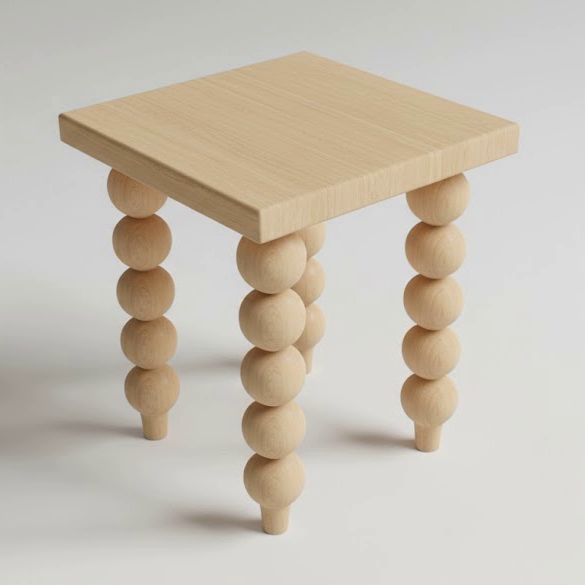
A stool is a piece of furniture often underestimated in modern interiors. And rightly so. A compact, practical, mobile stool with proper legs solves many tasks in spaces with limited area. Especially relevant for narrow kitchens, one-room apartments, small studios, where every centimeter counts.Legs for a stool to buymeans getting a compact, stable support that turns a simple wooden block into a stylish and functional piece of furniture.
Choosing legs for a stool is not just a technical solution, it's a stylistic statement. Four elegant wooden legs with proper proportions turn a utilitarian stool into a decorative element suitable for classic interiors. Compact metal supports create a modern look, fitting naturally in lofts and minimalist spaces. Adjustable supports ensure stability on uneven floors and extend the lifespan.
A standard stool is simply a seat 400-450 millimeters high, mounted on four legs. The distance between the legs is usually 300-350 millimeters, ensuring stability for an average human weight of 70-80 kilograms. At first glance, the construction is simple to the point of primitiveness. But it is precisely in this simplicity that the beauty of functional design lies. Properly chosen legs transform a stool from a necessity into an element that is pleasant to use for years.
This article covers all aspects of choosing, installing, and using stool legs. You will learn about types of constructions suitable for different interiors. We will discuss materials—from classic wood to modern metal and plastic. We will talk about sizes, heights, proportions critical for comfort and aesthetics. You will learn about adjustable supports that simplify life on uneven floors. And most importantly—you will understand how to correctly choose stool legs that will please the eye and serve faithfully for decades.


What are stool legs and why are they needed
A stool leg is a support element that is attached to the lower part of the seat and contacts the floor. A stool usually has four legs, positioned at the corners of the seat, although some designs have three legs—more compact and mobile, but less stable.
The functions of stool legs are multi-layered. The first and obvious one is structural. Legs support the weight of a person sitting on the stool and transfer the load to the floor. The strength of the legs determines the load capacity of the stool and the durability of the construction. Weak legs bend under weight, create play, and make the stool unstable and dangerous.
The second function is functional. The distance from the floor to the seat is determined by the height of the legs. The standard height of a kitchen stool is 400-450 millimeters, for a dining table—450-500 millimeters. The difference is small, but critical for comfort. A low stool is used as a footrest, a container for dishes, or for storing kitchen items. A high stool functions as a seat for a high table or bar counter.
The third function is visual. Legs determine the style of the stool. Elegant carved wooden legs create a classic look, fitting naturally in traditional interiors. Strict straight legs without ornamentation look modern and fit into minimalism. Turned balusters give the stool a vintage character. Heavy wooden legs with rectangular cross-sections work well in rustic interiors.
The fourth function is practical. Legs raise the seat above the floor, creating space under the stool. This makes cleaning easier, allows moving the stool under a table, and saves space. The stool becomes an item that is easy to move, hide behind other furniture, and use in different parts of the kitchen.




Types of stool legs
Stool legs are classified according to various criteria—construction, material, functionality, and style. Each type has strengths and weaknesses, as well as areas of application.
Our factory also produces:


Straight legs—a universal solution
Straight cylindrical or square legs are the most common option for stools. Structurally, this is a simple block or rod attached at a 90-degree angle to the seat's underside. The height is usually 380-450 millimeters for standard kitchen stools.
Straight wooden legs with a diameter of 25-30 millimeters (turned) or cross-section of 30x30, 40x40 millimeters (square) provide reliable support with minimal material usage. The rounded end of the leg prevents sharp angles and makes cleaning around the stool easier.
Advantages of straight legs—simple manufacturing, low cost, universality, suitable for any interior style. Disadvantages—look plain on a simple cut, require finishing for aesthetics, appear monotonous in space.
Visually, straight legs suit minimalist, Scandinavian, and modern interiors where simplicity of form and functionality are valued. They also fit well in contemporary kitchens with straight-line cabinetry and decor.
Get Consultation
Turned legs with decorative elements
stool legsWith a turned profile—balusters, cones, knobs—create visual interest. Turning allows adding elements—thickenings at the bottom, tapering in the middle, beads, rounded ends, grooves.
A typical profile of a turned leg for a stool may look like this: the upper part—attachment zone, usually straight, with a diameter of 28-30 millimeters. Next, a knob—a thickening that creates a visual accent. Then—the main part with gradual tapering to the floor or with grooves (vertical channels). The lower part—a rounded end for contact with the floor.
Turned legs require special equipment—a lathe—for manufacturing, which increases the cost. But the result justifies the investment—a stool with turned legs becomes an interior piece, not just utilitarian furniture.
Visually, turned legs suit classic and traditional interiors where decorative detailing and finish are valued. They also work well in eclectic spaces where warmth and coziness are needed.
Legs with decorative animal paw-shaped feet
An exclusive and rare option—legs shaped like animal paws, characteristic of antique furniture and Baroque, Rococo, and Empire styles. The front part of the leg is carved into a lion's paw, bear's mouth, or eagle's claw—depending on imagination and historical style.
Such legs are true works of woodcarving art, requiring handcrafting and significant time investment from the artisan. The cost of a stool on such legs may range from 5000 to 15000 rubles, justified only for exclusive projects, antique restorations, or specialized interiors (historic houses-museums, castles, palaces).
For home kitchens, such legs are impractical—too expensive, too difficult to maintain, requiring special care and attention during cleaning. But for lovers of historical style and beauty, they are the embodiment of a dream of a home where every detail speaks of the owner's taste.
Adjustable supports for stools
Adjustable legs for stools—a solution for uneven floors. The construction includes a main leg with a screw mechanism for height adjustment. By turning the adjustment screw, you can change the leg's length by 15-20 millimeters.
Adjustable supports are especially relevant for bar stools used at kitchen bar counters. During relocation, renovation, or floor replacement, there may be a need to change the stool's height. Adjustable legs solve this task in a few minutes without replacing the construction.
Lack of adjustable legs - the mechanism is visible, unattractive, unsuitable for classic interiors. However, for modern kitchens where functionality is valued, this is an ideal solution.
Curved legs - sabre and cabriole
Sabre - slightly curved legs, characteristic of English classic furniture and 18th-19th century furniture. Cabriole - more pronounced curve, smooth and graceful, like an animal's paw, characteristic of rococo and French baroque.
Curved legs require either special processing (wood bending under steam) or manufacturing from wood grain direction taking into account its natural annual ring pattern. This is complex work, accessible only to experienced craftsmen. The cost of a stool on curved legs is 3000-8000 rubles.
Visually curved legs create a sense of lightness and elegance, despite their structural complexity. A stool on cabriole legs appears airy and graceful, as if ready to jump at any moment. This solution is suitable for classic living rooms, dining rooms, bedrooms, less so for kitchens (where straight or turned legs are more practical).
Materials for stool legs
Material choice critically affects the durability, appearance, and cost of the stool. Each material has unique properties determining its suitability for specific conditions.
Wooden legs - classic and warmth
Wood - traditional and currently the most popular material for stool legs. Soft coniferous species - pine, spruce - are used for budget options. Hard deciduous - oak, beech, ash - for premium options.
Pine legs are inexpensive - 50-150 rubles per set of four legs. They are easy to process, paint, and stain. Pine has a beautiful texture with contrasting annual rings. The downside - softness, susceptibility to mechanical damage, need for quality protective treatment.
Oak legs cost 300-800 rubles per set. Oak is strong, durable, and has a beautiful natural texture. A stool on oak legs lasts for decades and looks respectable. The downside - high price, difficulty in processing due to material hardness.
Beech legs - the golden middle ground. Cost 200-400 rubles per set, offering a good balance of strength and price. Beech is uniform, ideal for carving and turning. The only limitation - hygroscopic nature, requires protective coating, especially in humid areas.
Larch legs - for high-humidity conditions. Larch density and moisture resistance exceed pine. Price 150-250 rubles per set - slightly more than pine, but more reliable. The golden hue over time develops a noble silver sheen.
Metal legs - modernity and minimalism
Metal legs for stools are made from steel, cast iron, and aluminum. Steel legs are chrome-plated, nickel-plated, or painted with powder coating for corrosion protection. Aluminum legs are anodized or painted. Cast iron legs are lacquered.
Chrome-plated steel legs look modern, are easy to clean, and are corrosion-resistant with proper finishing. Cost 200-400 rubles per set. Characteristic of kitchens in minimalist, high-tech, and loft styles. Visually lighter than wooden legs, they create a sense of open space.
Aluminum legs are lighter than steel (400-600 grams per set vs. 1200-1500 grams for steel). Cost 300-600 rubles per set. Usually anodized in black or silver. Ideal for bar stools where mobility is important.
Cast iron legs - a rare option, usually replicating historical furniture designs from the 18th-19th centuries. They look heavy and substantial, requiring regular maintenance - rust polishing. Cost 800-2000 rubles per set. Suitable for antique projects, museums, and historical buildings.
Combined options - the best of both worlds
Modern stools often have wooden seats and metal legs - such a combination creates an interesting texture contrast. Wooden tops provide warmth, coziness, and naturalness. Metal legs add modernity and clean lines.
Or vice versa - metal seats (steel sheet, perforated) and wooden legs. Such stools are characteristic of industrial interiors, where cold metallic surfaces combine with the warmth of natural wood.
Combinations with plastic are possible - wooden seats, plastic leg caps, metal legs. Plastic lightens the structure, simplifies cleaning, and adds color.
Stool sizes and heights
The correct stool size is critically important for comfort of use. Incorrect height causes discomfort and muscle strain during prolonged sitting.
Standard height of a kitchen stool
The standard height of a kitchen stool is 400-450 millimeters - the distance from the floor to the top surface of the seat. This is optimal for dining tables 700-750 millimeters high. A person sitting on such a stool is at a comfortable height for eating and conversation.
Simple calculation: the stool height should be 250-300 millimeters lower than the countertop height. If the table is 700 millimeters, the stool is 400-450 millimeters. If the bar counter is 1000 millimeters, the stool should be 700-750 millimeters.
Compact kitchens often require low stools - 350-380 millimeters. They visually take up less space, allow hiding the stool under the table, and create a sense of open space.
Stools for bar counters
Bar stools are usually much higher - 700-800 millimeters for standard bar counters 1000-1050 millimeters high. Greater height requires a heavier, more stable base, often includes a footrest at 400-500 millimeters for leg support.
Bar stool legs are usually thicker and longer than kitchen stool legs - 30-35 millimeters diameter for wood, 35x35 millimeters square section. Diagonal leg spacing may be 400-450 millimeters for reliable stability on high stools.
The aesthetic impression of a stool depends on the proportions of its legs and seat. Too thin legs relative to the seat look ridiculous and create an impression of instability. Too bulky legs for a small seat look crude.
Optimal ratio of leg diameter to seat size: for a 400x400 mm seat, the diameter of the turned leg is 25-28 mm; for a 500x500 mm seat, the diameter is 28-32 mm; for a 600x600 mm seat, the diameter is 32-38 mm.
Also important is the distance between the legs. Ideally, legs are positioned 50-100 mm from the edge of the seat. If the seat is 400x400 mm, the legs are arranged in a 200x200 mm or 250x250 mm square. If the legs are too close to the edge, the stool wobbles; if too far, the legs hit the back of the person sitting on it.
When compact legs solve the problem of a narrow kitchen
Narrow kitchens are a reality in Russian apartments, especially in 'Khrushchev' and panel buildings. Kitchen width often amounts to only 2.5-3 meters, leaving very little space for furniture and movement.
Narrow kitchens are a reality of Russian apartments, especially Khrushchev-era and panel buildings. Kitchen width often amounts to only 2.5–3 meters, leaving very little space for furniture and movement.
Stool as a space-saving solution
A full kitchen chair requires space not only for the chair itself but also for its movement. The chair's back, when tilted back, requires an additional meter of space. The chair's legs have a significant size — 400-500 mm diagonally.
A stool, however, is compact. Four legs positioned close to each other occupy minimal space. The stool's height allows it to be pushed completely under the table, freeing up kitchen passage. This turns the stool into an ideal solution for narrow kitchens.
Four stools around a small kitchen table occupy exactly the same space as one full table with four chairs, but thanks to the ability to tuck the stools under the table, the kitchen appears visually larger and more convenient for movement.
Stylistic perfection in limited space
A narrow kitchen requires well-proportioned elements. Stools with properly chosen legs become design elements, not just functional furniture.
If the cabinetry is light, choose stools with light wooden legs to create unity. If the cabinetry is dark, contrast legs made of light wood or chrome metal create an interesting visual effect.
Turned legs add classic elegance, transforming a narrow kitchen from merely a cooking space into a pleasant place to spend time. Straight, minimalist legs support a modern minimalist style.
Mobility as an advantage
A stool is easier to move than a chair. On a compact kitchen, this is critical — a stool can be taken out to the balcony, another room, or used for working at height (instead of a ladder). This functionality cannot be overestimated.
Correct legs ensure the stool's stability, allowing it to be used not only as a seat but also as a support for pots, bags, or as temporary shelves in case of limited space.
Mounting legs on a stool seat
Correct mounting of legs is critically important for the stool's longevity and safety. Installation errors lead to loosening, destruction of fasteners, and the stool falling.
Preparing the seat
A stool seat is typically a piece of plywood, MDF, or solid wood, 15-25 mm thick, sized 350x350 to 600x600 mm. Before installing the legs, the seat must be carefully prepared.
If the seat is made of particleboard or MDF — it needs to be sanded, the edges deburred, and treated with primer or protective coating. Particleboard is brittle and may break when screws are driven in — it is recommended to pre-drill holes slightly smaller than the screw diameter, fill the holes with wooden dowels or adhesive mixture, let dry, then screw in the screws.
If the seat is made of solid wood — it needs to be sanded, the chips and warps removed, and treated with oil or varnish for protection.
Marking the leg positions
Legs should be positioned symmetrically. For a square seat of size L x L, the legs are placed at a distance A from each edge, where A = (L - diagonal support between legs) / 2.
Typical calculation: seat 400x400 mm, diagonal leg distance 300 mm. Then the distance from the edge is (L - 300) / 2 = 50 mm. Mark the centers of the holes 50 mm from each corner.
The threaded fastener hole is drilled 1–2 mm smaller in diameter than the threaded rod of the leg, and 3–5 mm deeper than the length of the threaded portion. For example, for an M8 rod 15 mm long, a hole of 7 mm diameter and 18–20 mm depth is drilled.
The hole must be strictly perpendicular to the seat plane. Even a slight misalignment will cause the leg to install at an angle, ruining the stool's appearance and reducing its stability.
Leg installation
Legs with threaded fastening are screwed into prepared holes by hand or with a special tool. There should be no excessive force — the thread must enter the wood cleanly, without resistance. If resistance is encountered, re-drill the hole and ensure it has the correct diameter.
Apply a thin layer of wood glue to the threaded part before screwing. The glue will provide additional fixation, preventing the leg from loosening due to vibrations and use.
Legs are screwed in until they reach the body of the leg against the seat surface. The leg body must be tightly pressed against the seat, with no gaps. If a gap remains, the hole was not drilled to full depth; it needs to be re-drilled.
Check and adjust
After installing all legs, flip the stool over and place it on a table or floor to check for wobbling. Place a construction level on the top surface of the seat in different directions. If the stool wobbles, adjust the legs.
If using adjustable legs with a screw mechanism, turn the adjustment screw to set the height of each leg, achieving a level, horizontal seat position. This will take 10-15 minutes.
If using fixed-length legs, check whether each hole was drilled evenly and whether the legs are properly installed. If necessary, reinstall the leg and verify the hole’s perpendicularity.
Visual perfection of the stool
The appearance of the stool is determined not only by the shape of the legs but also by overall composition — the relationship of dimensions, color harmony, and finish.
Harmonious proportions
A good stool appears balanced, visually stable, and pleasing to the eye. This depends on the proportions of seat height to its size, leg thickness, and distance between them.
The seat should not appear overloaded with legs or, conversely, hanging in the air. Ideally, legs should occupy approximately 40-50% of the visible seat base area. If legs are too thin, the stool looks fragile; if too thick, it looks bulky.
Color solution
If legs are wooden, they may be the same color as the seat (same wood species) or contrasting. Light pine (Wood scale 120-130), darker oak (160-180), beech even lighter (100-120).
A unified color solution — when the seat and legs are made of the same wood species — creates harmony and unity. The stool is perceived as a single piece.
Contrasting solutions — for example, a light MDF seat on dark oak legs — create an interesting visual effect but require careful selection. The contrast should be sufficiently pronounced; otherwise, it looks unattractive.
Metal legs are universal — chrome steel matches any seat color, from white to black.
Finishing and Protection
Wooden legs must be protected. Unfinished wood quickly gets dirty, absorbs moisture, and deteriorates. Minimum protection — applying transparent varnish or oil that highlights the wood texture.
More opaque finishes — varnish or paint — hide the texture but allow any color to be achieved and better protect the wood. White stool legs look fresh and modern, suitable for Scandinavian-style kitchens.
Dark legs — stain, dark varnish, black paint — create a more respectable, heavier look, suitable for classic interiors.
Metal legs require less intensive maintenance but also need protection. Chrome plating provides shine and corrosion resistance. Powder coating creates a matte surface and protects against rusting.
Practical tips for selection and use
When choosing a stool, pay attention to the following points:
Mounting Strength
Rock the stool to ensure legs are tightly secured with no play. Press the stool down from above with 20-30 kilograms of force and check for wobbling. The stool must be completely stationary.
Stability on the floor
If the floor is uneven — choose a stool with adjustable legs or test whether the stool will be stable on your kitchen floor. Measure the floor level at the location where the stool will be placed beforehand.
Height relative to the table
Measure your table’s height and correctly calculate the stool’s height. Incorrect height will cause discomfort during use and muscle strain.
Material and finish
For the kitchen, choose materials resistant to moisture and stains. Wooden legs must be well-treated with varnish or oil. Metal legs must be protected against corrosion.
FAQ
How much does a quality stool with beautiful legs cost?
Price depends on material and leg complexity. A simple stool with straight pine legs costs 1500-2500 rubles. A stool with turned beech legs — 3000-5000 rubles. A stool with carved oak legs — 5000-10000 rubles. A stool with chrome metal legs and soft seat — 2000-4000 rubles.
With wooden legs, the price ranges from 1500–2500 rubles. A stool with turned beech legs costs 3000–5000 rubles. A stool with carved oak legs costs 5000–10000 rubles. A stool with chrome-plated metal legs and a soft seat costs 2000–4000 rubles.
What height should a stool be for a bar counter 1000 millimeters high?
The optimal height of a stool is 700-750 millimeters. A person sitting on such a stool is at a comfortable height for eating, conversing, and using a counter.
Can the height of a stool be adjusted after purchase?
If the stool has adjustable legs - easily, in a few minutes. If the legs are fixed - no, you either need to place something under the legs or buy a new stool of the appropriate height.
Which legs are better - wooden or metal?
Both options have advantages. Wooden legs - classic, warm, beautiful, require maintenance. Metal legs - modern, practical, require no treatment. The choice depends on interior style and personal preferences.
How to repair a wobbly stool?
If the legs wobble - tighten the fasteners (screws, bolts). If the joints have loosened - add wood glue and reinstall the legs. If wooden parts have loosened due to repeated tightening cycles - replace the damaged parts.
How difficult is it to install legs on a stool yourself?
Installing legs is accessible with a drill, drill bits, fasteners, and basic skills. It will take 20-30 minutes. The key is to correctly mark the leg positions, drill holes perpendicular to the seat, and securely fasten the legs.
Conclusion
A stool is a modest piece of furniture, but with the right choice of legs, it becomes a stylish and functional kitchen element. For narrow kitchens, compact legs solve the space-saving problem, allowing you to tuck the stool under the table and free up walkways.
Material choice - wood, metal, combinations - determines the style and durability of the stool. Correct leg proportions relative to the seat create visual harmony. Adjustable legs solve the problem of uneven floors, ensuring stability without compromise.
STAVROS company offers a wide selection ofstool legsfrom various types of wood - pine, beech, oak, ash, larch. Production on our own facilities ensures high quality of each set.
Wooden legsSTAVROS are made from carefully selected wood without defects, processed according to all carpentry craftsmanship rules. Turned legs are created on modern CNC machines to ensure geometric precision. Straight legs are perfectly sanded, ready for staining or painting.
Professional consultants will help you choose the optimal legs for your stool, taking into account the seat size, height, and interior style. Adjustable legs, combined solutions, and exclusive options are available.
STAVROS - the choice of designers, carpenters, owners of narrow kitchens who value quality and functionality. Stool legs from STAVROS will transform a modest item into an interior element worthy of admiration. Create kitchens where every detail is thoughtfully designed and executed flawlessly.


