Article Contents:
- What is Wallpaper Molding and Why is it Needed
- Functions Rarely Spoken About Aloud
- Why Molding Over Wallpaper is Not a Compromise
- Which Wallpaper Moldings to Buy for Your Task
- For Wall Frames
- For an accent wall
- For Panels
- For Paintable Wallpaper
- For classic interiors
- For Modern Interiors
- Moldings on Paintable Wallpaper: When It's the Best Option
- Why Paintable Wallpaper is the Perfect Base
- Solid Color Walls and Matching Moldings
- Contrasting frames: boldness as a principle
- Panels with painting inside the frame
- Molding as a border between colors on the wall
- What to consider before painting
- How to Choose a Profile: Narrow, Wide, Smooth, or Decorative
- Narrow profiles 15–30 mm: a thin line
- Medium profiles 30–55 mm: a universal solution
- Wide profiles 55–100 mm: scale and status
- Smooth profiles: strictness and purity
- Decorative profiles with relief
- How to combine moldings and wallpaper without visual chaos
- When to make frames
- When to build panels
- How to match wallpaper pattern and profile
- What to do with a high wall
- How to work with an accent wall
- When Decorative Molding is Needed
- Corner Elements
- Decorative appliqués
- Central inserts
- Ready-made compositions
- What determines the price of wallpaper molding
- Material: the main factor
- Width: linear dependence
- Relief: simple and complex
- Decor for moldings: added value
- Standard or custom profile
- Where to buy wallpaper molding without mistakes
- Step 1: Define the Task
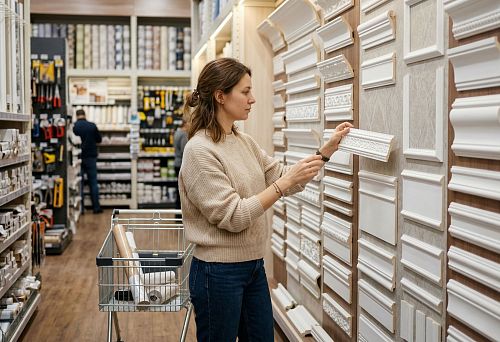
- Step 2: check the assortment
- Step 3: clarify about painting
- Step 4: determine if decor is needed
- Step 5: go to the desired catalog section
- About the Company STAVROS
- FAQ: popular questions about wallpaper molding
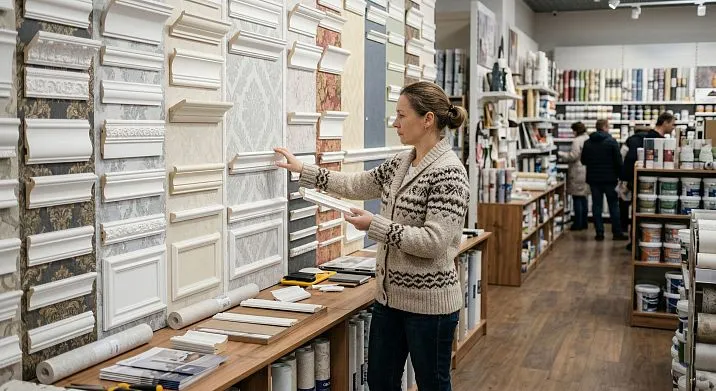
Imagine: a wall is covered with good wallpaper, smooth, without a single bubble. It's clean, neat — and yet completely faceless. Nothing bad, but nothing memorable. No character, no architecture. Just a background.
Now add molding. A thin decorative profile, glued over the wallpaper in the form of rectangular frames. And the wall stops being a background — it becomes part of the interior concept. This is not magic. This is the work of a properly chosen wallpaper molding.
If you're looking for which molding to buy for wallpaper, what works better for painting, how to create frame panels without renovation, and why a profile is not just a 'decoration', you've come to the right place. Here — practice, specifics, and a systematic view of the topic. Without fluff and without 'beautiful' but empty descriptions.



What is wallpaper molding and why is it needed
The answer to this question should start with what wallpaper molding is not.
It is not a border. Not a mass-market self-adhesive strip. Not a decorative strip that is glued 'for beauty' without understanding what happens to the space.
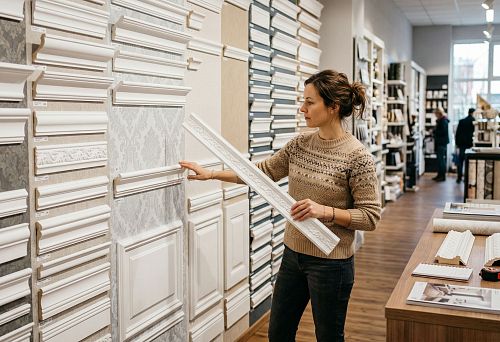
Wallpaper moldingis an architectural profile made of wood, MDF, or polyurethane that is mounted on top of a wall with wallpaper. It has several functions, and none of them are reduced to 'just pretty.'




Functions rarely spoken about out loud
Separation of planes. Molding is a line that divides the wall into meaningful zones. Lower panel zone / upper smooth zone. Accent part / neutral part. Where without molding the wall 'flows' continuously and monotonously, with molding rhythm appears.
Creating frames. Rectangular frames made of molding on a wall with wallpaper are a classic and powerful design technique. It creates depth where there is none structurally: a flat wall begins to be perceived as a three-dimensional, structured surface.
Boundary between colors. Molding is the perfect dividing line when the lower part of the wall is painted one color and the upper part another. The clean horizontal line of the profile makes this boundary architecturally precise, not accidental.
Hiding joints. Where two materials or two rolls of wallpaper meet, molding covers the seam—and does so not as a 'patch' but as a meaningful decorative element.
Accentuating zones. TV zone, headboard zone, gallery wall, niche — any functional center of a room can be 'highlighted' with molding by creating a frame or portal framing around it.
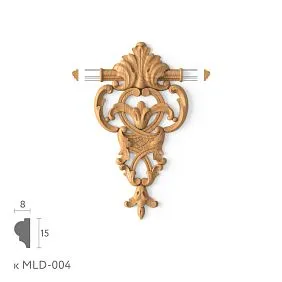
Our factory also produces:


Why molding over wallpaper is not a compromise
Many people think that molding is glued onto wallpaper 'instead of proper renovation'. In fact, it is a full-fledged design technique with its own logic.
Firstly, installing moldings over high-quality non-woven or vinyl wallpaper is technically correct — with the right choice of adhesive, the adhesion is reliable and durable.
Secondly, for paintable wallpaper — this is an ideal combination: the wallpaper forms a uniform surface, the molding creates relief and frames, everything is painted in a unified scheme. The result looks like complex, expensive finishing, although in terms of labor intensity it is quite accessible.
Get Consultation
Which moldings for wallpaper to buy for your task
The task is primary. Before choosing a profile, answer one question: what exactly do you want to do with this wall?
For frames on the wall
Decorative frames are the most popular scenario for using moldings on wallpaper. Rectangular frames made from profiles, placed on the wall with a calculated step, create a system that looks like expensive architectural finishing.
For frames: narrow or medium profile, 20–45 mm. Smooth or with minimal figured cross-section. Material — polyurethane or MDF for painting. The color of the frames — the same as the wall, or contrasting.
Key rule: all frames must be the same size and positioned symmetrically relative to the center of the wall or the main visual object (bed, sofa, TV).
For an accent wall
An accent wall requires decor that carries the 'weight' of the accent. A single large molding outline around the entire wall or large frames with pronounced relief—both techniques work. Here, the molding is not a background element but the main one.
For an accent wall: medium or wide profile, 40–80 mm, with a shaped cross-section or ornament. Contrast painting of the moldings against the wallpaper enhances the effect.
For panels
A panel zone is the lower part of a wall, highlighted by moldings as an independent decorative field. A horizontal top border + side verticals + baseboard at the bottom = a panel frame.
For panels: medium profile 30–55 mm, matte white or tinted paint. The panel zone occupies 1/3–1/2 of the wall height from the baseboard. Above—wallpaper with its own pattern.
For paintable wallpaper
This is a special case deserving its own section. When paintable wallpaper is uniform, without a pattern, with texture—the molding becomes the sole source of decorative relief. The system works like this: the wallpaper provides a uniform surface, the molding provides geometry and shadow.
For paintable wallpaper: any profile that holds paint well—polyurethane (primed), MDF (after priming), wood (clear varnish or opaque enamel). Detailed technology is in the articleMoldings on paintable wallpaper: installation technology without mistakes.
For a classic interior
Classic style is about relief, scale, warm tones. Molding for a classic living room with wallpaper: shaped profile with a goose or twist, width 45–75 mm, made of oak or beech for tinting, or polyurethane for painting in shades of ivory, parchment, creamy white.
A framing system in a classic interior is not an 'addition of decor,' but an essential architectural element, without which classic style looks unfinished.
For a modern interior
Modern interior + molding on wallpaper = unexpectedly powerful technique. Smooth rectangular profile 15–30 mm, matching the wall color, in the form of large rectangular frames — this is modern architectural graphics on the wall. No ornament, only line and shadow.
Scandinavian style, Japanese minimalism, modern classic — all these directions work excellently with molding frames. The key is restraint of the profile and precise geometry of placement.
Moldings on paintable wallpaper: when it's the best option
This is the main theme. Paintable wallpaper with molding — one of the most effective and underrated decorative techniques in modern renovation.
Why paintable wallpaper is the perfect base
Paintable wallpaper creates a uniform surface with texture — burlap, linen, silk, plaster. They level the wall, give 'warmth' to the surface, and are ready to accept any acrylic paint.
On such a base, molding is the only element creating decorative relief. And this is precisely what makes the 'paintable wallpaper + molding' system so expressive: a clean uniform plane + architectural line of the profile.
Solid-color walls and molding in the same tone
The first scheme is monochrome. Wallpaper of a solid color, molding of the same color. The entire wall is one color, but the molding creates shadow and relief. The wall is 'alive', not flat, but without decorative 'load'.
This is the most refined and expensive-feeling result. Especially effective in neutral shades: gray, taupe, white, linen.
Contrast frames: boldness as a principle
The second scheme is contrasting. Wallpaper in one color, moldings in another. White frames on a gray wall. Black outlines on terracotta wallpaper. Gold profiles on a dark blue background.
Contrast requires precision: the profile must be neat, joints must be perfect, and the placement of frames must be symmetrical. Any flaw stands out in a contrasting scheme.
Panels with painting inside the frame
The third scheme — inside the molding frame, the wallpaper is painted a different color. The molding frame defines a field, inside which is an accent color. Outside — a neutral background.
This imitates three-dimensional panels — and it works convincingly. The molding creates a 'border' between two colors, making the transition architecturally precise.
Molding as a border between colors on the wall
Horizontal molding — a belt on the wall — separates the lower and upper zones. The lower part is painted dark, the upper part light. Molding is the perfect dividing line that makes a two-color wall professional, not amateurish.
Without molding, the dividing line between colors is never perfectly even — wallpaper breathes, paint shifts, the boundary 'floats.' With molding, the boundary is architecturally precise, and that's enough.
What to consider before painting
A critically important point: if you plan to paint moldings on wallpaper, the order of work matters.
-
Paste the wallpaper, let it dry completely (minimum 48 hours).
-
Attach the moldings with high-adhesion glue suitable for wallpaper surfaces.
-
Fill the joints of the moldings with acrylic putty, then sand.
-
Prime the moldings (if necessary).
-
Paint everything with a single roller and brush.
Violating the order leads to problems: moldings hold poorly, joints are visible after painting, paint goes on unevenly.
How to choose a profile: narrow, wide, smooth, or decorative
Choosing a profile is choosing scale and tone.
Narrow profiles 15–30 mm: a fine line
A narrow molding creates a graphic line, not a three-dimensional relief. Its shadow is minimal. This is a choice for:
-
modern and Scandinavian interiors;
-
small spaces;
-
complex grids with frequent frame spacing;
-
solid monochrome walls, where extra relief would be overloading.
Rule: narrow molding — only with precise layout and perfect installation. Minor imperfections with a narrow profile are more noticeable than with a wide one.
Medium profiles 30–55 mm: a universal solution
Medium molding is the workhorse of decorative renovation. Wide enough to create noticeable relief and shadow; restrained enough not to overload the wall.
Suitable for:
-
frame panels in the living room and bedroom;
-
classical panel zones;
-
modern classic;
-
any interior of 'medium' scale.
Wide profiles 55–100 mm: scale and status
Wide molding is a statement. It creates strong relief, is legible from a distance, and sets the scale for the entire system. Suitable for:
-
high ceilings (3+ m);
-
on large panel fields;
-
classical, baroque, neoclassical style.
A wide profile on a small wall is overkill. Always match the width of the molding to the size of the field it frames.
Smooth profiles: strictness and purity
A smooth rectangular molding — without ornament, without a complex cross-section — is architectural strictness. Just a line, just a shadow. Works in any style where restraint is appropriate.
For plain paintable wallpaper + smooth molding — this is the most 'designer' scheme, which is not difficult to implement, and the result looks professional.
Decorative profiles with relief
A shaped profile with an ogee, a cavetto, a cyma, or ornamentation — this is the language of classical decor. It adds shadow, creates historical references, and gives the interior 'weight'.
For a classic living room with striped or floral wallpaper — a shaped profile 45–70 mm integrates organically into the stylistic context. For minimalism — it creates dissonance.
| Profile type | Width | Style | Material |
|---|---|---|---|
| Smooth thin | 15–30 mm | Modern, Scandinavian | MDF, polyurethane |
| Smooth medium | 30–55 mm | Modern classic, neutral | MDF, polyurethane, beech |
| Figural medium | 35–65 mm | Classic, neoclassic | Oak, beech, polyurethane |
| Figural wide | 60–100 mm | Classic, baroque, empire | Oak, polyurethane |
| Flexible | 20–50 mm | Arches, radius walls | Polyurethane |
How to combine moldings and wallpaper without visual chaos
This is not a question of aesthetics, but of systems thinking. Chaos arises not from moldings, but from the absence of a rule by which they are arranged.
When to use frames
Frames are appropriate on walls with plain or finely textured wallpaper. On wallpaper with a large pattern (flowers, landscape, geometry), frames compete with the pattern—and both lose.
Rule: frames + plain wallpaper. Frames on patterned wallpaper—only with a very restrained pattern (small geometry, light texture).
When to build panels
A paneled zone is appropriate in any interior where there is vertical space for two zones: lower (paneled) / upper (wallpaper). The standard height of the lower zone is 80–120 cm from the baseboard.
Above—wallpaper with its pattern. A horizontal molding belt separates the zones. The lower zone—a different color, different texture, or the same but with frames.
How to match wallpaper pattern and profile
Three working principles:
-
Pattern + smooth profile — the pattern 'reads', the profile creates a frame without competition.
-
Solid wallpaper + decorative profile — the uniform background 'holds' the ornamental molding.
-
Geometric wallpaper + rectangular frames — the geometry matches, the wall becomes a unified system.
Not allowed: large floral pattern + carved ornamental molding. Two bright patterns at once — this is a visual conflict that tires the eyes.
What to do on a high wall
A wall higher than 3 m requires vertical rhythm — otherwise it 'looms'. Two options:
-
Vertical frames, elongated in a 1:2 or 1:2.5 proportion — guide the eye upward.
-
Horizontal molding belt at a height of 2.0–2.2 m from the floor — 'divides' the height into proportionate parts.
How to work with an accent wall
Accent wall + molding — a powerful duo. The entire wall is a different color or material, while molding frames create structure within the accent. Result: the wall 'works' as the main focal point of the room, and the moldings give it architectural order.
A detailed look at wall decorative systems — in the articledecorative elements for wall finishing: moldings, panels, and overlays.
When molding decor is needed
Molding decor — corner elements, central overlays, decorative blocks — this is the next level of the system. When a basic frame is no longer enough.
Corner elements
In classic frames, corners are joined 'on a miter' — at a 45° angle. This is the basic method. But there are ready-made corner blocks — decorative square or round elements that are installed in the corners of the frame instead of a joint.
Corner blocks: easier to install (no precise miter saw needed), create an additional decorative accent. A traditional technique in classic and neoclassical interiors.
Decorative appliqués
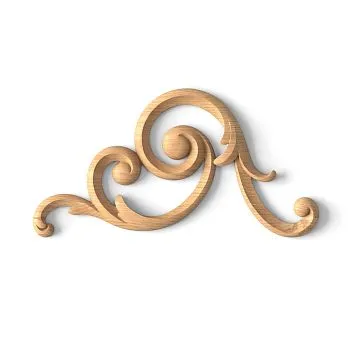
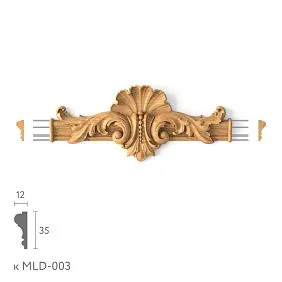
Central overlays on horizontal molding belts — small decorative elements (leaves, rosettes, cartouches) that are installed in the center of a long horizontal strip or at the intersection of profiles.
Overlays 'enliven' the system: rhythmic repetitions of small decorative elements create an ornamental belt without full-fledged carving work.
Central inserts
In large frame fields — a central decorative insert (small rosette, medallion, heraldic element). Transforms the frame from 'empty geometry' into a decorative object.
Especially effective on an accent wall and in the headboard area of a bedroom.
Ready-made compositions
When all the decor—profiles, corner blocks, central inserts—is from the same series and manufacturer, the system looks like a unified designer product. A mix from different series is almost always a compromise that is noticeable upon close inspection.
That is why it is important to choose moldings and their matching decor from a single manufacturer, rather than assembling them from different sources.
What determines the price of wallpaper molding
Honest pricing—no marketing.
Material: the main factor
| Material | Price (approx.) | Pros |
|---|---|---|
| Polyurethane | from 120–350 rub./m | Lightweight, primed, paintable |
| MDF | from 180–450 rub./m | Durable, paintable, clean cut |
| Beech | from 380–750 rub./m | Natural, for tinting |
| Oak | from 650–2,000 rub./m | Status, durability, texture |
| Carved oak | from 2,000–10,000+ rub./m | Handmade, top class |
Width: linear dependency
A 60 mm molding consumes approximately twice as much material as a 30 mm one. With the same relief and material, width directly determines the price.
Relief: simple and complex
A smooth rectangular profile is one milling operation. A shaped profile with a 'goose' is two to three operations. Carved ornament is 3D milling and manual finishing. The price difference ranges from 50% to 1,000%+ depending on the complexity of the ornament.
Molding decor: added value
Corner elements — from 200–1,500 rub./pc. Center overlays — from 300–3,000 rub./pc. Cost of a set for one frame (4 corners + center element) — from 1,200 to 15,000 rub. This adds to the cost per linear meter but qualitatively changes the visual result.
Standard or custom profile
Standard from catalog — minimum price, ready for shipment. Custom according to drawing — surcharge 30–100%, production time from 2–4 weeks. Relevant for project sites and design tasks with non-standard requirements.
Where to buy wallpaper molding without mistakes
Practical route from need to the right solution.
Step 1: define the task
-
Frames on the wall → smooth/figural profile 25–50 mm, polyurethane or MDF.
-
Paintable wallpaper → primed polyurethane or MDF, any width.
-
Classic interior → figural oak/beech 45–75 mm.
-
Modern → smooth MDF/polyurethane 15–35 mm.
Step 2: check the assortment
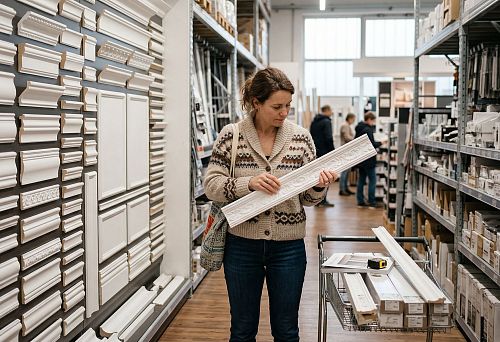
Consider not only the profile photo but also technical parameters: width, height, material, coating type (primed / ready for painting / tinted).
Step 3: clarify painting details
If painting is planned — the profile must be primed or made from a material that does not require special preparation for paint. MDF is primed before painting. Natural oak under opaque enamel — only with full priming.
Step 4: determine if decor is needed
If frames in a classic style are planned — corner blocks are appropriate and simplify installation. For modern frames — 45° joints are sufficient.
Step 5: go to the required catalog section
Wooden moldings for walls and wallpaper:
→ Solid wood moldings
Article about moldings on paintable wallpaper:
→ Moldings on paintable wallpaper: a revolution in decorative finishing
Molding installation technology on wallpaper:
→ Moldings on paintable wallpaper: installation technology without mistakes
Decorative elements for wall finishing:
→ decorative elements for wall finishing: moldings, panels, and overlays
Construction of panels and systems from moldings:
→ Polyurethane wall moldings: panel construction and rhythm
Slat panels combined with moldings:
→ Slatted panels for walls and wood moldings
About the company STAVROS
STAVROS is a Russian manufacturer of architectural wooden decor: moldings, trims, baseboards, cornices, slat panels, wall systems. Production in St. Petersburg since 2002, full cycle from solid wood drying to finished product.
STAVROS produces moldings for wallpaper and wall panels made of oak, beech, MDF — over 50 standard profiles, as well as custom-made products. For each profile — technical parameters, tinting samples, and project support.
For B2B partners — designers, architects, developers — STAVROS offers project support: from profile selection to developing a molding map and manufacturing for a specific project. Retail sales from 1 linear meter, prompt shipment from warehouse.
FAQ: popular questions about wallpaper molding
Which molding is best for wallpaper?
Depends on the task and style. For paintable wallpaper — primed polyurethane or MDF, any width, matching the chosen profile. For classic interiors with patterned wallpaper — figured profile made of oak or beech 45–70 mm. For modern — smooth polyurethane or MDF 20–40 mm.
Can molding be glued over wallpaper?
Yes, if conditions are met. Wallpaper must be tightly glued, without bubbles or peeling. Adhesive type — mounting adhesive with high adhesion to wallpaper surface: polyurethane, acrylic mounting, or hybrid adhesive-sealant. Heavy plaster moldings on paper wallpaper — not recommended.
Which moldings are suitable for painting?
Polyurethane (factory-primed), MDF (requires priming before painting), wood (for opaque enamel — full priming). It is not recommended to paint oak or beech with pronounced texture with opaque enamel — the main feature is lost.
Which profiles are better for wall frames?
For a modern interior — smooth profile 20–40 mm. For classic — figured 40–65 mm. For Scandinavian — smooth 15–25 mm. Frames are mounted strictly level, symmetrically relative to the center of the wall.
When are corner elements needed?
With a classic frame style — corner blocks are always appropriate: they simplify installation and add a decorative accent. With modern minimalism — only a 45° joint, no overlays.
How to choose molding width for wallpaper?
Guideline: molding width = 8–15% of the frame field width. Frame field 50 cm → molding 4–7.5 cm. For plain paintable wallpaper, you can take a larger width — the relief will work well. For patterned wallpaper — a narrower profile to avoid competing with the pattern.
What to buy for wallpaper molding: wood or polyurethane?
Polyurethane — if painting is needed, high humidity, flexible solutions, or quick installation. Wood (oak/beech) — if natural texture, tinting, and 50+ years durability are important. MDF — a universal budget option for painting with good cut quality.