Article Contents:
- What is living room molding and where is it used
- Wall moldings in the living room
- Moldings for accent walls
- Moldings for TV zones
- Moldings for classic living rooms
- Moldings for wall zoning
- Which moldings to choose for the living room
- Smooth moldings
- Classical profiles with historical cross-sections
- Relief moldings with ornament
- Paintable Molding
- Polyurethane moldings for living room walls
- What is better for the living room: moldings, stucco, or other wall decor
- When you specifically need molding
- When stucco is needed
- When polyurethane decor is appropriate
- When it is better to combine moldings and panels
- How to choose a molding for the living room according to interior style
- Classic Living Room
- Neoclassicism
- Modern Living Room
- Light living room
- Dark classic living room
- Moldings for the living room and TV area
- How to decorate a wall under a TV with moldings
- How not to overload the composition
- When to combine moldings and slatted panels
- Lighting and relief on one wall
- What elements to buy together with molding for the living room
- Relief decoration
- Polyurethane wall decor
- Moldings
- Cornices
- Recessed Outlets
- Elements for a classic composition
- Mistakes when choosing moldings for the living room
- Too small a profile on a large wall
- Too complex a pattern in a small room
- Lack of logic in symmetry
- Mixing moldings and furniture without stylistic connection
- Overloading the TV area with decor
- Where to buy moldings for the living room
- How to choose a profile
- How to choose the size
- How to combine with furniture
- How to assemble a wall composition
- What to buy as a set
- Table: Molding for living room by style
- FAQ: Answers to popular questions about living room moldings
- Which molding is best for the living room?
- Are polyurethane moldings suitable for the living room?
- What is better for a living room wall: molding or stucco?
- How to decorate a TV area with moldings?
- Can moldings and slatted panels be combined in the living room?
- Which moldings are suitable for a classic living room?
- Are corner elements needed for molding in the living room?
- Can moldings be painted to match the wall color?
- How much molding is needed for a 20 sq. m living room?
- How long does molding last on a living room wall?
- Is molding suitable for acoustic tasks in the living room?
- What's better for a TV area: molding or slat panel?
- What clearance should be left from the floor and ceiling when installing molding?
- How to avoid mistakes with the number of frames on the wall?
- About the Company STAVROS

The living room is the room everyone sees. This is where guests are received, where the family gathers in the evening, where the first impression of the home is formed in just a few seconds. And that's precisely why the question of wall decor in the living room isn't about 'decorating,' but about 'creating character.' Molding for the living room isn't just cosmetics. It's an architectural tool that gives walls structure, depth, and meaning.
That's exactly why the query"molding for the living room"is one of the most persistent in interior design searches. People come with a specific desire: to bring the wall to life with frame panels, horizontal bands, a decorative system around the TV. They are looking forplasterwork for the living room, decorative profiles, understanding—what to choose, how to arrange, what to buy together.
This article provides a comprehensive answer. No fluff, no generalities, just practical advice: what isWall moldings for the living room, how to choose them by style and scale, how to build a decorative system from profile to handle. Read on — and you'll definitely understand exactly what your living room needs.



What is a molding for the living room and where is it used
Let's start with a definition that changes everything.Moldings in the living room interior— are decorative profiles that are mounted directly on walls. They create framed panels, horizontal divisions, accent zones, and decorative bands. These are not just 'frames for beauty' — this is the architectural logic of a classic interior, transferred to a modern wall.
In historical architecture, walls were divided into three horizontal zones: the plinth (lower part), the main field, and the frieze (upper zone under the cornice). Each zone had its own solution, its own decorative division. The molding is precisely the main tool of this division. And today, when this principle returns to modern interiors, it works just as flawlessly as it did hundreds of years ago.




Wall moldings in the living room
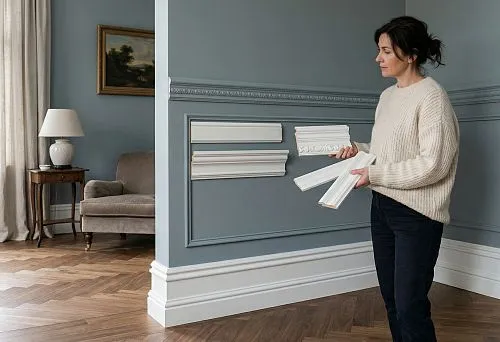
The most common scenario is framed panels around the entire perimeter of the living room. Straight sections of profile form rectangular frames with an offset from the floor and ceiling. After monochrome painting, the frames 'dissolve' into the wall color but remain visible through light and shadow. The result is an architecturally rich surface without a single additional decorative element.
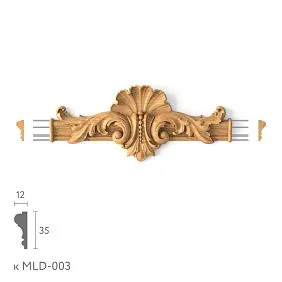
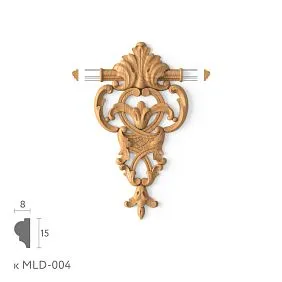
Our factory also produces:


Moldings for an accent wall
An accent wall in the living room is one of the most powerful design ideas. Molding on one wall with neutral others creates a visual focal point for the entire room. The scheme is especially expressive: the accent wall is painted in a contrasting color + molding matching the wall color + lighting behind the profile.
Get Consultation
Moldings for the TV zone
A TV on the wall is standard in a modern living room. But simply hanging a screen on a bare wall looks visually 'poor'.Molding on the wall in the living roomaround the screen creates a 'portal' effect: the TV is framed by a structural border, and the wall behind it turns into a decorative panel. This is one of the most effective ways to enhance the TV zone without overloading it with details.
Moldings for a classic living room
A classic living room without wall molding is classic at half strength. It is precisely the wall profile that creates that 'palatial' rhythm we associate with high style. Wide frame panels in the lower zone, a horizontal belt at 1100 mm level, a cornice around the ceiling perimeter—this is a three-level decorative system that transforms an ordinary room into an architectural space.
Moldings for wall zoning
The living room is often a large space where different functional zones need to be visually highlighted: the sofa zone, reading zone, TV zone. Molding solves this task without partitions: horizontal belts at different heights or different frame panel schemes on different walls create visual differentiation of the space.
Which moldings to choose for the living room
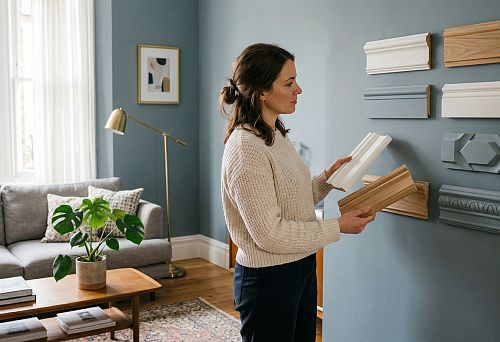
The market offers several fundamentally different types of profiles. Let's examine each in relation to the living room.
Smooth moldings
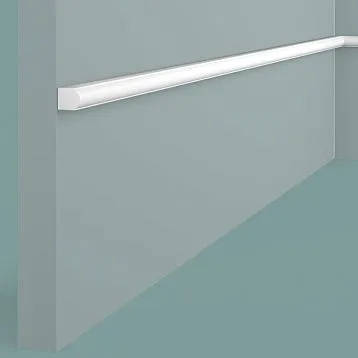
Smooth profile — rectangular or stepped cross-section without ornamental details. This is the most versatile choice for the living room: it works in neoclassical, Scandinavian classic, and modern neutral interiors. When painted the same color as the wall, it creates an exclusively geometric frame structure — without stylistic commitments.
Width of smooth profile for the living room: with ceilings 2.7–3.0 m — 40–55 mm. With ceilings 3.0–3.5 m — 55–70 mm. These parameters ensure the correct proportion between the profile and the scale of the wall.
Classical profiles with historical cross-section
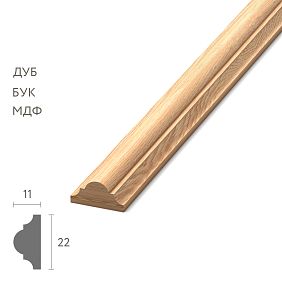
Relief profile with a scotia, ovolo, or torus — the correct choice for a classical or neoclassical living room. It is precisely such a cross-section that recreates the logic of historical architectural moldings and creates a rich play of light and shadow under side lighting.
Moldingwith a classical profile — this is not just 'decoration', it is an architectural tool. It is precisely such profiles that are installed in formal living rooms with ceilings of 3 m and higher, where the scale of the room requires the scale of decoration.
Relief moldings with ornament
For interiors in Baroque, Classicism, or Empire style — molding with ornamental relief: beads, acanthus leaf, meander, guilloche. This is the highest level of wall decoration. Requires strict stylistic discipline: the ornament of the molding should echo the ornament of other decor in the living room — furniture handles, cornices, overlays.
Moldings for painting
Most modern living rooms are monochrome or with minimal color accents.Decorative wall moldingand moldings here are painted the same color as the wall: white, light gray, mint, dusty pink. The molding 'merges' with the surface in color, remaining visible only through relief and shadow.
This is the highest class of wall decor. Architectural, refined, restrained. It is in this execution that molding becomes not a 'decoration,' but a 'structure.'
Polyurethane moldings for living room walls
Polyurethane wall decor— this is the optimal solution for a living room in terms of the balance of result, price, and installation convenience. Lightweight, precise in relief, installed with adhesive in one day, paintable with any paint, they do not warp or crack.
Compared to plaster: polyurethane is 15–20 times lighter, does not require wet work, needs no special skills for installation, and provides a sharper relief. Compared to wood: it is cheaper for complex ornamental profiles and does not react to humidity fluctuations. That is why most professional designers choose polyurethane for living room wall decor.
What is better for a living room: moldings, stucco, or other wall decor
An honest conversation about choosing between tools — because this is the question most often asked before purchase.
When molding is specifically needed
Molding is indispensable when the task is to create a geometric frame structure on walls. Frames, belts, divisions — all of this is the task of molding. No other tool provides the same architectural logic with the same simplicity of installation.
For a living room, molding is the first level of decor. It creates the 'skeleton' of the wall's decorative program. Everything else — overlays, rosettes, cornices — is built upon this skeleton.
When stucco is needed
Molding for the living room— this is three-dimensional ornamental decor: cartouches, medallions, relief panels, corner overlays, central rosettes. Stucco works within the frame structure of molding or as independent accent elements.
Correct scheme: molding creates frames →Molding for wallsdecorates the corners and centers of these frames. This is a two-level decorative system that delivers maximum classic results. This is exactly how formal living rooms in classic and neoclassical styles are decorated.
When polyurethane decor is appropriate
Polyurethane decor for interiors— this includes both moldings and stucco in one material. For a living room, this means complete freedom in forming the decorative program: you can take smooth molding + ornamental overlays + cornice — all made of polyurethane, all stylistically compatible, all glued with the same adhesive.
This is the most practical approach. One material, one installation technique, one paint job — and the living room's decorative system is ready.
When it's better to combine moldings and panels
Some areas of the living room — especially the TV wall — benefit from a combination of wall molding and slatted panels. The molding creates a framed border, inside whichSlatted panels in the living room interiorare installed. This is a modern, multi-layered technique that combines the classic architecture of a frame with the warm texture of wood.
How to choose molding for a living room based on interior style
Style is not just a word on a designer's sketch. It's a system of rules that must be followed consistently. An error in the stylistic choice of molding is always noticeable — even if it's difficult to explain.
Classic living room
Classic Furniture for the Living Roomrequires a classic decorative wall program. For walls: relief molding with a historical profile—cavetto, ogee, torus. Width: 55–80 mm. Frame panels on the lower wall zone (up to 1100 mm from the floor), a horizontal belt at this level, a cornice along the ceiling perimeter.
Corner rosettes and central ones— everything must correspond to the chosen era.are essential for a full classic result. Color: white, ivory, cream—all in a uniform tone.
For more on the logic of classic interiors and the rules for reproducing them, see thecomplete guide to classic furniture.
Neoclassicism
A modern interpretation of classicism—more concise, without formal solemnity. For a neoclassical living room:
-
smooth molding of medium width (40–55 mm);
-
simple frame panels without additional overlays;
-
neutral color program: white, light gray, warm beige;
-
furniture from the catalogclassic furniture in the interioras an organic complement.
Neoclassical is the most popular format for applying wall molding in the living room. It works without affectation, creates architectural character for the space, and yet remains fresh and modern.
Modern living room
For a modern neutral interior with historical notes: narrow smooth molding (25–40 mm), monochrome painting in the wall color. The frames are visible only through shadow. This is an extremely delicate, modern technique — 'a bit of structure' without stylistic commitments.
Light living room
A light living room — white walls, light furniture, soft neutral tones — perfectly accepts molding in the same white or light gray color. The profile's relief creates light shadows that are perceived as 'air' and depth, without disrupting the light character of the interior.
For a light living room, choose profiles with clear, deep geometric sections: it is the sharp changes in height that give noticeable shadow even on a white surface.
Dark classical living room
A living room with dark walls, dark furniture, gold and bronze accents — one of the most expressive modern interior trends. For a dark living room, molding is painted the same dark color or a contrasting light one — to create an expressive 'drawn' structure.
On shade combinations and selection principlesdark classic furniturefor the living room — details in a special article that breaks down shades, combinations, and rules for forming the color scheme of a dark interior.
Moldings for the living room and TV area
The TV area in the living room is a separate decorative task. The TV is the dominant visual element of any living room, and the impression of the entire room depends on how the wall around it is decorated.
How to decorate a wall for a TV with moldings
Basic scheme: molding creates a rectangular frame around the entire TV wall or its central part. The wall inside the frame can be painted in a contrasting color, covered with different wallpaper, or given textured plaster. In this scheme, the molding is the border, the 'mat' for the decorative field.
A more complex scheme — several nested frames of different widths, creating depth and volume. This is a technique from theatrical backdrops: each subsequent frame 'recesses' the previous field into depth, creating an illusion of spatial layering.
How not to overload the composition
The main mistake in a TV area is the desire to 'put everything at once': molding + shelves + decor + lighting + overlays. As a result, the wall screams, and the TV gets lost.
Rule: one dominant element. If it's molding — it's the main element, everything else is delicate. If it's a slatted panel — the molding acts as a framing border, not competing with the wooden texture.
When to combine moldings and slatted panels
Moldings and slatted panels are not competitors but an excellent duo when used correctly. Scheme: molding creates an outer rectangular frame on the TV wall → slatted panels are mounted inside the frame.slatted panel for the televisionMolding provides geometric logic, slats provide warm wooden texture. This combination of material and form creates a rich, multi-layered result.
For detailed designer scenarios with slatted panels and examples of their application, see thedetailed photo guide to slatted wall panelswhere examples and visual solutions for different styles and rooms are collected.
Lighting and texture on one wall
Molding + lighting is one of the most effective combinations in the living room. An LED strip hidden behind or under the molding creates a soft glow that 'pulls' the profile texture out of the shadows. With properly selected light temperature, the molding becomes a glowing architectural element — especially impressive in evening mode.
About the aesthetics of wooden slatted structures with lighting — in the article aboutslatted panels with lightingwhere the logic of lighting design in wooden decorative systems is analyzed in detail.
What elements to buy together with molding for the living room
Molding is the first and main element of the system. But it is the system, not an individual profile, that creates a truly complete interior.
Relief Decoration
Corner rosettes, cartouches, medallions —decorative elementsmade of polyurethane, which are mounted in the corners of frames and in the center of decorative fields. For a classic living room, this is a mandatory second level of decor. For neoclassical — optional, depending on the richness of the decorative program.
Polyurethane wall decor
Polyurethane Decoris a broad category: from simple corner elements to complex relief panels. In the living room, polyurethane decor works as a 'finisher' — it closes the corners of frames, creates central accents, adds an ornamental layer to the clean geometry of the molding.
Important: all decor should be from the same series, the same manufacturer — to guarantee stylistic compatibility.
Appliances
wall molding for saleseparately — the correct strategy for phased decoration. First, the molding is mounted, then — the overlays. This allows you to evaluate the result of the first level and accurately determine where accents of the next level are needed.
Crown mouldings
Ceiling cornice — a mandatory 'crown' of any classic and neoclassical living room. It completes the wall decorative program from above, creating a logical connection between the wall and the ceiling. Rule: the cornice profile should be in the same stylistic logic as the wall molding.
Rosettes
Ceiling rosette in the center of the plafond or chandelier — another point of the classic decorative system. In the living room, the rosette creates an accent in the center of the ceiling, which echoes the frame structures on the walls. This 'closes' the decorative system along the entire perimeter of the room — walls, ceiling, cornice — into a single architectural logic.
Elements for a classical composition
For a living room in a full-fledged classical style"living room classic furniture wood"— is a unified ensemble of furniture and decor. Furniture made of natural wood with carved elements organically complements the wall program of moldings and stucco. It is this unity of materials — wood in the furniture and wood (or polyurethane in the same color) on the walls — that creates that very "expensive" effect, which cannot be faked.
Mistakes when choosing moldings for the living room
Every mistake is either money down the drain or an interior that doesn't bring joy. Let's break down the main ones.
Too small a profile on a large wall
A molding 20 mm wide on a wall 3 meters high is a visual "nothing." The profile is not discernible, the frames do not create the necessary structure. For a tall and wide living room, the minimum molding width is 45–55 mm. This is the basic rule of scale correspondence.
Too intricate a pattern in a small room
A lush baroque ornamental molding in a living room of 20 sq. m is an overload. In a small space, a complex relief "compresses" the walls and creates a heavy, anxious feeling. For small living rooms — only a smooth or delicately relief profile.
The Absence of Logic in Symmetry
Frames of different sizes, different offsets on different walls, mismatched lines of horizontal belts—all of this undermines the decorative program. Molding works through symmetry and rhythm. A breach in the system is always noticeable—even to those who cannot explain why 'something is off.'
Mixing Moldings and Furniture Without Stylistic Connection
Ornamental classical molding on the walls + minimalist Scandinavian furniture + loft-style furniture handles—three different decorative languages in one room. Molding and furniture should speak the same language. That is why choosing wall decor and choosing furniture is a single decision made simultaneously.
Overloading the TV Zone with Decor
A TV zone with three levels of decor, perimeter lighting, and additional overlays on top of the molding—this is not decor, it's informational noise. In the TV zone, the screen dominates. Molding in this zone should be support, not a competitor.
Where to Buy Moldings for the Living Room
How to choose a profile
Before ordering, determine four parameters:
-
Interior style—classic, neoclassic, modern neutral;
-
Ceiling height—this determines the profile width;
-
Task — frames around the entire perimeter, accent wall, TV zone, horizontal molding;
-
Finish — monochrome painting or contrasting solution.
How to choose the size
| Ceiling height | Molding width |
|---|---|
| 2.5–2.7 m | 30–45 mm |
| 2.7–3.0 m | 45–60 mm |
| 3.0–3.5 m | 55–75 mm |
| Above 3.5 m | from 70 mm |
How to combine with furniture
Molding for the living roomand furniture — a unified decorative ensemble. Relief molding — for carved wooden furniture of classic shapes. Smooth molding — for modern neutral furniture with delicate classical notes. Mixing stylistic languages is taboo.
How to assemble a composition on the wall
Professional approach — start by marking the entire wall on paper. Determine the number of frames, their sizes, distances from the floor, ceiling, and corners. Mark directly on the wall with painter's tape — assess the proportions 'in real life'. And only after that — cut and glue.
What to buy as a set
Buy molding for the living roomand taking everything from one catalog is the right strategy. Molding + corner elements + central overlays + cornice + adhesive. Style compatibility is guaranteed. Material reserve — minimum 15% of the calculated quantity.
Table: Molding for living room by style
| Living room style | Profile type | Width | Decorative element | Color |
|---|---|---|---|---|
| Classic | Relief historical | 55–80 mm | Rosettes, cartouches | White, cream |
| Neoclassical | Smooth or low relief | 40–55 mm | Minimal overlays | White, Light Gray |
| Modern | Smooth narrow | 25–40 mm | Without overlays | Wall color |
| Dark Classic | Relief | 50–70 mm | Overlays with Ornament | Dark or Contrast |
| Provence | Smooth Delicate | 20–35 mm | Without Overlays or Simple | White, cream |
FAQ: Answers to Popular Questions about Living Room Mouldings
Which Moulding is Best for a Living Room?
The bestMolding for the living room— the one that matches the interior style, ceiling height, and planned finish. For most modern living rooms with ceilings 2.7–3.0 m — a smooth or delicately relief profile 40–55 mm made of polyurethane for monochrome painting.
Are Polyurethane Mouldings Suitable for a Living Room?
Yes, this is the optimal material for the living room. Lightweight, precise in relief, installed with adhesive without special skills, paintable with any paint, does not deform.Polyurethane moldings for the living room— the standard for professional designers for wall decor in residential spaces.
What is better for a living room wall: molding or plasterwork?
This is not an 'either/or' choice, but a question of sequence. Molding creates a frame structure.Molding for wallsdecorates this structure with ornamental accents. For a classic living room—both are needed. For a modern one—often only molding is sufficient.
How to design a TV zone with moldings?
Create a rectangular frame from molding around the TV wall or its central zone. Paint the wall inside the frame in a contrasting color or leave it the same color as the molding. If desired, add backlighting behind the profile. Do not overload the zone with additional decor—the TV should remain the dominant element.
Can moldings and slatted panels be combined in a living room?
Yes, this is a professional technique. Molding creates an outer frame,Slatted panels in the living room interior— an interior field with a wood texture. The combination of the frame's geometry and the organic nature of wood creates a rich, multi-layered result. Especially effective in the TV area and on accent walls.
Which moldings are suitable for a classic living room?
A relief profile with a historical cross-section — cavetto, ovolo, torus. Width from 55 mm. Corner rosettes and central overlays. Cornice around the perimeter of the ceiling. All in a unified stylistic program withclassic furniture for the living room.
Are corner elements needed for molding in the living room?
For frame panels — absolutely. Corner elements create clear rectangular corners without cutting at 45°. Without them, the frames look unfinished. For horizontal bands (without a frame) — corner elements are not needed.
Can moldings be painted to match the wall color?
Yes, this is a standard and correct technique.Buy moldings for the living roomand paint them to match the wall color — means obtaining an architectural frame structure that works through light and shadow, not through color contrast. This is the highest class of wall decor.
How much molding is needed for a 20 sq. m living room?
For one accent wall with frame panels — approximately 15–25 linear meters. For frame panels around the entire perimeter — 50–80 linear meters. Exact calculation: sum the perimeter of all frames + 20% margin.
How long does molding last on a living room wall?
With proper installation (even surface, correct adhesive, adherence to technology) — for decades. Polyurethane does not deform, shrink, or crack. It can be repainted during every renovation without removal.
Is molding suitable for acoustic tasks in the living room?
Molding itself does not solve acoustic tasks. But if the living room requires acoustic improvement, it makes sense to consider Acoustic slat wall panels — they combine decorative and acoustic effects and can be used in combination with molding as a frame border.
What is better for a TV zone: molding or slatted panel?
Depends on the living room style. For classic and neoclassical — molding creates the proper architectural frame. For a modern interior with wooden accents — a slatted panel or their combination. More about the logic of TV wall design — in the article on slatted panel for TV with specific designer solutions.
What spacing should be left from the floor and ceiling when installing molding?
For the lower frame panel: bottom spacing — skirting board height + 30–50 mm. Top spacing for the horizontal belt — typically 1000–1200 mm from the floor. Distance between the top of the frame and the cornice/ceiling — at least 150–200 mm. These parameters ensure correct classical proportions.
How to avoid mistakes with the number of frames on a wall?
Optimal number of frames in a row: no more than 4–5 on a standard wall (4–5 m wide). With more frames, they become too narrow and lose monumentality. Better fewer but larger — this is an architectural logic that should not be violated.
About the company STAVROS
Buy molding for the living roomand select a complete decorative system to match it — moldings,stucco on wallscornices, rosettes, and overlays — can be found in the STAVROS company catalog.
STAVROS is a manufacturer and supplier of decorative elements made of polyurethane and natural wood for interiors. The catalog includespolyurethane moldings for living roomsof various profiles and widths, corner rosettes and connectors, central overlays and cartouches, cornices, and slatted decorative systems. All catalog elements are developed as compatible systems — stylistic unity when purchasing from a single source is guaranteed.
STAVROS works with private customers, interior designers, and construction crews. Professional consultation on selection, quantity calculation, and installation technology — with every order. When the task is not just to 'buy molding,' but to create a decorative system with genuine architectural character in the living room, STAVROS is the right choice.