Article Contents:
- What is molding for the living room and where is it used
- Wall moldings in the living room
- Moldings for accent walls
- Moldings for classic living rooms
- Moldings for zoning and TV areas
- Which moldings are suitable for the living room
- Smooth moldings: neutral architecture
- Classical relief profiles
- Moldings with ornamental decoration
- Paintable Molding
- Polyurethane wall moldings
- What is better for the living room: molding, stucco, or other wall decor
- Molding — a structural tool
- Molding — a tool for ornamental accent
- When polyurethane decor is needed
- When it's better to combine moldings and slat panels
- How to choose molding for the living room by style
- Classic Living Room
- Neoclassicism
- Modern neutral living room
- Dark classic living room
- Bright spacious living room
- Moldings for TV zone and accent wall in the living room
- How to decorate a wall under a TV with moldings
- When to combine moldings and slatted panels
- How to use lighting with molding
- What elements to buy together with molding for the living room
- Molded decor: corner rosettes and cartouches
- Polyurethane overlays
- Cornice
- Ceiling rosette
- Mistakes when choosing moldings for the living room
- Too small a profile on a large wall
- Overloaded wall
- Violation of symmetry and rhythm
- Conflict between molding and furniture
- Excessive decor in the TV area
- Where to buy moldings for the living room: how to make the right choice
- FAQ: Answers to the most popular questions about living room moldings
- Which molding is best suited for the living room?
- How does molding differ from stucco?
- Can molding be glued directly to the wall?
- How to decorate a TV area with moldings?
- Can moldings and slatted panels be combined in the living room?
- Which moldings are suitable for a classic living room?
- How much molding is needed for the living room?
- How long does molding last on living room walls?
- Is primer needed before installing molding?
- Can molding be painted a different color if you want to change the interior?
- How to correctly calculate the spacing for molding frames?
- Which slatted panels pair best with molding?
- Is molding needed in a small living room?
- Can molding be used on walls with wallpaper?
- About the Company STAVROS
There are rooms you want to enter—and stay. Not because of expensive furniture or rare materials. But because the space has character: walls breathe architecture, light falls on reliefs, the eye lingers on details. Almost always behind this effect is one solution—Molding for the living room.
These are not 'little frames for beauty,' as some condescendingly say.Molding for the living room— is a decorative profile that is mounted directly onto walls, transforming flat painted surfaces into architecturally organized space. Frame panels in the lower zone, horizontal belts at waist level, relief framing around the TV, an accent wall with classic coffers—this is what turns a living room from an 'ordinary apartment' into an interior with a claim to historical depth.
Exactly thereforeWall moldings for the living roomremain one of the most stable queries in interior search—along withmolding for the living roomand decorative elements for walls. People are not just looking for a product; they are looking for a solution—how to transform the most important room in the house. This article is precisely about that solution: from choosing the profile to the final decorative touch.



What is molding for the living room and where is it used
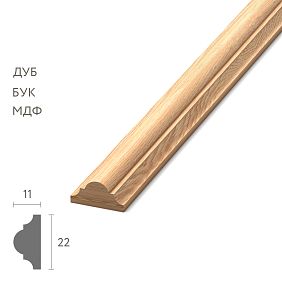
In short: molding is a wooden, polyurethane, or plaster profile with a specific cross-section that is glued to walls to create a decorative structure on them. It can be narrow—20 mm, or monumental—100 mm or more. It can mimic strict geometric protrusions or carry a complex ornamental relief.
But the main thing here is not the shape of the profile, but the principle of action. Molding does to a wall what a mat does to a photograph: it frames, structures, provides scale and context. A bare wall is just a background. A wall with molding is an architectural element.




Wall moldings in the living room
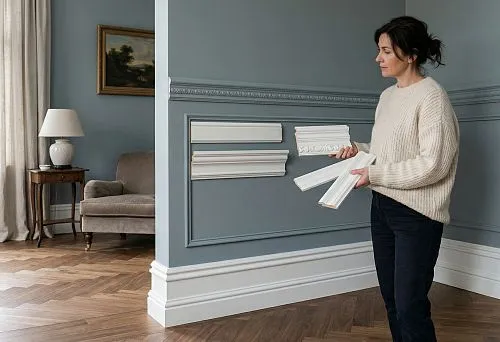
The most common scenario is frame panels around the entire perimeter of the living room. On each wall, a series of rectangular frames is created with equal spacing from the floor, ceiling, and each other. After painting in the same color as the wall, the frames 'blend' into the surface in color but remain alive through shadow and relief. At different times of the day, with different side lighting, the wall looks different—this is the main quality of good wall decor.
Our factory also produces:


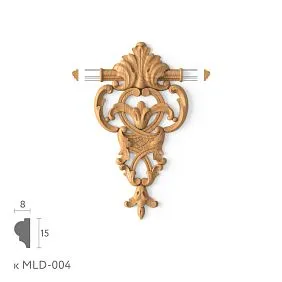
Moldings for an accent wall
An accent wall—one with concentrated decor. The others are neutral, background. For the accent wall, molding is used more intensively: wider profile, double frames, additional horizontal belts. Contrast painting enhances the effect. Such a wall becomes the architectural center of the living room—it is what draws the eye, and it is around it that key furniture is arranged.
Get Consultation
Moldings for a classic living room
Molding on the wall in the living roomin the classical style—is a three-level system: a lower zone with frame panels (up to 1100–1200 mm from the floor), a horizontal belt separating the lower zone from the upper, and a cornice around the ceiling perimeter. This system dates back to the architectural principles of order decor, where the wall was divided into a plinth, pylon, and entablature. It is precisely this that creates that very feeling of a 'palatial' living room, which people call 'classic'.
Moldings for zoning and TV area
In large open living rooms, molding solves not only a decorative but also a planning task: a horizontal band visually divides a high wall into zones, a framed panel on one wall highlights the sofa area, and a decorative frame around the TV screen emphasizes the TV zone. This is invisible zoning without partitions, without a barrier-like piece of furniture—only through rhythm and surface form.
Which moldings are suitable for the living room
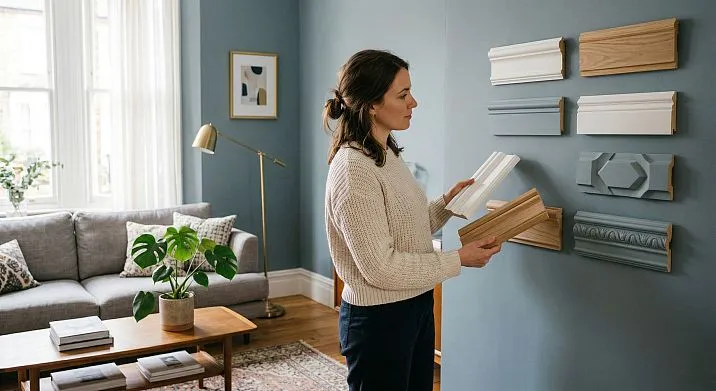
Choosing the profile is the first and most important decision. Making a mistake here means either getting a visually 'empty' result or an overloaded wall with heavy decor disproportionate to the space.
Smooth moldings: neutral architecture
A smooth profile is a rectangular or slightly stepped cross-section without ornament. After painting to match the wall color, it creates a clean geometric structure visible only through shadow. This is the most universal choice: it is organic in neoclassical, modern neutral interiors, Scandinavian classicism, and French urban style.
Important nuance: the smoother the profile, the more expressive its geometry. Sharp edges, straight angles, precise planes—these are what give a readable shadow. A blurred, 'plastic' profile with weak transitions does not create the desired effect.
Classical relief profiles
Moldings with a historical cross-section—cyma recta, cyma reversa, torus, scotia—reproduce the logic of ancient architectural moldings. With side lighting, each change in height casts a shadow, and the profile 'comes alive' in the light. This is the maximum decorative result for a living room in a classical or neoclassical style.
MoldingMoldings with historical relief are a professional choice for a formal living room with ceilings 3 meters and higher. On such a wall scale, a narrow smooth profile 'gets lost,' while a relief classical molding holds the space.
Moldings with ornamental decor
For baroque, Renaissance, and Empire-style living rooms — a profile with ornamental relief: beads, acanthus leaves, meander, braid, laurel branches. This is the highest decorative register, requiring strict stylistic discipline. The molding's ornament must echo the ornamentation of furniture, handles, and cornices — otherwise, decorative chaos ensues.
Moldings for painting
Most modern living rooms are monochrome or with minimal color accents.Decorative wall moldingAnd moldings in such interiors are painted the same color as the wall: white, light gray, mint, dusty pink, sage green, anthracite. The molding 'merges' with the surface in color, remaining architecturally active through its relief.
This is the highest class of wall decor. It is precisely this technique that creates the feeling of a 'luxurious' interior without external ostentation: you notice the depth of the wall but cannot explain where it came from.
Polyurethane wall moldings
Polyurethane wall decor— the optimal choice for a living room in all practical respects. Polyurethane weighs 15–20 times less than plaster — this means installation is done with adhesive only, without additional fasteners. Does not crack or deform with temperature and humidity fluctuations, accepts any paint, reproduces the most complex profiles with exceptional accuracy.
It is polyurethane molding that has become the standard for professional living room designers: it delivers a result identical to plaster or wood, at half the labor cost and one-third the installation time.
What is better for a living room: molding, plasterwork, or other wall decor
This question arises for everyone seriously engaged in decorating a living room. And it's the right question — because molding, plasterwork, and decorative overlays are different tools with different purposes.
Molding is a tool of structure
Molding creates the architectural organization of a wall. Frames, belts, horizontal divisions—all of this is molding. It does not decorate the wall in the traditional sense. It builds it. It defines rhythm, scale, proportions. Without molding, a wall remains flat and mute. With molding—it begins to 'speak'.
This is precisely why molding always comes first. It creates the coordinate system in which everything else is later placed.
Stucco is a tool for ornamental accent.
Molding for walls—these are three-dimensional decorative elements: corner rosettes, cartouches, medallions, relief overlays. They do not create structure—they decorate it. The correct scheme: molding creates frames → stucco is placed in the corners of the frames and at the centers of the fields.
wall moldingcan also work independently—as a point decorative accent on a neutral wall. But without the structure of molding, stucco looks like 'glued-on beauty' without logic. With molding—as an organic part of a unified decorative system.
When polyurethane decor is needed
Polyurethane decor for interiors—this includes both moldings and stucco in one material. For a living room, this means the ability to form a complete decorative system from a single source: molding, corner overlays, central cartouches, cornice, ceiling rosette. All from one catalog—guaranteed stylistic compatibility. All from one material—identical paint adhesion, identical behavior during installation.
When it's better to combine moldings and slatted panels
A separate and very productive technique is combining molding as a frame withslatted panels in a living room interioras interior filling. Molding creates a rectangular frame on the wall → vertical wooden slats are mounted inside the frame. Frame geometry + wood texture = rich, warm, multi-layered result. Especially effective on a TV wall and accent wall behind the sofa.
How to choose molding for the living room by style
Style is not an abstract word. It is a system of rules that cannot be broken with impunity. Molding chosen 'by eye' without considering stylistic logic always looks alien — even if it is beautiful on its own.
Classic living room
Classicism requires a systematic approach: wide relief molding (55–80 mm), three-zone wall division, corner rosettes in the corners of the frames, central cartouches. Ceiling cornice is mandatory.Classic Furniture for the Living Roommade of natural wood completes this system: wall decor and furniture decor must belong to the same stylistic register.
Color program of a classic living room: white, ivory, cream, soft gray-green. Molding is in the same palette as the wall. Furniture is wooden with a coating or varnish, possibly patinated.
Neoclassicism
Modern neoclassicism is classicism without baroque solemnity. Concise frames made of smooth or slightly relief molding (40–55 mm). Minimal overlays or their complete absence. Neutral colors — white, light gray, warm beige.classic furniture in the living room interiorwith wooden details is an organic addition.
Neoclassicism is the most 'functional' style for molding in a modern living room. It creates architectural character without historical overload.
Modern Neutral Living Room
Narrow smooth molding (20–35 mm), monochrome painting in wall color, without overlays or additional elements. Frames are visible only through shadow. This is a delicate, almost invisible technique — 'a bit of structure' without stylistic obligations. Ideal for neutral interiors where molding should assist, not dominate.
Dark classical living room
Living room with dark walls anddark classic furniture— one of the most refined modern interior trends. Molding in such a living room is either painted to match the wall color (dark blue, anthracite, deep green) — providing restrained architectural depth, or contrasts with it (cream molding on an anthracite wall) — creating an expressive 'outlined' pattern.
Bright spacious living room
In a bright living room, molding in white or close-to-white color creates shadows that work as an airy pattern. This is a 'light' version of decor: structure exists, but it doesn't overwhelm. For light spaces, profile geometry precision is especially important — only sharp edges and clear planes give a readable shadow on a light surface.
Moldings for TV zone and accent wall in the living room
The TV wall is the most significant wall in the living room. All sofas are oriented toward it, all gazes are directed at it. And it is precisely this wall that most often remains decoratively 'empty' — a television on a bare wall, without context or architectural framing.
How to decorate a wall for a TV with moldings
Basic scheme: a rectangular frame made of molding around the perimeter of the TV wall or its central part, with the television centered within this frame. The wall inside the frame can receive a contrasting color or textured plaster. The molding works as a 'mat': it doesn't compete with the screen for attention but creates a worthy context for it.
A more complex scheme is the 'portal' technique. Molding forms frames of different scales: an outer large frame encompasses the entire wall, inner smaller frames create depth and an architectural layered effect. The television is in the center of the inner frame. This technique transforms the TV wall into a true architectural object.
When to combine moldings and slatted panels
Molding + slatted panel — a professional duo for the TV zone. Molding creates the outer frame. Inside the frame, aslatted panel for the televisionWood grain texture within a geometric frame—a combination of natural and architectural elements that works flawlessly.
Important: molding and battens should follow the same color scheme. White molding + light battens = a light, Nordic character. Dark molding + dark battens = a dense, velvety effect. For details on batten panels in different living room scenarios, see the photo guide to wall batten panels.
How to use lighting with molding
Backlighting behind molding is one of the most striking techniques for a living room. An LED strip hidden in a groove behind the profile or under a horizontal band creates a soft glow that 'pulls' the relief out of the darkness. In evening mode, the illuminated molding transforms into a glowing architectural element.
Technically: molding is mounted with a 5–10 mm gap from the wall (using spacers), and the strip is concealed in this gap. The light is directed along the wall—downward or upward, depending on the goal. For detailed principles of wooden structures with lighting, see the article on slatted panels with lighting—the same principles apply to molding systems.
What elements to buy together with molding for the living room
Buy molding for the living roomand limiting yourself to just that means achieving a good but incomplete result. A full decorative system for the living room is always a set.
Plaster decor: corner rosettes and cartouches
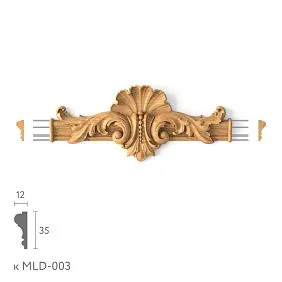
Corner rosette overlays are mounted at the corners of molding frames and create crisp, ornamentally rich corners. This is important for two reasons: first, they eliminate the issue of molding joints at corners (no need for 45° cuts), and second, they add a decorative accent at the most 'critical' points of the frame.
The central cartouche in the middle of the top rail of the frame or at the center of the decorative field is the 'finishing touch' of the decorative program. It is what transforms a 'simple frame' into 'classical wall decor' with full historical logic.Buy Molded Decorationfrom the same catalog as the molding — the correct strategy.
Polyurethane appliqués
Polyurethane Decor— a broad category of decorative elements: rosettes, medallions, relief panels, corner inserts. In the living room, polyurethane overlays work as a second level of decor: molding creates geometry, overlays create ornamental character.
Important: with monochrome painting, all elements — molding, corner overlays, cartouches, cornice — must be painted the same color. This guarantees the monolithic nature of the decorative system.
Cornice
Ceiling cornice — the top finishing element of the wall decorative program. It creates a logical link between the wall and the ceiling, 'closes' the decorative vertical. For a classical and neoclassical living room, a cornice is mandatory: without it, wall molding frames look like an unfinished system lacking a 'lid'.
The cornice profile should be in the same stylistic register as the wall molding: if the molding is smooth — the cornice is smooth or minimally relief. If the molding is classical relief — the cornice has a historical profile.
Ceiling rosette
The rosette in the center of the ceiling light fixture — the final chord of the decorative system. It creates an ornamental center for the ceiling, which echoes the frame structures of the walls. It is the ceiling rosette that 'closes' the architectural program of the room: walls with frames, cornice around the perimeter, rosette in the center — this is the complete classical decorative system for a living room.
Mistakes when choosing moldings for the living room
Practice shows: most unsuccessful solutions are explained by several typical mistakes that are easy to avoid by knowing the rules.
Too small a profile on a large wall
15 mm molding on a 3-meter high wall — decorative 'nothing'. The profile does not create a readable shadow, frames are perceived as scratches on the surface. The rule of scale correspondence: the higher the wall and the more spacious the living room, the wider the profile. For a standard living room with ceilings 2.7–3.0 m, the minimum working size for molding is 40–45 mm.
Overloaded wall
Lush ornamental molding + corner overlays + central cartouches + additional decorative belts — all in a 18 sq. m living room with a 2.5 m ceiling. The decor overwhelms the space, the walls 'shrink', the room becomes anxious. The smaller the living room, the more delicate the decor should be. In small spaces, only smooth molding with minimal overlays works.
Violation of symmetry and rhythm
Frames of different sizes on one wall, mismatched indents, different heights of horizontal belts on different walls — all this destroys the decorative order. Molding works through symmetry and rhythm. Asymmetry in molding is always either an intentional artistic technique (requiring skill) or a mistake (obvious to everyone).
Professional approach: before installation, the entire scheme is drawn on paper to scale and transferred to the walls with painter's tape for visual evaluation.
Conflict between molding and furniture
Rich classic molding with ornament on the walls + minimalist furniture without decor + metal accents of loft style — these are three different decorative languages in one room. The eye reads such an interior as chaos, finding no single semantic center. Molding andclassic furniture in the living room interiormust belong to the same stylistic system.
Excessive decor in the TV area
TV area with molding + shelves + decorative objects + perimeter lighting + additional relief overlays — this is informational noise. The television 'gets lost' in such a zone, the gaze scatters across the wall without focus. The principle of the TV area: one dominant element, the rest — delicate support.
Where to buy molding for the living room: how to make the right choice
Choosing molding doesn't start at the store, but with four key questions. Answering them, you already know exactly what you need.
First question: what style? Classic, neoclassical, modern neutral, dark classic — the profile type depends on the style.
Second question: what ceiling height? This determines the molding width. Here is the correspondence table:
| Ceiling height | Molding width |
|---|---|
| 2.5–2.7 m | 25–40 mm |
| 2.7–3.0 m | 40–55 mm |
| 3.0–3.5 m | 55–75 mm |
| Above 3.5 m | from 70 mm |
Third question: what is the task? Frames around the entire living room perimeter, an accent wall, a TV zone, only horizontal belts — the quantity and layout scheme depend on the task.
Fourth question: what are you buying as a set? Molding + corner overlays + cornice + ceiling rosette — all from one source. This guarantees stylistic compatibility and eliminates the search for 'matching' additions.
Buy moldings for the living roomfrom a unified catalog with a full set of decorative elements — the right strategy. Consider a 15–20% reserve beyond the calculated quantity: during cutting and fitting, some material goes to waste.
FAQ: Answers to the most popular questions about living room moldings
Which molding is best suited for a living room?
For most modern living rooms with ceilings 2.7–3.0 m, smooth or delicately relief polyurethane molding 40–55 mm wide for monochrome painting is optimal. It is universal in style, easy to install, and gives a flawless decorative result.
How does molding differ from stucco?
Molding is a profiled strip that creates linear frame structures and bands.wall molding for sale— these are three-dimensional ornamental overlays (rosettes, cartouches, medallions). Molding builds the architecture of the wall, plasterwork decorates it. The correct approach is to use both tools together in one decorative system.
Can molding be glued directly onto the wall?
Yes. Polyurethane molding is mounted using special acrylic adhesive or liquid nails. The surface is pre-degreased and primed. Joints are filled with putty, sanded, and painted along with the molding. No special skills or tools are required—just a flat surface and the right adhesive.
How to design a TV zone with moldings?
Create a rectangular frame from molding around the TV wall or its central part. Place the television in the center of the frame. Paint the wall inside the frame in a contrasting color or give it a textured finish. Optionally, add backlighting behind the molding. Avoid overloading the area with additional decor—the TV should remain the focal point.
Can moldings and slatted panels be combined in a living room?
This is a professional technique. Molding is the outer frame,Slatted panels in the living room interior— the inner field with a wooden texture. The geometry of the frame + the warm wood of the slat creates a rich, multi-layered result, especially for a TV wall or an accent wall behind a sofa.
Which moldings are suitable for a classic living room?
A relief profile with a historical cross-section (cavetto, ovolo, torus), width from 55 mm, corner rosettes and central cartouches at the corners of the frames. A cornice along the perimeter of the ceiling. All within a unified decorative program with"living room classic furniture wood".
How much molding is needed for a living room?
For one accent wall with frame panels — 15–25 linear meters. For frames around the entire perimeter of a 20 sq. m living room — 60–90 linear meters. Exact calculation: sum the perimeter of all frames and add 20% extra for fitting.
How long does molding last on living room walls?
With proper installation — for decades. Polyurethane does not deform, crack, or shrink. It can be repainted during every renovation without removal. This is practically a permanent solution, requiring only paint updates.
Is primer needed before installing molding?
Yes, definitely. Primer ensures the adhesive's adhesion to the wall. Without primer, the adhesive does not bond well with non-porous surfaces — paint or putty. Both the wall and the back side of the molding should be primed.
Can molding be painted a different color if you want to change the interior?
Yes. Polyurethane molding can be repainted without removal. It is enough to sand the surface, degrease it, and apply new paint. The color can be changed an unlimited number of times.
How to correctly calculate the offset for molding frames?
Standard rules: offset from the baseboard — baseboard height + 30–50 mm. Offset from the cornice — at least 150–200 mm. Distance between frames horizontally — 30–50 mm. All offsets should be the same on all walls — this creates rhythm and order.
Which slatted panels pair best with molding?
For a classic living room — light wood slats in a white or cream molding frame. For a modern one — dark slats in a dark frame or a contrasting combination. The width and spacing of the slats should be proportional to the width of the molding. More details — in the article aboutslatted panels in living room interiors with photos.
Is molding needed in a small living room?
Yes — but choose carefully. A narrow, smooth profile of 20–30 mm in a small living room creates structure without 'eating up' space. Tall vertical frames visually 'raise' the ceiling. A horizontal band at eye level — zones and calms. The main rule for a small space: less, more delicate, without molded overlays.
Can molding be used on walls with wallpaper?
Technically — yes, if the wallpaper is dense (non-woven) and well-adhered. Molding is glued over the wallpaper with liquid nails. But aesthetically, painting is more correct: the molding and wall should be in a unified color scheme, which is easier to achieve with painting, not with wallpaper.
About the company STAVROS
Buy moldings for the living roomwith a full set of decorative elements, selectstucco on walls, cornices, rosettes, and overlays — all in one catalog from the company STAVROS.
STAVROS — a manufacturer and supplier of decorative elements made of polyurethane and natural wood for residential and public interiors. The catalog includes a full range for living room design: profiles of different sections and widths, corner rosettes and connectors, central cartouches and medallions, ceiling cornices, slatted decorative systems. All elements are developed as stylistically compatible series — you take from one catalog and get guaranteed decorative unity.
STAVROS works with private buyers, interior designers, construction companies, and architectural firms. Professional consultation on profile selection, material quantity calculation, and installation technology — with every order. When a living room should be not just beautiful, but architecturally precise — STAVROS helps make it exactly that.