Article Contents:
- Why wood is returning to furniture hardware
- Solid wood vs veneer and MDF: what's the difference
- Solid wood: integrity and authenticity
- MDF with veneer: imitation with caveats
- Plastic wood-look: when budget dictates
- Wood species: character in timber
- Oak: king of durability
- Beech: balance of quality and price
- Ash: Expressive Texture
- Walnut: Luxury and Nobility
- Shapes and styles: from minimalism to carved baroque
- Cylindrical and rod handles
- Bracket handles
- Button handles (overlay)
- Carved sculptural handles
- Children's handles with playful shapes
- Finishes: protection and aesthetics
- Oil: naturalness and warmth
- Wax: matte nobility
- Varnish: maximum protection
- Painting: color in wood
- Where to use: from kitchen to wardrobe
- Kitchen: warmth versus sterility
- Bedroom: comfort and relaxation
- Living room: status and aesthetics
- Children's room: safety and joy
- Bathroom: the challenge of humidity
- Installation: simple but with nuances
- Tools
- Marking
- Drilling
- Fastening
- Cost in 2026: from affordable to elite
- Care: preserving beauty for decades
- Frequently asked questions about wooden handles
- Conclusion: an investment in daily pleasure
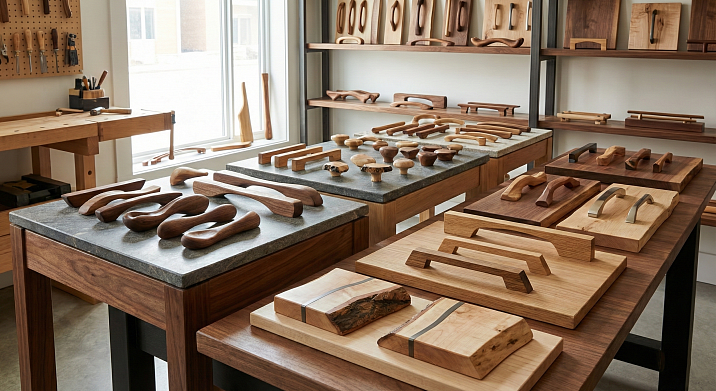
Touch the cabinet door. What do you feel? Cold metal, faceless plastic, or warm wood holding the energy of a living material?wooden furniture handles— is not just functional hardware. It's tactile pleasure every day, a visual accent that turns an ordinary dresser into a piece of furniture art. In 2026, the market is experiencing a renaissance of natural materials—people are tired of synthetics, craving authenticity. Let's figure out where to find truly high-quality designer handles made from solid wood and why they're worth every ruble invested.


Why wood is returning to furniture hardware
For the last two decades, metal dominated — chrome, stainless steel, aluminum. Minimalism dictated a cold aesthetic, industrial motifs ruled the roost. Plastic occupied the budget segment — cheap, practical, faceless. Wood seemed like a relic, an atavism from the era of grandmother's sideboards.
But the pendulum has swung back. People, tired of the sterility of high-tech, began seeking warmth, soul, and history in their interiors.Wooden handlehas become a symbol of this shift. It restores the tactile connection with nature that urbanized humans have lost.
Psychological research shows: touching natural wood reduces stress levels, slows heart rate, and creates a sense of comfort. Texture, temperature, even the barely perceptible aroma of wood work on a subconscious level. Opening a cabinet with wooden handles, you subconsciously receive a microdose of positivity.
The ecological trend reinforces wood's return. Conscious consumption, rejection of plastic, choosing renewable resources — all this makes wooden hardware not just beautiful, but ethically correct. Solid oak or beech will last 50 years, a plastic handle will break in five and end up in a landfill.




Solid wood vs. veneer and MDF: what's the difference
The market offers three main types of wooden handles. Let's break it down honestly, without marketing tricks.
Our factory also produces:




Solid wood: integrity and authenticity
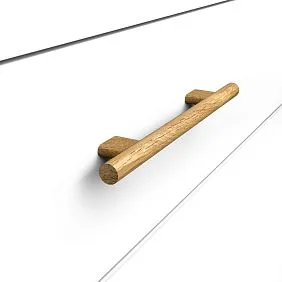
wooden handles from solid woodare handles carved from a single piece of wood. No gluing, pressing, or veneering. What you see on the outside — oak, beech, ash — is the same on the inside.
The advantages of solid wood are obvious. Strength — oak density is 700 kg/m³, beech is 680 kg/m³. Such a handle is hard to break even intentionally. The texture is natural, unique — annual rings, knots, rays form a pattern that cannot be replicated. Each handle is individual, like a fingerprint.
Tactile sensations are unparalleled. Solid wood is warm to the touch, pleasantly rough (if without varnish coating) or silky-smooth (under oil or wax). The hand feels: this is real.
Durability is measured in decades. A solid wood handle will outlast more than one generation of furniture. It can be repainted, restored, refinished — the material allows it.
There are also drawbacks. Price — solid wood is 3-5 times more expensive than alternatives. Weight — heavier than plastic and MDF, requires reliable fastening. Reaction to humidity — wood breathes, may slightly change geometry with sharp humidity fluctuations (rarely critical for handles, but a fact).
Get Consultation
MDF with veneer: imitation with caveats
MDF base, covered with natural wood veneer or a film with wood texture. Visually it can resemble solid wood, but tactilely and functionally — it's a compromise.
Advantages: price is 2-3 times lower than solid wood, geometric stability (MDF doesn't react to humidity), light weight simplifies installation.
Disadvantages: the thin veneer layer (veneer 0.6-1 mm, film even thinner) can be damaged by impact or chipping. Under the veneer — pressed wood fibers, not a living structure. Tactilely, the difference is felt — MDF is colder, sounds duller when tapped. Durability is lower — if the veneer is damaged, the handle loses its appearance, restoration is impossible.
Plastic imitating wood: when budget dictates
Plastic handles with texture imitating wood. The most affordable option, but with significant caveats.
Advantages: cheapness (5-10 times cheaper than solid wood), absolute moisture resistance, low weight, variety of shapes.
Disadvantages: visually the deception is obvious — the texture is printed, lacks depth and naturalness. Tactilely, no resemblance — cold plastic remains plastic. Low strength — breaks under load. Questionable eco-friendliness — emission of volatile substances, inability to recycle. Budget aesthetics — suitable for cottage furniture, but not for interiors where atmosphere matters.
The conclusion is simple: if the budget allows, choose solid wood. If limited — MDF with veneer. Plastic — only where aesthetics are secondary.
Wood species: character in the grain
Not all wood species are equally good for handles. Let's examine the leaders.
Oak: the king of durability
Oak — the classic of furniture hardware. Density of 700-750 kg/m³ makes it one of the hardest European deciduous species. The texture is expressive — large pores, pronounced rays, contrasting annual rings.
Color range from light beige (natural oak) to dark brown (bog oak, aged in water for centuries). Staining gives any shades — from bleached Scandinavian to black ebony.
Outstanding strength. An oak handle withstands thousands of open-close cycles without wear. Moisture resistance is higher than other species — oak contains tannins that protect against rot.
High status. Oak is associated with solidity, reliability, tradition. Furniture with oak handles is perceived as premium.
The price is corresponding — oak handles are 20-30 percent more expensive than beech ones.
Beech: balance of quality and price
Beech is a worthy alternative to oak. Its density of 680 kg/m³ is only slightly lower. The texture is more uniform, fine-pored, with a delicate ray pattern.
Natural color is light pink, beige-pink. When stained, it yields warm tones. Takes stains and enamels well.
Easier to work with than oak — beech is softer, mills cleaner, sands faster. This reduces production costs and the final price for the customer.
Moisture resistance is lower than oak — beech is more hygroscopic and requires a quality oil or varnish coating for protection.
Aesthetically neutral — beech doesn't shout status, but doesn't look cheap either. A universal option for various interior styles.
Ash: expressive texture
Ash is close to oak in density (700 kg/m³), but has a more contrasting, graphic texture. Annual rings are pronounced, creating a striped pattern.
Color ranges from light gray to yellowish-beige. When stained, it yields cool tones — gray, graphite, olive.
High strength, excellent impact resistance — ash was used for making spear shafts, axe handles.
Modern aesthetic — the graphic texture suits minimalist, Scandinavian, loft interiors.
Price is comparable to oak.
Walnut: luxury and nobility
Walnut (usually English walnut) — an elite species. Density of 600-650 kg/m³ is slightly lower than oak, but compensated by outstanding aesthetics.
Color is a rich chocolate with purple, reddish, golden iridescence. Texture is complex, with chaotic waves, swirls, burls.
Processing requires high skill — walnut is finicky, prone to chipping with improper milling. However, under oil or wax, it yields a deep, noble shine.
Price is high — walnut handles are one and a half to two times more expensive than oak ones. This is a choice for exclusive projects where status matters.
Shapes and styles: from minimalism to carved baroque
Designer handlescover the entire spectrum of forms — from the simplest geometric to complex sculptural ones.
Cylindrical and rod handles
The simplest form — a round or square rod. Diameter from 12 to 30 mm, length from 80 to 300 mm. Mounted with two screws from the ends.
Minimalist aesthetic. Suitable for modern kitchens, Scandinavian interiors, mid-century modern furniture. Clean lines, no decoration, emphasis on wood texture.
Tactilely comfortable — the hand naturally wraps around the rod without strain. A diameter of 20-25 mm is optimal for most people.
Variations: rod with thickenings at the edges, slightly curved for ergonomics, combination of wood and metal (wooden middle, metal tips).
Pull handles (bail handles)
Classic U-shaped form. The base attaches to the facade, the arched part serves as the grip. Arch height from 20 to 60 mm, width from 96 to 320 mm.
Universal form — suitable for any style from classic to modern. Excellent ergonomics — fingers slip under the arch, pull towards oneself effortlessly.
Material can be solid wood (arch and base from one piece) or combined (metal base, wooden arch).
Stylistic variations: strict rectangular bracket for minimalism, smooth rounded for neoclassical, with complex profile of curves and beads for classic.
Button handles (overlay)
Round, oval, square elements, mounted with one central screw. Diameter from 25 to 60 mm, projection height 15-40 mm.
Overlay handleDoes not require drilling two holes — only one in the center. Simplifies installation, allows placing the handle anywhere.
Aesthetics are diverse. Simple smooth buttons for minimalism. Carved with ornamentation for classic styles. Figurative shapes like animals, plants, geometric objects for custom projects.
Tactilely — a pinch grip, using two or three fingers. Less convenient for heavy doors, but ideal for drawers, lightweight fronts.
Carved sculptural handles
The highest skill — handles carved by hand or on CNC machines in the form of complex compositions. Floral motifs (grapevines, oak leaves, flowers), animals (lion heads, birds), abstract shapes.
Such handles are works of art, not just hardware. Each requires hours of a carver's work or complex machine programming.
The price is corresponding — from 2000 to 10000 rubles per handle. This is a choice for exclusive furniture projects, restoration of antique furniture, creation of custom collections.
The aesthetics are luxurious, suitable for classic, Baroque, Victorian interiors, where decorativeness and handcraft are valued.
Children's handles with playful shapes
A separate category —handles for children's furnitureIn the shape of cars, little animals, clouds, stars. Bright, amusing, safe (no sharp corners, environmentally friendly).
Such handles turn an ordinary dresser into a play element, make a child's room more cheerful. A child is more interested in opening a drawer when the handle is a little train or a kitten.
Safety is critical — rounded shapes, absence of small breakable parts, coating with safe oils without toxic solvents.
Finishes: protection and aesthetics
Wood requires protection from moisture, dirt, mechanical damage. The coating determines not only durability but also appearance, tactile sensations.
Oil: naturalness and warmth
Natural oils (linseed, tung, Danish) soak into the wood, emphasize the grain, impart a slight sheen and warm hue. Pores remain open — the wood breathes.
Pros: natural look, pleasant tactility (slightly rough surface, warm to the touch), easy restoration (wear marks are removed by re-applying oil), eco-friendliness (plant-based oils without solvents).
Cons: medium protection (oil does not create a film on the surface), requires renewal every 1-2 years, water stains may remain.
Suitable for: interiors where naturalness is important, eco-style, Scandinavian minimalism, furniture in rooms with normal humidity.
Wax: matte nobility
Beeswax or carnauba wax is applied over oil or onto bare wood. Creates a thin protective film, imparts a matte sheen.
Pros: noble appearance (soft glow without gloss), good tactility (silky surface), medium protection (better than just oil), possibility of polishing (over time, wax polishes with hands, acquiring a patina).
Cons: water protection is limited, requires periodic renewal, more expensive than oil.
Suitable for: classic interiors, furniture in living rooms and bedrooms, where noble appearance and pleasant tactile sensations are important.
Varnish: maximum protection
Acrylic or polyurethane varnish creates a durable film on the surface. Protection is maximum — moisture, dirt, scratches are not a problem.
Pros: durability (varnish lasts 5-10 years without renewal), absolute moisture resistance (can be placed in kitchens, bathrooms), easy care (wipe with a damp cloth).
Cons: tactilely colder (varnish film feels like plastic), visually glossy sheen can be excessive (though matte varnishes exist), restoration is more difficult (need to completely remove old varnish).
Suitable for: kitchens, bathrooms, furniture subject to intensive use.
Staining: color in wood
Stains, dyes, opaque enamels change the color of wood, preserving or hiding the grain.
Water-based or alcohol-based stains tint the wood, emphasizing the grain. Any shade can be obtained — from light natural to dark wenge.
Opaque enamels completely cover the texture, creating a smooth colored layer. Suitable for painting in white, gray, and colored shades to match the interior style.
Where to use: from kitchen to wardrobe
buy wooden handlescan be used for any furniture, but there are nuances in application.
Kitchen: warmth versus sterility
Modern kitchens are often cold — metal, glass, glossy fronts. Wooden handles bring warmth, coziness, and a connection to nature. Especially relevant in country, Provence, and Scandinavian styles.
Requirements: protective coating is mandatory (varnish or wax + oil), resistance to frequent contact with wet hands, easy cleaning from grease stains.
Wood types: oak or beech with varnish coating. Ash and walnut are beautiful but more expensive — for premium kitchens.
Shapes: rod handles for fronts, knobs for drawers. Rod length depends on front width — 96-128 mm for narrow, 160-320 mm for wide.
Bedroom: comfort and relaxation
The bedroom is a space for rest, relaxation, and intimacy. Wooden handles on dressers, nightstands, and wardrobes enhance the cozy atmosphere.
Requirements: pleasant tactile feel (oil or wax, not cold varnish), calm colors (natural wood, light tints), ergonomic shapes (easy to open with a half-asleep hand).
Wood types: beech — warm shade conducive to relaxation. Walnut — for luxurious bedrooms.
Shapes: rounded brackets, smooth knobs without sharp corners. Carved handles are appropriate in classic bedrooms.
Living room: status and aesthetics
The living room is the face of the house. Furniture here should impress. Wooden handles made of premium wood types with high-quality processing emphasize status.
Requirements: aesthetics come first, exclusivity (preferably non-standard shapes), harmony with the overall interior style.
Wood types: oak for classic and neoclassical, walnut for luxurious interiors, ash for modern.
Shapes: depend on style. Classic — carved handles with ornaments. Modern — smooth curved lines. Minimalism — strict rods.
Children's room: safety and joy
Children's furniture requires a special approach. Handles must be safe, bright, and interesting to the child.
Requirements: no sharp corners, eco-friendly coatings without toxic substances, durability (children are not always careful), fun design.
Wood types: beech — dense, safe, affordable.
Shapes: shaped handles in the form of animals, cars, clouds. Bright coloring with safe water-based paints.
Bathroom: the challenge of humidity
The bathroom is an aggressive environment for wood. But properly treated handles can withstand it.
Requirements: maximum protection (multiple layers of varnish), moisture-resistant wood types (oak, teak, larch), high-quality fastening (stainless steel screws).
Wood types: oak — contains tannins, resistant to moisture.
Shapes: simple, without complex relief where water can stagnate.
Installation: simple but with nuances
Installing wooden handles is not difficult but requires precision.
Tools
You will need: a drill or screwdriver, a drill bit matching the screw diameter (usually 3-5 mm), a tape measure, a pencil, a ruler or marking template, a screwdriver or bits for the screwdriver.
Marking
Determine the handle position. For vertical fronts — usually centered or in the upper third. For horizontal drawers — centered.
If the handle uses two screws (bracket, bar) — measure the center-to-center distance precisely. Usually 96, 128, 160, 192, 224, 320 mm. A deviation of even 1 mm — the handle won't fit or will be crooked.
Use a template — a strip with holes at standard distances. Place it against the front, mark the hole centers with a center punch.
Drilling
Drill perpendicular to the front surface. An incline of even 2-3 degrees — the screw will go in crooked, the handle will be askew.
Drilling depth depends on the front thickness and screw length. Usually screw length 25-35 mm, front 16-19 mm — drill through or to a depth of 20-25 mm.
If the front is thin (MDF 10-12 mm), the screw may protrude from the back. Use short screws 15-20 mm or do not drill all the way through.
Fastening
Place the handle, insert screws into the holes, hand-tighten until snug. Tighten with a screwdriver or screwdriver at low speed.
Do not overtighten — wood may crack under screw pressure. Tightening should be secure, but without fanaticism. The handle is pressed firmly against the front, no play — that's enough.
If the handle uses one screw (knob) — tightening is simpler, but it's important to hold the handle straight so it doesn't shift during tightening.
Cost in 2026: from affordable to elite
Prices depend on wood species, shape, complexity of processing, finish.
Simple bar handles made of beech:
-
Unfinished for self-staining: 200-400 rubles per piece
-
With oil finish: 300-500 rubles
-
With varnish finish: 400-600 rubles
Bracket handles made of beech or oak:
-
Simple profile, natural stain: 400-700 rubles
-
Complex profile, dark stain: 600-1000 rubles
-
Combined (wood + metal): 800-1500 rubles
Surface-mounted knob handles:
-
Simple round or square: 150-350 rubles
-
With decorative profile: 300-600 rubles
-
Carved with ornament: 500-1200 rubles
Carved sculptural handles:
-
Simple carving (leaves, geometry): 1000-2500 rubles
-
Complex composition (animals, scenes): 2500-5000 rubles
-
Exclusive handmade: from 5000 rubles
Children's shaped handles:
-
Cars, animals, simple shapes: 300-700 rubles
For a kitchen with 15 fronts and 10 drawers, you will need about 25 handles. Budget:
-
Economy (simple beech): 7500-10000 rubles
-
Mid-range (oak with tinting): 12000-18000 rubles
-
Premium (walnut, carved): 25000-50000 rubles
Care: preserving beauty for decades
Wooden handles are low-maintenance, but minimal care will extend their lifespan.
Regular cleaning: Wipe with a slightly damp cloth once a week to remove dust and dirt. Dry thoroughly — standing water can damage the finish.
Oil renewal: If the handles are oiled — apply a fresh coat once every year or two. Light sanding with fine 320-grit sandpaper, dust removal, applying oil with a cloth, removing excess after 15 minutes. Let dry for 24 hours.
Wax polishing: Wax coating is polished with a soft cloth. Over time, the wax hardens, develops a patina, and the shine deepens.
Avoid aggressive agents: Do not use alcohol-based cleaners, abrasives, or solvents. They will damage the finish. For wood — mild soap and water.
Repairing damage: Scratches on an oiled finish can be removed by reapplying oil. Chips in varnish require sanding and re-varnishing the area.
Frequently asked questions about wooden handles
Can wooden handles be installed in a kitchen, won't they be damaged by moisture?
Yes, if they are coated with varnish or wax + oil. Varnish coating reliably protects against water. Plain oil without wax is not recommended for kitchens — stains from wet hands may remain.
How to match the color of handles to the fronts?
Three strategies: tone-on-tone (handles matching the front color — furniture appears monolithic), contrast (dark handles on light fronts or vice versa — expressive), natural wood on any fronts (a universal solution).
How long do wooden handles last?
With proper care — for decades. Solid oak or beech withstands hundreds of thousands of opening cycles. The coating may require renewal after 5-10 years, but the handle itself will remain functional.
Can wooden handles be repainted?
Yes. Remove the old finish by sanding, apply new stain or paint, coat with oil, wax, or varnish. Solid wood allows for multiple restorations.
What is the standard center-to-center distance?
The most common: 96, 128, 160, 192, 224, 320 mm. When replacing handles, try to choose new ones with the same center-to-center distance to avoid re-drilling the fronts.
Wooden handles are heavier than metal ones, won't they tear off?
They won't tear off if the mounting is correct. Screws 4-5 mm in diameter, screwed into MDF or chipboard fronts to a depth of 20-25 mm, hold securely. For large carved handles, use longer screws.
Can wooden handles be used outdoors (summer kitchen, gazebo)?
Yes, but enhanced protection is required. Yacht varnish in 3-4 coats or special oils for exterior use. Periodically renew the coating — sun and rain break down the protective layer.
Where is it better to buy — in a store or from the manufacturer?
From the manufacturer. Factory price without trade markup saves 30-50 percent. Full assortment, possibility of custom orders (non-standard sizes, unique shapes), quality guarantee directly from the manufacturer.
Conclusion: an investment in daily pleasure
Furniture is not just about function. It's a tactile experience, visual aesthetics, an emotion you feel every day when opening a drawer or cabinet door.wooden furniture handlesturn a routine action into a moment of pleasure.
The touch of warm wood, the sensation of natural texture under your fingers, the subtle aroma of timber—all work on a subconscious level, creating an atmosphere of comfort and harmony. In an era of total synthetics, returning to natural materials is not nostalgia but a conscious choice in favor of quality of life.
decor for furnitureSolid wood is not a luxury accessible only to a few. Modern technology has made wooden hardware affordable while maintaining high quality. The price difference between plastic and wooden handles is offset by durability, aesthetics, and that daily pleasure.
The choice of wood species depends on budget and requirements. Oak is for those who value status and maximum durability. Beech offers the optimal balance of quality and price. Ash and walnut are for connoisseurs of expressive grain who are willing to pay for exclusivity.
The shape should match the interior style and ergonomics. Minimalism calls for simple bars. Classic styles suit brackets with elegant profiles or carved elements. Children's rooms benefit from playful shapes that turn furniture into a game.
Choose the finish based on operating conditions. Oil + wax for living rooms where tactility is important. Varnish for kitchens and bathrooms where maximum protection is needed. Painting for creating color accents to match the interior style.
For 23 years, the company STAVROS has been creatingpremium-quality wooden furniture handlesfor demanding clients, interior designers, furniture factories, and private customers across Russia and CIS countries. Their own production facility in the Moscow region is equipped with modern CNC machines for 3D milling, enabling the creation of handles of any complexity with jewelry-like precision. STAVROS works exclusively with select raw materials: solid oak with a density of 720 kg/m³, beech 680 kg/m³, ash 700 kg/m³—all kiln-dried wood with controlled moisture content of 8-10%, guaranteeing geometric stability and absence of deformation during use. The range includes over 150 handle models, from minimalist 20mm diameter bars to intricate carved compositions, exclusive children's handles shaped like cars and animals, classic brackets of all sizes, and elegant knobs with decorative profiles. Each handle undergoes multi-stage processing: milling on machines with a tolerance of 0.1mm, sanding with abrasives sequentially from 120-180-240 grit to a silky smoothness, coating with eco-friendly plant-based oils or professional varnishes with UV stabilizers. STAVROS offershandles without coatinghandles for independent tinting for designers creating unique color solutions, as well ashandles with factory-applied finishesin a wide palette of shades from natural light oak to deep black ebony. The company fulfills custom orders: if the catalog doesn't have the desired shape or size, their designers will develop a unique model based on your drawings or sample, producing a trial batch for on-site testing. Professional consultants will help select handles to match your furniture and interior style, calculate the required quantity including spares, and provide recommendations for installation and care of wooden products. Showrooms in Moscow and St. Petersburg allow you to see the handles in person, feel the wood texture, assess the ergonomics of different shapes, and obtain samples for fitting to furniture fronts. STAVROS organizes delivery across Russia with careful packaging in soft materials that protect wooden items from scratches and chips during transit. Direct sales from the manufacturer without intermediary markups mean savings of 30-50% compared to furniture showrooms and online stores. For furniture factories, design studios, and wholesale buyers, partnership programs are available with progressive discounts up to 25% and flexible payment terms. STAVROS works with projects of any scale: from replacing a few handles on home furniture to comprehensive hardware outfitting for a residential complex with hundreds of apartments, ensuring consistent quality and adherence to deadlines regardless of order volume. Choosing STAVROS means you get not just hardware, but a comprehensive solution: designer handles from solid wood of world-class quality, impeccable execution of every detail, technical support at all stages from selection to installation, and a guarantee of a result that will delight for decades, creating daily pleasure from touching real wood.