Article Contents:
- From master model to serial product: the technological chain
- Stage One: Creating the Master Model
- Stage two: manufacturing the casting mold
- Stage three: product casting
- Stage four: post-processing and quality control
- Custom manufacturing: from sketch to realization
- When custom manufacturing is required
- Custom order process
- Timelines and cost of custom manufacturing
- Quality control: multi-stage system
- Raw Material Incoming Inspection
- Operational process control
- Final inspection of finished products
- Advantages of ordering directly from the manufacturer
- Price without intermediary markups
- Full range without limitations
- Short manufacturing and delivery times
- Technical support and consultations
- Manufacturer's Warranty
- Possibility of a factory tour
- Frequently Asked Questions
- What is the minimum order quantity for custom manufacturing?
- Can molding be manufactured from a photograph of a historical sample?
- What is the accuracy of ornament reproduction during casting?
- How is the acceptance of a custom order carried out?
- Can an order be changed after production has started?
- What equipment is required for installing molding?
- How to store molding before installation?
- Conclusion: manufacturing that creates masterpieces
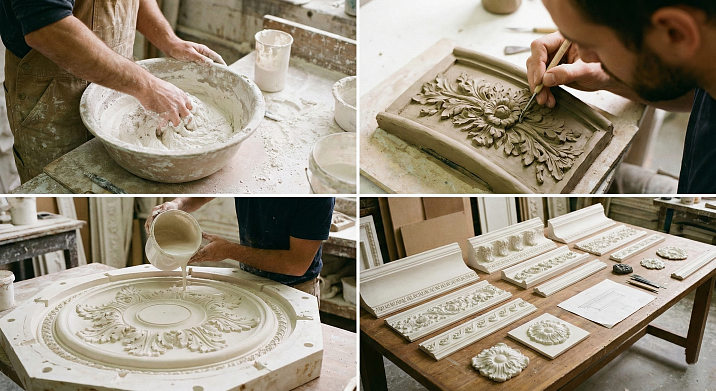
How is beauty born? The process of creating molded decor is a symbiosis of art and technology, where artistic vision meets the precision of industrial production.stucco decor manufacturing— not a mass conveyor of stamped, faceless products, but a production system where each element follows a path from artistic sketch to finished product while preserving the finest details of the ornament. Moderncustom molding productioncombines centuries-old traditions of molding craftsmanship (proportions of classical orders, canons of ornamental compositions) with high-tech equipment (computer-aided design, precision casting, automated quality control). The result is products that look like the handiwork of a master artist but possess industrial repeatability, consistent quality, and an affordable price.
Custom manufacturing of polyurethane facade moldingopens possibilities for realizing unique architectural projects. The standard catalog contains hundreds of items, but when a project requires an individual solution — a non-standard cornice size, a unique ornament for a window surround, an authorial capital design — the custom manufacturing system turns an idea into reality. How is production organized? What technologies ensure quality? How long does manufacturing take? What advantages does ordering directly from the manufacturer provide? We reveal production secrets.


From Master Model to Serial Product: The Technological Chain
The production process for creating molded decor consists of several sequential stages, each critically important for the final quality.




Stage one: creation of the master model
The master model is the original of the future serial product, from which a mold for casting is taken. It is created using one of three methods depending on the type of product and the complexity of the ornament.
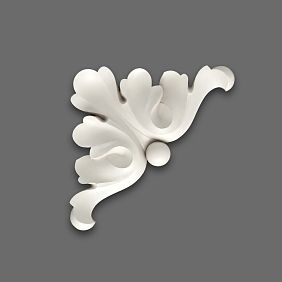
Hand sculpting is used for elements with complex artistic ornamentation — capitals with acanthus leaves, decorative rosettes with plant motifs, mascaron (faces), cartouches (decorative shields). A sculptor-artist sculpts the model from special plasticine or plaster, working from a designer's sketch or a historical sample. The process is manual — the master forms the general volume, then works out details with chisels, modeling tools, and models the smallest elements (leaf veins, fabric folds on drapery, hair texture). The time to create a complex master model ranges from several days to several weeks depending on size and detailing.
Advantage of hand sculpting: uniqueness, artistic expressiveness, ability to create ornamentation of any complexity. Disadvantage: labor intensity, high cost, impossibility of exact replication (each master model is unique, even if sculpted from the same sketch).
Mechanical processing is used for elements with geometric profiles — moldings, cornices, baseboards, pilasters with flutes (vertical grooves). The master model is turned on a lathe or milling machine from dense material (high-density polyurethane, hard wood, polymer composites). The profile is programmed according to a drawing, the machine turns the part with an accuracy of up to 0.1 mm.
Advantage of mechanical processing: high geometric accuracy, speed (the model is turned in a few hours), repeatability (identical models can be created from one program). Disadvantage: limitations on shape complexity (geometric profiles, symmetrical elements), inability to create artistic ornamentation.
3D printing is used for medium-complexity elements where a combination of precise geometry and decorative details is required. The designer creates a 3D model in a program (ZBrush for organic forms, Blender, 3ds Max for geometric ones), exports it to STL format, and prints it on a 3D printer. Printing technology: SLA (stereolithography) for high detail (resolution up to 25 microns, the smallest ornament details are visible) or FDM (Fused Deposition Modeling) for large elements with less detail.
The printed model undergoes post-processing: removal of supports (auxiliary structures printed for overhanging parts), surface sanding (elimination of layering that occurs during layer-by-layer printing), priming (coating with a compound that evens out the surface). After post-processing, the model is indistinguishable from one created by hand sculpting.
Advantage of 3D printing: speed (the model prints in hours to days depending on size), ability to create complex shapes (internal cavities, undercuts that cannot be machined mechanically), digital archiving (the model is saved in a file, can be reprinted at any time). Disadvantage: size limitations (maximum print size 30-50 cm, large elements are printed in parts and glued), need for post-processing.
Our factory also produces:


Stage two: manufacturing the casting mold
A mold — a negative copy — is taken from the finished master model, into which polyurethane will be poured to create serial products. The mold material is liquid silicone (RTV silicone, Room Temperature Vulcanizing — vulcanizes at room temperature). This is a two-component composition: base (silicone polymer) and catalyst (a substance that initiates polymerization). The components are mixed in a ratio of 10:1 or 9:1, the mixture is poured over the master model.
The mold manufacturing process depends on the complexity of the model. For simple flat elements (overlays, medallions, relief panels), an open mold is used — the master model is placed face up in a formwork (a box made of plastic or wood), silicone is poured on top, covering the model with a layer of 15-25 mm. After polymerization (12-24 hours at room temperature), the mold is extracted, the master model is removed — the mold is ready.
For volumetric elements (columns, balusters, large capitals), a split mold is used — the master model is installed vertically, coated with silicone, which forms a shell 10-15 mm thick. After partial curing, the silicone shell is divided into two or three parts along pre-marked parting lines (lines are chosen to ensure easy extraction of the finished product). The shell parts are reinforced on the outside with a plaster or polymer casing (a rigid frame that prevents deformation of the elastic silicone during pouring). During casting, the mold parts are connected, fixed with ties or clamps, forming a closed cavity into which polyurethane is poured.
Requirements for mold quality are critical. The silicone surface must be absolutely smooth (any roughness will be imprinted on the finished product). All details of the master model must be accurately imprinted in the mold (for this, the silicone is vacuumed before pouring — placed in a vacuum chamber where air bubbles are removed from the mixture, which can form cavities). The mold wall thickness must be sufficient to withstand the pressure of the poured material, but not excessive, to avoid wasting expensive silicone.
The service life of a silicone mold is 500-2000 pouring cycles depending on product complexity and silicone quality. Simple elements (moldings, trims) are extracted easily — the mold lasts 1500-2000 cycles. Complex elements with deep relief and undercuts (capitals, rosettes) require deformation of the mold during extraction — the mold lasts 500-800 cycles. After the resource is exhausted, the mold is disposed of, a new one is made from the same master model or from a new impression (if the master model is damaged).
Get Consultation
Stage three: product casting
Casting is the process of filling a mold with a liquid polyurethane composition, which polymerizes (hardens), turning into a finished product. The polyurethane composition is two-component: polyol (polyester resin, base) and isocyanate (reagent causing polymerization). The components are stored separately, mixed immediately before pouring in an exact ratio (usually 1:1 by weight, but depends on the manufacturer's formulation).
Mixing is performed in automatic dosing mixers — devices that supply components from containers, dose them with an accuracy of up to 1%, mix them in a mixing head (high-speed rotation or static mixing in a spiral tube), and supply the ready mixture into the mold. Automation is critically important: the component ratio must be precise (a deviation of 3-5% leads to incomplete polymerization — the product remains sticky, or excessive — the product becomes brittle), mixing must be complete (unmixed areas do not polymerize).
Before pouring, the mold is treated with a release agent — a thin layer of substance (wax emulsion, silicone spray) that prevents polyurethane from sticking to the silicone. Without a release agent, polyurethane may partially adhere to the mold, the product will be extracted with damage, and the mold will become contaminated.
Pouring is performed using one of two methods. Gravity pouring — the mixture is poured into an open mold from the top, spreads under gravity, filling all recesses of the relief. The method is used for flat elements (overlays, panels). Pressure pouring — the mixture is fed into a closed split mold through a sprue channel (hole) under a pressure of 2-5 atmospheres. The pressure forces air out of the mold, fills the smallest relief details, and ensures material density. The method is used for volumetric and complex elements (columns, capitals, large cornices).
After pouring, the mold is kept motionless until complete polymerization. Polymerization time depends on product thickness and ambient temperature: for thin elements (5-10 mm) at +25°C — 15-30 minutes, for medium (15-30 mm) — 1-2 hours, for thick (50-80 mm) — 3-6 hours. Acceleration of polymerization is achieved by heating the mold to +40-50°C (in thermal chambers or using infrared lamps) — time is reduced by 2-3 times.
After polymerization, the product is extracted from the mold. For open molds — the product is simply removed (flexible silicone is bent back, the product is separated). For split molds — the mold is opened, parts are unclipped or unscrewed, the product is removed. If the product has sprues (solidified channels through which the mixture was fed), they are cut off with a knife, and the cut areas are cleaned with sandpaper.
Stage four: post-processing and quality control
The freshly extracted product undergoes inspection and finishing. Visual inspection — checking the surface for cavities (air bubbles that were not removed during pouring, forming cavities on the surface), chips, short shots (areas where the mixture did not fill the mold completely), mold parting lines. Products with defects are rejected (remelted or disposed of).
Geometric inspection — checking dimensions with templates, rulers, calipers. For linear products (moldings, cornices, baseboards), the profile is checked — a metal template of the exact profile is applied, and the fit is checked. For piece elements (overlays, capitals), overall dimensions, thickness, and symmetry are checked. Permissible deviations: for linear products ±0.5 mm per meter of length, for piece elements ±1 mm per dimension.
Mechanical processing if necessary: end trimming (cutting the ends of linear products at a right angle on a miter saw to obtain precise length), drilling holes (for elements fastened with screws), sanding cut sprue areas or joint planes.
Priming — products are coated with white acrylic primer in one or two layers. The primer performs several functions: evens out the color (polyurethane after polymerization has a slight yellowish tint, primer makes it snow-white), creates a base for final painting (paint adheres better to primer than to bare polyurethane), emphasizes the relief (white surface better reveals ornament details under side lighting). Priming is done by spraying (for large elements, serial production) or with a brush (for piece, custom orders).
Packaging — products are packaged for protection during storage and transportation. Linear products (moldings, cornices, baseboards 2-2.4 m long) are wrapped in shrink film, ends are closed with plastic or cardboard caps, grouped into bundles of 5-10 pieces, bundles are strapped with stretch film, placed on pallets or in pallet containers. Piece elements (overlays, capitals, rosettes) are wrapped in bubble wrap (each element individually), placed in cardboard boxes with cushioning filler (foam, corrugated cardboard inserts), boxes are labeled (product name, article number, quantity, top-bottom direction, fragile sign).
Storage — packaged products are placed in the finished goods warehouse in racking systems (linear products horizontally in special cells, piece elements in boxes on shelves) in compliance with storage conditions (temperature +10-25°C, humidity 40-70%, absence of direct sunlight, which can cause primer yellowing).
Custom Manufacturing: From Sketch to Realization
The standard catalog satisfies 80-90% of requests, but there remain projects requiring unique solutions.Custom manufacturing of polyurethane facade molding— a service that transforms a custom concept into a real product.
When Custom Manufacturing is Required
Non-standard dimensions — a building with a floor height of 3.8 m requires cornices 45-60 cm high (standard 25-35 cm look disproportionately small), windows 220 cm wide require architraves 250 cm long (standard 200-240 cm are unsuitable), columns for a hall 5.5 m high require a diameter of 45-50 cm (standard 30-35 cm look thin).
Unique ornamentation — a designer developed an original ornament for capitals that combines elements of the Corinthian order with national motifs (Russian floral patterns, geometric braids). Restoration of a historical building requires reproducing lost stucco elements whose ornamentation does not match any from the standard catalog (each historical building has unique stucco created by a specific master or workshop).
Special structural requirements — facade stucco for a building in a seismically active zone requires a reinforced structure (thickened walls, internal stiffening ribs, special embedded parts for fastening), decor for a wet area (pool, hammam) requires maximum material density (300-350 kg/m³ instead of the standard 250-280 kg/m³) to eliminate water absorption.
Exclusive design — the client wants the stucco of their house to be unique, not repeated in any other project. A master model is created specifically for this project, the mold is made in a single copy, and after order completion, the mold is destroyed (if stipulated by the contract) or archived with a prohibition on commercial use.
Custom Order Process
Consultation with the company designer — the client presents the project concept (sketches, photos of interiors or facades, references). The designer analyzes the architectural features of the object (building style, proportions, scale), determines which decorative elements are required, their functions, and installation locations. Requirements for the elements are jointly formulated: dimensions (specific measurements in millimeters), profiles (cross-sectional shape for linear elements), ornamentation (style, motifs, level of detail), material (polyurethane density, need for reinforcement for large elements).
Development of technical specifications — the designer formalizes the discussed requirements into a document passed to the engineering department. The technical specifications include: drawings of elements with dimensions (front, side views, cross-sections), description of ornamentation (verbal or graphic — sketches, photos of samples, 3D models if available), material and construction requirements, quantity of elements, production deadlines.
Design — the engineer creates production documentation. For elements with geometric profiles — drawings with precise dimensions of all profile elements (beads, grooves, chamfers), machine programs (if the master model will be machined). For elements with artistic ornamentation — detailed sketches for the sculptor (views from several angles, detailing of individual ornament fragments) or 3D models for printing. For complex elements — strength calculations, determination of reinforcement necessity, design of embedded parts for fastening.
Client approval — finished drawings, sketches, or 3D visualizations are sent to the client for approval. The client checks compliance with their concept, makes adjustments (changing proportions, ornament details, dimensions). The iterative process (design — approval — correction) continues until full approval. It is critically important to approve all details at this stage — after manufacturing the master model and mold, changes are impossible or very expensive.
Master model manufacturing — the approved project is transferred to the production workshop. The master model is created using the chosen method (hand sculpting, machining, 3D printing — depending on the element type). Manufacturing time ranges from 3-5 days for simple elements to 4-6 weeks for complex ones with detailed ornamentation. The finished master model is presented to the client (if possible, or detailed photos are sent) for final approval before mold manufacturing.
Mold manufacturing — a silicone mold is taken from the approved master model using the technology described above. Mold manufacturing time ranges from 2-3 days for simple elements to 1-2 weeks for complex multi-part molds.
Test casting — a test product is cast from the new mold and checked for compliance with the technical specifications (dimensions, quality of ornament transfer, absence of defects). If the test product meets the requirements, serial production of the required number of elements is launched. If defects are found (the mold did not fully imprint ornament details, there are voids), the mold is refined or remade.
Serial production of the order — products are cast, undergo inspection, post-processing, priming, and packaging using standard technology. The number of products corresponds to the order (usually with a 5-10% reserve in case of damage during transportation or installation).
Shipment to the client — finished products are shipped according to the contract terms (pickup, delivery by manufacturer's transport, shipment by transport company). Documentation is attached to the order (specification with article numbers and quantities, quality certificates, material certificates, installation instructions).
Timelines and Cost of Custom Manufacturing
Timelines depend on the complexity and volume of the order. Simple elements with geometric profiles (moldings, cornices, baseboards of non-standard sizes but without complex ornamentation): design 3-5 days, master model manufacturing 5-7 days, mold manufacturing 3-5 days, test casting and production launch 2-3 days, serial production 5-10 days depending on quantity. Total: 18-30 days from technical specification approval to shipment.
Medium complexity elements with ornamentation (architraves with decorative overlays, capitals of standard orders but non-standard sizes, rosettes with classical motifs): design 7-10 days, master model manufacturing (3D printing and post-processing or hand sculpting) 10-20 days, mold manufacturing 5-10 days, test casting and refinement 3-5 days, serial production 7-15 days. Total: 32-60 days.
Complex unique elements with original ornamentation (facade panels with multi-figure compositions, capitals of unique design, large portals with complex decor): design and approval with iterations 15-30 days, master model manufacturing by hand sculpting 30-60 days, manufacturing of a complex multi-part mold 10-15 days, test casting, refinement, repeated test casting 7-10 days, serial production 10-20 days. Total: 72-135 days (2.5-4.5 months).
The cost of custom manufacturing includes several components. Project development — from 15,000 rubles for simple elements to 80,000-150,000 rubles for complex unique ones with original ornamentation (if work by a highly qualified sculptor-artist is required). Master model manufacturing — from 20,000 rubles for mechanically processed elements to 100,000-300,000 rubles for large elements with hand sculpting. Mold manufacturing — from 30,000 rubles for simple open molds to 150,000-250,000 rubles for complex multi-part molds of large dimensions.
Product production — the cost per unit depends on size, complexity, and quantity. The minimum batch is usually 10-20 pieces for linear elements (to recoup project and mold costs) or 2-5 sets for individual elements (capitals, portals). The unit price in a custom order is 30-50% higher than that of a catalog analog (if one exists), which compensates for the costs of the unique master model and mold.
Total cost of a custom order: simple elements from 80,000-120,000 rubles per project (including development, master model, mold, batch of 20-30 elements), medium complexity from 200,000-400,000 rubles, complex unique from 500,000-1,200,000 rubles and above depending on scale.
Quality Control: Multi-Stage System
The quality of stucco decor is determined at each production stage. The control system includes incoming raw material inspection, in-process control, and finished product output control.
Incoming Raw Material Control
Polyurethane components (polyol and isocyanate) arrive from suppliers in factory containers with quality certificates. Before production launch, incoming inspection is performed: certificate checks (compliance with the ordered grade, expiration date), visual inspection (clarity, absence of sediment, separation), laboratory tests (viscosity, density, gel time of a test mixture, mechanical properties of a test sample after polymerization). If parameters do not meet specifications, the raw material batch is returned to the supplier and not launched into production.
Silicone for molds also undergoes incoming inspection: hardness check (Shore A should be 20-30 units for high-detail molds, 30-40 for standard), tensile strength (should be at least 6-8 MPa so the mold does not tear when extracting products with undercuts), elongation at break (should be 300-500% so the mold stretches without destroying).
In-Process Control
At each production area, process parameters are controlled. Mixing area: checking component ratios (by weight sensors of dispensers, should be 1:1 ±1%), component temperatures (should be +20-25°C; at lower temperature viscosity increases, mixing worsens; at higher temperature polymerization starts too quickly), mixing time (should be 8-15 seconds for complete homogeneous mixing).
Casting area: checking mold filling (visually or by weight of poured mixture — must correspond to the calculated value for the given product), pouring pressure (for pressure casting — 2-5 atm, controlled by a pressure gauge), mold temperature (for heated molds — +40-50°C, controlled by temperature sensors). Polymerization area: controlling dwell time (according to the process sheet for each product), temperature in the polymerization chamber (should be +40-50°C ±2°C, controlled by thermostats).
Final inspection of finished products
Each product undergoes final inspection after removal from the mold. Visual inspection — examining the surface for defects (pores, chips, short shots, contamination). Defective products are rejected. Acceptable defects: micropores up to 2 mm in diameter, no more than 2-3 per product, located in non-visible areas (back side, ends), not affecting strength and aesthetics. Unacceptable defects: pores over 3 mm in diameter, pores on the front surface, relief chips, short shots (missing product fragments).
Geometric control — checking dimensions. For linear products: profile is checked with a template (a precise metal or plastic control template is applied, checking for full contact without gaps), length is checked with a ruler or tape measure (tolerance ±1 mm for lengths up to 2.4 m). For piece elements: overall dimensions are checked with a caliper (tolerance ±1 mm), symmetry is checked by overlaying on a control sample or mirror comparison (left and right halves of a symmetrical element must be identical).
Mechanical testing selectively — control samples (standard bars of specific sizes) are cast from the batch and tested for strength. Bending test (sample placed on two supports, loaded in the middle, measuring the force at which failure occurs — must be at least 15-20 MPa for standard polyurethane with density 250-280 kg/m³), compression test (sample compressed between plates, measuring failure stress — must be at least 40-60 MPa), impact toughness test (notched sample broken by pendulum impact, measuring failure energy — must be at least 15-20 kJ/m²).
Certification testing periodically (once a year or when raw materials, formulation, or equipment change) — product samples are sent to an independent testing laboratory accredited for certification testing. All standardized parameters are checked (geometry, strength, density, water absorption, frost resistance for facade molding, combustibility, toxicity). Based on test results, a certificate of compliance with GOST or technical specifications is issued, a sanitary-epidemiological conclusion (confirming safety for use in residential premises), and a fire safety certificate (combustibility class G2-G3, flammability group B2-B3).
Advantages of ordering from the manufacturer
Why it's more profitable to orderstucco decor manufacturingdirectly from the manufacturer, rather than through intermediary dealers or construction stores?
Price without intermediary markups
The manufacturer sells products at the factory price, which includes cost (raw materials, energy, personnel salaries, equipment depreciation) and the manufacturer's profit margin (usually 20-30%). The dealer purchases from the manufacturer at a wholesale price (factory price minus a wholesale discount of 10-15%), sells to the end consumer with a trade markup of 30-50%, sometimes 70-100% for exclusive products. Result: buying from a dealer, you overpay 20-40% compared to buying directly from the manufacturer.
For large orders (facade molding for a house, comprehensive interior decoration of 150-200 m²), the overpayment amounts to tens and hundreds of thousands of rubles. Buying directly from the manufacturer saves these funds.
Full range without restrictions
The dealer keeps a limited range in stock (fast-moving items that sell quickly), rare items are ordered for a specific customer order with waiting for delivery. The manufacturer has the full catalog in stock (all serial production items available) and the ability to manufacture any item, even if not in stock, in a short time (production launch takes days, not weeks of waiting for delivery from the manufacturer through a chain of dealers).
Custom manufacturing through a dealer is generally impossible (the dealer has no production capacity, can only forward the order to the manufacturer, adding their markup and increasing lead times). With the manufacturer, custom orders are executed directly without intermediaries.
Short manufacturing and delivery times
The manufacturer ships products from the finished goods warehouse immediately after payment (same or next day). Delivery is organized directly from the manufacturer to the customer (using own transport or a transport company). For Moscow and Moscow Region — 1-2 days, for St. Petersburg and Leningrad Region — 2-3 days, for Russian regions — 3-10 days depending on distance.
The dealer may not have the needed items in stock, order from the manufacturer (delivery time manufacturer→dealer 3-7 days), then deliver to the client (another 1-3 days). Result: delay of 4-10 days compared to ordering directly from the manufacturer.
Technical support and consultations
The manufacturer possesses complete technical information about the products (material composition, production technologies, performance characteristics, installation features). Consultations from the manufacturer's specialists are competent and reliable — engineers, technologists, designers who participated in product development and production can answer any technical question, provide recommendations on selection, quantity calculation, installation methods, solving non-standard tasks.
The dealer possesses commercial information (prices, availability, lead times), but technical competence is limited (sales consultant knows general characteristics from catalogs, but not technological nuances). For complex questions, the dealer must request information from the manufacturer, increasing the time to get an answer.
Manufacturer's Warranty
The manufacturer provides a warranty on its products (usually 3-5 years for polyurethane molding) and bears full responsibility for quality. If during the warranty period the product deforms, cracks, loses shape (with proper use and installation according to instructions) — the manufacturer replaces it free of charge.
The dealer formally also provides a warranty (resells the manufacturer's warranty), but is an intermediary in warranty service. The customer contacts the dealer, the dealer contacts the manufacturer, the manufacturer reviews the claim, sends a replacement to the dealer, the dealer passes it to the customer. The chain increases problem resolution time.
When buying from the manufacturer, warranty service is direct — the customer contacts the manufacturer directly, the manufacturer promptly reviews the claim, sends the replacement directly to the customer. Lead times are reduced by 2-3 times.
Possibility of a factory tour
The manufacturer can organize a factory tour for customers of large projects (developers, designers, architects). Visiting the production allows seeing the manufacturing process (how master models are created, how molds are taken, how casting is performed, how quality is controlled), verifying the technological sophistication and modernity of equipment, communicating with technologists and engineers, discussing possibilities for custom manufacturing.
The dealer has no production, a tour is impossible. The customer must rely on descriptions and certificates.
Frequently asked questions
What is the minimum order quantity for custom manufacturing?
The minimum order quantity depends on the product type and development cost. For linear products (moldings, cornices, baseboards) the minimum is usually 50-100 linear meters (20-40 pieces of 2.4 m each) to cover the costs of the master model and mold. For piece elements (capitals, overlays, rosettes) the minimum is 10-20 pieces. For large unique elements (portals, facade panels) manufacturing from 1-2 pieces is possible, but the unit cost will be high (the entire budget for development and the mold is divided by a small number of products).
Can molding be manufactured from a photograph of a historical sample?
Yes, this is a common task in restoration. The customer provides photographs of lost or damaged elements (preferably from several angles and with a scale ruler for determining dimensions). A sculptor or 3D modeler recreates the element from the photographs. For high accuracy, it is desirable to also provide measurements of preserved fragments, impressions (casts from plasticine or silicone of preserved ornamental details). The recreated master model is coordinated with the customer (or with the restoration council if the object is an architectural monument), after approval the mold is manufactured and the necessary elements are cast.
What is the accuracy of ornament reproduction in casting?
Modern silicone molds and pressure casting ensure detail reproduction accuracy up to 0.1 mm. The finest elements of the ornament (leaf veins 0.5 mm wide, thin scrolls, notches) are imprinted completely. A product cast from a mold is indistinguishable from the master model even upon close inspection. Accuracy is limited only by the quality of the master model — if the model is made with high detail, the products will be just as detailed.
How is the acceptance of an individual order carried out?
After manufacturing, the producer informs the customer of readiness. Two acceptance options are possible. Acceptance at the production facility — the customer (or their representative) comes to the production site, inspects the finished products, checks compliance with the technical specifications (dimensions, ornament, quality), signs the acceptance certificate, organizes transportation, or pays for delivery. Acceptance at the delivery location — the products are delivered to the customer's site, the customer inspects them upon receipt, signs the acceptance documents. If discrepancies with the technical specifications or defects are found — a report on identified deficiencies is drawn up, and the producer rectifies the deficiencies (manufactures replacements for defective elements) at their own expense.
Can an order be changed after production has started?
After approval of the master model and creation of the mold, changes are impossible without additional costs. If changes to dimensions, ornament, or construction are required — a new master model and a new mold will have to be created, which is equivalent to a new order. Therefore, it is critically important to thoroughly coordinate all details at the design stage, repeatedly check drawings and sketches, and ensure everything matches the concept before approval and production launch. Minor changes (adjusting post-processing, changing the coating — painting a different color) are possible at the final finishing stage, but changes to the form and ornament are only possible by remaking the master model and mold.
What equipment is required for installing molding?
Installation of molded decor is performed with simple tools. For cutting trim (moldings, cornices, baseboards) — a miter saw (with a blade for wood or plastic), a fine-toothed handsaw (for manual cutting), a sharp knife (for trimming small parts). For fastening — a mounting adhesive gun (if using adhesive in cartridges), a brush or trowel (for applying adhesive from buckets), a screwdriver or drill (for mechanical fastening with dowels), a level (for controlling horizontality and verticality), a tape measure, a pencil (for marking). For final finishing — acrylic putty (for sealing joints), sandpaper (for sanding putty), brushes and rollers (for painting).
How to store molding before installation?
Polyurethane molding is not demanding regarding storage conditions, but following the rules prolongs its preservation. Trim products (moldings, cornices, baseboards) are stored horizontally on a flat surface or in special racks (vertical storage can lead to deformation under their own weight). Individual elements (appliqués, capitals, rosettes) are stored in boxes on shelves. Conditions: temperature +5-30°C (at lower temperatures polyurethane becomes brittle, at higher temperatures it may deform if products are stored under load), humidity 30-80% (lower humidity may cause primer to dry out and crack, higher humidity may cause condensation on the surface), absence of direct sunlight (UV can cause primer yellowing). Storage period is practically unlimited (years) if conditions are met.
Conclusion: production that creates masterpieces
stucco decor manufacturing— is not just an industrial process of stamping products, but a complex system combining artistic craftsmanship, engineering technologies, and strict quality control. From the creation of the master model by a sculptor-artist to the final packaging of the finished product — every stage influences the final quality. Modern technologies (3D modeling, precision casting, automated control) do not replace manual craftsmanship but complement it, allowing the embodiment of ornaments of any complexity in polyurethane with a level of detail unattainable for traditional plaster.
custom molding production— at a modern factory is a high-tech process with computer control, automated dispensers, climate-controlled polymerization chambers, and multi-stage quality control. But simultaneously, it is also a creative workshop where sculptors create unique master models, designers develop individual projects, and engineers solve non-standard technical tasks. The symbiosis of industrial repeatability and an individual approach creates products that satisfy both the mass consumer (a wide catalog of standard items at affordable prices) and the discerning customer of exclusive projects (individual manufacturing based on author's sketches).
Custom manufacturing of polyurethane facade molding— turns a unique architectural concept into reality. Historical buildings restore lost molding, recreated from archival photographs and measurements. Modern designers implement authorial concepts with ornaments not found in any catalog. Developers create facades that stand out among standard construction. All this becomes possible thanks to the system of individual manufacturing, where a client's request is transformed into technical specifications, technical specifications into a master model, the master model into a mold, and the mold into a series of finished products that precisely match the concept.
The advantages of ordering directly from the manufacturer are obvious: price without intermediary markups (saving 20-40%), full range without limitations (any catalog item in stock or manufactured within days), short shipping and delivery times (1-10 days depending on the region), competent technical consultations (the manufacturer's engineers and designers know the products thoroughly), direct manufacturer warranty without intermediaries (prompt resolution of any issues), possibility of individual manufacturing (realization of unique projects that dealers cannot execute).
Quality control in production is not a formality but a real system ensuring stability of characteristics. Incoming raw material control guarantees that only materials meeting specifications enter production. Operational process control ensures compliance with technological regimes at each stage. Outgoing finished product control rejects defective items before shipment. Certification testing by independent laboratories confirms product compliance with regulatory requirements. The result — molding that lasts for decades without deformation, cracking, or loss of aesthetics, preserving the finest details of the ornament exactly as they were cast.
The company STAVROS — is one of the leaders in the Russian market for the production of molded decor and architectural elements with a 24-year history, combining traditions of joinery craftsmanship and modern industrial technologies. Its own full-cycle production includes woodworking shops (products from solid oak, beech, ash — trim, appliqués, balusters, stair posts), polyurethane casting shops (molding for interiors and facades), a design bureau (development of individual projects), an artistic workshop (creation of unique master models), a quality control laboratory
(testing of materials and finished products).
The STAVROS assortment includes over 3500 ready-made product items, of which over 800 items are polyurethane molding (ceiling cornices from 4 to 28 cm wide in 60+ profiles, floor and ceiling baseboards from 5 to 20 cm high in 40+ profiles, moldings from 2 to 12 cm wide in 80+ profiles, door and window casings from 6 to 25 cm wide, pilasters and columns from 150 to 330 cm high, capitals of all classical orders — Doric, Ionic, Corinthian, Composite, decorative appliqués from 5×5 cm to 80×40 cm with over 200 ornament variations, brackets, consoles, rosettes, corner pieces, corner elements, ready-made fireplace portals and components for self-assembly, facade decor — pediments, brackets, keystones, rustication, balustrades).
STAVROS production capacity — 15000 m² of production space across two sites (main production in St. Petersburg, additional in the Leningrad region), equipment fleet of over 120 units (from hand tools to automated lines), staff of over 180 people (engineers, technologists, sculptors, casting machine operators, woodworking masters, packers, logisticians).
The STAVROS individual manufacturing system executes over 200 individual projects annually — from small orders by private clients (unique furniture appliqués, fireplace decor) to large projects for developers and real estate companies (facade molding for residential complexes, decor for public buildings, hotels, restaurants). The design bureau develops projects based on designers' sketches or architectural drawings, creates 3D visualizations for approval, and consults on technological possibilities and limitations. The artistic workshop creates unique master models through hand sculpting or 3D printing. Production shops manufacture molds and cast products with quality control at every stage.