Article Contents:
- Why a Classic Wall Starts with the Base, Not the Upper Decor
- What Role Does a Pilaster Play on a Wall
- Three Parts of a Pilaster: What to Pay Attention To
- Where Does Molding Fit into This System
- Four Molding Tools for the Wall
- How to Connect a Pilaster and a Wooden Baseboard
- Practical Coordination Rules
- How to Connect Molding and Solid Wood Baseboard
- What's important when choosing a wooden baseboard for molding
- Moldings and cornices: how to assemble the middle and top lines
- Rules for moldings: four key principles
- How to choose a wooden baseboard: height, profile, wood species
- Best use cases
- Classic Living Room
- Office
- Dining Room
- Hall and Foyer
- Bedroom in Neoclassical Style
- Mistakes that cause wall architecture to fall apart
- Weak baseboard under an active pilaster
- Random molding without connection to vertical elements
- Too small molding next to a massive base
- Lack of connection between baseboard, pilaster, and cornice
- Molding is more active than the vertical
- Ignoring ceiling height when choosing baseboards
- FAQ: Answers to Popular Questions
- What's more important in a classic wall: baseboard or molding?
- How to choose pilasters for wooden baseboards?
- Can polyurethane molding be combined with solid wood baseboards?
- What baseboard is needed for a classic wall?
- Where should moldings and cornices be placed in the composition?
- When is a pilaster truly appropriate?
- How to match the proportions of pilasters and baseboards?
- What molding suits wooden baseboards?
- Conclusion: the classical wall as an architectural system
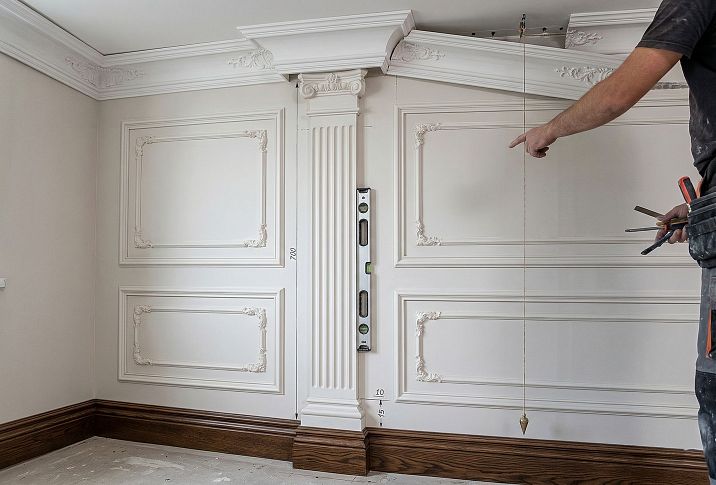
A classical wall is not a collection of beautiful details. It is an architectural system where each element occupies its place in a strict hierarchy: from bottom to top, from base to crown. WhenSkirting made of solid woodthe base is weak, a pilaster appears as a random decoration glued to the wall without meaning. WhenRelief Decorationan element lives on its own, without connection to the base and verticals—the architecture falls apart, and instead of a cohesive interior, you get a collection of disparate expensive details.
Everything changes when a clear logic of three levels appears in the project. A wooden baseboard forms a powerful, confident foundation. A pilaster sets the vertical rhythm, fixes the wall's support points, and connects the floor to the ceiling in one motion. Moldings, trims, and cornices assemble the middle and upper zones: they create articulation, scale, architectural plasticity, without which the wall remains merely a painted surface.
This article provides a complete breakdown of how a classical wall functions as an architectural system. How to choose moldings, pilasters, and wooden baseboards so that they work together, not exist in parallel. And why precisely the sequence—first the base, then the vertical, then the upper plasticity—determines the quality of the final result.


Why a classical wall starts with the base, not the upper decoration
This is the key question that most often remains unanswered in popular materials about classical interiors. Everyone writes about cornices, moldings, ceiling moldings—and almost no one mentions that without a strong base, these elements simply hang in the air, losing scale and conviction.
The visual weight of a wall is formed from the bottom. When the eye glides over the surface—it first registers the bottom line, and it is there that the first impression of the room's architectural character is established. A thin, inconspicuous baseboard signals: the wall 'doesn't hold,' it has no weight of its own, it is light and temporary. A tall wooden baseboard with an expressive profile sends a completely different message. It is a plinth, a foundation, an architectural confidence.
This is why, in the classical tradition, the baseboard was never a 'closing strip' between the floor and the wall. It was an architectural element—with a profile, height, and proportions coordinated with the other interior details.Wooden baseboardIn its classic execution, it is a minimum of 80–120 mm in height, often more. This is a massive profile visible from a distance. It is a material that, when viewed from below, says: here begins something substantial.
The second argument in favor of 'starting with the base' is technical. A pilaster must stand on something. Its base is an architectural element that visually rests on or transitions into the baseboard. If the height and profile of the baseboard and the pilaster's base are not coordinated, the pilaster appears attached to the wall from the outside, rather than grown into it from within. This is a fundamental difference between decor that looks built-in and decor that looks hung on.
The third argument is proportional. A classical wall is divided horizontally into several zones: the plinth (baseboard and base), the wall field (between the base and the cornice), and the upper zone (cornice, frieze). If the plinth is weak, the upper zone is overloaded, proportions are disrupted, and the entire wall looks 'top-heavy': heavy at the top and empty at the bottom.
A practical rule: before choosing moldings and pilasters, decide on the wooden baseboard. Its height, profile, and wood species set the tone for the entire system. A tall wooden baseboard is the platform on which everything else will stand.




What role does a pilaster play on a wall?
The pilaster is one of the most underrated elements of classical interior design. It is often perceived as a decorative excess, as a 'column leaned against a wall.' In reality, the pilaster is an architectural tool that solves several tasks at once.
The first task is vertical rhythm. A wall without vertical accents is perceived as a neutral plane.pilastersThey break it into sections, create a pulse, and set the scale. The distance between pilasters is like a beat in a musical piece: too frequent feels fussy, too sparse feels monotonous. The right interval creates a sense of noble measuredness.
The second task is connecting the levels. The pilaster physically connects the lower zone of the wall with the upper. Its base interacts with the baseboard, its shaft with the wall field, and its capital with the cornice. In this sense, the pilaster is the structural framework on which all the horizontal architecture of the wall rests. Remove it, and the moldings, cornices, and plasterwork lose their point of reference.
The third task is architectural support for secondary elements. Moldings in a classical interior are not placed arbitrarily—they follow the logic of vertical accents. If pilasters fix points on the wall, moldings fill the space between them, creating rectangular panels, frames, and raised panels. This is the principle of any classical architectural system: first the vertical, then the horizontal.
Our factory also produces:



Three parts of a pilaster: what to pay attention to
A pilaster consists of three elements: base, shaft, and capital. Each carries its own load in the architectural logic of the wall:
-
The base of a pilaster is the transitional zone between the plinth and the shaft. This is where the key junction occurs. The width and height of the base should be proportionate to the plinth: if the plinth is tall and massive, the pilaster base should support this, not contrast with it through a sharp transition.
-
The shaft of a pilaster is the main vertical element. Its proportions (the ratio of width to height) determine the character of the interior. Slender, elongated pilasters are Neoclassical, Ionic. Wider and shorter ones are Tuscan or Doric order, massive classicism.
-
The capital of a pilaster is the upper architectural element through which the pilaster interacts with the cornice. The capital can be laconic or ornamentally developed, but in any case, it should echo the style of the molding used in the upper zone of the wall.
Pilasters and columns made of solid wood— are both a structural and decorative element: a properly executed wooden pilaster adds warmth and character to the wall through the texture of the material, unattainable with polyurethane. At the same time, a wooden pilaster harmoniously coordinates with the wooden plinth in terms of wood species, tone, and finish.
Get Consultation
Where does molding work in this system
If the plinth is the foundation and the pilaster is the vertical, then molding is the plasticity that fills and unifies the entire wall space. Its role is not limited to individual elements: decorative molding works as a system that creates articulation, scale, and detailing.
The middle zone of the wall is the space between the base of the pilaster and the beginning of the cornice. This is where moldings form architectural frames and panels. A molding is not just a thin strip with a profile. It is a linear architectural element that makes the wall three-dimensional, creates shadow and light, and adds a sense of relief. Without moldings, the wall remains flat even with pilasters and decorative molding.
The upper zone is the transition from the wall field to the ceiling. This is where the cornice works: it completes the vertical wall, creates an architectural break, from which the ceiling visually 'separates' and is perceived as an independent plane. The cornice is the point of completion of the pilaster's verticality.
Polyurethane moldings— is today the primary material for decorative architectural plasticity in interiors. Its advantage over plaster is its lightness, geometric precision, and the ability to work with fine details. Over wood — the ability to create complex profiles without loss of precision. Polyurethane molding holds its shape, does not crack, is easy to paint, and coordinates well with wooden elements — baseboards, pilasters, frames.
Four Molding Tools for the Wall
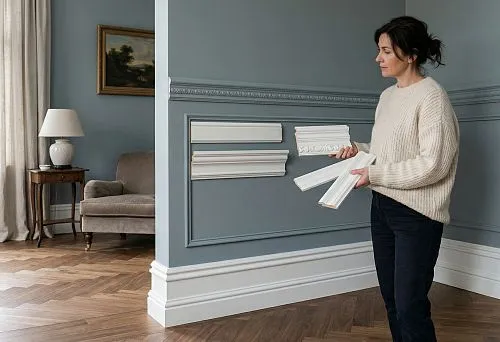
Let's break down by function how exactly Relief Decoration works in classical wall architecture:
-
Moldings — linear profiles that create frames, highlight zones, and make the wall multi-layered. They come in straight (for horizontal belts) and shaped (for corners and trims).
-
Cornices — volumetric profiles of the upper zone, transitional between the wall and ceiling. They set the scale of the room and 'close' the vertical elements from above.
-
Appliqués and ornaments — accent elements, rosettes, brackets, capitals. They are appropriate at nodal points — above pilasters, in the center of panels, at the intersections of moldings.
-
Belts and string courses — horizontal strips that divide the wall field into several zones by height. They are especially important with high ceilings, where a wall without belts seems endless and empty.
An important principle: molding must follow the logic of the pilaster. If the pilaster is a vertical accent, then moldings, frames, and cornices should start and end at its edges. This creates a sense of architectural order, not chaotic decoration.
How to connect a pilaster and a wooden baseboard
This is perhaps the most technically subtle question in assembling a classical wall. This is where mistakes most often occur—not due to poor taste, but due to a misunderstanding of the principles of abutment.
The essence of the question: does the pilaster sit on the baseboard or next to it? How does the base of the pilaster interact with the top edge of the baseboard? Should they be the same height, or should the pilaster base be higher?
The classical principle is that the pilaster base slightly exceeds the height of the baseboard. It sort of 'grows' out of it, continues its logic, but does not merge with it completely. This creates a neat transition: the baseboard is the horizontal belt of the base, the pilaster base is the vertical accent against its background. If they are the same height, the boundary between them blurs, and the wall becomes monotonous from below. If the base is too high, it visually detaches from the baseboard, and the pilaster again seems 'leaned against'.
The second aspect is the profile. The profile of the pilaster base must be coordinated with the profile of the baseboard. Both elements belong to the same architectural system—and this should be visible in the character of the lines. If the baseboard has a scotia and a reverse curve (a characteristic classical profile), then the pilaster base should also use similar profiling elements. This does not mean 'identical'—it means 'from the same vocabulary of forms'.
A detailed analysis of the connection of profiles, the selection of the height of the wooden baseboard for the pilaster, and specific solutions for different styles of classical interior are presented in the material Wooden skirting board and pilasters: vertical and horizontal decor in one style. Common abutment errors and rules of proportion are also discussed there.
Practical rules for coordination
Speaking practically, here are the key checkpoints for any project:
-
The height of the baseboard is chosen first—and everything else is then calculated from it
-
Pilaster base height = baseboard height + 15–25% (depends on room scale)
-
Pilaster base profile must include at least one element present in the baseboard profile
-
Width of wooden baseboard at pilaster base should not be noticeably greater than the width of the base itself
-
When using wooden floor baseboard as pilaster base, it's important that wood species and finish tone match
How to coordinate molding and solid wood baseboard
This question inevitably arises as soon as both materials appear in a project — wood below and polyurethane above. They seem to be from different systems. Actually — they're from the same one.
Wood and polyurethane solve different tasks in classical interiors that don't compete but complement each other.Skirting made of solid woodWood is the material, tactilely perceptible base: warm texture, living grain pattern, confident weight. It creates a sense of fundamentality, 'groundedness,' authenticity. Polyurethane molding is geometric precision, profile delicacy, ability to reproduce any ornament with absolute neatness. It's light, precise, formal.
Together these two materials provide the full spectrum of classical interior: warmth of natural wood below, strictness of architectural plasticity above. This principle of 'floor — wall — ceiling as a unified system' is analyzed in detail in the materialPolyurethane Stucco and Wooden Floor Baseboard: Perfect Finishing for All Interior Levels.
Key rule for coordinating wood and polyurethane: neutral color unites. If wooden baseboard has natural light tone — untinted oak, for example — then polyurethane molding should be painted white or light cream, and both materials exist in space as independent but non-competing accents. If baseboard is dark walnut or wenge — molding should be maximally neutral, white, so the contrast isn't aggressive.
What is important when choosing a wooden baseboard for molding
Several practical observations for projects where solid wood baseboard is combined with polyurethane molding:
-
Oak is a versatile wood species for classic interiors: the fiber structure is expressive enough for the baseboard to be 'readable' from a distance, yet it does not dominate over the molding
-
Beech has a finer, more uniform texture, well-suited for neoclassical solutions where the wall is stricter and more restrained
-
A profile with a reverse curve (classical 'classicist' profile) pairs well with polyurethane cornices featuring similar profiling elements
-
The height of a solid wood baseboard under molding should be at least 90–100 mm: with a lesser height, the molding 'overhangs' a weak base and the wall appears top-heavy
Moldings and cornices: how to assemble the middle and upper lines
Once the baseboard and pilasters are determined, it's time for the horizontal architecture: moldings and cornices. This is the level where the final plasticity of the wall is formed — its detailing, articulation, and sense of depth.
MoldingsIn a classic interior, they serve several functions. The first is creating rectangular panels on the wall surface. This is a classic technique: vertical pilasters set the anchor points, horizontal moldings create frames between them. The result is a rhythmic grid that makes the wall architecturally rich without being overloaded.
The second function of molding is transitions. At the junction of different zones — between the base and the shaft of a pilaster, between the wall surface and the frieze — molding softens the transition, lending it elegance. A sharp transition without molding looks careless, almost crude.
Crown MoldingThey solve a larger-scale task — they form the top line of the wall. The cornice is the architectural 'ceiling' of the wall: after it begins another plane, another world — the ceiling space. A correctly chosen cornice sets the scale of the entire room. A small, thin cornice in a large hall is a sign of incompleteness. A powerful, multi-component cornice in a small room creates a feeling of tightness and pressure.
The principle of subordination: in the architectural hierarchy of a classical wall, moldings and cornices must be subordinated to pilasters — as the horizontal is subordinated to the vertical. This does not mean 'to be smaller' or 'to be thinner'. It means that their placement and scale are determined by the logic of vertical accents, and not vice versa.
More details on how baseboards, moldings, and cornices form a unified architectural system of a classical interior are described in the article Solid Wood Baseboards and Moldings: Architectural Foundation of Classic Interior.
Rules for moldings: four key principles
-
The thickness of the molding in the panel should not exceed the projection of the pilaster base — otherwise, the molding visually 'jumps out' forward and the frame becomes more active than the vertical element.
-
The height of the horizontal band should be a multiple of the total height of the wall field — this creates proportionality of division.
-
Molding on an internal wall corner requires special corner elements — a 45° miter joint creates a neat transition without a visible seam.
-
For ceilings from 3 to 4 meters, two bands on the wall field are recommended: one at approximately one-third of the height, the second — at two-thirds.
How to choose a wooden baseboard: height, profile, wood species
Choosing a wooden baseboard is the first and most important decision in assembling a classical wall. The entire system begins precisely with it. And it is here that mistakes are most often made, guided only by aesthetic considerations, without understanding the architectural function.
Skirting board height is a key parameter. General rule: skirting board height should be 3 to 5% of the room height. For a 3-meter ceiling, that's 90–150 mm. For a 3.5–4 meter ceiling — 105–200 mm. A tall wooden skirting board acts as a vertical base — it sets the scale for pilasters and creates a sense of monumentality in the lower zone. A low skirting board (50–60 mm) is only appropriate in a modern interior where there are neither pilasters nor cornices.
Skirting board profile — its architectural character. Profiles of the classical tradition always include curved lines: cavettos (concave arcs), ogees (S-shaped profiles), reverse curves. Straight, 'boxy' profiles are for modern or minimalist styles. In a classical interior with moldings and pilasters, a skirting board with a geometric profile will create dissonance.
Wood species — a matter of tactile and visual character:
-
Solid oak skirting board— the most common choice for classic styles. Oak has an expressive grain structure, high density, and takes stain and varnish well. Color ranges from light beige (whitewashed oak) to rich cognac (oak with patina). Suitable for living rooms, studies, dining rooms.
-
Solid beech skirting board — lighter, more uniform texture. Beech takes well to painting in white or ivory, making it ideal for neoclassical styles with white surfaces and gold accents.
Color and finish: natural shade or painting depends on the overall interior palette. If the room has a wooden floor, wooden doors, and wooden pilasters — the skirting board should be the same tone (or slightly darker). If the walls are white and wood is used sparingly — a skirting board in natural wood becomes an accent.
Best application scenarios
The architectural system 'skirting board — pilaster — molding' works in different spaces, but has its nuances in each of them.
Classic living room
Living room — the main space for applying the full architectural system. All elements are possible here: a tall oak wooden skirting board, pilasters on the fireplace wall and along large blank wall planes, moldings in the form of panel frames, a ceiling cornice with a relief profile.
Wooden skirting board for a classic living room — minimum 100 mm, preferably 120–140 mm for ceilings 3 meters and higher. Pilasters in a living room interior are placed according to the principle of uniform rhythm: the distance between them is a multiple of the pilaster width (usually 5–8 times wider). Molding decor for a classic living room interior — moldings with rectangular frames and a cornice with a developed multi-step profile.
Office
In the study, the architectural wall system operates with greater rigor. Pilasters here are more appropriate in the Doric or Tuscan order—without complex ornaments, with geometric conciseness. Moldings form frames for bookshelves or paintings. The solid oak baseboard is dark, stained, with patina: it supports the atmosphere of a masculine, focused space.
The cornice in the study is restrained, without ornament: one or two setbacks, no acanthus leaves or volutes. The strength of the study lies in correct proportions, not in the richness of decoration.
Dining Room
The dining room is a formal yet intimate space. Here, a system with pilasters and panel moldings around the perimeter works well, and a beech wood baseboard painted white creates a light, airy character for the lower zone. Plasterwork in the dining room is often concentrated in the area above the sideboard or between windows.
Hall and Entrance
The hall is the first thing a guest sees. It is here that the pilaster as a vertical accent works especially vividly: it anchors the entrance space, sets the scale, and speaks to the character of the entire house. For a hall with a ceiling height of 3.5 meters or more—a tall wooden baseboard (from 120 mm), pilasters at the doorway, and a cornice with a developed profile.
Bedroom in Neoclassical Style
A bedroom in the neoclassical style requires a more delicate solution. Here, the principle 'fewer elements, more proportions' applies: a solid beech baseboard in white or light cream, one or two pilasters at the head of the bed (as an architectural 'headboard'), frame moldings instead of wallpaper, a modest cornice. Decorative plasterwork—only as accents: a ceiling rosette, a light ornament in the central frame.
Mistakes that cause the wall architecture to fall apart
No list of mistakes can replace an understanding of the system—but noting the most common problems is useful for checking any project.
A weak baseboard under an active pilaster
This is the most common mistake. A massive pilaster with a developed base is installed on a narrow baseboard 60–70 mm high—and that's it: the pilaster hangs in the air, its base 'disappears' into the floor without support. The more expressive the pilaster, the more substantial the wooden baseboard beneath it should be.
Random plasterwork without connection to the vertical
Wall moldings, cornices, applied elements — placed without considering pilaster placement. Moldings are awkwardly 'cut off' at pilaster shafts, frames start at arbitrary points, ornaments are glued where 'it looks nice.' The result is visual chaos that no material quality can fix.
Too small a molding next to a massive base.
A thin molding next to a wide, voluminous pilaster base is perceived as a random stroke. The scale of elements must be coordinated: if the pilaster base projects 20–25 mm from the wall plane, the molding should be at least 25–35 mm high.
Lack of connection between the baseboard, pilaster, and cornice.
All three elements are from different 'vocabularies': a geometric baseboard, a pilaster with a Corinthian capital, a cornice with a Tuscan profile. A classical wall is an architectural system, not an exhibition of samples from different catalogs. All elements should belong to the same order or at least the same stylistic tradition.
Molding is more active than the vertical.
If the ornamental molding in the middle field of the wall is richer and more complex than the pilaster capital — the architectural hierarchy is inverted. The main element is the vertical. Molding supports it but should not overwhelm it.
Ignoring room height when choosing a baseboard.
A baseboard 100–120 mm high in a room with a 2.4-meter ceiling — too heavy. A baseboard 60 mm high with a 4-meter ceiling — a lost detail. How not to overload a classical wall? First and foremost — correctly determine the scale of each element relative to the room height.
FAQ: Answers to popular questions
What is more important in a classical wall: the baseboard or the molding?
Architecturally speaking, it's the baseboard. It forms the foundation without which neither pilasters nor moldings will work correctly. Start by choosing a solid wood baseboard, and only then design the upper elements. A strong base forgives mistakes in details; a weak base cannot be saved even by the most expensive molding.
How to choose a pilaster for a wooden baseboard?
There are three key criteria: base height (should be slightly higher than the baseboard), base profile (should echo the baseboard profile), and width (not narrower than the visual 'weight' of the baseboard on that section of the wall). The optimal option is asolid wood pilastermade from the same wood species as the baseboard.
Can polyurethane molding be combined with a solid wood baseboard?
Not only can it be done — it's one of the best ways to assemble a classic wall. Polyurethane provides precision and lightness in the upper zones. A solid wood baseboard provides materiality and warmth at the bottom. The main condition is neutral and coordinated colors. This principle is discussed in detail in the article aboutmolding and wooden baseboard.
What kind of baseboard is needed for a classic wall?
A solid oak or beech baseboard, with a height from 90 to 150 mm (depending on ceiling height), with a classic shaped profile — with a scotia, ovolo, or reverse curve. Avoid rectangular, 'boxy' profiles — they belong to a different style.
Where should moldings and cornices be placed in the composition?
Moldings — in the wall field, forming rectangular frames between pilasters. Cornice — in the upper zone of the wall, as a transition to the ceiling. Moldings and cornices always follow the logic of the pilasters: they start and end at their edges, they do not arbitrarily 'cross' the verticals.
When is a pilaster truly appropriate?
A pilaster is appropriate where the wall has sufficient height (from 2.7 meters) and sufficient length (at least 1.5–2 meters between support points). In small rooms with low ceilings, a pilaster creates a feeling of pressure. The ideal application areas are living rooms, studies, halls, dining rooms, bedrooms with ceiling heights from 3 meters.
How to choose the proportions of a pilaster and a baseboard?
Classical formula: baseboard height — about 5% of the room height, pilaster base height — 120–130% of the baseboard height, pilaster shaft width — 1/10 of the shaft height (standard proportion of the classical order). If the solid oak baseboard is 120 mm high with a 3-meter ceiling — the pilaster base is about 140–150 mm, the shaft — 2400–2500 mm high and 250–280 mm wide.
What kind of molding is suitable for a wooden baseboard?
Any polyurethane molding with a classical profile, painted in a color that contrasts (but does not compete) with the wood. With light oak — white or cream molding. With dark oak or walnut — white molding as a neutral background. A detailed catalog of solutions is in the section Polyurethane moldings.
Summary: a classical wall as an architectural system
To assemble a classical wall means to follow a top-down logic in planning, but a bottom-up approach in execution. First, the Skirting made of solid wood— as the foundation, the base of the entire system. Then thepilasters— as the vertical framework, setting the rhythm and proportions. Then comes the turn ofstucco decoration— moldings, cornices, overlay elements that assemble the middle and upper plasticity of the wall.
Only in this sequence does a classical wall become whole, architecturally convincing, and visually complete. Only with this approach does decor cease to be mere decoration and becomes structure.
The company STAVROS manufactures all three components of this system: solid oak and beech baseboards, solid wood pilasters and columns, polyurethane stucco decor and moldings, wooden cornices and moldings. This means you can build a unified architectural system for a classical wall from a single source — with guaranteed consistency of scale, proportions, and style. STAVROS is not just a catalog of parts: it is a tool for creating interior architecture where every element takes its place and works towards the common result.