Article Contents:
- What is Wall Molding and Why It's Trending Again
- When Molding Stopped Being Just a Palace Decoration
- How Molding Makes Walls More Expressive
- Which Elements Belong to Wall Molding
- Moldings - The Foundation of Wall Decor
- Decorative Frames
- Inlays and Ornaments
- Pilasters and Columns
- Wall Panels with Plaster Decor
- What Materials Are Used for Molding: An Honest Comparison
- Plaster: classic with limitations
- Polyurethane: choice for modern interiors
- Polystyrene: budget option with caveats
- Wood and MDF: for wall panels and moldings
- Wall molding in different interior styles
- Classic and Baroque: ceremonial maximalism
- Neoclassicism: dignity without overload
- Modern classic: balance between tradition and relevance
- Minimalism with decorative accents
- Where to best use wall molding
- Living room — the main space for decor
- Bedroom: Delicacy and Coziness
- Entryway: First Impression
- Study: status and concentration
- Niches, Openings, TV Zones
- How to Decorate a Wall with Molding: Popular Scenarios
- Accent Wall with Frames
- Symmetrical Composition with a Central Accent
- Horizontal Division: Molding as an Architectural Boundary
- Combining Molding with Panels
- Decorating the Fireplace and TV Zone
- How to Choose the Size, Rhythm, and Pattern of Molding
- Scale — The Main Principle
- Rhythm and intervals
- For small spaces
- For high ceilings
- What to pair with wall molding
- Paint and plaster
- Wallpaper
- Mirrors and sconces
- Furniture and Textiles
- Common mistakes when using wall molding
- Overly ornate patterns in a small room
- Overloading the wall with elements
- Scale mismatch
- Incorrect material selection
- Molding clashing with furniture style
- Ignoring lighting
- How to choose molding for different purposes
- For delicate modern decor
- For a prestigious classic interior
- For accent wall in living room
- For a budget-friendly update
- For a modern project with geometric decor
- Conclusion: a short algorithm for choosing wall molding
- FAQ: answers to popular questions about wall molding
- About the Company STAVROS
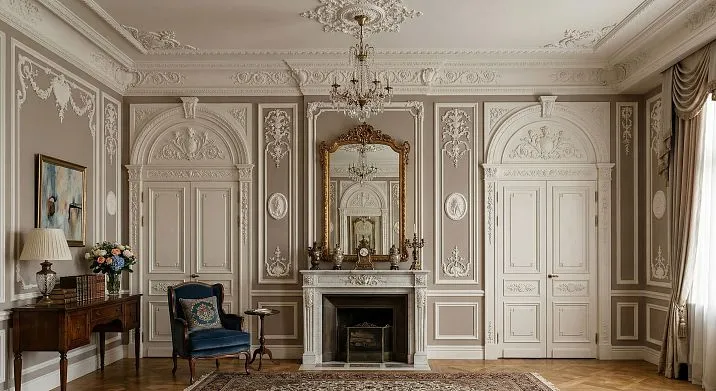
A wall is not just a partition. It is a canvas on which the entire character of a space is built. Wall molding transforms this canvas into an architectural statement: restrained or solemn, geometric or ornamental, concise or multi-layered. That is why decorative plaster molding for walls is experiencing a true revival today—not only in classic projects but also in modern interiors, where texture, depth, and a justified visual accent are valued.
This article is a practical guide for those who want to understand: what exactly is called molding, which elements to use on a wall, what material to choose them from, where to apply them, and how not to turn a beautiful idea into a design mistake.


What is wall molding and why is it trending again




When molding ceased to be just a palace decoration
Until recently, the word 'stucco' evoked a persistent image: a Baroque hall, a snow-white ceiling with cupids, heavy cornices, and gilded ornaments. This perception was formed historically—stucco decoration indeed long remained a privilege of palace and estate architecture. But today, the picture has changed dramatically.
The modern market offers decorative wall stucco in formats that organically exist in Scandinavian interiors, neoclassical styles, and contemporary projects. Moldings without ornamentation, clean geometric frames, minimalist overlays—all of this is also stucco decoration, just in a new interpretation. A wall with several correctly placed profiles looks more expensive, more structured, and more meaningful than a bare surface with a painting in the middle.
Our factory also produces:




How stucco makes a wall more expressive
Stucco decoration works on several levels of perception at once. First, it creates relief—and relief means chiaroscuro, that is, depth that cannot be achieved with paint or wallpaper. Second, decorative elements on the wall set a rhythm: horizontal moldings divide the plane into zones, vertical pilasters visually raise the ceiling, frames structure the wall and give it a finished look. Third, stucco signals the quality of the interior—it is a material detail that is visible and felt even from a distance.
This is why, in current interior trends, wall decoration with stucco is becoming a universal tool: it works both in budget projects with paintable polyurethane moldings and in status interiors with carved wooden panels and complex architectural compositions.
Get Consultation
Which elements belong to wall stucco
Moldings—the foundation of wall decor
Moldings for interior—are profile strips with a shaped cross-section that are attached to the wall horizontally, vertically, or along the contour. They perform several functions at once: divide the wall plane into sections, create frames around panels, frame niches and doorways, and decorate the transition between the wall and ceiling.
Based on the profile shape, moldings are divided into:
-
smooth—clean cross-section without ornamentation, suitable for modern and minimalist interiors;
-
with a recessed profile — a profile with a recess that creates pronounced chiaroscuro;
-
with relief — featuring an ornamental pattern along its entire length, for classic and neoclassical interiors;
-
composite — assembled from several profiles of different cross-sections to create multi-layered compositions.
Moldings are the most versatile tool in the entire arsenal of wall decor. They are usually the starting point when you want to give a wall structure without radical changes.
Decorative frames
Wall frames are one of the most popular modern uses of molding. Rectangular or square frames are formed from moldings, dividing the wall into equal sections. This technique comes from English panel decor and is now actively used in living rooms, bedrooms, and hallways. Frames can be painted the same color as the wall — then the decor remains delicate and unobtrusive, or done in a contrasting shade — then they become a striking graphic accent.
Overlays and ornaments
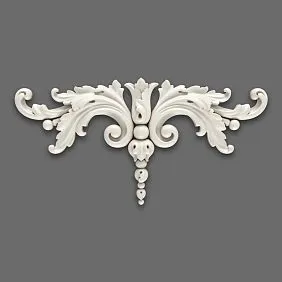
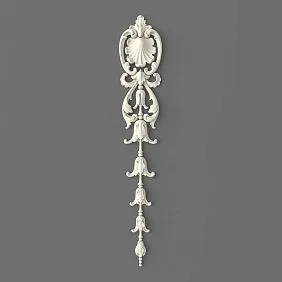
A separate category consists of individualWall Decorative Elements— rosettes, medallions, cartouches, corner blocks, ornamental inserts. These are not profiles, but three-dimensional shaped overlays that are mounted pointwise: in the center of a frame, at the intersection of moldings, above a doorway, or in a niche.
Their main function is accent. Where a simple profile creates rhythm, an overlay creates a focal point. Corner blocks look especially effective at the junctions of moldings in a frame composition: they eliminate the need for precise miter cuts and simultaneously add decorative appeal.
Pilasters and columns
Pilasters are flat vertical elements that imitate columns. They are attached to the wall and create a pronounced vertical rhythm. In classic interiors, pilasters are a mandatory element, giving the wall architectural dignity. In modern projects, they are used more restrainedly: as a structural accent at an entryway, on either side of a fireplace, or in a library area.
Wall panels with pilasters and capitalsfrom STAVROS is a good example of how this technique works in comprehensive design: pilasters set the proportions, the cornice completes the composition, and moldings and overlays fill it with details.
Wall panels with stucco decoration
A separate and very functional format is boiserie, or full-fledged wall panels. This is a ready-made system consisting of baseboards, pilasters, moldings, overlays, and cornice, united into a single architectural composition. SuchWall Panelsprovide the maximum effect — the wall looks like an interior created by an architect, not just a pasted or painted surface.
What materials are used for stucco: an honest comparison
Plaster: classic with limitations
Traditional stucco is made from plaster — a material with a history of several thousand years. Plaster decoration has the density and weight of natural stone, conveys the finest relief details well, and looks absolutely authentic. This is why plaster stucco is chosen for prestigious historical restorations and high-end classic interiors.
However, plaster has significant limitations:
-
significant weight — especially critical for large elements;
-
fragility during transportation and installation;
-
moisture sensitivity — not suitable for bathrooms and rooms with unstable humidity;
-
complex installation requiring professional skills.
For most modern residential projects, plaster is an excessive solution. It is justifiably chosen where authenticity is important and there are no budget or weight constraints.
Polyurethane: the choice for modern interiors
Polyurethane moldings— is today's standard for most residential and commercial projects. Polyurethane reproduces the detailing of the original plaster with high accuracy, but at the same time:
-
weighs several times less — large elements can be installed by one person;
-
not afraid of moisture — suitable for kitchens, hallways, bathrooms;
-
resistant to mechanical damage;
-
easily cut with a regular knife or saw;
-
adheres with mounting adhesive without complex surface preparation;
-
takes any paint perfectly — water-based, acrylic, decorative.
The last property is especially important:decorative polyurethane elementsthey come in white primed form and can be painted in any RAL or NCS color — making them completely flexible for working with any color concept.
Polystyrene: a budget option with caveats
Polystyrene moldings and baseboards are the most affordable market segment. They are sold by the meter in construction hypermarkets and are quite suitable for simple tasks (for example, finishing the transition between wall and ceiling in a low-cost renovation). However, polystyrene is brittle, holds paint poorly, provides less clear relief, and does not give the impression of an architectural detail. For serious wall decoration, polystyrene is not considered.
Wood and MDF: for wall panels and moldings
If the task is to create a full-fledged paneled wall finish, then wood and MDF come to the forefront.Decorative wooden moldings— made from solid oak, beech, ash — provide natural texture, warm tone, and a sense of genuine material. They are used for wall panels, fireplace portals, mirror frames, and doorways.
MDF moldings are a more affordable option that also takes paint well and ensures a clear profile. They are ideal for projects requiring white 'stucco-like' finish without significant costs.
Wall molding in different interior styles
Classic and Baroque: solemn maximalism
In classic and Baroque interiors, wall molding is a fundamental element of the architectural language. Walls are divided into three zones: the plinth part (panels or high baseboards), the main field (with frames, pilasters, ornaments), and the cornice, which completes the transition to the ceiling. The ornaments are rich—acanthus leaves, volutes, garlands, rocaille. The color palette is white on white, gold on cream, gray on a light background.
For such an interior, choose a meticulously detailedmolding decor for a classic interiorwith rich ornamentation, full pilasters, and complex cornice profiles.
Neoclassicism: dignity without overload
Neoclassicism is the most relevant style for working with molding today. It retains the architectural logic of classicism (rhythm, symmetry, tiering), but the decor becomes more restrained. Ornaments are simplified, frames remain clean, moldings have a simpler profile. Color is often monochromatic: the entire wall, including the molding, is painted in one tone, creating volume without contrast.
Wall decoration with moldingsin the neoclassical style is perhaps the most universal scenario: it works in a living room, bedroom, study, hallway, or meeting room.
Modern classic: balance between tradition and relevance
Modern classic is a freer interpretation of classical principles. Mixing textures (wood and molding, plaster and moldings), neutral colors, larger and more concise profiles are acceptable here. Molded decor plays the role of a structural element, not decorative abundance.
Minimalism with decorative accents
Even in a minimalist interior, wall molding can be appropriate — provided it is used sparingly and with moderation. One horizontal line of molding at a height of 90–100 cm from the floor (similar to a chair rail), several geometric frames on an accent wall, or a clean contour profile around a niche — all of this does not violate the minimalist code but adds an architectural dimension to the wall.
Where is it better to use molding on the wall
Living room — the main space for decor
Ornate wall panels
Living room — the perfect place for molding. It is here that walls are perceived at the maximum distance, and it is here that the most expressive decor is appropriate. Common scenarios:
-
accent wall behind the sofa — frames made of moldings, a central overlay, symmetrical composition;
-
TV area —molded decor for the living roomaround the TV: moldings create an 'inset' look for the panel, like a built-in architectural detail;
-
Fireplace zone — a portal, pilasters on the sides, cornice above the fireplace;
-
Full wall paneling — the most prestigious option.
Bedroom: delicacy and coziness
In the bedroomdecorative wall moldingworks differently — here intimacy is needed, not grandeur. The optimal scenario is an accent wall behind the bed headboard: symmetrical frames, a central ornamental element, or simple vertical rhythm of moldings. Molding in the wall color is preferable to contrasting here — it creates volume without visual noise.
Entryway: first impression
The hallway is a small space, but it is what forms the first impression of the apartment. Moldings and frames on the hallway walls create a sense of thoughtful, architecturally competent interior right from the threshold. Vertical wall divisions are especially effective here: they visually elongate the space and add nobility to it.
Study: status and concentration
For a home office or meeting roomMolding for an accent wall— this is the language of status. Book niches framed by moldings, pilasters on the sides of the work area, frame wall decoration — all this creates an atmosphere of seriousness and professional competence.
Niches, openings, TV zones
Molding works excellently as a framing element. A wall niche, framed with molding along its contour, transforms from a construction solution into an architectural detail. A door opening with a profile-casing looks finished and expensive. A TV area with a molding frame is perceived as a built-in element, not just a 'TV on the wall'.
How to decorate a wall with molding: popular scenarios
Accent wall with frames
Art Nouveau interior with poster
The most common and accessible scenario. A system of rectangular frames made from moldings is applied to one wall (usually the one visible upon entering the room or serving as a background for the main piece of furniture). They can be the same size or different — with large outer and small inner panels. The entire structure is painted the color of the wall — resulting in an exquisite relief decor.
Key principle: the frames must be proportional to the wall and set back from the edges at an equal distance. An error in symmetry is instantly noticeable.
Symmetrical composition with a central accent
A central decorative element — a large overlay, medallion, or ornamental insert — is placed on the accent wall. Smaller frames are arranged symmetrically on either side of it. This scheme is typical for classic and neoclassical interiors and creates a pronounced, solemn character for the wall.
Horizontal division: molding as an architectural boundary
One horizontal molding at a height of 90–120 cm from the floor is a technique from English and French classic interiors. It divides the wall into a plinth part (the lower third, often a darker tone or with a textured finish) and the main field (the upper two-thirds). This technique is simple but very effective: it visually structures the wall and creates a sense of architectural space.
Combining molding with panels
A combination of wooden or MDF panels with moldings and decorative overlays is one of the most expressive formats in modern decor. The panel creates texture and depth, the molding frames it, and the overlay adds the final accent.polyurethane wall decorin combination with wooden panels, creates a contrast of materials that is perceived as a sign of an expensive and well-thought-out interior.
Design of fireplace and TV zones
The fireplace is the traditional focal point of a classic interior. Moldings around the perimeter of the portal, pilasters on the sides, and a cornice above it create a complete architectural group. For the TV zone, a similar logic is applied: the screen is fitted into a frame made of moldings, and illuminated niches framed by the same profiles can be placed on the sides.
How to choose the size, rhythm, and pattern of moldings
Scale is the main principle
Decorative plasterwork should be proportionate to the room. Large profiles and rich ornaments in a small room create a feeling of oppressive space. Delicate moldings with a small cross-section in tall, formal halls get lost and appear random. The basic rule: the width of the molding in mm should correspond to the ceiling height in dm. That is, for ceilings of 2.7 m, profiles with a width of 25–35 mm are suitable; for ceilings of 3.2 m — 40–60 mm; for 4 m and above — 80 mm or more.
Rhythm and intervals
Frames on the wall create rhythm — and this rhythm should be uniform. The distance between frames, as well as from the frames to the edges of the wall, should be proportionate: usually, this is 15–25% of the frame size. Too dense placement creates clutter, too sparse — incompleteness.
For small spaces
In small rooms, the following work:
-
moldings with a simple profile without ornament;
-
frames of elongated proportions (taller than wider) — they visually raise the ceiling;
-
molding in the color of the wall — without contrast;
-
minimal number of elements — less is more, but more precise.
For high ceilings
In spaces with ceilings from 3.5 m, wall molding fully reveals itself. Here, the following are appropriate:
-
tripartite division of the wall (baseboard, main field, frieze);
-
large moldings with a pronounced profile;
-
full-fledged pilasters and cornices;
-
ornamental overlays within frames.
What to combine wall molding with
Paint and plaster
The most common combination is molding on a painted wall. It works in two versions: monochrome (molding in the color of the wall — emphasis is achieved through relief and chiaroscuro) and contrast (white molding on a colored wall or, conversely, tinted molding on a white background). Decorative plaster (Venetian, concrete effect) combined with moldings and frames creates an especially rich textural space.
Wallpaper
Molding and wallpaper are a classic combination. Wallpaper is fitted into frames made of moldings, framed by a profile — and the effect of inlaid panels is achieved. Textured or patterned wallpaper in frames on the neutral background of the main wall looks especially expressive.
Mirrors and sconces
A mirror framed by moldings or a decorative frame is one of the most effective techniques. Sconces installed on the sides of the mirror or at symmetrical points of the frame composition enhance the effect: side lighting emphasizes the relief of the molding and creates a lively play of shadows.
Furniture and textiles
Moldings and furniture should speak the same stylistic language. Classical molding requires furniture with curved legs, carved details, and soft fabrics. Geometric modern molding harmonizes with clear rectilinear forms, natural materials, and neutral textiles. A conflict of styles is one of the most common mistakes, which we will discuss further.
Common mistakes when using molding on walls
An overly ornate pattern in a small room
Richly decorated molding with acanthus, rocaille, and garlands in a room of 15 sq. m creates a feeling of oppression. A small space requires delicate decor: a simple profile, frames without overlays, and a minimum of details.
Overloading the wall with elements
A wall is not a display stand. When it simultaneously features moldings, sockets, overlays, framed wallpaper, sconces, and paintings, all of this ceases to be perceived as a system and turns into visual noise. Good decor is one that has rhythm, pauses, and breathing space.
Mismatch in scale
Moldings that would look appropriate in a 4-meter-high hall appear bulky and out of place in a standard city apartment with a 2.6-meter ceiling. Scale is the first thing to consider when choosing plaster decor.
Incorrect material choice
Plaster in wet areas, polystyrene in expensive classic interiors, wood where moisture resistance is needed—these are all typical material selection mistakes.Polyurethane Interior DecorationPolyurethane solves most of these problems: it is versatile in application, affordable, lightweight, and durable.
Conflict between moldings and furniture style
If the furniture in the room is clean-line contemporary with metal legs and matte fronts, and the walls are decorated in a heavy Baroque tradition, a stylistic conflict arises that cannot be resolved by any decor. Wall moldings should be selected in the context of the entire interior solution, not added after the fact.
Ignoring lighting
The relief of moldings comes alive in light. Without properly organized lighting, decor loses half of its expressiveness. Directional light (sconces, spotlights, floor lamps) creates side shadows that emphasize the depth of the profile. Diffused overhead light, on the contrary, 'flattens' the relief. When planning wall moldings, lighting should be considered in advance.
How to choose moldings for different tasks
For delicate modern decor
Choose moldings with a simple smooth profile or clean cut—without ornamentation. Mount them in the color of the wall. Limit yourself to a few frames or one horizontal molding.Moldings made of polyurethanein white, ready for painting—is the optimal choice for such a task.
For a status classic interior
Here, a full system is needed: pilasters, cornice, frames with overlays, decorative elements at key points. ConsiderSTAVROS wall panelswith a comprehensive solution—it's a ready-made architectural system that immediately sets the correct proportions and rhythm.
For an accent wall in the living room
Start by choosing an accent wall (behind the sofa or opposite the entrance). Determine the number and size of frames based on the proportions of the wall. Add corner blocks at the intersections of moldings. Finish with a central overlay. Paint in a single tone with the wall or highlight with a contrasting color.Stucco decor for an accent wallmade of polyurethane—is the best choice in terms of price, quality, and ease of installation.
For a budget update
One molding around the perimeter of the wall at chair rail height plus several corner overlays—this is a minimal and very affordable way to change the perception of the wall. Polyurethane profiles cost many times less than gypsum ones and can be installed independently in a few hours.
For a contemporary project with geometric decor
Geometric frames made from plain moldings without ornamentation, horizontal divisions, neat niches with profile framing — this is wall decor with molding in a contemporary interpretation. It doesn't reference Baroque, but creates architectural depth and structures the space.
Conclusion: a short algorithm for choosing wall molding
Choosing decorative molding for walls is a sequential process of several steps. Follow them, and the chance of error approaches zero:
-
Determine the interior style — classic, neoclassic, contemporary classic, minimalism. This sets the type of ornamentation: rich, moderate, or completely absent.
-
Assess the room's proportions — ceiling height, wall length, presence of niches and openings. This determines the scale of profiles and the number of frames.
-
Choose the material — for most tasks, polyurethane is optimal: it's lightweight, moisture-resistant, easy to paint and install. For a natural texture, consider wood or MDF.
-
Determine the application scenario — accent wall, full paneling, horizontal division, framing niches. The scenario determines the set of needed elements.
-
Choose a color solution — monochrome or contrast. If unsure — start with monochrome.
-
Plan the lighting — sconces, spotlights, or another source of directional light that emphasizes the relief.
The most versatile wall elements are smooth moldings with simple profiles, rectangular frames, and decorative overlays at intersection points. Moldings are chosen when a clean structure is needed; ready-made decorative elements are chosen when a ceremonial accent is desired. Combining both formats provides the greatest expressiveness.
FAQ: answers to popular questions about wall molding
What is considered wall molding?
Wall molding includes moldings, decorative frames, overlays, ornaments, pilasters, cornices, corner blocks, wall panels with relief decor. Essentially, any three-dimensional decorative element mounted on a wall.
How do moldings differ from other molding?
Molding is an extended profile that runs lengthwise (horizontally, vertically, or along a contour). Other molding consists of individual three-dimensional elements: rosettes, medallions, overlays. Moldings form the wall structure, individual elements create its accents.
Which wall molding is better: plaster or polyurethane?
For most modern residential and commercial projects, polyurethane is preferable: it's lightweight, moisture-resistant, easy to paint and install. Plaster is chosen for expensive historical restorations and projects with unlimited budgets.
Is molding suitable for a modern interior?
Yes, provided the right elements are chosen. Smooth moldings, geometric frames, clean profiles without ornamentation fit organically into modern and minimalist interiors.
Where is it better to create an accent wall with molding?
In the living room — the wall behind the sofa or opposite the entrance. In the bedroom — the wall behind the headboard. In the hallway — the end wall that greets you upon entry. In the study — the wall behind the desk.
Can molding be painted the same color as the wall?
Not only can it be done, but it should be in a number of scenarios. Monochrome molding is a decor that works exclusively through relief and chiaroscuro. This is one of the most modern and elegant ways to use wall decor.
What molding is best for a small room?
Simple profiles with a small cross-section, frames with elongated proportions, a minimum of individual elements. No dense ornamentation. Molding in the color of the wall.
Is molding suitable for a TV area?
Perfectly suitable. Moldings create a frame around the TV, integrating it into the wall's architecture. Symmetrical niches or vertical moldings can be arranged on the sides.
How to combine molding and wall panels?
Wooden or MDF panels are framed with moldings and complemented with overlays — this creates a classic boiserie system. Polyurethane moldings on wooden panels provide a contrast of materials while maintaining stylistic unity.
How to avoid overloading the interior with stucco decor?
The 'air' rule: frames and elements should not occupy more than 60–70% of the wall plane. Pauses are more important than details. It's better to have fewer elements, but each in its proper place.
About the company STAVROS
Concluding the discussion about wall moldings, it is impossible not to mention the manufacturer that has been setting quality standards in this field for over twenty years.
STAVROS is a St. Petersburg-based company with a 6,000 sq. m. production facility, founded in 2002. Over this time, STAVROS has become one of Russia's leading manufacturers of premium decorative moldings, wooden products, and interior solutions. The standard line includes over 4,000 models: moldings, pilasters, overlays, ornaments, cornices, rosettes, wall panels, furniture decor, and hardware. All of this is produced on 19 CNC machines with manual finishing, ensuring the precision and detail characteristic of handcrafted items.
STAVROS decor is now used not only in Russian apartments and private homes—the company's products adorn interiors in the USA, Canada, the UK, France, and other countries. This is not just a manufacturer; it is a partner for designers, architects, and clients seeking a well-thought-out wall solution.
Polyurethane molding STAVROS— is the choice of those who value material quality, execution precision, and the ability to realize any design concept: from delicate frames in a modern living room to grand paneled walls in a classic interior.