Article Contents:
- Comprehensive Approach: Why Fragmented Decor Doesn't Work
- Visual Cohesion of Space
- Proportions and Scale: Balancing Volumes
- Stylistic Unity: From Classic to Minimalism
- Ceiling Solutions: Architecture of the Fifth Wall
- Ceiling Cornices: Framing and Hidden Lighting
- Ceiling Rosettes: Chandelier Framing and Architectural Accent
- Coffers: Three-Dimensional Ceiling Architecture
- Wall Decor: Vertical Interior Architecture
- Molding Panels: Wall Structuring
- Doorway Framing: Architectural Portal
- Decorative Appliqués: Accents and Details
- Molding in the Living Room: Creating a Formal Space
- Material Combinations: Symphony of Polyurethane and Wood
- Floor Baseboards: Transition to Nobility
- Wooden Slats: Rhythm and Modernity
- Color Solutions: Unity or Contrast
- Practical Cases: From Idea to Implementation
- One-Room Apartment: Maximum Style with Minimum Space
- Three-Room Apartment: Complete Decor for a Family Nest
- Private House: Interior Molding from Entrance to Attic
- Where to Buy and How Much It Costs: Purchasing Practice
- Catalogs and Pricing
- How to Place an Order
- Frequently Asked Questions
- Conclusion: The Art of Creating Homes, Not Boxes

Interior beauty is born not from individual spectacular elements, but from their harmonious combination, thoughtful composition, and unified visual logic. You can install a magnificent chandelier in a beautiful ceiling rosette—but if the walls are bare and lack structure, the effect will be incomplete. You can create molding panels on the walls—but if the ceiling remains undecorated, the space loses its completeness.Polyurethane Ceiling and Wall Moldingenables the creation of a holistic decorative system where every element serves the overall concept, where ceilings and walls are connected by a unified rhythm, proportions, and style. A comprehensive approach to decor transforms an apartment from a collection of rooms into an architectural statement, where not only functions but also emotions, atmosphere, and visual pleasure are thoughtfully considered. In this article, we will explore in detail how to create a harmonious interior through the combination of ceiling and wall molding, which elements to choose for different rooms, how to combine polyurethane with wooden materials, how much it costs, and where to buy quality finishing kits.



Comprehensive Approach: Why Fragmented Decor Doesn't Work




Visual Cohesion of Space
The interior is perceived as a unified whole, not as a sum of parts. When you enter a room, the eye scans the entire space—ceiling, walls, floor, furniture—and looks for patterns, repetitions, rhythm. If there is a cornice with a classic profile on the ceiling, but the walls are smooth and undecorated, visual dissonance arises. The ceiling says 'I am in a classic style,' the walls remain silent 'we are neutral,' and the brain experiences mild confusion from the mismatch.
Harmony is achieved by repeating elements: if there is a cornice with a cavetto and ovolo on the ceiling, the walls should have moldings with a similar or analogous profile. If there is a ceiling rosette with a floral ornament (acanthus leaves, roses), the walls should have appliqués or moldings with botanical motifs. If the ceiling decor is smooth, modern, geometric—the wall decor should be the same.
This does not mean copying—rather, a visual rhyme. The elements echo each other but are not duplicated. A ceiling cornice 120 mm wide, a wall molding 80 mm wide—different sizes, but similar profile proportions. A ceiling rosette 70 cm in diameter with lush ornamentation, wall appliqués 20×30 cm with a simplified version of the same ornament—different scale, but a unified stylistic language.
Our factory also produces:


Proportions and Scale: Balancing Volumes
Ceiling height, wall area, and furniture size dictate the scale of the decor. A ceiling 2.7 meters high cannot support a lush cornice 200 mm wide and a rosette 100 cm in diameter—they will overwhelm the space, make the ceiling appear visually lower, and create a sense of clutter. A ceiling 3.5 meters high with a thin 60 mm cornice and a 40 cm rosette will look pitiful—the decor will get lost and fail to create the desired effect.
Scale rule: the width of a ceiling cornice should be 3-5% of the ceiling height. For a 2.7-meter ceiling, an 80-135 mm cornice is optimal. For a 3.0-meter ceiling—90-150 mm. For a 3.5-meter ceiling—105-175 mm. The diameter of a ceiling rosette should be 20-40 cm larger than the chandelier's diameter: a 50 cm chandelier requires a 70-90 cm rosette, a 70 cm chandelier requires a 90-110 cm rosette.
Wall moldings are chosen based on their proportion to the wall height. To create panels on a wall 2.7 meters high, moldings 60-100 mm wide are used. For a wall 3.0-3.5 meters—80-120 mm. The size of the panels depends on the wall area: on a 4-meter-long wall, you can place 3-4 panels each 80-120 cm wide; on a 6-meter-long wall—4-6 panels.
Get Consultation
Stylistic Unity: From Classic to Minimalism
Mixing styles is a risky technique requiring a fine sense of taste. Novice designers and homeowners are advised to adhere to a single style across all decorative elements.
Classic style—cornices and moldings with cavetto, ovolo, possibly dentils (small teeth), rosettes and appliqués with floral ornamentation (acanthus leaves, roses, laurel wreaths), symmetrical compositions, proportions borrowed from ancient architecture. Color—white, cream, light beige (traditional) or colored (pastel shades for Baroque, saturated for Empire).
Neoclassical—a simplified version of classicism, more laconic but retaining the main features. Cornices with a simple cavetto without abundant ornamentation, rosettes with moderate detailing, moldings smooth or with minimal relief. Proportions are balanced, symmetry is preserved but without excessive decorativeness. Color predominantly white or light gray.
Modern style—smooth profiles without ornamentation, geometric shapes (rectangular moldings, square appliqués), minimalist rosettes with concentric circles or no rosettes at all (chandelier mounted to the ceiling without decor). Proportions are clear, lines are strict, emphasis on purity of form. Color white, gray, black, contrasting combinations (white decor on dark gray wall).
Art Deco—geometric ornamentation (zigzags, stepped forms, sun rays), symmetry, luxurious materials or their imitation. Moldings with geometric relief, rosettes in the form of stylized suns or stars, appliqués with abstract motifs. Contrasting color—gold on black, silver on blue, white on emerald.
Ceiling Solutions: The Architecture of the Fifth Wall
Ceiling Cornices: Framing and Hidden Lighting
A ceiling cornice (other names: cove, ceiling skirting, molding) is mounted at the junction of the wall and ceiling, serving both decorative and functional roles. Decorative role—creating a finished transition between the vertical (wall) and horizontal (ceiling) planes, visually raising the ceiling (a light cornice on a light ceiling creates a height effect). Functional role—masking imperfections at the wall-ceiling junction (rarely perfectly even), creating a niche for hidden lighting (LED strip is hidden behind the cornice, light directed upward onto the ceiling or downward onto the wall).
Cornice profiles vary in width (from 40 to 300 mm), shape (smooth, with cavetto, with ovolo, with ornamentation), style (classic, Baroque, Art Nouveau, minimalism). For most apartments with standard ceilings of 2.5-2.8 meters, cornices 80-150 mm wide in classic or modern style are optimal. Narrow cornices 40-70 mm look cheap, wide ones 200+ mm overload low ceilings.
A cornice with hidden lighting is a popular solution in the 2020s. The cornice is mounted with an 8-15 cm offset from the ceiling (creating a gap between the top edge of the cornice and the ceiling), and an LED strip is placed in this gap. The light is directed upward, illuminating the ceiling with diffuse soft light, creating a floating ceiling effect (especially if the ceiling is a glossy stretch ceiling—light reflection enhances the effect). For hidden lighting, smooth cornices or cornices with a simple profile are suitable—complex ornamentation gets lost in the shadows.
Mounting a cornice on a stretch ceiling has its peculiarities: the cornice is attached only to the wall (the stretch fabric cannot bear the load), a gap of 3-8 mm remains between the top edge of the cornice and the fabric (masked by painting the cornice the color of the ceiling or left as a technical gap to compensate for the fabric's thermal expansion).
Ceiling Rosettes: Framing the Chandelier and Architectural Accent
Polyurethane stucco for a chandelier on the ceiling—an element that transforms the technical mounting point of a light fixture into the decorative centerpiece of the ceiling composition. The rosette serves functions: masking the mounting point (wires, hook, mounting plate are hidden under the chandelier, but the area around often has plaster marks, imperfections—the rosette covers this), visually enlarging the chandelier (a 50 cm diameter chandelier in a 70 cm diameter rosette is perceived as more significant, larger in scale), creating a focal point of the interior (the gaze is drawn to the center of the ceiling where the rosette and chandelier are located).
Rosettes vary in diameter (from 30 to 140 cm), shape (round, oval, square, polygonal), ornamentation (smooth with concentric circles, floral ornament, geometric pattern, Baroque carving), style (classic, Baroque, Rococo, Art Nouveau, Art Deco, minimalism). The choice of rosette is determined by room size, ceiling height, interior style, and chandelier size.
Diameter selection rule: the rosette should be 20-40 cm larger than the chandelier in diameter. A 40 cm chandelier requires a 60-80 cm rosette. A 60 cm chandelier—an 80-100 cm rosette. An 80 cm chandelier—a 100-120 cm rosette. A rosette that is too small (smaller than or equal to the chandelier) looks pitiful and gets lost against the chandelier. A rosette that is too large (2-3 times larger than the chandelier) overwhelms the light fixture and creates imbalance.
Installing a rosette is simple: adhesive (polyurethane or acrylic mounting adhesive) is applied to the ceiling, the rosette is pressed against the ceiling and held for 30-60 seconds until the adhesive sets. The chandelier wire is passed through the center of the rosette (a hole of the required diameter—usually 10-30 mm—is pre-drilled in the rosette). After the adhesive cures, the rosette is painted the color of the ceiling or a contrasting color (gold, silver, bronze—for classic interiors).
Rosettes can be used not only under a chandelier. Decorative rosettes of small diameter (30-50 cm) are placed symmetrically on the ceiling as independent decorative elements, creating rhythm and structure. In long hallways and corridors, instead of one large chandelier, 3-5 spotlights or small pendant shades are often used—a small rosette 25-40 cm in diameter is installed under each, creating a visual rhythm.
Coffers: Volumetric Ceiling Architecture
Coffers—decorative recesses in the ceiling formed by the intersection of moldings or beams. Creates an effect of a volumetric ceiling with geometric sections (square, rectangular, diamond-shaped). A classic coffered ceiling is an attribute of palaces, estates, town halls, where coffers were made of wood or stone. Modern polyurethane coffers imitate this luxury at an affordable price.
Technology for creating polyurethane coffers: a grid is marked on the ceiling (usually squares 60×60 cm, 80×80 cm, 100×100 cm), moldings 60-120 mm wide are glued along the grid lines, creating a relief structure. Inside each square, a decorative appliqué (small diameter rosette, ornamental insert) can be added, and the background of the square can be painted a contrasting color (white moldings, light gray background inside the squares).
Coffers visually reduce ceiling height by 10-15 cm (the relief of moldings creates shadow, making the ceiling appear lower), therefore they are only suitable for rooms with ceilings from 3.0 meters. For ceilings 2.7-2.9 meters, coffers will create a feeling of pressure and overload. The room area for coffers should be from 20 m² (in smaller rooms coffers do not fully reveal their effect and look small).
Cost of a coffered ceiling: moldings to create a grid of coffers on a ceiling area of 25 m² (5×5 meters) with a grid spacing of 1 meter require 50 meters of moldings (10 strips of 5 meters in one direction, 10 strips in the perpendicular direction). With a molding price of 600-1200 rub/m, we get 30,000-60,000 rubles for materials. Installation 500-900 rub/m, totaling 25,000-45,000 rubles for labor. Total costs 55,000-105,000 rubles for a 25 m² ceiling.
Wall decor: vertical interior architecture
Molding panels: structuring walls
Polyurethane wall molding in an apartmentMost often used to create decorative panels — rectangular or square frames made of moldings that structure the wall, breaking it into visual segments. Panels perform functions: visual division of space (a large smooth wall looks monotonous, panels create rhythm, depth), creation of a classic or neoclassical style (panels are associated with European aristocratic architecture of the 18th-19th centuries), protection of walls from damage (moldings protrude 10-30 mm from the wall, absorbing accidental impacts from furniture, toys).
Standard panel sizes: 80×120 cm, 100×150 cm, 60×180 cm (vertical), 150×100 cm (horizontal). Size selection depends on wall height and length. On a wall 2.7 meters high, two tiers of panels can be placed: lower tier 100-120 cm from the floor, upper tier 100-120 cm above the lower one, with a gap of 20-40 cm between tiers. On a wall 4 meters long, 3-4 panels are placed in a row.
Panel creation technology: rectangles of desired size are marked on the wall with pencil or painter's tape, moldings are glued along the marking lines (vertical and horizontal planks are joined at a 45° angle — cut with a miter box or miter saw). Joint corners are filled with sealant, sanded, painted. Inside the panels, the wall can be painted a contrasting color (white moldings, dark gray wall inside panels), wallpapered with a pattern, or covered with fabric.
Moldings for panels are chosen with a width of 60-120 mm depending on panel size and room scale. Narrow moldings 40-60 mm are suitable for small panels (60×80 cm) in small rooms (bedrooms, children's rooms). Medium moldings 70-100 mm are universal for panels 80×120 cm, 100×150 cm. Wide moldings 110-150 mm are suitable for large panels (150×200 cm) in spacious living rooms, halls.
Doorway framing: architectural portal
A doorway without decor is just a hole in the wall. A doorway with framing made of moldings is an architectural portal that highlights the passage, giving it significance. Framing includes: vertical moldings (casings) on the sides of the opening, a horizontal molding (cornice, pediment) above the opening, possibly corner appliqués (decorative elements at the junctions of vertical and horizontal moldings).
Molding width for a doorway 80-150 mm. Narrow moldings 80-100 mm are suitable for interior doors in apartments. Wide moldings 120-150 mm are suitable for main entrances, openings between living room and dining room, between hallway and hall. The molding profile should match the style of the ceiling cornice and wall panels (if present).
Installation: moldings are glued to the wall around the opening at a distance of 3-8 cm from the edge of the door (so the door does not hit the molding when opening). Vertical moldings run from the floor to the top of the opening (height 2.0-2.3 meters), horizontal molding runs above the opening (length equals the width of the opening plus 10-20 cm on each side to extend beyond the vertical moldings).
Cost of framing one doorway: moldings 7-8 meters (two vertical at 2.2 meters, one horizontal 1.3 meters, plus allowance for trimming) at a price of 600-1200 rub/m = 4,200-9,600 rubles materials. Installation 500-800 rub/m, totaling 3,500-6,400 rubles labor. Total costs 7,700-16,000 rubles per opening.
Decorative appliqués: accents and details
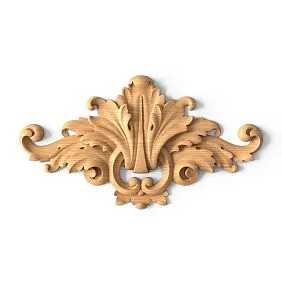
Appliqués — small decorative elements sized from 5×5 cm to 50×50 cm, used to create focal accents on walls. Appliqué shapes: rosettes (round, oval), cartouches (oval or shield-shaped with scrolls along edges), ornamental inserts (floral, geometric, zoomorphic motifs), corner appliqués (triangular or curvilinear elements for corners of molding panels).
Application: in corners of molding panels (instead of joining moldings at 45°, a corner appliqué is installed — easier installation, more beautiful result), in centers of panels (creates a focal point inside the frame), above door openings (an appliqué-keystone is installed in the center of the horizontal molding), on wall sections between windows (a vertical row of appliqués creates a decorative vertical line).
Appliqué price 450-3,500 rub/piece depending on size and ornament complexity. Small appliqués 8×8 cm for panel corners cost 450-900 rubles. Medium appliqués 15×20 cm cost 1,200-2,200 rubles. Large appliqués 30×40 cm cost 2,500-4,500 rubles.
Molding in the living room: creating a representative space
Polyurethane molding on walls photo living roomdemonstrates how decor transforms a standard room into a representative hall. The living room is the formal room of the apartment, where guests are received, family celebrations are held, status is demonstrated. Maximum decor is appropriate here: ceiling cornice width 100-150 mm, chandelier rosette diameter 70-100 cm, molding panels on the accent wall (usually the wall behind the sofa or the wall with the TV), doorway framing, possibly pilasters (vertical elements imitating flat columns) in room corners.
Typical decor project for a 20 m² living room (4×5 meters, ceilings 2.7 meters):
-
Ceiling cornice 120 mm around perimeter: 18 meters × 900 rub/m = 16,200 rub
-
Rosette diameter 80 cm: 3,600 rub
-
Molding panels on wall behind sofa (wall 4 meters long, 4 panels 80×120 cm): moldings 40 meters × 700 rub/m = 28,000 rub, corner appliqués 16 pcs × 650 rub = 10,400 rub
-
Framing two door openings: 15 meters of moldings × 750 rub/m = 11,250 rub
Total materials: 69,450 rubles. Installation: cornice 18 m × 600 rub/m = 10,800 rub, rosette 600 rub, panels 40 m × 700 rub/m = 28,000 rub, openings 15 m × 600 rub/m = 9,000 rub, total labor 48,400 rubles. Total costs 117,850 rubles.
Effect: the living room acquires a classic European appearance, creating a feeling of expensive renovation, high status, architectural thoughtfulness. The room is perceived as 20-30% more spacious due to visual structure (panels give depth, cornice raises the ceiling).
Material combination: symphony of polyurethane and wood
Floor skirting boards: transition to nobility
The ceiling and walls are decorated with polyurethane molding, but the floor remains without proper framing — the composition is incomplete.wooden baseboardIt completes the wall's vertical line, creates a transition from the wall to the floor, and protects the lower part of the wall from dirt, vacuum cleaner impacts, and mop hits.
Wood as a material for floor skirting boards has advantages: naturalness, warm texture (unlike cold plastic or polyurethane), strength (a wooden skirting board withstands impacts and does not crack), and the possibility of multiple restorations (scratches can be sanded, and the finish can be renewed). Polyurethane skirting is cheaper but is visually and tactilely inferior to wood.
The combination: polyurethane molding on the ceiling and walls (lightweight, inexpensive, diverse in forms) plus wooden skirting on the floor (noble, durable, long-lasting) creates an optimal balance of price/quality/aesthetics. Polyurethane works where complexity of forms and lightness are important (ceiling cornices, rosettes, wall panels). Wood works where strength and nobility are important (floor skirting boards, door architraves, furniture).
The height of the wooden skirting board is selected based on ceiling height: for ceilings 2.5-2.7 meters, skirting boards 80-120 mm high are optimal; for ceilings 2.8-3.2 meters — 100-150 mm; for ceilings 3.3+ meters — 120-200 mm. The skirting profile should visually rhyme with the profile of the ceiling cornice (if the cornice is classic with a fillet, the skirting should also have a fillet; if the cornice is modern and smooth, the skirting should also be smooth or with minimal relief).
Wood species: pine (budget option, price 350-700 rub/m, soft, easy to paint, but less durable), oak (premium option, price 1200-2500 rub/m, hard, durable, noble texture), ash (mid-range option, price 800-1500 rub/m, strong, beautiful texture). The skirting is supplied unfinished and is coated with varnish, oil, or paint after installation.
Wooden slats: rhythm and modernity
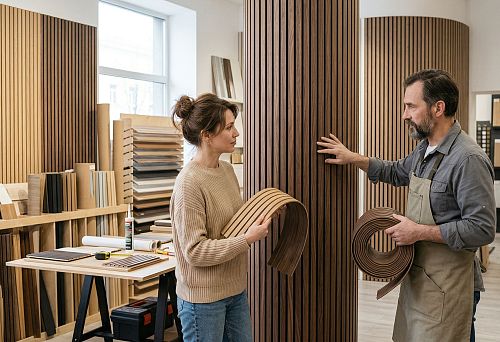
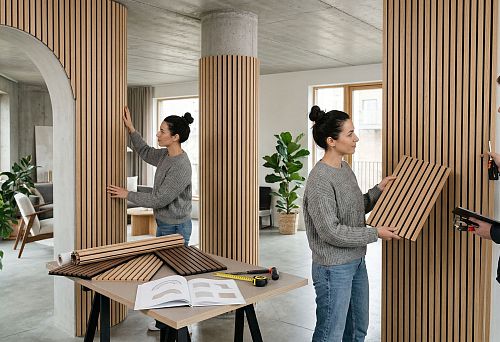
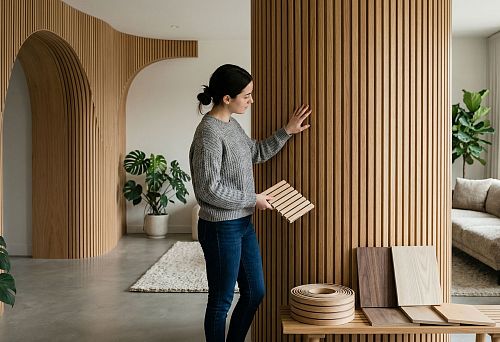
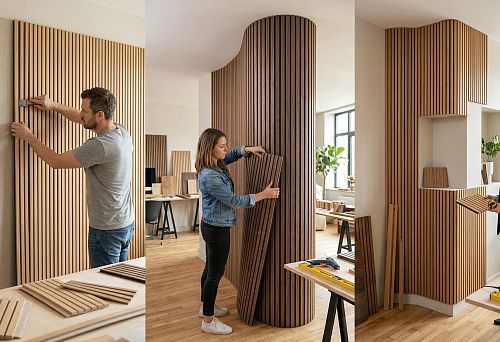
Wooden plank— a trend in interior design of the 2020s, originating from Scandinavian and Japanese minimalism. Slats are narrow planks with a cross-section of 20×40 mm, 30×50 mm, 40×60 mm, which are mounted on a wall or ceiling vertically or horizontally with gaps of 3-10 cm, creating a rhythmic structure, volume, and play of light and shadow.
Application of slats: accent wall behind the TV (vertical slats across the entire wall create texture, against which the TV is perceived as a painting in a frame), headboard of the bed (horizontal or vertical slats on the wall behind the bed create coziness, warmth of wood), zoning of space (slats are mounted as a semi-transparent partition between the kitchen and living room — light passes through, the space is visually divided).
Combination with polyurethane molding: slats create a modern texture, molding creates a classic frame. For example, an accent wall with vertical slats is framed around the perimeter with an 80 mm wide molding — resulting in modern content in a classic frame. Or a ceiling with wooden slats (creating rhythm, reducing acoustic echo) plus a polyurethane cornice around the perimeter (completing the composition, masking the wall-ceiling joint).
Price of slats: 250-800 rub/m depending on cross-section and species. Pine 20×40 mm costs 250-400 rub/m, oak 30×50 mm costs 600-1100 rub/m. For an accent wall 4×2.7 meters with vertical slats spaced 10 cm apart (distance between slats), 40 slats of 2.7 meters each = 108 meters are needed. At a price of 450 rub/m, materials will cost 48,600 rubles. Installation 300-500 rub/m, totaling 32,400-54,000 rubles for labor. Total costs 81,000-102,600 rubles.
Color solutions: unity or contrast
Polyurethane molding and wooden elements can be painted in a single color (all white, all gray, all black) or contrasted (white molding on dark gray walls, dark brown wooden skirting boards and slats on light walls).
Monochromatic solution — everything in one color, with differences only in material and texture. Walls light gray, ceiling cornice made of polyurethane painted light gray, floor skirting made of oak painted light gray, slats made of pine painted light gray. Effect: calmness, unity, minimalism, focus on form, not color. Suitable for modern and Scandinavian interiors.
Contrast solution — molding white (traditionally), walls colored (dark blue, emerald, terracotta), wooden elements in natural color (light oak, dark walnut) or contrasting (black). Effect: dynamism, expressiveness, architectural graphics, focus on combinations of colors and materials. Suitable for classic, neoclassical, art deco interiors.
Accent solution — the main mass of molding and wooden elements is white or neutral, but individual elements (ceiling rosette, corner panel overlays) are painted in gold, silver, bronze. Effect: luxury, status, palatial feel. Suitable for classic, baroque, empire interiors.
Practical cases: from idea to implementation
One-room apartment: maximum style with minimum area
Apartment 38 m² (studio: kitchen-living room 18 m², sleeping area 10 m², bathroom 5 m², hallway 5 m²), ceilings 2.65 meters. Task: create a stylish interior with classic elements, visually expand the space, zone the studio.
Solution:
-
Ceiling cornice 90 mm around the entire perimeter of the apartment (unified style for all rooms): 32 meters × 650 rub/m = 20,800 rub materials, installation 19,200 rub
-
Rosette with a diameter of 60 cm in the living area above the dining table: 2,400 rub materials, installation 600 rub
-
Molding panels on the accent wall of the sleeping area (wall 3 meters, 3 panels 60×100 cm): moldings 24 meters × 600 rub/m = 14,400 rub, corner overlays 12 pcs × 550 rub = 6,600 rub, installation 16,800 rub
-
Wooden skirting made of pine 100 mm throughout the apartment: 28 meters × 450 rub/m = 12,600 rub materials, installation 8,400 rub
Total: materials 56,800 rubles, labor 45,000 rubles, total 101,800 rubles. Result: the apartment acquired a stylish neoclassical look, the sleeping area is visually highlighted by panels, ceilings appear higher due to the light cornice.
Three-room apartment: full decor for a family nest
Apartment 78 m² (living room 22 m², parents' bedroom 14 m², children's room 12 m², kitchen 10 m², two hallways and bathroom 20 m²), ceilings 2.8 meters. Task: decorate all rooms in a unified style, create a representative living room, cozy bedrooms.
Solution:
-
Ceiling cornices 110 mm in all living rooms: 65 meters × 800 rub/m = 52,000 rub materials, installation 39,000 rub
-
Rosettes: in the living room diameter 90 cm (4,200 rub), in the parents' bedroom 70 cm (3,000 rub), in the children's room 60 cm (2,400 rub), total 9,600 rub materials, installation 1,800 rub
-
Molding panels in the living room on two walls (8 panels 100×150 cm): moldings 80 meters × 750 rub/m = 60,000 rub, corner overlays 32 pcs × 700 rub = 22,400 rub, installation 56,000 rub
-
Framing of door openings (5 openings): moldings 40 meters × 700 rub/m = 28,000 rub, installation 24,000 rub
-
Wooden skirting made of ash 120 mm: 52 meters × 950 rub/m = 49,400 rub materials, installation 15,600 rub
Total: materials 221,400 rubles, labor 136,400 rubles, total 357,800 rubles. Result: the apartment has been transformed into luxurious housing with classic decor, each room has a finished look, creating the feeling of an expensive European renovation.
Private house: interior molding from the entrance to the attic
House 180 m² (three floors: basement with garage and boiler room, first floor with living room, kitchen-dining room, study, second floor with three bedrooms), first-floor ceilings 3.2 meters, second floor 2.9 meters. Task: decorate the formal rooms on the first floor extensively, bedrooms on the second floor moderately.
First floor solution:
-
Ceiling cornices 140 mm: 48 meters × 1100 rub/m = 52,800 rub materials, installation 33,600 rub
-
Ceiling rosettes: in living room 110 cm (6500 rub), in dining room 80 cm (3600 rub), in study 70 cm (3000 rub), total 13,100 rub materials, installation 1800 rub
-
Molding panels in living room on three walls (14 panels 120×180 cm): moldings 140 meters × 900 rub/m = 126,000 rub, corner overlays 56 pcs × 800 rub = 44,800 rub, installation 98,000 rub
-
Doorway framing (6 openings): moldings 48 meters × 850 rub/m = 40,800 rub, installation 28,800 rub
-
Pilasters in living room corners (4 sets height 2.8 meters): 52,000 rub materials, installation 24,000 rub
Second floor solution (bedrooms):
-
Ceiling cornices 100 mm: 42 meters × 750 rub/m = 31,500 rub materials, installation 25,200 rub
-
Ceiling rosettes: in three bedrooms 60 cm each (3×2400 rub = 7200 rub), installation 1800 rub
-
Oak wooden skirting board 140 mm throughout the house: 95 meters × 1600 rub/m = 152,000 rub materials, installation 28,500 rub
Total: materials 519,000 rubles, labor 241,700 rubles, total 760,700 rubles. Result: the house acquired the appearance of a classic estate, the living room became a formal hall with pilasters and panels, bedrooms cozy with moderate decor, overall atmosphere of respectability and taste.
Where to buy and how much it costs: purchasing practice
Catalogs and pricing
Polyurethane molding price and photosare presented in online catalogs of manufacturers and distributors. Prices vary depending on brand, material density, profile complexity, element size.
Ceiling cornices: 380-2800 rub/m. Simple smooth cornices 50-80 mm cost 380-650 rub/m. Classic cornices with a cavetto 90-130 mm cost 650-1200 rub/m. Baroque cornices with lush ornamentation 150-250 mm cost 1400-2800 rub/m.
Ceiling rosettes: 950-14,500 rubles. Small rosettes diameter 30-50 cm simple design cost 950-2200 rubles. Medium rosettes 60-80 cm classic design cost 2200-5500 rubles. Large rosettes 90-120 cm baroque design cost 6000-14,500 rubles.
Wall moldings: 220-2400 rub/m. Narrow smooth moldings 40-60 mm cost 220-500 rub/m. Medium classic moldings 70-100 mm cost 500-1200 rub/m. Wide ornamented moldings 110-150 mm cost 1300-2400 rub/m.
Decorative overlays: 450-4500 rub/pc. Small corner overlays 8×8 cm cost 450-900 rubles. Medium ornamental overlays 15×20 cm cost 1200-2200 rubles. Large baroque overlays 30×40 cm cost 2500-4500 rubles.
Wooden skirting boards: 350-2500 rub/m. Pine costs 350-700 rub/m, ash 800-1500 rub/m, oak 1200-2500 rub/m.
Wooden battens: 250-1100 rub/m. Pine 20×40 mm costs 250-400 rub/m, oak 30×50 mm costs 600-1100 rub/m.
How to form an order
Determine the scope of work: make a list of rooms you will decorate. For each room, determine what is needed: ceiling cornice (measure the ceiling perimeter), rosette (determine the chandelier diameter), molding panels on walls (draw a wall diagram, apply panels, measure each perimeter), door framings (count the number of openings), floor skirting boards (measure the floor perimeter).
Choose profiles: open the catalog, filter by style (classic, modern, minimalism), browse profiles, select suitable ones by width and design. Add to cart or write down article numbers.
Calculate quantity: for cornices and moldings add 10% to the measured length for cutting and joints. For rosettes, overlays, pilasters quantity is exact (as many as needed per project). For skirting boards add 5-7% for corner cutting.
Choose accompanying materials: adhesive (polyurethane or acrylic mounting, consumption 1 tube 310 ml per 2-4 meters of cornice or 1-2 windows), sealant (acrylic white, consumption 1 tube 310 ml per 8-12 meters of joints), primer (if walls unprepared, 1 liter per 8-12 m² of wall), paint (if planning to paint, consumption 1 liter per 5-8 m² of molding surface in two coats).
Place the order: on the online store website or by phone. Specify delivery address, choose delivery method (transport company to your city or courier in Moscow/St. Petersburg), payment method (online card, cash on delivery, bank transfer for legal entities). Receive order confirmation, tracking number.
Frequently asked questions
Can polyurethane moldings from different manufacturers be combined?
Yes, but with caveats. Profiles of moldings and cornices from different manufacturers may differ in width, heel shape, and ornament detail even with visually similar designs. If you plan to combine them, purchase samples, place them together, and assess compatibility. Ideally, buy all elements from one manufacturer for guaranteed style matching.
How to care for interior moldings?
Minimal care. Dust is removed with a dry cloth, soft brush, or vacuum with a brush attachment every 1-3 months. Stains (in the kitchen, moldings may develop a greasy film) are removed with a damp cloth and soapy water. Painted moldings are easier to clean than unpainted ones. Repainting is recommended every 5-10 years to refresh the color.
How long does it take to install moldings in one room?
For a room of 18-20 m² with a ceiling cornice, rosette, molding panels on one wall, and door framing, a professional team of two people takes 1.5-2.5 working days. DIY installation will take 3-5 days (slower due to lack of experience and the need to correct mistakes).
Can molding be installed on wallpaper?
Yes, but not recommended. Moldings are glued to wallpaper, and wallpaper to the wall—a two-stage connection is less reliable than directly gluing moldings to the wall. If the wallpaper is non-woven with good adhesive and holds firmly, the risk is minimal. If the wallpaper is paper, old, or partially peeling, the moldings may fall off along with the wallpaper. It is optimal to install moldings on a bare plastered wall, then paint everything together (walls and moldings) or wallpaper around the moldings.
What is cheaper: polyurethane or plaster?
Polyurethane is 2-4 times cheaper than plaster in materials and 1.5-2 times cheaper in installation (plaster is heavy, requires reinforcement, and is more complex to install). A plaster cornice 120 mm wide costs 1800-3500 rub/m for materials plus 1200-2000 rub/m for installation. A polyurethane equivalent costs 700-1200 rub/m for materials plus 500-900 rub/m for installation. With similar aesthetics, polyurethane saves 50-60% of the budget.
Are moldings only suitable for classic interiors?
No, that's a misconception. Modern polyurethane molding collections include smooth minimalist profiles, geometric shapes that fit perfectly into contemporary, Scandinavian, and loft interiors. Molding panels with simple rectangular frames, smooth ceiling cornices without ornamentation, minimalist rosettes with concentric circles—all work in modern, contemporary, and minimalist styles.
Can polyurethane moldings be used in the bathroom?
Yes, polyurethane is water-resistant (water absorption less than 1%), not afraid of humidity, and does not create conditions for mold. In the bathroom, you can install ceiling cornices (to mask the wall-ceiling joint, especially relevant for stretch ceilings), moldings for framing mirrors, and decorative overlays. After installation, moldings must be painted with water-resistant paint in 2-3 layers for additional protection.
Conclusion: The art of creating homes, not boxes
An apartment is not a set of square meters with functions (sleeping, cooking, showering). A home is a space where emotions, memories, and daily rituals live, where every detail affects mood, self-perception, and quality of life. Bare walls with stretch ceilings, linoleum, and plastic skirting boards fulfill functions but do not bring joy. Walls with molding panels, ceilings with elegant cornices and rosettes, wooden skirting boards, thoughtful lighting—this creates an atmosphere where you want to live, return to, and be proud of.
Polyurethane moldings for ceilings and walls are an affordable tool for creating this atmosphere. You don't need to be a millionaire to afford a classic interior with architectural details. You don't need to wait years to save up for handmade plaster moldings. Polyurethane provides 90% of plaster's aesthetics for 30-40% of the price, installs 2-3 times faster, and lasts decades without losing appearance.
A comprehensive approach is key to success. Don't limit yourself to just a ceiling cornice—add a rosette, decorate walls with molding panels, frame doors, install wooden skirting boards. Each element enhances the others, creating synergy where the whole is greater than the sum of its parts. A living room with a cornice, rosette, and wall panels is perceived as an order of magnitude more luxurious than the same living room with only a cornice.
The cost of comprehensive decoration for a 60-80 m² apartment is 150,000-350,000 rubles (materials plus installation) depending on the richness of decor and chosen materials. This is 8-15% of the cost of a turnkey apartment renovation (usually 1.5-2.5 million rubles for an apartment of this size). Not a huge amount, but the effect is colossal—the apartment transforms from standard to unique, from functional to beautiful, from bland to stylish.
STAVROS offers a full range of solutions for comprehensive interior decoration—from ceiling to floor, from polyurethane to wood. Ceiling cornices with over 150 profiles (from minimalist smooth 40 mm to Baroque ornamented 300 mm), ceiling rosettes with over 80 models (diameters from 30 to 140 cm, styles from classic to modern), wall moldings with over 200 profiles (for panels, framing, accents), decorative overlays with over 120 types (corner, ornamental, functional), pilasters and capitals for creating order compositions.
Wooden elements made of solid oak, ash, pine, exotic species—floor skirting boards from 60 to 220 mm high, wooden ceiling cornices (an alternative to polyurethane for lovers of natural materials), decorative battens of all sections for modern interiors, door architraves, moldings, corner elements. Possibility of tinting to any color according to RAL, NCS catalogs, oil and varnish toning to emphasize wood texture, patination to create an antique effect.
STAVROS professional designers will develop a decoration concept for your apartment or house considering area, ceiling height, interior style, and budget. 3D visualization allows you to see the result before work begins, make adjustments, and choose optimal elements. Calculation of required materials, selection of related products (adhesives, sealants, paints), installation recommendations—full support from idea to implementation.
STAVROS installation teams—experienced specialists,