Article Contents:
- Aesthetic function of ceiling rose in lighting
- Material science: polyurethane as the ideal solution
- Technological Advantages of Production
- Stylistic typology of chandelier roses
- Classic compositions
- Baroque opulence
- Empire grandeur
- Modern organic style
- Dimensional gradation and selection of optimal parameters
- Compact solutions for intimate spaces
- Medium sizes for residential interiors
- Monumental compositions
- Installation technology and integration with electrical systems
- Preparation stage
- Adhesive technologies
- Finishing operations
- Lighting effects and their impact on decor perception
- Directional illumination of ornament
- Color temperature and material perception
- Compatibility with various chandelier types
- Classic crystal chandeliers
- Modern designer chandeliers
- Ethnic and exotic styles
- Maintenance and servicing during operation
- Regular procedures
- Periodic refreshment
- Economic aspects and return on investment
- Initial investments
- Long-Term Economic Efficiency
- Trends and innovations
- Technological Innovations
- Ecological Aspects
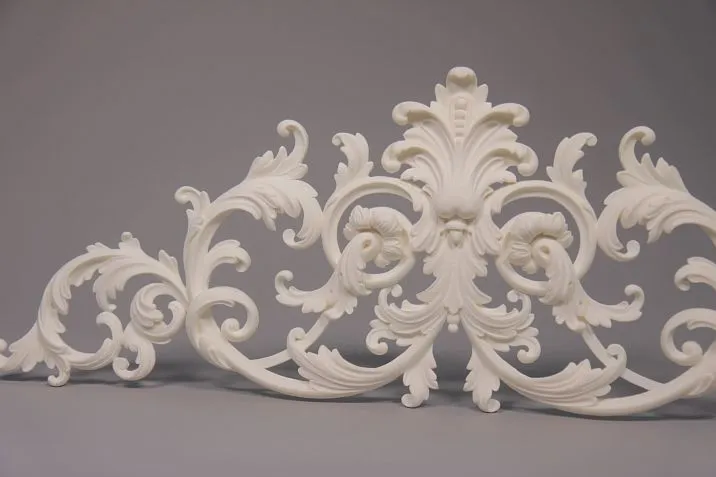
In interior design, there are details that define the character of the entire space. Chandelier ceiling molding It is precisely such a detail — it can transform ordinary lighting into a majestic composition worthy of royal palaces. Every glance directed upward meets not just a light source, but a work of architectural art.
Have you ever wondered why chandeliers in historical interiors never hung on bare ceilings? Masters of the past understood the fundamental principle — a central light fixture requires a worthy framing that highlights its significance and creates a harmonious transition from the horizontal plane of the ceiling to the vertical dominance of lighting.
Modern technologies have brought this forgotten art back into our homes, making it accessible and practical. Today, polyurethane ceiling rose fixtures can replicate the beauty of classic designs, surpassing them in durability and ease of installation. This is not a fashion trend, but a return to timeless principles of beauty, tested over centuries.


Aesthetic function of the ceiling rose in lighting
The ceiling rose serves as a visual anchor, organizing the entire room space around a central point. Without it, the chandelier hangs as if in emptiness, losing its monumentality and significance. Ceiling roses create the necessary context that allows the fixture to fully reveal its decorative potential.
The optical illusion of increased ceiling height is achieved by creating a visual center from which the gaze radiates outward. The round or polygonal shape of the rose naturally directs attention to the center, creating a dome effect even in rooms with flat ceilings.
Proportional relationships between the size of the chandelier and the diameter of the rose determine the harmony of the entire composition. The classical rule states: the diameter of the rose should be 1.3–1.7 times larger than the diameter of the chandelier's base. This creates visual support without the effect of suppressing the fixture.
The play of light and shadow on the relief surface of the rose enhances the decorative effect of lighting. Directed light from the chandelier creates a constantly changing pattern of shadows in the ornament's recesses, transforming static decor into a living, breathing surface.




Material science: polyurethane as the ideal solution
Polyurethane has revolutionized architectural decor, combining the beauty of classical forms with the practicality of modern materials. The density of quality polyurethane (700–900 kg/m³) ensures sufficient strength at minimal weight — a critically important factor for ceiling mounting.
The material's temperature stability in the range from -40°C to +80°C allows for use in any climatic conditions. The linear expansion coefficient is only 0.00015 per degree, eliminating deformation during seasonal temperature fluctuations.
Polyurethane's moisture resistance with a water absorption coefficient of less than 1% makes it possible to use roses even in rooms with high humidity. The material does not swell, warp, or lose geometric accuracy with changes in air humidity.
Chemical inertness ensures longevity in aggressive environments. Polyurethane does not react with household chemicals, does not absorb odors, and does not serve as a nutrient medium for microorganisms. The service life of quality products reaches 30 years without loss of original appearance.
Our factory also produces:


Technological Advantages of Production
Injection molding into precision silicone molds allows reproduction of the finest ornament details with accuracy down to 0.05 mm. Such detail surpasses the capabilities of master sculptors of previous centuries.
Geometric dimensional stability is ensured by automated control of technological parameters. The molding temperature, molding pressure, and holding time — all parameters are controlled with precision unattainable in manual production.
Decorative polyurethane elements have no internal stresses that could lead to cracking or deformation during operation. The uniform structure of the material guarantees shape stability for decades.
Get Consultation
Stylistic typology of ceiling roses for chandeliers
Classical compositions
Classical roses are based on principles of ancient architecture, adapted for residential interiors. The central medallion is surrounded by concentric ornament rings, creating radial symmetry that harmonizes with any type of chandelier.
The ornamental basis of the classical style includes plant motifs — acanthus leaves, laurel wreaths, roses, grapevines. Each element has symbolic meaning and a specific place in the composition. Acanthus symbolizes vital force, laurel — victory and glory, rose — beauty and perfection.
Mathematical proportions are constructed according to the golden section principle. The diameter of the central medallion constitutes 38% of the total rose diameter, the first ornamental ring — 24%, the outer contour — 38%. These proportions create harmony perceived subconsciously.
Chandelier ceiling molding In classical execution, it combines with crystal chandeliers, creating an atmosphere of refined luxury. The snowy-white surface highlights the sparkle of crystal, while gilded accents add grandeur.
Baroque opulence
Baroque roses are distinguished by maximum decorative saturation and theatrical effect. Deep relief reaches 20–25 mm, creating expressive play of light and shadow. The ornament is built on contrast between large and small elements, creating rich texture.
Movement — the main characteristic of baroque decor. Curved lines, spiral scrolls, fluttering ribbons create a sense of continuous motion. Plant forms are stylized to the point of complete naturalism loss, transforming into purely decorative elements.
Asymmetric details within overall symmetry give baroque roses a particular liveliness. These may include slightly rotated leaves, unequal scrolls, variations in size of similar elements. Such subtleties create a sense of handcraft even in industrial products.
Polyurethane items in baroque style perfectly complement massive chandeliers made of bronze or gilded metal. The opulence of the ornament supports the monumentality of the fixture, creating a unified composition.
Empire grandeur
The Empire style introduced imperial grandeur symbolism into decorative arts. The ornamental arsenal includes laurel wreaths, palm branches, torches, swords, shields, eagles, lions. Geometric elements dominate over plant motifs, creating a sense of strict order.
Radial compositions emanate from the center like rays of an imperial sun. The number of rays is usually a multiple of eight — the number symbolizing infinity and perfection. Each ray may carry its own ornamental motif, creating a rich yet orderly composition.
Monumentality is a distinctive feature of Empire roses. The size of elements is significantly larger than classical canons, emphasizing the grandeur and parade nature of the style. The diameter of roses may reach 120–150 cm in representative rooms.
Modern organic simplicity
The modern style revolutionized the perception of decorative art, introducing stylized natural forms and asymmetrical compositions. Rosettes often deviate from strict radial symmetry, creating more free, organic shapes.
Modern floral motifs — irises, lilies, poppies, sunflowers — are rendered with botanical accuracy but stylized to create a new decorative reality. Long, curved stems may begin at the center of the rosette and, winding, reach its edges.
Linearity is a characteristic feature of modern design. Ornamentation is built on smooth lines that imitate plant growth, water flow, and hair movement in the wind. Decorative elements made of polyurethane allow reproduction of the finest nuances of this complex style.
Dimensional gradation and selection of optimal parameters
Compact solutions for room-sized spaces
Rosettes with diameters of 200–400 mm are ideal for small rooms — bedrooms, offices, entryways. Their proportions do not overwhelm the space but create the necessary decorative accent around central lighting.
The relief of compact rosettes is usually shallow — 3–8 mm — ensuring clarity of details despite small dimensions. The ornament is simplified, retaining main stylistic features while avoiding fine details that would not be discernible from a distance.
Chandelier ceiling molding Small sizes are especially effective with modern design pendant lights. The classic rosette shape creates an interesting contrast with avant-garde light fixture forms.
Medium sizes for residential interiors
The 500–700 mm range represents the optimal balance of decorative appeal and practicality for most residential spaces. These dimensions allow for sufficiently rich ornamentation without a sense of excess.
Relief depth can reach 12–15 mm, creating expressive play of light and shadow. The ornament includes multiple levels of detail — from large shaping elements to fine decorative details.
Polyurethane items in this size range are versatile and compatible with most types of chandeliers — from classic crystal to modern metal constructions.
Monumental compositions
Rosettes with diameters of 800–1500 mm are intended for spacious halls, lobbies, and rooms with high ceilings. Their monumentality requires appropriate architectural surroundings and professional design approach.
Complex multi-level ornamentation may include several concentric bands of different decoration. The central medallion is complemented by intermediate rings and an outer frame, creating a rich yet orderly composition.
Installation of large rosettes requires special attention to mounting strength. Decorative polyurethane elements of large size may require additional mechanical fastening beyond adhesive bonding.
Installation technology and integration with electrical systems
Preparation Stage
Quality installation begins with careful preparation of the ceiling surface. The base must be perfectly flat — allowable deviations should not exceed 1 mm per rosette diameter. Any irregularities will be visible after installation, especially under side lighting.
Ceiling center marking is performed with maximum precision. In rectangular rooms, the center is determined by the intersection of diagonals. In rooms with complex configurations, adjustments may be needed based on furniture and other interior elements’ placement.
Electrical installation work is planned in advance. The pendant light’s suspension point must be precisely located at the center of the rosette. If existing wiring does not match the planned layout, it must be relocated before rosette installation begins.
Adhesive technologies
Modern polyurethane adhesives provide bonding strength up to 2.5 MPa while maintaining certain elasticity. Open time of 15–20 minutes allows precise positioning of the element and enables necessary adjustments.
Adhesive is applied using a notched trowel with 4–6 mm tooth size over the entire back surface of the rosette. Layer uniformity is critically important — uneven application may cause element deformation or air pocket formation.
Chandelier ceiling molding It is pressed against the surface with a smooth, even motion from center to edges. This ensures air displacement and uniform adhesive distribution. Excess adhesive is removed immediately before the adhesive begins to set.
Finishing operations
After the adhesive has fully set, joint finishing is performed. The central hole for wiring may be expanded with a sharp knife if necessary. Edges of the hole are carefully sanded with sandpaper to remove burrs.
The rosette surface is primed with a special adhesive primer, improving adhesion to finish coatings. Primer drying time is 2–4 hours depending on temperature and air humidity.
Polyurethane items are painted with quality water-dispersive paints in two coats. The first coat is applied with a brush, carefully covering all recesses. The second coat is applied with a roller or spray gun to achieve uniform texture.
Lighting effects and their influence on decorative perception
Directed ornament lighting
A properly chosen chandelier not only provides general lighting for the room but also highlights the beauty of the ceiling rose. Directed light creates deep shadows in the ornament's recesses, enhancing the decor's volume and expressiveness.
The height of the chandelier's suspension affects the lighting character of the rose. At a low suspension, light falls at a sharp angle, creating contrasting shadows. A high suspension provides softer, more even lighting with less pronounced shadows.
The type of fixture determines the nature of shadows. Chandeliers with multiple light sources create a complex interplay of intersecting shadows. Fixtures with a central light source produce clear radial shadows, emphasizing the composition's symmetry.
Decorative elements made of polyurethane look especially effective under dimmable lighting. Adjusting brightness allows creating various lighting scenarios — from bright daylight to intimate evening ambiance.
Color temperature and material perception
Warm light (2700-3000K) emphasizes the coziness of the interior and especially harmonizes with gilded moldings. Golden tones of light enhance the shine of metallic finishes, creating an atmosphere of luxury.
Neutral white light (4000-4500K) provides the most accurate color rendering and is suitable for spaces where color fidelity is important. White molding appears most naturally under such lighting.
Cool light (5000-6500K) creates a modern, energetic atmosphere. It looks especially effective with silver moldings and modern fixtures made of chrome or stainless steel.
Combination with different types of chandeliers
Classic crystal chandeliers
Crystal chandeliers require appropriate classical framing. Roses with botanical ornamentation, gilded details, and rich detailing create the ideal backdrop for the play of crystal pendants.
The rose size should be proportional to the chandelier's grandeur. For large crystal chandeliers with diameters of 80-120 cm, roses with diameters of 100-180 cm are required. Smaller sizes will create compositional imbalance.
Color solutions are typically built on the contrast of white and gold. A white base highlights the purity of crystal, while gold accents harmonize with brass or bronze chandelier hardware.
Modern designer chandeliers
Avant-garde chandeliers with unusual shapes require a special approach to selecting the rose. Chandelier ceiling molding can create an interesting contrast between the classic form and the modern design of the fixture.
Simple geometric roses without excessive ornamentation are best suited for modern chandeliers. They create the necessary visual center without competing with the complex forms of the fixture itself.
Monochromatic solutions — white, gray, black — emphasize the modernity of the composition. Metallic finishes — chrome, satin steel — create harmony with the metallic elements of the fixture.
Ethnic and exotic styles
Chandeliers in Eastern, African, and Indian styles require appropriate decorative surroundings. Polyurethane items can imitate wood carving, stone masonry, or ceramic tiles.
Color solutions are built on warm earth tones — terracotta, ochre, umber. Artificial aging and patination enhance the ethnic character of the composition.
Ornamental motifs are borrowed from corresponding cultural traditions — Arabic fretwork, Indian mandalas, African geometric patterns. Such solutions require a deep understanding of cultural context.
Care and maintenance during operation
Regular procedures
Ceiling-mounted roses are protected from most mechanical impacts, but dust accumulation in ornament recesses requires regular attention. Dry cleaning with a soft brush is performed every 2-3 months depending on room dustiness.
Wet cleaning is performed with slightly damp microfiber using neutral cleaning agents. It is important to avoid excessive moisture, which may penetrate under the coating and cause paint peeling.
Decorative polyurethane elements require no special care. Ordinary household cleaning agents are safe for polyurethane surfaces. Abrasive agents and stiff brushes should be avoided.
Periodic Renewal
Repainting the finish may be required after 8-12 years of use depending on conditions. Polyurethane holds new paint layers exceptionally well, allowing for a complete change in interior color scheme.
Preparation for repainting includes light sanding of the surface to create a rough texture. Deep scratches and chips are filled with acrylic putty. Adhesion primers are mandatory.
Chandelier ceiling molding can be repainted multiple times without loss of surface quality. This allows adapting the decor to changing design preferences without replacing the elements themselves.
Purchasing oak skirting boards should be considered a long-term investment in the quality and prestige of the interior. Despite higher initial cost compared to products made of other materials, oak skirting boards pay for themselves due to exceptional durability and the possibility of multiple restorations.
Initial investment
The cost of ceiling moldings varies from 1500 to 25000 rubles depending on size and ornament complexity. Installation work accounts for 30-50% of the molding’s cost. Total project expenses usually do not exceed 15000-40000 rubles.
Comparison with alternative solutions shows the economic efficiency of polyurethane moldings. Gypsum analogs cost 2-3 times more with significantly greater installation complexity. Wood carving may cost 10-15 times more.
Polyurethane products offer optimal price-to-quality ratio. At a cost comparable to other finishes, they significantly surpass alternatives in durability and aesthetic qualities.
Long-term economic efficiency
The service life of quality moldings is 25-30 years without replacement. With such longevity, annual costs amount to only 500-1500 rubles — a sum comparable to the cost of quality wallpaper for a similar area.
The increase in property value with quality decor amounts to 10-15%. For an apartment costing 8-10 million rubles, this yields an increase of 800000-1500000 rubles — an amount far exceeding decor expenses.
Minimal maintenance costs — an additional advantage. Unlike other finishes requiring periodic renewal, polyurethane moldings practically require no maintenance.
Trends in development and innovation
Technological innovations
The development of 3D printing opens opportunities to create custom moldings based on original designs. Unique elements with detail unattainable by traditional methods are already possible today.
New polyurethane formulations with enhanced properties — self-cleaning surfaces, antibacterial additives, photocatalytic properties — make modern products not only beautiful but also functional.
Integration of LED technology transforms moldings into active lighting elements. Built-in contour lighting creates an impressive glow, especially noticeable in the evening.
Ecological aspects
Growing demands for ecological safety stimulate development of biodegradable polymers. Plant-based materials combine all advantages of traditional polyurethane with minimal environmental impact.
Waste disposal programs for used elements are developed as part of manufacturers’ corporate responsibility. Polyurethane can be recycled into new products, reducing production’s ecological footprint.
Certification according to international ecological standards confirms the safety of modern polyurethane products for human health and the environment.
The art of creating a harmonious interior lies in the ability to combine functionality with beauty, tradition with innovation, practicality with aesthetics. Chandelier ceiling molding Represents the ideal embodiment of these principles — it is practical, durable, beautiful, and accessible.
Each molding installed in a home becomes not merely a decorative element, but a symbol of taste and understanding of beauty. It creates that special atmosphere which transforms a home into a work of art, where every detail serves a common idea of harmony and perfection.
Choosing quality molding is an investment in beauty that pays off every day with new emotions from appreciating the beautiful. It is a decision made once, but brings joy for many years, creating comfort and coziness for the entire family.
STAVROS is a recognized leader in producing high-quality moldings for chandeliers, combining rich traditions of decorative art with advanced modern technologies. The long experience of artisans, use of premium materials, and strict quality control at every production stage enable STAVROS to create products that become ornaments of the most refined interiors. Choosing STAVROS products means choosing proven quality, reliability, and that unique beauty which makes a home truly special — a place where one wants to live and create.