Article Contents:
- History of Molding: From Temples of Ancient Egypt to 21st Century Interiors
- Materials for Molding: Technological Evolution from Plaster to Composites
- Plaster: Classic, Tested for Millennia
- Polyurethane: A Revolution in Lightness and Strength
- Wood: Natural Warmth and Nobility
- Foam (Polystyrene): A Budget Solution with Caveats
- Composite Materials: The Future of Molding
- Material Comparison: A Table for Informed Choice
- Types of Molded Products: Complete Classification of Decorative Elements
- Cornices and Baseboards
- Moldings
- Cornices and Molding
- Columns and pilasters
- Brackets and Consoles
- Plates and panels
- Facade elements
- Molding in Interior: Stylistic Diversity from Baroque to High-Tech
- Classic and neoclassic
- Baroque and Rococo
- Neoclassicism
- Modern (Art Nouveau)
- Art Deco
- Scandinavian style and minimalism
- Loft and Industrial
- Contemporary Style
- Facade Molding for Houses: Monumentality and Durability
- Window and door casings
- Coffers and Panels
- Pilasters and Columns
- Rustication
- Balustrades
- How to Choose Molding to Match Interior Style: A Practical Algorithm
- Installation of Various Types of Molding: Technological Nuances
- Installation of Polyurethane Stucco
- Installation of Gypsum Stucco
- Installation of Wooden Molding
- Manufacturers and Brands: Navigating the Molding Market
- European Brands
- Russian Manufacturers
- Molding Prices in Russia: Price Benchmarks for 2026
- Where to Buy Molding: STAVROS Showrooms in Moscow and St. Petersburg
- STAVROS Showrooms
- STAVROS Online Store
- Trends 2026: Where the World of Molded Decor is Heading
- Trend 1: Minimalism with Accents
- Trend 2: Colored Molding
- Trend 3: Mix of Styles
- Trend 4: Deep Relief
- Trend 5: Eco-Friendliness and Durability
- Trend 6: Technology Integration
- Popular Questions About Molding: Expert Answers
- Is Molding Expensive?
- Is Molding Difficult to Maintain?
- Can molding be installed independently?
- Is Molding Suitable for Small Apartments?
- Can Molding Be Painted in Dark Colors?
- How Long Does Polyurethane Stucco Last?
- Can Molding Be Used in the Bathroom?
- Does Molding Go Well with Stretch Ceilings?
- Where Can I See Molding in Person Before Buying?
- Can I Order Custom Molding from a Sketch?
- Company STAVROS: A Quarter Century in the Service of Beauty
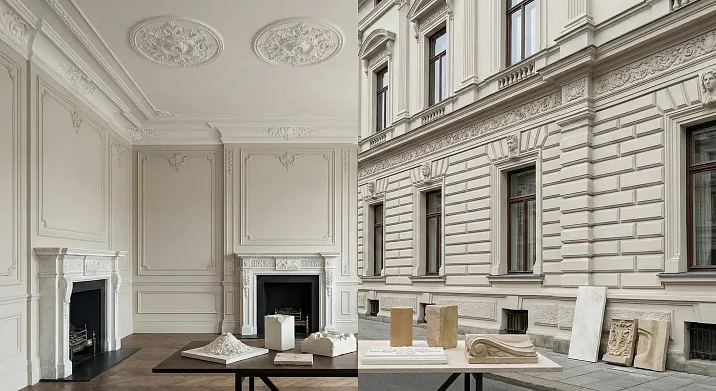
Have you ever noticed how an empty room transforms into a work of art with the addition of cornices, elegant moldings, and relief rosettes? Molding is not just decoration. It is the language of architecture, spoken by humanity for millennia, turning dwellings into temples of beauty. From ancient palaces to modern studio apartments, from classic mansions to minimalist lofts — decorative molding remains one of the most expressive and versatile tools for space design.
Why doesMoldingsis experiencing a new renaissance right now, in 2026? The answer lies in the revolution of materials and technologies. Modern molding is light as a feather, strong as stone, moisture-resistant as plastic, and detailed like the handiwork of a renowned sculptor. Polyurethane, composite materials, and innovative casting techniques have transformed what was once a privilege of palaces into an accessible solution for everyone who values beauty and strives for harmony.Decorative stuccohas ceased to be a museum rarity — it has become a tool for creating individuality, a way to tell the story of your space through forms, lines, and volumes.


History of Molding: From Ancient Egyptian Temples to 21st-Century Interiors
Decorative molding appeared long before writing. Archaeological finds confirm: 5,000 years ago, ancient Egyptians were already adorning temples and tombs with relief images of gods, pharaohs, and mythological scenes. They used a mixture of clay, crushed stone, and plant fibers — a precursor to modern plaster. Molding served not only as decoration but also as an information carrier: hieroglyphic texts, frozen in relief, transmitted knowledge to generations.
Ancient Greece elevated molding to the rank of high art. It was the Greeks who created the system of architectural orders — Doric, Ionic, Corinthian — where every detail from the column base to the cornice followed strict proportions. Acanthus leaves on capitals, meanders on friezes, egg-and-dart ornaments (ovolos) on cornices — all these elements, cast from plaster or carved from marble, created harmonious temple ensembles where architecture became sculpture.
Ancient Rome inherited the Greek tradition and developed it to colossal scales. Roman palaces, baths, and basilicas were covered with kilometers of cornices, rosettes, and panels. The stucco technique (decorative plaster based on gypsum, lime, and marble chips) allowed for reliefs of incredible complexity. Pompeian villas preserved examples of this art: ceilings entirely covered with coffered panels and rosettes, walls with pilasters and medallions.
The Middle Ages temporarily interrupted the tradition — the strict Romanesque style preferred massive stone carving. But the Renaissance triumphantly brought molding back. Italian masters of the 15th-16th centuries revived ancient forms, enriching them with Christian symbolism. Florentine palazzos and Roman churches were covered with exquisite molding: cherubs, garlands, cartouches, heraldic emblems.
The Baroque of the 17th century turned molding into a tool for creating illusions. Ceilings dissolved into imitations of celestial vaults with floating angels, walls grew with three-dimensional compositions where real molding smoothly transitioned into painted trompe-l'œil. Masters achieved such virtuosity that viewers lost the sense of where sculpture ended and painting began.
The Classicism of the 18th century brought back restraint: symmetrical panels, strict cornices, geometric rosettes. But opulence didn't disappear — it simply transformed into the Empire style of the early 19th century, where military symbolism (laurel wreaths, eagles, fasces) combined with ancient motifs.
The Industrial Revolution of the 19th century democratized molding. Mass production of plaster elements in molds made decoration accessible to the middle class. Victorian mansions and apartment buildings in European capitals were covered with standard cornices and rosettes — not unique, but solid.
The 20th century saw ups and downs in interest in molding. Art Nouveau of the early century created organic, flowing forms — molded panels with irises and dragonflies. Art Deco of the 1920s-30s brought back geometry — strict stepped profiles, zigzags, stylized plant motifs. Post-war modernism rejected decoration as a bourgeois relic — bare concrete slabs dominated. But already in the 1980s-90s, a revival began: postmodernism revived interest in historical forms, and new materials (polyurethane) made molding practical.
Today, in 2026, molding is experiencing a Renaissance. But this is not a blind copy of the past. Modern designersuse molding in interior designas a tool for creating unique spaces, where classic meets technology, where minimalism gains volume, and history dialogues with futurism.




Materials for Molding: Technological Evolution from Plaster to Composites
The choice of material determines not only the appearance of molding but also its durability, ease of installation, and performance properties. Let's examine the main materials used today.
Our factory also produces:


Plaster: Classic, Tested for Millennia
Plaster (calcium sulfate) is the oldest material for molding. It is obtained by firing gypsum stone, grinding it into a powder, which, when mixed with water, forms a plastic mass that hardens quickly in air.
Advantages of plaster: plasticity in the fresh state (allowing creation of elements of any complexity), eco-friendliness (a natural mineral without toxic additives), vapor permeability (walls under plaster molding 'breathe'), fire resistance (does not burn, releases water when heated, slowing fire spread), ability for fine detailing of relief.
Disadvantages: significant weight (plaster is 7-8 times heavier than polyurethane), fragility (easily breaks upon impact or during transportation), hygroscopicity (absorbs moisture, loses strength when wet), installation complexity (requires professional installation with mechanical fasteners), high labor cost.
Plaster molding is ideal for creating unique elements: custom-designed bas-reliefs, restoration of historical interiors, exclusive projects where material authenticity is important. In standard residential interiors, plaster is now giving way to more practical materials.
Get Consultation
Polyurethane: The Revolution of Lightness and Strength
Polyurethane is a synthetic polymer obtained from the reaction of polyols and isocyanates, forming a closed-cell foam structure. For molding, rigid polyurethane foam with a density of 280-350 kg/m³ is used.
Advantages of polyurethane: lightness (7-10 times lighter than plaster), moisture resistance (does not absorb water, does not deform from humidity), impact resistance (elastically resists impacts, does not break), ease of installation (glued with special adhesive in hours), durability (lasts 20-30 years without signs of aging), paintability (accepts any paints), reproduction accuracy (silicone molds replicate details with micron precision).
Disadvantages: flammability (classified as G3-G4, releases toxic gases when burned), inability to create unique elements (only serial casting in molds), vapor impermeability (wood underneath polyurethane can accumulate moisture).
Polyurethane moldings— the optimal choice for most modern projects. It combines the aesthetics of classical decor with the practicality of innovative materials, is affordable, and easy to install.
Wood: Natural Warmth and Nobility
Wooden molding consists of carved elements made from solid oak, beech, ash, or walnut. They are created using CNC milling machines or by hand by wood carvers.
Advantages of wood: naturalness and eco-friendliness, unique texture (each element is individual), warmth to the touch, ability to be tinted and patinated, durability (centuries with proper care), repairability (chips and scratches can be restored).
Disadvantages: high cost (hand carving is expensive, even machine processing of solid wood is more expensive than polyurethane), sensitivity to humidity (wood swells and shrinks with fluctuations), demanding maintenance (periodic treatment with oils, waxes), limitations in shapes (wood carving has technological constraints).
Wooden molding is used in interiors where the naturalness of materials is valued: country, Provence, eco-style, as well as in classic libraries, studies, where wood creates an atmosphere of solidity.carved wooden decor by STAVROS is represented by hundreds of models of overlays, rosettes, and brackets.
Foam (polystyrene foam): A Budget Solution with Caveats
Foam is expanded polystyrene, the lightest and cheapest material for molding. Density 15-40 kg/m³ (7-10 times less than polyurethane).
Advantages: minimal weight, low price (2-3 times cheaper than polyurethane), ease of cutting and installation.
Disadvantages: fragility (easily breaks, crumbles when pressed), low detail of relief (due to large granules, fine details are blurred), short lifespan (after 5-10 years it yellows, becomes brittle), flammability with release of toxic gases, low aesthetics (looks cheap).
Foam is acceptable only for temporary solutions or with extremely limited budgets. It is not used in serious interiors.
Composite Materials: The Future of Molding
Modern composites (glass fiber reinforced concrete, polymer concrete, reinforced plaster) combine the strength of stone with the lightness of polymers. They are used primarily for facade molding, where resistance to extreme conditions is required.
Advantages: high strength, frost resistance, durability (50-100 years), ability to create large elements.
Disadvantages: high cost, processing complexity, significant weight (though lighter than natural stone).
Material Comparison: A Table for Informed Choice
| Parameter | Gypsum | Polyurethane | Wood | Polystyrene |
|---|---|---|---|---|
| Weight | Heavy (5-7 kg/m²) | Light (0.5-1 kg/m²) | Medium (2-4 kg/m²) | Very light (0.1-0.3 kg/m²) |
| Moisture resistance | Low | High | Medium | Medium |
| Strength | Brittle | Impact-resistant | Strong | Very fragile |
| Installation | Complex | Simple | Medium | Simple |
| Material Price | Medium | Medium | High | Low |
| Price including installation | High | Low | High | Low |
| Durability | 30-50 years | 20-30 years | 50-100 years | 5-10 years |
| Detailing | Good | Good | Good | Poor |
| Uniqueness | Possible | Mass-produced | Possible | Mass-produced |
Conclusion: for most interior projects, polyurethane is optimal — a balance of price, quality, and practicality. For exclusive solutions — plaster or wood. For facades — composites or facade polyurethane. Polystyrene is a last resort.
Types of molding products: complete classification of decorative elements
The variety of moldings is enormous. Let's systematize the main types of elements.
Cornices and Baseboards
Cornices — horizontal profiled strips for decorating the junction of wall and ceiling. They create an architectural frame for the room and visually affect the perception of height. Width from 5 to 30 centimeters, profiles from smooth to ornamented. A special category — cornices with hidden lighting.
Baseboards — similar elements for the junction of wall and floor. Width 8-20 cm, usually more massive than cornices. They protect the bottom of the wall from damage and hide the gap between the floor and the wall.
Moldings are linear profiles used to create framed compositions, zone walls, and frame openings. They come in various widths (from 20 to 150 mm) and relief complexity — from smooth to richly decorated.
Moldings — narrow decorative strips (2-15 cm) for walls. Used to create frame compositions, frame doors and windows, zoning. Profile from flat to three-dimensional with ornament.
Rosettes and medallions
Rosettes — round or oval ceiling overlays framing a chandelier. Diameter from 20 to 150 cm. Medallions — similar elements for walls, often rectangular or shaped.
Columns and pilasters
Columns — vertical cylindrical elements consisting of a base, shaft, and capital. They reproduce classical orders (Doric, Ionic, Corinthian). Pilasters — flat projections on a wall imitating a column.
Brackets and Consoles
Decorative supports for cornices, shelves, beams. Create visual support for protruding elements.
Wall Plaques and Panels
Individual decorative elements of various shapes with ornament. Overlays are small (5-60 cm), panels are large (up to several meters). Used on furniture, doors, walls as accents.
Facade elements
Architraves (window and door frames), pediments (window lintels), keystones, rustication, balustrades, facade cornices, pilasters for external walls.
Molding in interior: stylistic diversity from Baroque to high-tech
How does molding work in various interior styles?
Classicism and neoclassicism
Classical interiors are unthinkable without molding. Symmetry, proportionality, use of orders. Cornices wide (12-20 cm), rosettes large (60-120 cm), moldings create panels on walls, pilasters frame openings. Color traditionally white or ivory, delicate gilding possible.
Neoclassicism simplifies the classical scheme: cornices narrower (8-12 cm), ornaments more restrained, emphasis on purity of lines.Decorative stuccoMolding in neoclassicism creates structure without excess.
Baroque and Rococo
Maximum saturation with decor. Wide ornamented cornices, large rosettes with cherubs, molded garlands, cartouches, abundance of gilding. Molding covers all available surfaces, creating a sense of luxury. Suitable only for high, spacious rooms.
Empire
Military symbolism meets antiquity. Cornices with meander, rosettes with laurel wreaths, pilasters with capitals, overlays with eagles and fasces. Colors: white with gold, strict symmetry, monumentality.
Modern (Art Nouveau)
Smooth organic lines, plant motifs (irises, lilies, algae), asymmetry. Molding has flowing forms, rejects strict geometry. Colors muted (beige, swamp green) with bronze accents.
Art Deco
Geometric strictness: stepped profiles, zigzags, radial rosettes, trapezoids. Molding is profiled but without plant decor. Colors contrasting: black with gold, dark blue with silver, chocolate with cream.
Scandinavian style and minimalism
Narrow smooth cornices (5-8 cm) in ceiling color, simplest rosettes or their absence. Molding is present as a barely noticeable structure, not as a decorative accent. Color exclusively cold white.
Loft and industrial
Unexpected application: classical molding against brick walls and exposed utilities creates a contrast of styles. Molding is painted in non-standard colors (graphite, black, concrete), often with a patina effect, aging.
Contemporary style
Molding is used selectively: cornices with hidden lighting to create a floating ceiling, minimalist moldings for zoning. Ornaments are excluded, emphasis on pure geometry.
Facade stucco for houses: monumentality and durability
Facade stucco transforms the appearance of a building, turning a standard house into an architectural object.
Window and door casings
Frame openings, emphasize their significance. Simple rectangular or complex with pediments (finials), consoles, keystones. Facade casings are wider than interior ones (10-25 cm), the profile is more massive.
Cornices and moldings
Horizontal elements dividing the facade. Cornice at the plinth level, interfloor cornice, eaves cornice. Create a rhythmic structure, visually balance the proportions of the house.
Pilasters and columns
Vertical accents. Pilasters at the corners of the building, framing the entrance group with columns. Create a sense of monumentality, connect the house with classical architecture.
Rustication
Imitation of stone masonry - horizontal or vertical projections on the wall, creating relief. Rusticated plinth or corner rustication make the facade more voluminous.
Balustrades
Decorative railings for balconies, terraces, roofs. Consist of balusters (vertical posts) and handrails. Create an elegant finish for the facade.
Material for the facade - special high-density polyurethane (350-400 kg/m³) with UV stabilizers or composites (glass fiber reinforced concrete). Installation on facade adhesive foam, finishing coating with facade paints with UV protection.
How to choose stucco to match the interior style: a practical algorithm
Choosing stucco is not an intuitive process. There is a clear algorithm.
Step 1: Determine the interior style. Classic, neoclassical, modern, minimalism? The style determines the complexity of the profiles, the width of the elements, and the presence of ornaments.
Step 2: Assess the ceiling height. Ceilings 2.4-2.7 m - narrow cornices (5-8 cm), small rosettes (30-50 cm). Ceilings 2.7-3.2 m - medium cornices (8-15 cm), medium rosettes (50-80 cm). Ceilings 3.5+ m - wide cornices (15-25 cm), large rosettes (80-120 cm).
Step 3: Select the profile. Smooth for minimalism and Scandinavian, profiled for neoclassical and contemporary, ornamented for classic, baroque, empire.
Step 4: Decide on a color strategy. White - universal. In the color of the walls/ceiling - modern minimalism. Contrasting - a classic technique. Gilding - for luxurious styles.
Step 5: Calculate the quantity. For cornices - room perimeter +10% for trimming. For moldings - total length of lines according to the diagram +15%. For rosettes - diameter = 2/3 of the chandelier diameter.
Step 6: Check element compatibility. All elements must be from the same collection or harmonize in style.STAVROS stucco catalogis organized by collections for easy selection.
Installation of various types of stucco: technological nuances
The installation technology depends on the material.
Installation of polyurethane molding
Preparation: surface clean, dry, primed. Marking with a laser level (horizontal for cornices is critical). Cutting with a hacksaw or miter saw, corner joints at 45° in a miter box.
Gluing: adhesive (polyurethane MS-polymer or acrylic mounting adhesive) is applied to the back of the element. The element is pressed against the surface for 30-60 seconds. Joints are coated with adhesive, pressed tightly.
Finishing: gaps are filled with acrylic sealant, after drying the elements are ready for painting.
Gypsum stucco is mounted using gypsum adhesive or plaster, sometimes with self-tapping screws for heavy elements. Installation requires professional skills, as gypsum is heavy and fragile, and the adhesive sets quickly. After installation, joints are filled with gypsum mortar and sanded. Gypsum stucco can be painted, patinated, or gilded.
More complex: requires professional installation. Large elements are mechanically fastened (dowels, anchors) plus gypsum mortar. Heavy elements require reinforcement. After installation, seams are puttied, sanded, elements are primed and painted.
Installation of wooden stucco
Depends on size. Small overlays are glued with wood glue or liquid nails. Large elements (cornices, panels) are fastened with screws, heads are countersunk and covered with wooden plugs or puttied.
Manufacturers and brands: navigating the stucco market
European Brands
Orac Decor (Belgium) — premium segment, thousands of SKUs, impeccable quality, high prices.
NMC (Belgium) — largest European manufacturer, balance of quality and price.
Russian manufacturers
STAVROS — leader of the Russian market. 24 years on the market, own production in the Moscow region, European equipment and raw materials. The catalog includes over 500 SKUs of polyurethane moldings and over 4000 models of wooden decor. Polyurethane density 300-350 kg/m³, relief detailing at the European level. Prices are 30-40% lower than imported counterparts. Technical support, assistance in selection, delivery across Russia.
Perfect — Russian manufacturer of classic profiles, stable quality, medium prices.
Europlast — wide assortment (3000+ SKUs), production in Russia and China, affordable prices.
Molding Prices in Russia: 2026 Price Benchmarks
Cornices and Moldings: 300-3000 RUB/m. Narrow smooth 300-800 RUB/m, medium profiled 800-1800 RUB/m, wide ornamented 1800-3000 RUB/m.
Rosettes: 800-12000 RUB/pc. Diameter 30-40 cm 800-2000 RUB, 50-70 cm 2000-5000 RUB, 80-120 cm 5000-12000 RUB.
Columns: 8000-50000 RUB per set (base+shaft+capital). Simple smooth 8000-15000 RUB, fluted 15000-30000 RUB, with rich decor 30000-50000 RUB.
Wooden Overlays: 200-5000 RUB/pc depending on size and carving complexity.
Installation: approximately equal to the cost of the material or slightly cheaper. Cornices 300-800 RUB/m of work, rosettes 1000-3000 RUB/pc, columns 5000-15000 RUB/pc.
Where to Buy Molding: STAVROS Showrooms in Moscow and St. Petersburg
Buy moldingoptimally from the manufacturer — maximum assortment, adequate prices, technical support.
STAVROS Showrooms
Moscow: Showroom, where all product categories are presented — polyurethane moldings, wooden decor, furniture hardware. You can see full-size samples, assess the quality of the relief, get a specialist consultation, order samples for home.
St. Petersburg: Similar format. Production is located in St. Petersburg, allowing clients to see the manufacturing process.
Consultants will help select elements for your style, calculate the amount of material, explain installation nuances. The showrooms have a discount system for designers, construction companies, regular clients.
STAVROS Online Store
On the websitewww.stavros.ruthe full catalog with photos, dimensions, prices is presented. Convenient filter system by categories, styles, sizes, collections. Online order placement, delivery to all regions of Russia (2-7 days), courier delivery in Moscow and St. Petersburg.
Advantages of buying from STAVROS: quality guarantee (each product undergoes control), large stock program (popular items always in stock), adherence to production deadlines for custom items, delivery from 1 piece, technical support at all stages.
2026 Trends: Where the World of Decorative Molding is Heading
What's relevant inmolding in designtoday?
Trend 1: Minimalism with Accents
Not bare walls, but structured spaces. Narrow cornices create a frame without overloading. Molding is present, but unobtrusively. Emphasis on clean lines, profile quality, not on abundance of decor.
Trend 2: Colored Molding
Moving away from the monopoly of white. Molding is painted to match the wall color (monochrome effect, noticeable only by shadow play), in a contrasting color (graphite, black, dark blue on light walls), in bright accent colors for eclectic interiors.
Trend 3: Mix of Styles
Classical molding in modern interiors. Concrete + ornamental rosette. Metal + gypsum panel. Eclecticism without chaos — the main trend of the era.
Trend 4: Deep relief
Return to tactility. Molding with deep relief (3-5 cm) creates pronounced shadows, turning the wall into a sculptural object. Especially relevant in interiors with directed lighting.
Trend 5: Sustainability and durability
Materials for 30-50 years of service, repaintable, non-toxic. Rejection of disposable decor in favor of quality, eternal solutions.
Trend 6: Technology integration
Cornices with built-in lighting, molding concealing acoustic systems, ventilation grilles in the form of decorative rosettes. Technologies become invisible, hidden behind beautiful forms.
Popular questions about molding: expert answers
Is molding expensive?
Polyurethane molding is affordable: decorating a standard 4x5 m room (cornice around the perimeter + rosette) will cost 15-25 thousand rubles including materials and labor. Gypsum and wood are 2-3 times more expensive.
Is caring for molding difficult?
Minimal: every 2-3 months dry cleaning with a soft brush or vacuum with an attachment. Every six months wipe with a slightly damp cloth. Do not use abrasives.
Can molding be installed independently?
Polyurethane — yes, the technology is accessible. Gypsum — better entrusted to professionals due to weight and fragility. Wooden — depends on the size of the elements.
Is molding suitable for small apartments?
Yes, if you choose the right scale. Narrow cornices (5-8 cm), small rosettes (30-40 cm), flat moldings will not overload even a compact space, but will add structure to it.
Can molding be painted in dark colors?
Yes, polyurethane and gypsum accept any paints. Dark molding on light walls is a relevant modern technique.
How long does polyurethane molding last?
With proper installation and painting — 20-30 years without signs of aging. Does not crack, yellow, or crumble.
Can molding be used in the bathroom?
Polyurethane — yes, it is moisture-resistant. Gypsum — not advisable, it can accumulate moisture and develop mold.
Does molding combine with stretch ceilings?
Yes, cornices are glued to the wall slightly below the ceiling level, creating a frame. For rosettes, embedded constructions under the canvas are used.
Where to see molding in person before purchase?
In manufacturers' showrooms. STAVROS salons in Moscow and St. Petersburg present the entire assortment in actual size.
Can molding be ordered according to an individual sketch?
Gypsum and wooden — yes, this is handcraft. Polyurethane — only if the manufacturer makes a mold (expensive, justified for large batches).
STAVROS company: a quarter of a century in the service of beauty
STAVROS is the largest Russian manufacturer of decorative elements from wood and polyurethane with a 24-year history of impeccable work. The company builds its reputation on reliability, responsibility, and a sincere pursuit of perfection. Each product is the result of meticulous work, embodying high artistic taste and impeccable world-class quality.
The STAVROS production complex is equipped with high-precision equipment of European production. For polyurethane molding, compositions from world leaders (BASF, Huntsman) with a density of 300-350 kg/m³ are used. For wooden decor — solid oak, beech, ash of the highest grades. CNC processing technologies are combined with the manual craftsmanship of carvers — where an individual approach is required.
The assortment is impressive: over 500 polyurethane SKUsInterior moldings, over 4000 models of wooden decor, thousands of furniture hardware options. The catalog is logically structured: categories by function (cornices, moldings, baseboards, rosettes, overlays, columns, facade decor), collections by styles (Classic, Baroque, Modern, Empire, Contemporary), selections by purpose (for ceiling, for walls, for furniture, for facade).
STAVROS guarantees are not marketing words, but real commitments. Complaint-free product quality — each element undergoes multi-stage control. Large warehouse program — popular items are always in stock, delivery within 2-7 days. Adherence to production deadlines for custom items — a streamlined process minimizes all risks. Delivery from 1 piece across all of Russia — quality service regardless of order volume.
Technical support — a special value of STAVROS. Consultants will help select elements for your style, calculate material quantity, explain installation nuances, and recommend adhesives and paints. In showrooms in Moscow and St. Petersburg, you can see all samples at full scale, touch the material, and assess quality.
Choosing STAVROS means choosing a reliable partner with a quarter-century history, who understands the value of your project and does everything to make it a reality. Create interiors that inspire. Create spaces that tell your story. With STAVROS moldings, every home becomes a work of art.