Article Contents:
- Choosing species: the character of wood determines the fate of the baluster
- Oak — unshakable classic
- Oak — warm elegance
- Ash — strength with elegance
- Larch — coniferous anomaly
- Spruce — budget reliability
- Baluster profile: shape follows function
- Turned balusters — symmetry and tradition
- Carved balusters — art in every detail
- Flat balusters — ethnic uniqueness
- Milled balusters — geometry and modernity
- Baluster height: safety and ergonomics
- Installation spacing: distance for safety
- Fastening and installation: reliability for decades
- Fastening with dowels
- Mounting with screws
- Fastening on metal newel posts
- Finishing and impregnation: protection and beauty
- Impregnation with antiseptics
- Priming
- Lacquering
- Oil-Wax
- Painting
- Durability: how long will balusters last?
- How to choose when purchasing: buyer’s checklist
- Inspecting the wood
- Geometric Check
- Checking dimensions
- Checking finish
- Packaging and Marking
- How much to buy: calculation with reserve
- Conclusion

Buying wooden balusters is not an impulsive decision at a hardware store. It is a conscious choice that will determine the safety of the staircase for decades to come, its visual harmony with the interior, ease of use, and durability of the structure. Standing before a display of dozens of options, it is easy to become overwhelmed: oak or spruce, turned or carved, 900 or 1000 millimeters in height, with 100 or 120 millimeters spacing between posts. Behind each parameter lies not just a number in the specification — it is years of master craftsmanship, building codes written based on analysis of thousands of cases, ergonomics of the human body, laws of material strength physics.
buy wooden balustersCorrectly — means understanding that the wood species determines not only color and texture, but also strength, resistance to moisture, ability to withstand mechanical loads. The profile affects not only aesthetics, but also the manufacturing technology, and therefore — price and quality. Height is not an arbitrary value, but the result of safety and ergonomics calculations. Installation spacing — a critical parameter, from which depends whether the staircase will pass the building inspection and will be safe for children. Fastening, finishing, impregnation — details that transform simple wooden posts into a durable, reliable, beautiful railing that will serve not just one generation.




Choosing species: the character of wood determines the fate of the baluster
Wood — a living material, and each species has its unique character. This is not just color and texture, but a complex set of physical and mechanical properties that determine how the baluster will behave during operation, how long it will last, how it will react to changes in humidity and temperature, how easy or difficult it will be to process, sand, paint, or lacquer.




Oak — Unshakable Classic
If there is a king among wood species for staircase elements, it is undoubtedly oak. Hardness of 3.7–4.1 on the Brinell scale makes oak balusters practically indestructible under normal operating conditions. Density of 700–800 kg/m³ ensures solidity — an oak baluster is 1.5 times heavier than a spruce one, and this weight is felt not only physically, but also visually.
Oak balustersThey have unique dimensional stability. Oak contains a high concentration of tannins — natural preservatives that protect wood from rot, mold, and insects. This means that oak balusters can be installed even in rooms with high humidity, on open terraces, in unheated spaces. Oak absorbs moisture slowly, releases it equally slowly, practically does not warp or crack.
The oak color palette is impressive in its variety: from light golden, almost white (bleached oak) to rich dark brown, almost black (worn oak). Between these extremes — dozens of shades: honey, amber, walnut, chocolate, coffee. The oak texture is distinctly visible — large pores, clear growth rings, noticeable medullary rays create a characteristic pattern that is impossible to confuse with anything else.
Processing oak requires professional equipment and experience. Hardness is an advantage in use, but a challenge in manufacturing. Turning oak balusters requires sharp tools made of hard alloys, powerful lathes, and slow feed rates. Carving oak is an art accessible only to experienced masters. But the result justifies the effort — oak balusters last 50-100 years without visible wear.
The only drawback of oak is its price. Oak balusters are 2-3 times more expensive than pine ones. But if considering purchase from a cost-of-ownership perspective over decades, oak proves economically advantageous — it does not require replacement, practically does not need repair, and retains its original appearance with minimal maintenance.
Our factory also produces:


Beech — warm elegance
Beech — a species rightfully considered the golden middle ground between accessibility and premium quality. Density 650-700 kg/m³, hardness 3.4-3.8 on the Brinell scale — parameters close to oak, yet beech is significantly easier to process.Beech balustersThey have a uniform fine-grained structure, allowing the creation of items with thin sections and elegant profiles without the risk of cracking.
The color of beech wood — delicate pink-cream or light brown with a peach tint. This warm palette creates a cozy atmosphere, especially when combined with classic interiors. Beech texture is fine and unobtrusive, with small pores and thin growth rings. This makes beech balusters ideal for staining — the smooth surface accepts paint evenly, without spots or streaks.
Beech polishes exceptionally well, achieving a silky smoothness that is pleasant to the touch. Beech balusters, after proper sanding and varnishing, look polished — the surface reflects light, creating a noble sheen. Beech bends well when steamed, allowing the creation of curved elements for spiral staircases or non-standard constructions.
Beech’s weak point — hygroscopicity. Beech actively absorbs moisture from the air, swells when humidity increases, and shrinks when it decreases. This may lead to warping, cracking, or splitting if balusters are installed in rooms with unstable climates or insufficient waterproof protection. Therefore, beech balusters are absolutely unsuitable for outdoor staircases, high-humidity areas (bathrooms, pools, saunas), or unheated spaces.
The solution to this problem — quality impregnation with hydrophobic compounds and multi-layer waterproof varnishing. With proper protection, beech balusters last for decades even in ordinary residential spaces with central heating. The price of beech balusters is approximately 20-30% lower than oak, making them an attractive choice for mid-range projects.
Get Consultation
Ash — strength with elegance
Ash — a species that seriously competes with oak in mechanical properties, surpassing it in some aspects. Ash hardness 3.5-4.0 on the Brinell scale, density 650-750 kg/m³. But ash’s main advantage — elasticity. Ash wood has high toughness and the ability to withstand dynamic loads without cracking. This makes ash balusters especially reliable under active use — they better withstand impacts, shocks, and sudden loads than harder but more brittle species.
The color of ash — light, from almost white to light golden, sometimes with a slight pink or olive tint. The texture is distinctly visible, with clear growth rings and straight fibers, creating a characteristic striped pattern. Ash polishes exceptionally well, achieving a silky surface with a pleasant sheen.wooden balustersAsh — choice for modern interiors where the natural beauty of light wood is appreciated.
Ash bends well, allowing the creation of curved elements without the risk of cracking. It processes excellently on turning lathes, enabling the creation of complex profiles with smooth transitions. Ash stains well — its open-pored structure actively absorbs stains and oils, allowing for deep, rich tones.
Ash’s drawback — moderate resistance to moisture and biological damage. Ash does not contain natural preservatives like oak, so it requires mandatory protective treatment. Without proper impregnation and varnishing, ash balusters may be attacked by fungi, mold, and insects, especially in humid conditions. With proper protection, the problem is resolved, and ash balusters last 30-50 years.
The price of ash balusters is comparable to oak or slightly lower — by 10-15%. This is a premium material for those who value the combination of strength, beauty, and light wood tones.
Larch — coniferous anomaly
Larch — a unique species that combines the advantages of conifers (accessibility, ease of processing, pleasant aroma) and hardwoods (hardness, density, longevity). Larch density 550-650 kg/m³, hardness 2.6-3.1 on the Brinell scale — significantly higher than pine or spruce, nearly at the level of beech.
Larch’s unique property — resistance to moisture. Larch contains a high concentration of resin — natural sap — which protects the wood from rot even under constant contact with water. Moreover, larch becomes harder over time — the natural polymerization of resin makes old larch practically stone-like. This is why larch has been used for centuries for piles, bridges, piers, and shipbuilding.
For balusters, larch is the ideal choice if the staircase is located in a high-humidity room, on an open terrace, in an unheated cabin, in a bath or sauna. Larch balusters do not fear water, steam, or temperature fluctuations. They do not rot, mold, or attract insects.
The color of larch varies from golden-yellow to reddish-brown, often with characteristic dark streaks. The texture is expressive, with clear growth rings and resin channels. Larch processes well, though its high resin content requires the use of sharp tools and periodic cleaning of adhered resin.
Larch’s drawback — tendency to crack during rapid drying. Larch must be dried slowly, at low temperatures, with gradual reduction in moisture. Poor drying leads to internal stresses and cracks. Therefore, when purchasing larch balusters, it is critically important to choose a manufacturer with modern drying equipment.
The price of larch balusters is 30-50% higher than pine, but lower than oak. This is the optimal choice for demanding conditions of use, where other species quickly fail.
Pine — budget-friendly reliability
Pine — the most accessible and widely used species for manufacturing balusters. Density 450-550 kg/m³, hardness 1.6-2.5 on the Brinell scale — modest parameters compared to hardwoods, yet sufficient for most applications.Buy wooden balustersPine balusters — means obtaining a functional, reliable product at reasonable cost.
Pine’s advantages — ease of processing. Pine is soft, easily cuts, turns, and sands. This reduces production costs and allows creating balusters with complex profiles without expensive equipment. Pine holds fasteners well — self-tapping screws and dowels enter easily, hold securely, and do not split the wood.
The color of pine — light, from almost white (sapwood) to yellowish-brown (heartwood), with characteristic resin pockets and amber inclusions. The texture is soft, with noticeable but not sharp growth rings. Pine stains well, especially after preliminary resin removal. Stained pine balusters can imitate any species — from oak to walnut.
Pine’s drawbacks — softness makes it vulnerable to mechanical damage. Pine balusters are easily scratched, dented, or chipped upon impact. Resin content requires special preparation before staining — without resin removal, resin will appear on the surface, creating spots and uneven staining. Pine has moderate resistance to moisture and biological damage — requires protective treatment.
But with proper protection — quality antiseptic treatment, priming, and multi-layer varnishing — pine balusters can last 20-30 years. For internal staircases in ordinary residential spaces, this is sufficient. The price of pine balusters is 2-4 times lower than that of oak, making them the first choice for budget projects.
Baluster profile: form follows function
The baluster profile is not only aesthetics, but also the manufacturing technology, structural strength, and maintenance complexity. Each profile type has its own characteristics, advantages, and limitations.
Turned balusters — symmetry and tradition
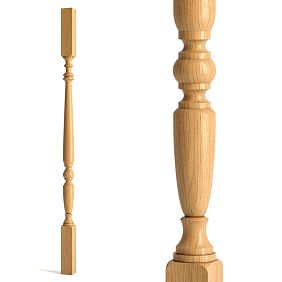
Turned balusters are created on lathe machines by rotational cutting. A square-section blank is secured in the lathe, rotates, and the cutting tool gradually removes excess wood, forming a rotational profile. The result is a baluster with axial symmetry, where all elements (spheres, shafts, cones, ovals) are evenly distributed around the central axis.
Turned balusters are classics, tested over centuries. Their profiles were developed by masters of different eras and styles: from simple cylindrical posts in minimalist style to complex baroque forms with multiple protrusions and recesses.Turned balustersThey are universal — suitable for any interior style, from rustic country to urban classic.
Advantages of turned balusters — relatively simple manufacturing (compared to carved), which affects the price. Strength — turned balusters have a solid structure without weakened areas. Repairability — a turned baluster can be easily replicated on a lathe if replacement is needed.
Disadvantage — limited forms. Turned balusters are always symmetrical and always round in cross-section (though diameter may vary along height). It is impossible to create asymmetrical elements, flat faces, or through cuts.
Carved balusters — art in every detail
Carved balusters are the pinnacle of carpentry craftsmanship. They are created by hand or machine carving, where the craftsman (or CNC router) cuts out three-dimensional elements: leaves, flowers, scrolls, figures, ornaments. Carving can be surface-mounted (individual carved elements attached to a turned base) or integrated (cut from a solid blank).
Carved balusters turn staircases into works of art. They become the central decorative element of the interior, drawing attention and creating an atmosphere of luxury and uniqueness. Carving emphasizes the wood species — relief looks especially expressive on oak or beech, and the play of light and shadow creates depth.
Advantages of carved balusters — uniqueness. Each hand-carved piece is unique, even when working from the same template. Carving allows creating any complexity of forms, realizing any designer ideas, adapting balusters to a specific interior style.
Disadvantages — high cost (3-10 times higher than turned, depending on carving complexity), difficult maintenance (dust accumulates in carving recesses, requiring regular cleaning with a soft brush), difficult repair (damaged carving can only be restored by an experienced carver).
Flat balusters — ethnic originality
Flat balusters are sawn items with rectangular cross-sections, often with decorative cutouts along the contour or through cuts inside. They are characteristic of Slavic, Scandinavian, and Alpine wooden architecture.Flat balustersThey create a sense of tradition, folk character, and coziness.
Flat balusters are cut on band saws, jigsaws, or CNC routers. The contour can be simple (straight lines, rounded edges) or complex (vegetable motifs, geometric patterns). Through carving creates a lacy effect — the baluster becomes light, airy, and lets light pass through.
Advantages of flat balusters — possibility of creating unique ethnic designs, relatively simple manufacturing (easier than volumetric carving), material savings (can be cut from boards rather than beams). Flat balusters fit well into country, Provence, rustic, and chalet styles.
Disadvantages — lower strength compared to solid turned balusters (especially if there are thin cut-out elements), difficulty with handrail mounting (flat top surface requires special solutions).
Milled balusters — geometry and modernity
Milled balusters are created on four-sided milling machines or CNC machines. They have square or rectangular cross-sections with milled edges — grooves, protrusions, dados, chamfers. This is a modern type of baluster that fits well into minimalist, loft, and Scandinavian interiors.
Milled balusters are strict, geometrically correct, without excessive decoration. Their beauty lies in the purity of lines, precision of edges, and quality of finish. They emphasize the staircase architecture, not drawing attention to themselves.
Advantages — modern appearance, relatively simple mass production (CNC machines ensure perfect repeatability), strength (solid cross-section without weakened areas), easy handrail mounting (flat top surface).
Disadvantages — limited stylistic range (not suitable for classical, baroque, or vintage interiors), more massive appearance compared to turned balusters.
Baluster height: safety and ergonomics
Baluster height is not an arbitrary value, but the result of safety and ergonomic calculations. Building codes stipulate that the total height of the staircase railing (from step surface to top of handrail) must be at least 900 millimeters for residential buildings and 1200 millimeters for children’s facilities.
The standard height of balusters themselves (excluding handrail) is 850-900 millimeters. This ensures a final railing height of 900-950 millimeters when accounting for a 40-50 millimeter thick handrail. In rooms with high ceilings or by customer request, baluster height can be increased to 950-1000 millimeters, resulting in a final railing height of 1000-1050 millimeters.
When choosing height, consider the height of people who will use the staircase. For tall individuals (height over 180 centimeters), a 1000-1100 millimeter railing is more comfortable — no need to lean far to reach the handrail. For children, however, the standard 900 millimeter height may be too high — some install an additional child handrail at 600-700 millimeters.
balusters for staircase to buyThe height must be precise — insufficiently tall balusters will create a low railing, unsafe for use. If too tall, they will need to be trimmed, increasing installation labor.
Important note: baluster height is specified for vertical installation. If installed on a sloped staircase, the bottom end must be cut at an angle equal to the staircase’s slope. This means the actual vertical height of the baluster will be slightly less than nominal. Experienced craftsmen account for this when ordering, selecting balusters 10–20 millimeters taller than the calculated height.
Installation spacing: safety distance
Installation spacing (distance between centers of adjacent posts) — a critically important parameter regulated by building codes. Main requirement: the gap between adjacent balusters must not exceed 120 millimeters for residential buildings and 100 millimeters for childcare facilities.
Spacing calculation: if the baluster width is 50 millimeters and the required gap is 100 millimeters, the spacing will be 150 millimeters (50 + 100). If the baluster is 40 millimeters and the gap is 120 millimeters, the spacing will be 160 millimeters.
In practice, spacing is often tied to the number of balusters per step. Common options: one baluster per step (if step depth is shallow, 250–280 millimeters), two balusters per step (for deeper steps 300–350 millimeters or for increased safety), three balusters per step (for very deep steps or in childcare facilities).
When purchasing balusters, consider: the smaller the installation spacing (the more frequently balusters are placed), the more balusters you’ll need, and the higher the total cost. However, saving on the number of balusters may result in violating safety norms and creating a visually sparse railing — the staircase will appear unfinished.
Calculating the number of balusters for a straight run: divide the run length (measured along the treads) by the installation spacing to get the number of balusters. Add 2–3 extra pieces as a reserve for defects or installation errors.Buy wooden balustersBetter to have a small reserve — buying the exact same balusters later may be difficult.
Fastening and installation: reliability for decades
The method of fastening balusters determines the strength, durability, and aesthetics of the railing. Several main methods exist, each with its own advantages.
Mounting with dowels
Dowel pins (wooden pegs) — a traditional carpentry method of joining. Drill coaxial holes of 8–10 mm diameter and 30–40 mm depth in the tread and the bottom end of the baluster. Apply PVA wood glue to the dowel and drive it first into the tread, then slide the baluster onto it. The connection becomes strong, invisible, with no visible fasteners.
Advantages: aesthetics (no visible screw heads), strength when properly executed, traditionalism. Disadvantages: difficulty of disassembly (the connection is practically non-disassemblable), requires precision drilling (holes must be perfectly coaxial).
Mounting with screws
Screws — the most common modern method. Drill a hole in the bottom end of the baluster slightly smaller than the screw diameter, then install the baluster and screw it into place through a pre-drilled hole in the tread with a plastic anchor. The screw head is countersunk into the baluster body and covered with a decorative cap or filled with putty.
Advantages: simplicity and speed of installation, possibility of disassembly, adjustment of baluster position before final tightening. Disadvantages: visible fasteners (if not covered with caps), risk of wood cracking from over-tightening the screw.
Fastening with metal washers
Metal washers — a modern solution for precise and strong fastenings. A washer is a metal plate with a threaded stud, secured to the tread with screws. Drill a threaded hole in the bottom end of the baluster, and screw the baluster onto the stud. The system allows height adjustment with precision down to the millimeter.
Advantages: high installation accuracy, strong connection, possibility of adjustment and tightening, easy disassembly. Disadvantages: visible metal element at the base of the baluster (though it may be decorative), higher cost of fasteners.
Regardless of the fastening method, vertical alignment of each baluster is critically important. Even a slight tilt of several balusters will create a visual impression of curvature across the entire railing. Each baluster is checked with a level in two planes — along and across the staircase.
Lacquering and impregnation: protection and beauty
Protective-decorative coating of balusters — this is not just aesthetics. It protects wood from moisture, dirt, UV radiation, mechanical damage, and biological factors. Proper coating extends the life of balusters many times over.
Impregnation with antiseptics
Impregnation with antiseptic compounds — mandatory first stage of wood protection. Antiseptics penetrate deeply into the wood structure, protecting against fungi, mold, insects, and blue stain. Especially important for medium biostable species — pine, beech, birch.
Modern antiseptics come in several types: water-soluble (based on boron and copper salts), organic-soluble (based on organic biocides), oil-based (based on linseed or tung oil with biocides added). For interior work, water-soluble and oil-based types are preferred — they have no strong odor and are safe for health.
Impregnation is applied with a brush, roller, or dipping method. For maximum protection, double impregnation with intermediate drying is recommended. Ends of balusters require special attention — moisture enters through them most quickly. Ends are impregnated especially thoroughly, sometimes three times.
Priming
Priming prepares the surface for final coating. Primer fills wood pores, creates uniform absorption, improves lacquer or paint adhesion, and prevents resin stains on coniferous species.
For wood, use special primers on water or organic bases. Primers come in clear (to preserve natural wood color) and pigmented (to change shade) types. Primer is applied in a thin layer; after drying, the surface is lightly sanded with fine-grit sandpaper (320–400 grit) to remove raised fibers.
Lacquering
Lacquering — the most common method of final finishing for wooden balusters. Lacquer creates a transparent protective film that protects wood from moisture, dirt, mechanical damage, while preserving its natural texture and color.
For balusters, use high-wear-resistant polyurethane, alkyd, or acrylic lacquers. Polyurethane lacquers are the strongest — they withstand heavy use, do not wear or yellow. Alkyd lacquers are cheaper but less durable. Water-based acrylic lacquers are eco-friendly, odorless, dry quickly, but are less durable than polyurethane.
Lacquer is applied in 2–3 coats with intermediate drying and light sanding. The first coat is often applied diluted (1:1 with solvent) — it penetrates deeper into the wood. Subsequent coats are applied undiluted. The final coat is not sanded — it creates the final gloss or matte finish.
Gloss is chosen based on taste and interior style: glossy (gloss over 80%) creates an elegant, festive look, highlights wood texture, but scratches and fingerprints are noticeable. Satin (gloss 40-60%) is a universal option, combining texture expressiveness with practicality. Matte (gloss less than 20%) creates a restrained, noble look, hiding minor defects.
Oil-wax
Wax-oil is a natural finish based on plant oils (linseed, tung) and natural waxes (beeswax, carnauba). Oil penetrates deeply into wood, while wax remains on the surface, forming a silky protective film. Unlike lacquer, wax-oil does not create a surface film — wood remains "breathable," tactilely pleasant, and warm.
Advantages of wax-oil: naturalness and eco-friendliness, highlighting wood texture, tactile qualities, ease of local repair (simply reapply oil to the damaged area). Disadvantages: requires periodic renewal (every 2-3 years), less resistant to moisture and dirt compared to lacquer.
Wax-oil is ideal for wood species with expressive grain — oak, ash, walnut. It emphasizes every fiber, creates depth of color, and imparts wood with a noble, silky sheen.Wooden staircase elementsWith an oil finish, they look especially natural and luxurious.
Painting
Staining — a choice for those who want to change the color of balusters or hide wood defects. Special wood paints — alkyd, acrylic, polyurethane — are used. Paint creates an opaque finish, completely hiding wood texture.
Staining requires careful preparation: sanding, filling all defects, priming. Paint is applied in 2-3 coats with intermediate drying and light sanding. The quality of the stained surface depends on the quality of preparation — any unevenness, scratch, or stain will become visible after staining.
Stained balusters are practical — dirt is less noticeable, scratches are easy to touch up. White stained balusters — classic for traditional interiors, creating a sense of freshness, cleanliness, and visually expanding space.
Wear resistance: how long will balusters last?
Wear resistance of wooden balusters depends on three factors: wood species, quality of protective coating, intensity of use.
Oak balusters with quality polyurethane lacquer in a residential home with moderate use last 50-100 years practically without visible wear. The coating may require renewal every 10-15 years, but the wood itself remains unchanged.
Spruce balusters with the same coating under the same conditions last 20-30 years. Softwood gradually wears down in contact areas, and surface dents from impacts appear, but with careful use, they remain durable.
Intensive use (public buildings, large families, active use) shortens service life. Here, coating wear resistance is critical — polyurethane lacquer lasts 5-7 years, alkyd 3-4 years, wax-oil 2-3 years. After coating wear, renewal is required.
Signs of wear: surface dullness, appearance of small scratches, coating wear in contact areas (top of balusters where people hold with hands), roughness. Upon detecting these signs, coating renewal is required — removing old lacquer, sanding, applying new coating.
Proper care extends service life: regular dust cleaning, avoiding excessive moisture, using protective pads when moving heavy items up stairs, periodic coating renewal until critical wear.Wooden balusters for staircasesWith proper care, they serve generations.
How to choose when purchasing: buyer’s checklist
Wood inspection
Species: ensure the species matches the stated one. Oak is heavy with large-pored texture. Beech is light with fine pores. Ash has a characteristic striped pattern. Spruce is light with resin pockets.
Grade: for visible elements, choose Extra or A grade — without knots, cracks, defects. Grade B is acceptable for staining when texture will be hidden.
Moisture: optimal 8-12%. Check with a moisture meter or indirectly — dry wood is light, not cold to the touch, and sounds crisp when tapped.
Absence of defects: check each baluster for cracks, loose knots, resin pockets, blue stain, mold marks.
Geometry check
Straightness: place the baluster on a flat surface and check for bowing, curvature, or helical twisting. Allowable deflection — no more than 2 mm over 900 mm length.
End perpendicularity: place a square against the end — it must be strictly perpendicular to the baluster’s axis. Deviation exceeding 1 degree will cause installation problems.
Profile consistency: compare several balusters from the batch — the profile must be identical. All diameters, transitions, and elements must match within 1-2 mm precision.
Surface quality: surface must be smooth, without fuzz, scratches, or steps. Run your hand over it — no catches or roughness should be felt.
Size verification
Height: measure several balusters — they must be identical within 2-3 mm. Check that height matches the ordered size.
Cross-section: for square balusters, check the cross-section size. For round ones — diameter at the thickest point. Deviations no more than 1-2 mm.
Symmetry: for turned balusters, check symmetry relative to the central axis. All elements must be precisely centered.
Coverage Check
If balusters are sold with a finish, check its quality:
Uniformity: the finish must be applied evenly, without gaps, streaks, spots, or bubbles.
Thickness: adequate finish thickness provides protection. A too thin layer will not protect, while an overly thick one may crack.
Adhesion: run your fingernail over the surface — the finish should not peel or scratch.
Ends: check if the ends are painted. Unprotected ends are a pathway for moisture ingress.
Packaging and labeling
Packaging: balusters must be protected from damage during transport. Individual wrapping, cardboard spacers, rigid packaging.
Labeling: the packaging must include information about the manufacturer, wood species, grade, dimensions, quantity, production date, and batch number.
Documents: request a certificate of conformity or declaration, a quality passport with product specifications.
How much to buy: calculate with a reserve
The number of balusters is calculated by the formula: (length of run / installation spacing) + support posts + reserve.
A reserve is necessary in case of defects in the batch, installation errors, or damage during transport. It is better to have 2-3 extra balusters than to discover a shortage during installation and not find exact matches.
Allowance is needed for defects in the batch, assembly errors, or damage during transport. It is better to have 2-3 extra balusters than to discover a shortage and not be able to find exact matches during installation.
If the staircase has multiple runs or turning sections, calculate separately for each section, then sum up.
Support posts are calculated separately: 2 per straight run (start and end), plus additional posts at turns and landings.
Conclusion
buy wooden balusters— this is a decision made for decades. The correctness of the choice determines the safety, longevity, visual harmony with the interior, and usability of the staircase. The choice of wood species determines strength, durability, and reaction to humidity. Oak — for those who choose maximum longevity and are willing to invest. Beech — optimal balance of quality and price for dry rooms. Ash — for lovers of light wood with high strength. Larch — for challenging conditions with increased humidity. Pine — budget solution for standard conditions.
Baluster profile — this is a stylistic choice that determines the character of the staircase. Turned balusters are universal and suitable for any style. Carved balusters transform the staircase into a work of art. Flat balusters create an ethnic atmosphere. Routered balusters are ideal for modern minimalist interiors.
Height and installation spacing — safety parameters regulated by building codes. Guardrail height minimum 900 mm for adults, 1200 mm for children’s facilities. Maximum distance between balusters 120 mm for residential buildings, 100 mm for children’s facilities. Violation of these norms creates a risk of injury.
Fasteners determine the strength and longevity of the guardrail. Dowels — traditional aesthetic method. Self-tapping screws — universal practical option. Metal shoe brackets — modern solution with adjustable capability.
Finishing and impregnation — not cosmetic procedures, but critical protection of wood against moisture, biological factors, and mechanical damage. Quality finish extends the life of balusters many times over. Impregnation with antiseptics protects against mold and insects. Priming prepares for final finish. Lacquering creates a durable protective film. Oil-wax — natural alternative with excellent tactile qualities.
Durability depends on wood species, finish quality, and usage intensity. Oak balusters with polyurethane lacquer last 50–100 years. Pine balusters 20–30 years. Proper care and timely finish renewal significantly extend service life.
STAVROS company offers a full range of wooden balusters for any project. In-house production on modern equipment ensures consistent quality, precise geometry, and ideal processing. Wood undergoes a full cycle of kiln drying to 8–10% moisture content, guaranteeing dimensional stability and absence of deformation.
STAVROS catalog features balusters made of oak, ash, beech, larch, and pine. Dozens of profiles — from simple turned to complex carved. All standard sizes: height from 800 to 1000 mm, cross-section from 40×40 to 70×70 mm. Balusters are available both without finish (for self-finishing) and pre-finished with high-durability polyurethane lacquer.
Buy wooden balustersBuying from STAVROS means receiving products that have undergone multi-stage quality control. Each batch is checked for compliance with dimensions, straightness, processing quality, and wood moisture content. Defects are not allowed to be shipped.
In addition to balusters, STAVROS offers all staircase components: support posts, handrails, baluster supports, treads, landings,staircase components made of wood— a complete set for turnkey staircase construction. Everything made of quality wood, everything compliant with standards, everything with manufacturer’s warranty.
STAVROS consultants will help calculate the number of balusters for your staircase, select the optimal wood species based on usage conditions, choose a profile matching the interior style, recommend fastening and protective coating methods. They will provide detailed installation instructions or recommend trusted specialists.
Choosing STAVROS means choosing quality without compromise. You choose balusters that will serve for decades, retaining their original appearance. You choose safety, confirmed by compliance with all building codes. You choose beauty crafted from natural wood by skilled artisans. Because a staircase is not just a structure for moving between floors. It is an architectural element that defines the character of the entire house. And it must be flawless.