Article Contents:
- What are flexible wall panels for interior finishing
- Structural base
- How they differ from rigid panels
- Why this solution is specifically for interior finishing
- Where flexible wall panels are most commonly used
- Living Room
- Bedroom
- Entry Hall
- Hallway
- Office and meeting rooms
- Office
- Commercial spaces
- Columns, arches, niches, radius walls
- What types of flexible wall panels exist by texture and appearance
- Wood-like: natural solid wood versus imitation
- Stone-look
- Plaster and concrete-look
- For painting
- Smooth and textured
- Slatted panels
- What tasks do flexible panels solve in interior design
- Accent Wall
- Decorating complex geometry
- Soft transition between surfaces
- Zoning
- Visual complexity of the interior
- Combination of wall and furniture
- How to choose flexible wall panels by room type
- living room
- for the bedroom
- For the hallway
- For the corridor
- For Office
- For Offices
- For commercial spaces
- How to choose panels according to interior style
- Modern minimalism
- Japandi and Scandinavian style
- Neoclassicism and Modern Classicism
- Loft and Industrial Style
- Warm natural interior
- Premium commercial spaces
- How to choose panels by texture, color and format
- Light and dark
- Smooth and textured
- Vertical and horizontal pattern
- Pattern scale
- Combination with floor, ceiling, furniture
- Flexible panels or regular wall panels: which is better
- What to look for when choosing flexible wall panels
- Wall geometry
- Quality of the fabric base
- End geometry accuracy
- Lighting
- Pattern rhythm and room architecture
- Party affiliation
- Wall preparation for flexible panel installation
- Substrate condition
- Leveling
- Dry fitting and marking
- Joint planning
- Flexible wall panel installation
- Cutting
- Applying adhesive
- Fixation
- Module joining
- Corner finishing
- Adjacency to other materials
- Final inspection
- Typical mistakes when choosing and installing
- Inappropriate texture for the room
- Overloaded interior
- Scale error
- Poor base preparation
- Poorly thought-out layout
- Ignoring lighting
- Different batches
- What to combine flexible wall panels with in interior design
- Who are flexible wall panels especially suitable for
- FAQ: Answers to Popular Questions
- Conclusion
- About the Company STAVROS
A wall is not just a partition. In modern interiors, a wall carries semantic weight: it creates a mood, sets the scale, and defines the sense of space. And when it comes to finishing, the choice of material is not a technical question, but a design decision with long-term consequences.
Flexible wall panels for interior finishingturned out to be exactly the solution that combines decorative expressiveness and architectural functionality. They work where conventional materials fail: on columns, arches, curved walls, rounded niches. They provide texture, depth, and a lively rhythm to the surface. And at the same time, they are installed without guides, without complex preparation, without special equipment.
Why are they being asked about so often right now? Because interior design has changed. Straight-line geometry has given way to soft transitions. Smooth surfaces have become tiresome — volume is desired. Wood on the wall is back in priority — but not as rustic decor, but as an architectural material.
This article provides a systematic breakdown: what it is, where to use it, how to choose, how to avoid mistakes, and how to achieve a result you can be proud of.







What are flexible wall panels for interior finishing




Structural basis
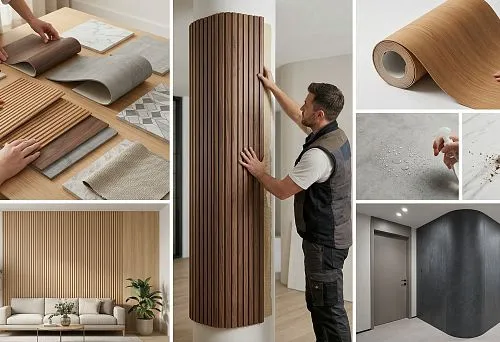
The foundation of a flexible wall panel is a fundamentally different logic than that of a rigid counterpart. Decorative elements: slats, strips, planks — are attached not to a rigid backing, but to a dense elastic fabric base. The fabric maintains the spacing and parallelism of the elements but allows the panel to bend along any curve.
This means the panel literally follows the architecture of the surface. It does not require the wall to be straight. It takes on the shape you give it.
Our factory also produces:





How does it differ from rigid panels
Rigid panel - slats on MDF board. It's a monolith. Works flawlessly on flat surfaces but doesn't tolerate bends: when trying to bend - it breaks, delaminates, deforms. Attempting to use a rigid panel on a column or arch ends with either visible seams or rework.
Flexible panel - slats on fabric. Wraps around any radius. Seamlessly joins. Cut with a knife (MDF slats) or hacksaw (solid wood). Mounted with adhesive without guides.
Get Consultation
Why this solution is specifically for interior finishing
The word 'interior' is not a formal clarification. It means the material is designed for residential and commercial interior conditions: stable temperature, normal humidity, direct visual contact. That's precisely why higher requirements are placed here for geometric precision, surface cleanliness, edge quality, and batch color consistency.
Panels for interior wall finishing— this is not a construction material in the technical sense. It's a final decorative product that a person sees every day and returns their gaze to again and again. Hence the requirement for quality that cannot be compromised.
Where are flexible wall panels most commonly used
Before talking about selection — let's talk about application. It's the context that dictates the panel type, texture, pattern scale, and installation method.
Living Room
Living room — the most representative space in the house. TV wall, side accent, area behind the sofa — three classic scenarios. If the geometry is straight — the choice is wide. If there are decorative columns, arched transitions, or rounded niches — only flexible format.
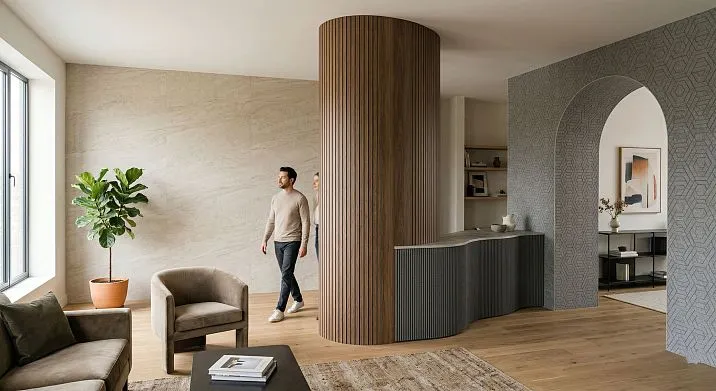
The living room is particularly expressive, where the slatted cladding wraps around a column and continues onto the adjacent wall in a single pattern. This is an architectural technique that creates a sense of designed work—not just a glued-on panel.
Bedroom
A bed headboard with slatted cladding is a classic today, but a classic that doesn't get boring. Because depending on the material, tone, and scale of the slats, it sounds new every time.
Flexible panels for the bedroomare especially in demand when the headboard is located in a niche with rounded transitions or an arched vault. The flexible canvas wraps around all these surfaces without breaking the pattern—and the wall behind the bed reads as a single architectural element.
Entryway
The hallway welcomes guests. It is often here that the most unconventional architecture is concentrated: arched openings, pylons, transitions at non-standard angles.Decorative flexible panels for interior finishingin the hallway allow all these elements to be decorated with a unified slatted rhythm.
Practical bonus: the slatted structure effectively hides minor irregularities in old walls—and in hallways, they are especially common.
Corridor
In a long corridor, a slatted wall serves two functions at once. The first is decorative: it adds depth and rhythm to a monotonous space. The second is visual: vertical slats organize the corridor space, guide the eye, and create a sense of completeness.
Light, sparsely spaced slats—for a narrow corridor: visually widen it. Dark, densely placed ones—for a wide one: add depth and weight.
Study and meeting rooms
In a professional environment, walls carry a reputational function. Slatted cladding made of dark oak with a matte oil finish speaks of seriousness without unnecessary words. If the office contains niches for shelving, rounded architectural elements, or decorative columns—the flexible format solves the task of unified finishing without manual carpentry.
Office
A slatted panel in the office is not just about aesthetics. It's a function. The slatted structure disperses sound, reducing reverberation in meeting rooms with high ceilings. Sound absorption is a measurable result worth considering when making a choice.
Commercial spaces
Restaurant, hotel, boutique, medical center — commercial interiors place demands on finishing materials that residential spaces rarely require: high traffic, resistance to mechanical impact, durability, visual representativeness.
Flexible wall panels for interiorsSolid oak in a commercial space is an investment with a horizon of years, not months. Oak does not lose its appearance over time, does not fade, and is easily renewed by applying a new coat of oil.
Columns, arches, niches, radius walls
This is the key 'specialization' of the flexible format — and it is here that the difference between flexible and rigid panels becomes most obvious.
A cylindrical column that needs to be clad with a slatted texture around the entire perimeter. An arched vault with a continuous slatted pattern. A niche with rounded corners where a rigid backing will not lay on the curve without visible gaps. A radius partition in a restaurant hall — a smooth curve that needs to be finished with a single material.
For all these tasks, there arepanels for complex surfacesin a flexible version — the only truly correct solution.
What types of flexible wall panels are available by texture and appearance
Under the tree: natural solid wood vs. imitation
The most in-demand texture in modern interiors. Here it's important to distinguish between two fundamentally different products.
Natural solid wood – oak or other wood species slats on a fabric base. Living texture, unique grain pattern, tactile warmth, natural depth of color. This cannot be reproduced by any printing or coating.
Wood imitation – MDF, PVC or other synthetic material with an applied pattern. More affordable in price, more uniform in tone. But upon closer inspection, the difference is obvious: an image instead of material.
The choice between them is not only a matter of budget, but also of honesty towards the interior.Flexible panels with wood-grain texturemade of natural oak – is a long-term value that doesn't need to be replaced in five years.
Stone-look
Slate, travertine, limestone, marble – flexible panels with stone texture reproduce the texture of natural stone. The key advantage of the flexible format specifically: cladding a column or arch with natural stone is the manual work of a professional mason. A flexible panel with a similar texture is installed without special skills.
In interiors, such panels create a brutal, 'grounded' aesthetic. They are especially good in combination with metal details and concrete surfaces.
Plaster and concrete-look
Relief panels imitating the texture of decorative plaster or raw concrete – a tool for industrial and loft interiors. They allow achieving a brutal aesthetic without the labor costs of manual application of decorative compounds.
On curved surfaces – for example, on a rounded partition – a rigid sheet with concrete imitation will require manual leveling. A flexible panel follows the curve effortlessly.
For painting
Smooth or textured primed MDF panels for painting are a tool for those who value precise color. RAL, NCS, Pantone, a custom shade from any tinting system. Repaint in the future without dismantling.
This is the most flexible solution in commercial terms: the interior is updated by painting, not by replacing the material. Especially valuable for commercial spaces with a corporate style.
Smooth and textured
Smooth flexible panel — strict, concise, architectural. Works in minimalist and modern interiors where excessive decor is inappropriate.
Textured — volumetric, textured, 'alive' in any lighting. Especially good with accent directional lighting: the texture creates deep shadows that change throughout the day along with the position of the light sources.
Rack panels
SlattedFlexible wall panels— is a separate and very important category. Parallel slats with equal spacing on a fabric base. Linear rhythm, pronounced chiaroscuro, architectural expressiveness. These are most often meant when people say 'slatted wall'.
What tasks do flexible panels solve in the interior
Accent Wall
One textured wall in a neutral space is the most effective decorative technique in modern interiors. A slatted surface creates depth through chiaroscuro, which cannot be achieved by paint, wallpaper, or plaster.
Complex geometry finishing
This is the main functional task that only flexible panels handle. Where the architecture is curved — the panel follows it without creating seams or losing the pattern.
Smooth transition between surfaces
A unified slatted pattern from a straight wall through a rounded corner onto the next plane — this creates a sense of monolithic space that is difficult to achieve by other means. The interior reads as architecturally developed, not as a set of separate solutions.
Zoning
A slatted wall is a visual divider of zones without physical partitions. In an open plan layout — between the living room and dining area, work zone and relaxation area. The difference in texture reads as a spatial boundary.
Visual complication of the interior
A volumetric surface with a rhythmic pattern adds complexity and 'substantiality' to the interior. This is the effect professionals call 'visual upscaling of the space'.
Combination of wall and furniture
Flexible panels for interior wall finishingcan be applied simultaneously on walls and on furniture fronts — creating a unified material environment for the room. A built-in wardrobe clad with the same slats as the wall behind it — that's the level of a design solution.
How to choose flexible wall panels by room type
For the living room
The scale of the slat — in accordance with the area of the room. A spacious living room: wide slat, pronounced spacing. A small one: thin slat, dense rhythm. Tone: warm, natural — oiled oak or MDF in a neutral shade. Orientation: predominantly vertical — it visually increases the height.
For the bedroom
The bedroom does not tolerate aggression. A panel for the bedroom should be quiet: light tone, moderate spacing, soft texture.Flexible decorative wall panelsin the Scandinavian spirit — light oak, thin slat, transparent oil — create an atmosphere of calm and warmth.
Avoid: dark saturated tones and large relief near the sleeping area. They create tension where silence is needed.
For the hallway
Functionality is a priority: coating resistance to mechanical contact. Solid oak with oil finish is more durable than painted MDF in high-traffic areas. Dark tones hide marks better than light ones.
For the corridor
Vertical slat rhythm is optimal for any hallway. In narrow ones: light slats, sparse spacing. In wide ones: dark accent, dense rhythm.
For an office
Dark oak, strict vertical lines, matte finish. Here the panel is not decor, but the character of the space.
For an office
MDF painted to match the corporate color — or neutral oak. The slat structure additionally contributes to acoustics.
For commercial spaces
Solid oak is an investment material. Durable, prestigious, renewable. The flexible format is indispensable for columns, arches, and curved areas in restaurant halls.
How to choose panels based on interior style
Modern minimalism
Narrow or medium slat. Neutral color: white, light gray, off-white. Painted MDF in matte finish. Strict geometry, minimal decor around. The panel works as architectural rhythm, not as an accent.
Japandi and Scandinavian style
Oak with clear oil or light whitewashed tint. Thin slats, moderate spacing. Plenty of air, natural texture, no excessive decorativeness.Panels for a warm interiorin Scandinavian style — it's not decor, but the material itself.
Neoclassicism and modern classicism
A slatted panel in the lower third of the wall serves as a decorative frieze. Wide slats, dark oak tone, combined with moldings and cornice profiles. Precision in proportions is key here: the pattern must align with the architectural divisions.
Loft and industrial style
Wide slats. Dark paint: anthracite, dark blue, olive. Adjacent to exposed concrete, metal, rough textures.Flexible panels for paintingin a loft interior — a 'warm' counterbalance to cold materials.
Warm natural interior
Natural oak without tinting. Organic forms, natural materials. The slatted surface here is the central material. Everything else is in dialogue with it.
Premium commercial spaces
Dark oak, matte oil, pronounced spacing. Adjacent to natural stone, brass details, soft lighting. This is the language of spaces where reputation is materialized in details.
How to choose panels by texture, color, and format
Light and dark
Light tones expand the space, open it up. Dark tones add weight and depth — good for accent elements and large rooms that need a visual 'anchor' point.
Smooth and textured
A smooth panel is strict. A textured one is lively. But texture only works with directional lighting: in a room with diffused light, a three-dimensional surface 'fades'. Test the sample under real lighting conditions.
Vertical and horizontal pattern
A vertical slat pattern visually increases the height of a room. A horizontal one expands the wall. For most residential interiors, vertical is preferred.
Pattern scale
The width of the slat and the spacing should correspond to the scale of the space. This rule is most often broken—and it is precisely this that creates the greatest visual problems. A wide slat in a small room feels oppressive. A thin slat in a large hall gets lost.
Check the scale on a physical sample—not in a picture.
Combination with floor, ceiling, furniture
Oak on the wall + oak parquet: warmth and unity. But with a difference in the finish—so that two matte or two glossy finishes don't create monotony. A light wall + light ceiling + light floor—an excess of one tone. Introduce contrast.
Flexible panels or regular wall panels: which is better
Fair comparison is the key to the right choice.
| Criterion | Flexible panel | Rigid panel | Plaster | Wallpaper | Paint |
|---|---|---|---|---|---|
| Curvilinear surfaces | Yes | No | Yes | Limited | Yes |
| Plank pattern | Yes | Yes | No | Imitation | No |
| Natural texture | Yes (oak) | Yes (oak) | No | No | No |
| Installation without guides | Yes | Partially | No | Yes | Yes |
| Repainting | Yes (MDF) | Yes (MDF) | Yes | No | Yes |
| Durability | High (oak) | High (oak) | High | Low | Medium |
| Visual depth | High | High | Medium | Low | No |
| Columns and Arches | Yes | No | Yes | No | Yes |
| Installation speed | High | High | Low | Medium | High |
| Sound diffusion | Present | Present | No | Minimal | No |
Direct output:Flexible wall panels for interior finishingare indispensable where there is a curve. On straight walls, they compete with rigid panels on equal terms. The choice on a flat surface is determined by the material, color, and installation method.
What to look for when choosing flexible wall panels
Wall geometry
The first and main question: is there at least one curve? If yes — only flexible format. If no — the choice is determined by other parameters.
Quality of the fabric base
It is precisely this that determines how well the panel will handle a curve. Dense, durable fabric that does not tear when bent is a sign of a quality product. Loose, cheap base is a guarantee of problems on curved surfaces.
Accuracy of end geometry
Take two samples and place them end to end. A perfect joint — plank to plank, without a gap and without overlap. This is a sign of precise manufacturing and a guarantee of seamless installation. A crooked end — no installer's care can fix it.
Lighting
Striped and relief surfaces are revealed under directional light. Plan accent lighting before choosing a panel, not after. Without it, 30–40% of the material's visual potential is lost.
Pattern rhythm and room architecture
The spacing of battens should be coordinated with the proportions of the room: ceiling height, wall width, and the placement of furniture and windows. A haphazard choice of 'the first one you like' leads to visual discomfort.
Batch
The entire volume for one project should be from a single batch. Natural oak may have color variations between batches. Order with an 8–10% surplus and from a single shipment.
Wall preparation for flexible panel installation
Substrate condition
A clean, dry, degreased, and sturdy surface is a prerequisite; without it, adhesive mounting will not be durable. Remove all unstable elements: peeling paint, loose plaster, old wallpaper.
Porous surfaces should be primed with a deep-penetration primer. Dense, smooth surfaces only need to be dusted and degreased.
Leveling
Minor irregularities (up to 3 mm per meter) are concealed by the batten structure. Significant variations (more than 5 mm) must be leveled with filler before installation. On surfaces with large variations, install on a frame with leveling.
Dry fitting and marking
This is a step that cannot be skipped. Lay out the panels without adhesive. Check the layout, ensure symmetry, locate joint positions. Apply vertical and horizontal guidelines.
30 minutes of dry fitting prevents several hours of rework.
Joint planning
Where will the joints be? They should fall in the least noticeable areas: behind furniture, in corners, behind door frames. On columns — at one selected point around the perimeter.
Installation of flexible wall panels
Cutting
MDF battens are cut with a utility knife along the fabric backing line — cleanly, without chips. Oak — with a fine-toothed saw or miter saw. Cut angle: strictly 90° for a standard joint; precise angle — for joints on external or internal corners.
Applying adhesive
Mounting adhesive with high initial adhesion is a mandatory requirement. Apply to the fabric backing in a zigzag pattern, not a solid layer: excess will seep through gaps and ruin the surface. On vertical planes — also apply adhesive to the wall.
Fixation
On a straight wall: press smoothly, from one edge to the other, without jerking. On a curved surface: wrap gradually, holding pressure for 5–7 seconds on each section. On a column: work around the perimeter gradually, place the joint at a pre-selected point.
Module Joining
Batten to batten, without gaps. With precise end geometry, the joint visually disappears. This is exactly the property that distinguishes a quality panel from a cheap one.
Corner finishing
External corner: both panels are cut at 45°, joined with a miter joint. Internal corner: one panel flush against the other. Alternative — corner profiles matching the panel color.
Adjacency to other materials
Transition to stone, metal, glass — via a transition profile or minimal gap with color-matched sealant. Adjacency to floor and ceiling — baseboard or ceiling profile matching the panel color.
Final inspection
Check the parallelism of the slats and the uniformity of the spacing. Evaluate the surface under accent lighting—ensure the pattern reads correctly. This is the last moment to make adjustments without significant losses.
Typical Errors in Selection and Installation
Inappropriate texture for the room
A textured panel in a bedroom with diffused light—the texture gets lost, money spent with no result. A smooth panel in a large hall—the surface looks 'empty'. Test the sample under real lighting conditions.
Overloaded interior
Bright accent wall + bright floor + bright furniture = visual chaos. A slatted panel works well on one accent wall with a neutral surrounding. It 'speaks' first—everything else should listen.
Scale error
This rule is repeated again—because it's broken again. The scale of the slat must match the scale of the room. Check it live on a sample.
Poor surface preparation
Any savings at this stage mean a panel peeling off in 3–6 months and a complete redo from scratch. The substrate is the foundation of the result.
Poorly thought-out layout
Skipping a dry fit—a narrow offcut in the most visible spot, a seam in the middle of the accent wall. 30 minutes of fitting—priceless.
Ignoring lighting
Plan the lighting before installation. Pre-install cable channels for built-in lighting—later it will be impossible without demolition.
Different batches
Natural oak—color variation between batches. Order the entire volume as a single batch with a surplus.
What to combine flexible wall panels with in interior design
Wood + marble. An archetypal contrast of warmth and cold. Particularly expressive in kitchens, bathrooms, and dining areas. Marble next to wood appears warmer; wood next to marble appears more substantial.
Wood + metal. Brass lighting fixtures, matte steel accents, black handles — the rhythm of metal echoes the rhythm of slats. One of the most relevant material duets today.
Slatted wall + integrated lighting. LED in front of the panel: active chiaroscuro, deep shadows, expressive relief. LED in the grooves between slats: soft diffuse glow. Plan cable channels before installation.
Slatted wall + hidden doors. A door integrated into the slatted rhythm without visible frames and trims is one of the most impressive architectural techniques. The slatted pattern 'absorbs' the door.
Slats + textiles. Linen, wool, velvet — a tactile dialogue with the slatted surface. Textured wood and soft textiles create a richness of textures without visual overload.
Wood + parquet. One material on the wall and on the floor — warmth and unity. The difference in finish creates the necessary contrast: matte wall + glossy floor, or vice versa.
Who flexible wall panels are especially suitable for
Interior designer. A professional tool for any non-standard geometry. Predictable result, stable batch, precise edges. This is not a compromise solution — it's the first choice.
Architect. Large-scale commercial projects with columns, arches, radius walls — the direct specialization of the flexible solid oak format. The material's durability matches the planning horizon of an architectural project.
Private client. A person who renovates consciously and wants a designer result without a designer budget.Flexible panels for interior wallsThey are mounted with adhesive, cut with a knife, and joined without special tools. With careful preparation and dry fitting — accessible to the attentive DIYer.
For those finishing complex surfaces. Column, arch, niche, radius wall — without the flexible format, these tasks are either unsolvable or solved at a significantly higher cost through custom carpentry.
For those who want to combine decorativeness and practicality. An oak slat wall is beautiful and durable. Calculate the cost of ownership: solid oak for 30 years versus wallpaper for 5 — and the choice becomes obvious.
FAQ: Answers to popular questions
What are flexible wall panels for interior finishing?
These are decorative constructions where slats, strips, or relief elements are fixed on an elastic fabric base. They bend along any curve, preserving the pattern, and are used for interior finishing of walls, columns, arches, niches, and furniture fronts.
How do they differ from regular wall panels?
A regular rigid panel — slats on an MDF backing, does not bend. A flexible one — slats on a fabric base, wraps around any curve without pattern deformation and without visible seams.
Are flexible panels suitable for an apartment?
Yes, this is one of the main application scenarios. Accent walls in the living room and bedroom, headboard, hallway finishing — all of this is implemented in private projects.
Can they be used in the living room?
Yes. TV zone, accent wall, decorative columns, arches — all of this is covered byFlexible wall panel for interior.
Are they suitable for the bedroom?
Yes. An accent wall behind the headboard is a classic scenario. Choose a calm tone and moderate slat spacing.
Can flexible panels be used in the hallway?
Yes. Especially where there are arched openings, rounded transitions, or non-standard wall geometry.
Are they suitable for columns and arches?
Yes—and that's their main specialty. A rigid panel does not wrap around the closed perimeter of a column; a flexible one wraps around it completely.
What textures are available?
Wood-look (including solid oak), stone-look, plaster and concrete-look, smooth for painting, textured, slatted.
What is better to choose for a modern interior?
Slatted panels in natural oak or paintable MDF in neutral tones—vertical rhythm, matte finish.
Is it difficult to install flexible panels?
No. Installation with adhesive, cutting with a knife or saw, seamless joining. With a prepared base and dry fitting—accessible to a careful non-specialist.
Does the substrate need to be perfectly level?
No. Minor irregularities are concealed by the slatted structure. Significant deviations are corrected before installation.
How are flexible panels joined?
Slat to slat, without a gap. With precise ends, the joint visually disappears.
How to care for it?
Paintable MDF—wipe with a damp cloth, local touch-up if needed. Oiled oak—renew the finish every 2–5 years.
What's better: flexible panels or rigid ones?
Depends on geometry. If there's a curve — only flexible panels. Flat surface — choose based on material and installation method.
Conclusion
Flexible wall panels for interior finishing— is a material for interiors where surface form is primary. Where there's a column, arch, radius wall, or rounded niche — they are the only full-fledged solution. On flat surfaces — they compete with rigid formats on equal terms.
Choose based on surface geometry. Choose based on material: oak — for natural aesthetics and durability, paintable MDF — for precise color and the ability to refresh. Check a sample in person. Plan lighting together with the panel.
About the company STAVROS
When the task is specific and the solution must be precise — professionals turn to STAVROS.
The range includes paintable MDF and solid oak slatted panels, flexible fabric-backed modules for all types of curved surfaces, interior slats for project solutions. In-house production guarantees stable end geometry, consistent batch tone, and a surface ready for finishing from the first time.
STAVROS — the choice of designers, architects, and private clients for whom the result is more important than compromise. Full catalog, technical parameters, and professional consultation — on the official websitestavros.ru.