Article Contents:
- What are flexible slatted panels and how do they differ from rigid ones
- Flexible panel construction
- Rigid panel construction
- Main practical conclusion
- When it's really worth buying a flexible slatted panel
- Radius wall
- Column
- Arch
- Niche with rounded corners
- Rounded corner
- Furniture front with curved geometry
- Complex interior partition
- When to buy a rigid slat panel instead of a flexible one
- Smooth accent wall
- Bedroom: headboard on a smooth wall
- TV zone and living room with straight geometry
- Project for painting with exact color
- What types of slat solutions exist: from flexible panel to individual slat
- Type 1. Flexible panel on fabric base — PAN-001
- Type 2. Primed MDF panel for painting — PAN-002
- Type 3. Interior slat for project solutions — RK-002
- Type 4. Slat panel sample — OPAN-001
- How to choose and buy a slat panel without mistakes: algorithm
- Step 1. Determine the surface geometry
- Step 2. Determine the finish
- Step 3. Determine the usage scenario
- Step 4. Determine the slat scale
- Step 5. Determine the volume with margin
- Step 6. Order a sample
- Which slatted panel to buy for different rooms
- Living Room
- Bedroom
- Hallway and corridor
- Office and meeting rooms
- Reception and commercial spaces
- Furniture front
- What to check before buying: technical checklist
- Installation: why panel type affects the result
- Installation PAN-001 (flexible panel)
- Installation PAN-002 (rigid panel for painting)
- Common Installation Mistakes
- Mistakes when choosing slatted panels: top 7 situations
- Mistake 1. Buying a rigid panel for a curved surface
- Mistake 2. Buying a flexible panel when a strict plane for painting is needed
- Error 3. Not ordering a sample
- Error 4. Choosing a slat scale without reference to the room
- Error 5. Different batches in one project
- Mistake 6. Ignoring lighting
- Error 7. Buying without considering joints and abutments
- What to combine slat panels with: a brief practical guide
- FAQ: answers to questions before purchase
- Conclusion: which product for which task
- About the Company STAVROS
Every time someone types 'buy slat panel' into a search engine, behind that query lies one of several very different tasks. Someone wants to decorate an accent wall in a bedroom. Someone wants to cover a column in a restaurant hall. Someone wants to clad a radius niche in an entrance hall. And someone is simply looking for a paintable material for a flat wall in a living room. All four people enter the same query—but they need to buy fundamentally different things.
This is where the main mistake is made: a person looks at a beautiful picture of a slat panel, orders the first suitable one, and then discovers that a rigid module absolutely refuses to wrap around a column, or that a flexible panel on a flat wall behaves differently than expected. Money is spent, time is lost, rework is inevitable.
The goal of this article is to give you a selection tool, not just a material review. We will break down what a Flexible slatted panelshow they differ from rigid ones, when to buy one format versus the other, and—most importantly—which specific product solves which task.

What are flexible slatted panels and how do they differ from rigid ones
Let's start with the basics—because confusion in terminology comes at a high cost.




Construction of a flexible panel
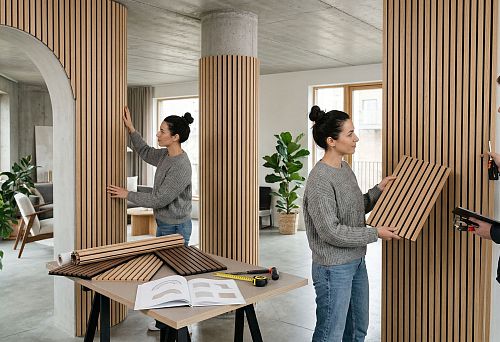
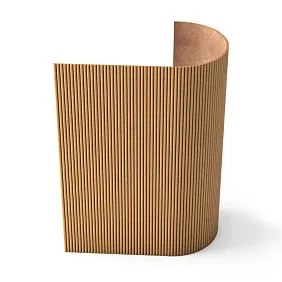
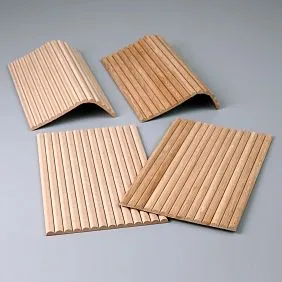
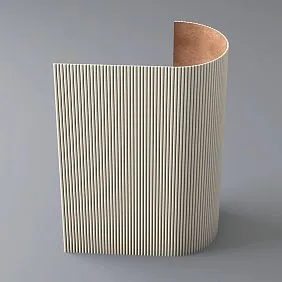
A flexible slatted panel is a structure where wooden or MDF slats are fixed at equal intervals not on a rigid backing, but on a dense elastic fabric base. The fabric holds the slats in precise position, prevents them from shifting when bent, and evenly distributes force across the entire panel. It is precisely due to this base that the panel bends along a curve—whether it's a radius of 30 centimeters or a gentle wall arc.
Key point: the slatted pattern does not deform when bent. The spacing between slats remains uniform, and parallelism is preserved. The surface looks the same as on a straight wall—it simply follows the shape of the underlying surface.
Our factory also produces:


Construction of a rigid panel
A rigid slatted module consists of slats plus an MDF board as the base. It is a monolithic structure with fixed geometry. It works flawlessly on flat surfaces: precise geometry, stable spacing, and the possibility of mechanical fastening along guides. But it does not bend. Any attempt to bend a rigid module leads to delamination, breakage, or, at best, deformation that cannot be concealed.
Get Consultation
Main practical takeaway
If your surface is flat—both formats are equally suitable. The choice is determined by material, color, and installation method. If the surface is curved in the slightest degree—only the flexible format. No exceptions.
PAN-001 Panel— is a flexible slatted panel on a fabric base that works on both curved and flat surfaces. It wraps around radius walls, columns, arches, and niches, creates a slatted texture without assembling individual planks, and joins seamlessly. Installed with adhesive, cut with a utility knife.
When it really makes sense to buy a flexible slatted panel
Let's be honest: there are significantly more tasks where a flexible format is the only correct solution than it seems at first glance.
Radius wall
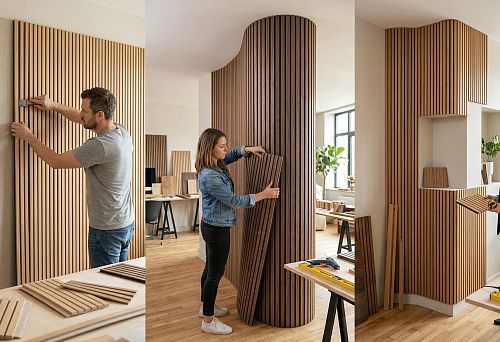
Walls with smooth curves are the architectural language of modern commercial and residential interiors. Radius partitions in offices, rounded living room areas, arched walls in restaurant halls — all of this requires a material that follows the shape.Flexible slatted panel for a radius walllays on a curved surface as a single sheet, maintaining a continuous slatted rhythm along the entire length. No fitting, no seams on the bend.
Column
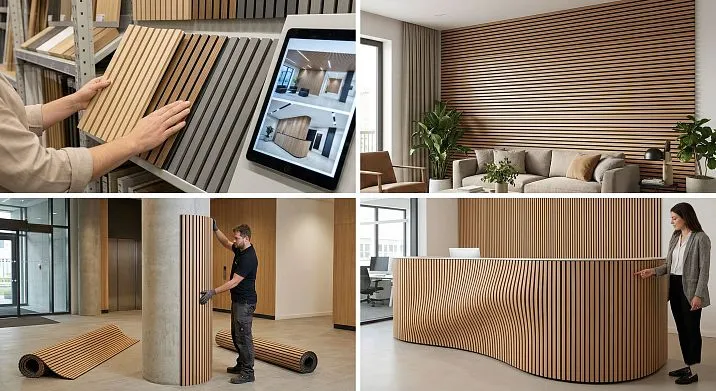
A cylindrical or polygonal column is the absolute limit for a rigid panel. The closed perimeter prevents a monolithic module from fitting flush to the surface without gaps.Buy flexible slatted panelfor a column means getting a single fabric that wraps around the column completely, joins at one point, and provides a continuous slatted surface around the entire perimeter. This is exactly the solution used in all professional projects where there are columns with finishing.
Arch
An arched vault with slatted finishing is a strong architectural technique. The flexible panel lays out an even slatted rhythm along the curve of the vault without losing step or creating visible adjustments. The transition looks especially expressive: the arch smoothly flows into the adjacent wall, and the slatted finishing runs as a single fabric from the flat surface to the curved vault and back.Flexible slatted panel for an archis the only way to achieve such a result without manual carpentry.
Niche with rounded corners
A niche with sharp straight corners is one task. A niche where the internal transitions are rounded is a completely different one. A rigid panel in a rounded niche requires piece-by-piece fitting of each transition.Slatted panel for a nichein a flexible design wraps around rounded corners as a single fabric — monolithically, without fitting, without visible seams on the bend.
Rounded corner
Transitioning from one wall to another through a rounded corner is a common technique in modern interiors. A continuous slat pattern that smoothly wraps around the corner without interruption is exactly what the flexible format offers.Panel for rounded cornerallows creating a continuous architectural detail where a rigid panel would require a special corner element or visible joint.
Furniture front with curved geometry
Radius kitchen islands, curved cabinets, rounded cabinet sides—furniture with non-standard geometry is now the norm in professional projects. Cladding such a front with a slat texture without a flexible panel means engaging in complex manual carpentry with individual elements.Buy slat panel for curved surfacein furniture production—this directly saves on labor costs.
Complex interior partition
Partitions with smooth curves, radius finishes, transitions from straight sections to rounded ones—all this is the flexible format. Where a rigid panel ends, the flexible one just begins to work.
When it's better to buy a rigid slat panel rather than a flexible one
To be fair, let's also consider the opposite situation. A flexible format is not a universally best solution for all tasks. There are contexts where a rigid panel is preferable.
Flat accent wall
If the surface is straight, flat, and the goal is to create an expressive accent with precise geometry of the slat pattern, a rigid panel provides a more stable plane. Especially with mechanical mounting on guides: perfect spacing, perfect vertical alignment.
Bedroom: headboard on a flat wall
A bed headboard on a straight wall is a classic slat design. If the wall is straight, with no curves, both formats work equally well. If a flat and stable panel surface for painting is preferred —buy slat panel for paintinga rigid MDF version may be the optimal choice.
TV zone and living room with straight geometry
A large TV wall plane in a living room with straight geometry is a task equally suited for rigid or flexible panels. Here, the choice is made not based on construction, but on material and the method of finishing.
Project for painting with an exact color
If the task is to paint a slatted surface in a specific RAL or NCS color, a rigid, primed MDF panel provides a more predictable and uniform result. It was created specifically for this task.panel PAN-002— a primed slatted MDF panel, ready for painting, for decorative wall and furniture finishing.
PAN-002 is the choice when you need:
-
precise color to match the interior or corporate style;
-
a uniform batch without color variation;
-
Possibility of repainting in the future without disassembly;
-
a stable, rigid plane on a flat wall.
What types of slatted solutions exist: from flexible panels to individual slats
The market for slatted solutions is broader than it seems. Here are four types of products, each solving its own task.
Type 1. Flexible panel on a fabric base — PAN-001
Panel for curved and flat surfaces. Works on columns, arches, radius walls, rounded niches, curved furniture fronts. Mounted with adhesive, cut with a knife, joined seamlessly.
When to buy: any curve + flat plane, if adhesive mounting without guides is preferred.
Buy flexible slatted panels — PAN-001
Type 2. Primed MDF panel for painting — PAN-002
Rigid slatted panel on MDF backing, primed, ready for paint application. For flat walls, accent planes, furniture fronts with straight geometry. Complete freedom of color choice.
When to buy: flat surface + precise color needed + subsequent repainting possible.
Buy slatted panel for painting — PAN-002
Type 3. Interior slat for project solutions — RK-002
Individual slat for project assembly: when non-standard spacing, custom combination of slat widths, point decorative assembly, or integration into complex furniture construction is needed.Interior Rail RK-002— a tool for architects and furniture manufacturers who need flexibility at the design level, not just installation.
When to buy: non-standard project, custom combination of elements, specific decorative task.
Type 4. Sample of slatted panel — OPAN-001
Before ordering panels for an entire wall, it's wise to ensure the choice is correct.Sample slat panel OPAN-001— is an opportunity to evaluate the material in person: compare the tone with flooring and furniture, check the surface texture, verify the accuracy of end geometry, coordinate the color with the designer or client.
When to order: for any new project, especially when matching a tone to a specific interior.
How to choose and buy a slatted panel without mistakes: algorithm
Let's reduce the choice to a practical six-step algorithm. Go through them sequentially — and you won't make a mistake.
Step 1. Determine the surface geometry
Is there any kind of curvature? Column, arch, radius wall, rounded corner, curved furniture front — even the slightest radius? Answer 'yes' — your product is PAN-001. Period. No discussion.
Is the surface straight? Proceed to step 2.
Step 2. Determine the final finish
Need painting in a specific color? → PAN-002. Primed surface, exact color, uniform batch.
Need natural oak texture without painting? → PAN-001 or PAN-002 in solid wood version. Specify when ordering.
Step 3. Determine the application scenario
| Scenario | Product |
|---|---|
| Column | PAN-001 |
| Arch | PAN-001 |
| Radius wall | PAN-001 |
| Rounded corner | PAN-001 |
| Niche with curves | PAN-001 |
| Curved furniture front | PAN-001 |
| Accent wall (straight) | PAN-001 or PAN-002 |
| Smooth wall for painting | PAN-002 |
| Headboard on a smooth wall | PAN-001 or PAN-002 |
| Custom project assembly | RK-002 |
| Color and texture coordination | OPAN-001 |
Step 4. Determine the scale of the slat
The width of the slat and the spacing are a matter of proportions. A small room cannot tolerate wide spacing: a large slat pattern visually 'presses' on the space. A large hall with small slats—the panel gets lost and does not create the desired effect.
Rule: the larger the room—the larger the slat and spacing. The more intimate the space—the thinner and denser the slat pattern.
Step 5. Determine the volume with a margin
Calculate the wall area for finishing. Add 8–10% for cutting and unforeseen losses. All volume from one batch. Especially critical for solid oak, where color variations between batches are possible.
Step 6. Order a sample
If you are choosing for the first time or matching a tone to a specific interior —order a sample of the slatted panel OPAN-001before placing the main order. These 15 minutes can save significant costs.
Which slatted panel to buy for different rooms
Now — specific scenarios by room. Not abstract recommendations, but practical pairings: 'room → task → product'.
Living Room
TV area with a straight wall: an accent slatted plane behind the TV. Straight surface, neutral color for painting — optimallybuy a slatted panel for the living roomin the PAN-002 version. If the TV area is framed by decorative columns or transitions into rounded niches — PAN-001, no questions.
Living room with non-standard architecture: decorative columns, arched transitions, rounded niches near the sofa — all this context requires a flexible format. PAN-001 works on all elements with a unified slatted pattern.
Bedroom
Bed headboard on a flat wall: an elegant slatted plane behind the bed, painted to match the entire interior.Buy slatted panel for bedroomin PAN-002 finish — the right choice for a bedroom with straight walls and a color scheme for painting.
Headboard in an arch or rounded niche: PAN-001. Flexible canvas wraps around the arch with a single pattern — without seams on the bend.
Hallway and corridor
The hallway often contains arched openings, pylons, rounded transitions. This is a direct scenario for PAN-001. Additional bonus: the slatted texture hides minor irregularities of old walls, which are especially common in hallways.
If the hallway is straight and the task is only an accent with painting — PAN-002 with a neutral tone creates a warm, architecturally expressive corridor.
Study and meeting rooms
Dark oak tone, matte oil finish, strict slatted rhythm. If the room geometry is straight — both formats. If there are non-standard architectural elements — PAN-001.Wall slatted MDF panelfor painting in a dark tone creates a study-like character of the space without extra costs.
Reception and commercial spaces
A reception desk with radius corners — a classic scenario for PAN-001. Straight wall planes in a restaurant hall, clad with slatted texture — PAN-002 in a large-scale execution. Decorative columns in a hotel lobby — PAN-001, definitely.
Furniture front
Straight cabinet or dresser front — PAN-002 for painting to match the furniture color. Curved kitchen island front, rounded side panel of a dresser, radius decorative insert — PAN-001. Custom project furniture with an individual combination of slats —Interior Rail RK-002.
What to check before purchase: technical checklist
Go through this list before placing an order. Each item is a prevention of a specific mistake.
Surface geometry:
-
Is there at least one curve? → If yes — PAN-001
-
Minimum radius of curvature?
-
Are there closed radii (columns)? → PAN-001 is mandatory
Finishing:
-
Need painting? → PAN-002
-
What color? → Order OPAN-001 for approval
Volume:
-
Surface area with 8–10% margin?
-
All volume from one batch?
-
Joints, trimming, and fitting accounted for?
Installation:
-
Base condition (dry, solid, degreased)?
-
Slat orientation (vertical / horizontal)?
-
Is built-in lighting planned? (need to lay channel before installation)
-
Are there hidden doors in the wall plane?
Logistics:
-
Need a sample for approval? → OPAN-001
Installation: why panel type affects the result
Installation of flexible and rigid panels involves different technologies. And confusion here also comes at a high cost.
Installation of PAN-001 (flexible panel)
The main tool is mounting adhesive with high initial adhesion. The panel is cut with a utility knife along the fabric backing line — cleanly, without chipping. Adhesive is applied to the fabric backing in a zigzag pattern, not a solid layer: excess will seep through the gaps between the slats.
On a flat wall: press from one edge to the other smoothly, without jerking. On a curved surface: wrap gradually, maintaining pressure for 5–7 seconds on each bend section. On a column: go around the perimeter with gradual pressure, place the seam at the least noticeable point.
Seamless connection of modules is ensured by precise end geometry: slat to slat, without gaps. It is this property that distinguishes a quality panel from a cheap one.
Installation of PAN-002 (rigid panel for painting)
Installed with adhesive or on mounting rails — depending on flatness requirements and load. For even walls — adhesive plus temporary fixation with finishing nails until set. For large areas requiring precise flatness — metal mounting rails.
After installation: priming + two coats of paint in the chosen color. Edges are finished with the same color.
Typical installation mistakes
Dry fitting was not performed. This always results in either unexpected joints in the center of the panel or an incorrectly trimmed end module. 30 minutes of fitting is a mandatory step.
Damp substrate. Adhesive does not hold on wet or frozen substrate. Check moisture before installation.
Edges from different batches. With different batches, a slight color variation on the edges is possible, creating a visible joint. One batch ensures a seamless result.
Insufficient curing time. Full adhesive curing is 24 hours. Loading the surface earlier risks delamination.
Mistakes when choosing slatted panels: top 7 situations
Mistake 1. Buying a rigid panel for a curved surface
The most costly mistake. Result — redoing from scratch, double material consumption. Rule: any curve — only PAN-001.
Mistake 2. Buying a flexible panel when a strict plane for painting is needed
Flexible panel on a straight wall works well — but if the task specifically requires a homogeneous batch for precise painting, PAN-002 will give more predictable results.
Mistake 3. Not ordering a sample
"Looked at the photo — seemed similar" — this is not color approval. Natural oak changes tone depending on lighting.Order a sample of slatted panel OPAN-001— this is the first correct action in any new project.
Mistake 4. Choosing slat scale without reference to the room
Large slats in a small room — visually "overwhelm". Small slats in a large hall — get lost. The scale of the slatted pattern is a decision made before purchase, not after.
Mistake 5. Different batches in one project
Color variation between batches in natural wood is a natural reality. Order the entire volume as a single batch with a reserve.
Error 6. Ignoring lighting
Slatted surface reveals its beauty under directional light. Without accent lighting, a significant part of the effect disappears. Plan lighting and panels together.
Error 7. Purchase without considering joints and connections
How will the external corner be finished? How does the panel connect to the ceiling? To other materials? These questions are resolved before purchase — and affect the amount of material and the choice of additional elements.
What to combine slatted panels with: a brief practical guide
Slatted surface — a material with a strong character of its own. It works well in pairs.
Oak + marble: a classic contrast of warmth and cold. Works in a living room, bathroom, restaurant space. Marble looks warmer next to wood; wood looks more substantial next to stone.
MDF for painting + metal accents: neutral slatted surface + brass lighting fixtures or black matte handles. A universal combination for a modern minimalist space.
Oak + linen and wool: a natural interior. Both materials are tactile, warm, organic. Create a space you want to stay in.
Slatted panel + built-in lighting: directional light in front of the panel creates deep shadows and enlivens the surface. Lighting in the grooves between the slats gives a soft diffuse glow. Plan cable channels before installation.
Slatted wall + hidden doors: a door embedded into the slatted rhythm without visible frames is one of the most current techniques. The slatted pattern 'absorbs' the door, and it disappears into the wall.
FAQ: answers to questions before purchase
What is better to buy for a column: a flexible or rigid slatted panel?
Only flexible — PAN-001. A rigid module does not wrap around a cylindrical surface without visible seams. The flexible panel wraps around the column completely.
Can I buy a slatted panel for painting?
Yes. For this purpose, PAN-002 was created — a primed MDF slatted panel, ready for applying any paint. Can be painted in any color from the RAL or NCS system.
Which panel is suitable for a radius wall?
PAN-001 — a flexible panel on a fabric base. The only option for any curved surface.
Which panel is suitable for a bedroom?
Depends on the geometry. A flat wall with the task of an exact color — PAN-002. A headboard in an arch or rounded niche — PAN-001.
Can I use a slatted panel on furniture?
Yes. PAN-001 covers curved fronts, islands, and inserts without milling. PAN-002 — for straight fronts for painting.
Why do I need a panel sample?
To coordinate the tone with the flooring, furniture, and walls before the main order. The OPAN-001 sample is the first step in any new project.
What is the difference between an interior slat and a finished panel?
A finished panel (PAN-001 or PAN-002) is a modular construction with a fixed slat spacing. The RK-002 interior slat is a separate element for custom assembly with non-standard parameters.
Can flexible and rigid panels be combined in one project?
Yes — and it's the optimal strategy. Use rigid modules on flat planes, and flexible ones on transitions and curved surfaces. With the same spacing and slat width, the transition between them is visually seamless.
How to calculate the required number of panels?
Calculate the surface area, add 8–10% margin for trimming. Order the entire volume from a single batch.
Can I install a flexible panel myself?
Yes, if you follow the technology: prepared substrate, dry fitting, correct adhesive. Start with straight sections, move to radius sections after mastering the basics.
Conclusion: which product for which task
Let's sum it up, briefly and to the point.
There's a curve — any curve, any radius, any shape — your choice:
→ Buy flexible slatted panels PAN-001
A flat wall, needs painting in a specific color — your choice:
→ Buy slatted panel for painting PAN-002
A non-standard project, custom project assembly — your choice:
→ Interior Rail RK-002
The first step — coordinating color and texture — your choice:
→ Sample slat panel OPAN-001
Choosing the right format isn't a technical nuance. It's the difference between a result you're proud of and a redo you want to forget.
About the company STAVROS
When it comes to slatted panels for professional and private projects, STAVROS is a name spoken with respect among designers, architects, and furniture manufacturers.
The product line covers all major application scenarios:Flexible slatted panel for wallsand complex surfaces PAN-001, primed panel for painting PAN-002, interior slat for project solutions RK-002, and sample OPAN-001 for a safe start. Production works with MDF and solid oak — two materials that cover the entire spectrum of interior tasks from Scandinavian minimalism to representative neoclassicism.
STAVROS — stable end geometry, batch uniformity, surface readiness for finishing from the first time. Full catalog, technical parameters, and professional consultation — on the official website. If the task is non-standard — this is exactly where it will be solved.