Article Contents:
- Where to buy molding in Moscow and how to choose a reliable store
- What is important to evaluate in a molding store
- Why polyurethane molding is convenient for apartments and houses
- Why polyurethane is more convenient than plaster for standard apartments
- When polyurethane molding is especially advantageous
- How to choose wall molding: moldings, frames, wall decor
- Molding for small apartments
- Molding for neoclassicism
- Molded decor for classic interior
- How to choose ceiling decor: cornices, rosettes, ceiling elements
- Cornices: the main element of ceiling molding
- Rosettes and ceiling medallions
- What's better for interior: cornice, molding or baseboard
- Molding
- Cornice
- Skirting
- How to choose decorative molding to match interior style
- Classic
- Neoclassicism
- Modern classicism
- Calm light interior
- How to understand if a molding store in Moscow is right for you
- Common mistakes when choosing stucco decor
- Error 1: profile does not match the scale of the room
- Error 2: molding chosen without reference to style
- Error 3: mixing incompatible profiles
- Error 4: ceiling overload
- Error 5: lack of logic between wall, ceiling, and floor
- Error 6: incorrect quantity calculation
- Molding in Moscow: from selection to application
- FAQ: answers to common questions about molding in Moscow
- Conclusion: molding as an investment in interior design

If you type 'molding Moscow' into a search engine, you already know what you want from your interior. You want volume, relief, architectural expressiveness. You want walls and ceilings to stop being just a background and become part of the interior concept. And you're right: it is molding that turns an ordinary apartment or house into a space with character and history.
Buying molding in Moscow today is not difficult — the real challenge is choosing correctly. The market offers plaster, expanded polystyrene, polyurethane, and MDF profiles for painting. Each material behaves differently and suits different tasks. But to be honest and professional — for residential interiors, whether it's an apartment in a new building, a country house, or commercial space,Polyurethane moldingshas long been the standard. Lightweight, precise, resistant to deformation — it is convenient both for installation and in use.
This article provides a complete practical breakdown: how to choose decorative molding in Moscow, how moldings, cornices, baseboards, and applied decor differ, how to select proportions according to ceiling height, and what mistakes to avoid when choosing.


Where to buy molding in Moscow and how to choose a reliable store
Moscow is a saturated market. You can find a molding store at a construction market, online, or in specialized showrooms. But the number of offers is not a sign of quality. To buy molding in Moscow and not regret it, you need to understand what exactly to check before ordering.




What is important to evaluate in a molding store
Range by product types. A full-fledged molding store in Moscow should offer not just 'decor,' but a structured catalog: moldings separately, cornices separately, baseboards separately, applied elements and rosettes separately. If everything is dumped into one category without filtering — that's a signal to be cautious.
Dimensions and technical parameters. A good catalog contains precise dimensions: width, profile height, standard run length. This is critical because the correct molding for walls and ceilings is selected strictly according to proportions — and a 10 mm error in cornice height changes the entire visual logic of the room.
Photos in interiors. A profile on a white background and a profile on a real wall represent different levels of product understanding. A store that publishes photos of decorative molding in live interiors helps make an informed decision.
Ability to assemble a set. Lower baseboard, wall molding, ceiling cornice — three elements of one stylistic ensemble. A proper molding store in Moscow allows you to choose all three from compatible series, without risking a clash of profiles.
Delivery in Moscow and the region. Polyurethane molding is lighter than plaster but still requires careful packaging and handling. Clarify delivery terms, availability of protective packaging, and the possibility of courier delivery in Moscow.
Online navigation by sections. If a molding store's website allows filtering products by type, profile, width, and style, this is a sign of a professional approach. Exactly this kind of navigation helps quickly and accurately select decorative molding for a specific room.
Once you understand what exactly to look for in a store, the next step is to figure out the material.
Our factory also produces:


Why polyurethane molding is convenient for apartments and houses
Comparing polyurethane with plaster is one of the most frequent questions on renovation forums. Let's try to answer honestly, without marketing clichés.
Plaster molding is historically the first material for decorative finishing. Heavy, fragile, requiring special knowledge for installation and a special approach for transportation. In pre-revolutionary mansions, plaster cornices and rosettes are the norm; there, ceilings are over three and a half meters, and load-bearing walls hold all this without problems. But in a typical Moscow apartment with a ceiling of 2.7–2.8 m, plaster is a material with serious limitations.
Polyurethane moldingsprovides all the same visual richness with fundamentally different performance characteristics.
Get Consultation
Why polyurethane is more convenient than plaster for a typical apartment
-
Weight. Polyurethane decor weighs 5–10 times less than its plaster counterpart. This means it is attached with liquid nails without anchors, dowels, or chasing—simply, quickly, without dust or damage to the base.
-
Flexibility. Polyurethane is slightly flexible—it conforms to minor wall and ceiling irregularities, which is especially important in houses with monolithic or panel floors, where perfect geometry is rare.
-
Geometric precision. Products are cast in high-precision molds. Angle, profile, relief—everything is replicated from piece to piece without deviations. This is important for long cornice runs, where a mismatched profile would create a noticeable 'step'.
-
Ease of processing. Polyurethane can be cut with a regular hacksaw for metal or a fine-toothed saw. Corner joints are made at 45° using a miter box—no special techniques are needed.
-
Painting. Polyurethane molding accepts any water-dispersion paint. It can be painted to match the wall color for a 'tone-on-tone' effect, or highlighted with patina and contrasting colors for accent decoration.
-
Durability. Polyurethane does not crumble over time, does not develop shrinkage cracks, and does not react to normal household humidity fluctuations.
When polyurethane molding is especially advantageous
There are situations where the advantages of polyurethane become particularly noticeable:
-
In apartments with ceilings 2.6–3.0 m high, where molding is needed without excessive load on the structure.
-
In spaces with curved surfaces: arches, niches, radius walls—the flexibility of polyurethane is indispensable here.
-
For DIY installation: polyurethane forgives inexperience, plaster does not.
-
In projects with large areas, where installation speed and part repeatability are important.
-
For commercial interiors requiring decorative molding in Moscow with fast delivery and installation without complex technologies.
How to choose wall molding: moldings, frames, wall decor
Wall molding is an architectural technique that works in both a small apartment and a spacious mansion. But the selection principle differs.
Three main types of products are used for walls: moldings (framed decor), applied wall decor (ornaments, cartouches, medallions), and panel systems with molding frames. Sometimes they are combined—molding frames surround fields containing ornamental inserts.
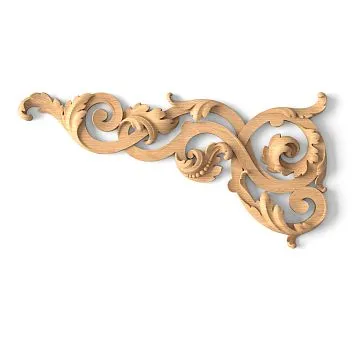
wall moldingPolyurethane molding primarily consists of applied elements: corner pieces, central medallions, horizontal friezes, decorative inserts. They are installed on the wall as standalone decor or as part of molding frame compositions.
Molding for a small apartment
A small room requires restraint. Here, wall molding should work to expand the space, not compress it. Several principles:
-
Narrow moldings (profile width up to 40–50 mm) do not take up space.
-
Frame compositions with large fields 'push apart' the wall visually.
-
White molding matching the wall color is the most delicate technique: volume is present, but 'heaviness' is absent.
-
One accent element per wall is better than a dense ornamental carpet.
Decorative molding in a small apartment is a subtle play with volume. It should be noticeable enough to add depth, and unnoticeable enough not to feel oppressive.
Molding for neoclassicism
Neoclassicism is the most common style in Moscow apartments with high ceilings and architectural pretensions. Here, wall molding is a mandatory element of the system. But it's important not to overdo it.
Signs of proper neoclassical wall molding:
-
Medium-width moldings (50–80 mm) with a clear profile.
-
Corner elements with a laconic, uncluttered ornament.
-
Frame systems with precise proportions: vertical rectangles, ratio 3:2 or 4:3.
-
One or two levels of decor: baseboard, a molding belt at 1/3 of the wall height — and that's it.
Molding decor for a classic interior
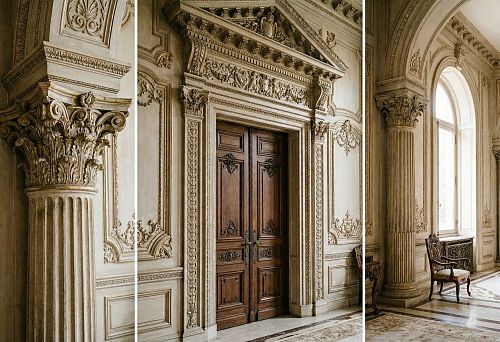
Classicism allows for more. Acanthus leaves, garlands, cartouches, medallions, stucco friezes with floral ornamentation — all of these are appropriate in a classical space.Relief DecorationFor classicism, it is richer and more monumental than for neoclassicism. It works on proportions: the greater the height of the room, the larger the details can be.
Important: decorative wall stucco in classicism is always a system, not point inserts. One cornice at the ceiling, a molding belt in the middle, a baseboard at the floor, corner elements — only as a complex does it work as a full-fledged classical interior.
How to decorate walls with stucco decor in different styles is described in detail in the article"Stucco on the wall in the interior: how to choose stucco decor and beautifully decorate walls in different styles".
How to choose decor for the ceiling: cornices, rosettes, ceiling elements
The ceiling is the second most important front of work for stucco decor. And here there is its own logic, different from the wall.
Cornices: the main element of ceiling stucco
Corniceis a decorative profile that is installed in the corner between the wall and the ceiling. Its function is dual: architectural (creates a visual transition between the vertical and horizontal) and decorative (enriches the top line of the wall).
The cornice is chosen based on the ceiling height:
| Ceiling Height | Recommended cornice width |
|---|---|
| Up to 2.5 m | 40–60 mm |
| 2.5–2.8 m | 60–100 mm |
| 2.8–3.2 m | 100–150 mm |
| 3.2 m and above | 150–200 mm and more |
A cornice that is too wide for a low ceiling "lowers" it even further—this is a classic mistake. A cornice that is too narrow in a high room gets lost and fails to create the necessary architectural pause.
Ceiling rosettes and medallions
Ceiling molding includes not only cornices.ceiling decor—these are primarily rosettes: round or polygonal relief elements installed in the center of the ceiling around a chandelier. A rosette "gathers" the ceiling toward the center, creates a focal point, and adds a sense of completeness.
The diameter of the rosette is chosen proportionally to the ceiling area:
-
Up to 15 sq. m — rosette diameter 200–350 mm
-
15–25 sq. m — 350–500 mm
-
25–40 sq. m — 500–700 mm
-
More than 40 sq. m — from 700 mm, composite structures are possible
In addition to outlets, ceilings use crown molding with decorative profiles, polyurethane decorative beams, and coffered frames. All these— everything must correspond to the chosen era.share one thing: they create architectural complexity in the ceiling plane that cannot be achieved with paint alone.
A separate article on working with ceiling decor —"How to Make Ceiling Molding: The Art of Transforming Space"— breaks down specific techniques from simple cornices to complex composite compositions.
What's Better for Interior Design: Cornice, Molding, or Baseboard
This is one of the most common questions for those encountering decorative molding for walls and ceilings for the first time. The answer is simple if you understand the function of each element.
Molding
Moldingis a decorative profile designed for dividing walls into fields, creating frames, framing doorways, and panels. It works horizontally (dividing the wall into upper and lower zones), vertically (creating posts between frames), and diagonally (in frame compositions).
Molding is structural decor. It sets the rhythm of the wall, its 'architecture.' Without molding, a frame system on the wall is impossible.
The width of the molding is chosen based on the principle: the higher and more spacious the room, the wider the profile can be. For standard apartments — 20–50 mm. For high ceilings in classic-style rooms — 50–100 mm.
Cornice
A cornice is a profile for the wall/ceiling corner. It is not used on walls in horizontal bands (though sometimes applied as a powerful decorative band—but that is a special technique). The main area is the ceiling line. A cornice is wider and more voluminous than molding, with a more complex profile featuring several setbacks.
If molding is the rhythm of the wall, then the cornice is its finishing touch at the top.
Baseboard
Skirting— the lower boundary of the wall. It covers the technological gap between the wall and the floor while simultaneously creating the architectural base of the entire vertical plane. In a classic interior, the baseboard profile mirrors the logic of the cornice, but inversely: the baseboard is the 'base' of the wall, the cornice is its 'capital'.
In a properly designed interior, the cornice, molding, and baseboard form a unified system where each element occupies its vertical position. Cornice at the top, molding band in the middle, baseboard at the bottom. Together they create a three-level wall structure that reads as an architectural quote from classicism.
If the budget or task constraints limit the set—it's better to keep the cornice and baseboard as the essential minimum, and add the molding band if possible.
How to choose decorative molding to match the interior style
Molding in Moscow is sold for all styles—from minimalist modern to rich Baroque. But this is where most people make a mistake: they choose 'what they like' without thinking about the system. The result is a set of beautiful details without stylistic logic.
Classic
A classic interior requires a rich ornamental structure. Acanthus leaves, egg-and-dart, dentils, laurel garlands—these are classic ornamental programs. For classic style, choose wide cornices with multi-layered profiles, rich moldings with ornamental inserts, large ceiling rosettes. Decorative molding in Moscow for classic style is an item for careful selection: it's important that all elements belong to the same ornamental language.
Neoclassicism
Neoclassicism simplifies classicism while preserving its structure. Here, ornamentation is less intricate, profiles are cleaner, and the scale is more restrained. Cornices are of medium width, moldings have geometric or lightly ornamented profiles, and rosettes are of moderate diameter.Molding for neoclassicism— is a balance between tradition and modernity.
Modern classic
Modern classicism is classical structures realized through minimalist design. Framing systems on walls, but moldings without ornamentation, with sharp or slightly rounded edges. The cornice has a minimal number of setbacks. The rosette is geometric, without floral motifs. Decorative molding here speaks in hints, not in full voice.
Calm light interior
If the interior is built on neutral shades—ivory, warm gray, natural linen—the molding is painted in the same tone as the walls. This is a relief-in-color effect: volume is present, color contrast is absent. The result is softness, tactility, a feeling of an 'authentic' interior without pomp.
Detailed material on the application offor molding in interiorsbreaks down all stylistic scenarios—from classicism to contemporary spaces with historical references.
How to understand if a molding store in Moscow is right for you
Not all molding stores are equally useful. Here is a specific checklist that will help quickly assess whether it's worth dealing with a particular supplier.
Structured catalog by product types. If catalog categories are divided by purpose—moldings, cornices, baseboards, rosettes, overlay elements—this indicates a professional manufacturer or supplier, not just a reseller.
Availability of dimensions and profiles. Height, width, length of run—these parameters should be in each product card. Without this, it is impossible to select wall or ceiling molding with correct proportions.
Clear navigation by styles. A good molding store allows filtering decor by style: classic, neoclassical, modern classic. This helps avoid wasting time browsing irrelevant items.
Ability to order a set. Buying molding in Moscow for one wall is one thing. Buying a set: cornice, moldings, baseboards, corner elements, rosette—is quite another. A store that allows assembling a complete set from compatible series saves time and reduces the risk of style conflicts.
Photographs in real interiors. This is one of the most important criteria. A profile 'in a vacuum' and a profile in a living space are perceived completely differently. A store that shows molding in real application respects its customer.
Delivery in Moscow with proper logistics. Decorative polyurethane molding is not fragile—but with careless packaging, edges and relief can be damaged. A proper molding store in Moscow packages items in protective material and ensures delivery without damage.
Common mistakes when choosing stucco decor
Years of practice show: mistakes when choosing decorative molding for walls and ceilings repeat again and again. It's better to know about them in advance.
Mistake 1: profile does not match the scale of the room
Too small molding in a large living room—invisible. Too wide cornice in a small bedroom—a visual burden that 'lowers' the ceiling. Molding should be proportionate to the space: height, area, proportions of openings.
Mistake 2: molding chosen without reference to style
A classic ornamental cornice in a minimalist interior creates a stylistic dissonance that is difficult to explain but easy to feel. Before choosing molding, decide on the architectural language of the room.
Mistake 3: mixing incompatible profiles
A cornice from one series, molding from another, baseboard from a third—each with its own ornamental motifs. The result is visual chaos where every element fights for attention. The rule: in one room, all molding profiles should belong to the same style, ideally the same series.
Mistake 4: ceiling overload
Cornice + large rosette + additional ceiling decorative elements—all of this in a small room creates a feeling of a 'pressing' ceiling. Ceiling molding should add depth, not accumulate mass. In small rooms, one element is enough: either a cornice or a rosette.
Mistake 5: lack of logic between wall, ceiling, and floor
Cornice at the ceiling—yes. Moldings on the walls—no. Baseboard—random, not stylistically related to the cornice. This is not a system but a set of separate solutions. Proper decorative molding is built as an architectural ensemble: baseboard at the floor, molding system on the walls, cornice at the ceiling—a unified whole.
Mistake 6: incorrect quantity calculation
Molding is sold in linear meters (cornices, moldings, baseboards) and pieces (corner elements, rosettes). A calculation error means either a shortage for finishing or excess leftover. Correct calculation: perimeter of walls/ceiling + 10–15% for trimming.
Molding in Moscow: from selection to application
Moscow is a market with high demands for quality and aesthetics. The Moscow buyer most often knows what they want: architectural interiors, natural or high-quality materials, professional execution. That is why the query 'buy molding in Moscow' is almost always a request not for 'the cheapest', but for 'the most correct'.
Decorative molding in Moscow is purchased for a wide variety of tasks:
-
Living room — framing systems on walls, cornice on the ceiling, rosette for the chandelier, baseboard with a profile coordinated with the moldings.
-
Bedroom — delicateWall moldings headboards, narrow cornice on the ceiling, baseboard matching the decor.
-
Hallway — cornice, molding frieze, corner elements on doorways — all this creates the first and very convincing impression.
-
Study — strict profile, geometric precision, minimal ornamentation, maximum architecturality.
-
Commercial interiors — offices, restaurants, showrooms, hotels in Moscow are increasingly using molded decor to create representative spaces.
For each of these scenarios, one thing is important: a systematic approach to selection, understanding of scale and style.
FAQ: answers to frequently asked questions about molding in Moscow
Where to buy molding in Moscow for an apartment?
The best option is the manufacturer's online store or an official supplier with a full catalog, exact dimensions, and delivery options in Moscow and the region. This way you get an up-to-date assortment, correct technical parameters, and a quality guarantee for the products.
What polyurethane molding is suitable for walls?
For walls, moldings (for framing systems), applied decorative elements (cartouches, medallions, corner inserts), and decorative friezes are used. The choice depends on the interior style and room height. In standard apartments, profiles with a width of 30–60 mm work well.
What to choose for the ceiling: cornice or rosette?
Both elements perform different functions. A cornice is a linear profile along the perimeter of the ceiling (wall/ceiling transition). A rosette is a central accent. The ideal solution is to use both: a cornice around the perimeter and a rosette in the center. With a limited budget — prioritize the cornice.
What is the difference between molding and cornice?
Molding is a narrower profile designed for dividing walls into fields and creating frames. A cornice is a wider, more voluminous profile that is installed exclusively in the corner between the ceiling and wall. A cornice creates an architectural transition, molding creates a decorative rhythm.
Is decorative stucco suitable for neoclassicism?
Yes, and it is one of the most organic styles for stucco decor. For neoclassicism, choose profiles with clear geometry, restrained ornamentation, and medium width. It is important to avoid overloaded 'baroque' details — neoclassicism values conciseness while preserving the classical structure.
Can moldings and baseboards be combined in the same style?
Not just can — you should. Molding, cornice, and baseboard in the same style form an architectural system where each element occupies its vertical position on the wall. They should belong to the same ornamental program: geometric, floral, or combined.
How to choose molding for ceiling height?
Rule: the lower the ceiling, the narrower the profiles. For ceilings up to 2.6 m — cornice no wider than 60–80 mm, moldings — up to 30–40 mm. For ceilings 3 m and above — cornice can reach 150–200 mm, moldings — 60–80 mm. A wide profile under a low ceiling 'weighs down' the space.
Molding for a living room in Moscow — where to start?
Start by defining the style and ceiling height. Then choose a cornice for the ceiling line, moldings for a frame system on an accent wall, a baseboard coordinated in profile with the cornice. If you plan to have a chandelier — add a rosette. This is a ready-made system for classic living room design.
Can molding be used in a modern apartment?
Yes, with the correct selection of profiles. For a modern interior, choose geometric, laconic profiles without ornament. Molding 'in tone' with the walls (the same paint) works as architectural relief — adds depth without historical references.
How to avoid mistakes when choosing wall molding?
Three key rules: choose a system, not individual elements; observe scale (profile size — in accordance with the room height); adhere to one stylistic register for all molding elements in the room.
Conclusion: molding as an investment in interior design
Decorative molding for walls and ceilings is not a matter of fashion. It is an architectural tool, tested over centuries. Moldings, cornices, baseboards, rosettes, and applied molding elements create that spatial quality which cannot be imitated by any wallpaper or paint.
Properly chosen molding in Moscow is a long-term investment in the value of an interior. It does not become outdated, does not go out of style, and does not require replacement. It simply becomes part of the architecture of the space—just as it has been throughout all times when finishing was taken seriously.
The company STAVROS manufactures polyurethane molding decor, moldings, cornices, baseboards, and overlay elements—over 4000 models in a professional catalog. All STAVROS products are distinguished by precise geometry, a rich selection of profiles, and stable production quality. Here you can buy molding in Moscow with delivery throughout Russia and the CIS, select a complete set for walls and ceilings from compatible series, and receive professional consultation on selection.
Catalogpolyurethane molding— moldings, cornices, baseboards, rosettes, and decorative elements — is open for online ordering with delivery directly from the manufacturer.