












































































Article Contents:
- Types of wooden skirting board coatings: from primer to laminate
- Coating hierarchy: not all are equal
- Coating scheme: primer — finish layer
- Painted wooden skirting board: ready for installation or requires finish layer
- Two concepts of 'painted': let's clear up the confusion
- Advantages of factory painting over on-site painting
- Which colors are most in demand for painted skirting boards
- Varnished skirting board: gloss, matte, semi-matte
- Varnish as coating: chemistry and visual result
- Gloss level: from matte to gloss
- Varnish vs oil: what's the fundamental difference for skirting boards
- Laminated wooden skirting board: what it is and where it's used
- Wood lamination: technology and result
- Types of lamination for wooden skirting boards
- Where laminated wooden skirting board is appropriate and where it's not
- Laminated skirting board vs painted: what to choose
- Wooden skirting board quality certificate: what to look for when purchasing
- Why the certificate is important: not a formality, but information
- What to pay attention to in the certificate: checklist
- Wooden skirting board without certificate: risks
- Caring for wooden skirting board with coating: what to clean with and what to avoid
- General principle: coating determines care
- Caring for varnished skirting board
- Caring for skirting board with oil coating
- Caring for painted (enamel) skirting board
- Caring for laminated skirting board
- Patination of wooden skirting board: techniques and results
- What is patina on wooden skirting board
- Patination Techniques: Step by Step
- FAQ: Answers to Common Questions About Wooden Skirting Board Finishes
- About the Company STAVROS

The finish is the final chapter in the story of every wooden skirting board. The raw material is chosen, the profile is milled, the surface is sanded — and now everything is decided by the final layer. It is this layer that determines whether the skirting board will last ten years or two. It answers the question of what the customer will see on the wall: the living texture of oak under natural oil or the satin white gloss of a creamy enamel.
Painted wooden skirting board, varnished, waxed, patinated, laminated — these are not different products, they are different destinies of the same solid wood. The same oak K-006 under white matte enamel and under 'dark walnut' oil — visually two different interior solutions, two different characters, two different lifespans.
This article is a professional discussion about each type of finish: what lies behind the names, what result each option provides, how factory-applied finishes differ from DIY application, what to look for when purchasingpainted wooden skirting boardand what the quality certificate says about the actual product.


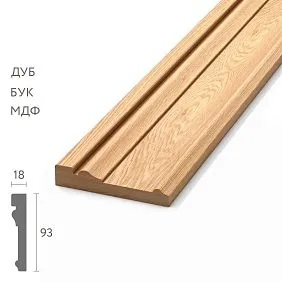

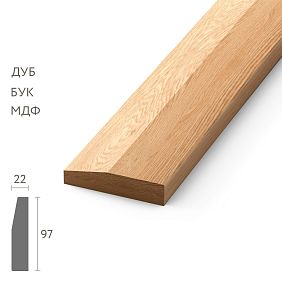


Types of Wooden Skirting Board Finishes: From Primer to Laminate




Finish Hierarchy: Not All Are Created Equal
Before examining each type of finish, it's important to understand the fundamental difference between them. Finishes are divided into two main categories:
Film-forming — create a hard or semi-hard film on the wood surface that physically separates the wood from the external environment. These include: varnishes (nitrocellulose, polyurethane, acrylate), enamels and paints (alkyd, acrylic, polyurethane), laminating films.
Penetrating (oils, waxes, impregnations) — soak into the wood structure without creating a surface film. They strengthen and protect the fibers from within. The surface remains 'alive', matte, tactilely wooden.
Between these two categories lies a fundamental difference in the nature of the surface, durability, method of renewal, restoration possibilities, and reaction to moisture.
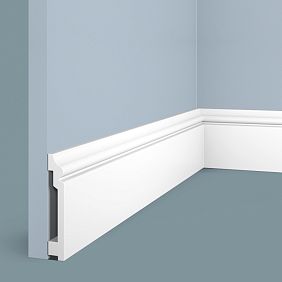
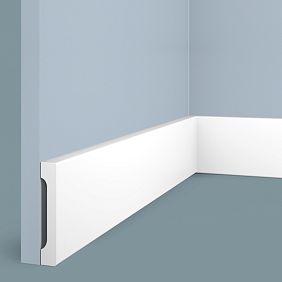
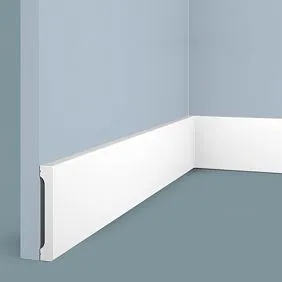
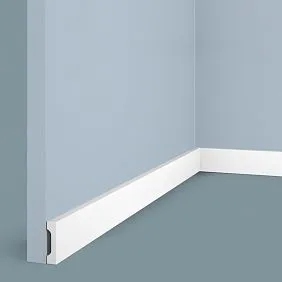
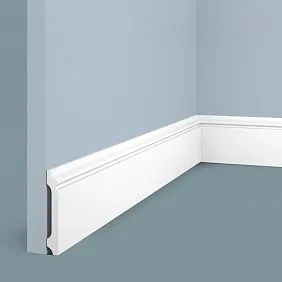
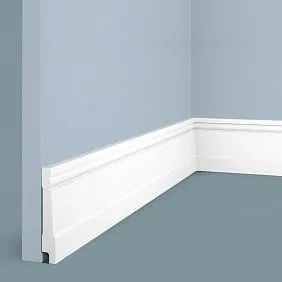
Our factory also produces:
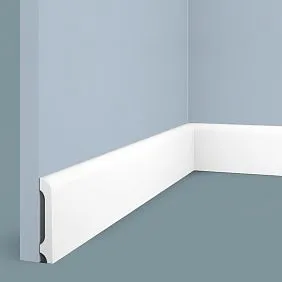
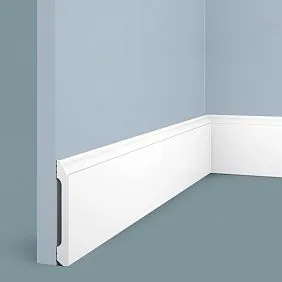
Finish Scheme: Primer — Topcoat
Regardless of the type of topcoat, a professional application scheme includes at least two stages:
Stage 1: Priming. The primer is the 'bridge' between the wood and the topcoat. It:
-
Seals the wood pores, ensuring even absorption of the topcoat
-
Improves adhesion of the topcoat
-
Blocks resin bleed (especially important for softwoods — pine, spruce)
-
Prevents raised grain under the topcoat
For softwoods — an isolating shellac primer or a special alkyd 'anti-resin' primer. For hard hardwoods (oak, beech) — an acrylic or polyurethane isolating primer.
Stage 2: Topcoat. One or two layers of the main finish. Between layers — light intermediate sanding with P320–P400 grit to remove raised grain.
Without primer, the topcoat 'pulls' unevenly, causes stains, and chips at points of maximum absorption. This is relevant for both factory-applied and DIY finishes.
Get Consultation
Painted Wooden Skirting Board: Ready for Installation or Requires a Topcoat
Two Meanings of 'Painted': Let's Clear Up the Confusion
In common usage, there are two fundamentally different meanings of 'painted skirting board', which are often confused:
First: A skirting board with a factory-applied full finish — primer + topcoat applied at the factory under controlled conditions. Such apainted wooden skirting boardafter installation only requires painting the cut ends and filling the fastener holes — and it's ready.
Second: factory-primed skirting board — only the first technological layer is applied at the factory. After installation, it requires the application of a finishing coat (1–2 passes). This is a 'semi-finished product' — not fully ready for use, but with a pre-prepared surface.
Fundamental difference: in the first case, the color is chosen by the manufacturer or customer before installation. In the second — the color is chosen on-site, which provides flexibility but requires work.
Advantages of factory painting over on-site painting
Why is factory coating better than brush painting after installation? Several technical reasons:
Uniform application. In production conditions — spray gun, viscosity control, stable temperature and humidity. On-site — brush, uncontrolled environment, risk of 'orange peel' and drips.
Accessibility of all surfaces. Before installation, the skirting board can be coated on all sides, including the back surface and bottom edge. After installation — the back side is inaccessible.
Speed of work on-site. Installation of already painted skirting board + touch-up of edges — a few hours. Installation of unpainted + priming + finishing painting on-site — 2–3 days including drying time.
Coating quality in inaccessible areas. Joints with the floor, areas under furniture — after installation, painting them properly is practically impossible. Before installation — the coating is complete.
Which colors are most in demand for painted skirting boards
Statistics of requests and orders form a very clear picture of preferences:
| Color | RAL | Interior style |
|---|---|---|
| Warm white | RAL 9010 | Classic, neoclassical, Provence |
| Cool white | RAL 9003 | Modern, Scandinavian |
| Cream | RAL 9001 | Classic, empire |
| Light gray | RAL 7044, 7047 | Minimalism, loft |
| Anthracite gray | RAL 7021 | Loft, modern |
| Matte black | RAL 9005 | Loft, contemporary |
| Natural oil | — | Natural, eco, wooden house |
| Walnut oil | — | Classic, English style |
| Dark walnut oil | — | Study, hunting style |
White is the undisputed leader. Over 60% of orders for painting wooden skirting boards are shades of white (RAL 9010, 9003, 9001). The explanation is simple: white skirting board is compatible with any wall color, any style from classic to modern, and any type of parquet.
Varnished skirting board: gloss, matte, semi-matte
Varnish as a coating: chemistry and visual result
Varnishing wooden skirting boards— is the creation of a transparent protective film on the surface while preserving the visibility of the wood texture. Varnish is not an opaque coating: the wood is visible through it. This is precisely why varnish is chosen when one wants to preserve and highlight the natural texture of oak, beech, or other wood species.
Three categories of varnishes by composition:
Nitrocellulose varnishes (NC) — fast-drying, cheap, but not durable. They yellow over time. Practically not used in professional production of wooden skirting boards.
Alkyd varnishes — good elasticity, moderate price, sufficient durability. But long drying time (8–24 hours) and moderate chemical resistance.
Polyurethane varnishes (PU) — industry standard for wooden floors, skirting boards, and furniture. High film hardness, excellent abrasion resistance, resistance to household chemicals, fast curing (1–3 hours to dust-free). Polyurethane varnish is precisely what is used in professional wooden skirting board production.
Water-based acrylic varnishes — eco-friendly, no strong odor, but inferior in hardness to polyurethane. Acceptable in living spaces, but not optimal for hallways and kitchens.
Gloss level: from matte to gloss
One of the most important varnish parameters is the gloss level, measured in gloss units (GU):
| Gloss level | GU | Visual effect | Application |
|---|---|---|---|
| Matte | 5–10 GU | No glare, 'velvety' | Modern, minimalism, natural |
| Satin | 25–35 GU | Light silk sheen | Universal |
| Semi-gloss | 50–60 GU | Noticeable shine | Neoclassical, Scandinavian |
| Glossy | 70–85 GU | Mirror surface | Baroque, glossy classic |
| High gloss | 90–95 GU | Mirror | Piano lacquer, special order |
Matte varnish is a modern choice. It does not emphasize surface defects, does not glare under artificial lighting, visually 'brings' the surface closer to the natural look of wood.
Glossy varnish is classic, baroque. A highlight on a varnished skirting board under a crystal chandelier is an aesthetically justified choice in a certain context. But in a modern interior, gloss looks excessive and draws attention to the slightest scratches.
Varnish vs oil: what is the fundamental difference for skirting boards
This question is asked by every buyer thinking about a transparent coating:
Varnish (film-forming):
-
Creates a surface film — wood is 'sealed' from contact
-
High resistance to abrasion and mechanical stress
-
The only way to renew is complete sanding and repolishing
-
If damaged — chip, film breakage, 'breach' of protection
-
Visual effect: glass over wood (especially on glossy)
Oil (penetrating):
-
Penetrates into fibers - wood "breathes"
-
Matte surface, tactilely "alive"
-
Easy to refresh: local application of new layer without sanding
-
For scratches - "heals" locally
-
Visual effect: "alive" surface, texture maximally open
For wooden skirting boards in living spaces - oil is a more modern and practical solution. For classic interiors with parquet, lacquered "piano finish" - semi-gloss polyurethane lacquer maintains stylistic unity.
Laminated wooden skirting board: what it is and where it's used
Wood lamination: technology and result
Wooden laminated skirting boardis a skirting board whose surface is covered with a thin film of PVC, melamine or HPL (high-pressure laminate) using hot pressing. The film is not a coating in the usual sense: it's a physically different material glued onto the wood surface.
Why is this done? Lamination solves several tasks:
-
Imitation of other materials (stone, metal, valuable wood species based on inexpensive species)
-
Creating absolutely uniform color without visible texture
-
Water resistance and chemical resistance of the surface (especially PVC laminate)
-
Cost reduction (wenge laminate based on pine is cheaper than solid wenge)
Types of lamination for wooden skirting boards
PVC laminate (PVC film): the most common variant of laminated skirting board. 0.2-0.4 mm thick film is glued or pressed onto the surface. Variety of decors: "light oak", "wenge", "bleached concrete", "stone" decors, solid colors. Water-resistant surface.
Cons: under mechanical impact (impact, scratch) the film "delaminates" at the damage point - and the defect is very visually noticeable. Repair of point damage is practically impossible.
Melamine film (HPL): harder and more wear-resistant than PVC. Used in commercial spaces with high traffic. Scratch resistance is higher.
CPL (Continuous Pressure Laminate): laminate with continuous pressing. Dense structure, high wear resistance. Used in professional commercial and retail spaces.
Where laminated wooden skirting board is appropriate and where it's not
Appropriate:
-
Office spaces with laminate flooring - skirting board in decor "matching the laminate": unified visual system without the cost of solid wood
-
Corridors of commercial facilities - high HPL resistance to intensive use
-
High humidity spaces with PVC laminate - surface is water-resistant
Not appropriate:
-
Residential interiors with natural materials - next to solid wood parquet, leather furniture, wooden details, laminate reads as a "substitute"
-
Classic interiors - laminate is incompatible with historical style in terms of material "honesty"
-
Spaces where skirting board regularly receives mechanical impacts (entryways) - point damage to the film cannot be repaired
Laminated Skirting Board vs Painted: What to Choose
| Parameter | Laminated | Painted (Enamel) |
|---|---|---|
| Water Resistance | High (PVC) | Medium (depends on varnish) |
| Scratch Resistance | Medium | High (PU enamel) |
| Repairability | Low | High (touch-up possible) |
| Naturalness | No | Yes (wood under coating) |
| Color Variety | Wide | Unlimited (RAL) |
| Price | Lower on budget options | Higher |
For a natural living interior — painted or oiled solid wood skirting board is preferable. Laminated is a commercial solution for offices, shops, shopping centers.
Wooden Skirting Board Quality Certificate: What to Look for When Buying
Why the certificate is important: not a formality, but information
Wooden skirting board certificate— a topic that seems purely legal, but in fact carries practical information about the real characteristics of the product.
Three documents to pay attention to:
1. Certificate of Conformity or Declaration of Conformity to GOST
In Russia, wooden moldings are regulated by a number of GOST standards, in particular GOST 8242–88 "Profile parts made of wood and wood-based materials for construction." This GOST establishes requirements for geometry, moisture content, wood defects, and processing quality.
Key requirements of GOST 8242:
-
Wood moisture content: no more than 12% (for kiln-dried — 8–10%)
-
Deviation from straightness: no more than 3 mm over 2 m
-
Deviation in height and width of cross-section: ±1 mm
-
Knots: normalized sizes are allowed for the corresponding grade
-
Surface roughness: regulated by Ra (µm)
The presence of a Declaration of Conformity to GOST means that the manufacturer has tested its product and confirmed compliance with these parameters.
2. Sanitary-epidemiological conclusion (SEZ) or test report
Especially important when buying skirting boards for children's rooms, bedrooms, and rooms with constant occupancy. SEZ confirms:
-
Formaldehyde absence above permissible levels
-
Absence of heavy metals in coating (lead, cadmium)
-
Compliance with sanitary standards for volatile organic compounds (VOC) emission
For water-based coatings (water-based acrylic varnishes and enamels) — VOC content is minimal. For solvent-based varnishes — regulated and specified in technical documentation.
3. Moisture test protocol
Practically the most important document for the end consumer. Moisture 8–10% — this is not a website claim, it's a measurable parameter that must be confirmed by a test protocol. Manufacturers truly adhering to this standard do not avoid providing data.
What to look for in the certificate: checklist
Check:
-
Issue date: a certificate issued more than 3 years ago may not reflect current product characteristics
-
Product name: must match what you're buying — 'oak wooden skirting' ≠ 'wooden skirting' without specifying the wood species
-
Moisture: specific value or range must be indicated
-
Wood species: specified in the certificate — prevents substitution with cheaper species
-
Coating: if skirting has coating — paintwork material composition must be specified in documents
Wooden skirting without certificate: risks
Lack of certificate — not a legal violation for manufacturer: declaration of conformity (voluntary) ≠ mandatory certification. But lack of documentation means:
-
No way to officially verify moisture
-
No confirmation of coating environmental safety
-
No data on actual wood species
-
No grounds for claims regarding inadequate quality, except Consumer Protection Law
For large projects — design, construction, renovation — requesting documentation from supplier is mandatory.
Care for wooden skirting with coating: what to clean with and what to avoid
General principle: coating determines care
Care rules for wooden skirting with coating — direct consequence of this coating type. Cannot care for oiled skirting same as varnished: they're structured differently.
Care for varnished skirting
Regular cleaning:
-
Dry brush or microfiber cloth — dust removal without water
-
Slightly damp cloth (well wrung) — for removing household dirt
-
Neutral pH-neutral detergent (7 pH) — for stubborn stains
What not to use:
-
Aggressive cleaning agents: alkalis, acids, bleach, solvents (acetone, white spirit) — damage varnish film
-
Steam (steam mop) — softens varnish, causes peeling
-
Abrasive sponges and powders — scratch the film
-
Abundant moisture – water penetrates micro-scratches and breaks down the varnish adhesion
Update: when matte spots or scratches appear – polishing paste for lacquered surfaces eliminates surface defects. For serious damage – local sanding and re-polishing.
Care for skirting board with oil finish
Regular cleaning:
-
Dry microfiber – the main tool
-
Wet cleaning – with the addition of special oil soap (Osmo Spray Cleaner, BioFa Cleaner) – it does not wash away the oil, but restores it
-
Neutral soap (Castle Soap) – acceptable if specialized soap is unavailable
What not to use:
-
Regular soap solution with high pH – 'washes out' oil from the fibers, the surface becomes matte gray
-
All-in-one parquet chemistry with polymer gloss – creates an impermeable film on the oil, which is extremely difficult to remove later
-
Chlorine-containing products – destroy the oil impregnation
Update: every 3–5 years (with normal use) – applying a new layer of oil over the existing one without sanding. This is the main advantage of oil finish over varnish. To refresh the color – tinting oil of the same shade.
Care for painted (enamel) skirting board
Regular cleaning:
-
Damp microfiber – the main tool. White enamel skirting board – the most 'stain-prone' option, requires regular care
-
pH-neutral universal cleaner – for household dirt
What not to use:
-
Abrasive sponges – scratch the enamel, white skirting board loses uniform tone
-
Alcohol-containing products (>30% alcohol) – matte glossy enamel
-
Strong solvents – destroy the enamel layer
Update: unlike varnish – a painted skirting board is easy to refresh locally: sand with P320, wipe with an anti-silicone compound, and apply a layer of enamel in the same tone. Color matching using a RAL chart ensures an exact match.
Care for laminated skirting board
The most low-maintenance option:
-
Wet cleaning with any neutral product
-
No abrasive sponges – the surface will get scratched
-
Steam is acceptable in moderate amounts for PVC laminate
-
Does not require coating renewal – the film either lasts or it doesn't
But also not repairable: if the film peels or scratches – only replacement of the element.
Patination of wooden skirting board: techniques and results
What is patina on a wooden skirting board
Patina is a decorative technique that imitates age. On a skirting board, patina creates an 'old wood' effect: dark recesses in the profile relief, light protruding ridges, a matte surface without a machine shine.
Patina is applied exclusively on profiled, shaped skirting boards – K-070, K-009, K-018, K-066 and other K-series with pronounced relief. On a flat profile, patina is unreadable: no relief – no contrast between recesses and protrusions.
Patination techniques: step by step
Technique 1: Wax patina (classic)
-
Application of the base color (usually cream, white, or ivory) — matte enamel, 1–2 coats
-
After complete drying — dark pigmented wax is worked into the profile recesses with a stiff brush
-
After 5–10 minutes of 'setting' — polishing the raised elements with a soft cloth. Wax is removed from the raised areas, remains in the recesses
-
Final protection — a layer of clear furniture wax over the entire surface
Result: classic 'antique' patina — cream/white base with dark accents in the relief.
Technique 2: Glazing patina (antique)
-
Base — white or cream enamel
-
Glazing layer: burnt umber or golden ochre + clear matte varnish (ratio 1:5–1:8) applied in a thin layer over the enamel
-
While the layer is still wet — wiped with a damp cloth from the raised elements, remains in the recesses
-
Final layer of clear matte varnish — fixation
Result: a more 'watercolor', transparent patina — the texture of the base color is visible through the semi-transparent pigment layer.
Technique 3: Gilding with patina (Baroque)
-
Base — white or dark enamel
-
Application of gilding adhesive (mordant) to the raised parts of the relief in spots
-
After drying to a 'tacky' stage — application of leaf metal (gold leaf)
-
Polishing — the leaf metal is fixed on the raised areas, excess is removed
-
Final layer of clear varnish — protects the leaf metal from tarnishing
Result: luxurious gilding of the raised ribs of the profile on a white or dark background. Classic Baroque interior.
FAQ: answers to popular questions about finishing wooden skirting boards
Can you paint an oak wooden skirting board with white enamel?
Yes, absolutely. Oak under white enamel is a common and effective option. Important: before applying enamel — use an isolating primer to block tannins that can yellow the white finish.
Is it necessary to finish the back side of the skirting board?
Recommended — especially in rooms with humidity fluctuations (kitchen, bathrooms, country house). One-sided finishing creates 'moisture absorption' from the unprotected side — wood draws moisture through the back surface and can warp.
How to choose oil for an oak skirting board?
Osmo Polyx-Oil (Germany) — industry standard. 'Natural' tone — preserves the color of oak. 'Walnut' tone — golden-brown accent. 'Dark Walnut' tone — rich dark. 'Cashmere' tone — bleached, Scandinavian. Before applying to the skirting board — test on a scrap piece.
Can you repaint a varnished skirting board?
Yes, but preparation is essential: sanding with P150–P220 to remove old varnish, degreasing with an anti-silicone agent, isolating primer. Without sanding, new enamel will not adhere to the varnish film.
What is better — oil or varnish for a skirting board in the living room?
For a living room with moderate traffic — oil-wax: 'live' surface, easy to refresh, natural look. For a living room with glossy lacquered parquet — semi-gloss polyurethane varnish: unity of floor and skirting board finish.
What is 'primer-varnish' for wood?
This is a single-component product that combines the functions of primer and thin finish coat. It is used as a primary coating before the final varnish or as the sole coating on budget projects. It cannot replace a full finish coat.
About the company STAVROS
The coating is the final step in the production chain, and it is here that the quality of the skirting board from all previous stages is tested.Wooden skirting board K-series STAVROSis supplied in a base finish with P180 sanding — the surface is ready for the application of any type of coating without additional processing. This is professional sanding that ensures uniform absorption of oil and primer along the entire length of the plank.
Available to customers — factory coating at the STAVROS production facility: oil tinting with Osmo in standard shades, custom enamel painting in RAL colors. Ordering pre-painted skirting boards is more convenient for the installer, faster for the project, and more accurate in color (production-controlled application, not a brush in construction conditions).
Full range — 30+ K-series profiles from K-034 (from 230 rub./lm) to K-104 (from 6,060 rub./lm). Additionally —KPU-series polyurethane moldingfor wet areas: KPU-125 (840 rub./lm), KPU-105 (860 rub./lm) and other profiles for painting in any RAL color. CoordinatedKZ-series cornices, K-series architraves,Furniture legsandstaircase components— all from one series, all in one coating.
Samples — 180 rub. Stock program. Pickup in Moscow and St. Petersburg. Delivery across Russia and CIS. Phone: 8 (800) 555-46-75.
STAVROS — because coatings may vary, but the wood beneath them must be impeccable.


