Article Contents:
- Philosophy of Linear Decoration in Modern Space
- Materiality and Texture: Why Solid Wood is Irreplaceable
- Space Zoning: The Art of Division Without Separation
- Acoustic Panels: Function Plus Aesthetics
- Mounting Variations: From Classic to Avant-Garde
- Combined Patterns: Geometry of Emotions
- Practical Aspects: From Selection to Installation
- Installation: Reliability and Aesthetics
- Stylistic Contexts: Universality of Linear Decoration
- Modern Classicism: Balance of Tradition and Innovation
- Light and Shadow: Play of Depth
- Scale and Proportions: Find Your Rhythm
- Integration with Functional Elements
- Technological Solutions: Comfort and Aesthetics
- Combination with Other Interior Elements
- Additional Decoration: Balance of Complexity
- Maintenance and Longevity: Investment in Beauty
- Restoration and renewal
- Ecological and Healthy Environment
- Antibacterial Properties
- Economic Aspects: Investment or Expense
- Added Value of Real Estate
- Creative Experiments: Beyond Standards
- Ceiling Structures: The Fifth Wall
- Individuality Through Standard
- Common Mistakes and How to Avoid Them
- Technical Mistakes During Installation
- Frequently Asked Questions
- Conclusion: Choosing Quality and Aesthetics

Walls are no longer just vertical surfaces dividing space. Today, they have become canvases for implementing bold design ideas, where every line, texture, and material tells its own story.wooden planks on the wallThey have emerged as a prominent method of modern finishing, offering that rare balance between functionality and aesthetics, which is so valued in contemporary interior design.
Why exactly solid wood planks have gained such popularity? The answer lies in their versatility. These minimalist wooden elements can transform any room, whether it's a spacious living room or a compact studio. They create rhythm, set the direction of gaze, and form volume where there was once only a smooth surface.Wall Wood FinishingThey open up boundless possibilities for zoning space without erecting bulky partitions, preserving airiness and light.



Philosophy of Linear Decoration in Modern Space
When we talk about wooden wall panels, we are not simply referring to a finishing material. It is a way to establish visual communication between space and person.Solid Wood PlanksThey work on multiple levels of perception simultaneously. Tactilely, they bring the warmth of natural wood into the interior, visually create dynamics and depth, and acoustically soften the sound of the room.
Modern design tends toward the purity of lines and honesty of materials.Decorative PlanksThey fit perfectly into this concept. They do not hide behind artificial coatings, do not imitate anything else, but demonstrate the natural beauty of wood in all its textural complexity. Each plank carries the story of the wood from which it was made: growth rings, unique fiber patterns, natural tones.
Vertical planks visually raise the ceiling, creating an illusion of height even in rooms with standard ceiling height. Horizontal planks expand walls, making the room appear more spacious. Diagonal placement introduces an element of dynamism and surprise. Combined compositions allow creating complex geometric patterns, turning the wall into an art object.




Materiality and Texture: Why Solid Wood is Irreplaceable
In the era of synthetic materials, natural wood acquires special value.Solid Wood PlanksThey breathe, change along with the microclimate of the room, age gracefully. They do not emit toxic substances, regulate air humidity, and create a healthy atmosphere in the home. These are not marketing claims, but physical properties of the material, tested over centuries of use.
Hardwood species serve for decades, maintaining their original appearance with minimal maintenance.Decorative PlanksSurface treatment reveals the potential of wood. Oils highlight texture and depth of color, preserving the tactile pleasure of touching wood. Lacquers create a protective layer and add a noble sheen. Brushing reveals the relief of growth rings, making the wood structure even more expressive. Staining allows adapting the natural wood tone to the overall color concept of the interior.
Zoning Space: The Art of Division Without Separation
Our factory also produces:


Zoning Space: The Art of Division Without Separation
Open floor plans have become the norm in modern housing, but the complete absence of boundaries is not always comfortable. We psychologically need to feel structure, understand functional zones.wooden planks on the wallThey solve this task elegantly: they mark boundaries but do not isolate, create privacy but do not block light and air.
Imagine a studio apartment where the kitchen seamlessly flows into the living room. A plank structure from floor to ceiling visually separates the cooking zone from the relaxation zone, without turning the space into a labyrinth of boxes. Light penetrates through gaps between planks, preserving the feeling of a single space. The gaze does not hit a solid wall, but glides further, perceiving the room as a whole.
In the bedroomvertical plankscan separate a wardrobe zone or a work corner. This creates psychological comfort: the sleeping area remains private, yet maintains visual connection with the rest of the space. There is no feeling of enclosure, which often comes from solid partitions or heavy curtains.
Get Consultation
Acoustic Panels: Function Plus Aesthetics
Acoustic PanelsWooden plank panels solve the problem of echo, typical for rooms with hard surfaces. Modern interiors often suffer from an excess of reflective materials: glass, concrete, ceramic tiles create acoustic discomfort. Sound is repeatedly reflected, creating echo and irritating noise.
Wooden planks arranged with a certain spacing partially absorb sound waves, especially in the high-frequency range. Gaps between planks create micro-resonators that dampen certain frequencies. If sound-absorbing material is placed behind the plank structure, the effect is amplified many times. This solution is ideal for home theaters, music rooms, open-plan offices.
At the same time, the acoustic function does not conflict with the aesthetic. On the contrary,wooden wall panelslook stylish and modern, adding depth and texture to the interior. Technology and beauty unite in one solution.
Mounting Variations: From Classic to Avant-Garde
Ways to usewooden planks on the wallThere are as many ways to use them as there are design concepts. The classic variant implies uniform vertical placement with equal spacing. This creates a calm rhythm, elegant repetition, which calms the gaze and adds structure to the room.
Horizontal orientation works differently. It visually expands the wall, making the room appear more spacious. This technique is especially effective in narrow rooms, where proportions need to be corrected.Decorative PlanksPlanks placed horizontally behind the headboard of a bed or along the dining area create an accent wall that draws attention.
Diagonal placement introduces dynamism and surprise. This is a bold solution for those who are not afraid of experimentation. Planks installed at an angle create a sense of movement, adding energy to the interior. This approach suits creative spaces, youth interiors, and modern offices.
Combined Patterns: Geometry of Emotions
Playing with the directions and sizes of planks opens up unlimited compositional possibilities. You can create geometric patterns by alternating vertical and horizontal elements. Change the spacing between planks, creating areas of different density. Combine planks of different thicknesses and widths, adding volume to the composition.
Asymmetric compositions look especially expressive. Concentrating boards in one part of the wall and gradually spacing them out creates movement and directs the gaze. Framing structures, where boards frame a specific area of the wall, allow highlighting an important interior element: fireplace, TV, artwork.
Wall Wood Finishingcan be combined with other materials. Wood works especially effectively with concrete, creating a contrast between warm and cold, natural and industrial. Combination with painted surfaces allows playing with color, adding or reducing intensity. Combination with mirrors visually multiplies space and creates interesting optical effects.
Practical aspects: from selection to installation
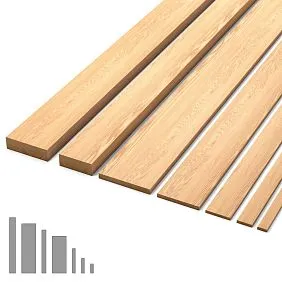
ChoosingSolid Wood PlanksWhen selecting for your project, several key parameters must be considered. The cross-section of the boards determines the visual weight of the structure. Thin boards 20×40 mm create a light, almost airy structure. More substantial 40×60 mm or 50×70 mm look more solid and suit spacious rooms with high ceilings.
The length of the boards depends on ceiling height and intended composition. Solid boards from floor to ceiling look monolithic and elegant. Composite structures made of shorter elements offer more flexibility during installation but require careful jointing to create a seamless visual effect.
The spacing between boards affects not only aesthetics but also functionality. Frequent placement (gap 20-40 mm) creates almost a solid surface, effectively working for zoning and acoustics. Sparse (gap 60-100 mm) allows more light and air, suitable for light decorative accents.
Installation: reliability and aesthetics
There are several ways to mountwooden boards on the wallThe choice of method depends on the type of base, weight of the structure, and desired degree of monolithic appearance.
Adhesive mounting is suitable for light, small-section boards on flat, prepared surfaces. Special wood-mounting adhesives are used, ensuring secure fixation. This method provides a clean surface without visible fasteners, but requires an ideally flat base and does not allow significant loads on the structure.
Mechanical mounting with screws through boards into the wall is the most reliable method. It withstands significant loads and is suitable for heavy, bulky elements. Screw heads can be countersunk and spackled to match the wood tone, making them practically invisible. Alternatively, decorative fasteners can be used as additional design accents.
Mounting on a frame is a professional solution for complex structures. A system of guides made of wood or metal profile is mounted on the wall, to which decorative boards are then attached. This method allows leveling uneven surfaces, hiding utilities or sound insulation materials behind the board surface, and creating a ventilated gap for air circulation.
Stylistic contexts: universality of linear decor
Design with boardsadapts to any stylistic direction, proving its universality. In minimalist interiors, simple wooden boards support the philosophy "less is more," adding texture with minimal decorative elements. The natural warmth of wood softens the austerity of minimalism, making it more human and cozy.
Scandinavian style naturally embraceswooden planks on the wallas an extension of its love for natural materials and functionality. Light wood species, natural tones, simple forms perfectly match the aesthetics of a Scandinavian home. Boards here do not dominate but delicately complement the overall atmosphere of light, air, and natural harmony.
In loft spacesWall Wood Finishingcreates a contrast with industrial elements: brickwork, concrete surfaces, metal structures. This dialogue of warmth and cold, natural and man-made, constitutes the essence of loft aesthetics. Wooden boards soften the brutality of industrial interiors, making them suitable for living.
Modern classic: balance of tradition and innovation
Even classic interiors can embraceDecorative Planksif approached with appropriate delicacy. Here, noble wood species, flawless surface treatment, and thoughtful proportions matter.wooden cornicein combination with board panels creates an elegant frame for the wall, echoing traditional boiserie but in a more modern interpretation.
Neoclassicism is especially friendly to linear decor. Here, symmetry and proportions of classic interiors combine with the simplicity of modern forms.Solid Wood Plankscan frame classic moldings, creating a multi-layered composition where tradition and modernity complement each other.
It is important to note that board structures harmonize well with other elements of classic finishing.Wooden baseboardandBaseboardmade from the same wood species and with similar surface treatment create a cohesive ensemble, where each element supports the overall concept.
Light and shadow: play of depth
One of the most underrated propertieswooden boards on the wallis their ability to work with light. Vertical boards create a rhythmic play of light and shadow, changing throughout the day with the movement of the sun. Morning rays gliding along the wall create one picture. Midday sun draws clear contrasting stripes. Evening light envelops the boards in a soft, warm glow.
Artificial lighting opens up even more possibilities. Hidden backlighting placed behind the board structure creates a floating wall effect, adding a futuristic touch to the interior. Spotlights directed along the boards highlight the wood texture and depth of the composition. Side lighting enhances relief, making the surface more expressive.
Lighting scenarios allow changing the mood of the space. Bright lighting demonstrates clear geometric lines, suitable for active daytime hours. Dimmed light creates an intimate atmosphere, ideal for evening relaxation. Colored backlighting can transform the space for special occasions, creating the desired mood.
Scale and proportions: find your rhythm
Working withvertical boardsrequires understanding of room proportions. In rooms with low ceilings, frequent placement of thin boards visually lifts the space. In high rooms, one can afford more substantial elements with larger spacing — this emphasizes the grandeur of the volume.
The size of the wall itself affects the choice of board parameters. A small accent wall in a bedroom requires a delicate approach: thin boards, moderate contrast. A large wall in an open-plan living room allows playing with scale: one can use boards of different cross-sections, create complex compositions, and experiment with density.
The rhythm of board placement creates a visual metronome, setting the pace of space perception. Uniform rhythm calms, creating a sense of order and stability. Variable rhythm, where spacing between boards changes, introduces dynamism, intrigues the gaze, and encourages exploring the composition.
Integration with functional elements
wooden planks on the wallBoard structures do not have to be purely decorative. Thoughtful construction allows integrating functional elements into the board system. Shelves — open or hidden — can be placed between boards.Decorative brackets for shelvesmade from the same wood species will create a harmonious composition.
A board wall can hide a storage system. Behind boards with increased gaps, hooks, holders, small pull-out drawers can be placed. This solution is especially relevant in hallways, where it is necessary to combine aesthetics and functionality. Outside — beautiful modern finish, inside — thoughtfully designed system for daily needs.
In a bedroom, a board structure can integrate bedside lighting, outlets, switches, even small shelves for books or phones. All technical elements are hidden in gaps between boards, leaving visible only a clean linear composition. This is especially appreciated by perfectionists striving for visual interior purity.
Technological solutions: comfort and aesthetics
Modern technologies allow embedding even more functions into board systems. Wireless charging for mobile devices, integrated into one of the boards. Hidden speakers for multi-room audio systems. Light and motion sensors for automatic lighting control. All this is achievable without compromising aesthetic integrity.
Climate functions can also be integrated. Behind the board structure, a humidification or air ionization system is placed. Air circulates through gaps between boards, filling the room. Outside — only beautiful wooden finish, inside — technologies for a healthy microclimate.
For home theaters, board walls become an ideal solution, combining acoustic treatment and aesthetics. Behindacoustic panelssound-absorbing material is placed, and the boards themselves perform the function of a diffuser, dispersing sound to create proper acoustics.
Combination with other interior elements
Full interior harmony is achieved when all elements complement each other.wooden planks on the wallperfectly complement furniture elements made from the same wood species.Furniture legsfor tables and chairs,Pedestalfor dining tables,chair legs— when these details are made from the same material as the wall finish, a sense of thoughtful design and overall unity is created.
Furniture HandlesWooden elements on kitchen facades or cabinets add another level of cohesion. It is not necessary to make all elements identical — it is sufficient to use the same wood species and similar surface treatment. This creates a subtle visual rhyme that the eye subconsciously perceives.
A staircase in a two-level apartment or house can support the linear theme of the interior throughbalustersand othercomponents for wooden staircasesWhen the wall in the living room is clad with boards, and the staircase uses similar linear elements, the space acquires cohesion and logic.
Additional decor: balance of complexity
A board wall is itself a strong decorative accent. But this does not mean it must exist in isolation.Wooden wall decorin the form ofof carved elementsordecorative outletscan complement the board composition if the interior is classic or eclectic.
It is important to maintain balance. If boards cover a large area of the wall, additional decor should be restrained to avoid overloading the composition. A fewdecorative elementsaccent points will be created without disrupting the overall harmony. If the slatted structure occupies a small fragment, you can afford a more complex decoration.
Modern interiors often combineSolid Wood Plankswith minimalist art: graphics, abstract painting, photography. The linear structure of the slats creates a neutral yet textured background that does not compete with artworks but gently supports them.
Maintenance and longevity: an investment in beauty
Correctly installed and treatedwooden planks on the wallserve for decades, requiring minimal maintenance. Regular dry cleaning with a soft cloth or vacuum cleaner with a soft brush removes dust that may accumulate in the gaps between slats. This is a simple procedure taking only a few minutes.
Wet cleaning is permissible but with caution. Use a slightly damp, well-wrung cloth. Excess moisture may damage the wood, causing swelling or deformation. After wet cleaning, it is recommended to wipe the surface with a dry cloth. For solid wood coated with oil, periodic renewal of the oil layer maintains protective properties and appearance.
Lacquered surfaces are more resistant to moisture and dirt, but require careful cleaning. Abrasive agents and stiff brushes may scratch the lacquer finish. Special lacquer-care products are used, which simultaneously clean and polish the surface.
Restoration and renewal
Even if over timeSolid Wood Plankslost their original appearance, they can be renewed. Sanding removes the top damaged layer, revealing fresh wood. After sanding, the surface is re-coated with oil or lacquer. This procedure restores the slats' original beauty, extending their service life by many years.
The possibility of restoration is an important advantage of natural wood over artificial analogs. MDF or plastic imitations can only be replaced after damage. Solid wood can be restored, preserving the entire structure. This makeswooden wall claddingeconomically advantageous in the long term.
If you wish to change the color or tone of the slatted structure, this is also possible. Wood can be stained, painted, or treated with patina to create an aged effect. Wood is malleable and accepts various treatments, allowing you to refresh the interior without radical changes.
Ecological and healthy environment
In an era of growing ecological awareness, choosing natural materials becomes not just an aesthetic but an ethical decision.Solid Wood PlanksThey are made from renewable resources. Responsible manufacturers use wood from certified forests, where a new tree is planted for every tree felled.
The production of wooden items requires significantly less energy compared to synthetic materials. The carbon footprintof decorative slatsof wood is minimal. Moreover, wood continues to store the carbon bound within it during growth, without releasing it into the atmosphere.
Natural wood creates a favorable environment for health. It does not emit toxic substances, unlike many synthetic finishing materials. Wood regulates air humidity, absorbing excess moisture during high humidity and releasing it during low humidity. This creates a comfortable microclimate, especially important for people with respiratory conditions.
Antibacterial properties
Some wood species possess natural antibacterial properties. For example, oak contains tannins that suppress bacterial and fungal growth. This makeswooden planks on the wallnot only an aesthetically pleasing but also a hygienic solution.
Properly treated wood does not become a breeding ground for microorganisms. Oils and lacquers used for finishing create a protective barrier without blocking the wood's ability to breathe. Modern water-based eco-friendly coatings contain no harmful solvents and are completely safe for humans.
The aroma of natural wood, especially premium species, creates a pleasant atmosphere in the room. This is not the artificial scent of air fresheners, but the natural aroma of wood, which many find pleasant and calming. Over time, it becomes barely perceptible, but never completely disappears, reminding one of the material's natural origin.
Economic aspects: investment or expense
Pricewooden boards on the wallvaries depending on the wood species, dimensions, and surface treatment. Budget options made of pine are accessible to a wide range of consumers. Premium solutions made of oak or beech cost more, but justify the price through longevity and aesthetic qualities.
When assessing economic feasibility, it is important to consider the long-term perspective.Solid Wood Planksserve for decades without losing quality. They do not require replacement, unlike many modern finishing materials. The possibility of restoration extends their service life almost indefinitely. This is not a consumable material, but an investment in the interior that pays off over time.
Installing slatted structures does not require radical renovation. They can be mounted on existing walls without complex foundation preparation. This saves time and money on renovation work. Demolition also occurs relatively easily, allowing you to change the interior concept if needed without extensive destruction.
The added value of real estate
QualityWall Wood Finishingincreases the attractiveness of real estate on the market. Buyers appreciate thoughtful design using natural materials. An apartment or house with wooden lath structures is perceived as more expensive and higher quality.
This is especially relevant for the premium segment of the market, where finishing details play a decisive role.Decorative PlanksThey demonstrate attention to detail, understanding of modern design trends, and willingness to invest in quality materials. All of this increases both the perceived and actual value of the property.
When handing over real estate for rent, quality finishing also contributes to increasing the rental rate. Tenants are willing to pay more for spaces where every element is thoughtfully designed, where natural materials are used, and where it is pleasant to be.wooden planks on the wallBecomes a competitive advantage in the rental market.
Creative experiments: beyond standards
Although there are established ways of usingsolid wood lathsTrue magic begins when designers and homeowners go beyond standard solutions. Three-dimensional compositions, where laths are placed at different distances from the wall, create a volumetric effect and play of shadows. This transforms a flat wall into a sculptural object.
Color experiments open new horizons. Laths do not have to be monochromatic. Alternating planks of different shades create a gradient effect or geometric patterns. Painting the ends of laths in a contrasting color while preserving the natural color of the front side adds an unexpected accent.
Combining different wood species in one composition creates a rich textural palette. Dark walnut next to light beech, warm oak contrasting with cool maple. These combinations require refined taste, but the result can be stunning.Design with boardsBecomes a work of art.
Ceiling structures: the fifth wall
Ifwooden planks on the wallWhile wall-mounted lath structures have already become a standard solution, ceiling lath structures remain relatively rare and make a strong impression. Laths on the ceiling create a sense of security, reduce the visual height in overly high rooms, and add texture to the fifth wall of the interior.
Ceiling laths excellently hide utilities: electrical wiring, ventilation channels, pipes. Behind a lath structure, you can install built-in lighting, creating the effect of a glowing ceiling. Gaps between planks ensure ventilation, preventing heat buildup from lights.
Combining wall and ceiling lath structures creates a unified volumetric composition enveloping the space. It is important not to overdo it — if laths are everywhere, the effect may be overwhelming. A proper balance between lath surfaces and smooth planes creates dynamism and visual comfort.
Individuality through standard
Paradoxically,Decorative Planksbeing a standard industrial product, allow for deeply individual interiors. The secret lies in infinite combinations: dimensions, spacing, orientation, wood species, surface treatment, installation method. Each solution is unique, reflecting the taste and needs of a specific individual or family.
Working with a professional designer helps unlock the potential of the material. The specialist sees opportunities that are not obvious to a non-professional, offers non-standard solutions, and helps avoid common mistakes. But even self-work withas solid wood plankscan lead to impressive results if approached thoughtfully and creatively.
It is important to remember that interiors are created for specific people with their lifestyles, habits, and preferences. A lath structure ideal for one may not suit another. There are no universal solutions — there is an individual approach that takes into account all the specifics of the space and the people living in it.
Common mistakes and how to avoid them
Despite its apparent simplicity, working withwooden wall plankshides pitfalls. One common mistake is incorrect scale selection. Too thin laths in spacious rooms disappear, appearing insignificant. Too bulky laths in small rooms create a sense of confinement, pressing down.
Ignoring the features of the room leads to unsuccessful results. In rooms with low ceilings, horizontal laths visually further reduce height. In narrow spaces, vertical planks on long walls emphasize disproportion. You must work with the space, correcting its shortcomings rather than amplifying them.
Insufficient attention to material quality leads to problems. Poorly dried wood deforms after installation, creating gaps and unevenness. Wood with defects (knots, cracks) in visible areas spoils the impression. Saving on material quality forwooden wall finishingrarely justifies itself.
Installation errors
Poor installation can ruin even high-quality material. Uneven placement of boards creates visual dissonance that is impossible to ignore. The eye is drawn to the disruption of rhythm, and the entire structure appears as careless work. Careful marking and use of a level are mandatory.
Visible fasteners in inappropriate places are another common problem. If the concept does not intend to showcase fasteners as a design element, they must be hidden or as inconspicuous as possible. Screw heads are spackled and painted to match the wood tone. Or hidden fastening systems are used.
The absence of a ventilation gap between the wall and boards may lead to humidity problems, especially on exterior walls. Wood must breathe. Gluing directly to the wall without an air gap creates a risk of mold and rot. Proper construction provides air circulation.
Frequently asked questions
Are wooden boards suitable for humid rooms?
Natural wood is sensitive to excessive humidity, therefore the use ofwooden boards on the wallin bathrooms and saunas requires a special approach. It is necessary to choose moisture-resistant wood species (larch, oak) and provide quality protective treatment with special compounds. In areas of direct contact with water, it is better to avoid wooden finishes or use alternative moisture-resistant materials.
How do boards affect room acoustics?
Acoustic Panelsfrom wooden boards positively affect the acoustic environment. Gaps between boards partially absorb sound waves, reducing echo effects, especially in the high-frequency range. To enhance the acoustic effect, sound-absorbing materials are placed behind the board structure. This solution is ideal for home theaters, music rooms, and open-plan offices.
Can boards be installed on uneven walls?
Yes, one of the advantages of installingsolid wood lathson a frame is the ability to level the base. A guide system is mounted on the wall, leveled with a level, to which decorative boards are then attached. This allows creating a perfectly flat surface without labor-intensive wall leveling. An additional benefit is the ability to hide utilities in the space between the wall and boards.
How long does it take to install a board structure?
Installation time depends on the coverage area, construction complexity, and installation method. Simple vertical placementof decorative slatson a single wall of 10-15 square meters takes one to two working days for experienced professionals. Complex compositions with variable spacing, combined directions, or integration of additional elements require more time. DIY installation will take longer, especially without experience.
Is special wall preparation needed before installation?
For adhesive installation, the wall must be flat, clean, dry, and primed. For frame mounting, special preparation is not required — simply remove peeling coatings and treat the surface with antiseptic if there is a risk of mold. Mechanical fastening with screws also does not require an ideally prepared base; the main thing is to ensure secure fastening of the screws into the wall.
How do board structures combine with underfloor heating and wall heating?
Wood is an insulator, thereforewooden planks on the wallover a wall heating system will reduce its efficiency. If such a combination is planned, sufficient gaps must be left for warm air circulation and the reduced heat output of the system must be considered. With underfloor heating, board wall structures do not conflict — they are installed higher and do not affect the efficiency of the floor heating.
Can a TV or shelves be mounted on boards?
The ability to hang loads on a board structure depends on the installation method. IfSolid Wood Planksare securely mounted on a reliable frame attached to the wall, a TV or shelves can be mounted using long screws that pass through the board, frame, and into the structural wall. For adhesive mounting, hanging significant loads is not recommended — the adhesive joint may not withstand the weight.
How often should protective coating be renewed?
The frequency of renewal depends on the type of coating and operating conditions. LacqueredDecorative Planksin residential spaces with normal humidity do not require coating renewal for decades. Oil-based coating should be renewed every 3-5 years depending on usage intensity and conditions. Oil renewal is a simple procedure requiring no dismantling or professional skills.
Conclusion: Choosing quality and aesthetics
wooden planks on the wallrepresent an ideal combination of aesthetics, functionality, and durability. This solution is for those who value natural materials, understand the power of thoughtful design, and are willing to invest in quality. Linear decor from solid wood creates a modern atmosphere, not blindly following short-term trends, but relying on timeless principles of good taste.
realize space zoning, acoustic correction, and visual transformation of the room — all these functions are achieved through the simplicity of form and honesty of material.Wall Wood Finishingwill never go out of style, because wood is a material that humanity has worked with for millennia, and this connection is deeply rooted in our perception of comfort and beauty.
STAVROS Company offers a wide range of solutions to realize your design ideas.Solid Wood PlanksVarious wood species, sizes, and surface treatments allow you to realize any concept—from minimalist to complex multi-layered compositions. Professional production guarantees high product quality: properly dried wood, precise geometry of items, flawless finishing.
In addition towooden stripsSTAVROS catalog features a full spectrum of elements for creating a harmonious interior:Furniture Legs and Supports, table aprons, balusters for staircases, Wooden cornices, Baseboardsand much more. A comprehensive approach allows creating a cohesive space where every detail supports the overall concept.
STAVROS specialists are always ready to assist with material selection, advise on installation, and propose optimal solutions for your specific project. Experience working with natural wood, understanding of modern design trends, and commitment to quality make STAVROS a reliable partner in creating your dream interior. High-quality materials, professional approach, and attention to detail — the foundation of a successful project that will delight for decades.