Article Contents:
- Why Wooden Planks Have Captured the Hearts of Designers
- Varieties of Wooden Planks and Their Characteristics
- Oak Solid Wood Planks
- Beech Solid Wood Planks
- Size Variety
- Application of Wooden Planks in Various Interior Zones
- Accent Walls
- Space zoning
- Ceiling structures
- Decorating Niches and Openings
- Installing Wooden Planks: A Professional Approach
- Foundation Preparation
- Installation on Lathing
- Mounting with adhesive
- Hidden fasteners
- Combining Wooden Planks with Other Materials
- Wood and stone
- Wood and metal
- Wood and glass
- Wood and textile
- Processing and Final Finishing of Wooden Planks
- Oil Finish
- Varnish Finish
- Staining and painting
- Brushing and Texturing
- Advantages of Natural Wood Over Imitations
- Ecological Safety
- Durability and Repairability
- Uniqueness and Aesthetics
- Application of Wooden Planks in Various Interior Styles
- Scandinavian Style
- Loft Style
- Modern minimalism
- Classic and neoclassical style
- Eco-Style and Biodesign
- Practicality and Care for Wooden Planks
- Regular Cleaning
- Protection against damage
- Recoating
- Economic aspects: investment in quality
- Long-term perspective
- Impact on property value
- Operational cost savings
- Company STAVROS: The Benchmark of Quality Trim Products
- Advantages of STAVROS products
- Individual approach
- FAQ: Frequently Asked Questions About Wooden Planks
- Conclusion

Modern interior design opens up boundless opportunities for creative self-expression for apartment and house owners. Among many finishing materials, wooden planks occupy a special place — an elegant and functional decoration capable of transforming any space. If you are consideringBuy wooden planks for decorationthis article will be your comprehensive guide to selecting, applying, and understanding the unique features of this material.


Why Wooden Planks Have Captured the Hearts of Designers
Wooden planks in interior design are not just a fashion trend, but a thoughtful solution to numerous design and functional tasks. These elementswood trimpossess a unique ability to create visual lightness without burdening the space with heavy structures.
Unlike solid panels or heavy decorative elements, planks form an airy structure that lets light pass through and visually expands the room. Their linear form creates rhythm, guides the eye, and helps correct room proportions. Vertical placement of planks visually raises ceilings, horizontal placement expands walls, and diagonal placement adds dynamism and modernity to the interior.
Natural wood has an irreplaceable texture and warmth that cannot be reproduced by artificial materials. Each plank made of oak or beech solid wood has a unique grain pattern, making the finish truly exclusive. The natural beauty of wood creates an atmosphere of coziness and comfort, filling the space with positive energy.




Varieties of Wooden Planks and Their Characteristics
When it comes toBuy wooden planks for decorationIt is important to understand that there are many options differing by wood species, dimensions, profile, and processing method.
Our factory also produces:


Oak Solid Boards
Oak is a classic proven over centuries.oak trimIt features exceptional strength, noble texture, and a variety of shades—from light honey to rich brown. Oak boards are virtually immune to deformation, resistant to mechanical damage and moisture. This wood species is ideal for creating long-lasting interior solutions that retain their beauty for decades.
Its dense structure allows creating boards of various profiles—from simple rectangular to complex decorative shapes. The natural grain pattern of oak adds aristocracy and status to the finish. Especially striking inoak planksclassical and neoclassical interiors, as well as in loft and Scandinavian minimalist styles.
Get Consultation
Beech Solid Boards
Beech is a wood species that matches oak in strength but has a more uniform texture and lighter shade.Beech parquetIt has a fine-grained structure, ensuring a smooth surface even after minimal processing. Beech boards easily accept staining and painting, offering wide possibilities for color solutions.
This wood is characterized by high density and hardness, making it ideal for high-traffic areas. Beech holds its shape well, does not crack or warp when proper room humidity is maintained. The light natural shade of beech boards blends beautifully into modern interiors, creating a sense of freshness and purity.
Size Variety
Modernwooden planks on the wallThey are available in a wide range of sizes. Thickness can vary from thin 10-mm boards to massive 40-mm beams. Board width typically ranges from 20 to 100 mm, though for special projects, elements wider than that can be manufactured.
Standard board lengths are usually 2000 to 3000 mm, matching the height of most rooms. This length is convenient for vertical installation without additional joints. For horizontal compositions, you can order non-standard lengths or combine multiple elements.
Application of wooden boards in various interior zones
Versatilitydecorative wooden planksThese elementsdecorative trimcan transform any living space zone.
Accent walls
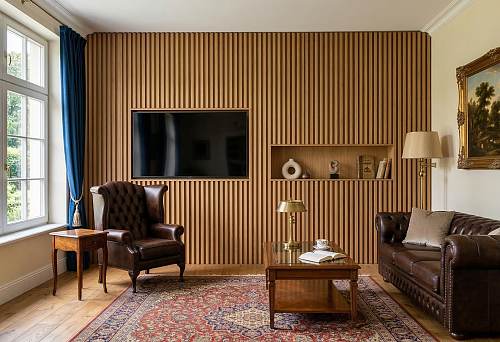
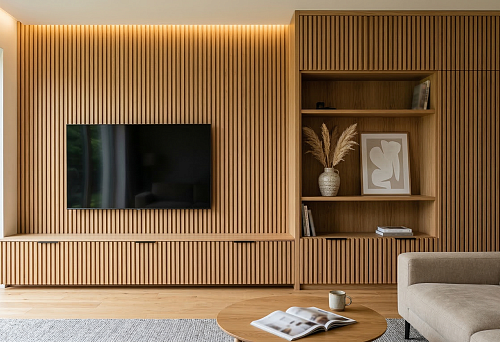
Creating an accent wall using wooden boards is one of the most popular techniques in modern design. Boards are mounted on a selected wall with a specific interval, creating a rhythmic structure. The distance between boards can equal their width, creating a 50/50 effect, or vary to achieve different visual effects.
Such finishing is especially effective behind a bed headboard in a bedroom, behind a sofa in a living room, or in a dining area. The play of light and shadow between boards creates a textured, three-dimensional surface that changes appearance throughout the day. An accent wall made ofwooden lumber in interior designbecomes the compositional center of the room, drawing attention and setting the tone for the entire space.
Space Zoning
Open floor plans require thoughtful zoning, and wooden boards handle this task brilliantly. A vertical board partition does not divide space with a solid wall but merely indicates the boundary between functional zones, preserving the sense of openness and unity of the interior.
Such partitions beautifully separate the living room and dining area, highlight a home office in a bedroom, or create a private zone in a studio. Light passes through the boards, air circulates, and visual continuity between zones is maintained. At the same time, each area gains its own identity and functional autonomy.
Ceiling structures
Ceiling finishingwooden lathsis a bold solution that gives the interior character and individuality. A board ceiling can cover the entire area or highlight specific zones—for example, above a bar counter, dining table, or relaxation zone.
Horizontal boards on the ceiling visually expand the room, making it appear more spacious. LED lighting is often installed between boards, creating an attractive diffused glow. This solution is especially suitable for rooms with low ceilings, as the play of light distracts from height and adds volume.
Decorating niches and openings
form the architecture of walls and ceilings, creating a play of light and shadow.are ideal for finishing niches, arches, and doorways. Vertical boards installed along the sides of a niche visually increase its height and add architectural expressiveness. Horizontal elements emphasize width and create an interesting interplay of lines.
Especially striking is the finishing of boards in niches with integrated lighting. Light passing between boards creates a dramatic chiaroscuro effect, transforming a simple niche into an art object. This solution is ideal for displaying collections, books, or decorative items.
Installing wooden boards: professional approach
Proper installation is the key to the longevity and aesthetic appeal of board finishing. There are several mounting methods, the choice of which depends on the structural features of the wall and the desired result.
Foundation Preparation
Before installation, the surface must be carefully prepared. The wall should be flat, dry, and clean. Significant irregularities should be filled with putty or plaster. If boards with gaps are planned, behind which the wall is visible, the base should be pre-painted to match or covered with wallpaper.
For rooms with high humidity, it is recommended to treat the walls with antiseptic compositions to prevent mold and fungal growth. Wooden battens are also advisable to impregnate with protective agents, especially if installed in bathrooms, kitchens, or other humid areas.
Mounting on a subframe
Classic installation methodwooden boards on the wallInvolves creating a subframe. Horizontal beams are attached to the wall at 40-60 cm intervals, serving as a base for mounting vertical battens. The subframe compensates for wall irregularities and creates a ventilated space between the finish and the wall.
Battens are attached to the subframe using screws, nails, or special clips. It is important to use a construction level at each stage to ensure perfectly vertical or horizontal positioning of elements. The distance between battens is measured using a calibration template, ensuring uniform composition.
Mounting with adhesive
For perfectly flat surfaces, battens can be mounted directly on adhesive. Special wood mounting compounds are used, ensuring strong and durable connections. This method is faster and does not require drilling into the wall, but is suitable only for lightweight, thin battens.
Adhesive is applied in dots or strips to the back of the batten, after which the element is firmly pressed against the wall and held for several seconds. It is important to work quickly but carefully, constantly checking geometry with a level and marking.
Hidden fastening
To achieve a flawless appearance, a hidden fastening system is used. Special metal clips or plates are mounted to the wall, and battens are secured to them using slots or latches. This installation leaves no visible fastening marks, creating a "floating" batten effect.
The hidden fastening system is especially convenient if disassembly or replacement of individual elements is required. Battens can be easily removed and reinstalled without damaging the material or wall finish.
Combining wooden battens with other materials
The art of interior design lies in skillfully combining various textures and materials.wooden strips, beamsThey harmoniously combine with a wide range of finishing materials, creating harmonious and stylish compositions.
Wood and stone
The combination of warm wood and cool stone is a classic design based on the contrast of textures and temperatures. Wooden battens against a wall of natural stone, marble, or ceramic tile create a balance between natural organic qualities and architectural rigidity. This solution is especially effective in living rooms, hallways, and fireplace zones.
Can be usedWooden moldingsto frame stone panels or create a composition where batten sections alternate with stone inserts. The play of textures adds depth and layering to the interior.
Wood and metal
Industrial loft style and modern minimalism often rely on the contrast between wood and metal. Wooden battens combined with metal profiles, shelves, or lighting fixtures create a dynamic and contemporary look. Black metal emphasizes the naturalness of wood, while brass or copper add warmth and luxury.
An interesting solution is metal profile frames filled with wooden battens. Such panels can be mobile, serving as movable partitions or decorative screens.
Wood and glass
The transparency of glass and the materiality of wood complement each other, creating a sense of lightness and airiness. Batten partitions with glass inserts allow light to pass through while ensuring privacy. This solution is ideal for zoning spaces in studios and small apartments.
Glass can also be used as a base for mounting battens—for example, on a glass partition. This creates a floating structure effect, which appears weightless despite using solid wood.
Wood and textile
The softness of textiles balances the geometric nature of wooden battens, adding coziness to the interior. A batten wall behind a bed headboard combines beautifully with soft textile headboards, creating a layered composition. Curtains, cushions, and blankets in natural tones complement the wooden finish, forming a harmonious ensemble.
Finishing and treatment of wooden battens
Beauty and durabilitywood trimdepend largely on the quality of the final finish. There are many ways to protect and decorate wooden battens, each imparting specific properties and appearance to the material.
Oil coating
Oil is one of the most natural and eco-friendly ways to protect wood. Oil penetrates deeply into the wood structure, highlighting its texture and imparting a rich tone. Oil protects against moisture and contaminants, while the wood retains its ability to "breathe," which is important for maintaining a healthy microclimate in the room.
Oil coating is easy to refresh—simply apply a fresh layer to a cleaned surface. This makes oil an ideal choice forwooden trimresidential spaces where naturalness and eco-friendliness are valued.
Coating with varnish
The varnish creates a strong protective film on the surface of the wood, reliably protecting the material from mechanical damage, moisture, and UV radiation. The varnish coating can be matte, satin, or glossy, allowing you to achieve the desired visual effect.
Matte varnish preserves the natural look of wood, subtly enhancing its natural beauty. Satin varnish gives a gentle noble sheen, while glossy varnish creates a polished surface effect. Forof wooden planks in St. Petersburgoften choose polyurethane varnishes, which have high wear resistance and do not yellow over time.
Staining and painting
If the natural color of the wood does not fit the interior concept, you can use staining or painting. Stains and impregnations allow you to change the wood's tone while preserving its texture. Light beech can be stained to resemble walnut or wenge, and oak can be given a warmer or cooler tone.
Full painting with covering paints hides the wood's texture but allows achieving any color. This solution is suitable for interiors requiring a strict color palette. Wood paints can be matte, glossy, or metallic, offering endless creative possibilities.
Brushing and texturing
Brushing is a process of artificial aging of wood, where soft fibers are removed while hard ones remain, creating a pronounced relief. Brushed planks have a unique texture and expressiveness, perfectly suited for loft, country, or vintage-style interiors.
Texturing may also include charring, which gives wood a dark tone and enhances the grain pattern. Charred and oiled planks look dramatic and stylish, adding character and depth to the interior.
Advantages of natural wood over imitations
A wide range of materials imitating wood is available on the market - from MDF and particleboard with film coating to plastic panels. HoweverBuy wooden planks for decorationmade from natural solid wood means investing in quality, durability, and a healthy home atmosphere.
Oak skirting boards are an indispensable element of classic interior styles. In the English style, oak skirting boards with rich carving emphasize the aristocracy and solidity of the space. Dark wood tones harmonize beautifully with traditional materials — natural stone, leather, bronze.
Natural wood is an absolutely eco-friendly material that does not emit harmful substances and does not cause allergies. Moreover, wood has the ability to regulate humidity in a room, absorbing excess moisture and releasing it when the air is dry. This creates a comfortable microclimate, beneficial for health and well-being.
Imitations often contain synthetic resins, adhesives, and plasticizers that may evaporate, especially when heated.Trimming ItemsPlanks made from solid oak or beech are completely safe even for children's rooms and spaces where people with chemical sensitivities reside.
Durability and repairability
Quality-made and processedOak parquetor oak serve for decades, maintaining their strength and appearance. Natural wood can be renewed multiple times - sanded, repainted, or covered with a new layer of oil or varnish. Scratches and minor damage are easily repaired, whereas imitations permanently lose their appearance once the top layer is damaged.
Wood has a natural ability to adapt to changes in temperature and humidity. When proper drying technology and correct usage are followed, solid wood does not deform or crack. Imitations, however, often suffer from environmental fluctuations, swell from moisture, and fade in sunlight.
Uniqueness and aesthetics
Each plank from solid wood is unique due to its distinctive grain pattern, tones, and natural characteristics. This natural variability creates a lively, organic interior that does not appear mass-produced or artificial. The tactile sensation of touching natural wood is incomparable to that of plastic or film.
Over time, noble wood develops a patina, becoming even more beautiful and valuable. This quality is especially prized in classic and traditional interiors, where the history and age of materials add character and nobility to the space.
Application of wooden planks in various interior styles
Versatilitydecorative wooden stripsallows using them in interiors of various styles - from classic to ultra-modern minimalism.
Scandinavian style
Scandinavian design is based on principles of naturalness, functionality, and restraint. LightBeech plank trimplanks, coated with white oil or light stain, fit perfectly into this aesthetic. Vertical planks with even spacing create rhythm and structure without overwhelming the space.
In Scandinavian interiors, wooden planks are often used for zoning open floor plans, creating accent walls in bedrooms, and decorating entryways. The combination of light wood with white walls, natural fabrics, and minimalist furniture creates an atmosphere of calm and harmony.
Loft style
Industrial loft aesthetics welcome the combination of rough textures and natural materials.Round wooden trim to buyor use dark-colored brushed planks - an excellent solution for loft spaces. Dark oak, charred or aged wood, emphasizes the urban character of the interior.
In lofts, planks are often mounted on concrete or brick walls, creating a contrast between industrial rigidity and the natural warmth of wood. Combining planks with metal structures, exposed utilities, and modern lighting creates a dynamic and stylish interior.
Modern minimalism
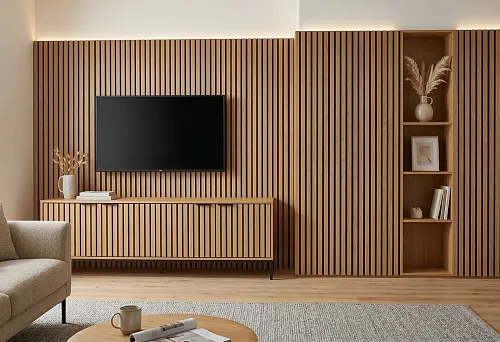
Minimalist interiors value clean lines, simple forms, and functionality.Thin wooden lathsplanks with perfectly proportioned dimensions and spacing create a geometrically precise structure characteristic of minimalism. Planks can be painted in neutral colors - gray, beige, black - or retain the natural tone of light wood.
In minimalist spaces, plank structures often serve a dual function - decorative and practical. They can conceal storage systems, serve as a base for mounting shelves, or create privacy without compromising the openness of the space.
Classic and neoclassical style
Traditional interiors useBuy wooden trimto create architectural expressiveness. In classic styles, rails often have a complex profile with milling, forming latticed panels or frames.wooden wall moldingsCombined with rails, they form complex decorative compositions.
Neoclassicism simplifies classical forms while preserving their elegance. Here, more laconic rails are used, but with adherence to proportions and symmetry characteristic of classical interiors. Noble wood species — oak, beech — emphasize the status and sophistication of the setting.
Eco-style and biodesign
Interiors oriented toward connection with nature and eco-friendliness maximally use natural materials.Wall cladding with wooden lathsThis creates the effect of nature being present in urban space. Rails in eco-style retain their most natural appearance — uncolored, with emphasized texture, sometimes preserving natural wood irregularities and features.
Combining wooden rails with live plants, natural textiles, stone, and ceramics creates a harmonious eco-friendly space. Vertical greening against a rail wall is one of the popular techniques in biodesign.
Practicality and care for wooden rails
Buy oak wooden planks for walls— this is not only beautiful but also practical. With proper care, rail cladding retains its appearance and functionality for many years.
Regular cleaning
The main care for wooden rails involves regular dust removal. This is done using a soft dry cloth, a brush with natural bristles, or a vacuum cleaner with a soft attachment. Vertical rails are cleaned from top to bottom, horizontal rails — along the direction of the fibers.
For more thorough cleaning, a slightly damp cloth soaked in water or a special wood cleaner can be used. It is important to avoid excessive moisture, which may damage the finish or cause wood swelling. After wet cleaning, rails should be wiped with a dry cloth.
Protection against damage
To prevent scratches and mechanical damage, it is recommended to avoid impacts from hard objects and friction with abrasive materials. In high-traffic areas, additional protection in the form of transparent corner caps or bumpers can be installed.
Exposure to direct sunlight may cause wood to fade and lose color saturation. Protection is provided by curtains, blinds, or special UV filters on windows. Quality lacquer finishes also contain UV filters that slow down the fading process.
Recoating
Over time, the protective coating may thin, especially in areas of frequent contact. Oil-based coating is easily renewed by applying a fresh layer of oil to a cleaned surface. Lacquer coating requires more complex renewal with prior sanding, but when applied correctly, it lasts much longer.
Minor scratches and scuffs on wooden rails can be removed with spot restoration. For this, wax pencils matched to the wood tone or special touch-up compounds are used. Deep damage requires local sanding and reapplication of the coating.
Economic Aspects: Investment in Quality
SolutionWooden planks for wall decorationMade from natural solid wood may seem more expensive compared to budget alternatives. However, a proper analysis shows that this is an investment that pays off many times over.
Long-term perspective
QualityBuy wooden profiled productsMeans obtaining a finish that will last 20–30 years or more without replacement. Over this period, budget materials will need to be replaced several times, ultimately costing more. Considering the cost of dismantling, surface preparation, and new installation, the economic advantage of natural wood becomes obvious.
Impact on property value
Quality finish with natural materials significantly increases the attractiveness and market value of real estate. Interior withwooden profiles priceof which corresponds to the premium segment, is perceived as more prestigious and high-quality. This is especially important when selling or renting out property.
Operational Cost Savings
Natural wood does not require frequent replacement or complex maintenance. Unlike imitations, which may lose their appearance within a few years, high-quality wooden rails retain their appeal for decades. The possibility of local repair and coating renewal without full replacement also saves money in the long term.
Company STAVROS: benchmark quality of trim products
Choosing whereBuy wooden planks for decorationpay attention to the company STAVROS —the trim manufacturerwith an impeccable reputation. The company specializes in producing high-quality solid oak and beech products, using modern European equipment and adhering to strict quality standards.
Advantages of STAVROS products
STAVROS offers a wide selection ofof wooden skirting boards, Furniture moldings, Oak trim, Oak beamsand other decorative molding elements. Each item undergoes careful quality control at all production stages - from raw material selection to final finishing.
STAVROS uses only premium wood with proper drying in specialized chambers, ensuring geometric stability and absence of deformation during use. Precision processing on high-precision equipment ensures ideal dimensions and smooth surface finish.
Individual Approach
STAVROS offers not only a standard assortment, but also manufacturingwooden trimto custom sizes and profiles. This allows implementing even the most non-standard design solutions, creating unique interiors.
Company specialists provide consulting support at all stages - from material and profile selection to recommendations on installation and maintenance. This approach ensures the client receives the solution that best suits their project.
FAQ: Frequently Asked Questions about Wooden Molding
What distance should be between the molding on the wall?
The distance between the molding depends on the desired visual effect and the width of the molding itself. The classic option is a gap equal to the width of the molding (ratio 1:1). For a more airy effect, the gap is increased to 1.5-2 times the width of the molding. For a dense textured surface, the gap is reduced to 0.5 times the width.
Can wooden boards be used in a bathroom?
Yes, but under certain conditions. It is necessary to choose moisture-resistant wood species (oak is preferable to beech) and to treat the molding with moisture-protective compositions - oil with water-repellent properties or yacht varnish. Good room ventilation is also important. It is not recommended to install molding in areas directly exposed to water.
How to properly paint wooden molding?
Before painting, the molding must be sanded with fine-grit sandpaper and dust removed. For toning, water-based or oil-based stains are used, applied along the grain. After the stain dries, a protective finish - oil or varnish - is applied. For solid color painting, special wood paints are used, applied in 2-3 layers with intermediate sanding.
How many molding pieces are needed for a wall?
The number of molding pieces is calculated based on the wall area, molding width, and desired spacing between them. Formula: number of molding pieces = wall length / (molding width + gap). It is recommended to order 10-15% more than the calculated amount, accounting for trimming and possible defects.
How do oak molding differ from beech molding?
Oak has a more pronounced texture, is darker in tone, and is more resistant to moisture. Beech has a more uniform structure, is lighter, and is easier to tone. Both materials are comparable in strength, but oak is considered more prestigious and durable. The choice depends on aesthetic preferences and usage conditions.
Can molding be installed horizontally?
Yes, horizontal installation of molding is a popular design technique that visually expands the space. The installation technology is similar to vertical installation, but requires creating a vertical substructure. Horizontal molding looks striking in hallways, corridors, and on walls of low height.
Is special care required for wooden molding?
Wooden molding with quality protective coating does not require complex care. It is sufficient to regularly remove dust with a dry soft cloth or vacuum cleaner. Every few months, wet cleaning with special wood cleaning agents can be performed. Oil-based coating is recommended to renew every 2-3 years.
What is the optimal thickness of molding for walls?
The optimal thickness of molding for wall finishing is 15-25 mm. This thickness provides sufficient rigidity, creates a pronounced play of light and shadow, and does not look overly bulky. For accent zones, thicker molding (up to 40 mm) can be used, and for light partitions - thinner (10-15 mm).
Do wooden molding change color over time?
Natural wood slightly changes shade under the influence of light and time - this is a natural patination process. Light-colored species may darken slightly, while dark ones may lighten slightly or acquire a noble patina. Quality lacquer coating with UV filters slows down this process. Many admirers of natural wood consider these changes an additional advantage, giving the interior history and character.
Can molding of different widths be combined?
Yes, combining molding of different widths is an interesting design technique that creates a dynamic composition. Wide and narrow molding can be alternated in a certain rhythm or combined randomly. It is important to maintain a consistent style and avoid overcomplicating the composition with excessive complexity.
Conclusion
Wooden molding for decoration is a universal solution that combines aesthetics, functionality, and eco-friendliness. It can transform any interior, add character and individuality, and create a comfortable atmosphere of naturalness and closeness to nature.
ChoosingBuy wooden planks for decorationWooden molding from natural oak or beech blocks from STAVROS - this is an investment in quality, durability, and beauty of your home. Wide assortmentmolding productsHigh production standards and individual approach allow to realize any design ideas — from classic to ultra-modern.
Regardless of interior style, room size, or project budget, wooden planks will become the element that creates a complete and harmonious look for your space. Natural wood never goes out of fashion, and its beauty and value only increase over time, making your home not just beautiful, but truly comfortable for living.
Contact STAVROS specialists to receive professional consultation, choose the optimal solution for your project andbuy wooden trimhighest quality. Create the interior of your dreams with products that will last for decades, delighting the eye and filling your home with the warmth of natural wood.