Article Contents:
- What are furniture legs and why are they more important than they seem
- The role of supports in furniture stability and durability
- How legs affect height, proportions, and comfort
- Why wooden legs remain unrivaled
- What types of furniture legs exist: classification by shape and purpose
- Straight and tapered legs
- Turned legs
- Carved and figured supports
- Geometric and modern models
- High legs for bar furniture
- For which furniture wooden supports are selected
- Legs for coffee and dining tables
- Sofa and armchair legs
- Legs for dressers, cabinets, and wardrobes
- Legs for wardrobes and beds
- Legs for consoles, bar furniture, and designer pieces
- What materials are furniture legs made from: oak vs. beech
- Oak legs: durability and prestigious appearance
- Beech legs: even structure and ease of finishing
- What to choose for different tasks: oak or beech
- Furniture legs with coating or unfinished: what and when to choose
- When it's more advantageous to buy legs without coating
- When to choose a ready-made finish
- Tinting, varnish, patina, decorative finishing
- How to choose the right size of furniture legs
- Leg height: standards and non-standard
- Cross-section and visual massiveness
- Load and load-bearing capacity
- How not to make a mistake with the height
- How to choose legs to match the furniture style and interior
- Classic models
- Modern geometric shapes
- Carved legs for expressive decor
- How to match legs with fronts, handles, and finishes
- How to choose legs by load type
- For lightweight furniture
- For massive tables and dressers
- For upholstered furniture with constant load
- For commercial projects
- Mountings and hardware for furniture legs
- Main mounting options
- When a hardware kit is needed
- Why it's important to consider installation before purchase
- How to avoid skew and play
- When to order custom furniture legs
- If a non-standard height is needed
- If a specific shape or style is required
- If you need to replicate a sample
- If the project is being developed for custom furniture
- How custom furniture legs are made
- Technical Specification
- 3D model and drawings
- Prototype manufacturing
- Serial Production
- Finishing and hardware kit
- What affects the price of furniture legs
- Common mistakes when choosing furniture legs
- Choosing only by photo
- Height mistake
- Incorrect load assessment
- Ignoring the mounting
- Style mismatch
- Not understanding the difference between unfinished and coated
- Quick checklist: how to choose furniture legs for a specific task
- For a dining or coffee table
- For sofa and armchair
- For a cabinet and dresser
- For a Wardrobe
- For a design project
- Why it's profitable to buy furniture legs from the manufacturer
- Wide selection of models
- Custom order options
- Quality control and materials
- Finishing services
- Fasteners and installation support
- Delivery across Russia and to other countries
- FAQ: popular questions about furniture legs
- Conclusion: three steps to the right choice
Furniture starts with the foundation. Not with the facade, not with the upholstery, and not even with the shape of the body — but with the legs. They determine the stability, height, proportions, and character of the piece. Well-chosen Solid wood furniture legstransform an ordinary sofa into an elegant piece, and a chest of drawers into an interior accent. Poorly chosen ones ruin the entire look, like an ill-fitting tie with an impeccable suit.
If you are involved in furniture renovation, designing an interior from scratch, manufacturing upholstered furniture, or ordering custom-sized case goods, the question of choosing wooden legs will inevitably arise. And here it is important not to make a mistake. This article provides a practical answer: what types of legs exist, how they differ, how to select them for specific furniture, material, style, and load. As well as when it's better to buy a ready-made model and when to order custom manufacturing to your specifications.


What are furniture legs and why are they more important than they seem




The role of supports in furniture stability and durability
A leg is not just a 'stand'. It is a load-bearing element that takes on the entire weight of the product plus operational load: the weight of a person, objects, dynamic forces during movement, tilting, pressure. If the support is incorrectly chosen in terms of cross-section, height, or wood species, it deforms, becomes loose, and breaks. Worse, the furniture carcass itself suffers along with it: joints shift, corners crack, and facades warp.
Wooden supports made from solid natural wood have one fundamental advantage over plastic and metal: they work as a single material with the furniture itself, not creating contrasting stress zones. Wood 'breathes' together with the structure—expanding and contracting in sync with the room's temperature and humidity changes.
Our factory also produces:


How legs affect height, proportions, and convenience
The height of the support directly determines the height of the product. For a dining table, the standard is 720–760 mm, and the legs account for a significant part of this dimension. For a coffee table with a height of 400–500 mm, low but visually expressive supports are required. For a sofa, the legs set the distance from the floor: low ones give massiveness and a 'grounded' feel, high ones give lightness and airiness.
Proportions are no less important. A thin tapered leg emphasizes the elegance of a coffee table but will look absurd under a heavy chest of drawers. A massive carved support will adorn a classic sideboard but overwhelm a minimalist console table.
Get Consultation
Why wooden legs remain unrivaled
Metal is cold and requires a specific style. Plastic doesn't convey a sense of quality. Natural wood is universal. It looks equally organic in classic, Scandinavian, loft, Provence, and eco-interiors. Warm texture, natural shades, richness of forms — that's precisely whywooden furniture legsthey remain the choice of those who want a result, not a compromise.
What types of furniture legs exist: classification by shape and purpose
Straight and tapered supports
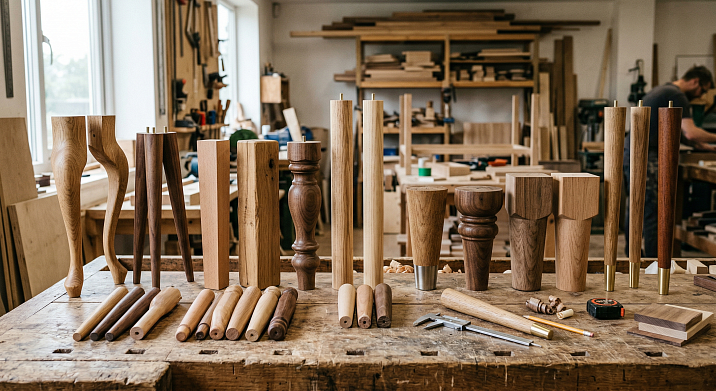
Straight legs are the basic option. They maintain a uniform cross-section along their entire height, providing a sense of strictness and reliability. They are used in modern, Scandinavian, and minimalist furniture. Tapered supports narrow towards the bottom, creating dynamism and lightness. They are especially suitable for coffee tables, ottomans, and consoles. In the STAVROS catalog, tapered furniture supports are available in heights of 100, 150, 200, 250 mm with a base diameter of 40–55 mm — this offers wide possibilities for matching a specific piece.
Turned legs
Turned legs — a classic of lathe craftsmanship. On a lathe, a complex profile is turned from a blank: alternating balls, barrels, disks, transitions. Turned legs are appropriate in classic, Baroque, and colonial interiors. They are visually more complex than straight ones, adding expressiveness and decorative value even to simple pieces.
Carved and figured supports
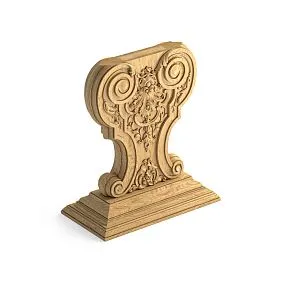
Carved legs are created by hand or on CNC machines. This is the most decorative option: ornaments, leaves, scrolls, geometric facets, interweavings. They transform a leg from a structural element into a work of art. Such supports are appropriate in classic buffets, Baroque consoles, designer handmade pieces. In the STAVROS collectioncarved furniture legsthey are presented in different sizes and degrees of pattern complexity — from restrained geometric decor to rich classic forms.
Geometric and modern models
Modern design demands clean lines: square, rectangular, faceted supports without rounding or decoration. Such legs are harmonious in furniture in loft, brutalism, minimalism, contemporary styles. They don't distract attention but complement the overall image of the piece.
High legs for bar furniture
Bar counters, high tables, pub tables — a special category. Here, legs reach 700–900 mm. The load on the support is significant, so the cross-section must be increased, and the fastening must be reinforced. STAVROS offers high supports for bar counters made of solid oak and beech, ensuring stability under any operating conditions.
For which furniture wooden supports are selected
Legs for coffee and dining tables
A coffee table works in tandem with a sofa: the height of the supports here is usually 250–400 mm. Legs should be sufficiently elegant so as not to 'weigh down' the table to the floor. Tapered, turned, geometric — all options are appropriate. For a dining table, the requirements are stricter: standard height is 720–760 mm, the load is significant — dishes are placed on the tabletop, elbows press, hands lean. Here, supports with a cross-section of at least 50–70 mm and quality fasteners are needed.
Legs for sofa and armchair
Upholstered furniture is a special case. Sofa legs serve not only as load-bearing elements but also as aesthetic accents: they are visible from the side and below, they form the 'lift' of the product above the floor. Low legs of 50–100 mm give the sofa monumentality. Legs of 100–150 mm are the most universal option, creating a sense of lightness without loss of stability. Legs for armchairs are usually slightly thinner but require the same strength: the load on one support for an armchair is higher than for a sofa.
Legs for chest of drawers, cabinet, and wardrobe
Case furniture with legs looks fundamentally different than that which stands 'on a plinth'. Legs add air under the product, facilitate cleaning, and visually lift the furniture. For a chest of drawers, the optimal support height is 80–150 mm, for a cabinet — 60–100 mm.Wooden legs for cabinetand for the chest of drawers in the STAVROS catalog, they are available both unfinished (for subsequent finishing) and with a ready-made coating to suit different interior styles.
Legs for cabinets and beds
Cabinets with legs are a trend in modern design. The correct balance is important here: the height of the supports should be such that the cabinet does not look 'lifted' and does not lose stability when loaded. For beds, legs are most often low—50–100 mm—but must be as stable as possible, as they bear significant dynamic loads.
Legs for consoles, bar furniture, and designer pieces
Consoles are a case where the legs are almost entirely visible. They become the central visual element. Turned, carved, geometric—the choice depends on the interior style. Bar furniture requires tall and sturdy supports with reinforced fasteners. In design projects, legs are often custom-ordered from individual drawings—specifically tailored to the product's shape and stylistic concept.
What materials are furniture legs made from: oak vs. beech
Oak legs: strength and a prestigious appearance
Oak is the benchmark in furniture making. The wood density is about 700 kg/m³, which ensures exceptional resistance to compression and bending. Oak supports do not deform under heavy loads, do not 'shift' over time, and maintain their geometry for decades. The pronounced texture with a large grain pattern makes each leg visually unique. Natural tannins provide inherent protection against moisture and insects.
Oak takes well to staining, oil, wax, and varnish. Over time, the wood develops a noble patina. This is a material for those who choose furniture once and for the long term.Furniture supports made of oak— choice of classic, neo-classical, Scandinavian, and natural interiors.
Beech legs: smooth structure and ease of finishing
Beech is slightly softer than oak but no less valuable in furniture production. Density is about 650 kg/m³, with an even and uniform structure. This makes beech an ideal material for turning and carving: it 'obeys' the cutting tool better than oak, allowing for more precise details. The pinkish tone of beech wood gives products warmth and softness.
Beech takes stain excellently: it is easy to achieve almost any shade—from light ash to dark wenge. Therefore, beech legs with a finish are a popular choice for interiors with a rich color palette.
What to choose for different tasks: oak or beech
| Criterion | Oak | Beech |
|---|---|---|
| Strength | Very High | High |
| Texture | Pronounced, large | Fine, uniform |
| Staining | Good | Excellent |
| Carving | Possible | Lighter |
| Appearance | Prestigious, noble | Soft, warm |
| Application | Classic, heavy furniture | Carved models, bright finishes |
Both materials are used in STAVROS production — this allows selecting exactly the wood species that best suits the task.
Furniture legs with finish or unfinished: what to choose and when
When it's more advantageous to take legs without finish
Unfinished furniture legs are a 'blank canvas'. You get a product ready for any finishing: painting in the desired color, tinting, varnishing, applying wax or oil. This is the optimal choice if you already have finished furniture with a specific finish and need to match the tone exactly. Unfinished legs are also preferable if you want to perform the final finishing yourself or order it from a craftsman.
This option is in demand in production conditions: furniture workshops, design studios, woodworking productions — all of them purchase unfinished supports for further processing.
When it's better to choose a ready-made finish
Legs with finish are convenient for those who want to get a ready-to-install element. The manufacturer has already performed sanding, applied primer, applied the final finish, and controlled the result. This saves time and guarantees uniformity of finishing. The STAVROS catalog features furniture legs with finish in various shades — from light natural to rich dark tones.
Tinting, varnish, patina, decorative finishing
Types of finished coatings used in production:
-
Tinting — gives the desired shade while preserving the visibility of the wood texture
-
Varnish — protects the surface from moisture, dirt, and mechanical damage
-
Patination — creates an 'aging' effect, popular in classic and Provence styles
-
Decorative finishing — special techniques that imitate old varnish, gilding, and contrasting highlighting of carvings
STAVROS offers all types of finishing — both in standard orders and in custom production according to customer parameters.
How to choose the right size of furniture legs
Leg height: standards and non-standard
The working height of the furniture determines everything else. Guidelines:
| Furniture type | Optimal leg height |
|---|---|
| Dining table | 680–720 mm |
| Coffee table | 200–400 mm |
| Sofa | 80–150 mm |
| Chair | 100–180 mm |
| Commode | 80–150 mm |
| Nightstand | 50–100 mm |
| Bed | 80–150 mm |
| Bar counter | 700–900 mm |
| Desk | 700–730 mm |
Important: these values refer to the height of the support itself, not the final height of the product with a top or seat.
Cross-section and visual massiveness
The more massive the product, the larger the leg cross-section should be. For a coffee table, a diameter of 35–45 mm can look elegant. For a dining table, at least 55–70 mm is needed. For a chest of drawers — 50–60 mm. Violating these proportions creates a sense of instability, even if the leg actually supports the load.
Load and load-bearing capacity
Each support has a maximum load capacity, depending on the wood species, cross-section, height, and mounting design. For heavy items (massive tables, loaded chests of drawers, cabinet furniture), choose oak supports with an increased cross-section. For lightweight decorative furniture — beech supports will work excellently.
How to avoid mistakes with height
Before ordering, take precise measurements:
-
Measure the current height of the item (or the desired final height)
-
Subtract the height of the lid/seat/base
-
Account for the thickness of the mounting platform (usually 10–15 mm)
-
The resulting value is the required leg height
If you are unsure — STAVROS specialists will help calculate the correct size based on your item's parameters.
How to choose legs to match furniture style and interior
Classic models
Classic style demands details: turned profiles, S-shaped cabriole legs, supports with scrolls and carved elements. Wood species — oak or beech with a dark walnut tint or patina. Exactly suchLegs for solid wood furnitureare included in STAVROS classic collections and are suitable for dressers, consoles, sideboards, armchairs, and benches in a traditional interior.
Modern geometric shapes
Minimalism and contemporary styles require clean lines. Square or rectangular legs with bevels, tapered supports without decoration, straight posts with matte finishes — these are the solutions that work in modern interiors. Colors include natural oak, light beech, dark wenge, or black paint.
Carved legs for expressive decor
Carving on legs is either handcrafted or CNC machined. Carved supports turn a piece into a collectible item. They are suitable for Baroque, Renaissance, Classicism, Colonial styles, as well as in eclectic designs where a strong accent is needed.
How to combine legs with fronts, handles, and finishes
The rule is simple: either everything matches (one wood species, one finish, one series), or intentional contrast (white fronts + dark oak legs). Mixing similar but mismatched shades is the main mistake. STAVROS allows you to order in one style andFurniture Handles, and legs — in a unified series, with the same finish and proportions. This eliminates inconsistency and saves time on selection.
How to choose legs based on load type
For lightweight furniture
Coffee tables, benches, poufs, small cabinets — here the load on the support rarely exceeds 30–50 kg. Beech legs of any diameter, thin tapered or elegant turned options are suitable.
For massive tables and dressers
A dining table for 6–8 people and a massive dresser with contents already amount to 150–250 kg of total load. Oak supports with a diameter of at least 60 mm are needed, along with high-quality fastening using embedded nuts and metal plates.
For upholstered furniture with constant load
Sofas and armchairs bear a person's weight when sitting down: dynamic load can be 1.5–2 times higher than static load. Legs must be designed with a safety margin. Ideally, use oak with a cross-section of at least 50 mm, fastened via an embedded nut into the product's frame.
For commercial projects
Restaurants, hotels, offices — furniture here is used more intensively than at home. Loads are higher, wear is faster. For such tasks, STAVROS offers serial production of supports with enhanced characteristics and the possibility of custom manufacturing according to technical specifications.
Fasteners and hardware for furniture legs
Main fastening options
There are several standard mounting methods:
-
Screw-in bolt (stud) — the leg has an M8–M10 metal stud that screws into an embedded nut in the furniture body. The most common method.
-
Mounting plate — a flat metal plate that screws onto the frame; the leg attaches through it. Used for upholstered furniture.
-
Direct mounting to the body — the leg is screwed directly with screws. Suitable for lightweight furniture.
-
Adjustable feet — legs with height adjustment via threading, essential for uneven floors.
When a hardware kit is needed
If a leg is supplied without fasteners, you will have to select them yourself. This is risky: the wrong bolt, the wrong nut, insufficient seating depth — and the mounting is unreliable. STAVROS offers legs already with a kit of mounting and connecting hardware — this saves time and guarantees proper fit.
Why it's important to consider mounting before purchase
An error in choosing the mounting is discovered only during installation — and then you either need to re-drill holes in the body or return the legs. It's better to determine in advance: whether the furniture frame has embedded nuts, what the thread diameter is, and if there is an option to install plates.
How to avoid misalignment and play
Misalignment occurs if the legs are not installed strictly perpendicular to the plane. Play is a consequence of an incorrectly selected stud diameter or a worn nut. Factory assembly with precise tolerances solves both problems.
When to order custom furniture legs
The standard catalog covers most needs. But there are situations when more is required.
If a non-standard height is needed
Furniture with custom dimensions is a common task in design projects. If a table is made to order for a specific person or for a room with a non-standard height, then non-standard legs are needed. STAVROS manufactures supports of any height to the specified size.
If a specific shape or style is required
Sometimes a designer develops a unique leg silhouette that is not found in the ready-made assortment. In such cases — development based on a sketch or 3D model.
If a sample needs to be replicated
Restoration of antique furniture, recreation of a lost support, expansion of serial production — all of this requires precise replication of the form. STAVROS accepts tasks based on a sample, drawing, or measurements.
If a project is being developed for custom furniture
Furniture manufacturers, design studios, construction companies equipping facilities — they all need serial supports for a specific collection. STAVROS offers a full cycle: from model development to serial production.
How custom furniture leg manufacturing works
Technical specification
Everything starts with the specifications: height, cross-section, profile shape, wood species, finish type, fastener requirements, batch volume, deadlines. The more precise the specifications — the faster and more accurate the result.
3D model and drawings
Based on the specifications, a 3D model or drawing is developed. The customer approves the geometry, proportions, and details. This stage eliminates misinterpretations and allows for adjustments before production begins.
Manufacturing of a prototype sample
Before launching the series, a prototype sample is made. This is an opportunity to evaluate the shape, surface quality, dimensional accuracy, appearance of the coating — and make adjustments if necessary.
Mass production
After the sample is approved, the series is launched. STAVROS uses modern lathe, milling, and grinding equipment with automatic humidity control. Only technologically properly dried wood is used.
Finishing and fastener kit
After production — applying the coating according to approved samples, marking, packaging, and kitting with fastening elements. Result: the customer receives ready-to-install supports, without the need to search for fasteners independently.
What affects the price of furniture legs
The price range for wooden supports is wide — from budget beech conical legs to expensive hand-carved oak supports. The cost is influenced by:
-
Material: oak is more expensive than beech due to higher density and processing complexity
-
Shape complexity: turned and carved legs require more machine and manual time than straight ones
-
Size: the taller and larger the support, the more raw materials and processing time required
-
Finish: uncolored legs are cheaper; ready-made coating, patination, and decorative finishing add to the price
-
Mounting type: a leg with mounting hardware included costs slightly more but is more cost-effective when purchasing
-
Order volume: a serial order is always cheaper per unit than a single order
Common mistakes when choosing furniture legs
Choosing based only on a photo
A photo does not convey weight, texture, or real proportions. A support that looks beautiful in an advertising shot may not fit in size or visually 'get lost' next to your product.
Height mistake
A difference of 30–50 mm changes the entire feel of the product. Always take precise measurements before ordering, accounting for the thickness of the top, frame, and mounting plate.
Incorrect load assessment
Don't skimp on the cross-section for load-bearing furniture. A leg with insufficient diameter will become loose after six months of active use.
Ignoring the mounting method
Buying beautiful legs is only half the job. If you don't plan the installation in advance, mounting becomes a problem.
Style mismatch
Modern geometric legs on classic carved furniture is a disaster. The style of the support should match the style of the product and the interior.
Not understanding the difference between unfinished and finished
An unfinished leg requires your own finishing. Without a coating, it will quickly get dirty and lose its appearance. If you don't plan to paint it — choose a ready-made option.
Quick checklist: how to choose furniture legs for a specific task
For a dining or coffee table
-
Determine the required table height and calculate the leg height
-
Consider the load: for dining tables — oak, diameter from 60 mm
-
Choose a style: turned, tapered, geometric
-
Check the mounting type: stud or plate
-
Decide: finished coating or for finishing
For a sofa and armchair
-
Leg height: 80–150 mm (standard)
-
Wood species: oak for heavy sofas, beech for light armchairs
-
Mounting: through a mounting plate into the frame
-
Coating: to match the fabric or product body
For cabinets and chests of drawers
-
Height 80–150 mm
-
Style matches the cabinet style
-
Unpainted — if you plan to paint along with the furniture
-
With coating — if you are taking a finished product
For a cabinet
-
Legs must ensure stability with a high center of gravity
-
Adjustable option recommended for uneven floors
-
Style — strict, geometric for modern cabinets
For a design project
-
Development according to specifications or 3D models
-
Wood species, shape, coating — according to the designer's concept
-
A prototype before the series is mandatory
Why it's profitable to buy furniture legs from the manufacturer
Wide selection of models
Over 130 unique models — this is a real collection featuring straight, tapered, turned, carved, geometric, classic, and modern supports for any type of furniture. No intermediary offers such an assortment.
Custom order capability
This is a fundamental advantage of a direct manufacturer: if the desired model is not in the catalog — it will be made to your dimensions, sketch, or sample. Neither a trade base nor a marketplace will offer this.
Quality control and materials
STAVROS uses technologically properly dried wood from Russian suppliers. Each workshop operates a system to maintain humidity and temperature conditions — this prevents deformation of finished products when storage or operating conditions change.
Finishing services
Toning, varnishing, patination, decorative treatment — all are performed in-house with adherence to uniform standards. This ensures coating uniformity in serial orders.
Fasteners and mounting support
Legs come with necessary mounting hardware, installation instructions included. Technical consultation for installation available if needed.
Delivery across Russia and to other countries
STAVROS ships orders throughout Russia, CIS countries, and European countries. Both retail and large wholesale batches can be shipped.
FAQ: Popular questions about furniture legs
Which furniture legs are better — oak or beech?
Oak is stronger and more prestigious — suitable for heavy-duty furniture and classic interiors. Beech is easier to work with, takes staining better, and is preferable for carved models. Both materials are high quality; the choice depends on the task and style.
What to choose: legs with a finish or unfinished?
If you plan to paint or stain yourself — choose unfinished. If you want a ready-to-install element with a guaranteed appearance — choose with a finish.
How to select the leg height for a cabinet, table, or sofa?
Determine the desired final height of the item, subtract the height of the body and mounting plate — this is the required leg height. For sofas, the standard is 80–150 mm; for dining tables, legs together with the top give 720–760 mm.
What legs are suitable for heavy furniture?
Oak supports with a diameter of at least 55–70 mm, with a mounting stud through an embedded nut. The more massive the product, the larger the cross-section should be and the more reliable the fastening.
Can legs be ordered according to one's own drawing or technical specifications?
Yes. STAVROS accepts custom orders based on technical specifications, sketches, drawings, and 3D models. This is standard practice for furniture manufacturers, designers, and construction companies.
Can a prototype be made before a serial order?
Yes. Before launching a series, a prototype is always manufactured to approve the shape, dimensions, and finish.
What legs are suitable for classic furniture?
Turned, carved, with an S-shaped profile ('cabriole'), made of oak with a dark walnut tint or with a patina. Such models are available in the collectionSTAVROS for classic interiors.
What is needed for mounting legs?
Hairpin, embedded nut or mounting plate, mounting screws. STAVROS supplies legs with mounting hardware and includes installation instructions — installation requires no special tools.
Can I order a series for furniture production?
Yes. STAVROS works with furniture factories and manufacturers on serial production terms. Development of an exclusive model for a brand's collection is possible.
How to choose legs so they match the interior?
Determine the interior style, main colors, and textures. For a unified look, it's better to order furniture legs and handles from the same series with the same finish. STAVROS offers complete solutions ina unified style for all furniture.
Conclusion: three steps to the right choice
Choosing wooden furniture legs is not a minor technical issue. It's a decision that affects both the furniture's appearance and its stability and lifespan. A properly selected solid wood support turns a mass-produced item into an interior accent. An incorrectly selected one can ruin even expensive furniture within a few months.
Three steps that deliver results:
-
Determine the type of leg — by shape, style, and purpose. Consider which furniture they are for, what load they will bear, and in what interior they will be placed.
-
Choose the material, finish, and dimensions — oak or beech, unfinished or with a ready-made finish, exact height and cross-section according to your measurements.
-
Proceed to selecting a ready-made model or place an order for custom manufacturing — the ready-made catalog covers most needs, and for non-standard solutions STAVROS offers a full production cycle.
STAVROS — a Russian manufacturer with 20 years of experience, a collection of over 130 models of wooden furniture legs made of oak and beech, finishing services, hardware included, serial production to specifications, and delivery across Russia, CIS, and European countries. Everything — from a single source, with a quality guarantee.