Article Contents:
- Wooden Slat as an Architectural Tool: From Utility to Art
- Types of Wooden Slats: Cross-Sections, Wood Species, Purpose
- Classification by Cross-Section
- Choosing Wood Species: Character and Color
- Finishing and surface treatments
- Using Wooden Slats in Interior Design: From Walls to Ceilings
- Accent Walls: Rhythm and Depth
- Space Zoning: Transparent Partitions
- Ceilings: Volume and Coziness
- Decorative Panels and Headboards
- Furniture Fronts and Radiator Screens
- Stairs and Railings
- Installing Wooden Slats: Technology and Nuances
- Surface Preparation and Marking
- Mounting Methods: Frame or Direct Installation
- Spacing Between Slats: Visual Effects
- Final finishing
- Interior Styles and Wooden Slats: Versatility of Application
- Scandinavian style: minimalism and light
- Japanese Minimalism: Zen and Harmony
- Eco-Style: Nature in the Interior
- Modern Classic: Elegance and Structure
- Loft: industrial aesthetics
- Where to Buy Wooden Slats: A Strategy for Smart Choice
- Construction Warehouses and Hypermarkets: Mass Production Without Quality
- Private Sawmills: Unpredictable Results
- Specialized Manufacturers: Quality and Systematic Approach
- Why STAVROS is the Choice of Professionals and Conscious Clients

Wooden slats have become the main trend in interior design in recent years, and in 2026 their popularity has reached its peak. It is no longer just a utilitarian linear material for technical purposes—it is a full-fledged tool for creating expressive spaces, a philosophy of zoning without physical partitions, a way to add rhythm and structure to neutral interiors. The question "where you can buy wooden planks" is now asked not only by professional designers and architects but also by conscious clients who understand: slats are a versatile decorative element capable of transforming a space without major interventions, creating visual depth on flat surfaces, and adding naturalness and tactile comfort to technogenic urban interiors.
The phenomenon of wooden slats can be explained by several factors. First, it's a return to natural materials after decades of plastic and imitation dominance. Second, ease of installation: even a non-professional can install slats with a minimal set of tools. Third, versatility of application: slats work on walls, ceilings, as partitions, decorative panels, and niche framing. Fourth, stylistic flexibility: slats fit organically into Scandinavian minimalism, Japanese Zen, eco-style, modern classic, and loft. That's why queries like "Where to buy wooden planks for decoration" are increasingly heard from those who create interiors themselves or work with designers who understand the value of simple and honest solutions.


Wooden Slat as an Architectural Tool: From Utility to Art
Just five years ago, wooden slats were perceived as a technical material: a base for lathing, an auxiliary element of structures, a frame for finishing. Today, slats have emerged from the shadows and become the main decorative accent in the most prestigious interiors. What happened? Designers discovered the expressive potential of rhythmic structures created by slats installed at specific intervals. Vertical slats visually raise the ceiling, draw the eye upward, and add height to the space. Horizontal slats expand the room, creating an illusion of greater area. Cross compositions form complex geometric patterns that turn a wall into an architectural object.
Wooden slat for decoration works on several levels of perception simultaneously. Visual level: the rhythm of vertical or horizontal lines structures the space, creates visual depth, and breaks the monotony of flat surfaces. Tactile level: natural wood is warm to the touch, pleasant, and creates a contrast with smooth painted walls. Acoustic level: slats on walls act as an additional sound-absorbing layer, especially if acoustic underlayment is installed between the slats. Psychological level: natural wood reduces stress levels, creates a sense of connection with nature, which is especially important in urban apartments.
Modern wood processing technologies enable the creation of slats of perfect quality. Kiln drying to 8–10% moisture content guarantees geometric stability: the slats will not warp or twist, maintaining straightness for decades. Precision processing on a four-sided planer ensures perfect cross-section consistency along the entire length of the product, which is critical for creating even compositions. Final sanding gives the surface tactile perfection: the slat is pleasant to touch, with no burrs, roughness, or splinters.




Types of Wooden Slats: Cross-Sections, Wood Species, Purpose
Not all slats are created equal. Behind a seemingly similar name lie products of fundamentally different purposes, quality, and aesthetics.
Our factory also produces:



Classification by Cross-Section
Wooden planksThey differ primarily in cross-section—the ratio of width to thickness. Thin slats with a 20×40 mm cross-section create elegant, lightweight structures, ideal for minimalist interiors where airiness and visual weightlessness are important. Medium slats of 30×50 mm or 40×60 mm are a universal choice for most projects, balancing expressiveness and restraint. Wide slats of 50×70 mm and larger create massive, expressive structures that work in spacious rooms with high ceilings, adding weight and status.
The profile shape also varies. Rectangular cross-section is a classic, universal option for any application. Rounded edges make the slat visually and tactilely softer, eliminating sharp corners, which is important for children's rooms and spaces where there is a risk of accidental injury. Shaped profiles with decorative milling add individuality to the slat, turning simple molding into a decorative element.
Get Consultation
Choice of Wood Species: Character and Color
The wood species determines the color, texture, and durability of the slat. Oak is a premium choice for those who value strength, expressive texture with clear annual rings, and a noble warm shade from light honey to dark brown.oak slatsThey will last for decades, acquiring a noble patina over the years. Beech is a European species with a uniform, fine-pored structure, warm pinkish hue, and silky surface. Beech slats look softer and cozier than oak ones, ideally suited for residential interiors.
Ash is a species with a contrasting, dynamic texture where light and dark fibers create an expressive pattern. Ash slats work in modern interiors where the visual activity of the material is valued. Pine and spruce are budget-friendly coniferous species with a light tone and soft structure. Coniferous slats are lighter than hardwood, easier to process, but less durable and prone to resin pockets.
Finishing and surface treatments
Natural untreated slats preserve the wood's natural color and texture. They can be left as is for eco-interiors where the material's pristine quality is important, or coated with a protective compound. Oil emphasizes the wood grain, deepens the color, creates a matte velvety surface while preserving the wood's tactility. Varnish creates a protective film, simplifies maintenance, but deprives the wood of its natural tactility.
Tinted slats are stained with pigments in stains or oils, allowing any shade to be achieved—from light Scandinavian ash to dark wenge—while keeping the wood grain visible. Painted slats are completely covered with opaque paint, hiding the grain, which is relevant for modern interiors where a clean color without the visual noise of texture is important. Brushed slats undergo mechanical processing that removes soft fibers and leaves hard ones, creating a pronounced relief that emphasizes the material's naturalness.
Application of Wooden Slats in Interiors: From Walls to Ceilings
The versatility of wooden slats is evident in the variety of ways they can be applied.
Accent Walls: Rhythm and Depth
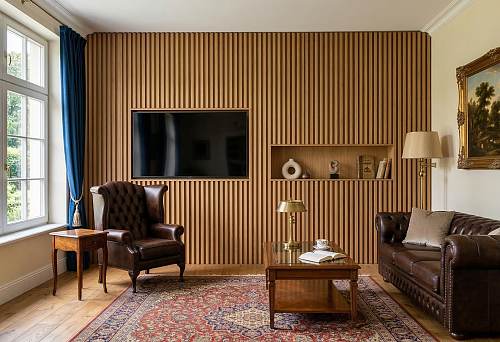
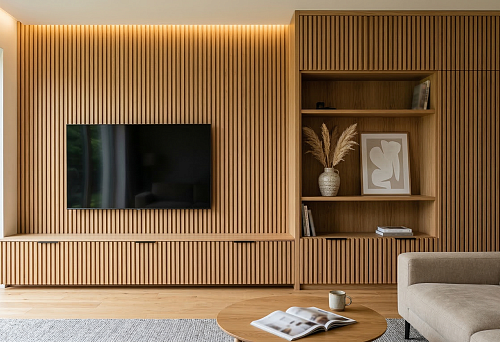
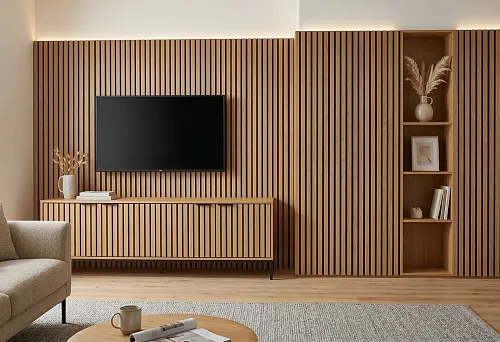
The most popular application is creating accent walls from vertical slats.wooden planks on the wallThey are installed with a specific spacing—usually 30–100 millimeters—creating a rhythmic structure that visually organizes the wall plane. The vertical rhythm visually raises the ceiling, which is especially valuable in standard apartments with 2.7-meter ceilings. An accent wall made of slats becomes the compositional center of the room: behind the sofa in the living room, behind the bed headboard in the bedroom, in the dining area of the kitchen.
There can be a contrasting background between the slats: dark slats on a light wall or light slats on a dark background create a graphic effect. A monochrome solution, where the slats and wall are the same color, works through relief and light play: with side lighting, each slat casts a shadow, and a flat wall turns into a three-dimensional structure. LED lighting can be hidden behind the slats, creating an effect of glowing vertical lines, adding a futuristic touch to the space.
Space Zoning: Transparent Partitions
Wooden rails for decorationThey are ideal for creating lightweight partitions that zone space without physically dividing it. In a studio, a slatted partition separates the sleeping area from the living room, maintaining a visual connection between them. In a kitchen-living room, slats mark the boundary between zones without blocking light and air. In a child's room, a slatted structure separates the play and study areas.
A partition made of vertical slats allows light, air, and sight to pass through, creating a semi-transparent effect. It does not feel oppressive or create a sense of confinement, yet clearly defines functional boundaries. Slatted partitions can be stationary, fixed from floor to ceiling, or mobile on casters, allowing the space to be transformed as needed.
Ceilings: Volume and Coziness
Wooden slats on the ceiling create a completely different atmosphere compared to traditional smooth white ceilings. A slatted ceiling adds volume, visual complexity, and coziness to a room. This is especially relevant for high spaces of 3.5–4 meters, where a white ceiling can seem cold and distant. Slats visually bring the ceiling closer, making it part of the living space, not an abstract upper boundary.
Lighting can be integrated between the slats on the ceiling: spotlights create local light accents, LED strips form uniform background lighting. Slatted structures allow hiding utilities—ventilation, wiring, pipes—while maintaining access for maintenance.
Decorative Panels and Headboards
Wooden railsThey are used to create decorative panels on walls: horizontal or vertical panels made of slats frame the TV area, fireplace, or create a background for paintings and posters. In the bedroom, a slatted bed headboard becomes an architectural accent: slats are installed vertically from floor to ceiling behind the bed, visually highlighting the sleeping area and creating an expressive backdrop.
Decorative panels can be three-dimensional, where slats are mounted with a setback from the wall on brackets, creating deep shadows and a three-dimensional effect. They can be flat, where slats are attached directly to the wall, working through rhythm and texture. They can combine different directions: vertical and horizontal slats form geometric compositions, lattices, frames.
Furniture Fronts and Radiator Screens
Slatted fronts for cabinets, dressers, and sideboards add lightness and modernity to furniture. Instead of solid doors—semi-transparent slatted ones that hint at the contents without fully displaying them. Slatted screens for heating radiators turn a utilitarian element into a decorative one: a screen made of wooden slats hides the radiator while not obstructing the circulation of warm air.
Stairs and Railings
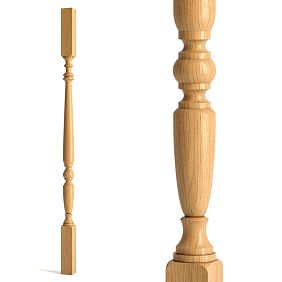
Staircase balustrades made from vertical wooden slats create a modern alternative to traditional turned balusters. Slatted railings are visually lightweight, allow light to pass through, and create a rhythmic structure that organizes the verticality of the stairwell. Such constructions are ideal for modern interiors where visual lightness and geometric purity are important.
Installation of wooden slats: technology and nuances
Installing slats is technically not difficult but requires care, precision, and an understanding of the sequence of operations.
Surface preparation and marking
The base must be level: significant irregularities will cause the slats to follow the wall's waves, resulting in a crooked composition. If the wall has substantial unevenness, it is advisable to level it first with plaster or drywall. Marking is a critical stage. Vertical lines are marked using a level or laser level with a specified spacing. Even a slight deviation from vertical over a height of 3 meters will produce a noticeable visual tilt.
Fastening methods: frame or direct mounting
Slats can be mounted in two ways. The first is onto a frame of horizontal battens secured to the wall. The frame allows for leveling out base irregularities and creates an air gap between the wall and slats for ventilation and concealed wiring. Slats are fastened to the frame with screws or nails; the heads are countersunk and filled with wood-colored putty.
The second method is direct mounting of slats onto the wall using adhesive. This option is simpler and faster but requires a perfectly level base. Polyurethane adhesives or liquid nails with high adhesion to wood and mineral substrates are used. The slat is coated with adhesive, pressed against the wall, and fixed with temporary supports until the adhesive sets.
Spacing between slats: visual effects
The distance between slats determines the visual effect of the composition. A close spacing of 20–40 millimeters creates a dense structure where slats dominate over gaps, and the surface is perceived as semi-transparent. A medium spacing of 50–80 millimeters provides a balance between slats and gaps, with a clearly readable rhythm. A wide spacing of 100–150 millimeters creates a sparse structure where gaps dominate, and the slats function as graphic lines against the wall background.
Final finishing
After installation, slats are sanded with fine sandpaper to remove any defects that may have occurred during transportation and installation. Then, a finish is applied: oil is rubbed into the wood with a soft cloth, excess is removed, and the composition polymerizes within 24 hours. Varnish is applied with a brush or spray gun in two to three coats with intermediate sanding. Paint provides an opaque colored coating, which requires preliminary priming.
Interior styles and wooden slats: versatility of application
Slats are one of the few decorative elements that work organically in a wide variety of stylistic directions.
Scandinavian style: minimalism and light
Light slats made of ash or bleached oakfit perfectly into Scandinavian aesthetics with its cult of light, simplicity, and natural materials. Vertical slats on a white wall create a delicate rhythm, add volume without overloading the space. Slatted partitions zone a studio apartment while preserving airiness and light permeability.
Japanese Minimalism: Zen and Harmony
In Japanese interiors, wooden slats are a traditional element, tracing back to shoji architecture—sliding partitions with wooden frames. Slatted structures create a meditative atmosphere, organize space through rhythm, and emphasize the philosophy of wabi-sabi—the beauty of imperfection and transience. Dark slats on a light background or light slats on a dark background create graphic compositions characteristic of Japanese aesthetics.
Eco-style: nature in the interior
In eco-interiors, wooden slats are a way to enhance the presence of natural materials. Slats with pronounced texture, brushed, coated with natural oil without tinting, preserve the pristine quality of the wood. Combining slats of different species creates interesting color and texture combinations: light ash alternates with dark oak, creating a natural palette.
Modern classic: elegance and structure
In neoclassical interiors, slats work as a way to add modernity without losing nobility. Dark slats made of walnut or tinted oak on light walls create elegant vertical compositions. Slatted panels frame classic elements—fireplaces, mirrors, paintings—bringing geometric clarity to the ornamentation of classicism.
Loft: industrial aesthetics
In lofts, wooden slats create a contrast with rough industrial elements—brick walls, concrete ceilings, metal beams. Slats add warmth to cold industrial spaces, making them livable and cozy. Rough slats with knots and cracks, coated with matte oil, emphasize the authenticity of the material.
Where to buy wooden slats: a strategy for a reasonable choice
The market offers many channels for purchasing wooden slats, but not all of them ensure the necessary quality of material, processing, and service.
Construction warehouses and hypermarkets: mass availability without quality
Construction chains offer slats as construction molding, without considering decorative requirements. Processing quality is usually low: slats are not planed on all four sides, have roughness, burrs, and inconsistent cross-section along the length. The wood is often under-dried, with moisture content exceeding 12–15%, which guarantees deformation after installation. The choice of species is limited to pine and spruce; there are no noble hardwood species.
Private sawmills: unpredictability of results
Local sawmills can cut slats of the required cross-section from available material. The price will be low, but quality is unpredictable. Wood drying is usually natural, without control of final moisture content. Processing on simple circular saws yields a rough surface with waves. Cross-section geometry varies, which will create problems during installation.
Specialized manufacturers: quality and systematic approach
The optimal strategy is purchasing from a manufacturer that specializes in decorative wooden products and understands the specifics of interior application. This is precisely the approach demonstrated by the STAVROS architectural decor center.
where you can buy wooden planksWhere to buy wooden slats with high quality, guaranteed geometry and moisture content, and the ability to choose species and finish? From a manufacturer that controls the entire cycle: from purchasing quality wood to final packaging of the finished product. STAVROS offers slats made from solid oak and beech—premium species with an optimal combination of strength, beauty, and durability.
The wood undergoes kiln drying to a moisture content of 8–10%, which is the gold standard for interior products. This moisture level guarantees stability: the slats will not warp or twist; they will retain their geometry for decades. Production takes place in a controlled microclimate at a temperature of 20–24°C and humidity of at least 40%, which prevents deformations during processing.
Processing is performed on a four-sided planer, which in one pass processes all four faces of the slat, ensuring perfect parallelism of opposite sides and perpendicularity of adjacent ones. This is critical for creating even vertical or horizontal compositions: if the cross-section is inconsistent, slats will protrude or sink relative to each other, creating visual chaos.
Final sanding gives the surface tactile perfection. STAVROS slats are pleasant to hold, with no burrs, tears, or roughness. This is especially important for structures that people come into contact with: partitions, railings, furniture fronts.
The assortment includes slats of various cross-sections: from miniature 20×40 mm to massive 50×70 mm, allowing you to choose the optimal option for a specific project.Where to buy wooden planks for decorationwith the possibility of custom ordering non-standard sizes? From a manufacturer that has its own production facilities and can adapt standard products to specific requirements.
A large stock program ensures shipment of popular items from one piece without waiting for production. Delivery across all of Russia means high-quality slats are available not only to clients in the capital. Technical support includes consultations on choosing the cross-section, wood species, and finish for a specific interior, installation recommendations, and calculating the required amount of material, taking into account waste from cutting.
Why STAVROS is the choice of professionals and discerning customers
When you ask yourself the questionwhere you can buy wooden planksand you want to get not just millwork, but a high-quality decorative material with guaranteed geometry and durability — the choice is obvious. STAVROS is an architectural decor center with a 23-year history, combining its own full-cycle Russian production, work with premium wood species, a culture of quality control at all stages, and a reputation as a reliable partner among leading interior designers and architects.
The company works exclusively with select species — oak and beech from environmentally clean regions, which have undergone strict incoming inspection. Blanks with unacceptable defects are rejected: through knots, cracks, rot, blue stain. Chamber drying using optimal regimes brings moisture content to 8–10% without over-drying, which makes wood brittle. Production is carried out on professional European-quality woodworking equipment, which guarantees machining accuracy within tenths of a millimeter.
Two quality levels — Standard and Prestige — allow you to choose the optimal option. Standard — high quality at a reasonable price, allowing for small sound knots and minor color variations. Prestige — premium quality with selection of the highest category wood, perfect processing, and uniform color.
The company offers not only slats but also all related elements for creating complete compositions:Moldings, Baseboards, applique, Furniture legsmade from the same wood species with the possibility of matching a unified tint. This allows for creating harmonious interiors where all wooden elements speak the same language.
Working with STAVROS is not just buying material, but a partnership where the manufacturer is interested in the success of your project and is ready to support you at all stages: from choosing the optimal cross-section and wood species to consultations on installation and finishing. In a world where the market is flooded with low-quality millwork of dubious origin, STAVROS remains an island of professionalism, whereWooden rails for decorationare created with respect for the material, for the craft, for the client, with the understanding that an interior is built for decades and every detail must serve flawlessly.